Tag Archives: vegan

Recipe: How to Make Bright Green Pesto

5 Oct

The very last of my basil has flowered, so today I headed out and harvested all the remaining good leaves. It took a while, but the sun was warm on my back, the bees were buzzing gently by, and the smell of the basil as I plucked each leaf one by one, was intoxicating. There are worse ways to spend part of an October morning.

My aim? To make a few batches of pesto to freeze. But the end result looked (and smelled) so good, I couldn’t wait; I decided to use one batch tonight. It will get drizzled over a Sausage, Kale and Bean soup, the thought of which is already making me hungry!

This recipe calls for blanching the basil, which I find is a key way to get the greenest color. Today, I used another trick, too: I added a handful of baby spinach leaves that needed using up as spinach also amplifies the emerald factor. The addition of a few drops of lemon juice makes the pesto a bit brighter, too; I almost feel like it makes the pesto taste greener (is that possible?).

Note: When I am making pesto to freeze, I do not add the cheese or lemon juice. Instead, I add both those things later on to the thawed pesto. So the photos below are pre-cheese, and thus, represent a vegan version that would be delicious on its own, too.

Bright Green Pesto
(makes 2 cups total = 3 batches)

6 c. (slightly compressed but not packed) fresh basil leaves (about 120 gr.); can substitute up to 1 c. baby spinach leaves
3/4 c. toasted pine nuts
6 large garlic cloves
1/2 tsp. salt
1 c. extra-virgin olive oil
*1.5 c. freshly grated Pecorino Romano cheese (preferred) or Parmesan
*lemon juice, to taste

Preparation

1. Set a large pot of water to boil.
2. Pick over the basil leaves to make sure there are no blemishes (or stems). Fill a large bowl with ice water and set aside. When the water in the pot is boiling, add the basil and garlic, and push down on the basil leaves with a slotted spoon (to submerge them), just until they turn bright green. This blanching process should take less than a minute.

3. Immediately drain the basil and garlic in a colander, and then set the colander in the bowl of ice water to stop the cooking.
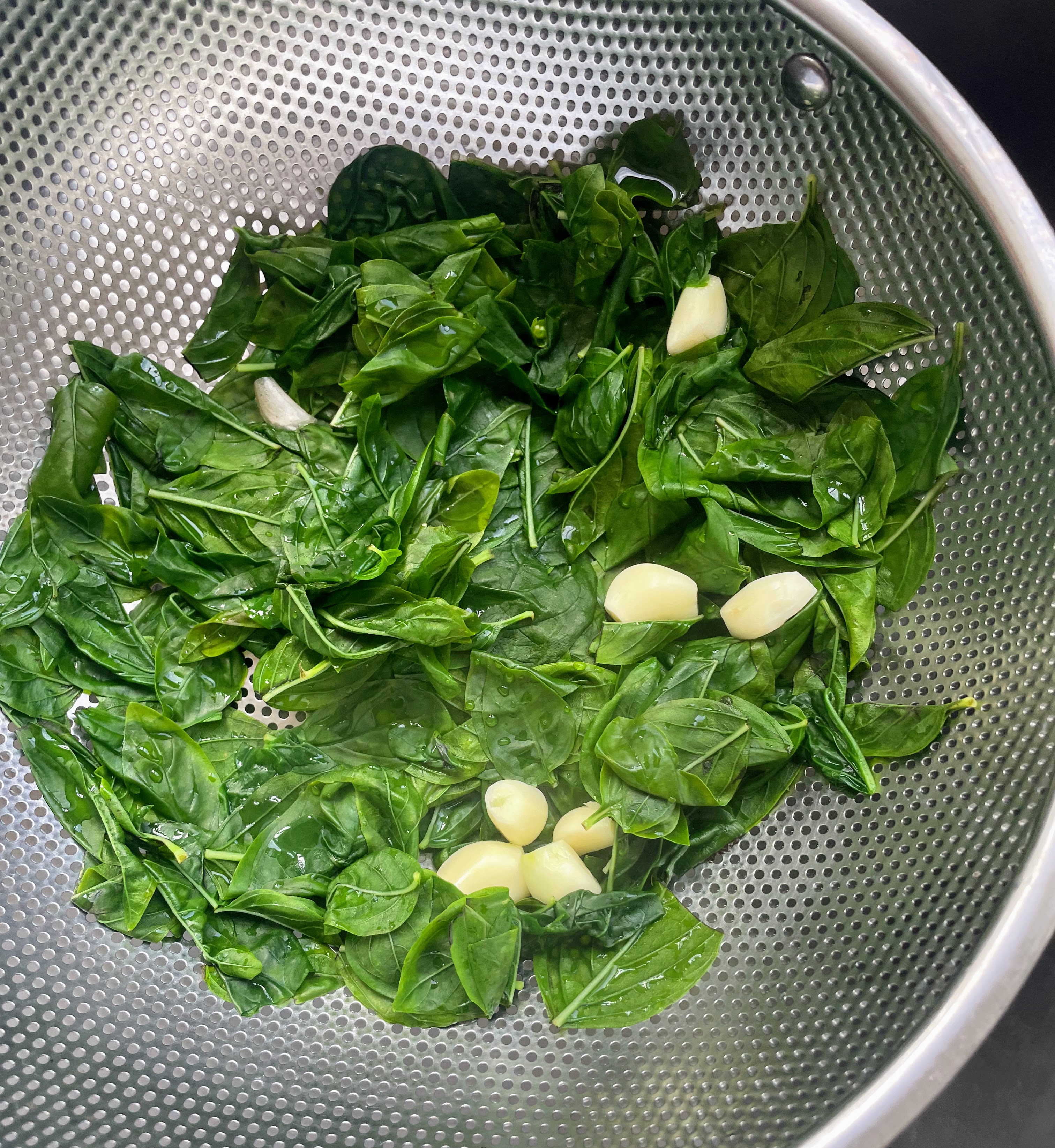
4. Once the spinach is cold, remove the colander from the bowl, set in the sink, and let the basil and garlic drain for a few minutes. Then place the basil and garlic on a clean dish towel and pat as dry as possible.

5. Put the basil and garlic in a food processor, add the pine nuts and salt, and pulse until the mixture is finely chopped and begins to come together. With the food processor still running, slowly pour in the olive oil and process until smooth.
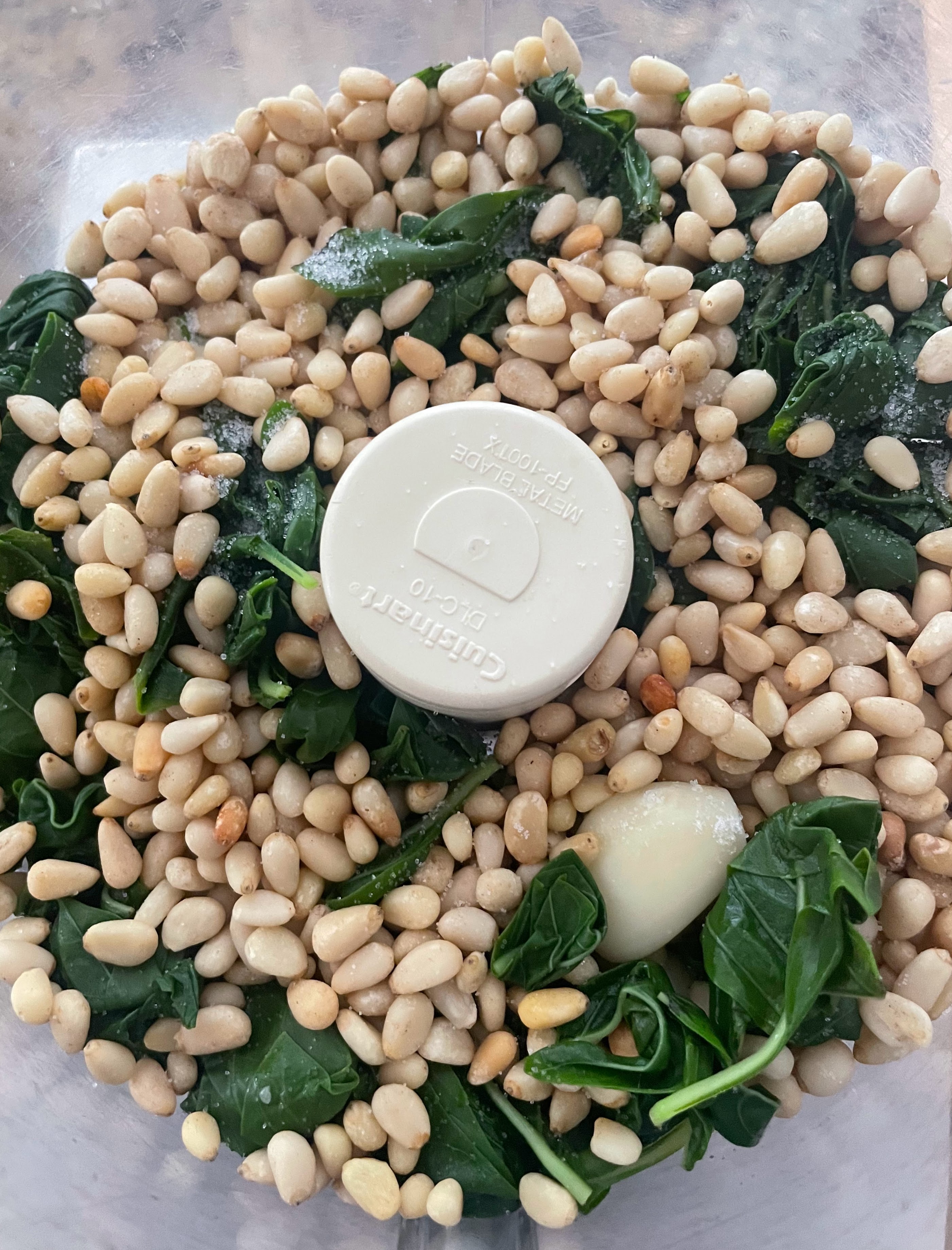
6. If using the pesto the same day, add the cheese and lemon juice, and pulse again very briefly, just long enough to combine. Do a quick taste test to gauge lemon and salt levels; add more if needed. You can also add a bit more olive oil if the pesto seems too thick.

*7. If freezing the pesto, omit the cheese and lemon juice, divide the pesto among three freezer-proof containers, and freeze. When you want to use a batch, thaw it fully and let it come to room temperature. Prior to using, add 1/2 cup grated cheese and a few drops of lemon juice, and mix well. Do a quick taste test to gauge lemon and salt levels; add more if needed. You can also add a bit more olive oil if the pesto seems too thick.

Recipe: Power Smoothie

14 Oct

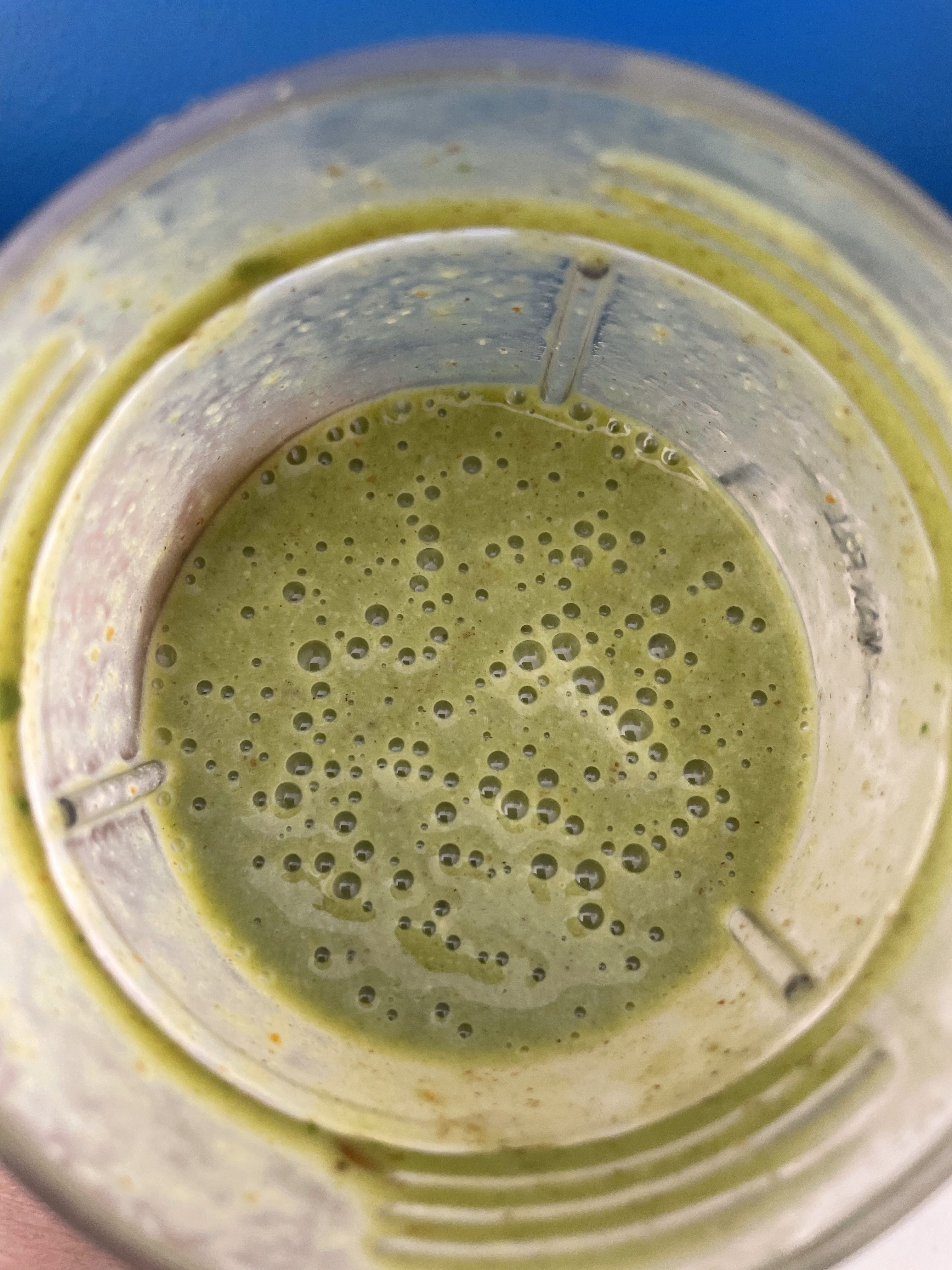
Sometimes, probably not as often as I should, I feel the need to eat (or drink) something super, extra virtuous. Even better if it’s delicious and quick, too. One signifier of virtuous for me = green, which is why I love this smoothie. It has such a beautiful color. It also has bananas, dates, oatmeal, flax seed, and cinnamon. Mmmmm! Perfect for breakfast, and even as part of lunch. Another bonus; it can be adapted countless ways:

  • I like less-thick smoothies, so I don’t usually add all-frozen produce; instead, I mix fresh with frozen, or add crushed ice to offset any lingering warmness from the softened oats and dates.
  • Also, if my banana is very ripe (and thus, very sweet), I put in blueberries instead of the dates, to temper the sweetness. But… blueberries muddy the lovely green color somewhat, so be prepared for less vibrancy.
  • If I need an extra boost, I add almond butter or kefir or protein powder.
  • Sometimes, I put everything in!

Power Smoothie (one serving)

2 tbsp rolled oats
2 pitted Medjool dates (opened up and flattened out)
boiling water (about 1/3 cup)
1 banana, in chunks (fresh or frozen)
1 tbsp ground flaxseed
sprinkle cinnamon
1-2 handfuls baby spinach (can add in frozen chopped spinach instead)
milk/plant milk of choice (about 1/2-3/4 cup)
handful ice, or some ice water

Optional add-ins:
blueberries (fresh or frozen)
1 tbsp almond butter
kefir
1 scoop protein powder

Preparation

1. Boil a small amount of water.

2. Put the oats in a small glass ramekin, and the dates in another. Pour boiling water over each, just to cover. Let the oatmeal and dates soften (and cool) while prepping the rest of the smoothie ingredients.

3. In a smoothie blender container (or in a blender), add the banana, flaxseed, cinnamon, oats, and dates. Stuff as much spinach as will fit. Pour in milk of choice, ice or ice water if using, and any optional ingredients.

4. Blend, and enjoy!

Recipe: Raspberry Chocolate Cake with Ganache Frosting

22 Sep

This moist, raspberry-scented chocolate cake is a family favorite. It’s also a crowd pleaser, though very few people who ooh and aah over it realize it’s vegan. I love it because it’s easy to make and I can lick the bowl with a clear conscience. But mainly, I love it because it’s a great cake, perfect for anyone who wants a delectable, double dose of dark chocolate.

Note: There are times I have made a non-vegan version of this cake out of necessity; some of the vegan ingredients can be hard to come by here in Italy. So, if you are making this for a non-vegan crowd, it is possible to substitute regular (ideally, whole) milk for the soy milk in the cake and frosting, and to also use butter and (preferably dark/bittersweet) regular chocolate chips in the frosting.

Raspberry Chocolate Cake with Ganache Frosting

Raspberry Chocolate Cake with Ganache Frosting
(very slightly adapted from the recipe for Raspberry Blackout Cake with Ganache-y Frosting in Vegan with a Vengeance by Isa Chandra Moskowitz)

Serves 12

Cake

1 ½ c. all-purpose flour
½ c. Dutch-process cocoa powder
1 tsp. baking powder
1 tsp. baking soda
½ tsp. salt
1 ½ c. vanilla soy milk
½ c. canola (or vegetable) oil
1 (10-oz.) jar seedless raspberry preserves (reserve ½ c. for batter)
2 tsp. vanilla extract
1 ¼ c. sugar

Preparation:

  1. Preheat oven to 350 degrees. Spray two 8-inch round cake pans with cooking spray,* place a round of parchment paper on the bottom of each pan, and spray again.
  2. Sift together the flour, cocoa powder, baking powder, baking soda, and salt.
  3. Combine the soy milk, oil, ½ c. preserves, vanilla, and sugar in large bowl and mix well. The preserves should be mostly dissolved; small clumps are okay.
  4. Add the dry ingredients to the wet in batches and mix until everything is incorporated.
  5. Divide the batter between the prepared pans and bake 40-45 minutes, or until a toothpick or knife comes out clean. Remove from the oven and let cool in pans.
  6. When cool, remove one cake layer from the pan and place on a cake plate or stand. Spread with a thin layer of the remaining raspberry preserves, then with a thin layer of chocolate ganache on top of the preserves. Place the second cake layer on top and repeat, then ice the sides.

* In lieu of cooking spray, coat lightly with vegetable oil.

Ganache Frosting

¾ c. + 1 tbsp. vanilla soy milk
6 tbsp. non-hydrogenated margarine (such as Earth Balance)
12 oz. vegan chocolate chips

Preparation:

  1. In a saucepan over medium heat, bring soy milk to a low boil. Add margarine and melt, turn off the heat, then add the chocolate chips and stir until smooth. Let cool–then refrigerate the frosting for an hour or so to thicken to a spreadable consistency. Check to make sure the frosting does not become too firm–remove from the refrigerator if necessary.

Recipe: Broccoletti Ripassati (Twice-Cooked Romanesco Broccoli)

12 Feb

After our visit to Sora Margherita, I found I could not get the broccoletti ripassati out of my mind. Soft, delicately sweet and nutty, redolent of roasted garlic and chilies, it was a perfect wintery comfort food, and I wanted to replicate it at home.

Broccoletti
So last week I went in search of a nice Broccolo Romanesco. It is in the Brassica oleracea family, along with broccoli, Brussels sprouts, cabbage, cauliflower, collard greens, and kale. Not to be confused with regular broccoli (Brassica oleracea Italica Group), Romanesco broccoli (Brassica oleracea Botrytis Group) is bright green and pointy and has been grown in Italy for centuries. It is most closely related to cauliflower and tastes a bit like it–though it is richer and more tender. And while it is sometimes labelled “broccoflower,” it should not be confused with the other, more common “broccoflower” that looks just like a green cauliflower. By now, I’m sure you are confused…. But rest assured, if you see a swirly, pointy, highly decorative Broccolo Romanesco, you will immediately know it is the one that is not like the others.

Romanesco broccoli
And if you do see one, grab it, take it home, and make some Broccoletti Ripassati; you won’t regret it. You can it eat it as a side dish, on its own (pictured up top as an oh-so-good, next-day lunch eaten with a spoon)–or mixed into pasta with some of the cooking liquid, as is very common in Rome.

Broccoletti Ripassati

1 head Romanesco broccoli
roughly 8 c. chicken or vegetable broth (I used water and chicken bouillon cubes at slightly less than full strength)
1/4 c. olive oil, plus extra as needed
freshly ground black pepper
1/4-1/2 tsp. chili flakes, or to taste
4 medium garlic cloves, minced–plus another 2 cloves, minced (optional)
2 tsp. red wine vinegar
salt & pepper to taste

Preparation

1. Trim the broccoli, cut it in half, cut out the core, and separate each half into florets.
2. Bring the broth to a boil and simmer the florets in the broth until they are soft enough to be pierced with a fork–it should take less than 10 minutes.
3. Drain the florets, reserving 1 c. of the cooking water.
4.  Heat the olive oil in a large, heavy skillet over medium-high heat and grind some black pepper over the top. Add the chili flakes, cook for about a minute, then add the 4 cloves of minced garlic. Cook for about 30 seconds while stirring, then add the broccoli and stir to coat it with the garlic.
5. Cook for about 15 minutes, stirring periodically and scraping up any bits from the bottom of the skillet, until parts of the broccoli turn very slightly golden. During the course of this second cooking, the broccoli will begin to disintegrate, which is perfect.
6. If the broccoli gets too dry, add some of the reserved cooking liquid and/or olive oil. You do not want the broccoli to be either too wet or too oily; you want it to be soft, moist, and almost slow roasted.
7. Sprinkle the red wine vinegar over the broccoli and cook until the vinegar has evaporated. Add the remaining 2 cloves of minced garlic, and cook for another 5 minutes (the first batch of garlic contributes to the slow-roasted taste; this batch adds a little extra kick–but it’s optional).
8. Season to taste and serve.

Recipe: Creamy Double Mushroom Soup with Green Onions

5 Mar

Mother Nature is really letting us have it this winter; we have been hit with yet another snow storm. The government has shut down and so has my office: today is an official snow day. Being home on a day such as this, my thoughts turned to warm and comforting things such as soup. Specifically, to an earthy soup featuring two types of mushrooms and lots of green onions–hence the name. I might have called it quadruple mushroom soup because it features mushrooms four ways: dried (and soaked) mushrooms, sautéed sliced mushrooms, fresh chopped mushrooms–and sliced raw mushrooms as a garnish. This is definitely a soup for mushroom lovers, of which I am one. But it is also a good soup for anyone needing some flexibility (that would be me, too). Not enough dried mushrooms on hand? Add more of the fresh ones. Don’t like (or have) button mushrooms? Substitute portabella or another type. Use one, two, or all three of the broths suggested below. Make it vegan, or not (see below). This is a forgiving soup perfectly suited to an unforgiving day.

Mushroom Soup

Creamy Double Mushroom Soup with Green Onions
Serves 4-6

2 oz. dried mushrooms (porcini, shitake, etc.)
2-3 tbsp. olive oil
20 oz. white button mushrooms–slice half the mushrooms, finely chop the other half (save two mushrooms to slice later for garnish)
2 bunches green onions/scallions, trimmed at both ends, rinsed clean, and thinly sliced (save one green onion to slice later for garnish)
3 cloves garlic, minced
freshly ground pepper, to taste
dash of dry sherry or splash of white wine (optional)
5 c. beef broth (or veggie broth or miso broth, or combination of broths)
1 tbsp. soy sauce (optional)
pinch of sugar (about 1/2 tsp.), to taste
1 c. heavy cream (or unsweetened coconut milk or soy creamer)

Preparation
1. Place the dried mushrooms in a bowl and pour enough boiling water over them to cover; soak for 30 minutes.
2. Meanwhile, heat half the olive oil in a soup pot over medium-high heat, add the sliced white mushrooms, and sauté until they start to turn golden; remove the mushrooms from the pot and reserve.
3. Add  the remaining olive oil to the soup pot and sauté the green onions until soft. Add the minced garlic and pepper; cook for another two minutes. Add the sherry/wine (if using) and reserved sautéed mushrooms. Turn heat to low.
4. Strain the soaked mushrooms through a fine sieve, saving the dark mushroom liquid. Rinse the mushrooms twice in a small amount of water, adding the first rinse to the dark mushroom liquid and discarding the second rinse. 5. Add the rinsed mushrooms to the soup pot. Strain the saved mushroom liquid and add it to the soup pot, along with the broth, soy sauce (if using), and sugar. Turn the heat back to medium high.
6. Using an immersion blender, blend the contents of the soup pot (or blend in batches in a blender and return to pot).
7. Add the chopped mushrooms to the soup and simmer for 20 minutes. Turn off the heat and add the heavy cream (or coconut milk/soy creamer). Check seasonings, adding more pepper, soy sauce, or sugar as desired.
8. Serve soup in individual bowls and top with a few thin mushroom slices and a sprinkle of sliced green onions.

Recipe: Walnut-Pomegranate Dip (Muhammara)

31 Jan

In the world of dips, hummus reigns supreme–but there is another Middle Eastern dip that also has lots of protein and lots of tang, and is equally easy to make. Although, now that I think of it, I realize it’s been a while since I made my own hummus; my local grocery store now devotes entire refrigerator sections to it and I have gotten lazy. This is a sad state of affairs–because hummus is really incredibly easy to make…. But back to the Muhammara. It gets its protein from the walnuts and its tang from pomegranate molasses, which you can find in Middle Eastern and Indian grocery stories and at a certain national, upscale grocery-store chain that shall not be named. Roasted red peppers also add to the slightly sweet undertones of this dip, which deserves a spot on any appetizer palette. This recipe comes from Bon Appetit magazine.

Muhammara
Walnut-Pomegranate Dip (Muhammara)

1 c. walnuts
½ c. roasted red bell peppers from a jar, drained (reserve the liquid)
1/3 c. panko (Japanese bread crumbs)
2 tbsp. extra-virgin olive oil
1 tbsp. pomegranate molasses
1 tsp. cumin
1/2 tsp. dried crushed red pepper

Preparation
1. Blend/process all ingredients until coarsely ground. (Add a bit more panko or walnuts if too thin, or roasted red pepper liquid or molasses if too thick.)

Food processor
2. Place the dip in a serving bowl. Drizzle some olive oil over the top–or for extra tang, mix together a bit of olive oil and pomegranate molasses and drizzle that instead.

Note: This is what pomegranate molasses looks like, if helpful.

PM

Recipe: Roasted Tomatoes, Onions, and Garlic with Basil

28 Jun

This year, I planted three tomato plants, which are beginning to completely take over the vegetable garden. If that weren’t enough, a fourth rogue plant sprung from the seeds of  last year’s tomatoes is giving them a run for their money. Which means I’m soon going to be faced with a bumper crop of tomatoes and the challenge of figuring out what to do with the ones I keep. This recipe is one of my all-time favorites for tomatoes, and I often serve it at brunches as an accompaniment to cold roasted meats. It is a very flexible recipe: it can be made ahead, served warm or at room temperature–and you can play around with the ingredients depending on what you have on hand. However you tweak it, it’s hard to go wrong with tomatoes, red onions, garlic, basil, and pine nuts.


Roasted Tomatoes, Onions, and Garlic with Basil
12 servings

3 lb. roma tomatoes (other smaller types work well, too)
2 large red onions, cut in half, each half cut into eight wedges
30 cloves garlic /2 bulbs, peeled (slice large cloves in half)
2/3 c. olive oil
2 tsp. sambal oelek (or sweet chilli sauce)
1 tbsp. sugar
2 tbsp. bottled pesto (or fresh, if you have it)
1 tsp. salt
2 tbsp. balsamic vinegar
1/2 c. shredded fresh basil
2 tbsp. chopped fresh oregano
1/2 c. pine nuts, toasted

Preparation

1. Heat oven to 400º.
2. Cut the tomatoes in half lengthwise. Place tomatoes, cut side up, in large baking dish, then nestle the onions and garlic around the tomatoes.
3. In a small bowl, combine the olive oil, sambal oelek, sugar, pesto, and salt. Pour over the vegetables.
4. Bake uncovered for about 30 minutes or until tomatoes, onions, and garlic are soft.
5. Meanwhile, dry toast the pine nuts in a small skillet over medium-high heat (watching carefully), until they start to turn golden. Remove them from the skillet and reserve.
6. Once the tomatoes come out of the oven, add the vinegar, herbs, and pine nuts, and mix gently. Serve warm or cold.

Recipe: Bolivian Peanut Soup with Chicken (Sopa de Mani)

3 Mar

Bolivian Peanut Soup is a one-bowl wonder, the ultimate comfort food–especially with fried potatoes and queso fresco (or the un-Latin American but perfectly substitutable feta cheese) sprinkled on top. Traditionally, the soup is made with beef bones, but I prefer to make it with small pieces of boneless chicken breast instead; chicken and peanuts have a natural affinity for each other, and chicken makes the soup a bit lighter. This can easily be made vegetarian or vegan, too, by omitting the chicken and making the soup with vegetable broth. The 1 tbsp. chili paste listed here adds a mild kick to the soup–if you like heat, add more.

Bolivian Peanut Soup with Chicken (Sopa de Mani)

1 cup (150 gr.) roasted unsalted peanuts
3 tbsp. peanut or canola oil, divided in half
2 large boneless chicken breast halves (about 1.5 lb./680 gr. total), cut into small bite-sized pieces (about 1/4 inch)
1 lg. white onion, diced
1 large carrot, coarsely grated
2 tsp. cumin
1 tsp. oregano
1/2 tsp. turmeric (or palillo)
1 tbsp. aji amarillo paste (yellow chili paste), available at international/Latin food markets
2 lg. potatoes, peeled and diced
6 cup (1.4 liters) chicken broth
salt and pepper
chicken bouillon cube or powder (if needed)

Garnish
2 large potatoes, julienned, and fried in oil until golden
crumbled queso blanco (or feta)
chopped parsley or cilantro

Preparation
1. Grind the peanuts almost to a powder in a food processor (or pound them in a mortar and pestle in several batches); set aside.

Crushed peanuts

2. Heat 1.5 tbsp oil in large Dutch oven over medium-high heat, add the chicken, and cook until no longer pink; remove the chicken from the pot along with any juices that may have accumulated, and keep warm.
3. Add the remaining oil to the pot, then cook the onion and carrots until the onion is soft, stirring occasionally.  Mix in the spices and aji amarillo (yellow chili) paste and cook 1-2 minutes.

One of the many brands of aji amarillo paste

4. Add the potatoes and peanuts to the pot, and stir well to coat.

Onions, carrots, potatoes, peanuts, and spices

5. Pour the broth over the vegetables, cover the pot, reduce the heat to low, and simmer about 20-30 minutes until the potatoes are tender. Blend the soup with an immersion blender (or in a standard blender, in batches, returning soup to pot after it is blended). Add chicken pieces and accumulated juices to the soup  and simmer another 15 minutes, adding a bit more broth if the soup appears thick. Season to taste with salt, pepper, and/or a chicken bouillon cube or bouillon powder if needed.


Soup, pre-garnish

6. Before serving the soup, fry potatoes until crisp; salt lightly.
7. Ladle soup into bowls, top with fried potatoes, then sprinkle with cheese and parsley (or cilantro). Serve immediately.

Recipe: Red Lentils with Coriander and Cumin (Masoor Dal)

27 Feb

The first time I ever cooked red lentils, they promptly turned yellow and fell apart–which is what they are meant to do, only I didn’t know it then. Red lentils are lentils with the hulls removed; in addition, they are also usually split in half, so they cook (and disintegrate) fairly quickly. I look forward to this transformation, because the resulting golden, buttery, and aromatic stew-like dish is the ultimate comfort food served on top of rice, or even eaten on its own.

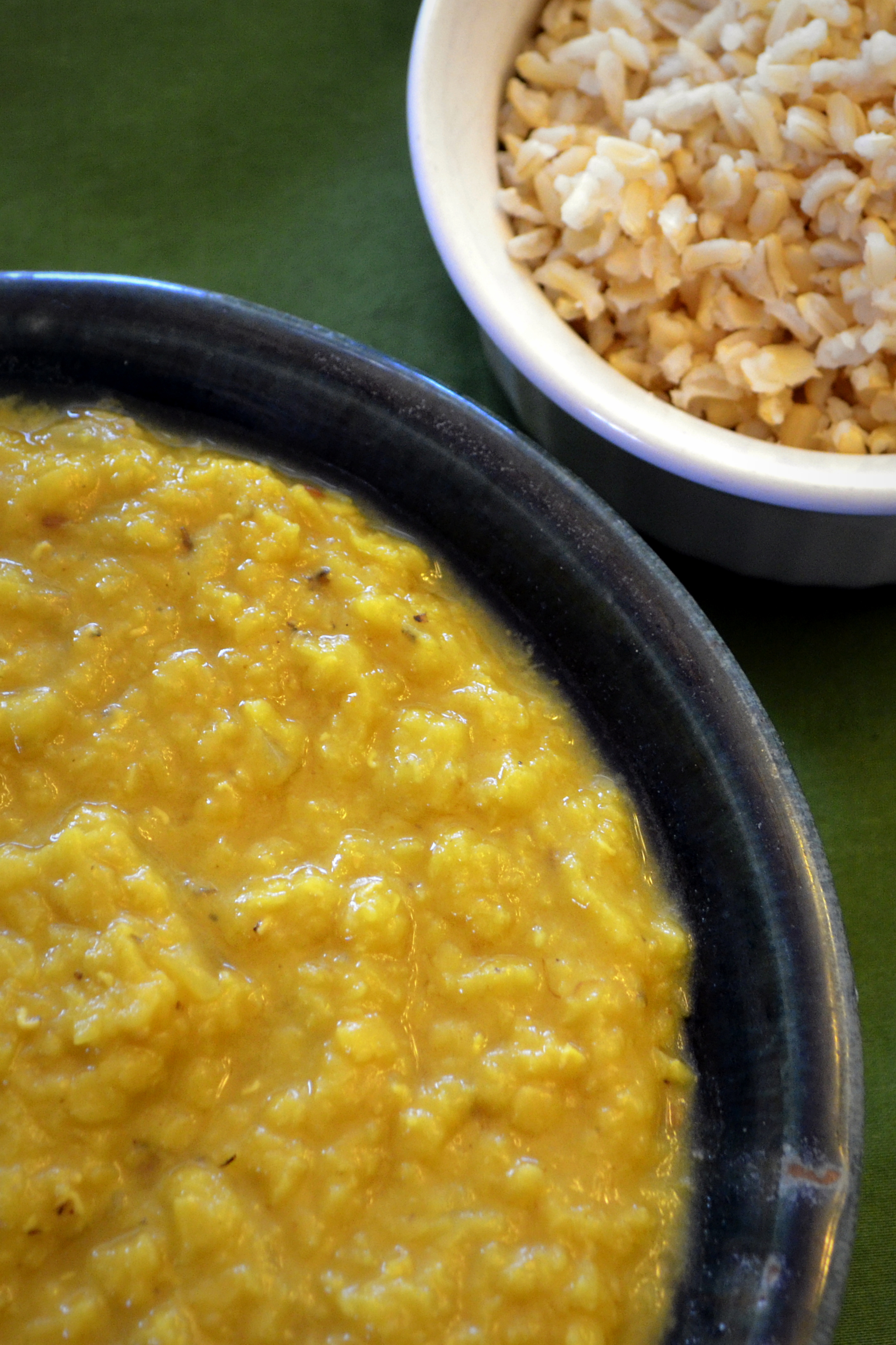
Most dal recipes call for spices cooked in oil (a tadka) to be added to the lentils at the end of the cooking time. This recipe also calls for cooked onions, garlic, and spices to be added at the beginning, too. Mmm good. And even better because my husband made the version shown below (pictured with brown rice). This dal is great the second day because it thickens slightly and the flavors deepen, so it’s an excellent make-ahead dish.

Red Lentils with Coriander and Cumin (Masoor Dal)

1 c. (200 gr.) red split lentils/masoor dal
4 c. (1 liter) water
2 tbsp. canola oil
1/2 large onion diced
3 cloves garlic
1 tsp. coriander seeds
1 tsp. ground ginger
1/2 tsp. ground turmeric
1 tsp. salt
2 tbsp. canola oil
1 tsp. whole cumin seeds
1 tsp. ground coriander
1 tbsp. butter (14 gr.), optional
finely chopped cilantro, optional
fried onions, optional

Preparation
1.  Pick over the lentils, rinse thoroughly in a fine-meshed colander, and place in a heavy-bottomed pot along with the 4 c. water. Bring to a boil over high heat and remove any foam that rises to the surface.
2. Heat the 2 tbsp. canola oil in a skillet over medium heat, add the onion and cook until it is soft and translucent. Add the garlic and cook for 2-3 minutes, stirring frequently. Add the coriander seeds, ginger, and turmeric, and cook for 1 more minute. Add this mixture to the lentils; set the skillet to one side for later use.
3. Reduce the heat to low, cover the pot, and cook for about 30 minutes or until lentils are tender. The lentils will turn yellow as they cook and will disintegrate.
4. Toward the end of the lentils’ cooking time, heat the other 2 tbsp. oil in the same skillet over medium heat and add the cumin seeds. Let sizzle for a few seconds, then add the ground coriander and salt. Cook for 1 minute, then add the spices and oil to the lentils, along with the butter (if using). Stir to mix well.
5. Before serving, garnish with chopped cilantro and/or fried onions  if desired.

Adapted from Madhur Jaffrey’s Indian Cooking.

Recipe: Citrus-Spiced Braised Red Cabbage

24 Jan

I love cabbage, that most humble of vegetables. Humble it may be, but versatile, too–and good for you, especially the red kind. With its lovely jewel tones (from a type of pigment also found in flower petals and fruits), red cabbage adds a beautiful touch of color to any meal.

This braised red cabbage is tangy and slightly sweet, featuring fresh orange juice, red wine, and  balsamic vinegar, as well as cinnamon, cloves, and caraway seed. It is a very nice accompaniment to pork or sausages, or a Thanksgiving meal–and also adds bit of zing to sandwiches. And if you are like me, you may also find yourself eating it cold, just because.


Citrus-Spiced Braised Red Cabbage

2 tbsp. olive oil
1 lg. onion, cut in half through the ends, then sliced into thin strips
3 cloves garlic, minced
1/2 tsp. caraway seeds
1/2 tsp. ground cinnamon
1/8 tsp. ground cloves
2 lb. red cabbage, any bruised outer leaves removed, cored, and sliced into strips (about 10 c.)
ground black pepper
1 c. vegetable broth
juice of one orange
3 tbsp. red wine
2 tbsp. balsamic vinegar

Preparation
1. Heat a large, heavy-bottom pot over medium-high heat and add the oil. When hot, add the onions and cook until soft and translucent. Add the garlic and spices and cook for a few more minutes, stirring frequently.
2. Add the cabbage and mix well to coat with garlic and spices. Continue cooking until the cabbage has wilted, then sprinkle with black pepper to taste, and add the broth and orange juice. With the heat on medium high, cook the cabbage for about 15 minutes, or until the liquid has reduced by at least half.
3. Add the wine and vinegar, and cook another 15 minutes. There should be some liquid at the bottom of the pot–but the cabbage should not be soupy. Turn up the heat if needed to allow any excess liquid to evaporate.
4. Serve immediately with a slotted spoon.