Tag Archives: tomatoes

Recipe: No-Fail, No-Knead Focaccia

22 Sep

This is a recipe I turn to time and again when serving Italian antipasti. It is the quick version of a Bon Appetit recipe, cutting the first rise time from 8-24 hours, to just 3-4. Even with the shorter first rise, this recipe has never failed me. I start the focaccia in the morning and it is ready at meal time, with only a few brief interventions in between while I am making other dishes. If you do have more time, definitely make the original, longer version. But if you need a quicker focaccia fix, search no further.

Note: Wherever possible, it is best to weigh key ingredients on a kitchen scale to preserve the correct ratios between them.

No-Fail, No-Knead Focaccia

Ingredients:
¼ oz. (7 gr.) active dry yeast
2 tsp. honey
2.5 c. (590 ml.) lukewarm water
22 oz. (625 gr.) all-purpose flour
5.5 tsp. (about 16 gr.) Diamond Crystal kosher salt
6 tbsp. extra-virgin olive oil, divided, plus more for hands
butter
Maldon sea salt flakes
fresh rosemary (optional)

Preparation:

1. Whisk the honey and lukewarm water in a medium bowl; add the yeast, whisk again, and let sit 5 minutes (the mixture should look foamy or at least creamy; if it doesn’t, you should start again with new yeast).

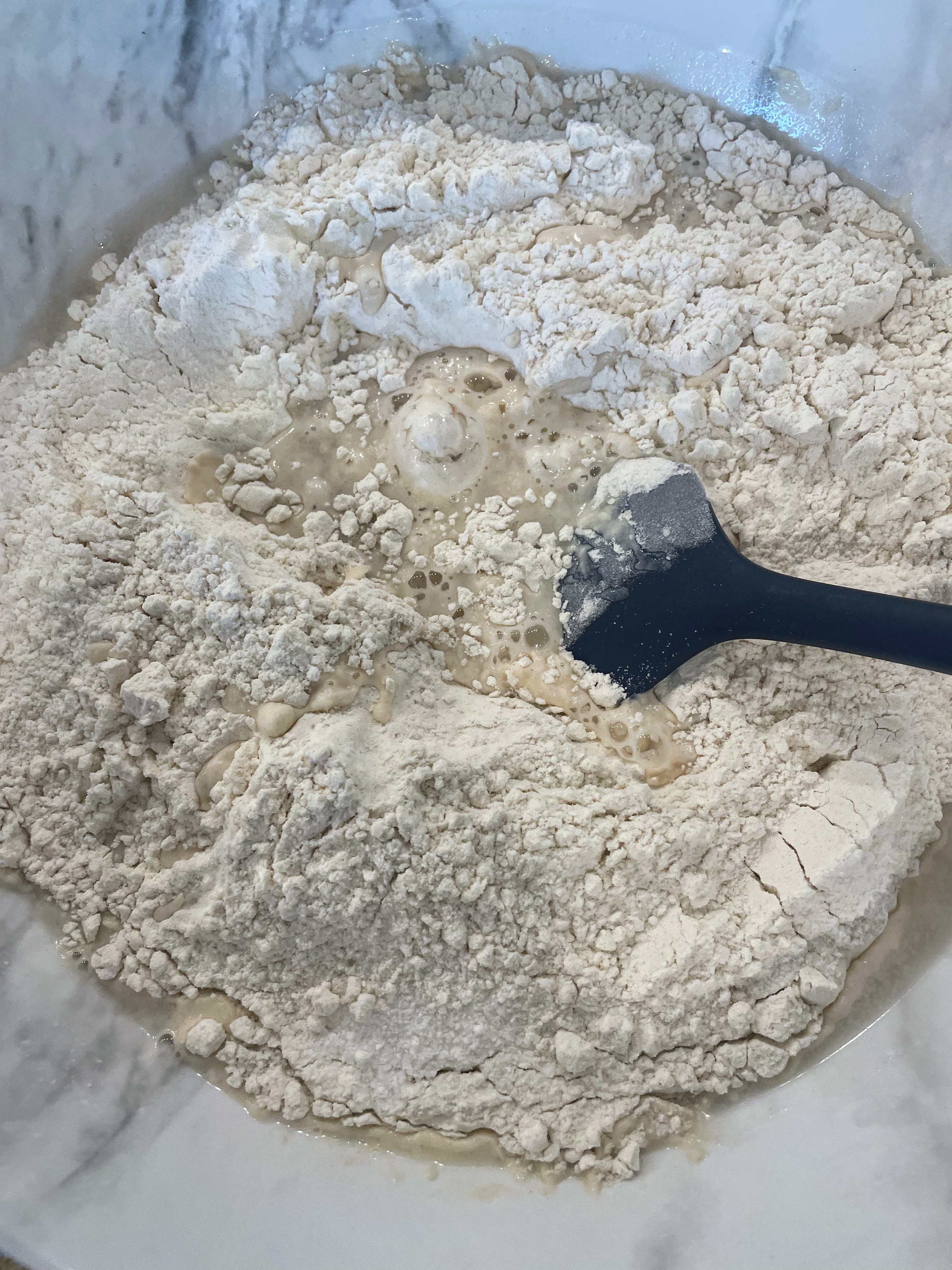
2. Add the all-purpose flour and kosher salt and mix with a rubber spatula until a shaggy dough forms and no dry streaks remain.
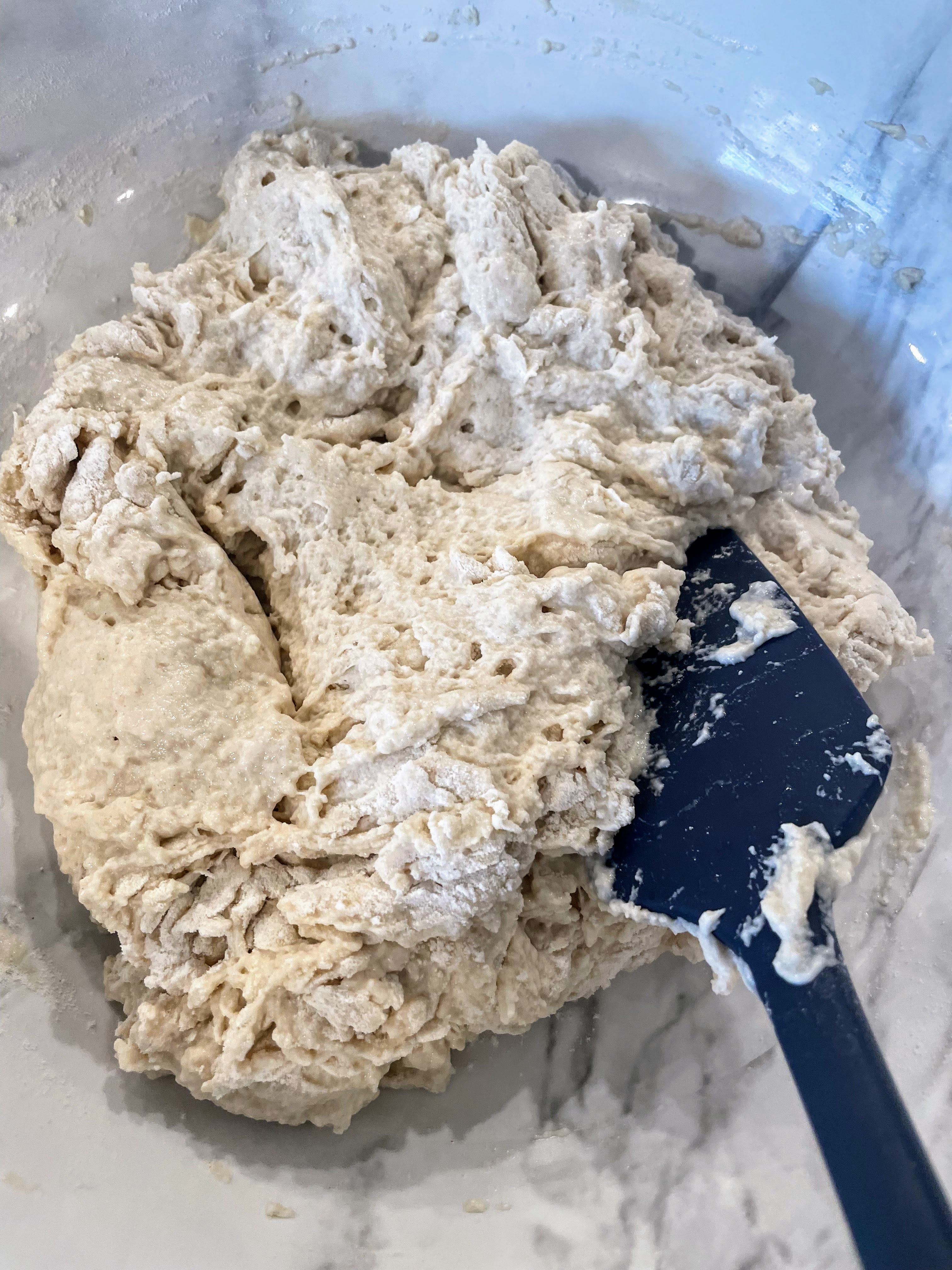
3. Pour 4 tbsp. of the extra-virgin olive oil into a large bowl, as the dough will rise a lot. Transfer the dough to the bowl and turn to coat in oil. Cover with a lid or plastic wrap and let rise at room temperature until doubled in size, 3–4 hours. This is the first rise (quick version).

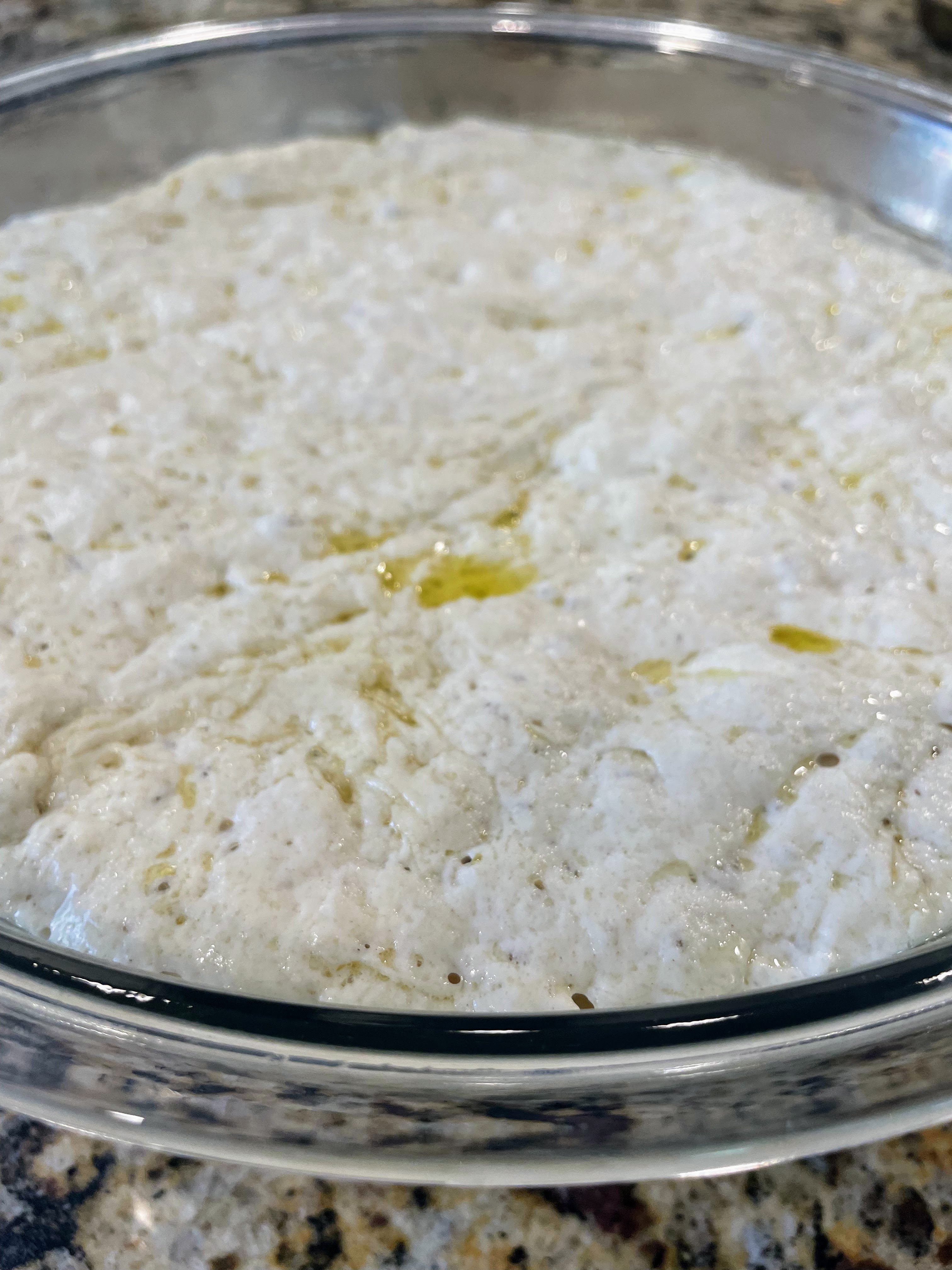
4. Generously butter a half-sheet (18×13 in./45×33 cm.) rimmed baking sheet. The butter will ensure that your focaccia doesn’t stick. After buttering, pour 1 tbsp. extra-virgin olive oil into the center of the sheet.

5. Keeping the dough in the bowl and using a fork in each hand, gather up the edges of the dough farthest from you and lift up and over into center of bowl. Give the bowl a quarter turn and repeat the process. Do this two more times until you have made it all the way around the bowl; you want to deflate the dough while slowly forming it into a rough ball. Transfer the dough to the buttered baking sheet. Pour any oil left in the bowl over and turn the dough to coat. Let rise, uncovered, in a warm, dry spot until doubled in size, at least 1½ hours and up to 4 hours. This is the second rise. By the end of it, the dough should have expanded toward the edges of the baking sheet.

6. Place a rack in the middle of the oven; preheat to 450F/230C.

7. To see if the dough is ready, poke it with your finger. It should spring back slowly, leaving a small indentation. If it springs back quickly, the dough isn’t ready. (If at this point the dough is ready to bake but you aren’t, you can chill it up to 1 hour.)

8. Lightly oil your hands. Gently stretch the dough to completely fill the sheet. Dimple the focaccia all over with your fingers, creating very deep depressions in the dough (reach your fingers all the way to the bottom of the pan). Drizzle with the remaining 1 tbsp. extra-virgin olive oil and sprinkle with the flaky sea salt (and rosemary, if using). Bake the focaccia until it is puffed and golden brown all over, 20–30 minutes.

Photos below are from two different bakes; one with flaky salt only, the other with rosemary and coarsely ground salt as I didn’t have the Maldon at the time. Both versions are delicious–you really can’t go wrong.
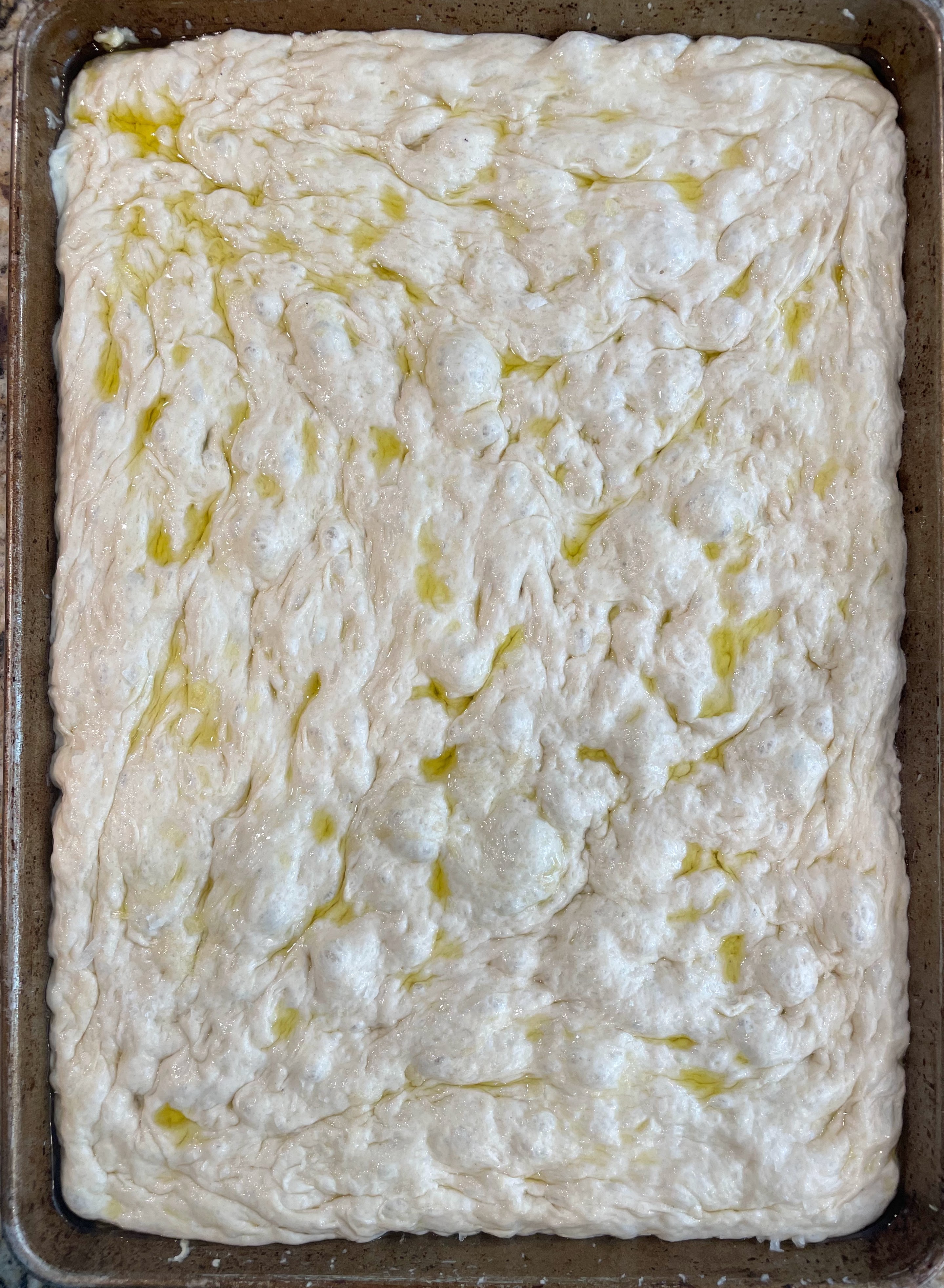
9. The focaccia is best the day it is made, but is delicious toasted the next day, too. My current favorite toppings: burrata and good-quality anchovies. Or burrata and mortadella. Or burrata and marinated tomatoes or marinated roasted peppers. Or no toppings at all….

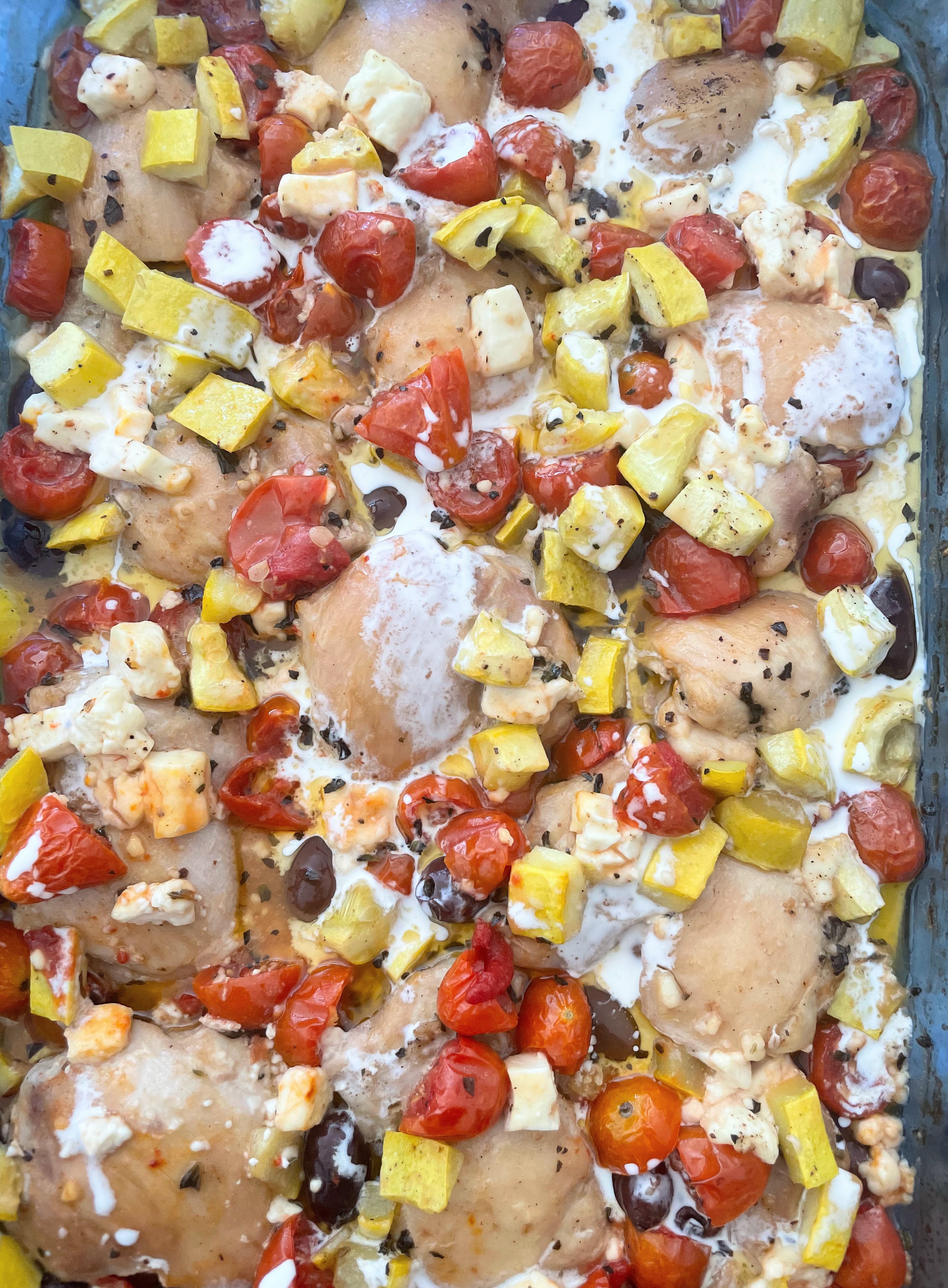
Recipe: Mediterranean Chicken with Feta and Olives

25 Aug

Necessity is the mother of invention. In this case, I had recently purchased a pack of chicken thighs, without a clear idea of what to do with them — except that now I was home from work and dinner time was looming, I needed an easy solution, and a fairly quick one. So I opened the fridge and cupboards to see what my options were. I guess I could have asked ChatGPT to come up with a recipe, but that would have meant inputting the available ingredients into a prompt, which 1) I was too lazy to do, and also, 2) I like to think that the non-artificial intelligence center within my cranium is still capable of putting 1+1, or 2+3, together to come up with something to eat. (But ask me next week…).

The result of my kitchen scan? I had cherry tomatoes that definitely needed using and some yellow squash from the garden that was now languishing in the crisper bin. Hmmm. What else was in the fridge? There was feta, kalamata olives, and cream. And rosemary outside. An idea began to form. So, what follows is a non-recipe recipe, without actual amounts. I’m confident that no matter how you yourself approach this dish, you can’t go wrong. The ingredients combine into something really, really good!

Mediterranean Chicken with Feta and Olives

Boneless, skinless chicken thighs
Salt and pepper
Dried oregano
Fresh rosemary, finely chopped
Olive oil (I used garlic-infused olive oil)
Cherry tomatoes, cut in half
Yellow summer squash (or zucchini if you have it), diced
Kalamata olives
Feta cheese (cubed or crumbled)
Heavy cream
Oregano (dried or fresh)

Preparation

  1. Preheat oven to 350 F (180C).
  2. Sprinkle both sides of the chicken thighs with salt, pepper, oregano, and rosemary.
  3. In a large heavy-bottomed pot, saute the thighs in olive oil over high heat until they are no longer pink on the outside and have picked up a bit of color.
  4. Place the thighs, and any juices or crispy bits from the pot, into a casserole dish large enough to fit the thighs in one layer.
  5. Sprinkle the olives, tomatoes, squash, and feta around the thighs, drizzle with some cream, and sprinkle a little more salt, pepper, and oregano over top.

6. Bake, covered, for about 30 minutes, or until the tomatoes and squash are soft.

    You can serve this multiple ways: with crusty bread to soak up the creamy, tomato-ey broth, over quinoa or rice, with potatoes or other roast vegetables, etc.

    Recipe: Sausage Cheese Dip, Two Ways

    4 Nov

    I love recipes that can do double duty. This one’s dual role came about by accident when I was pondering what to make for dinner one recent busy weeknight. We first had the very delicious sausage cheese dip on a weekend while watching a football game, but had some leftovers. So, when staring at the contents of my fridge a couple days later, I thought: “Sausage and cheese? Both those things go very well with pasta…. hmmm.” And I had a zucchini that I needed to use, too. Thus, Sausage Cheese Dip Rigatoni with Zucchini was born. And it was good! Both recipes follow.

    Sausage Cheese Dip (based on a recipe from Natasha’s Kitchen)
    Note: This serves 4 without leftovers (2 with leftovers)

    Ingredients
    1/2 lb. (226 gr) mild Italian sausage, removed from casing
    2 garlic cloves, minced
    pinch onion powder
    salt and pepper to taste
    4 oz (113 gr) cream cheese, cut into cubes (no need to soften)
    10 oz (283 gr) can diced tomatoes with green chilies
    1/2 cup corn (I cut the corn off one previously cooked cob, but frozen would also work)
    4 oz (113 gr) sharp cheddar or similar cheese, shredded

    Preparation
    1. Drizzle a small amount of olive oil in a medium skillet. Brown sausage over med/high heat, breaking it apart with a wooden spoon, until browned. If the sausage generates a lot of grease, drain the grease.
    2. Add the garlic, onion powder, and some pepper, and cook over medium heat for one more minute, stirring through.
    3. Add the cream cheese cubes and stir until melted and incorporated.
    4. Add the undrained tomatoes, corn, and shredded cheddar. Cook, stirring occasionally, just until bubbly and cheese is melted. Check seasonings, and add salt or pepper as needed.
    5. Remove from heat and serve with tortilla chips. The kind that look like scoops are perfect for this dip. (Note: The photo below also includes Cumin-Scented Black Bean Salad.)

    Sausage Cheese Dip Pasta with Zucchini
    (serves 2 hungry people)

    Ingredients
    5.3 oz (150 gr) pasta of choice (I used mezzi rigatoni)
    olive oil
    1 zucchini, diced
    1 cup Sausage Cheese dip
    cream or milk (if needed)
    Pecorino Romano or Parmesan cheese, grated
    salt and pepper to taste

    Preparation
    1. Bring salted water to a boil and cook pasta as directed for al dente.
    2. While water is coming to a boil, drizzle some olive oil into a large skillet. Add diced zucchini and cook over medium-high heat until zucchini starts to get golden around the edges.
    3. Add the sausage cheese dip and stir until warm and melted. Check the consistency; add a splash of cream or milk if too thick. If too thin, add some grated Pecorino Romano or Parmesan cheese.
    4. When pasta is ready, drain, and add to sauce in skillet, along with more grated cheese. Check the seasonings, and add salt or pepper as needed.
    5. Serve immediately.

    Recipe: Lamb with Eggplant, Tomatoes, and Pine Nuts

    20 Apr

    This is a Lebanese dish for saucy eggplant (and lamb) lovers. Lamb and eggplant are natural partners and frequent appear together in Middle Eastern, Turkish, Greek and Balkan dishes. There are many recipes for this as a stuffed eggplant dish but I like this deconstructed version, which layers the filling on top. As it all cooks together, the lamb and tomatoes season and soften the eggplant below, resulting in comforting, cinnamon-scented mouthfuls that are enhanced by the taste and texture of buttery pine nuts.

    L

    Lamb and Eggplant

    Ingredients:

    olive oil
    3 small-medium eggplants, thinly sliced
    garlic powder
    salt and pepper

    1 onion, diced
    4 cloves garlic, minced
    1 tsp. cinnamon
    1/2 tsp. allspice
    salt and pepper
    1 lb. (450 gr.) ground lamb
    1 can (14 oz./411 gr.) petite diced tomatoes
    1 can (14 oz./411 gr.) tomato sauce

    1/3-1/2 c. pine nuts
    chopped parsley (optional; I forgot it this time around!)

    Preparation

    1. Cook the eggplant slices in olive oil (in a singe layer, working in batches) in a large frying pan over medium-high heat until they are golden, tending to them carefully so they don’t burn. You will likely need to add more oil to the pan with every new layer. Place the eggplant slices in the bottom of a 9×13-inch (23×33 cm) baking dish and sprinkle them with a little garlic powder, salt, and pepper as you layer them, while they are still warm. (I have a garlic salt grinder and sometimes grind that over the layers, along with some black pepper, so that’s another option.)

    2. In another pan, cook the onion in about 2 tbsp. olive oil until soft. (Note: If you’d like to up the heat factor of this dish, you could also add a pinch of red-pepper/chili flakes along with the onions.) Add the minced garlic and cook a couple minutes more, then add the cinnamon and allspice and cook for another couple minutes. Remove the onions from the pan and set aside. Add the ground lamb to the pan and cook until no longer pink; drain,* then add the cooked onions, the diced tomatoes and the tomato sauce. Simmer until the liquid is slightly reduced, about 20 minutes. Check the seasonings after about 10 minutes, and add more cinnamon, allspice, salt, or pepper as needed.

    3. Melt a bit of butter or olive oil in a small frying pan over medium heat and sauté the pine nuts until they start to turn golden.

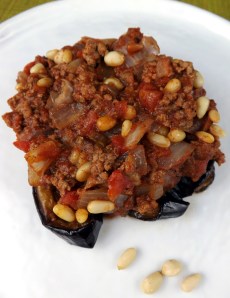
    4. Spoon the lamb mixture over the eggplant slices in the baking dish and sprinkle the pine nuts on top. The photo below shows this step halfway through.

    LE

    4. Bake at 350 degrees F (180 C) until bubbling, about 30 minutes.

    5. Sprinkle chopped parsley on top and serve with vermicelli rice pilaf. I also like to eat the lamb and eggplant (and the rice) with plain full-fat yogurt on the side, too.

    *In the United States, the lamb sometimes requires draining. If your lamb is leaner, you can add the ground lamb directly to the cooked onions in the pan and skip the draining part.

    Recipe: Coda alla Vaccinara (Oxtail Stew) with Rigatoni

    2 Dec

    One of the pleasures of being in a new place is tasting local dishes and then trying to figure out how to make them. In Italy, part of the fun lies in consulting butchers, greengrocers, cheese purveyors, wine merchants, and really, any Italian who eats, because they are all happy to offer advice. As soon as the days grew cooler, I knew what I wanted to make: Coda alla Vaccinara (Oxtail Stew) served over rigatoni–an old-style dish appearing on many Roman menus.

    DSC_0063
    In previous times, the slaughterhouse workers of Testaccio (the vacccinari) were given offal and oxtails to pad their slim salaries. Their wives rose to the challenge and created dishes that made the most of the available ingredients. In Coda alla Vaccinara, the oxtails are braised in a sauce made with pancetta, lots of celery, onions, carrots, tomatoes, wine, and spices, though the stew is open to interpretation; everyone I asked prepares the dish in a slightly different way. Some people make it with red wine instead of white, some add water, some forego the carrot, some add raisins. Large pieces of celery are de rigueur, but in a rebellious break from tradition (and knowing I wanted to turn the entire stew into a sauce), I finely diced all the celery and survived to tell the tale.

    However, I did not escape looks of shock and dismay on the faces of two Italian friends when I mentioned I had added a pinch of cinnamon to the stew. “Cinnamon? CINNAMON? No. NO.” But I say “Yes.” In addition to cloves, cinnamon very frequently appears in recipes for Coda, which is meant to have a warm-scented, delicately sweet undertone. So here is the resulting recipe, a hearty interpretation perfect for autumn and winter. And following on the advice of Alessandro Volpetti (and I’m happy to take the word of anyone at Volpetti’s), I topped the Coda with grated Ricotta Salata cheese, one of my favorites. But omit the cinnamon if you prefer, top with Parmesan or Pecorino Romano instead–this dish is yours to interpret.

    DSC_0020

    Rigatoni with Oxtail Sauce (con Coda alla Vaccinara)

    1-2 tbsp. olive oil
    2.2 lb. (1 kg.) oxtails
    salt and pepper
    4 oz. (about 112 grams) pancetta, cubed
    1 large onion, finely chopped
    1 large carrot, finely diced (or coarsely grated)
    5 stalks celery, finely diced
    5 cloves garlic, minced
    1 bay leaf
    1/8 -1/4 tsp. chili flakes
    4 whole cloves (or 1/8 tsp. ground)
    ¼ tsp. ground cinnamon
    1.5 tbsp. tomato paste
    1.5 c. white wine
    1 large (28 oz./800 grams) can peeled Italian tomatoes
    fresh parsley and marjoram (or oregano)
    tiny pinch sugar

    1 lb. (500 grams) rigatoni
    Ricotta salata cheese, grated

    Preparation
    1. Lightly season the oxtail pieces with salt and pepper. Heat the olive oil in a large Dutch oven, then brown the oxtail pieces, turning them on all sides. Remove from the pot and place in a bowl.
    2. Add the pancetta to the pot and cook until mostly crispy and the fat has rendered; do not drain the fat. Add the onion, carrot, and celery and cook until soft, deglazing the pot as you go. Sprinkle the onion mixture with more black pepper, add the garlic and bay leaf, and cook for a couple of minutes. Add the chili flakes, cloves, and cinnamon and cook for a minute or two while stirring. Add the tomato paste and the wine. Simmer gently for about 5 minutes to reduce the liquid slightly.
    3. With clean hands, take a peeled tomato from the can and crush it into the stew; repeat with all the tomatoes. This is a very satisfying technique—but moderation is key; if you are too enthusiastic, you may end up shooting tomato bits across the kitchen. If you prefer a slightly less visceral experience, you can cut the tomatoes while in the can, or remove them and dice, adding all the tomatoes and all the tomato sauce/juice from the can to the pot.
    4. Mix in the pinch of sugar, nestle the oxtail pieces into the vegetable mixture, pour in any liquid from the bowl they were in, sprinkle with more black pepper, and then scatter some of the herbs on top.

    DSC_0048
    5. Cover the pot and simmer on low heat for about 3 hours, or until the meat is very tender when pierced with a fork (it may take longer depending on the oxtails). Remove the oxtails, place on a dish, let cool, then pull off as much meat from the bones as possible (this will require some patience). Return the shredded meat to the sauce; keep warm.
    6. Cook the rigatoni according to package instructions until al dente, drain, return to its pot, and then mix in the Coda sauce. Scatter more fresh herbs on top and serve with the grated cheese.

    DSC_0060

    Recipe: Salade Nicoise with Salmon

    1 Jul

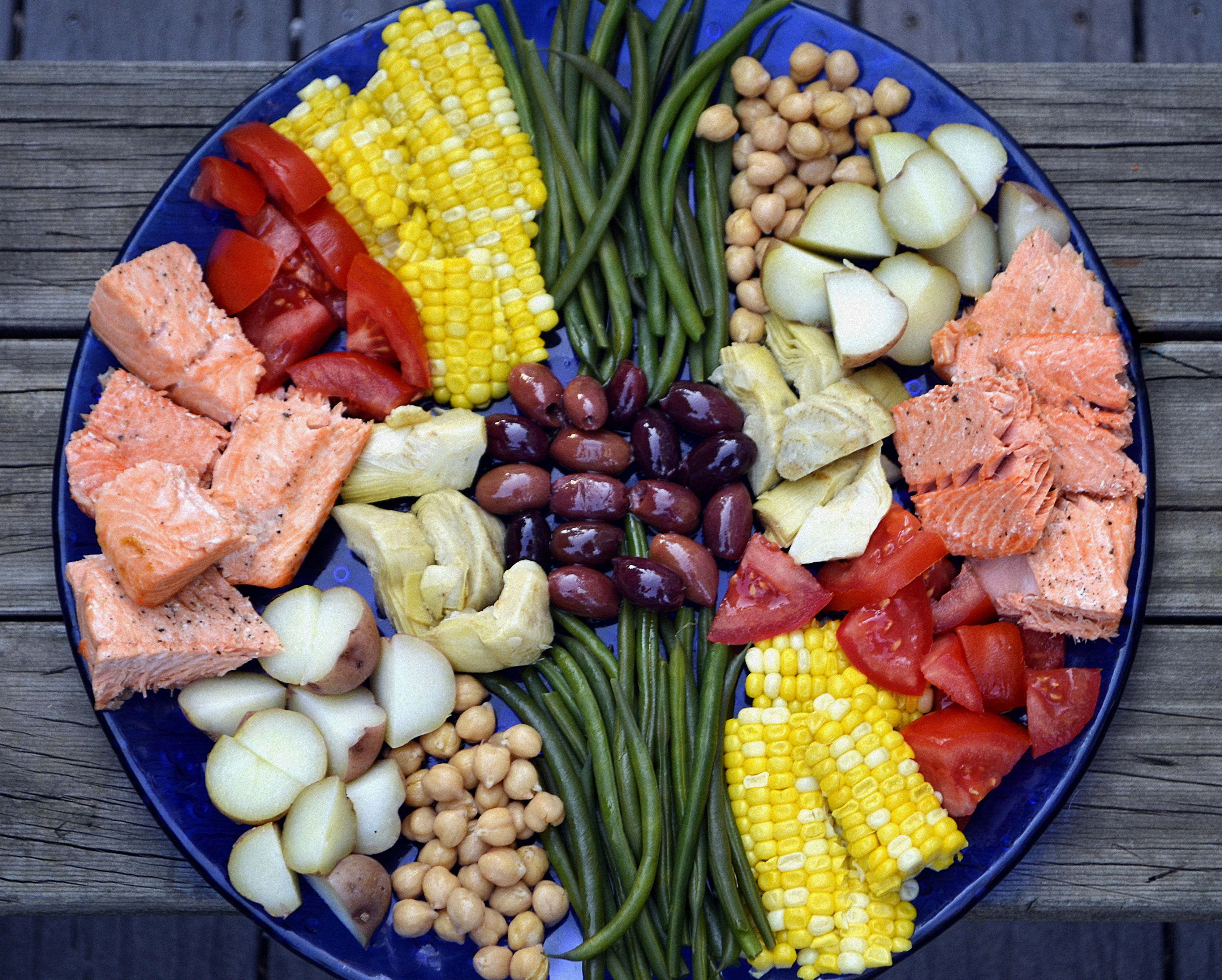
    Sometimes, you just get tired of lettuce and yearn for something a bit “more.” The deconstructed Salade Nicoise meets that need. It is one of my favorite salads for that reason, and because all parts of it can be prepared in advance. Plus, salad makers with an artistic flair can have a lot of fun deciding how to present the ingredients to maximum effect. To earn the name “nicoise,” a dish must contain a few specific items: olives, garlic, French green beans, tomatoes, and anchovies (or tuna in oil). Artichokes and hard-boiled eggs are also characteristic of a salade nicoise, but just as I was assembling this one in front of a hungry audience I realized I had forgotten to boil the eggs…. So, no eggs this time around. However, the beauty of this salad is that you can improvise and make it with whatever you have on hand. I had a craving for broiled salmon, so substituted that for the tuna, and added corn off the cob and chick peas, just because. Three hungry people polished off this platter–but with some crusty bread on the side, it could feed four less ravenous eaters. The recipe below is a free-form one–the quantities of all the ingredients (and the ingredients themselves) can be adjusted as desired.

    Salade Nicoise 2
    Salade Nicoise with Salmon

    1 filet of salmon, about 1 lb.
    olive oil
    salt and pepper
    fresh lemon juice

    2-3 ears of corn, husked, with silky threads removed
    a couple handfuls of thin, French-style green beans, rinsed
    6-8 small red potatoes, rinsed and scrubbed but not peeled, and cut into quarters
    3 eggs (which I forgot)

    1-2 ripe tomatoes, diced
    nice black olives, about 1/3 c. (I had Kalamata on hand, but Nicoise or other French olives would be more traditional)
    cooked chickpeas, about 1/2 c.
    8-10 canned/tinned artichoke hearts

    your favorite garlicky vinaigrette

    Preparation

    1. Set oven to broil. Pat the salmon dry and place on a rimmed cookie sheet sprayed with cooking spray. Rub the salmon with olive oil, sprinkle with salt and pepper, drizzle lightly with lemon juice, and broil a couple minutes on each side, or until cooked through. Remove from oven and let cool, then cut into chunks.
    2. Meanwhile, bring a large pot of water to a boil. Drop the corn cobs and green beans into the pot, and cook 5-8 minutes or just until tender. Using a slotted spoon, remove the vegetables from the pot and place them in a colander set on a dinner plate. Take the colander to the sink, rinse the vegetables in cold water, and set them aside. Keep the water in the pot boiling.
    3. Drop the quartered red potatoes into the boiling water and cook until tender; remove them from the pot with a slotted spoon and set aside to cool. Finally, gently lower the eggs into the boiling water, turn off the heat, cover the pan, and let the eggs cook for 10-12 minutes. Remove the eggs and place them in cold water to cool, then peel and quarter them.
    4. Take a cooked corn cob and stand it on its end on a stable cutting board. Carefully cut the corn off the cob in vertical strips with a sharp knife. If the green beans remain wet, pat them dry.
    5. Assemble the salade nicoise by placing all the ingredients (including the tomatoes, olives, chickpeas, and artichokes) in an alternating pattern on a large platter. Drizzle lightly with the vinaigrette, and serve with additional vinaigrette on the side.

    Summertime Bliss: Sun-Warmed Cherry Tomatoes

    6 Jul

    Few things beat the taste of a tomato that’s come straight from the garden. And cherry tomatoes offer that extra, satisfying little pop as you bite into them. The photo below shows our first harvest of the season, but the tomatoes in this bowl won’t make it into any recipe; these sun-warmed beauties are all going to be eaten just as they are–as a snack straight from Nature. However, there is a reason these tomatoes are called Sweet 100s: before long, I’ll be wondering what to do with all of them. I see lots of salads on the horizon, as well as our favorite Pasta with Cherry Tomatoes, Fresh Mozzarella, and Basil. And cherry tomatoes would also work in Roasted Tomatoes, Onions, and Garlic with Basil–though I’d start cooking the onions and garlic first, adding the cherry tomatoes toward the end of the roasting time. I detect a common theme in both recipes: basil. And now that I recall, last I saw it, our basil was in danger of being overtaken by the flowering oregano that has run riot in the herb garden…. Time for some triage in the name of good eats!


    Recipe: Roasted Tomatoes, Onions, and Garlic with Basil

    28 Jun

    This year, I planted three tomato plants, which are beginning to completely take over the vegetable garden. If that weren’t enough, a fourth rogue plant sprung from the seeds of  last year’s tomatoes is giving them a run for their money. Which means I’m soon going to be faced with a bumper crop of tomatoes and the challenge of figuring out what to do with the ones I keep. This recipe is one of my all-time favorites for tomatoes, and I often serve it at brunches as an accompaniment to cold roasted meats. It is a very flexible recipe: it can be made ahead, served warm or at room temperature–and you can play around with the ingredients depending on what you have on hand. However you tweak it, it’s hard to go wrong with tomatoes, red onions, garlic, basil, and pine nuts.


    Roasted Tomatoes, Onions, and Garlic with Basil
    12 servings

    3 lb. roma tomatoes (other smaller types work well, too)
    2 large red onions, cut in half, each half cut into eight wedges
    30 cloves garlic /2 bulbs, peeled (slice large cloves in half)
    2/3 c. olive oil
    2 tsp. sambal oelek (or sweet chilli sauce)
    1 tbsp. sugar
    2 tbsp. bottled pesto (or fresh, if you have it)
    1 tsp. salt
    2 tbsp. balsamic vinegar
    1/2 c. shredded fresh basil
    2 tbsp. chopped fresh oregano
    1/2 c. pine nuts, toasted

    Preparation

    1. Heat oven to 400º.
    2. Cut the tomatoes in half lengthwise. Place tomatoes, cut side up, in large baking dish, then nestle the onions and garlic around the tomatoes.
    3. In a small bowl, combine the olive oil, sambal oelek, sugar, pesto, and salt. Pour over the vegetables.
    4. Bake uncovered for about 30 minutes or until tomatoes, onions, and garlic are soft.
    5. Meanwhile, dry toast the pine nuts in a small skillet over medium-high heat (watching carefully), until they start to turn golden. Remove them from the skillet and reserve.
    6. Once the tomatoes come out of the oven, add the vinegar, herbs, and pine nuts, and mix gently. Serve warm or cold.

    Recipe: Spicy Indian Eggplant with Tomatoes

    27 Oct

    I have always loved logic problems. You know–the kind where a man in a blue coat on a bus is sitting two seats away from a woman with red hair who is diagonally across from another woman using an iPhone and one seat away from a man with a green scarf reading the paper.  Eventually, given more clues, you’d have to say where everyone was sitting, what color hair they had, what they were wearing, and what they were doing.

    Perhaps that is why I also greatly enjoy certain culinary challenges. For example, tonight we had friends over for dinner and had a lovely time with them. But having lived in Berkeley, we learned early on to ask if our guests had any dietary preferences or restrictions. This time around, several of our guests could not eat dairy, gluten, or meat (two friends are each avoiding one of those items, the other cannot have two of them–but no one friend is avoiding all three). The remaining five people at the table tonight eat anything and everything. No one was vegan.

    So, what to serve? In cases such as this, I find that Indian food is perfect. There are myriad vegetarian and non-dairy options, and rice does not contain gluten. So I decided to use this opportunity to experiment by making several dishes I haven’t tried before. This eggplant dish is one of them, and one of the reasons I chose it is that it can be served at room temperature. Anything that can be made ahead of time, I like. This recipe, which family members deemed a keeper, is adapted from Madhur Jaffrey’s Indian Cooking.

    Spicy Indian Eggplant with Tomatoes
    Serves 6
    [Updated 9 March 2021]

    1 tsp. ground ginger
    6 large cloves garlic, minced
    1/8 c. (30 ml.) water

    1 3/4 lb. (795 gr.) baby eggplant
    about 1.5 c. (415 ml.) canola or vegetable oil

    1 tsp. whole fennel seeds
    1/2 tsp. whole cumin seeds
    1 (15-oz./425 gr.) can petite diced tomatoes, drained, liquid reserved
    1 tbsp. ground coriander
    1/4 tsp. ground turmeric
    1/8 tsp. cayenne (or chili flakes)
    1 tsp. salt
    1/2 tsp. sugar
    1 tbsp. fresh lemon juice

    Preparation

    1. Combine the ginger, garlic and water in a small bowl; set aside.
    2. Cut the eggplant lengthwise into halves, then cut each half lengthwise into four strips; cut the strips in half crosswise.
    3. Heat 1/2 c. (140 ml.) of the oil in a deep frying pan over medium-high heat; when hot, add one layer of eggplant and cook until the eggplant is golden-brown, turning pieces over as they cook. Remove eggplant and drain on a layer of paper towels.
    4. Repeat until all eggplant slices have been cooked, adding additional oil to the pan each time as needed.
    5. Once all the eggplant has been cooked, keep about 3 tbsp. of the oil in the pan, and discard the rest.
    6. Add the fennel and cumin seeds to the hot oil in the pan. Stir for a few seconds, then add the tomato, the ginger-garlic mixture, and the coriander, turmeric, cayenne, salt, and sugar.
    7. Stir and cook for 5-6 minutes, breaking up the tomato pieces with the back of a slotted spoon. Continue to cook until the mixture gets thick and paste-like.
    8. Return the eggplant to the pan and gently mix in; add the lemon juice. Cook on medium-low for about 10 minutes, adding some of the reserved tomato liquid if the eggplant looks too dry.
    9. Check the seasonings and adjust as needed (you may like to add more salt, or a pinch more sugar, or a bit more lemon juice).
    10. Serve warm or at room temperature.