This is a recipe I turn to time and again when serving Italian antipasti. It is the quick version of a Bon Appetit recipe, cutting the first rise time from 8-24 hours, to just 3-4. Even with the shorter first rise, this recipe has never failed me. I start the focaccia in the morning and it is ready at meal time, with only a few brief interventions in between while I am making other dishes. If you do have more time, definitely make the original, longer version. But if you need a quicker focaccia fix, search no further.
Note: Wherever possible, it is best to weigh key ingredients on a kitchen scale to preserve the correct ratios between them.
No-Fail, No-Knead Focaccia
Ingredients: ¼ oz. (7 gr.) active dry yeast 2 tsp. honey 2.5 c. (590 ml.) lukewarm water 22 oz. (625 gr.) all-purpose flour 5.5 tsp. (about 16 gr.) Diamond Crystal kosher salt 6 tbsp. extra-virgin olive oil, divided, plus more for hands butter Maldon sea salt flakes fresh rosemary (optional)
Preparation:
1. Whisk the honey and lukewarm water in a medium bowl; add the yeast, whisk again, and let sit 5 minutes (the mixture should look foamy or at least creamy; if it doesn’t, you should start again with new yeast).
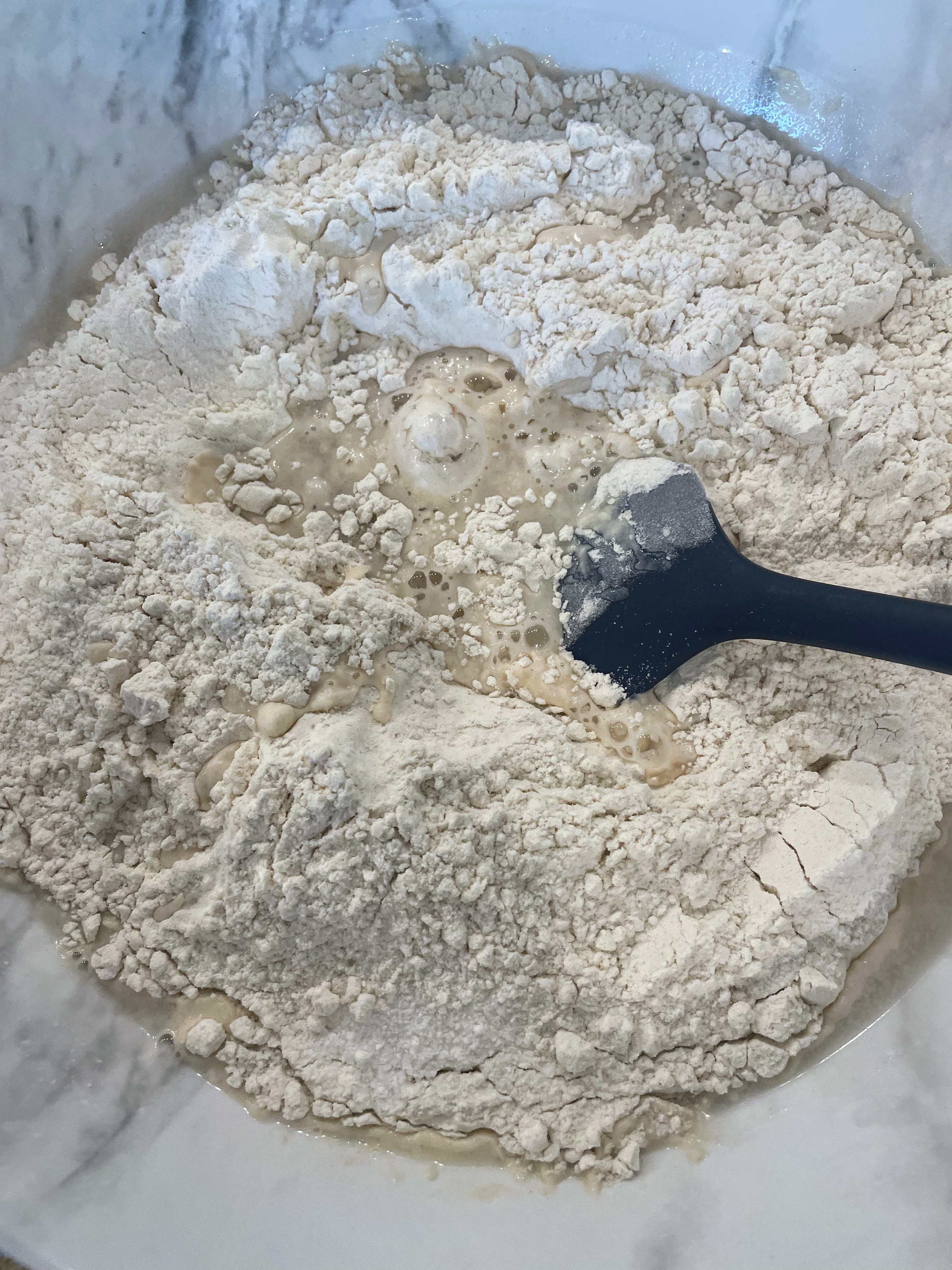
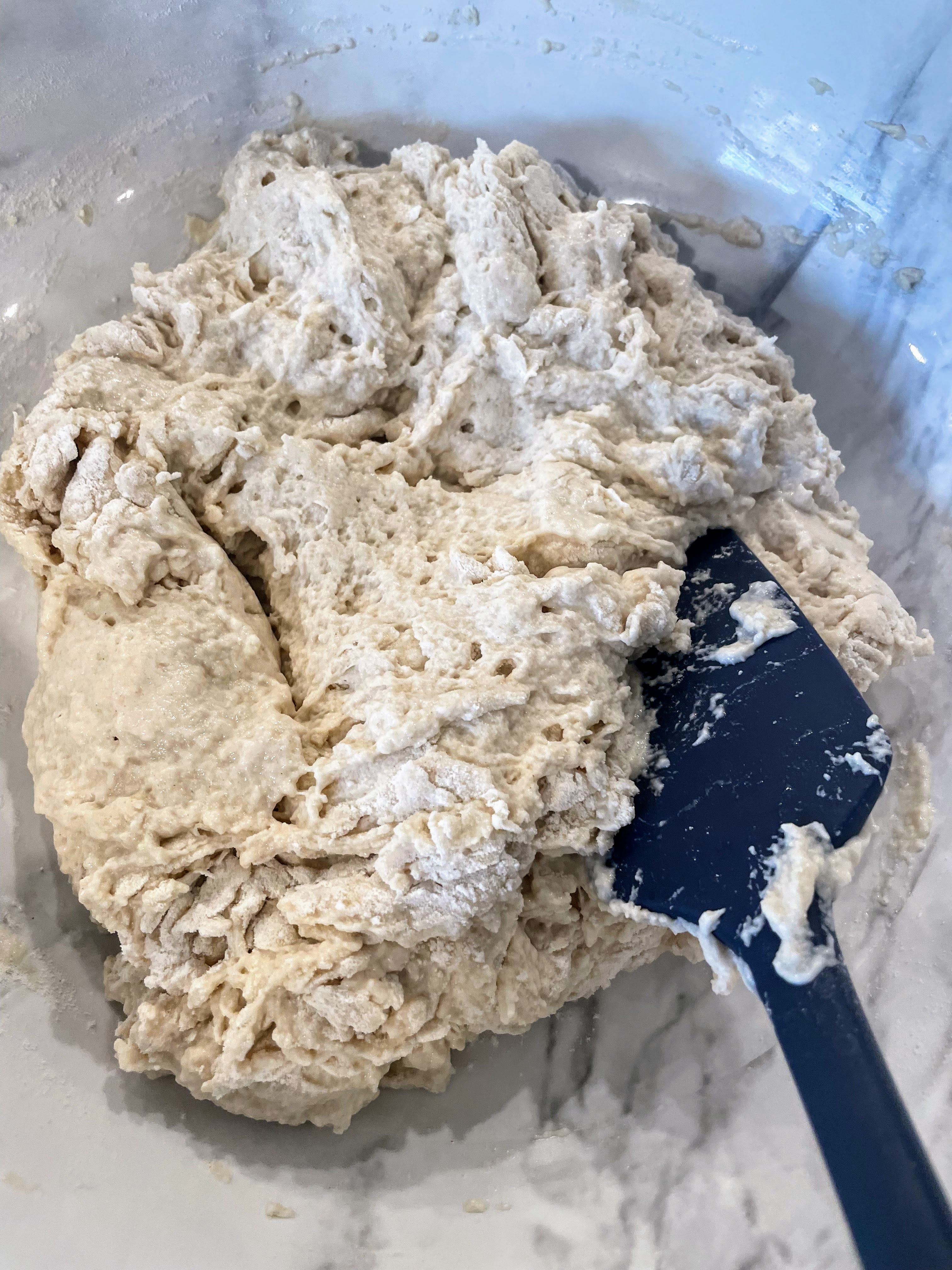
2. Add the all-purpose flour and kosher salt and mix with a rubber spatula until a shaggy dough forms and no dry streaks remain.
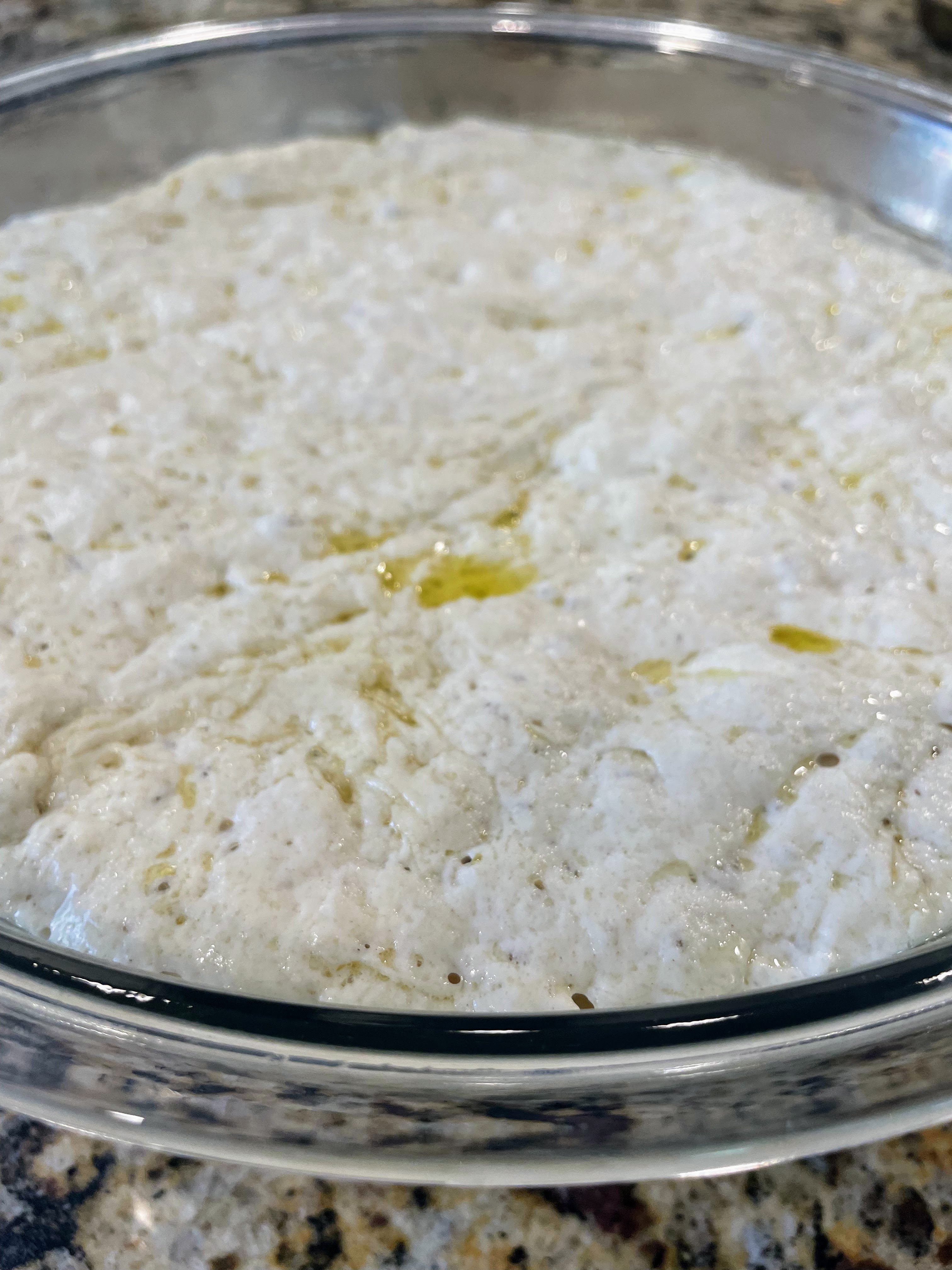
3. Pour 4 tbsp. of the extra-virgin olive oil into a large bowl, as the dough will rise a lot. Transfer the dough to the bowl and turn to coat in oil. Cover with a lid or plastic wrap and let rise at room temperature until doubled in size, 3–4 hours. This is the first rise (quick version).
4. Generously butter a half-sheet (18×13 in./45×33 cm.) rimmed baking sheet. The butter will ensure that your focaccia doesn’t stick. After buttering, pour 1 tbsp. extra-virgin olive oil into the center of the sheet.
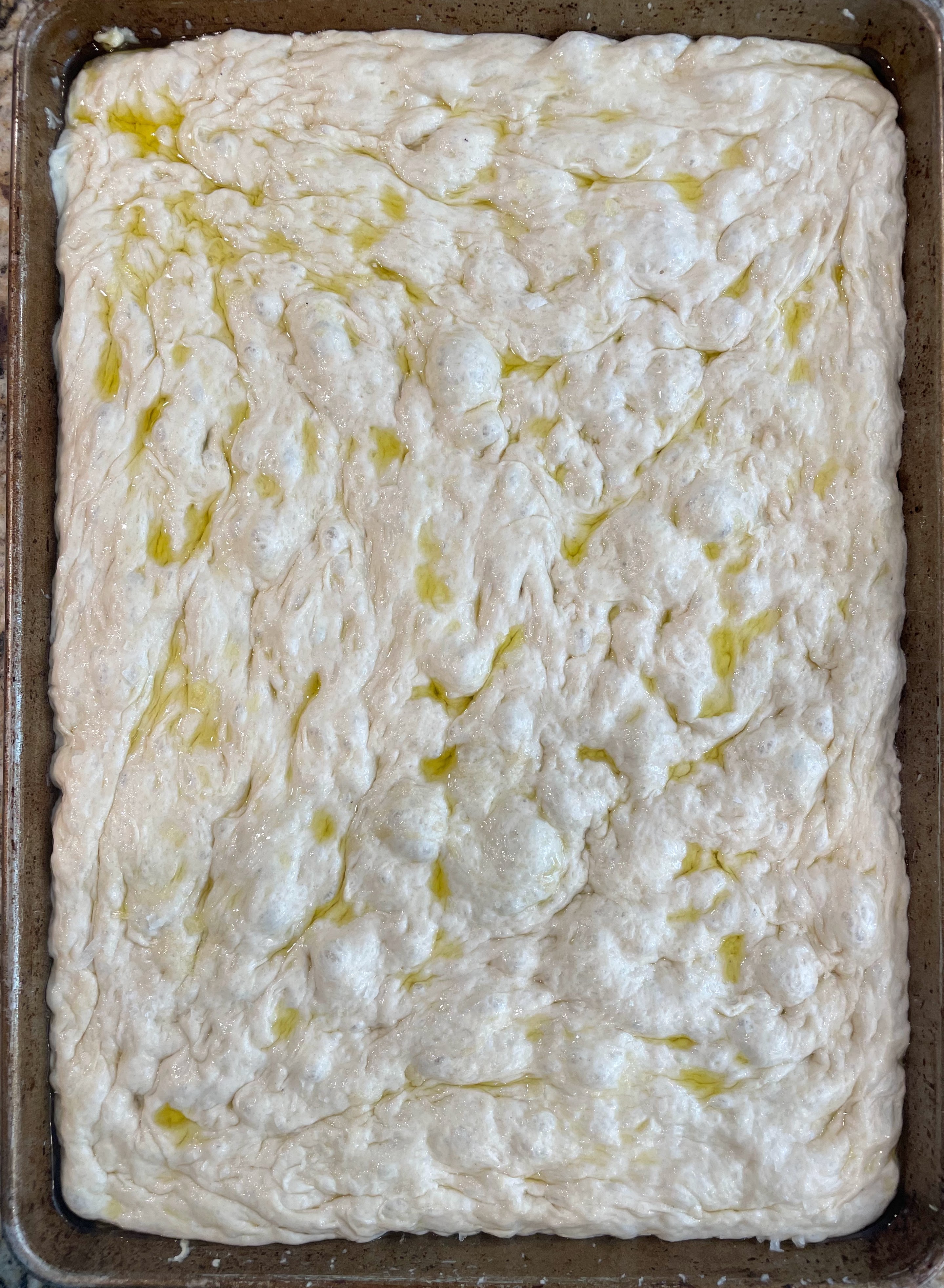
5. Keeping the dough in the bowl and using a fork in each hand, gather up the edges of the dough farthest from you and lift up and over into center of bowl. Give the bowl a quarter turn and repeat the process. Do this two more times until you have made it all the way around the bowl; you want to deflate the dough while slowly forming it into a rough ball. Transfer the dough to the buttered baking sheet. Pour any oil left in the bowl over and turn the dough to coat. Let rise, uncovered, in a warm, dry spot until doubled in size, at least 1½ hours and up to 4 hours. This is the second rise. By the end of it, the dough should have expanded toward the edges of the baking sheet.
6. Place a rack in the middle of the oven; preheat to 450F/230C.
7. To see if the dough is ready, poke it with your finger. It should spring back slowly, leaving a small indentation. If it springs back quickly, the dough isn’t ready. (If at this point the dough is ready to bake but you aren’t, you can chill it up to 1 hour.)
8. Lightly oil your hands. Gently stretch the dough to completely fill the sheet. Dimple the focaccia all over with your fingers, creating very deep depressions in the dough (reach your fingers all the way to the bottom of the pan). Drizzle with the remaining 1 tbsp. extra-virgin olive oil and sprinkle with the flaky sea salt (and rosemary, if using). Bake the focaccia until it is puffed and golden brown all over, 20–30 minutes.
Photos below are from two different bakes; one with flaky salt only, the other with rosemary and coarsely ground salt as I didn’t have the Maldon at the time. Both versions are delicious–you really can’t go wrong.
9. The focaccia is best the day it is made, but is delicious toasted the next day, too. My current favorite toppings: burrata and good-quality anchovies. Or burrata and mortadella. Or burrata and marinated tomatoes or marinated roasted peppers. Or no toppings at all….
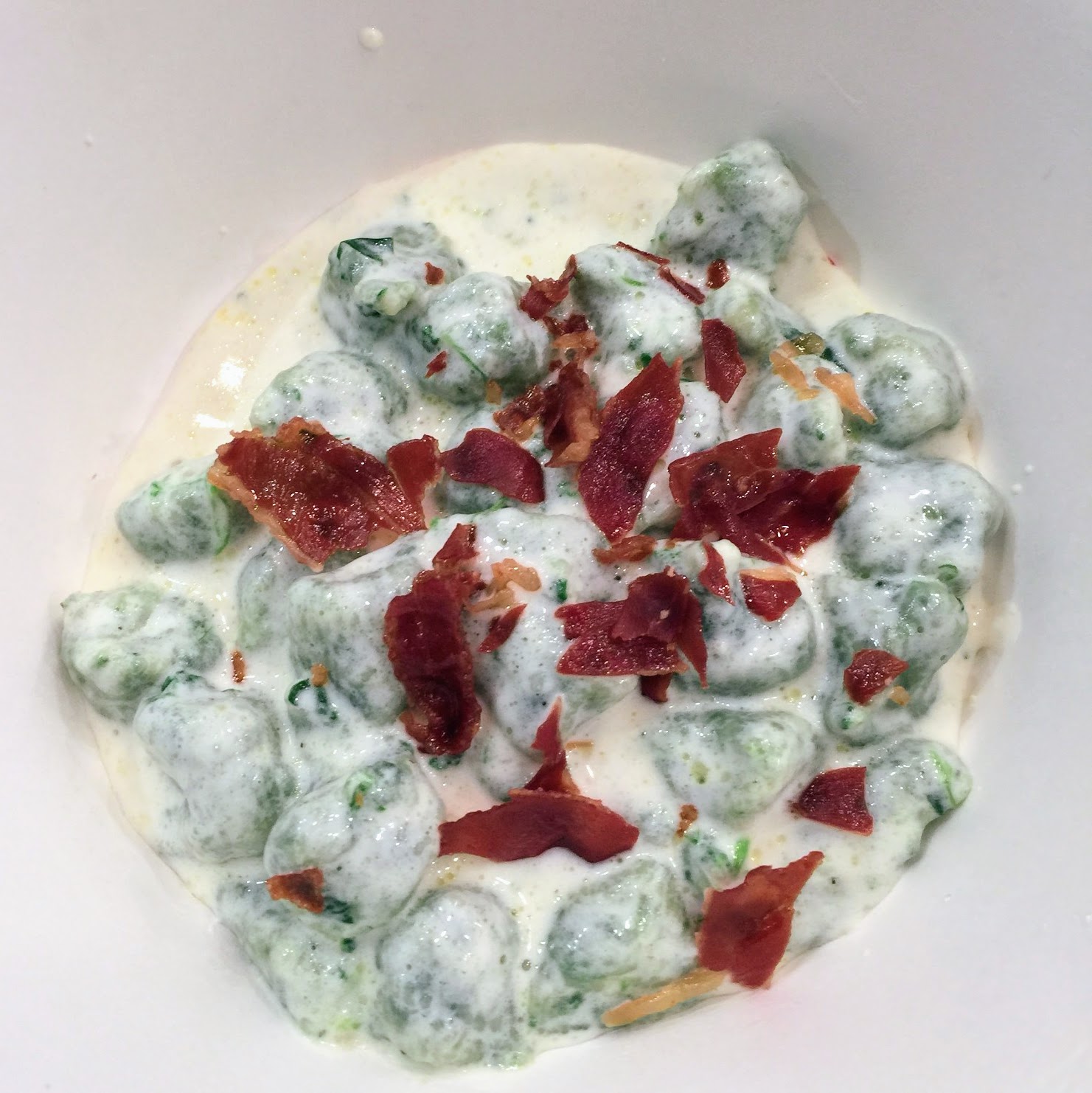
If you like gnocchi, or spinach-ricotta ravioli, you may very well also like gnudi.Gnocchi and gnudiare similar, except gnocchi are made with potatoes and have some chewiness, whereas gnudi are made with ricotta and are quite light and soft, which I prefer. In Italian, “gnudi” means “naked ones;” these spinach-ricotta delights are essentially the filling for ravioli, without the pasta to cover it up.
You can eat them with a marinara sauce, which would keep them very light — but I first learned how to make gnudi in a cream sauce with crunchy prosciutto on top, which is what I’ll share here because it is delicious! You can easily omit the prosciutto for a vegetarian main, however.
Ingredients 4 servings
11 oz (300 gr) spinach leaves 2 garlic cloves, minced extra-virgin olive oil 150 gr whole-milk ricotta (drained if very wet) 1 egg, lightly beaten 150 gr. ( about 2 c.) Parmesan or Pecorino Romano cheese, grated — and divided in half 2-3 tbsp. flour 500 gr. (2 c.) heavy cream salt and freshly ground pepper, to taste pinch ground nutmeg
Preparation
1. Preheat the oven to 400F (200C). 2. Rinse the spinach well and cook in a pot with only the water that is clinging to it, until soft and wilted. Remove, drain/squeeze dry, then chop. Put the spinach in a bowl with the garlic and a drizzle of olive oil; toss to combine.
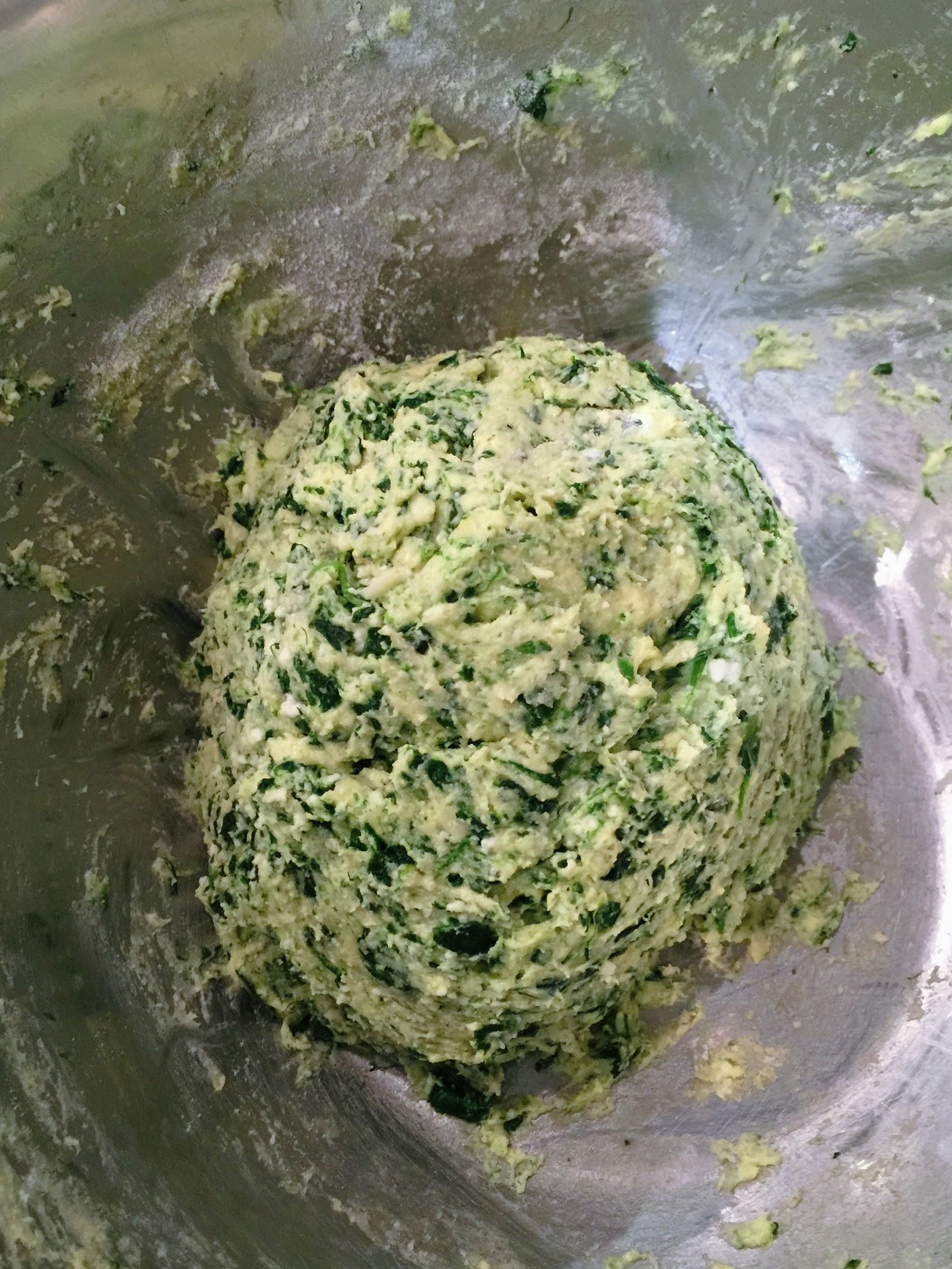
3. Add the ricotta, egg, 1 cup of the grated cheese, flour, a small pinch of salt (but not too much, due to the cheese), and pepper. Mix well, form the dough into a ball, and let rest for 30 minutes.
4. Meanwhile, place the prosciutto on a baking sheet and bake until crispy, keeping a close eye on it as it can go from crispy to burnt very quickly. Let the prosciutto cool, then break into pieces. Set aside.
5. Once the gnudi dough has rested, take pieces of it and roll into logs on flour-dusted parchment paper. Cut the logs into small pieces. Start a big pot of lightly salted water boiling.
6. Make the cream sauce: Bring the cream to a simmer for a couple minutes, stirring continuously. Take it off the heat and add the remaining cup of grated cheese, whisking to incorporate. Season to taste with salt, pepper, and nutmeg (if desired). 7. Gently slide the gnudi in the boiling water (you can take the parchment paper and slowly funnel them into the pot that way, or use a skimmer, spider, or slotted spoon). You may need to add the gnudi to the boiling water in batches; only put enough in to form a single layer across the top of the pot. The gnudi will be ready in just a few minutes — as soon as they float back up to the surface.
8. Remove the gnudi with the skimmer, spider, or slotted spoon and place them in a serving bowl (or another pot); pour the cream sauce over, adding more grated cheese if desired. Serve in individual bowls with crispy prosciutto on top. Enjoy!
Recently, my husband pointed out that we had TWO jars of cherry preserves, TWO jars of fig jam, and an unruly assortment of other jams, jellies, and preserves in the fridge. I was accused of jam overpopulation. I admitted to accidently opening a new jar of cherry preserves (my favorite) without realizing we already had one in the fridge, but I still maintain the other jars were not my fault…. However, in the spirit of providing a solution to this problem, I offered to make a ricotta crostata with what was left in one of the jars of cherry preserves. One less jar in the fridge, and attention diverted to dessert. A win-win.
Actually, a ricotta crostata is always a win-win; the sweet ricotta is beautifully creamy and you can use any preserves or jam of your liking, though the most traditional way of preparing this Italian sweet is with cherry preserves. Second, the dough for this crostata comes together in a food processor, adding speed and ease to the recipe’s many virtues. And finally, a crostata not only makes a great dessert, but a tasty breakfast as well — and a good accompaniment to afternoon tea or coffee.
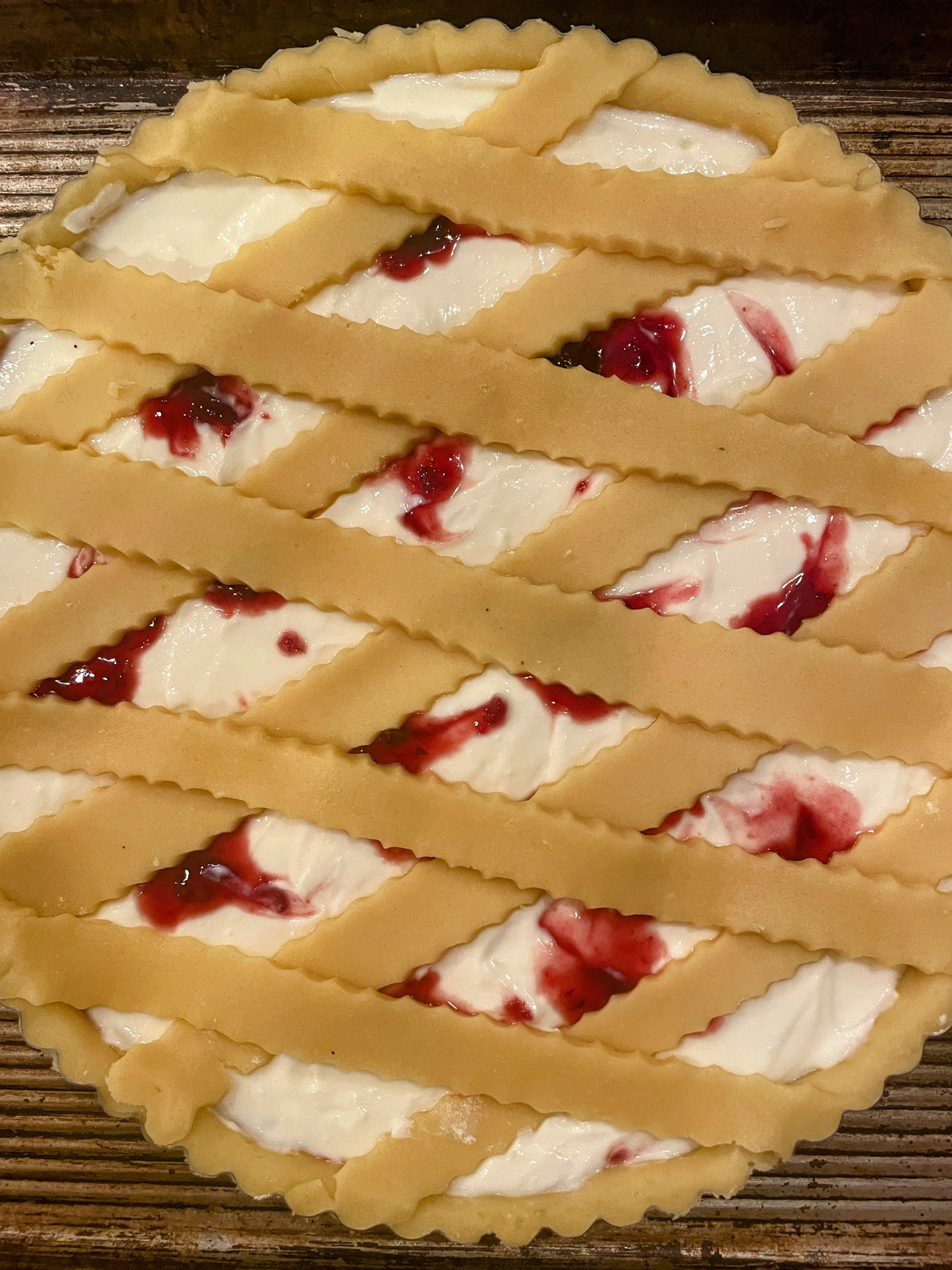
You can also let your creative side loose on the top crust; I made a very simple (unwoven) lattice with scalloped strips this time around.
Crostata Ricotta e Visciole Recipe inspired by (and translated from) Antonio Romano Runchef Note: This recipe is best made using a kitchen scale to weigh the ingredients.
Tart Dough: 225 gr. sugar (about 1 1/8 c.) grated zest of one lemon 250 gr. butter (2 sticks + 1 tbsp) 120 gr. eggs (I used 3 yolks + 2 whole eggs, carefully adding the white of the last egg until I got to 120 gr.) 1 tsp. vanilla pinch of salt 500 gr. flour (I used all-purpose; you can also use 00)
Filling: 450-500 gr. ricotta (16-oz. container); I try to find ricotta that is not super wet. Here in the U.S., I like Bel Gioioso Ricotta con Latte. I pour out any little liquid that may have collected in the container and dab the top with a paper towel to remove any extra moisture. 100 gr. sugar
250 gr. cherry preserves (about 3/4 c.)
Directions: 1. Place the sugar and lemon zest in a food processor and pulse until combined. 2. Cut the butter into cubes. (Note: An easy way to cut butter into cubes is to use a bench scraper; cut the sticks lengthwise into quarters, then chop into cubes. ) Add the butter cubes to the sugar in the food processor and continue to pulse until incorporated; the butter will look grainy. Add the eggs and vanilla and process until well combined. 3. Add the flour and sprinkle the pinch of salt over. Process just until a smooth dough forms.
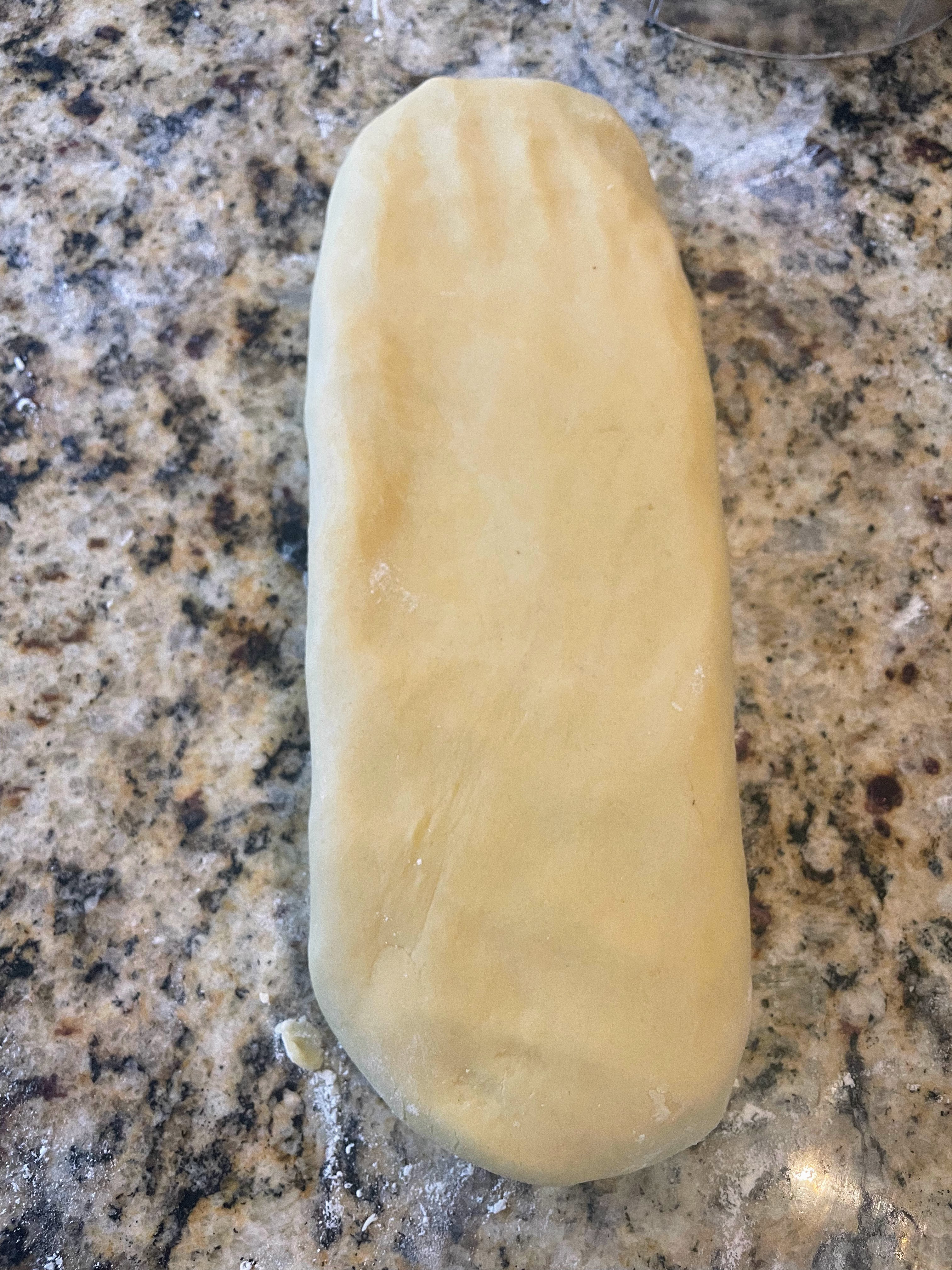
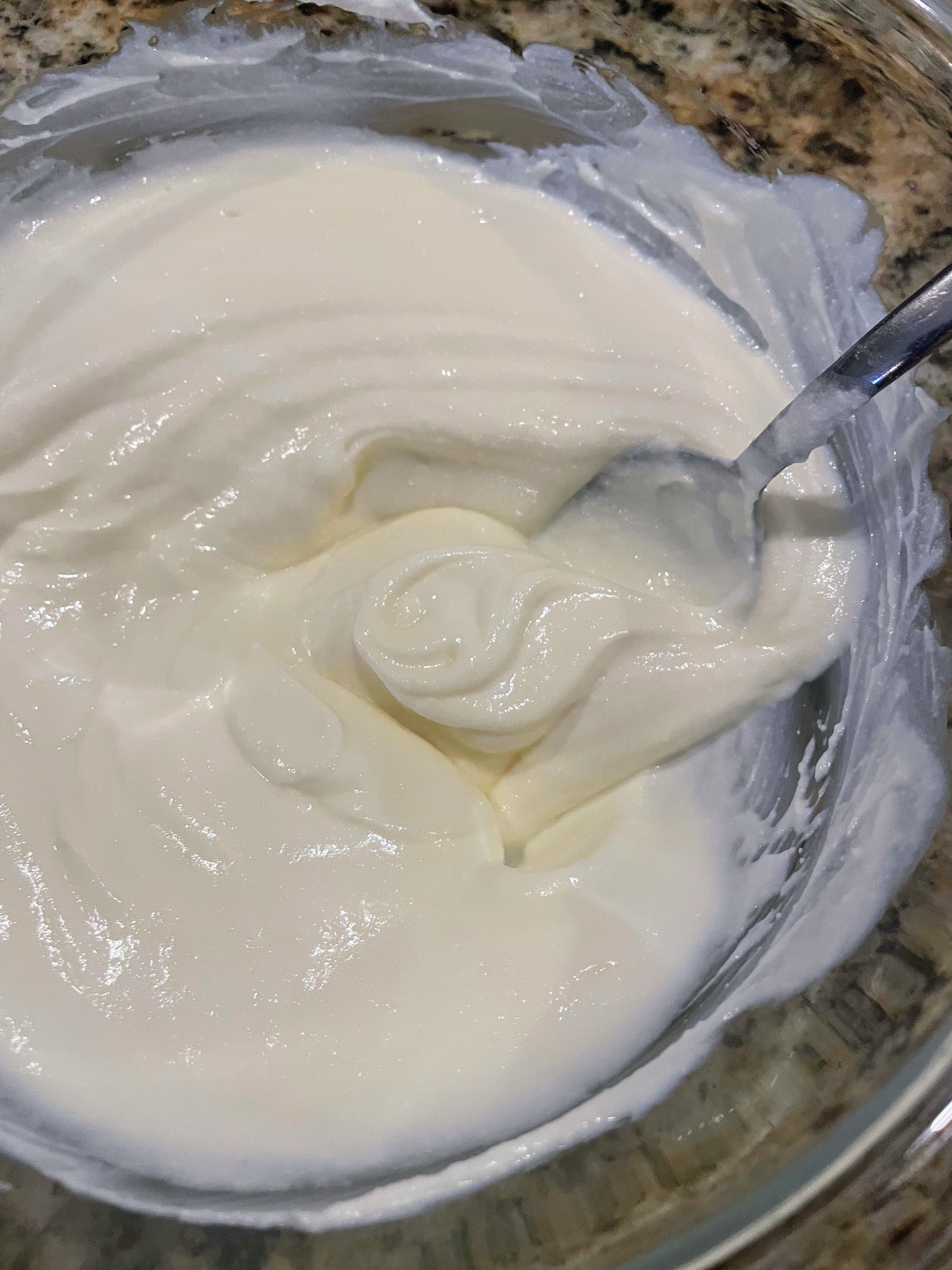
4. Turn the dough onto a floured countertop and roll into a thick log. Pat into a rectangle, wrap in plastic film (or put in a sealable bag) and refrigerate for 2 hours. 5. Meanwhile, butter a tart pan. Make the ricotta filling by mixing the ricotta and sugar together; let it sit, stirring occasionally, until the sugar is fully incorporated.
6. Cut the dough into a 2/3 piece and a 1/3 piece. Return the 1/3 piece to the refrigerator. Roll the 2/3 piece into a circle about 3 inches wider than your tart pan. Carefully drape the dough over the pan, lifting it gently to tuck it into the inner diameter of the pan. If any dough overlaps the edge, press on it to crimp it off. Save the extra dough. 7. Spoon 2/3 of the preserves ( 1/2 c.) over the base of the tart. Carefully add the ricotta mixture, smoothing the top as best as possible. Dollop the remaining preserves across the top of the ricotta mixture and gently swirl.
8. Roll the remaining 1/3 piece of dough into a rectangle at least as long as the diameter of your tart pan. Cut into 10 strips, and lay the strips in a diamond pattern across the top of the tart. (You can also re-use any extra dough you have leftover from lining the tart pan, to make the 10 strips.)
9. Bake the crostata at 170C/340F for about 35 minutes, or until the lattice is golden. Let cool and then serve.
Much to the dismay of one son in particular when he was younger, there is almost no way, shape, or form of zucchini I don’t like; I cooked it often when he was little. Back in those days of juggling work and young kids, I usually sauteed zucchini slices in olive oil, with salt, pepper, and maybe some basil and/or a sprinkle of Parmesan or Pecorino Romano: a quick and easy side dish that I still love. But it was not one my son enjoyed…. However, times change. He now prepares zucchini frequently for his daughter, who likes it a lot. So the family tradition continues!
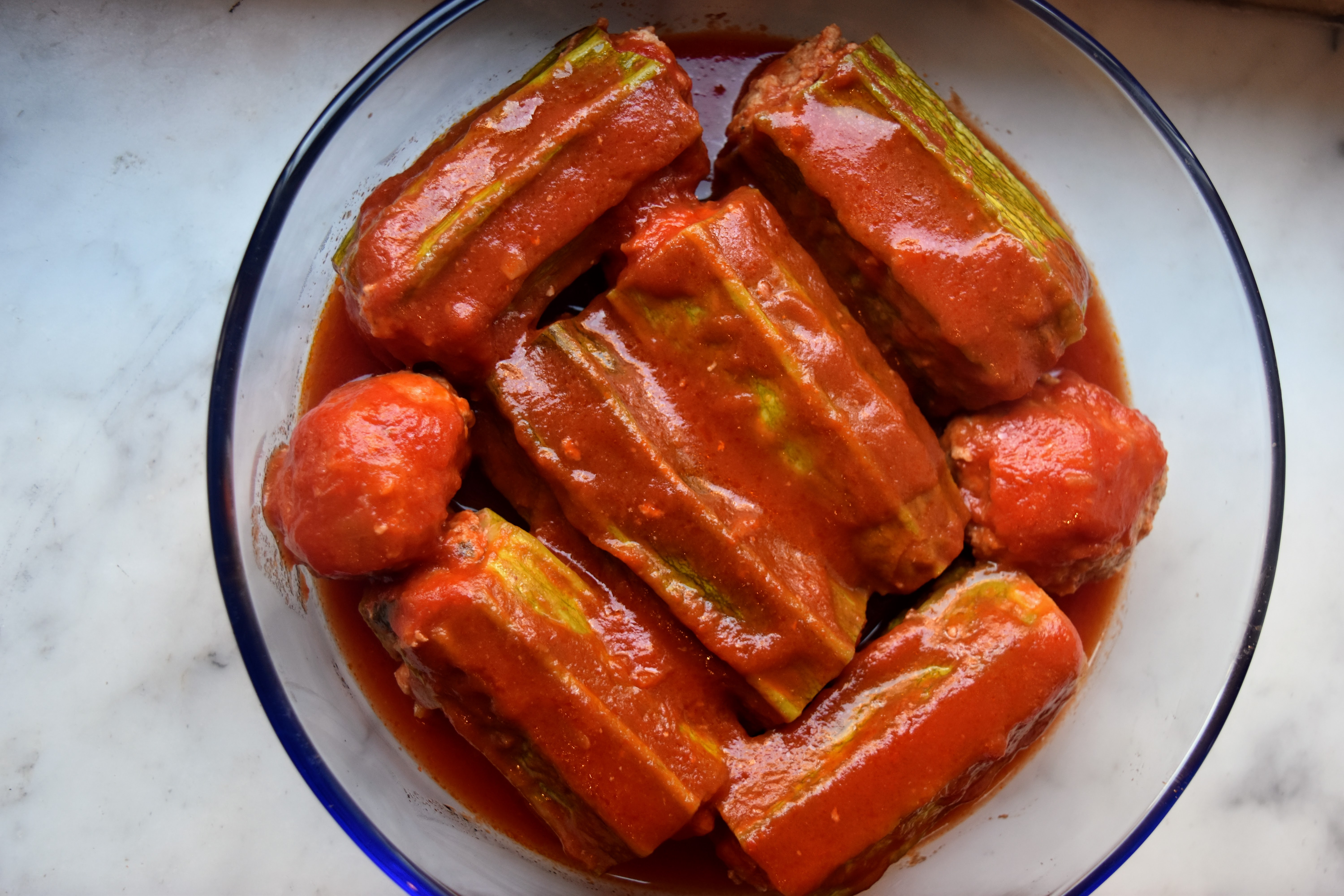
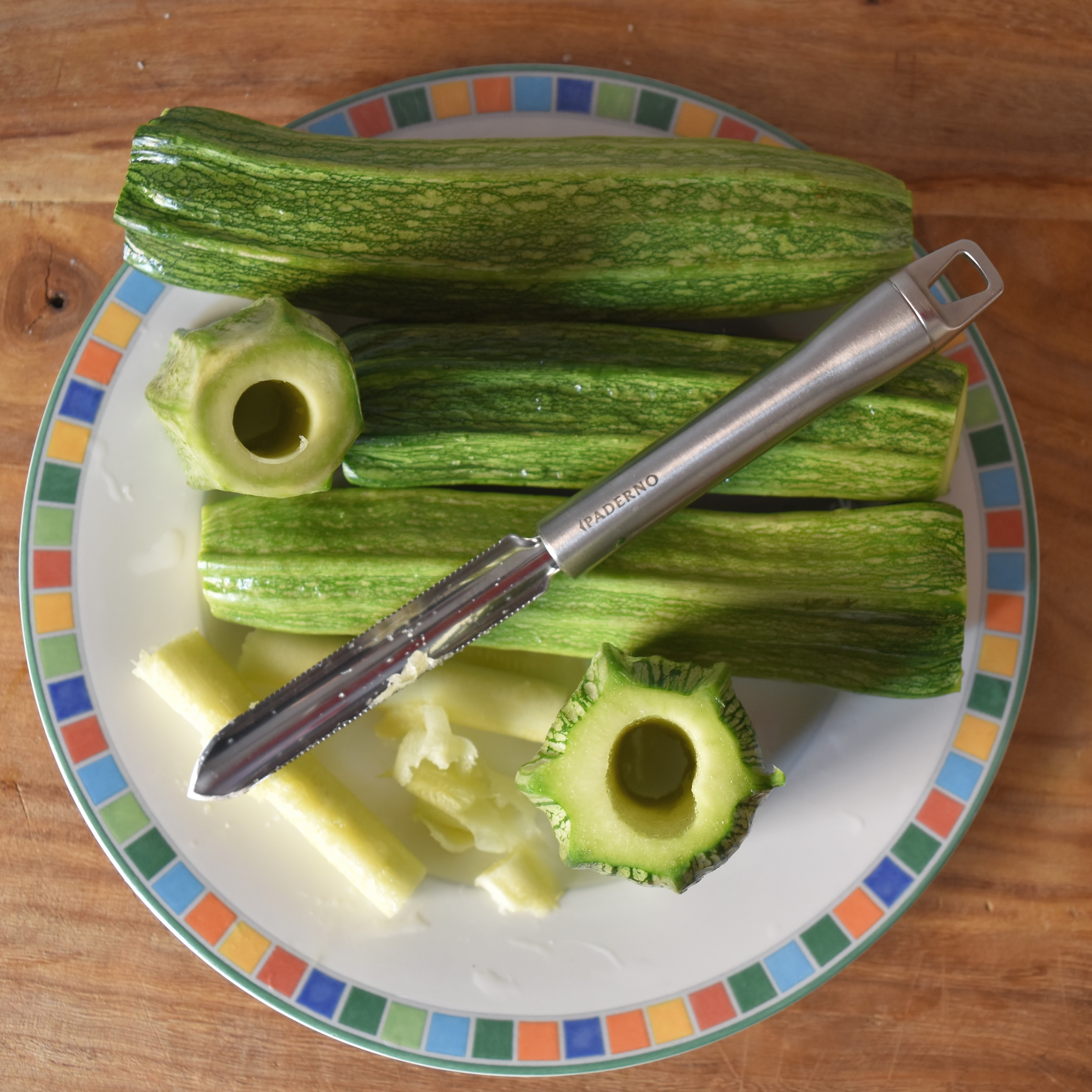
This stuffed zucchini dish is one I learned from an Italian friend when we lived in Rome. It is especially good as the weather gets colder. Note: I’ve made this dish many times, in Rome and here in the US. The photos in this post come from various times; some show Roman zucchini (Costata romanesco zucchini–which is lighter green, more speckled, and ridged) and others show the darker, smoother zucchini more typically found in the U.S. (see first photos below). Both are delicious!
Fun fact: In Italian, the word “zucchini” does not exist. The vegetable has a feminine name: one single vegetable is called a zucchina, and multiple ones are zucchine. I’m not entirely sure how we in the U.S. ended up using a masculine plural form for both singular and plural versions of a “feminine” vegetable, but there you have it. To complicate things, other English-speaking countries call the vegetable “courgette,” which comes from the French word for marrow, which is actually a big zucchini (ok, a big zucchina).
Ingredients
4 zucchini, as equal in length and diameter as possible
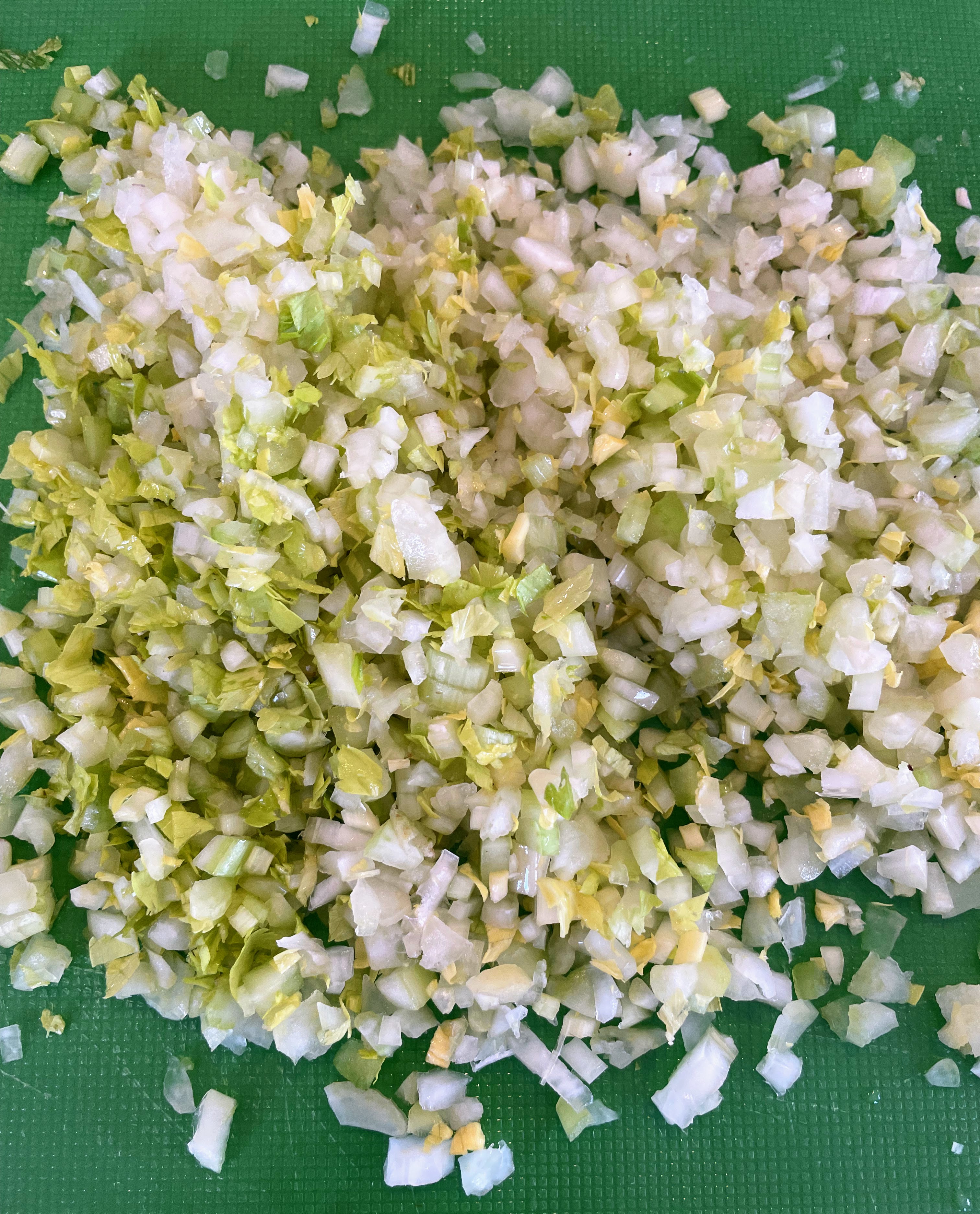
olive oil 1/2 onion, finely diced 1 carrot, grated 4-5 innermost, tenderest stalks of celery (with leaves), finely diced 1 lb (450 gr) ground pork (or other ground meat of choice) 2 garlic cloves, minced 1 tsp. (6 gr) table salt freshly ground pepper 1 egg, lightly beaten 1/3 c. (36 gr) panko breadcrumbs 1/2 c. (110 gr) grated Pecorino Romano (or Parmesan) cheese nice handful of parsley, finely chopped nice handful of basil leaves, finely chopped
About 32-40 oz (940 ml-1.1 liters) marinara sauce (such as Rao’s), or tomato passata (such as Mutti), or any marinara/passata/tomato sauce of your preference
Preparation
1. Cut each zucchini into 3 equal sections, then core each section. Finely dice the cores (the inner parts) and set aside.
2. Drizzle some olive oil into a skillet, and sauté the onion, carrots, and celery/celery leaves until almost soft. Add the diced zucchini innards, and cook until just tender. Place the veggies in a mixing bowl and let cool.
3. Add the remaining filling ingredients and mix well.
4. Pour the marinara sauce or passata into a Dutch oven or pot that is large enough to hold all zucchini pieces upright in a single layer. Start by adding sauce to a depth that is half the length of each zucchini piece. So, if your zucchini pieces are 4 inches/10 cm long, then add about 2 inches/5 cm depth of sauce to the pot. The sauce will rise up as you add the zucchini pieces to it.
5. With clean hands, take a small handful of filling and stuff the filling into the cored zucchini pieces with your fingers (you may need to stuff both ends). If you have extra filling, shape it into mini meatballs.
6. Nestle the stuffed zucchini pieces (and any meatballs) into the sauce in the pot. If needed, add more sauce so that it comes close to the tops of the zucchini pieces.
7. Bring to a simmer over high heat, then cover the pot and lower the heat to a simmer. Cook for about 30 minutes or until the zucchini are tender.
8. Serve with extra grated cheese sprinkled on top, if desired. Enjoy!
I remember a teacher in elementary school bringing our class a batch of “Everything But the Kitchen Sink” cookies, which I’d never had before. I didn’t quite understand the name, so the teacher explained that it meant she had put all sorts of things into the cookies, almost everything in her kitchen but the kitchen sink. That day, I tasted a new cookie and learned a new phrase.
For me, Minestrone is an “Everything but the Kitchen Sink” soup. When the leaves start turning colors in the fall — ie, when soup weather is upon us — and I have vegetables to use up, I immediately think “Minestrone.” In Italian, minestra means “soup;” minestrone means “big soup.” And it really is a big soup, full of so many good things.
Of those good things, there is one without which this cannot be Minestrone, in my view: the cheese rinds. We usually have a wedge of Pecorino Romano cheese in the fridge, and as we get to the last of each wedge, I save the rinds. Without some rind, the soup will not taste like Minestrone; the slow-simmered cheese is a huge part of what makes the broth so delicious.
Pecorino Romano rind (black), Parmesan rind (golden yellow). And a Pecorino rind with the black part already trimmed off.
Aside from the rinds and the soffritto ingredients (onion, carrot, celery; see below), I like to add canned tomatoes, zucchini, white beans, and cabbage or spinach or both (or any other leafy green). Plus pancetta when I have it, potatoes if I need to use some up, and small pasta if there is room.
Today this is what I had at hand:
Fridge:
two onion halves (one red, one white)
four stalks of celery
some leftover grated carrots (about 1.5 c.)
zucchini (I had 2, but ended up using only 1 big one)
some shredded cabbage, ie ‘cole slaw’ mix (about 4.5 oz/127 gr)
baby spinach (about 3-4 handfuls)
Some Pecorino Romano and Parmesan ‘heels’ (see photo)
Freezer:
Cubed pancetta (4 o oz/113 gr)
Pantry:
Yukon Gold potatoes (I had 3, but ended up using only 2)
Whole peeled tomatoes
Cannellini beans (2 cans, 15.5 oz/440 gr each, undrained)
Garlic (3 large cloves)
Bay leaves
Vegetable bouillon cubes
Salt and pepper
Perfect–I had everything I needed for Minestrone! I also had mini pasta sea shells, which I’ve used in Minestrone before, but I did not use them this time; by the time I got to the point where I would have added them, there was no more room in the pot! Plus, dry pasta keeps and I had to use up the potatoes. (If you have pasta but no potatoes or just prefer the pasta, add a handful of that instead.)
For me, Minestrone is a soup I make in ‘layers,’ meaning I start with the first ingredients and while they are cooking, I prep the others, adding them to the pot as I go. Today, I started by cooking the pancetta in olive oil in a large Dutch Oven until it got crispy. (If you are vegetarian, omit the pancetta).
While the pancetta was cooking, I diced the onions and celery, then added them–and the already-grated carrots and a couple bay leaves–to the pot along with a splash more olive oil. This mixture of onions, celery, and carrots is what the Italians call soffritto and the French call mirepoix, and it is the foundation of many great soups. When the veggies got soft, I crushed the garlic cloves straight into the pot, added some freshly ground black pepper, and cooked everything for a couple more minutes. This is what I consider to be Layer 1, made up of a few subparts. [I forgot to take a photo of this, however.]
To start building Layer 2, I added some hand-crushed tomatoes and their juices to the soup pot. If I’d had a can of diced tomatoes, I would have used that instead–but necessity is the mother of hand crushing. With a very clean hand, I gently took a whole peeled tomato from the can, and crushed it into the soup pot, repeating until I had crushed all the tomatoes. [Note: If you will also crush the tomatoes by hand, lower your hand as far as possible into the pot, and crush each tomato very slowly. Otherwise, the likelihood of having crushed tomato all over your back stove wall, and yourself, is extremely high–as I’ve learned from experience.]
Successfully hand-crushed tomatoes; all in the pot, none on me
Then I added the cheese rinds (trimmed of the outer, colored parts) and 4 cups of water and let everything simmer while I diced the potatoes. When the potatoes were ready, I added them, the canned cannellini beans with all their liquid, and a vegetable bouillon cube to the pot, along with more freshly ground pepper. This is Layer 2. I let this simmer, partially covered, for about 10 minutes while I prepped the zucchini for Layer 3.
Nestling cheese rinds into the soup
In Layer 3, I added the diced zucchini and the already-shredded cabbage, and continued to simmer the soup until the zucchini and potatoes were both soft. I also checked the seasonings and decided to add another bouillon cube and a little salt. At that point, my Minestrone was essentially done and ready to serve, so I did the very last thing: I put the handfuls of spinach on top and stirred until the spinach was wilted in.
Then I set the soup pot out for everyone to serve themselves (with everyone getting at least one piece of the now-soft cheese rinds–an absolute treat), along with some freshly grated Pecorino Romano to sprinkle on top. Mmmm. So good on a fall day.
I’m a fairly equal-opportunity eater; I’m happy with all kinds of food, even airplane food. Yes, I admit it: I actually look forward to seeing what’s on the menu when I’m flying. But I absolutely cannot eat airplane pasta. It is always too soft, and I have been conditioned (spoiled?) to need a bit of “bite” to my pasta.
Luckily, today I’m writing about a pasta dish I would gladly eat many times over: Ragù Bolognese. I’ve been making some form of this since college, and have even provided a quick(er) version of it on this blog, more suited to a weeknight meal. But now I want to point you to a more traditional/authentic recipe that is my go-to for fall and winter weekends when I have more time. It is from the Washington Post, whose author tested six well-known ragu bolognese recipes before settling on a new version combining the best elements of her favorite three recipes. I am so glad she did all that testing, because since I read the article in the Post two years ago, I stopped searching for the perfect ragù myself; for me, this one is it.
The first time I made it, I also decided to make the pasta to go with it. It was the dead of winter, we were fairly snowbound, and I had not used my pasta-making equipment in a while, so I decided to go for it, using a New York Timesrecipe for the pasta dough (see below, including the notes). But then I returned to my lazy ways the other times I’ve made this ragù and used store-bought pasta instead, which did not fill me with quite the same sense of satisfaction, but allowed me to focus on other tasks. If you do have the time and inclination to make your own pasta, then definitely try it. You will be proud of your accomplishment.
Notes: 1) The ragù recipe takes about five hours to make–though most of that time is slow simmering time. You don’t need to be actively engaged for those five hours, but you will need to tend to the ragù every so often. If you are making the pasta yourself, you can also do that during the ragù cooking time. 2) I found it is best to weigh the vegetables for the ragù, as that is most accurate; a medium onion or celery stalk can mean different things to different people. 3) The ragù is delicious the next day, too, so you can make it ahead. I also try to freeze some each time, to use for future lasagna fillings.
4 oz (113 gr) cubed pancetta 3 large garlic cloves 6 tbsp (85 gr) unsalted butter, divided 1 medium onion (8-9 oz/226-255 gr), very finely chopped 1 medium carrot (4-5 oz/113-141 gr), grated 2 medium celery stalks with tender leaves, if any (about 3 oz/85 gr), very finely chopped 1 lb (454 gr) ground beef, 80% lean, 20% fat 1 lb (454 gr) ground pork 3 cups (710 ml) chicken broth 1 cup (237 ml) dry white wine, such as pinot grigio 1 teaspoon (3 gr) kosher salt 1 pinch grated nutmeg 1 cup (237 ml) whole milk 2 tablespoons (32 gr) tomato paste 1 cup (237 ml) tomato puree/passata (such as Pomi or Mutti) Freshly ground black pepper
Preparation: 1. In a mini food processor, combine the pancetta and garlic, pulse a few times to break up the pieces, then process until it becomes a smooth paste.
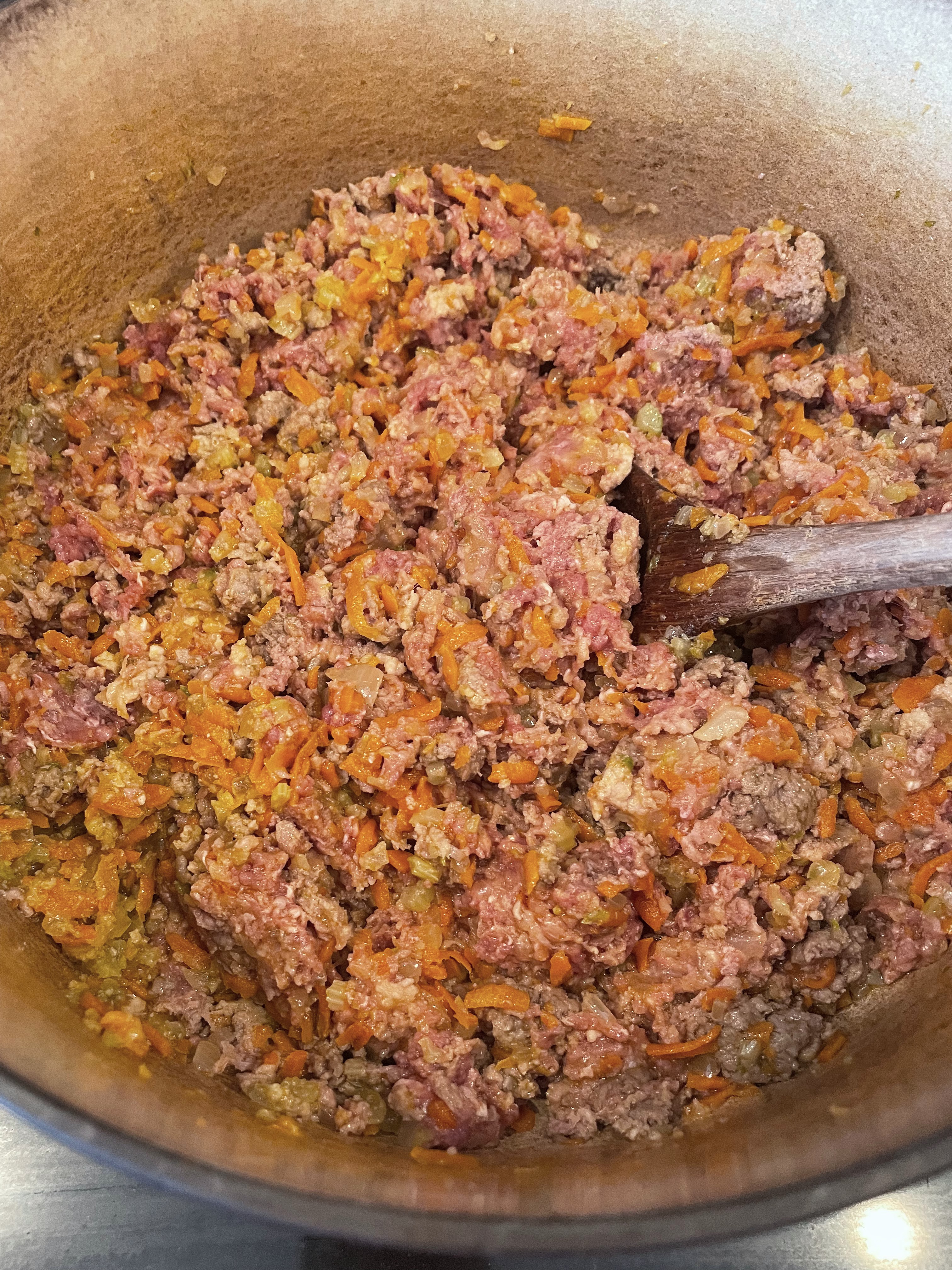
2. Scrape the paste into a large, wide Dutch oven or other heavy-bottomed pot, along with 2 tablespoons of the butter. Melt them together over medium heat, spreading the paste around with a wooden spoon so the pancetta fat begins to render. Cook until the fat is mostly rendered, about 4 minutes, stirring occasionally. Add the onion, carrot and celery — the soffritto — and cook slowly over medium-low heat, stirring frequently enough so the soffritto doesn’t brown — until the onion is soft, translucent and pale gold, about 15 minutes. 3. Add the ground beef and pork to the pot, increase the heat to medium, and break up the meat with a wooden spoon as much as possible. Once the meat starts to faintly sizzle, reduce the heat to medium-low. Let the meat brown slowly, stirring occasionally and continuing to break up any remaining clumps, for about 1 hour, until evenly browned and burnished.
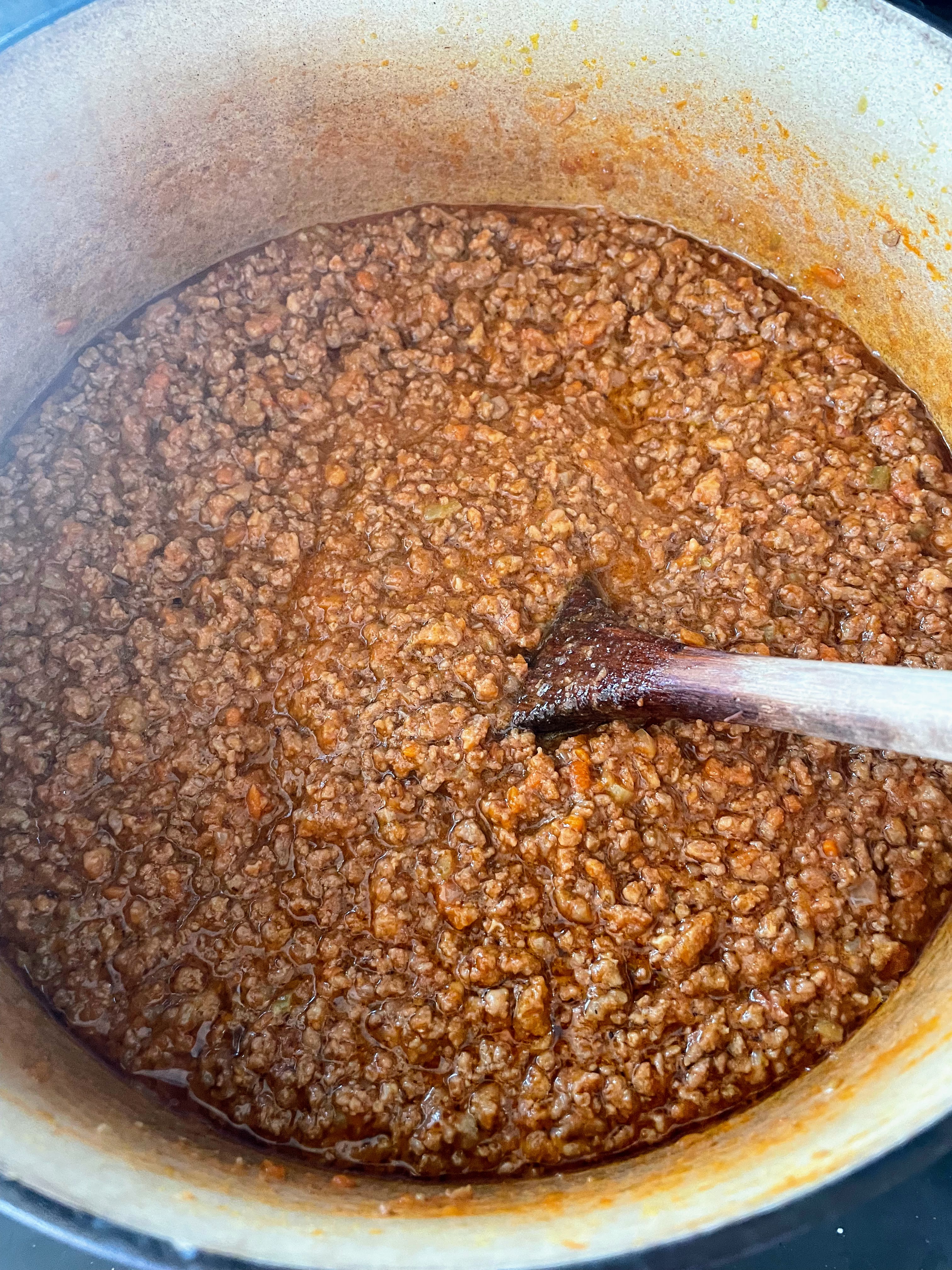
4. When the meat is nearly done browning, in a medium saucepan over high heat (or in the microwave), heat the broth until simmering; cover and keep hot over low heat until ready to use. Increase the heat under the browned meat to medium-high and stir in the wine, scraping up any browned bits or deposits on the bottom of the pan. Cook and stir until the wine is mostly soaked in and evaporated, about 3 minutes. Stir in the salt and nutmeg, reduce the heat to medium-low and add the milk, cooking and stirring until it is barely visible, about 3 minutes. 5. Measure 2 cups of the hot broth and dissolve the tomato paste in it. Stir the broth with paste into the meat sauce, then stir in the tomato puree. (Keep the unused broth handy in the pot in case you need to reheat it and add more to the sauce later.) Partially cover the pot and let the sauce simmer slowly and gently, stirring occasionally, until it is thick and all the components begin to melt together, about 2 hours.
Left: Earlier in the simmering phase. Right: Later, as sauce has thickened more.
6. Stir the sauce — if it looks at all dry, reheat the remaining broth, ladle in a little more, about 1/2 cup, and stir. Continue to simmer gently, uncovered, stirring occasionally and adding a little more broth or water as needed to keep the sauce sumptuously saucy, until the vegetables have completely melted into the sauce, about 1 hour. 7. Cut the remaining 4 tablespoons of butter into a few pieces and stir them into the sauce; add about 20 grinds of black pepper and stir that in, too. Taste, and season with more salt and/or pepper, if desired.
Note from NYT: “Using the “00” flour gives the silkiest, softest pasta while bread flour will give you more of a satisfying chew, and all-purpose lands you squarely in the middle.” Note from me: I made this first with “00” flour, and it was delicious, but as you now know, I need more “bite” to my pasta. So I prefer to make it with bread flour if I have it, or all-purpose otherwise.
2 1/4 cups (290 gr) all-purpose flour, bread flour, or “00” flour, more as needed 1 tsp (3 gr) kosher salt 2 whole large eggs 3 egg yolks 1 tbsp (15 ml) extra-virgin olive oil, more as needed
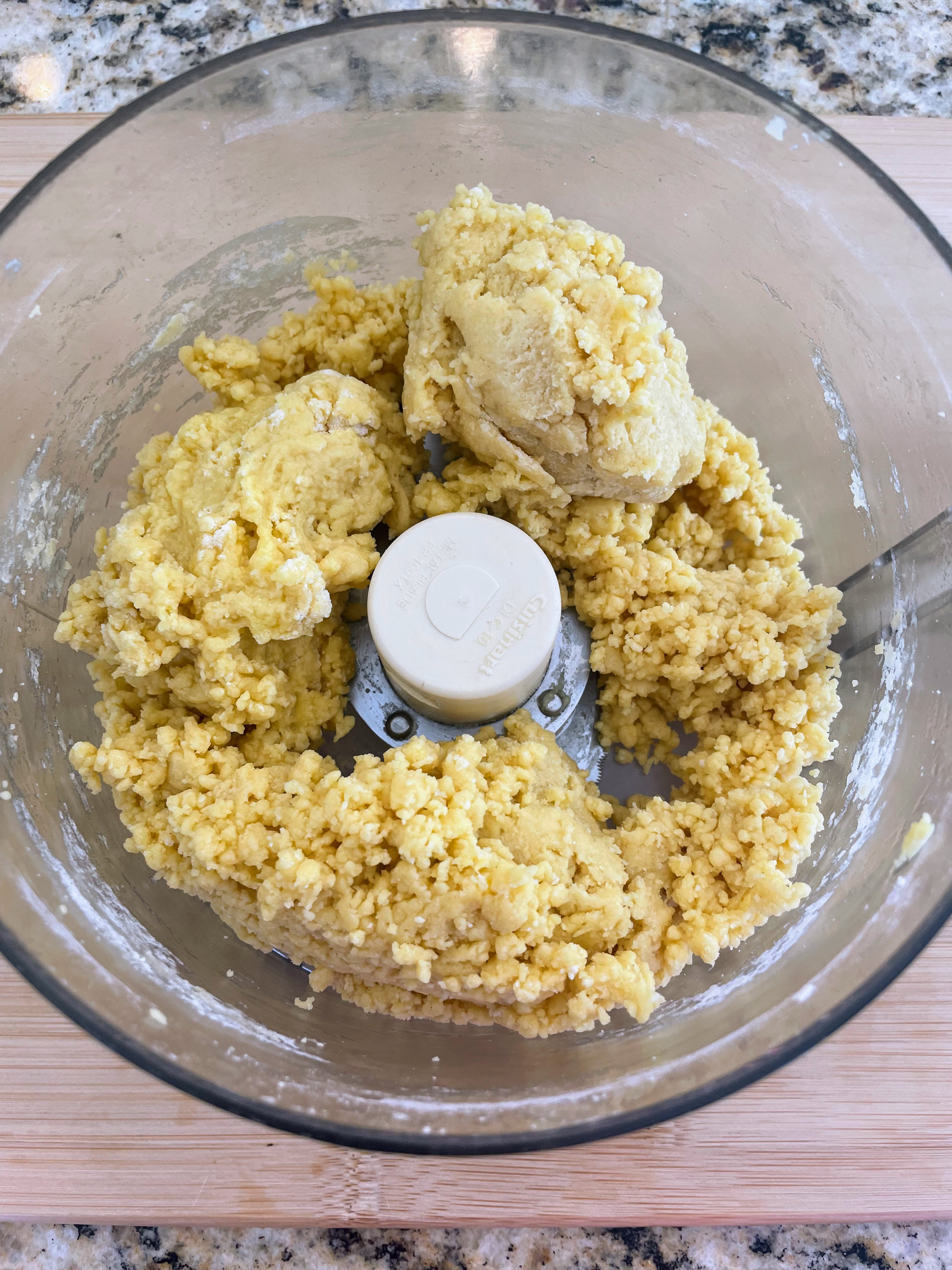
Preparation: 1. In a food processor, pulse together flour and salt. Add eggs, yolks, and oil and run the machine until the dough holds together. If dough looks dry, add another teaspoon olive oil. If dough looks wet, add a little flour until dough is tacky and elastic.
2. Dump dough onto a work surface and knead briefly until very smooth. Wrap in plastic and rest at room temperature for 2 hours or in the fridge overnight.
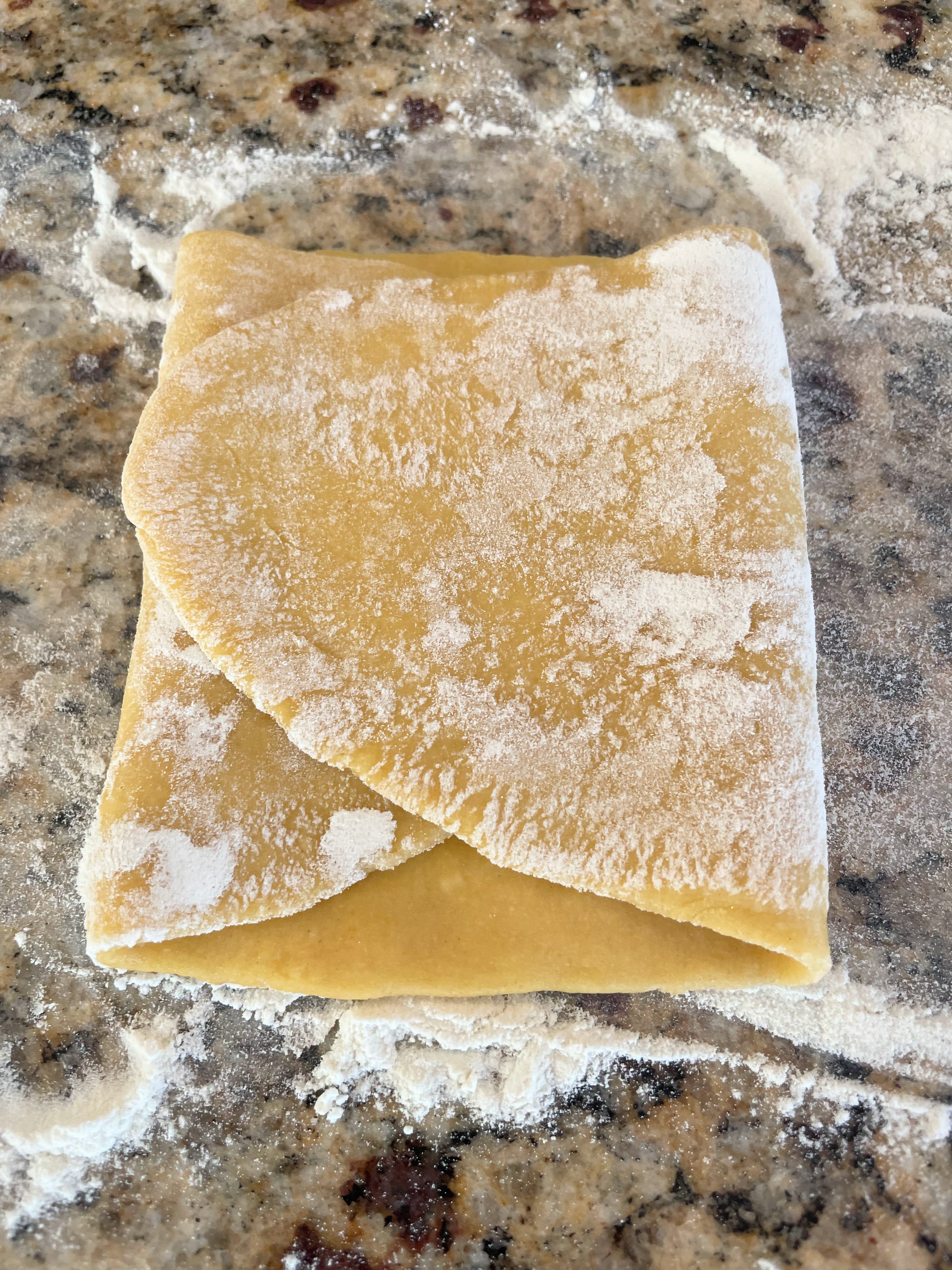
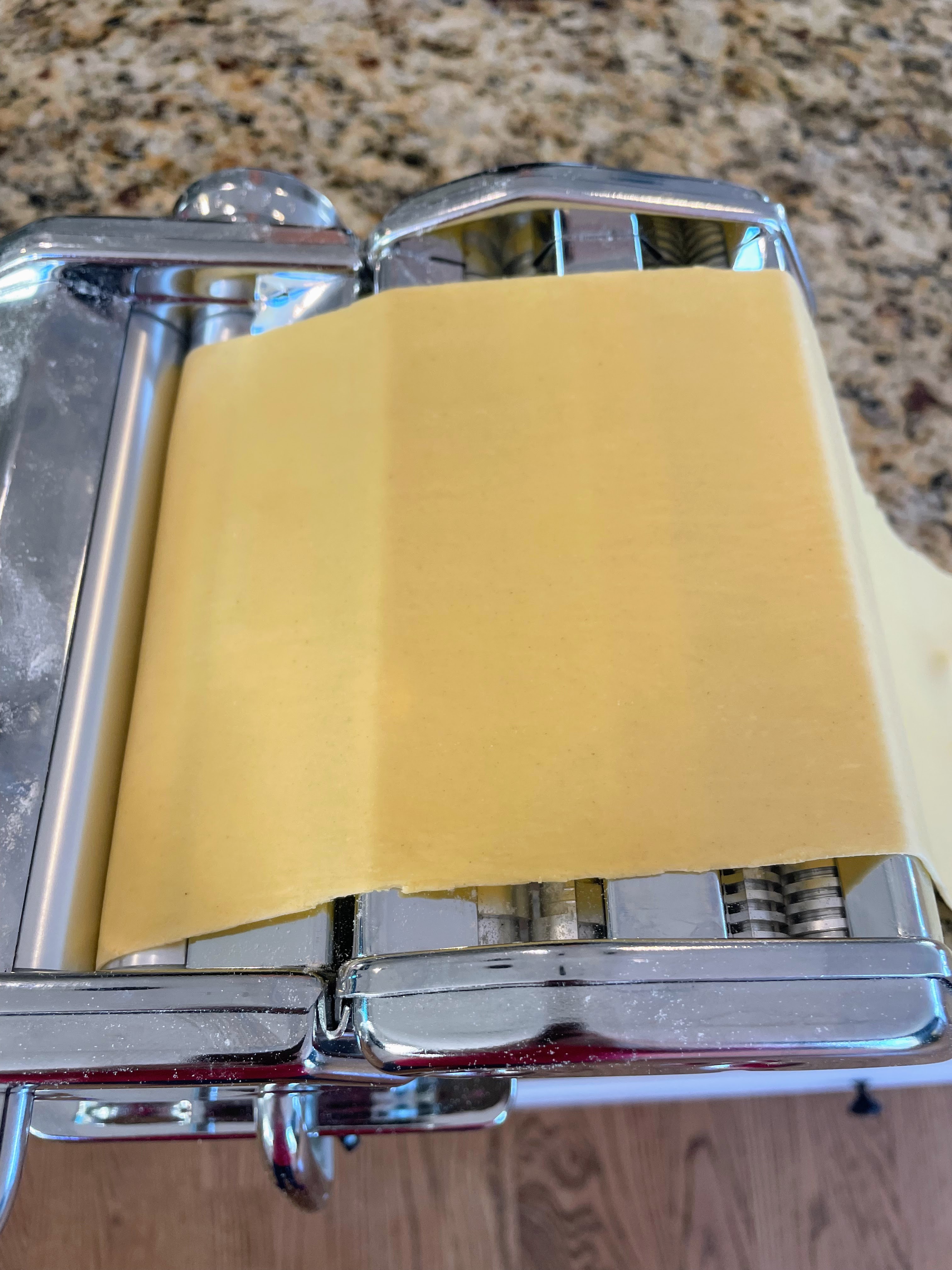
3. Cut the dough into 4 pieces, keeping them covered with plastic wrap or a dish towel when not in use. (If you’re rolling the dough out by hand, rather than using a pasta machine, cut it into 2 pieces instead.) Using a pasta roller set to the thickest (widest) setting, roll one piece of dough out into a sheet. Fold the sheet in thirds like a letter and pass it through the machine 2 more times on the same setting.
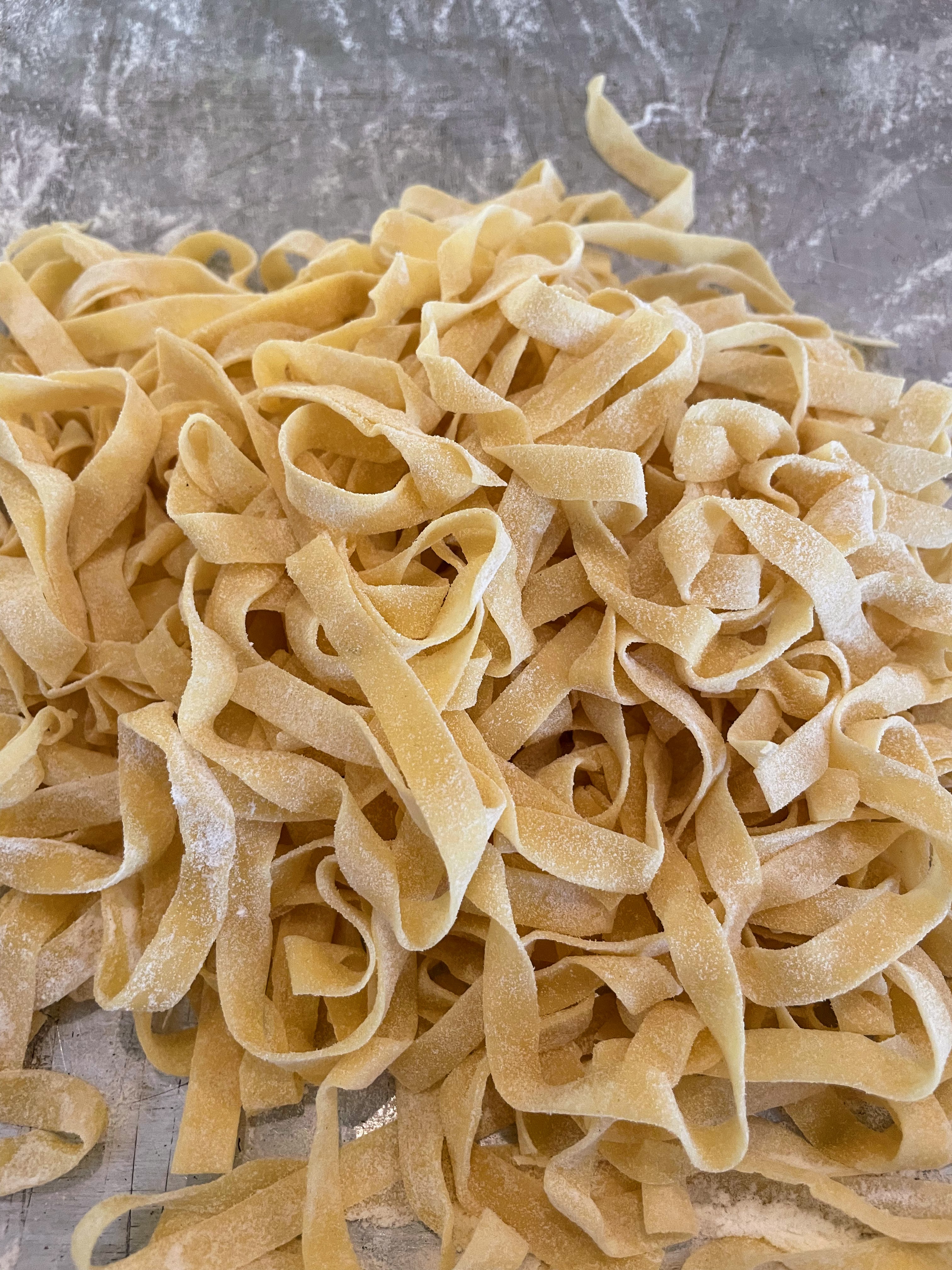
4. Reduce the setting, and repeat rolling, passing it through the machine 2 or 3 times before going to the next setting. For pappardelle and fettuccine, stop rolling after the dough has gone through setting #6. 5. Shape the pasta. For pappardelle, cut rolled pasta into 1-inch-wide strips. For fettuccine, run the rolled sheets through the fettuccine setting on your roller. Place cut pasta on a flour-dusted sheet tray and cover with a dish towel while rolling and cutting the remaining dough. Make sure to sprinkle flour over the cut pasta before you place another layer on top. If not using immediately, cover the sheet pan with a dish towel to keep the dough supple.
6. Bring a large pot of well-salted water to a boil, add fresh pasta and boil for 60-90 seconds, depending on thickness of the pasta. Drain well.
After our visit to Sora Margherita, I found I could not get the broccoletti ripassati out of my mind. Soft, delicately sweet and nutty, redolent of roasted garlic and chilies, it was a perfect wintery comfort food, and I wanted to replicate it at home.
So last week I went in search of a nice Broccolo Romanesco. It is in the Brassica oleracea family, along with broccoli, Brussels sprouts, cabbage, cauliflower, collard greens, and kale. Not to be confused with regular broccoli (Brassica oleracea Italica Group), Romanesco broccoli (Brassica oleracea Botrytis Group) is bright green and pointy and has been grown in Italy for centuries. It is most closely related to cauliflower and tastes a bit like it–though it is richer and more tender. And while it is sometimes labelled “broccoflower,” it should not be confused with the other, more common “broccoflower” that looks just like a green cauliflower. By now, I’m sure you are confused…. But rest assured, if you see a swirly, pointy, highly decorative Broccolo Romanesco, you will immediately know it is the one that is not like the others.
And if you do see one, grab it, take it home, and make some Broccoletti Ripassati; you won’t regret it. You can it eat it as a side dish, on its own (pictured up top as an oh-so-good, next-day lunch eaten with a spoon)–or mixed into pasta with some of the cooking liquid, as is very common in Rome.
Broccoletti Ripassati
1 head Romanesco broccoli
roughly 8 c. chicken or vegetable broth (I used water and chicken bouillon cubes at slightly less than full strength)
1/4 c. olive oil, plus extra as needed
freshly ground black pepper
1/4-1/2 tsp. chili flakes, or to taste
4 medium garlic cloves, minced–plus another 2 cloves, minced (optional)
2 tsp. red wine vinegar
salt & pepper to taste
Preparation
1. Trim the broccoli, cut it in half, cut out the core, and separate each half into florets.
2. Bring the broth to a boil and simmer the florets in the broth until they are soft enough to be pierced with a fork–it should take less than 10 minutes.
3. Drain the florets, reserving 1 c. of the cooking water.
4. Heat the olive oil in a large, heavy skillet over medium-high heat and grind some black pepper over the top. Add the chili flakes, cook for about a minute, then add the 4 cloves of minced garlic. Cook for about 30 seconds while stirring, then add the broccoli and stir to coat it with the garlic.
5. Cook for about 15 minutes, stirring periodically and scraping up any bits from the bottom of the skillet, until parts of the broccoli turn very slightly golden. During the course of this second cooking, the broccoli will begin to disintegrate, which is perfect.
6. If the broccoli gets too dry, add some of the reserved cooking liquid and/or olive oil. You do not want the broccoli to be either too wet or too oily; you want it to be soft, moist, and almost slow roasted.
7. Sprinkle the red wine vinegar over the broccoli and cook until the vinegar has evaporated. Add the remaining 2 cloves of minced garlic, and cook for another 5 minutes (the first batch of garlic contributes to the slow-roasted taste; this batch adds a little extra kick–but it’s optional).
8. Season to taste and serve.
One of the pleasures of being in a new place is tasting local dishes and then trying to figure out how to make them. In Italy, part of the fun lies in consulting butchers, greengrocers, cheese purveyors, wine merchants, and really, any Italian who eats, because they are all happy to offer advice. As soon as the days grew cooler, I knew what I wanted to make: Coda alla Vaccinara (Oxtail Stew) served over rigatoni–an old-style dish appearing on many Roman menus.
In previous times, the slaughterhouse workers of Testaccio (the vacccinari) were given offal and oxtails to pad their slim salaries. Their wives rose to the challenge and created dishes that made the most of the available ingredients. In Coda alla Vaccinara, the oxtails are braised in a sauce made with pancetta, lots of celery, onions, carrots, tomatoes, wine, and spices, though the stew is open to interpretation; everyone I asked prepares the dish in a slightly different way. Some people make it with red wine instead of white, some add water, some forego the carrot, some add raisins. Large pieces of celery are de rigueur, but in a rebellious break from tradition (and knowing I wanted to turn the entire stew into a sauce), I finely diced all the celery and survived to tell the tale.
However, I did not escape looks of shock and dismay on the faces of two Italian friends when I mentioned I had added a pinch of cinnamon to the stew. “Cinnamon? CINNAMON? No. NO.” But I say “Yes.” In addition to cloves, cinnamon very frequently appears in recipes for Coda, which is meant to have a warm-scented, delicately sweet undertone. So here is the resulting recipe, a hearty interpretation perfect for autumn and winter. And following on the advice of Alessandro Volpetti (and I’m happy to take the word of anyone at Volpetti’s), I topped the Coda with grated Ricotta Salata cheese, one of my favorites. But omit the cinnamon if you prefer, top with Parmesan or Pecorino Romano instead–this dish is yours to interpret.
Rigatoni with Oxtail Sauce (con Coda alla Vaccinara)
1-2 tbsp. olive oil
2.2 lb. (1 kg.) oxtails
salt and pepper
4 oz. (about 112 grams) pancetta, cubed
1 large onion, finely chopped
1 large carrot, finely diced (or coarsely grated)
5 stalks celery, finely diced
5 cloves garlic, minced
1 bay leaf
1/8 -1/4 tsp. chili flakes
4 whole cloves (or 1/8 tsp. ground)
¼ tsp. ground cinnamon
1.5 tbsp. tomato paste
1.5 c. white wine
1 large (28 oz./800 grams) can peeled Italian tomatoes
fresh parsley and marjoram (or oregano)
tiny pinch sugar
Preparation
1. Lightly season the oxtail pieces with salt and pepper. Heat the olive oil in a large Dutch oven, then brown the oxtail pieces, turning them on all sides. Remove from the pot and place in a bowl.
2. Add the pancetta to the pot and cook until mostly crispy and the fat has rendered; do not drain the fat. Add the onion, carrot, and celery and cook until soft, deglazing the pot as you go. Sprinkle the onion mixture with more black pepper, add the garlic and bay leaf, and cook for a couple of minutes. Add the chili flakes, cloves, and cinnamon and cook for a minute or two while stirring. Add the tomato paste and the wine. Simmer gently for about 5 minutes to reduce the liquid slightly.
3. With clean hands, take a peeled tomato from the can and crush it into the stew; repeat with all the tomatoes. This is a very satisfying technique—but moderation is key; if you are too enthusiastic, you may end up shooting tomato bits across the kitchen. If you prefer a slightly less visceral experience, you can cut the tomatoes while in the can, or remove them and dice, adding all the tomatoes and all the tomato sauce/juice from the can to the pot.
4. Mix in the pinch of sugar, nestle the oxtail pieces into the vegetable mixture, pour in any liquid from the bowl they were in, sprinkle with more black pepper, and then scatter some of the herbs on top.
5. Cover the pot and simmer on low heat for about 3 hours, or until the meat is very tender when pierced with a fork (it may take longer depending on the oxtails). Remove the oxtails, place on a dish, let cool, then pull off as much meat from the bones as possible (this will require some patience). Return the shredded meat to the sauce; keep warm.
6. Cook the rigatoni according to package instructions until al dente, drain, return to its pot, and then mix in the Coda sauce. Scatter more fresh herbs on top and serve with the grated cheese.





















 Perennial Pastimes