
An Echinacea (Ruby Star), petals just beginning to open–in soft focus.

An Echinacea (Ruby Star), petals just beginning to open–in soft focus.
At this time of year, every day brings some new development in the garden. You take each change into account, bit by bit. But when you are away for an extended time, as I was recently for work, you come back and feel that those changes occurred far too quickly–how did that peony bloom in such a short time? Where did that red-hot poker come from?
All this was driven home to me yesterday, when my youngest son graduated from high school. How did that happen so quickly? Now, like his two brothers before him, he will follow his own path, and we will no longer see those day-to-day changes. But we will continue to admire the growth and the blooming. Luckily, our daughter is still at home for one more year. And the garden will remain, though it, too, undergoes constant and rapid metamorphoses.
Before I left for my two-week trip, the brand-new peonies I had planted were only in bud; when I returned, the blooms were already spent. I never did see what the full flowers looked like–I will have to save that treat for next year.
Peony (Kansas)


The new roses I had planted last month were also just beginning to bud, but since they bloom for months, I was able to see the flowers when I got back.
Hybrid Tea Rose (Love and Peace)


And finally, I caught the Red Hot Pokers just in time; now, their color is fading and the flower spikes are drying up. Here is one seen from above and in full bloom.
Red Hot Poker (Flamenco)


One of the joys of spring is seeing the transformation from bud to bloom. Last year, I planted two tree azaleas (they are more upright than bushy) just after peak blooming time and so caught only a brief glimpse of the sole remaining flower on one of the plants. Azalea ‘Gibraltar’ is a deep orange color, but I was not able to appreciate it in all its glory — though I had high hopes for Spring 2013.
But as summer progressed, the azaleas’ foliage turned brown and shriveled up. It was clear I had planted them where it was too sunny, and they were not at all happy. In fact, they were dying. So we took emergency measures and dug them out, relocating them into large whisky barrels in a shadier part of the garden. And then there was nothing to do but wait and hope they survived the experience.
Luckily, they did; here are some photos showing the birth of a glorious, ruffled, orange Azalea ‘Gibraltar’ bloom.


I have a thing for the color orange, and I especially love how it combines with blue. So when I had to decide where to put this potted Wallflower (Apricot Twist), there was no question: it had to be on the porch, against the blue wall of our house. And then I stepped back and let the magic happen.


Once upon a time, tulips were the most expensive flower in the world, the basis for a speculative bubble in the 1600s that later burst. Lucky for those of us who like tulips, we no longer have to fork over a small fortune to own just a single bulb; today, mere mortals can now choose from thousands of varieties. And while tulips are associated with the Dutch, the flower actually originated in Central Asia — the Ottomans were the first to cultivate it commercially.

The photos above are from a recent stroll around my neighborhood (which is, alas, not in the Netherlands or Turkey). I planted three varieties of tulips when I started my garden a couple of years ago, but now only have one variety left. Those miserable squirrels are tulip-bulb connoisseurs. But I have had the last laugh — the variety they did not manage to steal is my absolute favorite: a flame-colored, graceful, lily-flowering tulip, Tulipa Ballerina. It is aptly named. When I look at the photo below, I can almost see a group of ballerinas, gracefully bending to the right, holding their arms above their heads as they prepare for the next movement.

Fresh from my trip to Italy and with lots to do to get ready for the work week, I decided to prepare a Mediterranean antipasti-tapas-mezze meal made up of little dishes, simple ingredients, and nice bread. These Roasted and Marinated Bell Peppers are part of that meal, and they can be made ahead — they get better the longer they marinate. You can use all red peppers, or any combination of red, yellow, or orange that suits your fancy. In this case, I used one of each color. I forgot the parsley before taking the photo, but will try to remember to sprinkle some on top before serving! With or without parsley, this is a nice addition to any Mediterranean multi-dish meal.
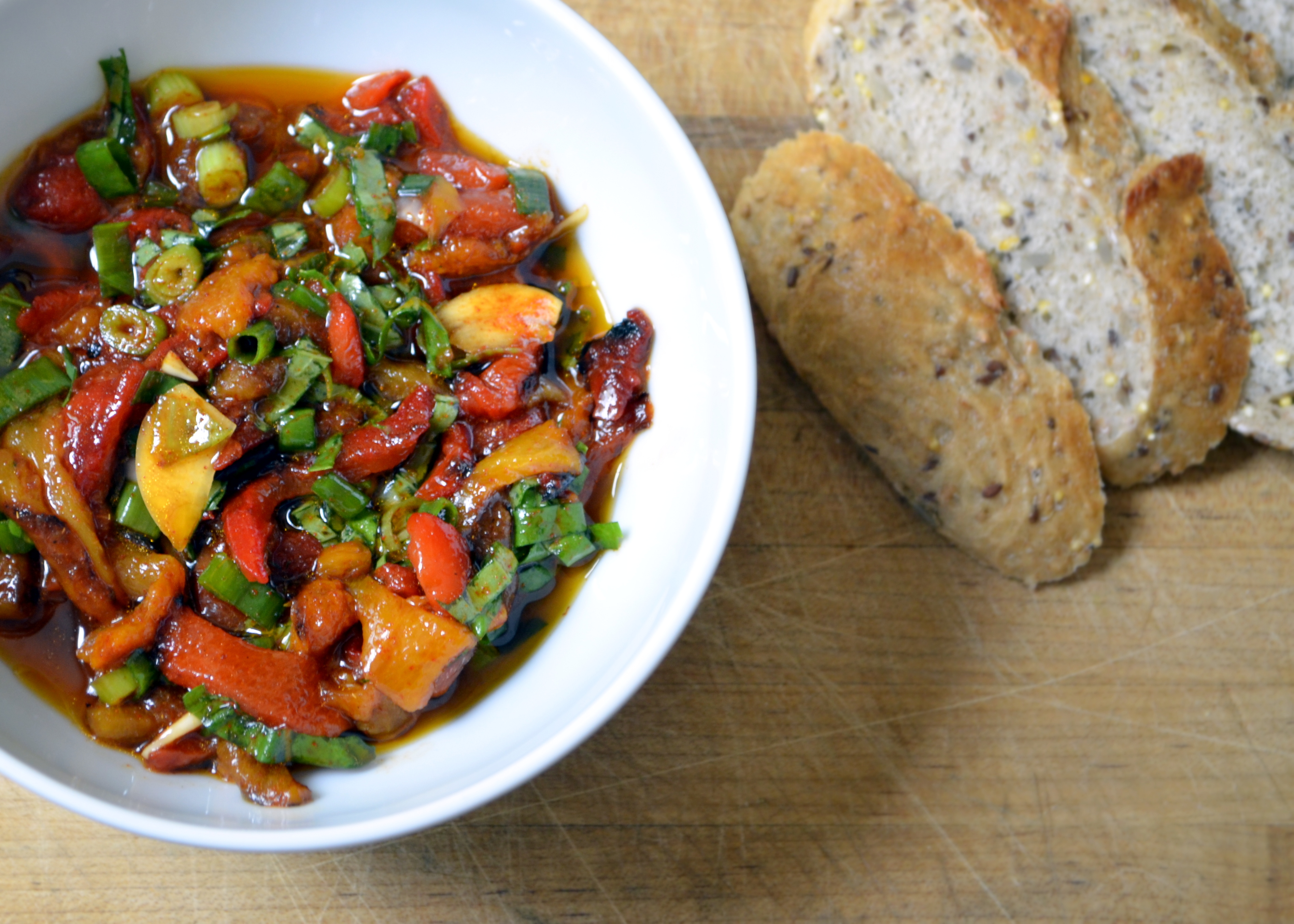
Roasted and Marinated Bell Peppers
3 large red, yellow, or orange (or combination) bell peppers
1/4 c. olive oil
2 tbsp. red wine vinegar
1 clove garlic, finely sliced
1 bay leaf
1 tsp. paprika
1 spring onion, sliced
5-6 leaves fresh basil
2 tsp. coarsely chopped parsley
Preparation
1. Turn on broiler.
2. Cut peppers into quarters; remove all seeds and membrane. Place peppers on baking sheet, skin-side up.

2. Broil until skin blackens, then put peppers into container with lid, cover tightly, and let cool.
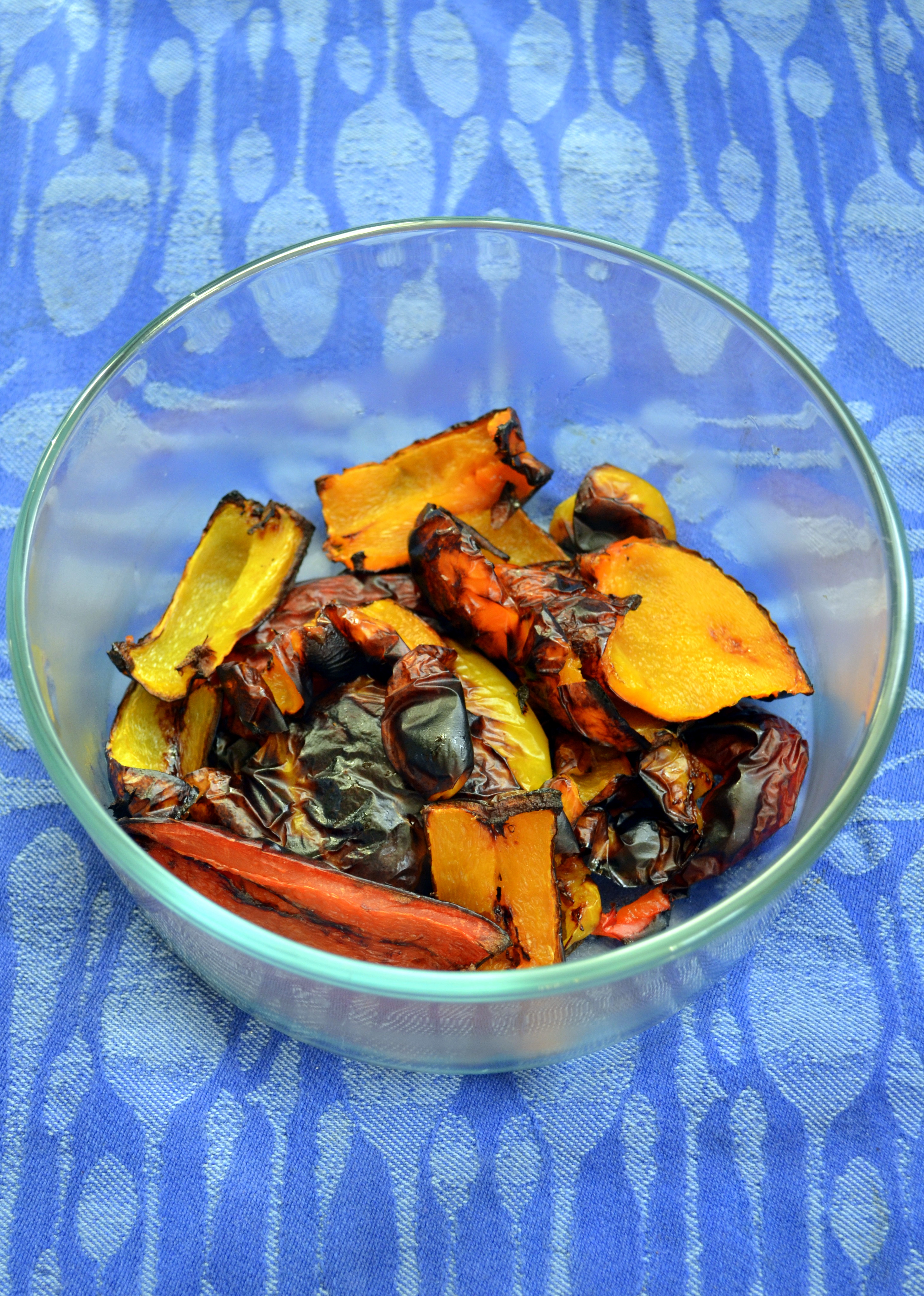
3. When cool, carefully peel the skin off the peppers, and cut peppers diagonally into thin slices.

4. Add the remaining ingredients to the peppers, stir to combine, and marinate for at least 3 hours (or overnight) before serving.
Adapted from the Australian Family Circle Tapas booklet.
Until today, I knew next to nothing about Witch Hazel. I had a vague idea it could be found in a bottle at the pharmacy, but thought of it as something from a bygone era, like cod liver oil. Not that it didn’t have its uses –I just wasn’t sure what those uses were….
But an absolutely glorious day propelled me to nearby Brookside Gardens in Wheaton, Maryland to see what might be of interest there. Turns out, there was a great deal of interest, not the least of which was Witch Hazel (Hamamelis). As I came around a bend I noticed a tree (ok, technically a very large shrub) with the most delicate, spidery looking flowers on it. It was striking not only because it was in bloom, but because the flowers were almost ethereal. I bent to read the sign beneath and learned it was a Witch Hazel, something I had not see before. But once I saw that one, I noticed many others, in different colors, all equally stunning. I immediately experienced garden envy. Or perhaps garden regret–there is only so much I can pack into my own small garden, and Witch Hazel will just have to be admired from afar.
Below are a few photos of a remarkable plant, the extract of which helps control blemishes, soothe burns (including sunburns and razor burns) and cuts and bruises, relieve insect bites and itchy poison ivy/poison oak, and relieve tired eyes. Now that I know this, I will certainly get some extract from the pharmacy in the near future, but for now I will feast my eyes on the lovely Witch Hazel flowers and feel glad that I learned something new today.

‘Diane’

‘Diane’

‘Orange Peel’

‘Moonlight’
I love how flowers and foliage — and tree trunks and bark — look after it rains. The colors pop, and any beads of water that linger add nice visual interest. I recently walked around our neighborhood just after a rainy spell, and came across this very colorful, wet tree trunk with speckled bark. I’m not certain what kind of tree it is (any clarification on that is welcome), but the mossy green of the bark that remained on the trunk and the contrasting yellow-orange layer underneath really caught my eye.

Update 3-3-13: I think this may be either a Chinese or Lacebark Elm.
Upon arriving in San Diego just before Christmas, one of the first things I noticed was a profusion of striking Red Hot Pokers in flower; they were everywhere, or so I thought. Upon closer inspection, I realized they weren’t Red Hot Pokers. Or were they? The dark-orange spires I saw everywhere in San Diego were aloes. And the Red Hot Pokers I know and love (and have in my garden) are kniphofias. Both plants are originally from Africa, and the flowers look remarkably similar. But one is a succulent, and the other is not.
When most people talk about Red Hot Pokers, they mean kniphofias, which feature clumps of grass-like leaves. Aloe plants have thick and frequently spiky foliage; you can snap off a piece of aloe vera and apply the soothing gel to burns. But some people refer to both aloes and kniphofias as Red Hot Pokers. And in fact, the genus Kniphofia is very closely related to the genus Aloe.
Here are three photos of aloes in bloom in San Diego in January, plus an inadvertent (and less than ideal) photo taken this past May in my garden of a Red Hot Poker Flamenco — a kniphofia — next to a Foxglove.

Aloe


Aloe Kniphofia (with Foxglove on left)

And an aloe that doesn’t look like a Red Hot Poker: Aloe Saponaria
Ramen noodles don’t frequently appear on our dinner menus, but this salad is the reason my children started eating salmon. With cooked ramen noodles, cabbage, carrots, and cilantro (from the herb garden) in a light orange-honey dressing, it has been a family favorite for years. And since I only make this salad as an accompaniment to the salmon, the kids quickly came to appreciate the whole package. It also helps that the two parts of this meal (adapted from an old Redbook magazine recipe) look so nice together.
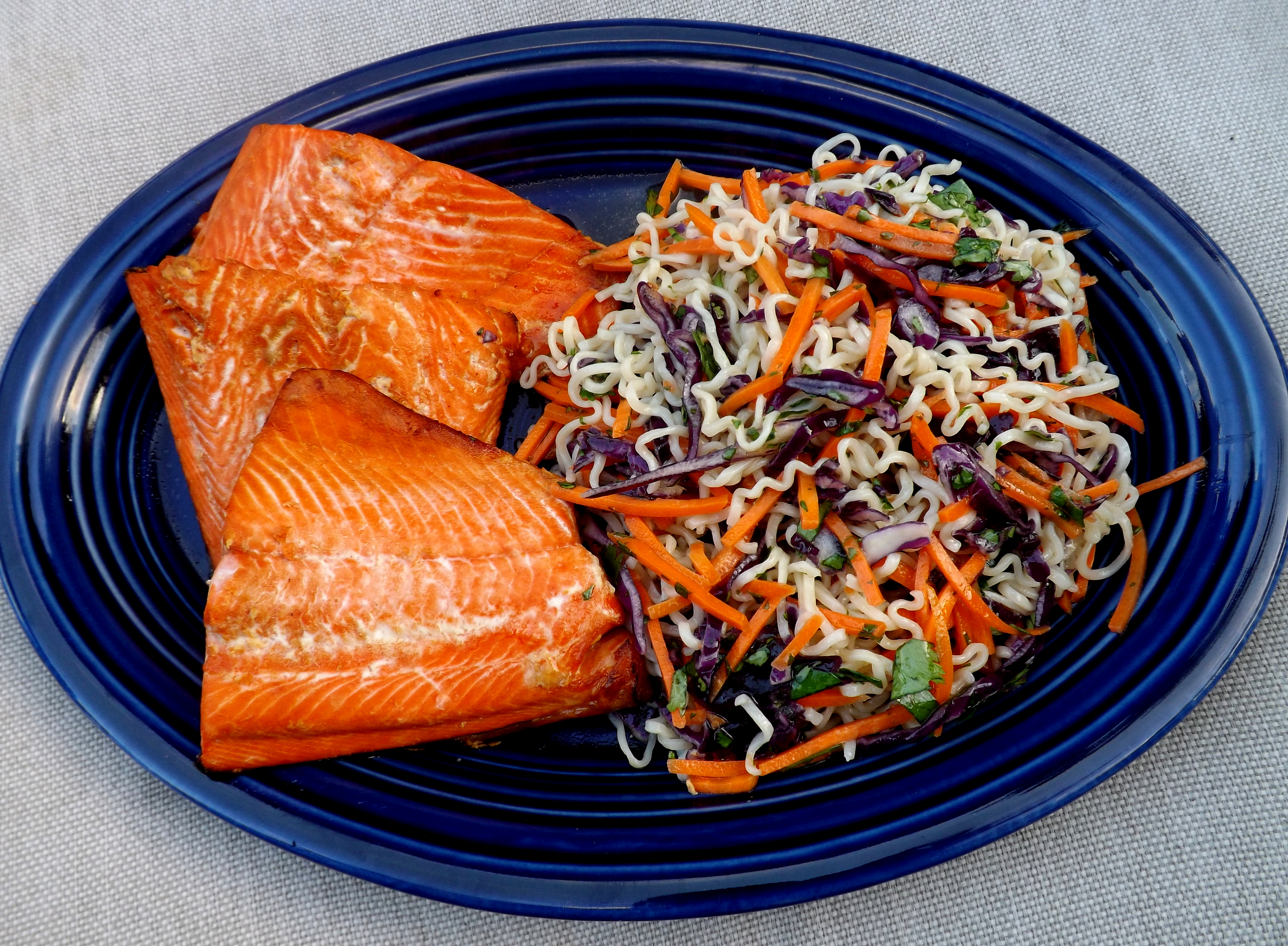
Orange Ginger Salmon with Ramen Cabbage Salad
Serves 5-6
Marinade
1/2 c. soy sauce
1/4 c. orange juice
3 tbsp. honey
1 heaping tsp. ground ginger, or 1.5 tbsp. freshly grated ginger
2 lb. salmon fillets
3 (3-oz.) packages Oriental-flavored ramen noodles, broken into halves
1 (1o-oz.) bag grated carrots (about 4 c.)
1 (1o-oz.) bag shredded red cabbage (about 4 c.)
1/4 c. packed chopped cilantro
Dressing
3/4 c. orange juice
6 tbsp. extra virgin olive oil
1 tbsp. sesame oil
2 seasoning packets from the ramen noodles
Combine marinade ingredients in glass 9×13 baking dish. Place salmon fillets in dish and let marinate while preparing the salad, turning salmon occasionally.
Combine dressing in ingredients in a large salad bowl, mix well, and add carrots and cabbage, tossing to coat. Cook noodles in boiling, unseasoned water for two minutes, drain, and rinse thoroughly with cold water. Shake the colander to remove excess water, set aside to drain further, then add to cabbage mixture and mix well.
Remove salmon from marinade and broil (or grill) about 5 minutes per side, basting with marinade. Place on platter. Just before serving, add cilantro to salad and combine. Serve salmon with salad.


 Perennial Pastimes