Archive | Vegan/Adaptable RSS feed for this section

Recipe: How to Make Bright Green Pesto

5 Oct

The very last of my basil has flowered, so today I headed out and harvested all the remaining good leaves. It took a while, but the sun was warm on my back, the bees were buzzing gently by, and the smell of the basil as I plucked each leaf one by one, was intoxicating. There are worse ways to spend part of an October morning.

My aim? To make a few batches of pesto to freeze. But the end result looked (and smelled) so good, I couldn’t wait; I decided to use one batch tonight. It will get drizzled over a Sausage, Kale and Bean soup, the thought of which is already making me hungry!

This recipe calls for blanching the basil, which I find is a key way to get the greenest color. Today, I used another trick, too: I added a handful of baby spinach leaves that needed using up as spinach also amplifies the emerald factor. The addition of a few drops of lemon juice makes the pesto a bit brighter, too; I almost feel like it makes the pesto taste greener (is that possible?).

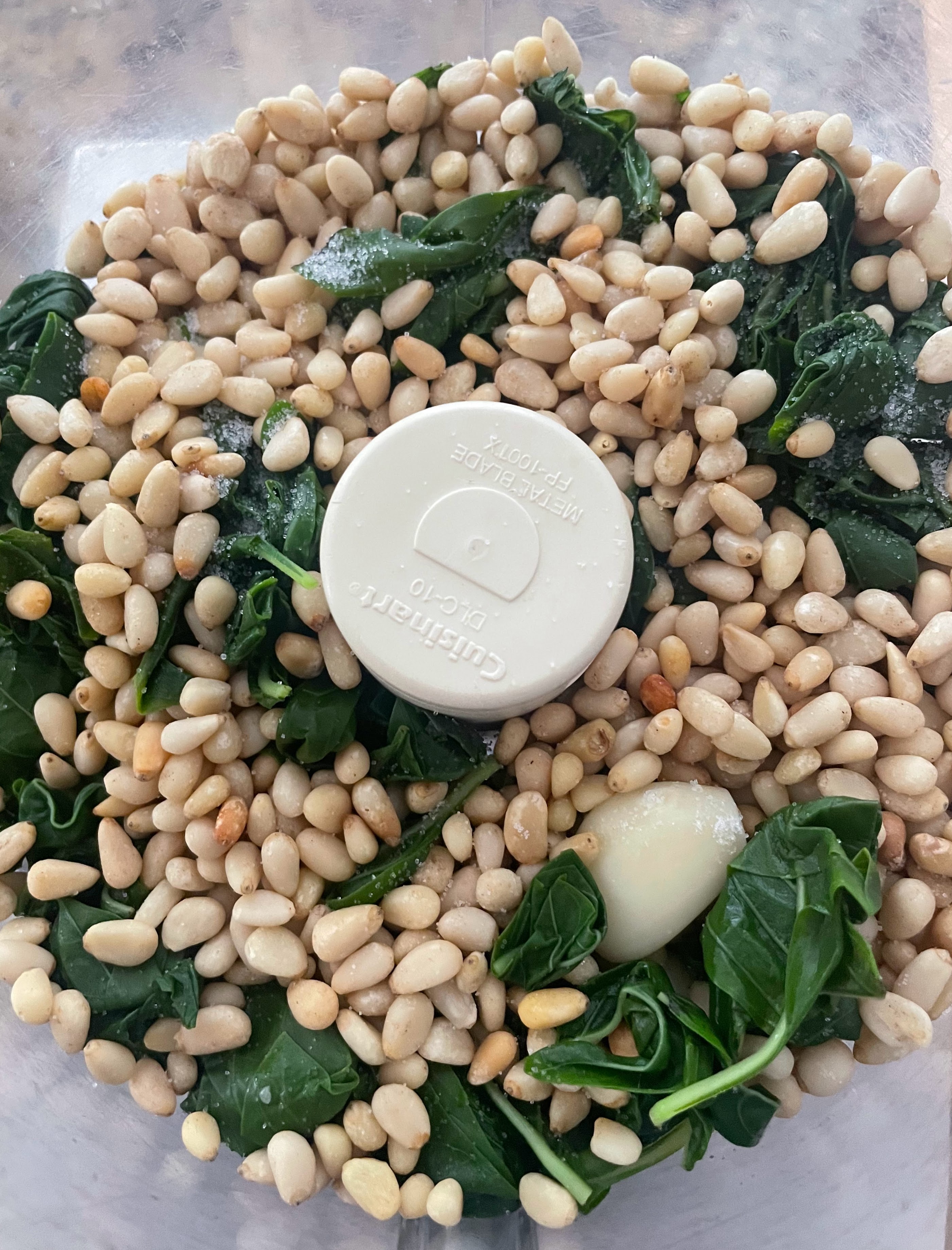
Note: When I am making pesto to freeze, I do not add the cheese or lemon juice. Instead, I add both those things later on to the thawed pesto. So the photos below are pre-cheese, and thus, represent a vegan version that would be delicious on its own, too.

Bright Green Pesto
(makes 2 cups total = 3 batches)

6 c. (slightly compressed but not packed) fresh basil leaves (about 120 gr.); can substitute up to 1 c. baby spinach leaves
3/4 c. toasted pine nuts
6 large garlic cloves
1/2 tsp. salt
1 c. extra-virgin olive oil
*1.5 c. freshly grated Pecorino Romano cheese (preferred) or Parmesan
*lemon juice, to taste

Preparation

1. Set a large pot of water to boil.
2. Pick over the basil leaves to make sure there are no blemishes (or stems). Fill a large bowl with ice water and set aside. When the water in the pot is boiling, add the basil and garlic, and push down on the basil leaves with a slotted spoon (to submerge them), just until they turn bright green. This blanching process should take less than a minute.

3. Immediately drain the basil and garlic in a colander, and then set the colander in the bowl of ice water to stop the cooking.
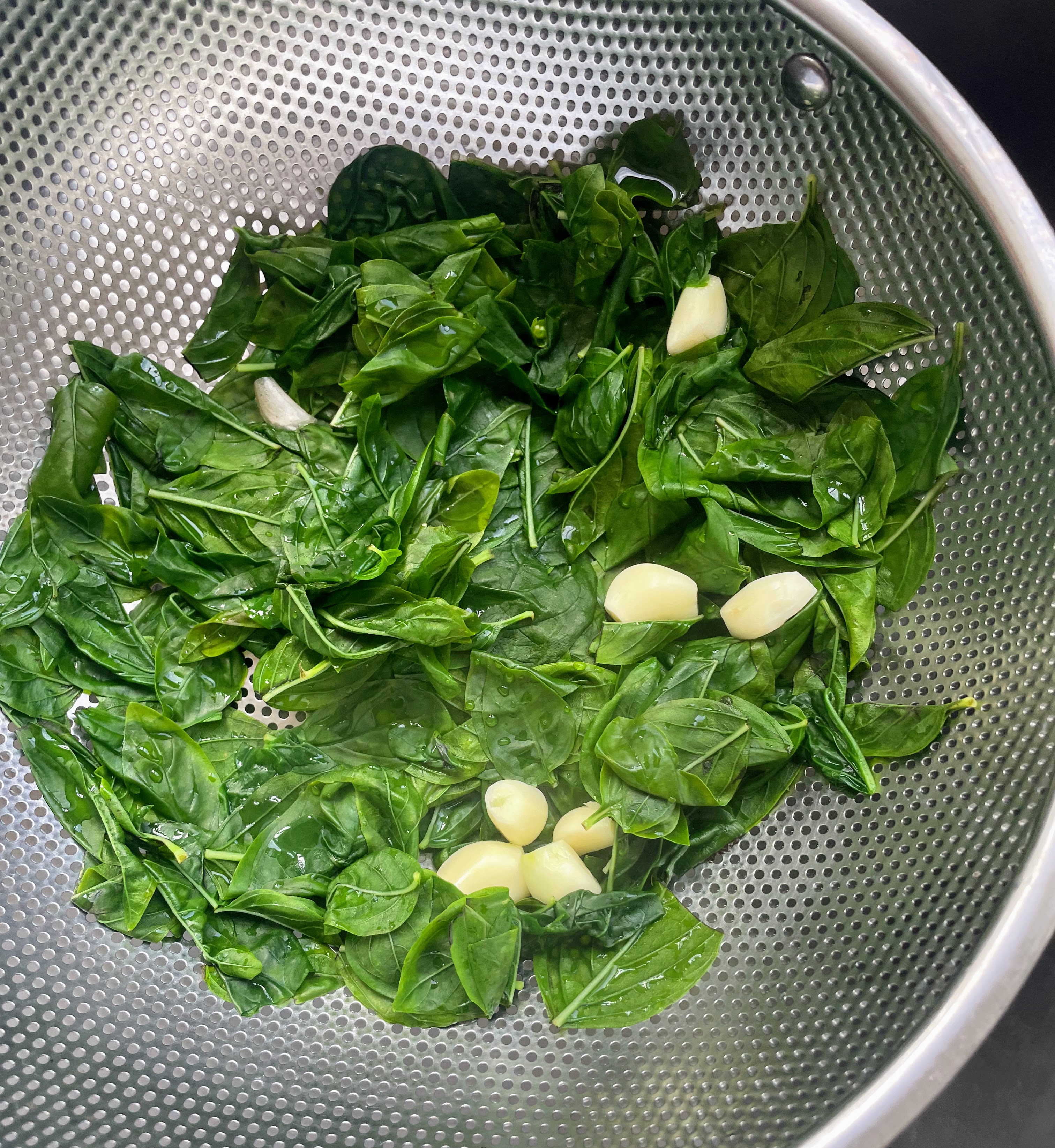
4. Once the spinach is cold, remove the colander from the bowl, set in the sink, and let the basil and garlic drain for a few minutes. Then place the basil and garlic on a clean dish towel and pat as dry as possible.

5. Put the basil and garlic in a food processor, add the pine nuts and salt, and pulse until the mixture is finely chopped and begins to come together. With the food processor still running, slowly pour in the olive oil and process until smooth.
6. If using the pesto the same day, add the cheese and lemon juice, and pulse again very briefly, just long enough to combine. Do a quick taste test to gauge lemon and salt levels; add more if needed. You can also add a bit more olive oil if the pesto seems too thick.
*7. If freezing the pesto, omit the cheese and lemon juice, divide the pesto among three freezer-proof containers, and freeze. When you want to use a batch, thaw it fully and let it come to room temperature. Prior to using, add 1/2 cup grated cheese and a few drops of lemon juice, and mix well. Do a quick taste test to gauge lemon and salt levels; add more if needed. You can also add a bit more olive oil if the pesto seems too thick.

Recipe: Zucchini Carpaccio

26 Jun

This refreshing, no-cook zucchini recipe (which I very slightly adapted from the New York Times) is just the thing when it’s hot outside, you have zucchini to use up, and you’d like to make an impression. It’s an unusual recipe in that the thinly-sliced zucchini is raw, though nicely marinated and softened in lemon juice (a bit like what happens with ceviche). Definitely worth a try.

Ingredients:
2 medium zucchini
salt
2 garlic cloves, thinly sliced
freshly squeezed juice of 1/2 lemon (or more, as needed)
2-3 tbsp. of the best olive oil you have
2 tbsp. toasted pine nuts
torn or chopped fresh mint, to taste
Optional: 1 tbsp. Parmesan (or Pecorino Romano) shavings, 1 tablespoon currants, 1 tsp. honey, and/or freshly ground black pepper

Directions:
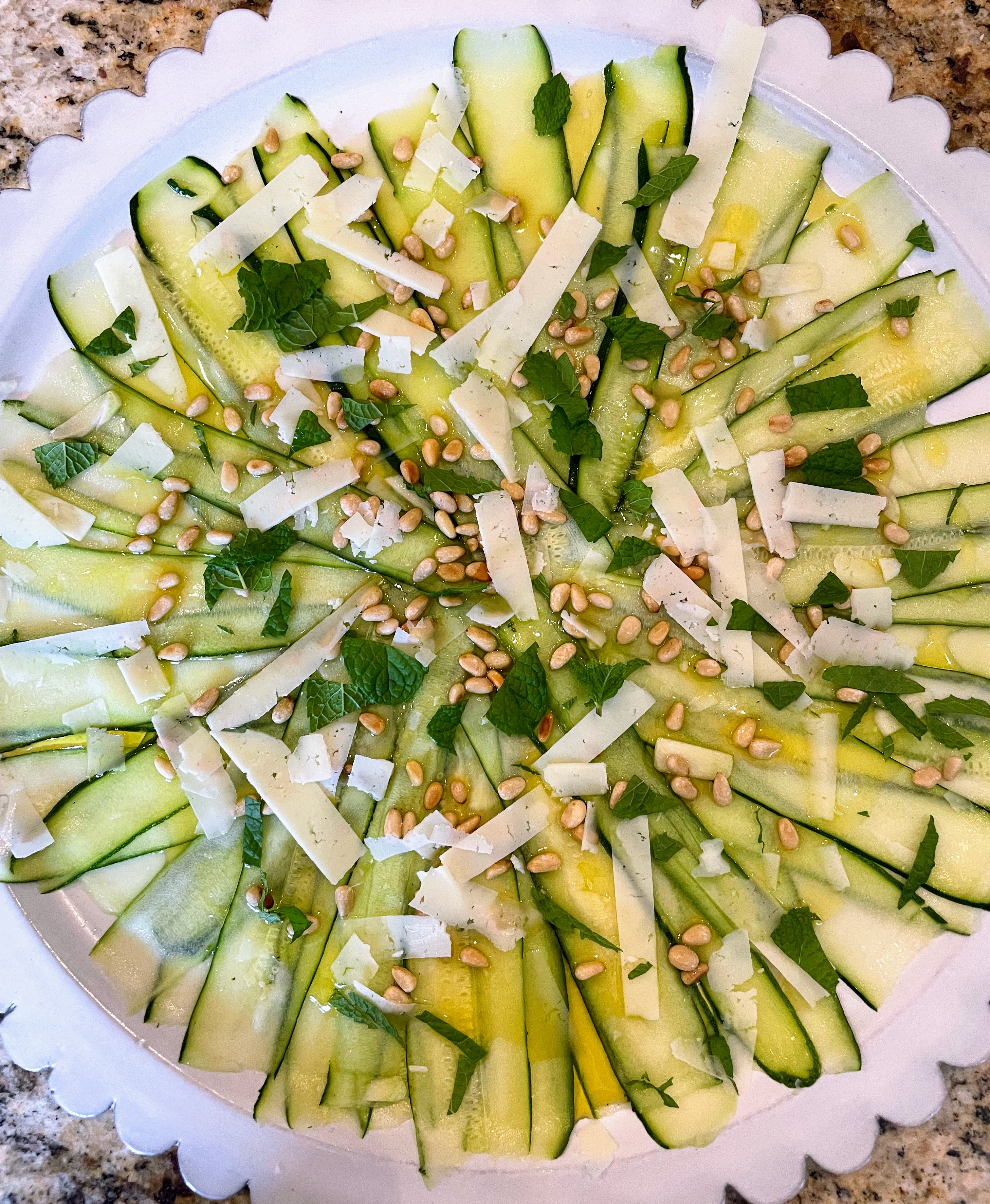
1. Slice zucchini lengthwise with a mandoline or chef’s knife as thinly as you can, and sprinkle lightly with salt. Place in a colander for 30 minutes to remove the excess moisture, tossing occasionally.
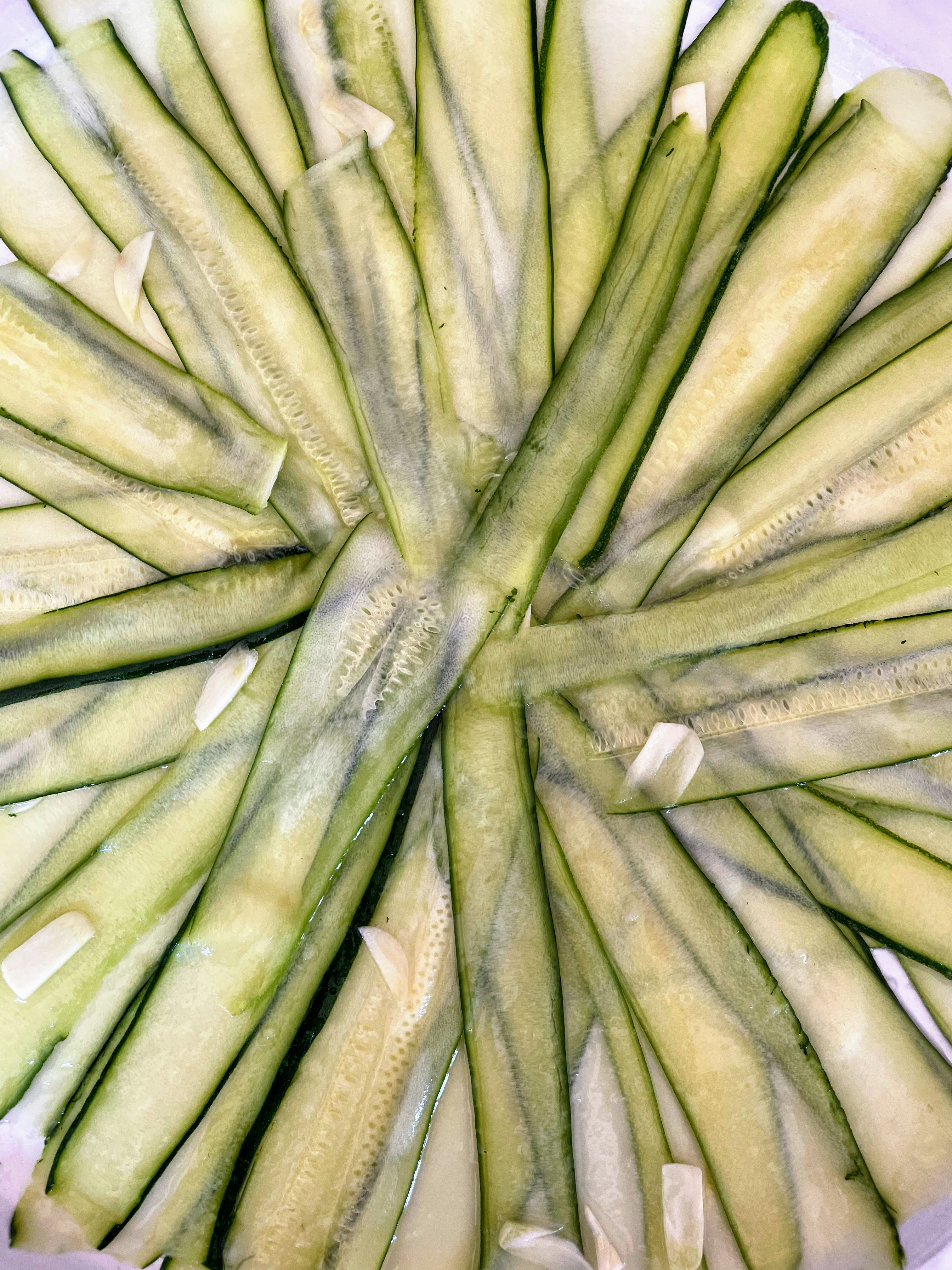
2. Dry the zucchini on paper towels and arrange the slices in layers on a shallow platter or serving dish, adding slices of garlic between the layers, and drizzling each layer with some of the lemon juice (if you run out, squeeze some juice from the other half of the lemon).

3. Marinate, refrigerated, for at least 15 minutes and up to 1 hour.
4. Drizzle olive oil over and top with pine nuts and mint (and any of the optional ingredients, if using).

Recipe: Baba Ghanoush

30 Sep

Years ago, I learned to make some Lebanese dishes from watching (and helping) college friends cook a few classics, but my main teacher was a cookbook called Lebanese Cuisine by Madelain Farah. The version I have is from 1979, meaning it predates the internet. (And no, I wasn’t in college in 1979; I bought the cookbook some years later). Despite there being so many delicious Lebanese recipes now available online, I still find myself going back to this well-loved, well-spattered, paperback cookbook for some of my favorites. It has accompanied me on many moves and is now held together with tape.

Ms. Farah was a straightforward recipe writer; no coddling of the reader for her. In her recipe for Baba Ghanoush (which she calls Baba Ghannuj, as there are many ways to spell it), the first instruction is written this way: “Eggplant may be baked or grilled over a flame until well done.” There’s a lot of room for interpretation in those instructions…. Ms Farah was also a proponent of mashing the ingredients, either with a potato masher or a wooden mallet. I now use a food processor, which may be anathema in some quarters, but it produces a silky smooth dip.

So, this recipe takes its inspiration from Madelain Farah’s, with a few twists: I added smoked paprika and cumin, which play on the smokiness of the eggplant and really help bring out its flavor. And I use a faster blending technique.

Baba Ghanoush

Ingredients:
2 medium eggplants (2 lb/900 gr total). Note: Ms Farah called for one large eggplant, but the larger the eggplant, the more seeds there are, so I prefer using two smaller ones. (Since I grow eggplant in my garden each summer, I can pick them at just the right size!).
olive oil

2 cloves of garlic, minced (we like garlic in our house; you can use 1 clove as the recipe originally called for)
1/4 c. (60 gr.) tahini
1/4 c. (60 ml.) lemon juice, or more to taste
1/4 tsp. smoked paprika
1/4 tsp. cumin
1/2 tsp. salt, to taste
1 tbsp. (15 ml.) water (optional)

To garnish:
–chopped fresh flat-leaf parsley
–smoked paprika and cumin (or, substitute the paprika and cumin with sumac, which is a more traditional topping and one Ms. Farah suggested; both options taste great)
–olive oil

Preparation:

Cooking method #1: Preheat the oven to 450 degrees F (230 degrees C). Cut the eggplant(s) in half lengthwise, and brush a generous amount of olive oil on the cut sides. Place the cut sides down on a large baking sheet (use a rimmed one as the eggplant will get juicy). Bake for about 30-45 minutes until the eggplant is dark golden brown and very, very soft.

Cooking method #2: Grill the eggplant(s) cut side down on a barbecue, until golden and soft, taking care not to completely incinerate them (some burnt bits are ok and add to the flavor, but a carbonized eggplant is a step too far; I say this from experience).

Flip the eggplants over and let cool.

Scoop out the eggplant pulp and place in the bowl of a food processor, carefully removing any skin that may have made its way in, too. Also, check for big clumps of seeds; individual seeds are fine and will get blended right up, but I like to take out any big clusters if I see them, to ensure a smoother dip.

Add the remaining dip ingredients and process until nice and smooth, adjusting the ingredients to suit your taste. If the dip is too thick, you can add more lemon juice or a spoonful of water.

Pour the dip into a serving bowl. Sprinkle with chopped parsley and more smoked paprika and cumin (or use sumac instead); drizzle with olive oil.

Serve with pita bread, pita chips, and/or veggies — or use in a Middle Eastern wrap as a substitute for hummus. I also love putting Baba Ghanoush, lamb kafta, and some tabouli in a pita and calling it a meal.

Recipe: Sautéed Baby Red Swiss Chard (Bietina)

10 Mar

You’ve vowed to eat more leafy greens, and you’re doing a great job adding more collard, kale, mustard greens, spinach, and other leafy greens to your diet. In Italy, where I live, those other greens would also include borage, broccoli rabe, chicory, escarole, watercress, and wild greens. But as you munch your way through one high-fiber, high-mineral, high-vitamin leafy green after another, there comes a day when you realize that, much as you love them all, one sautéed leafy green looks much like another. You have fallen into a green rut. That’s when Swiss Chard comes to the rescue. With Swiss Chard, you can have your leafy greens and ruby-red stems, too (if you get the right kind; chard stems can be white, yellow, or red).

Swiss Chard, or bietina/bietola in Italian, is widely eaten in Italy and around the Mediterranean. Why, you may ask, is it called Swiss Chard? No one knows. It’s not Swiss. But the plant may have first been described by a Swiss botanist, so that could be the answer–though it’s possible a German botanist actually did the describing first. It is one of those common plant-name oddities, like Jerusalem Artichoke.

This recipe uses tender, baby red Swiss Chard. If the chard you have is bigger/older, you may need to cut the leaves off the stalks, and add the chopped stalks to the skillet first, to give them more cooking time.

Recipe: Sautéed Baby Red Swiss Chard
2-3 servings

1 1/2 lb. (3/4 kg.) baby red Swiss Chard
olive oil
2 cloves garlic, chopped
chili flakes/crushed red pepper
salt and pepper

Preparation

1. Trim the stalks by cutting them off the root end of the bunch of chard. Most stalks should be thin and tender. With larger stalks, take a knife and carefully remove the stringy part by peeling down the center of the stalk.

2. Wash the greens in plenty of cold water, swishing and swirling to remove any dirt or grit. Drain in a colander.

3. Drizzle some olive oil around the bottom of a heavy skillet; add the garlic, chili, and salt; grind some pepper over; and cook the garlic and chili over medium-high heat for about a minute. Add the chard, stirring occasionally to make that sure none of the leaves get stuck to the bottom of the skillet, and that all leaves get cooked. As with all greens, what looks like a huge amount will soon cook down to a fraction of its former volume. If the pan seems too dry, add a bit more olive oil.

4. Check the seasonings, and serve either warm or at room temperature.

Recipe: Bolivian Soup with Wheat Berries (Sopa de Trigo)

29 Jan

There are probably as many versions of this soup as there are Bolivian families, and all of them likely to be delicious, but this is the version that has evolved at our house over the years. I love the bright-red color that comes from the tomato and chili pastes; it brightens even the coldest, most dreary day. I also love the soup’s many layers of flavor, each one contributing to the overall symphony. It’s even better the next day, so it’s a great make-ahead dish. And it’s very adaptable: make a vegetarian version by eliminating the beef/lamb, adding more veggies, and using vegetable broth/bouillon. Or substitute quinoa for the wheat if gluten is an issue.

dsc_0370-1

Bolivian Soup with Wheat Berries (Sopa de Trigo)

Wheat/Hominy:
1/3-1/2 c. (60-95 gr.) dry wheat berries/trigo pelado
1 can (14 oz./400 gr.) cooked hominy/mote blanco, undrained, OR 1/2 c. (60 gr.) dried cracked hominy/maiz blanco trillado–see photo below

½ c. freeze-dried potato/black chuño (optional)

Soup broth:
12 c. (3 liters) beef broth
1 lb. (500 gr.) meaty, bone-in beef or lamb
1 large onion, halved
1 large tomato, quartered
2 carrots, peeled and halved
2 bay leaves
beef bouillon cubes (optional)

Soup Vegetables:
3/4 c. (100 gr.) frozen petite peas
2 large carrots, julienned
3 large potatoes, julienned (it’s traditional to julienne both the carrots and the potatoes, but I have been known to dice both instead…)

Sofrito:
2 tbsp. olive oil
1 lg. onion, finely diced
1 tbsp. finely chopped parsley
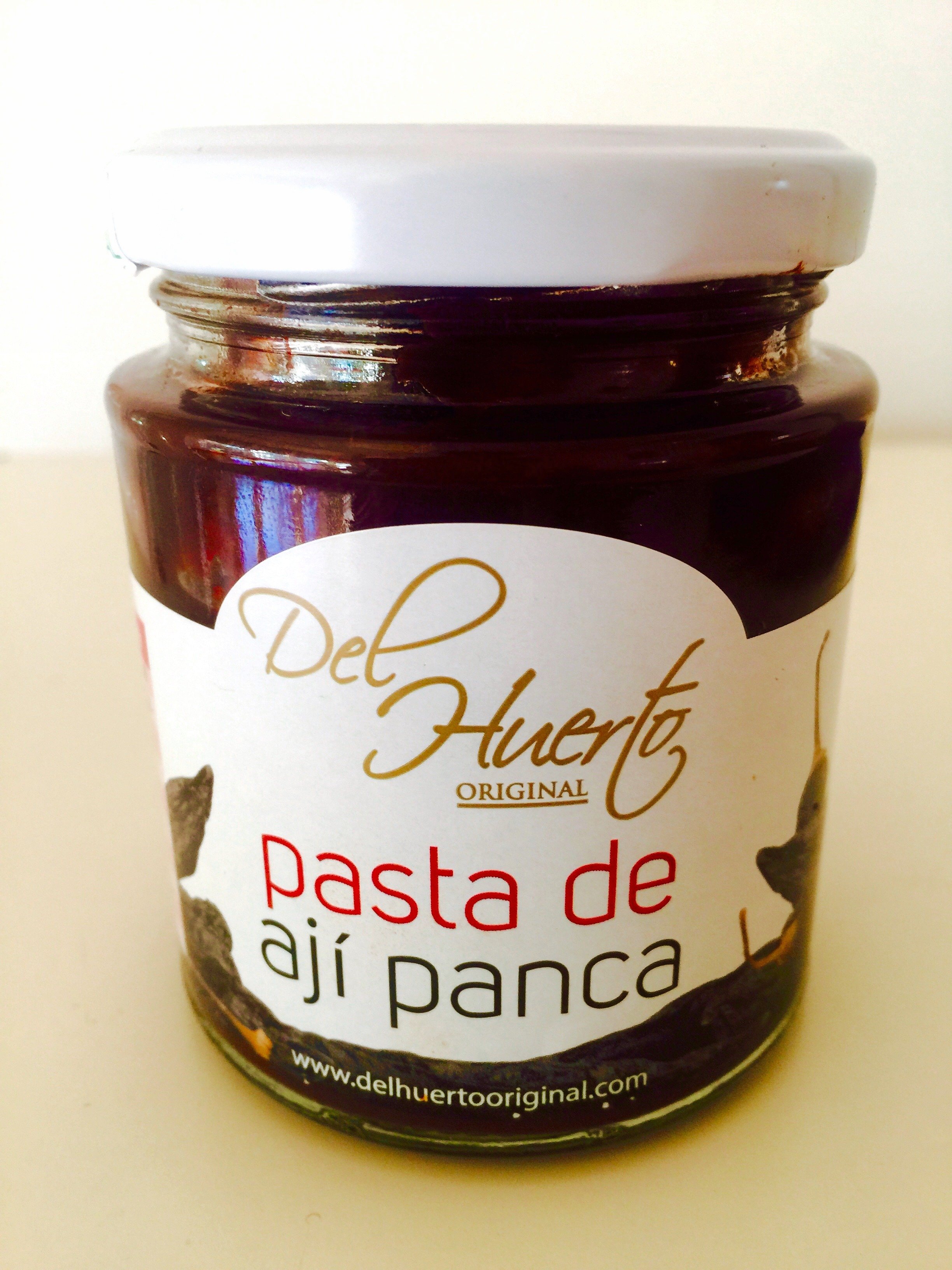
1-2 tbsp. red aji (chili) paste (aji colorado/aji panca)–see photo below
2 tbsp. tomato paste
1 tsp. dried oregano
coarsely ground black pepper, to taste

Toppings:
2 green onions, finely sliced
1 tsbp. finely chopped fresh parsley
1 tbsp. finely chopped fresh oregano
1 tbsp. finely chopped  fresh mint

1-fullsizerender-14
Dried cracked hominy

1-fullsizerender-13
Red aji (chili) paste

Preparation:

  1. Note: If using  the optional freeze-dried potato/chuño, soak it in warm water overnight prior to making the soup. Before adding it to the soup in step #5, drain it and squeeze as much water out as possible. If necessary, chop into small pieces.
  2. Place the wheat berries (and, if using, the dried hominy) in a medium saucepan, cover with several inches of water, and bring to a boil. Reduce heat, cover, and simmer for about 60-90 minutes or until both wheat and hominy are soft. Drain and set aside. If using canned hominy, pre-cook only the wheat, and add the undrained canned hominy to the soup in step #5.
  3. Meanwhile, add the broth and meat/bones to a large pot and bring to a low simmer, skimming periodically until no more foam is produced. Add the halved onion, quartered tomato, halved carrots, and the bay leaves and continue simmering slowly until the vegetables are soft, about 30 minutes. Check the seasonings and add beef bouillon cubes to taste, if needed.
  4. Remove the beef/lamb to a dish and let cool. Strain the broth through a fine-meshed sieve into a large bowl, mashing the tomato pieces to extract any remaining liquid. Return the broth to the pot and discard the vegetables.
  5. Shred the meat, discarding the bones and any fat, and add the shredded meat to the pot along with 1 c. of the cooked wheat, the hominy, the freeze-dried potato/chuño (if using), and the peas, carrots, and potatoes. Bring to a low simmer and cook for 15 minutes.
  6. Meanwhile, prepare the sofrito: Heat the olive oil  in a skillet over medium-high heat, add the onion, and cook until soft and slightly golden. Add the remaining ingredients to the skillet and cook for a few minutes, stirring frequently, to make a fragrant paste. Add the paste to the soup pot, stir to mix, and continue simmering the soup, covered, for 15 minutes or more to develop the flavors and ensure all vegetables are soft. If the soup seems too thick, add more water. If it needs more salt, add another bouillon cube.
  7. Serve with the sliced green onions and herbs sprinkled on top, and with plenty of crusty bread.

Recipe: Broccoletti Ripassati (Twice-Cooked Romanesco Broccoli)

12 Feb

After our visit to Sora Margherita, I found I could not get the broccoletti ripassati out of my mind. Soft, delicately sweet and nutty, redolent of roasted garlic and chilies, it was a perfect wintery comfort food, and I wanted to replicate it at home.

Broccoletti
So last week I went in search of a nice Broccolo Romanesco. It is in the Brassica oleracea family, along with broccoli, Brussels sprouts, cabbage, cauliflower, collard greens, and kale. Not to be confused with regular broccoli (Brassica oleracea Italica Group), Romanesco broccoli (Brassica oleracea Botrytis Group) is bright green and pointy and has been grown in Italy for centuries. It is most closely related to cauliflower and tastes a bit like it–though it is richer and more tender. And while it is sometimes labelled “broccoflower,” it should not be confused with the other, more common “broccoflower” that looks just like a green cauliflower. By now, I’m sure you are confused…. But rest assured, if you see a swirly, pointy, highly decorative Broccolo Romanesco, you will immediately know it is the one that is not like the others.

Romanesco broccoli
And if you do see one, grab it, take it home, and make some Broccoletti Ripassati; you won’t regret it. You can it eat it as a side dish, on its own (pictured up top as an oh-so-good, next-day lunch eaten with a spoon)–or mixed into pasta with some of the cooking liquid, as is very common in Rome.

Broccoletti Ripassati

1 head Romanesco broccoli
roughly 8 c. chicken or vegetable broth (I used water and chicken bouillon cubes at slightly less than full strength)
1/4 c. olive oil, plus extra as needed
freshly ground black pepper
1/4-1/2 tsp. chili flakes, or to taste
4 medium garlic cloves, minced–plus another 2 cloves, minced (optional)
2 tsp. red wine vinegar
salt & pepper to taste

Preparation

1. Trim the broccoli, cut it in half, cut out the core, and separate each half into florets.
2. Bring the broth to a boil and simmer the florets in the broth until they are soft enough to be pierced with a fork–it should take less than 10 minutes.
3. Drain the florets, reserving 1 c. of the cooking water.
4.  Heat the olive oil in a large, heavy skillet over medium-high heat and grind some black pepper over the top. Add the chili flakes, cook for about a minute, then add the 4 cloves of minced garlic. Cook for about 30 seconds while stirring, then add the broccoli and stir to coat it with the garlic.
5. Cook for about 15 minutes, stirring periodically and scraping up any bits from the bottom of the skillet, until parts of the broccoli turn very slightly golden. During the course of this second cooking, the broccoli will begin to disintegrate, which is perfect.
6. If the broccoli gets too dry, add some of the reserved cooking liquid and/or olive oil. You do not want the broccoli to be either too wet or too oily; you want it to be soft, moist, and almost slow roasted.
7. Sprinkle the red wine vinegar over the broccoli and cook until the vinegar has evaporated. Add the remaining 2 cloves of minced garlic, and cook for another 5 minutes (the first batch of garlic contributes to the slow-roasted taste; this batch adds a little extra kick–but it’s optional).
8. Season to taste and serve.

Recipe: Creamy Double Mushroom Soup with Green Onions

5 Mar

Mother Nature is really letting us have it this winter; we have been hit with yet another snow storm. The government has shut down and so has my office: today is an official snow day. Being home on a day such as this, my thoughts turned to warm and comforting things such as soup. Specifically, to an earthy soup featuring two types of mushrooms and lots of green onions–hence the name. I might have called it quadruple mushroom soup because it features mushrooms four ways: dried (and soaked) mushrooms, sautéed sliced mushrooms, fresh chopped mushrooms–and sliced raw mushrooms as a garnish. This is definitely a soup for mushroom lovers, of which I am one. But it is also a good soup for anyone needing some flexibility (that would be me, too). Not enough dried mushrooms on hand? Add more of the fresh ones. Don’t like (or have) button mushrooms? Substitute portabella or another type. Use one, two, or all three of the broths suggested below. Make it vegan, or not (see below). This is a forgiving soup perfectly suited to an unforgiving day.

Mushroom Soup

Creamy Double Mushroom Soup with Green Onions
Serves 4-6

2 oz. dried mushrooms (porcini, shitake, etc.)
2-3 tbsp. olive oil
20 oz. white button mushrooms–slice half the mushrooms, finely chop the other half (save two mushrooms to slice later for garnish)
2 bunches green onions/scallions, trimmed at both ends, rinsed clean, and thinly sliced (save one green onion to slice later for garnish)
3 cloves garlic, minced
freshly ground pepper, to taste
dash of dry sherry or splash of white wine (optional)
5 c. beef broth (or veggie broth or miso broth, or combination of broths)
1 tbsp. soy sauce (optional)
pinch of sugar (about 1/2 tsp.), to taste
1 c. heavy cream (or unsweetened coconut milk or soy creamer)

Preparation
1. Place the dried mushrooms in a bowl and pour enough boiling water over them to cover; soak for 30 minutes.
2. Meanwhile, heat half the olive oil in a soup pot over medium-high heat, add the sliced white mushrooms, and sauté until they start to turn golden; remove the mushrooms from the pot and reserve.
3. Add  the remaining olive oil to the soup pot and sauté the green onions until soft. Add the minced garlic and pepper; cook for another two minutes. Add the sherry/wine (if using) and reserved sautéed mushrooms. Turn heat to low.
4. Strain the soaked mushrooms through a fine sieve, saving the dark mushroom liquid. Rinse the mushrooms twice in a small amount of water, adding the first rinse to the dark mushroom liquid and discarding the second rinse. 5. Add the rinsed mushrooms to the soup pot. Strain the saved mushroom liquid and add it to the soup pot, along with the broth, soy sauce (if using), and sugar. Turn the heat back to medium high.
6. Using an immersion blender, blend the contents of the soup pot (or blend in batches in a blender and return to pot).
7. Add the chopped mushrooms to the soup and simmer for 20 minutes. Turn off the heat and add the heavy cream (or coconut milk/soy creamer). Check seasonings, adding more pepper, soy sauce, or sugar as desired.
8. Serve soup in individual bowls and top with a few thin mushroom slices and a sprinkle of sliced green onions.

Recipe: Walnut-Pomegranate Dip (Muhammara)

31 Jan

In the world of dips, hummus reigns supreme–but there is another Middle Eastern dip that also has lots of protein and lots of tang, and is equally easy to make. Although, now that I think of it, I realize it’s been a while since I made my own hummus; my local grocery store now devotes entire refrigerator sections to it and I have gotten lazy. This is a sad state of affairs–because hummus is really incredibly easy to make…. But back to the Muhammara. It gets its protein from the walnuts and its tang from pomegranate molasses, which you can find in Middle Eastern and Indian grocery stories and at a certain national, upscale grocery-store chain that shall not be named. Roasted red peppers also add to the slightly sweet undertones of this dip, which deserves a spot on any appetizer palette. This recipe comes from Bon Appetit magazine.

Muhammara
Walnut-Pomegranate Dip (Muhammara)

1 c. walnuts
½ c. roasted red bell peppers from a jar, drained (reserve the liquid)
1/3 c. panko (Japanese bread crumbs)
2 tbsp. extra-virgin olive oil
1 tbsp. pomegranate molasses
1 tsp. cumin
1/2 tsp. dried crushed red pepper

Preparation
1. Blend/process all ingredients until coarsely ground. (Add a bit more panko or walnuts if too thin, or roasted red pepper liquid or molasses if too thick.)

Food processor
2. Place the dip in a serving bowl. Drizzle some olive oil over the top–or for extra tang, mix together a bit of olive oil and pomegranate molasses and drizzle that instead.

Note: This is what pomegranate molasses looks like, if helpful.

PM

Recipe: Roasted Tomatoes, Onions, and Garlic with Basil

28 Jun

This year, I planted three tomato plants, which are beginning to completely take over the vegetable garden. If that weren’t enough, a fourth rogue plant sprung from the seeds of  last year’s tomatoes is giving them a run for their money. Which means I’m soon going to be faced with a bumper crop of tomatoes and the challenge of figuring out what to do with the ones I keep. This recipe is one of my all-time favorites for tomatoes, and I often serve it at brunches as an accompaniment to cold roasted meats. It is a very flexible recipe: it can be made ahead, served warm or at room temperature–and you can play around with the ingredients depending on what you have on hand. However you tweak it, it’s hard to go wrong with tomatoes, red onions, garlic, basil, and pine nuts.


Roasted Tomatoes, Onions, and Garlic with Basil
12 servings

3 lb. roma tomatoes (other smaller types work well, too)
2 large red onions, cut in half, each half cut into eight wedges
30 cloves garlic /2 bulbs, peeled (slice large cloves in half)
2/3 c. olive oil
2 tsp. sambal oelek (or sweet chilli sauce)
1 tbsp. sugar
2 tbsp. bottled pesto (or fresh, if you have it)
1 tsp. salt
2 tbsp. balsamic vinegar
1/2 c. shredded fresh basil
2 tbsp. chopped fresh oregano
1/2 c. pine nuts, toasted

Preparation

1. Heat oven to 400º.
2. Cut the tomatoes in half lengthwise. Place tomatoes, cut side up, in large baking dish, then nestle the onions and garlic around the tomatoes.
3. In a small bowl, combine the olive oil, sambal oelek, sugar, pesto, and salt. Pour over the vegetables.
4. Bake uncovered for about 30 minutes or until tomatoes, onions, and garlic are soft.
5. Meanwhile, dry toast the pine nuts in a small skillet over medium-high heat (watching carefully), until they start to turn golden. Remove them from the skillet and reserve.
6. Once the tomatoes come out of the oven, add the vinegar, herbs, and pine nuts, and mix gently. Serve warm or cold.

Recipe: Bolivian Peanut Soup with Chicken (Sopa de Mani)

3 Mar

Bolivian Peanut Soup is a one-bowl wonder, the ultimate comfort food–especially with fried potatoes and queso fresco (or the un-Latin American but perfectly substitutable feta cheese) sprinkled on top. Traditionally, the soup is made with beef bones, but I prefer to make it with small pieces of boneless chicken breast instead; chicken and peanuts have a natural affinity for each other, and chicken makes the soup a bit lighter. This can easily be made vegetarian or vegan, too, by omitting the chicken and making the soup with vegetable broth. The 1 tbsp. chili paste listed here adds a mild kick to the soup–if you like heat, add more.

Bolivian Peanut Soup with Chicken (Sopa de Mani)

1 cup (150 gr.) roasted unsalted peanuts
3 tbsp. peanut or canola oil, divided in half
2 large boneless chicken breast halves (about 1.5 lb./680 gr. total), cut into small bite-sized pieces (about 1/4 inch)
1 lg. white onion, diced
1 large carrot, coarsely grated
2 tsp. cumin
1 tsp. oregano
1/2 tsp. turmeric (or palillo)
1 tbsp. aji amarillo paste (yellow chili paste), available at international/Latin food markets
2 lg. potatoes, peeled and diced
6 cup (1.4 liters) chicken broth
salt and pepper
chicken bouillon cube or powder (if needed)

Garnish
2 large potatoes, julienned, and fried in oil until golden
crumbled queso blanco (or feta)
chopped parsley or cilantro

Preparation
1. Grind the peanuts almost to a powder in a food processor (or pound them in a mortar and pestle in several batches); set aside.

Crushed peanuts

2. Heat 1.5 tbsp oil in large Dutch oven over medium-high heat, add the chicken, and cook until no longer pink; remove the chicken from the pot along with any juices that may have accumulated, and keep warm.
3. Add the remaining oil to the pot, then cook the onion and carrots until the onion is soft, stirring occasionally.  Mix in the spices and aji amarillo (yellow chili) paste and cook 1-2 minutes.

One of the many brands of aji amarillo paste

4. Add the potatoes and peanuts to the pot, and stir well to coat.

Onions, carrots, potatoes, peanuts, and spices

5. Pour the broth over the vegetables, cover the pot, reduce the heat to low, and simmer about 20-30 minutes until the potatoes are tender. Blend the soup with an immersion blender (or in a standard blender, in batches, returning soup to pot after it is blended). Add chicken pieces and accumulated juices to the soup  and simmer another 15 minutes, adding a bit more broth if the soup appears thick. Season to taste with salt, pepper, and/or a chicken bouillon cube or bouillon powder if needed.


Soup, pre-garnish

6. Before serving the soup, fry potatoes until crisp; salt lightly.
7. Ladle soup into bowls, top with fried potatoes, then sprinkle with cheese and parsley (or cilantro). Serve immediately.