It is cold, windy, and grey here in the Mid-Atlantic United States, and I am ready for color and warmth. Where is spring? In my own yard, there a few small signs: tender shoots emerging from the ground, buds on trees, and increased bird activity. And though nothing has yet bloomed, I was encouraged today when I saw a few promising indicators from around the neighborhood, including a lone daffodil in flower. Here’s hoping my garden will not be too far behind.
Recipe: Stuffed Grape Leaves
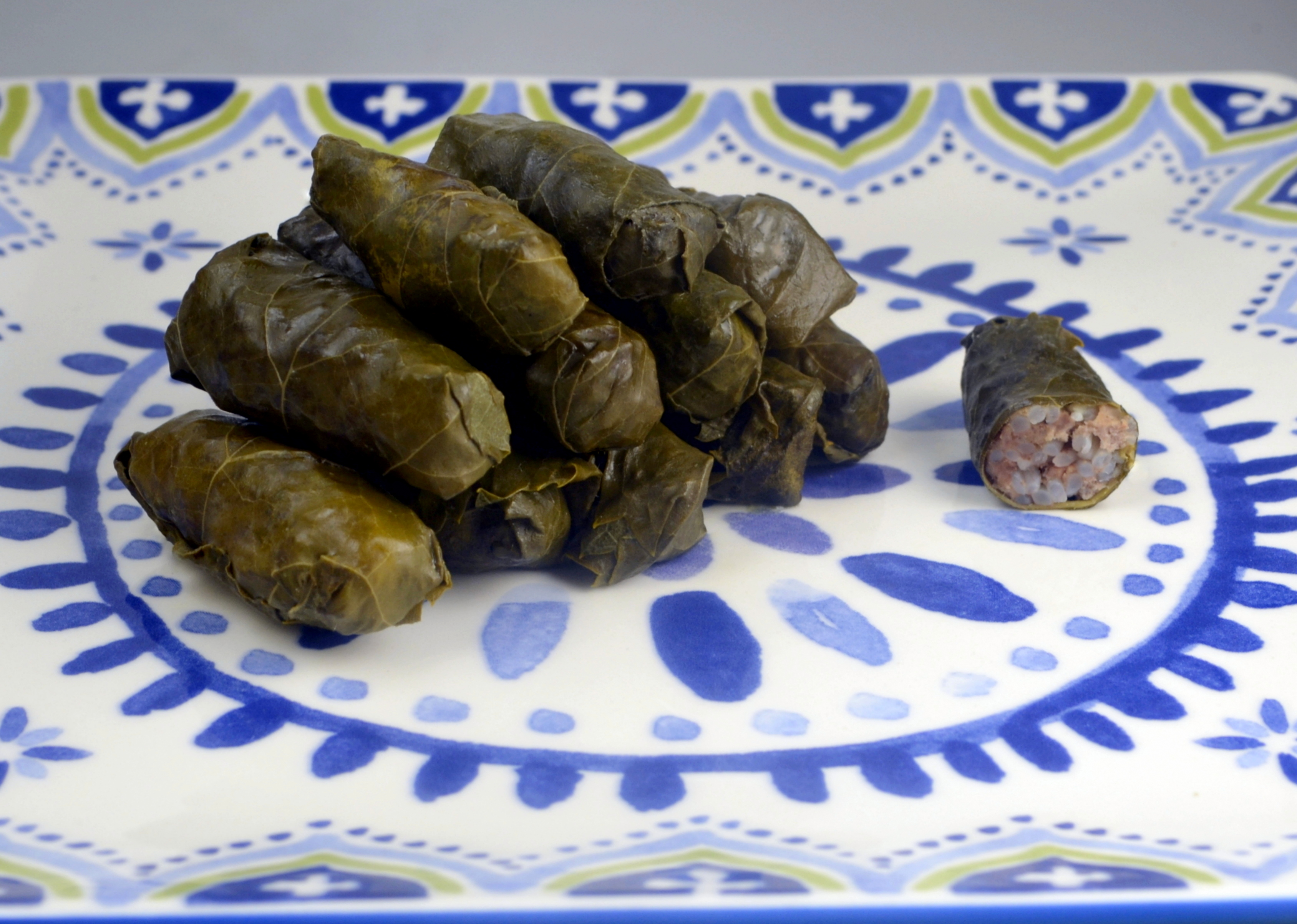
13 FebI would be hard pressed to come up with a last meal. I like so many foods, that I’d want something more along the lines of a smorgasbord. But one dish that would certainly be part of that smorgasbord would be stuffed grape leaves — the warm, simple, and oh so heavenly Lebanese version made with a lemony lamb and rice filling. In my very biased view, the versions of stuffed grape leaves that are meant to be eaten cold (usually meatless) cannot compare with their fragrant, hot-out-of the pot counterparts.
For a sublime gastronomic experience, dip these grape leaves in plain yogurt. The cool, smooth tanginess complements them perfectly. See photos below for step-by-step instructions on how to fill and roll grape leaves.
Stuffed Grape Leaves
1 (15-oz. ) jar grape leaves in vinegar brine
1 lb. ground lamb
1 c. white rice, such as jasmine
1/8 tsp. cinnamon
1/8 tsp. allspice
1 tbsp. salt
1/4 c. fresh lemon juice
Preparation
1. Open the jar of grape leaves, pour out the brine, and carefully ease the grape leaves out of the jar. (They will be tightly packed, in rolls.)
2. Put the grape leaves in warm water and let soak while making the filling.
3. For filling, combine lamb, rice, cinnamon, and allspice in a medium bowl, and mix well. Set aside.
4. Gently swish grape leaves around in the warm water, and slowly begin to separate as many as possible, taking care to not tear them. When most have come out of their rolls, drain the water.
5. Line the bottom of a medium saucepan with a layer of grape leaves (this is a good way to use any that are torn or too small).
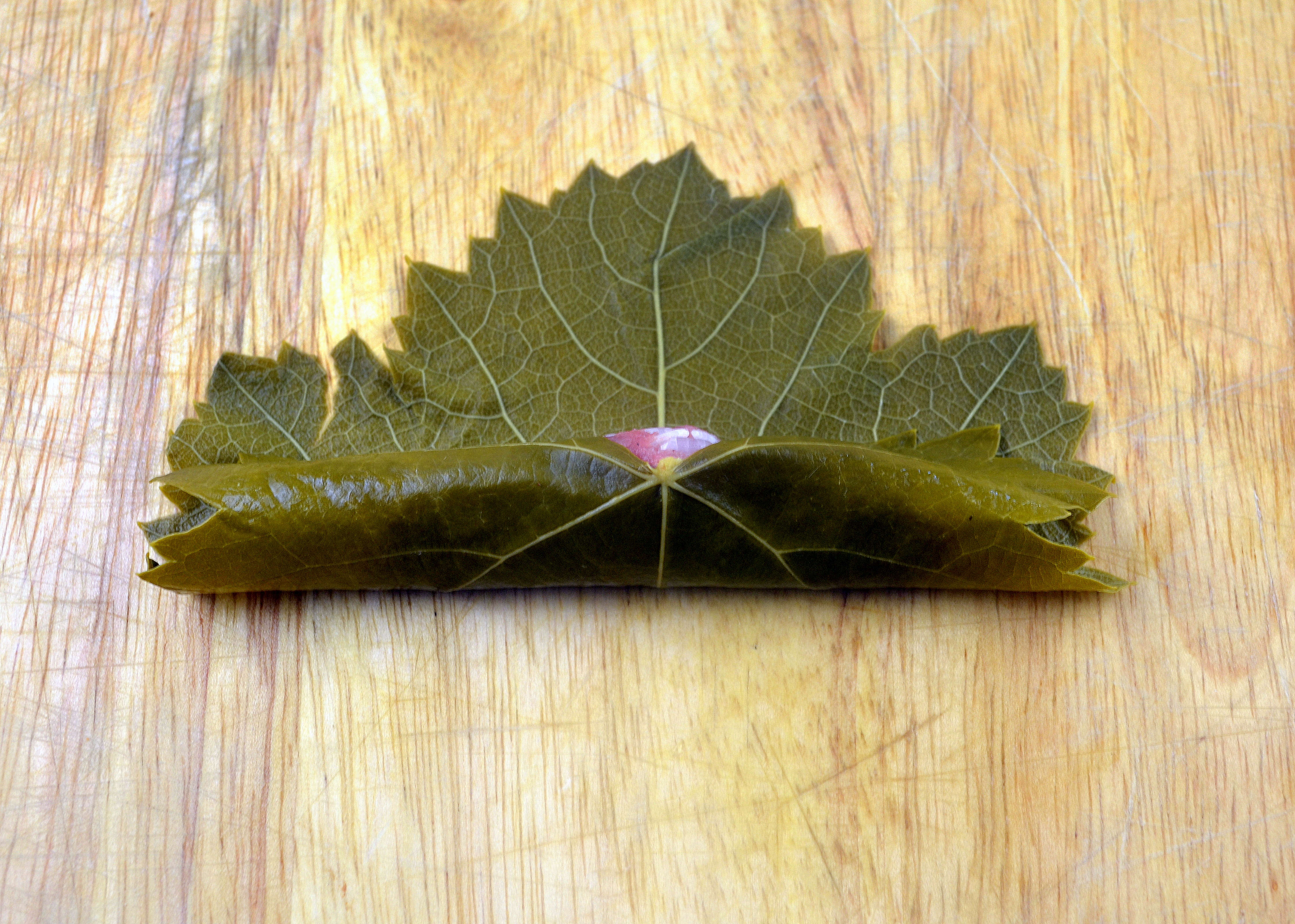
6. Select a grape leaf and shake to remove any excess water that may be clinging to it. Place it on a cutting board glossy side down (veiny side up). If there is a bit of stem still attached, cut it off (see photo below).
7. Take a bit of filling and shape into a small roll; lay horizontally across grape leaf, just above where the stem was.
8. Fold the bottom part of the grape leaf over the filling.
8. Tuck in each side, as if making a burrito.
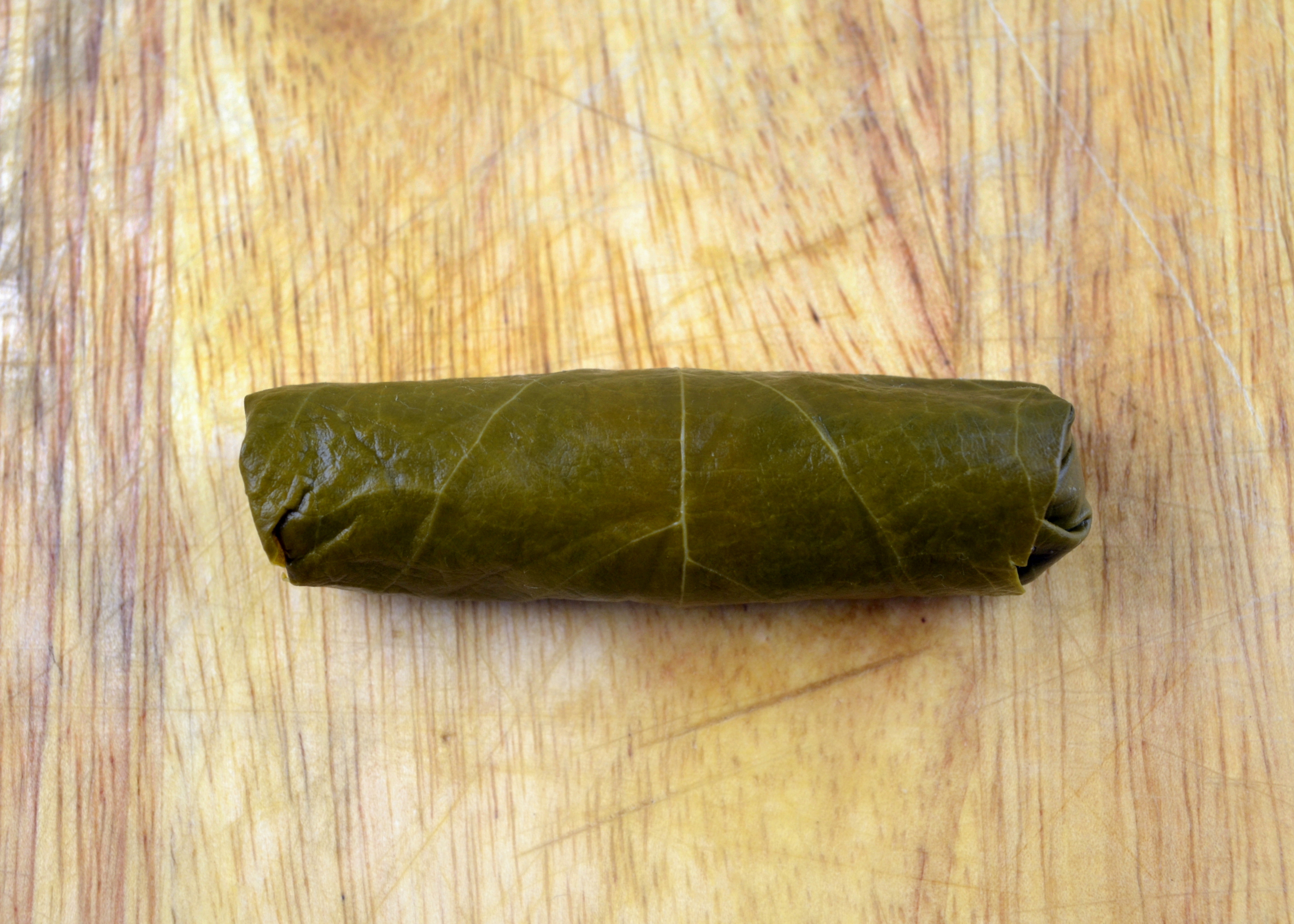
9. Continue to roll the grape leaf, folding in the sides as you go.
10. Place the rolled grape leaf seam side down in the sauce pan, tucking tightly against the side of pan.
11. Repeat the process until you have run out of filling. Depending on the size of the saucepan, you should have about two layers of rolled grape leaves. Be sure to tuck them in tightly; you do not want them to unroll while cooking.
12. Sprinkle the 1 tbsp. salt on top of the grape leaves. Add enough water to the pan to just cover the grape leaves. Place an inverted heat-proof ceramic plate on top of the grape leaves (you can also use the lid of a smaller saucepan–you will need something that fits inside the main saucepan and can lay on top of the grape leaves to keep them from shifting while cooking). Cover the saucepan with a tight-fitting lid.
13. Cook, covered, over medium heat for 15 minutes. Lift the lid, and pour in the lemon juice (you can pour it around the sides of the plate; it will seep underneath). Replace the lid, reduce heat to low/simmer, and cook for 15 more minutes, checking periodically to make sure the water has not completely dried up. Ideally, the water will be absorbed by the end of the cooking period, but you don’t want to run the risk of burning the grape leaves.
14. After 15 minutes, gently pour out any water that might remain, holding the grape leaves in place with the plate (or small lid).
15. Invert the sauce pan onto a serving platter, discard the grape leaves that lined the pan, and serve the stuffed grape leaves immediately, with plain yogurt as an accompaniment.
Adapted from Lebanese Cuisine, by Madelain Farah.
Joseph Banks and the Bottlebrush Tree
10 FebDuring our wanderings around San Diego this past Christmas, we came across many striking trees with bright red, cylindrical flowers that looked like bottle brushes. I was delighted to see them, but they made me feel a bit homesick. Not for Maryland, which has been home for more than a decade now, but for Australia, where we lived for four wonderful years and where these trees are very popular.
They are Crimson Bottlebrushes (Callistemon citrinus)–a shrubby evergreen plant native to Australia that can grow to about 15 feet. It is a plant that loves warm climates with lots of sun, which explains why it is also well suited to Southern California. How it got to the United States, I don’t know, but Joseph Banks, an English naturalist/botanist, introduced it to England in the 18th century. Banks was a member of Captain James Cook’s voyage on the Endeavour (1768-1771), travelling to Madeira, Brazil, Tahiti, New Zealand, Australia, and what is now Indonesia. Banks later became an unofficial advisor to King George III on the Royal Botanic Gardens at Kew, and ships returning to England from far and wide brought back plants for his collections. As a result, Kew Gardens became a pre-eminent botanical garden, introducing many of these plants to the rest of Europe.
As for the bottlebrush, it is greatly admired by humans and hummingbirds alike, as I discovered when walking up to the tree to take a photo. I realized at the very last second that a hummingbird was closing in on the flower I had targeted. Had I had my wits about me, I might have taken a better photo (see last photo below), but time and reflexes were not on my side.
Though I cannot grow bottlebrushes in Maryland, I have at least preserved a small but very fond memory of Australia in these photographs, by way of San Diego.
A Not So Bleak Midwinter
7 FebThus far, our winter has been relatively mild, but nonetheless, the garden looks like a shell of its former self: gaps where perennials have died back or where old growth was pruned to make way for new–and all remaining plants a monochromatic brown relieved only by occasional bits of evergreen.
A fleeting snowfall transformed this landscape for a day, accentuating the stark beauty of the plants that have soldiered on. A reminder that there are bright spots even in the depth of winter.
Presenting three “roses”: a frozen Hybrid Tea Rose bud, a sprig of Rosemary, and the dried seed pods of Rose of Sharon.
Recipe: Tortilla Soup
5 FebTwenty-four years ago today, my husband and I had our first date at an El Torito Mexican restaurant in Georgetown, Washington DC, whereupon I not only polished off a full platter of food, but found extra room for dessert, too. Ah, the joys of youth (and first dates). My future husband was amazed, but that was because he did not yet appreciate the magnitude of my sweet tooth — in my view, there’s always room for at least a little dessert.
The restaurant is now gone and my ability to eat that much dinner has gone with it. So on the anniversary of that first date, I present a light meal that was an El Torito favorite: Tortilla Soup. If you have this for dinner, you will certainly have room to satisfy any sweet cravings afterward.
This recipe calls for chicken, but a vegetarian version could easily be made without the chicken and using vegetable broth/bouillon instead of chicken broth/bouillon. A vegan version would also omit the cheese.
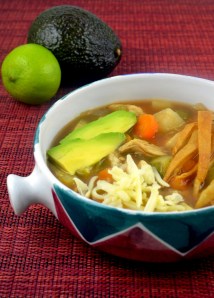
Tortilla Soup
[Updated instructions 2/7/2015]
3 chicken breast halves (about 1.5 lb.)
7 c. chicken broth
1 onion, diced
2 carrots, diced
2 stalks celery, diced
1/2 green bell pepper, seeded and diced
1 potato, diced
1/4 c. tomato paste
2 bay leaves
2 cloves garlic, sliced
1 tsp. oregano
1 tsp. cumin
salt and pepper to taste
1 zucchini, diced
1 tomato, diced
1/4 jalapeno pepper, seeded and thinly sliced
chicken (or vegetable) bouillon powder or cubes to taste
juice of 1/2 lime
Accompaniments:
corn tortilla strips (see cooking instructions below; will need 5 corn tortillas and canola oil)
1 1/2 c. shredded Monterey Jack cheese
2 avocados, sliced
3/4 jalapeno pepper, seeded and thinly sliced
chopped fresh cilantro
Preparation
1. Heat the broth in a large pot over medium heat. Add chicken breasts, reduce heat, and gently poach the chicken. [Note: Whenever possible, I like to poach the chicken ahead of time and let it cool in the broth: bring the chicken and broth to a simmer, turn down the heat so that the liquid ripples but doesn’t actually boil, cover the pot, poach the chicken for about 15 minutes–skimming the broth as needed–then turn off the heat and let the chicken breasts cool in the broth for about half an hour. If time is short, poach the chicken for 20-25 minutes, skimming as needed, remove from the pot, and transfer to a plate to cool.]
2. Add onion, carrots, celery, bell pepper, potato, tomato paste, bay leaf, garlic, oregano, cumin, and a dash of salt and pepper to the broth in the soup pot. Bring to a boil, reduce heat and simmer, covered, 25 minutes.
3. While soup is simmering, cut the 5 corn tortillas into quarters and then cut each quarter into thin strips; leave the strips on the cutting board until ready to cook. Shred the cool chicken with a fork or clean fingers, and set aside.
4. Heat canola oil over high heat in heavy skillet (should be at least 1- to 1.5-inch depth of oil). When oil is very hot, add a layer of corn tortilla strips. Fry until golden, flipping as needed to ensure even coloring. Drain tortilla strips on a layer of paper towels. Repeat until all strips have been cooked; reserve.
5. Add zucchini, tomatoes, jalapeno, and shredded chicken to the soup pot, then simmer 10 more minutes. Check seasonings; if broth needs a bit more flavor, add chicken (or vegetable) bouillon powder or cubes and more pepper as needed. Add lime juice just before serving.
6. Serve soup in individual bowls, with avocado slices, jalapenos, tortilla strips, cheese, and cilantro as accompaniments.
Photo of the Month: January 2013 (Salad)
2 FebWell, my plan to post an interesting photo at the end of each month has gotten off to a rocky start. With a busy end of the week, life got in the way, and it is clearly no longer January 31.
But setting aside that small detail, my original thinking was this: I have only been taking photographs since last spring, when my children gave me a camera for Mother’s Day. Any nice photos that appear on this blog are mostly the result of luck. So I try to practice when I can, by taking still life photos (great way to practice — nothing moves or gets cold!) and occasionally, some of the photos turn out much better than I expected.
So I thought that I would post one a month, starting in 2013. We’ll pretend this is still January; I’ll try to get my act together and post another one on time at the end of February. And after this, it will be almost all photo and very little “talk.”
This first one is of a salad I was making. The colors looked so nice, that I grabbed the camera and miraculously, the resulting photos looked almost artistic when I viewed them on the computer (one day, I’ll know how to achieve that on purpose). I put this photo in soft focus to heighten the effect.
Recipe: Light and Easy Cassoulet
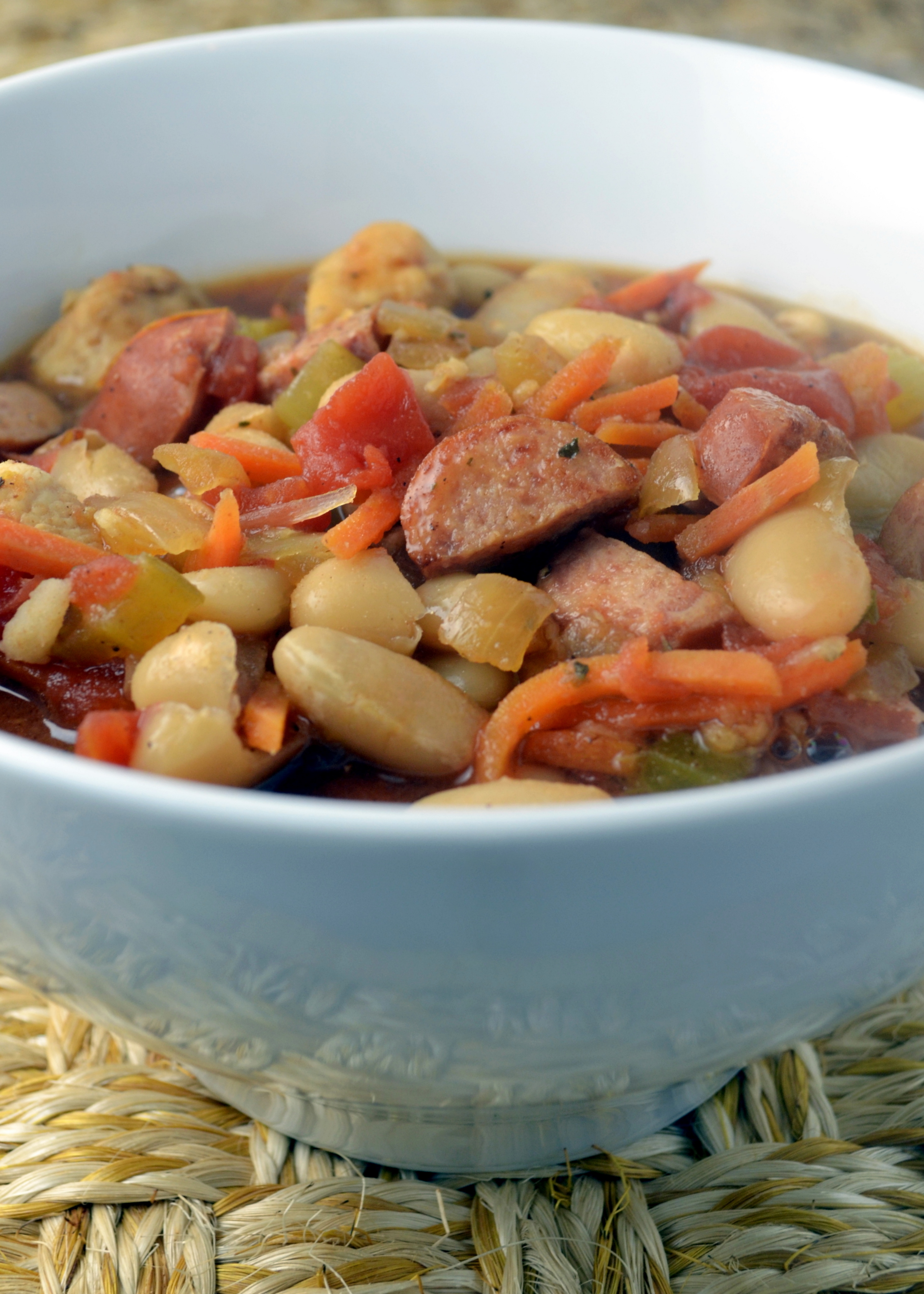
29 JanA cassoulet is a slow-cooked one-pot meal, originally from the south of France. It typically includes an assortment of meats, sausages, duck confit, and white beans, topped off with crispy bread crumbs. In essence, it is a hearty bean-based casserole meant to stick to your ribs. But delicious as it may be, duck confit can be hard to come by. And while I appreciate hearty dishes as much as the next person, I wanted to see if I could make an equally flavorful version that was just a tiny bit lighter, relied upon easy-to-find ingredients appealing to all members of the family, and took less than a full day to make. So, out with the pork sausages and duck confit, and in with some turkey kielbasa and diced chicken breast. This cassoulet is also fantastic the next day, when the flavors have melded and the beans have thickened it a bit more.
Light and Easy Cassoulet
2 tbsp. olive oil, divided
1 lb. turkey kielbasa sausage, sliced lengthwise and diced into quarters
1 lb. chicken breast, cubed
1 large onion, diced
3 carrots, diced (or 1.5 c. grated carrots)
3 celery stalks, diced
4 cloves garlic, crushed
3 (14-oz.) cans small white beans (cannellini), undrained (or one large, 1 lb. 13 oz. can, undrained)
1 (14.5-oz.) can diced tomatoes with olive oil and garlic (or plain–see note below)
1 (14.5-oz.) can diced tomatoes with basil, garlic, and oregano (or plain–see note below)
splash white wine (optional)
2 bay leaves
lots of freshly ground pepper
Preparation
1. Cook kielbasa in 1 tbsp. olive oil in Dutch Oven (or other heavy-bottomed pot) over medium-high heat until nicely browned. Add chicken and cook until no longer pink; remove kielbasa and chicken from pot.
2. Add the remaining 1 tbsp. olive oil to the pot, followed by the onion, carrot, celery, and a sprinkle of black pepper. Cook until soft, scraping the bottom of the pan with a wooden spoon to loosen the savory bits remaining from the kielbasa and chicken. Add the garlic and cook for 2-3 minutes.
3. Return kielbasa and chicken to pot; mix into the vegetables. Add tomatoes, wine (if using), and bay leaves, plus another dusting of black pepper. NOTE: if using plain diced tomatoes, sprinkle roughly 1 tsp. each dried basil and oregano over top of the tomatoes. Mix well, then layer beans on top.
4. Simmer on low heat for about an hour, stirring gently every so often.
5. Serve cassoulet with hearty bread and a salad.
Recipe: Savory Baked Salmon
26 JanNine times out of ten when deciding how to prepare fish, I opt for lightly marinated or seasoned fish that is then broiled or grilled — a fresh and simple preparation. It is a choice that makes me feel virtuous and happy (because, of course, a wise dinner decision opens up all sorts of possibilities for dessert). But sometimes I find myself yearning for a slightly heartier fish dish that warms the soul in a different way. I don’t pretend this Savory Salmon is light, but it is good–the topping would work on almost any fish. And children like it. I serve it with oven-roasted asparagus and a cucumber-tomato salad.
Savory Baked Salmon
Serves 6
2.5 lb. (1.1 kg.) salmon or other fish fillets
salt and pepper
Topping
1/2 c. mayonnaise
2 tbsp. fresh lemon juice
2 tsp. paprika
sprinkle crushed red pepper (chilli flakes)–roughly 1/4. tsp. , or tiny pinch cayenne pepper
1 tbsp. finely chopped fresh parsley (or 1.5 tsp. parsley flakes)
3 tbsp. grated Parmesan cheese or Pecorino Romano cheese
Preparation
1. For Topping: Combine mayonnaise and lemon juice and stir until smooth; add remaining ingredients and mix well to combine.
2. For Salmon: Sprinkle each fillet with salt and pepper, then generously coat each fillet with topping. Bake at 400 degrees for about 20-30 minutes, or until salmon is cooked through and flakes easily. If topping is not golden, broil briefly, keeping a careful eye on the fish.