In the Blink of an Eye

8 Jun

At this time of year, every day brings some new development in the garden. You take each change into account, bit by bit. But when you are away for an extended time, as I was recently for work, you come back and feel that those changes occurred far too quickly–how did that peony bloom in such a short time? Where did that red-hot poker come from?

All this was driven home to me yesterday, when my youngest son graduated from high school. How did that happen so quickly? Now, like his two brothers before him, he will follow his own path, and we will no longer see those day-to-day changes. But we will continue to admire the growth and the blooming. Luckily, our daughter is still at home for one more year. And the garden will remain, though it, too, undergoes constant and rapid metamorphoses.

Before I left for my two-week trip, the brand-new peonies I had planted were only in bud; when I returned, the blooms were already spent. I never did see what the full flowers looked like–I will have to save that treat for next year.

Peony (Kansas)
 
The new roses I had planted last month were also just beginning to bud, but since they bloom for months, I was able to see the flowers when I got back.

Hybrid Tea Rose (Love and Peace)
 
And finally, I caught the Red Hot Pokers just in time; now, their color is fading and the flower spikes are drying up. Here is one seen from above and in full bloom.

Red Hot Poker (Flamenco)
 

Recipe: Peruvian Chicken in Creamy Walnut Sauce with Chili (Ají de Gallina)

4 Jun

We lived in Peru for a couple of years, and considered ourselves to be in gastronomic heaven. Peruvian cuisine takes advantage of the country’s geography (coast, jungle, mountains) and history (including the Inca, Spanish conquistadores, African slaves, Chinese indentured labor, and many other immigrants). All these influences–different foods and cooking techniques–came together to contribute to an absolutely wonderful cuisine, one that continues to evolve.

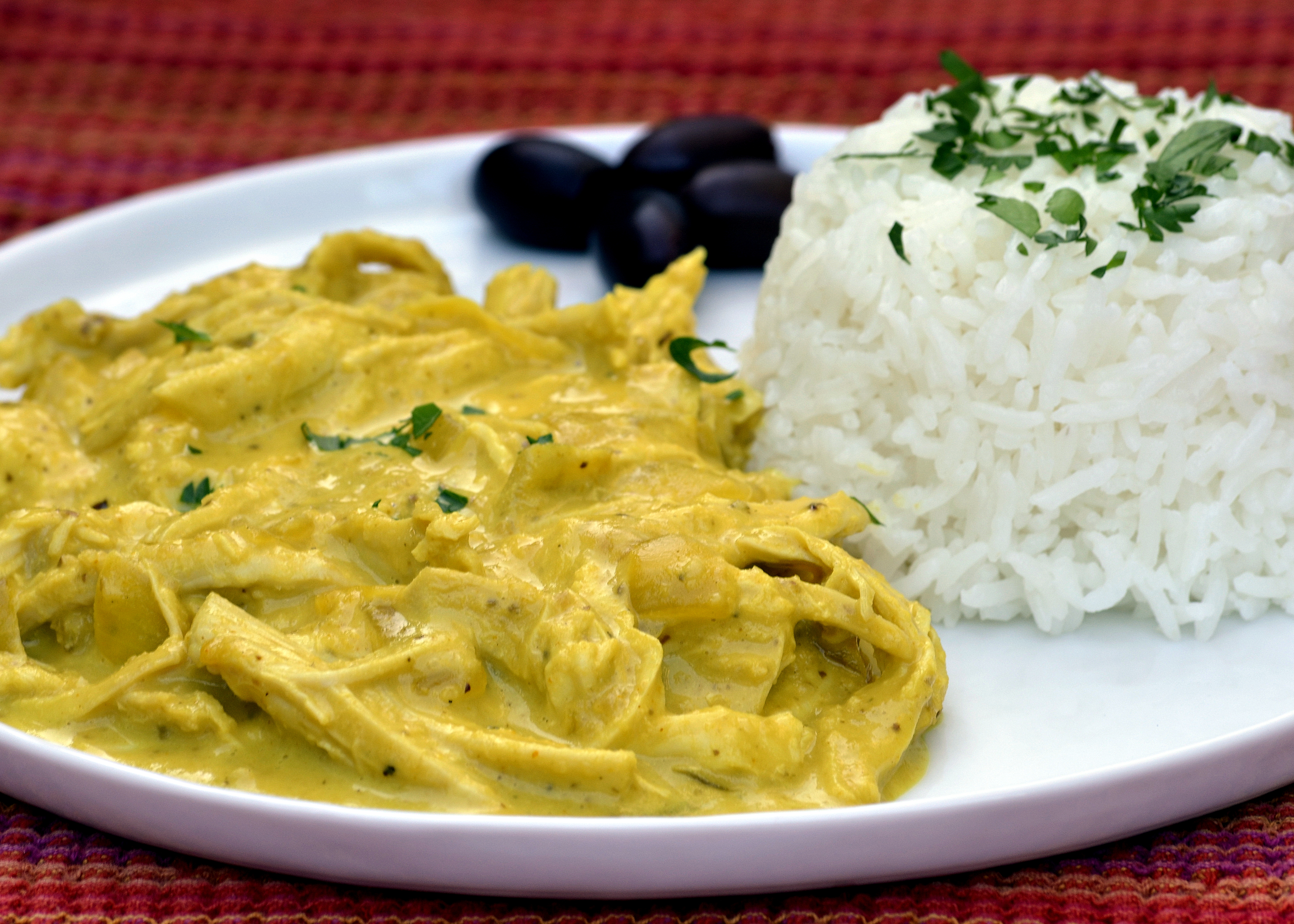
Of the many Peruvian dishes I like, Ají de Gallina is one of my favorites. Ají means chili; the yellow in this dish comes from the signature yellow chili peppers that symbolize Peruvian cooking (plus a bit of turmeric). Gallina means hen–in this case, shredded chicken. And the creamy, cheesy, nutty part of the dish speaks to European influences. It is traditionally served with black olives (which I had on hand) and boiled yellow potatoes and quartered hard-boiled egg (which I belatedly discovered I did not have on hand).

This is not a difficult dish to make, but does require some preparation time, so if your weekdays are busy, this may be best made on a weekend. I tend to make it in stages while taking care of other tasks around the house and in the garden.


Ají de Gallina (Peruvian Chicken in Creamy Walnut Sauce with Chili)
Serves 8

3 lb. (1.4 kg.) boneless chicken breast halves
½ onion
2 carrots, peeled
2 bay leaves
4 slices white bread, crusts removed, cut into quarters
1 (12-oz./354 ml.) can evaporated milk, plus extra milk if needed
3 tbsp. canola or vegetable oil
2 large onions, diced
4-6 large garlic cloves, minced
2 tbsp. aji amarillo paste (yellow chili paste)–available at international/Latin food markets
2 tsp. turmeric
1.5 tsp. salt
pinch pepper
1 cup (120 gr.) chopped walnuts, toasted (see below)
¾ cup (84 gr.) grated Parmesan cheese

Accompaniments:
boiled yellow potatoes, peeled and halved
black olives
hard-boiled eggs, quartered

Preparation

1. Place chicken breasts in a large pot, and add onions, carrots, and bay leaves. Add enough water to cover the chicken, then lightly salt the water. Bring water to a boil, immediately turn off the heat, cover pot, and let the chicken poach for about an hour. Remove chicken from the broth, let cool, and then shred with clean fingers. Reserve all of the broth.
2. Meanwhile, soak the bread in the milk.
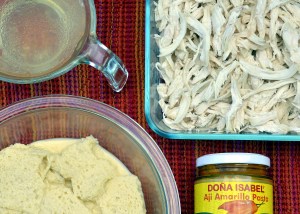

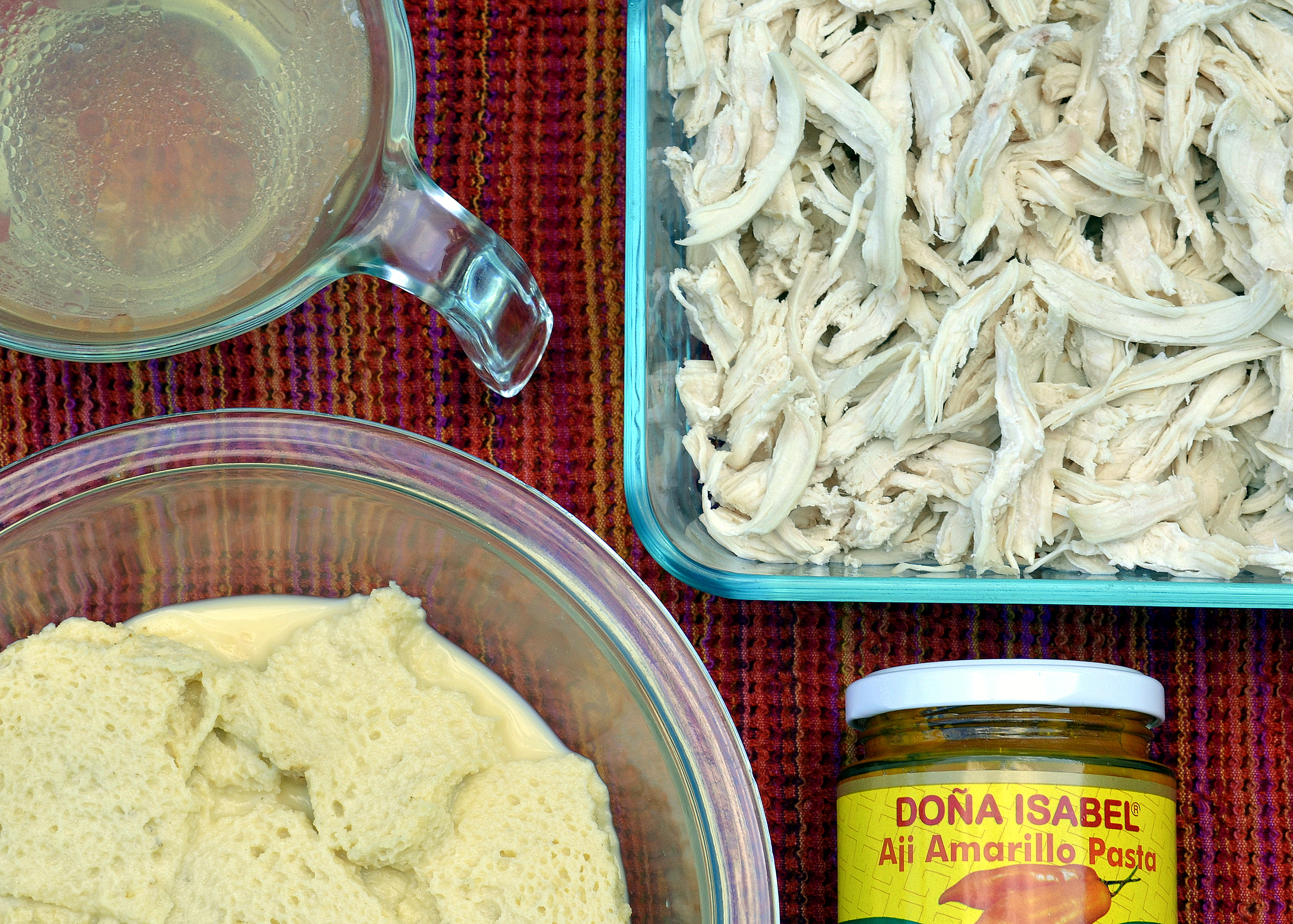
Clockwise from top left: chicken broth from poaching process, shredded chicken, aji amarillo (yellow chili) paste, bread soaked in milk.

3. Sauté onion in oil in a heavy-bottomed Dutch Oven or large pot over medium heat until softened and turning golden at edges. Add garlic, cook 2 more minutes, then add the turmeric, salt, and pepper. Cook for 2 minutes, then add aji amarillo paste and cook for 5 more minutes. Note: 2 tbsp. chili paste gives this dish a nice little kick; for more heat, add 3 tbsp.
4. Toast the walnuts (place walnuts on a baking sheet in a single layer, and toast in a 350-degree oven for about 5-10 minutes or until lightly golden and aromatic; be careful not to burn them, as I have done on more than one occasion when trying to do too much multitasking….).


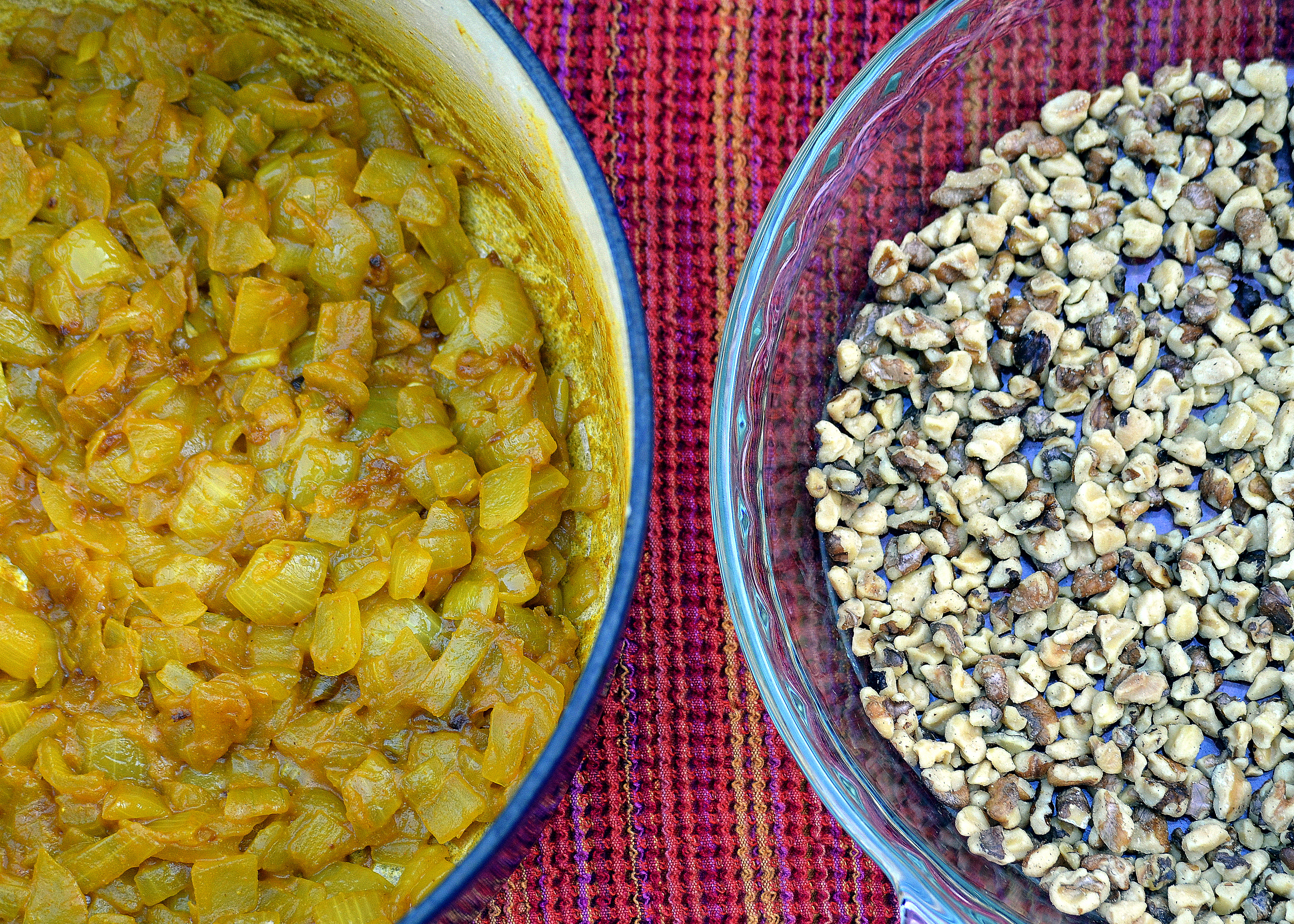
Left: onion-garlic-chili paste mixture. Right: toasted walnuts

5. Put the bread and milk into a blender or food processor, add the toasted walnuts and a splash of reserved chicken broth (about 1/4 c.), and blend until smooth. Add this mixture to the onions in the pot, cook for a few minutes, adding more broth if necessary to thin, then add chicken and parmesan cheese. Thin as needed with more milk or broth (you will probably need a fair amount; add more milk for a creamier texture, more broth for a lighter dish). Add more salt and pepper to taste.
6. Serve over rice and with suggested accompaniments. Garnish with some chopped parsley for additional color, if desired.

Postcard from Senegal, Part II

2 Jun

After a week of meetings in Dakar, we had a nice opportunity to get out of the capital city and go on a field trip: first to a farming cooperative east of Dakar and then south to the Bandia Wildlife Reserve. It was lovely to be able to see a bit of the countryside.

The area around the farm and the reserve (and in fact, a large part of Senegal) is savannah. The landscape is dotted with the famous baobab trees, which store water in their trunks and can live for thousands of years:

 
… and also with acacias (new foliage, left; old vine creeping around acacia trunk, right).

  
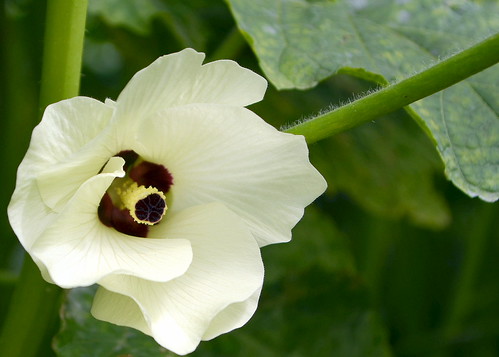
On the farm, okra plants were in bloom. I had never thought about okra flowers before (which shows that I have never grown okra)–but I now know that okra flowers are quite lovely–as are the pom-pom like flowers of the Acacia robusta trees lining some of the farm’s roads.
 
We did not make it to the Wildlife Reserve until the afternoon, when most animals would normally be taking a siesta in a shady spot, but we were lucky to see monkeys, antelope, warthogs, ostriches, zebras, rhinos (from a suitably safe distance), and giraffes.
 

Photo of the Month: May 2013 (Poppy Bud)

31 May

Red Poppy Bud, unfurling
Montpellier, France: Jardin des Plantes

Recipe: Chickpea Curry (Indian Sour Chickpeas)

30 May

Chickpeas, or garbanzo beans, are the basis for many delicious things, from hummus to brownie bites — all made much more easily (and quickly) by using canned chickpeas. This recipe, adapted from Madhur’s Jaffrey’s Indian Cooking, is one of our favorites–a light curry sprinkled with onions marinated in lemon juice and ginger (hence the lovely “sour” element).

Serve with rice and other curries for a crowd, or with a simple raita (made with yogurt, cucumbers, garlic, and a pinch of mint) for a one-dish meal.

Indian Sour Chickpeas
Serves 6

2 (15-oz./425 gr.) cans chickpeas, undrained
3 medium onions, finely chopped
1 tbsp. finely grated peeled fresh ginger (or 1 tsp. ground)
4 tbsp. fresh lemon juice
3-4 tbsp. vegetable oil
2 medium tomatoes, chopped
1 tbsp. ground coriander
1 tbsp. ground cumin
½ tsp. ground turmeric
2 tsp. garam masala
cayenne pepper (if desired)

Preparation

1. Put 3 tbsp. of the chopped onion and the ginger and lemon juice into a small cup. Mix well and set aside.
2. Heat oil over medium-high heat and add remaining onions. Fry until slightly brown at the edges, then add the tomatoes. Cook another 5-6 minutes, mashing the tomatoes with the back of slotted spoon.
3. Add the coriander, cumin, and turmeric. Stir and cook for about 30 seconds. Add the chickpeas and their liquid, the garam masala, and the cayenne (if desired). Stir to mix and bring to a simmer. Cook gently, covered, for about 20 minutes. Before serving, add onion/ginger/lemon mixture. Stir to combine.

Postcard from Senegal, Part I

26 May

After two weeks away, it’s amazing what has happened in the garden in my absence–but more about that later. I spent the first leg of my work trip in Senegal. In and amongst all-day meetings, we were able to get out a bit and see Dakar and Goree Island, and to go on a day trip to a farm and wildlife preserve.

It was a lovely trip, the only downside being that I never got a good photograph of any of the delicious things I ate, including  Thiéboudienne (a traditional Senegalese dish made with fish, rice, and stewed vegetables in a rich and flavorful tomato-based sauce) and Poulet Yassa (another favorite, made with chicken in a lemony onion sauce). Since Senegal is on the coast, seafood figures prominently on the menu–with the exception of the Poulet Yassa, I had fish almost every day.

In the early evenings, people gather at key spots on the beach in Dakar to buy fish straight off the small, colorful fishing boats (I took the photo below from a moving car, so it leaves a bit to be desired, but gives an idea of the lively beachside fish market).

Here is another photo of the fishing boats, taken on Gorée Island, a trading post from which slaves were transported; the House of Slaves shows the cells in which the slaves were kept and features a museum as well.


The island is very colorful–boats, walls, and flowers.  I was struck by a blue bench at a small eatery on the island, and a splash of orange bougainvillea against a yellow wall.


Allium Update

20 May

A short while ago, I posted a photo from above of an Allium ‘Purple Sensation’ bud just before it was about to open. Here are side views of subsequent phases in the Allium lifecycle: opening, and fully open (ok, those might not actually be the technical terms).


Alliums look delicate, but pitted against squirrels, Alliums will usually win. Why? Because they are members of the onion/garlic family, and squirrels prefer slightly less aromatic bulbs for dinner. Hummingbirds and butterflies have more sophisticated palates, however, and love Alliums. It can’t get any better: a flower that deters pests but attracts welcome guests.

Adding to the Alliums’ charms is the fact that they 1) don’t take up much space and so can be tucked almost anywhere, 2) are long lasting, 3) are pretty hardy, and 4) are just pretty. In the language of flowers, the message Alliums convey is one of perfection and elegance. It’s hard to disagree with that.

Birth of an Azalea ‘Gibraltar’

16 May

One of the joys of spring is seeing the transformation from bud to bloom. Last year, I planted two tree azaleas (they are more upright than bushy) just after peak blooming time and so caught only a brief glimpse of the sole remaining flower on one of the plants. Azalea ‘Gibraltar’ is a deep orange color, but I was not able to appreciate it in all its glory — though I had high hopes for Spring 2013.

But as summer progressed, the azaleas’ foliage turned brown and shriveled up. It was clear I had planted them where it was too sunny, and they were not at all happy. In fact, they were dying. So we took emergency measures and dug them out, relocating them into large whisky barrels in a shadier part of the garden. And then there was nothing to do but wait and hope they survived the experience.

Luckily, they did; here are some photos showing the birth of a glorious, ruffled, orange Azalea ‘Gibraltar’ bloom.

Weekly Photo Challenge: Pattern

13 May

Another photo challenge, and amazingly, I had another photo that might work for this week’s theme: Pattern. This is a close-up of the spiny bark of the Madagascar Palm (pachypodium lamerei), taken at the US Botanic Garden last month. It is not really a palm; it’s in the succulent/cactus family. When you look at the tree from afar, its spines are neatly splayed across the trunk in diagonal rows, forming a diamond-like pattern. But this pattern is best observed from afar–if the 2.5-inch spines don’t already say “keep away,” the fact that all parts of the tree are also poisonous (if ingested) reinforces the message.

Recipe: Chocolate Waffles

11 May

Because I’m leaving on a work trip tomorrow, I was treated to an early Mother’s Day breakfast of my choosing. But really, I didn’t have to think about it at all — I asked for the same thing I  always ask for: Chocolate Waffles. My 16-year-old daughter made them this year, and they looked absolutely gorgeous:


They tasted fantastic, too, with some whipped cream, maple syrup, and a sprinkle of cinnamon. A heavenly combination. And long after breakfast or brunch, you can grab a plain waffle and break off pieces to eat along with a nice cup of coffee or tea.

Chocolate Waffles
Makes 8-12 waffles
2 oz. unsweetened chocolate
1 1/2 c. flour
2 tsp. baking powder
1/4 tsp. salt
1/2 tsp. cinnamon
1/2 c. canola oil
1 c. sugar
2 eggs
1 tsp. vanilla
1/2 c. milk

Preparation

1. Melt chocolate, let cool.
2. Preheat waffle iron.
3. Sift dry ingredients together over medium bowl.
4. Mix oil and sugar together, then beat in eggs until well blended. Add vanilla and melted chocolate.
5. Add sifted ingredients to wet ingredients in three batches, alternating with milk.
6. Spray waffle iron with cooking spray. Pour batter onto iron and cook according to manufacturer’s directions. (Our waffle iron makes 4 waffles–we pour about 1 c. batter into the center of the iron, close, and wait for the waffle iron to beep.)
7. For these waffles, it’s important to spray the waffle iron each time you make a set of waffles.
8. Serve with whipped cream and maple syrup.

Adapted from Joy of Cooking.