Tag Archives: ricotta

Recipe: Spinach and Ricotta Gnudi in a Parmesan Cream Sauce with Crispy Prosciutto

16 Mar

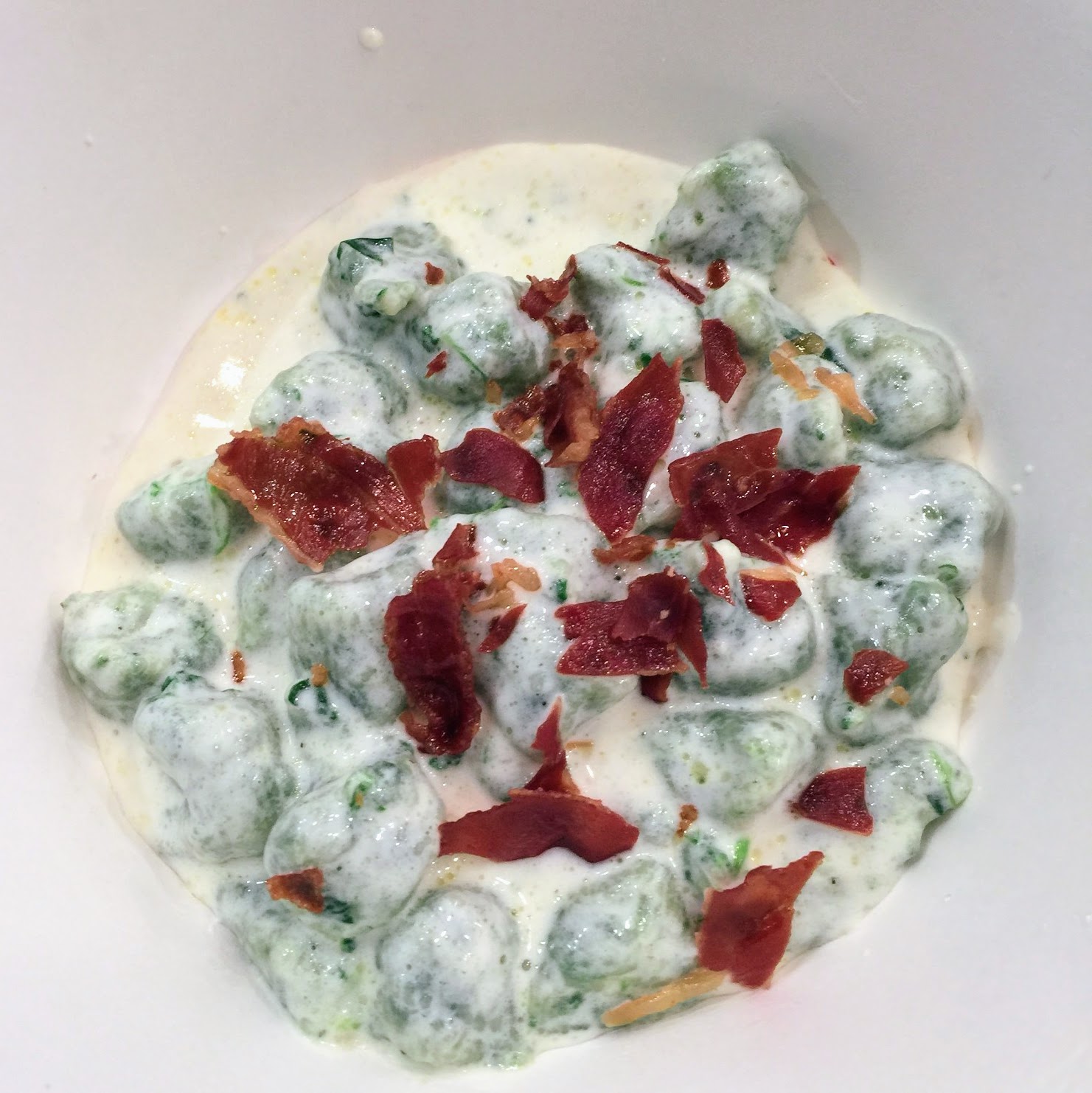
If you like gnocchi, or spinach-ricotta ravioli, you may very well also like gnudi. Gnocchi and gnudi are similar, except gnocchi are made with potatoes and have some chewiness, whereas gnudi are made with ricotta and are quite light and soft, which I prefer. In Italian, “gnudi” means “naked ones;” these spinach-ricotta delights are essentially the filling for ravioli, without the pasta to cover it up.

You can eat them with a marinara sauce, which would keep them very light — but I first learned how to make gnudi in a cream sauce with crunchy prosciutto on top, which is what I’ll share here because it is delicious! You can easily omit the prosciutto for a vegetarian main, however.

Ingredients
4 servings

11 oz (300 gr) spinach leaves
2 garlic cloves, minced
extra-virgin olive oil
150 gr whole-milk ricotta (drained if very wet)
1 egg, lightly beaten
150 gr. ( about 2 c.) Parmesan or Pecorino Romano cheese, grated — and divided in half
2-3 tbsp. flour
500 gr. (2 c.) heavy cream
salt and freshly ground pepper, to taste
pinch ground nutmeg

Preparation

1. Preheat the oven to 400F (200C).
2. Rinse the spinach well and cook in a pot with only the water that is clinging to it, until soft and wilted. Remove, drain/squeeze dry, then chop. Put the spinach in a bowl with the garlic and a drizzle of olive oil; toss to combine.

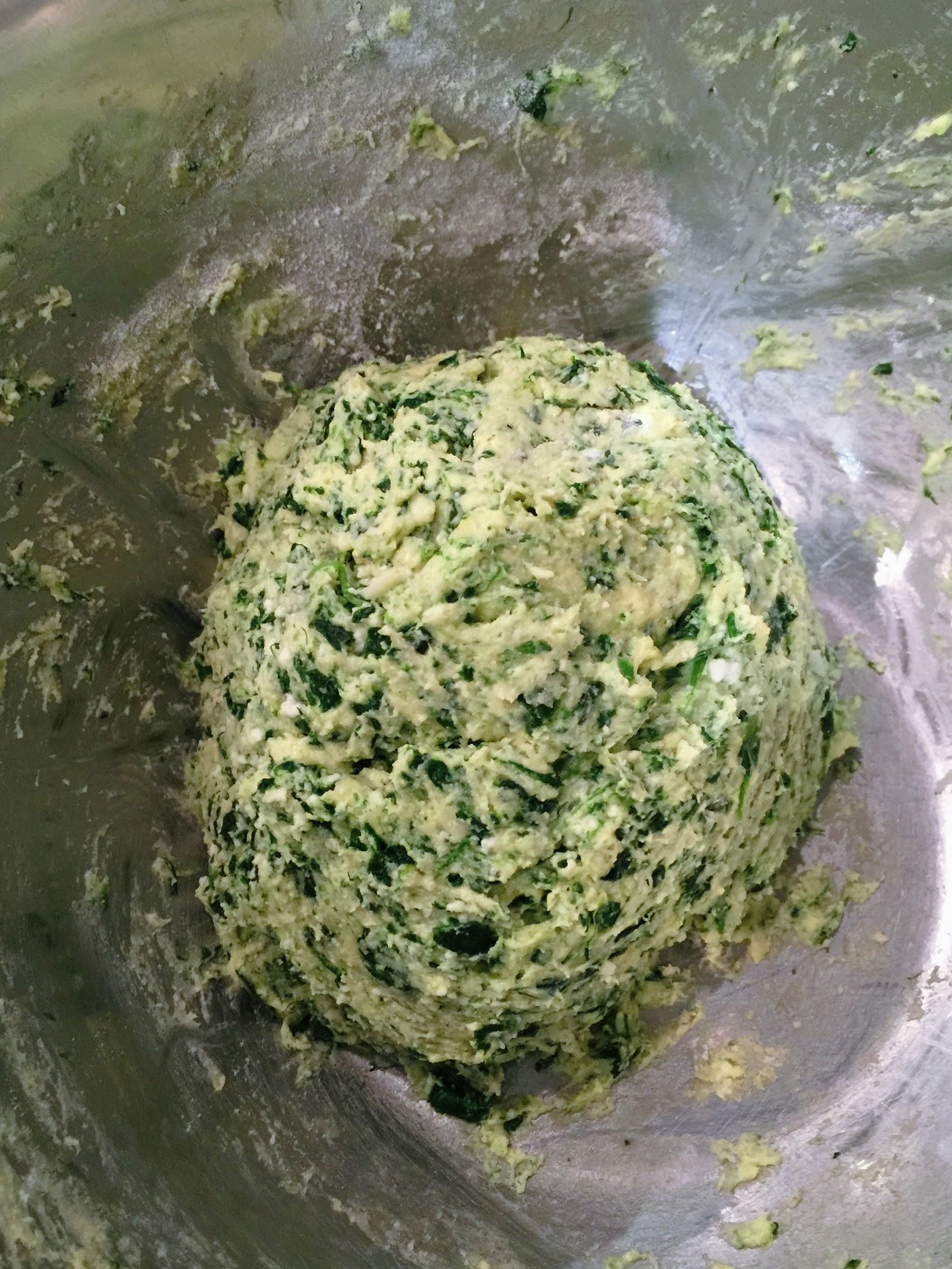
3. Add the ricotta, egg, 1 cup of the grated cheese, flour, a small pinch of salt (but not too much, due to the cheese), and pepper. Mix well, form the dough into a ball, and let rest for 30 minutes.

4. Meanwhile, place the prosciutto on a baking sheet and bake until crispy, keeping a close eye on it as it can go from crispy to burnt very quickly. Let the prosciutto cool, then break into pieces. Set aside.

5. Once the gnudi dough has rested, take pieces of it and roll into logs on flour-dusted parchment paper. Cut the logs into small pieces. Start a big pot of lightly salted water boiling.

6. Make the cream sauce: Bring the cream to a simmer for a couple minutes, stirring continuously. Take it off the heat and add the remaining cup of grated cheese, whisking to incorporate. Season to taste with salt, pepper, and nutmeg (if desired).
7. Gently slide the gnudi in the boiling water (you can take the parchment paper and slowly funnel them into the pot that way, or use a skimmer, spider, or slotted spoon). You may need to add the gnudi to the boiling water in batches; only put enough in to form a single layer across the top of the pot. The gnudi will be ready in just a few minutes — as soon as they float back up to the surface.

8. Remove the gnudi with the skimmer, spider, or slotted spoon and place them in a serving bowl (or another pot); pour the cream sauce over, adding more grated cheese if desired. Serve in individual bowls with crispy prosciutto on top. Enjoy!

Recipe: Crostata Ricotta e Visciole (Sweet Ricotta Tart with Cherry Preserves)

17 Dec

Recently, my husband pointed out that we had TWO jars of cherry preserves, TWO jars of fig jam, and an unruly assortment of other jams, jellies, and preserves in the fridge. I was accused of jam overpopulation. I admitted to accidently opening a new jar of cherry preserves (my favorite) without realizing we already had one in the fridge, but I still maintain the other jars were not my fault…. However, in the spirit of providing a solution to this problem, I offered to make a ricotta crostata with what was left in one of the jars of cherry preserves. One less jar in the fridge, and attention diverted to dessert. A win-win.

Actually, a ricotta crostata is always a win-win; the sweet ricotta is beautifully creamy and you can use any preserves or jam of your liking, though the most traditional way of preparing this Italian sweet is with cherry preserves. Second, the dough for this crostata comes together in a food processor, adding speed and ease to the recipe’s many virtues. And finally, a crostata not only makes a great dessert, but a tasty breakfast as well — and a good accompaniment to afternoon tea or coffee.

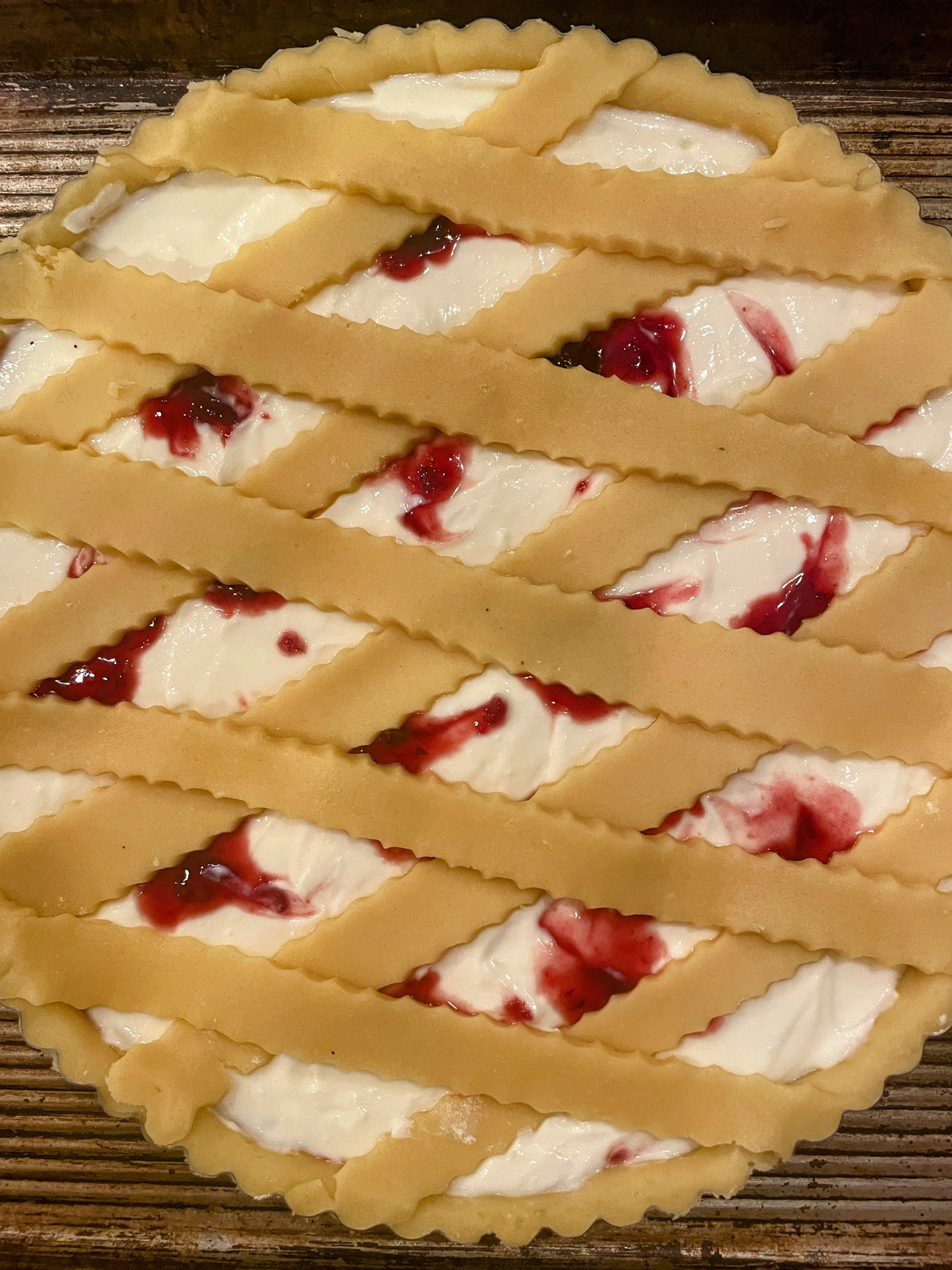
You can also let your creative side loose on the top crust; I made a very simple (unwoven) lattice with scalloped strips this time around.

Crostata Ricotta e Visciole
Recipe inspired by (and translated from) Antonio Romano Runchef
Note: This recipe is best made using a kitchen scale to weigh the ingredients.

Tart Dough:
225 gr. sugar (about 1 1/8 c.)
grated zest of one lemon
250 gr. butter (2 sticks + 1 tbsp)
120 gr. eggs (I used 3 yolks + 2 whole eggs, carefully adding the white of the last egg until I got to 120 gr.)
1 tsp. vanilla
pinch of salt
500 gr. flour (I used all-purpose; you can also use 00)

Filling:
450-500 gr. ricotta (16-oz. container); I try to find ricotta that is not super wet. Here in the U.S., I like Bel Gioioso Ricotta con Latte. I pour out any little liquid that may have collected in the container and dab the top with a paper towel to remove any extra moisture.
100 gr. sugar

250 gr. cherry preserves (about 3/4 c.)

Directions:
1. Place the sugar and lemon zest in a food processor and pulse until combined.
2. Cut the butter into cubes. (Note: An easy way to cut butter into cubes is to use a bench scraper; cut the sticks lengthwise into quarters, then chop into cubes. ) Add the butter cubes to the sugar in the food processor and continue to pulse until incorporated; the butter will look grainy. Add the eggs and vanilla and process until well combined.
3. Add the flour and sprinkle the pinch of salt over. Process just until a smooth dough forms.

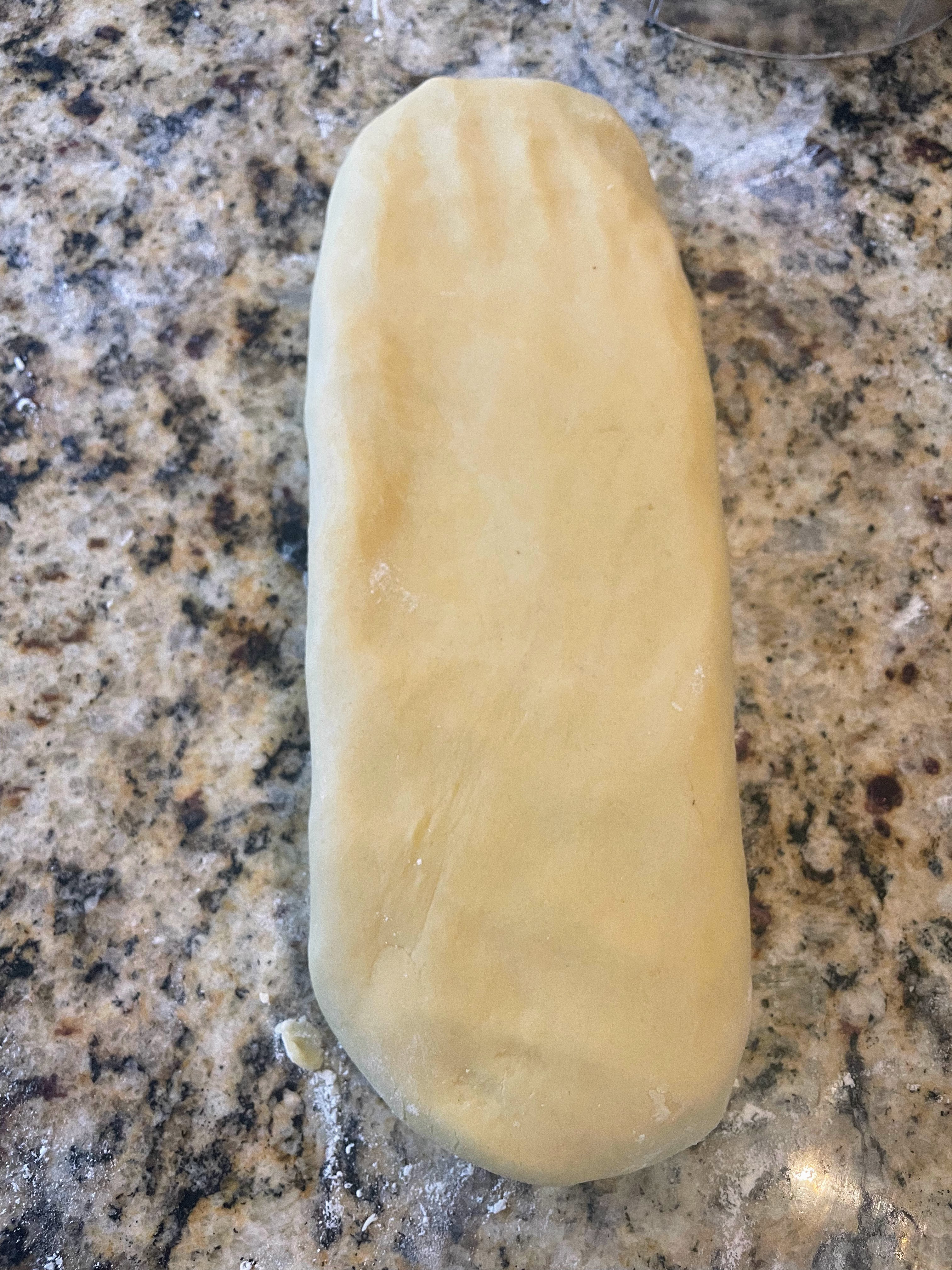
4. Turn the dough onto a floured countertop and roll into a thick log. Pat into a rectangle, wrap in plastic film (or put in a sealable bag) and refrigerate for 2 hours.
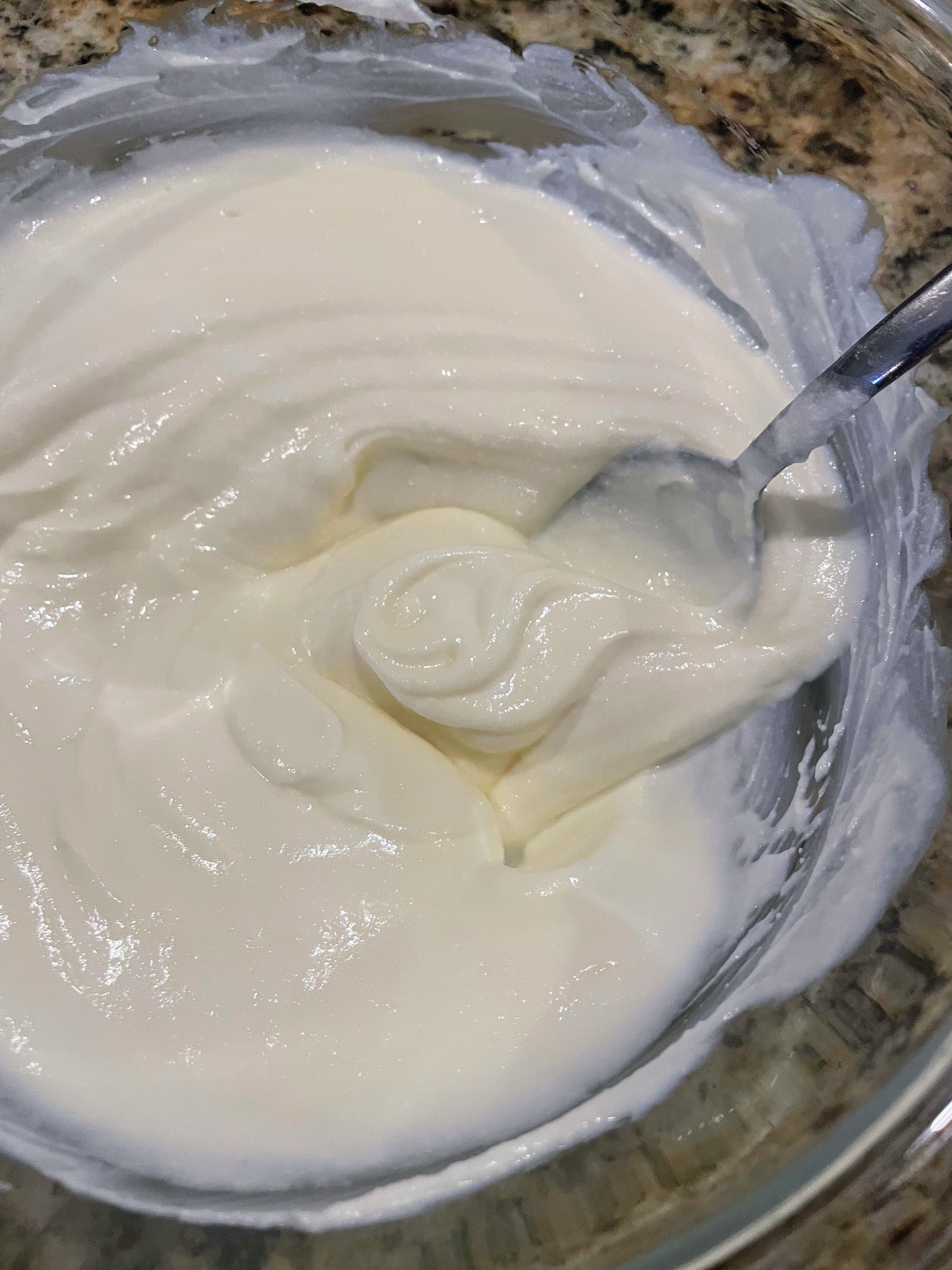
5. Meanwhile, butter a tart pan. Make the ricotta filling by mixing the ricotta and sugar together; let it sit, stirring occasionally, until the sugar is fully incorporated.

6. Cut the dough into a 2/3 piece and a 1/3 piece. Return the 1/3 piece to the refrigerator. Roll the 2/3 piece into a circle about 3 inches wider than your tart pan. Carefully drape the dough over the pan, lifting it gently to tuck it into the inner diameter of the pan. If any dough overlaps the edge, press on it to crimp it off. Save the extra dough.
7. Spoon 2/3 of the preserves ( 1/2 c.) over the base of the tart. Carefully add the ricotta mixture, smoothing the top as best as possible. Dollop the remaining preserves across the top of the ricotta mixture and gently swirl.

8. Roll the remaining 1/3 piece of dough into a rectangle at least as long as the diameter of your tart pan. Cut into 10 strips, and lay the strips in a diamond pattern across the top of the tart. (You can also re-use any extra dough you have leftover from lining the tart pan, to make the 10 strips.)

9. Bake the crostata at 170C/340F for about 35 minutes, or until the lattice is golden. Let cool and then serve.

Recipe: Spaghetti with Ricotta and Pecorino Romano

3 Mar

Sometimes, you need comfort food. While home today with a very sore throat and not much food in the fridge, I wondered what to make for lunch. It needed to be soft. It needed to make me feel better. It needed to be made from the few items I could scrounge up, and it needed to be prepared quickly. There was only one possibility: Spaghetti with Ricotta and Pecorino Romano, a double dose of sheep-milk heaven — and ready in less than 15 minutes. Perfect.

dsc_0115

Spaghetti with Ricotta and Pecorino Romano

This is a free-form recipe; you can adjust any of the ingredients to suit your tastes. The quantities below are for one hungry pasta lover, but this dish could serve two people if part of a multi-course meal.

  • ¼ lb. (113 grams) spaghetti, fettucine, tonnarelli, or other pasta
  • 1 tbsp. (14 grams) butter, cut into small pieces
  • ¼-1/3 cup (28-38 grams) grated Pecorino Romano cheese
  • fresh, coarsely ground black pepper, to taste
  • 2 ¼ oz. (64 grams) sheep’s-milk ricotta, crumbled or cut into small pieces (* use the best, freshest ricotta you can find)

Preparation

  1. Start boiling lightly salted water in a generously sized pot. When the water comes to a boil, add the spaghetti and cook just until al dente—often that’s about 1 minute less than indicated on the package.
  2. Meanwhile, place the pieces of butter in an unheated skillet or large bowl next to the pasta pot. Add the Pecorino Romano cheese,  grind black pepper over  top (to your liking), and sprinkle 2 tbsp. cooking water around the sides of the skillet or bowl.
  3. When the spaghetti is done, quickly scoop it out of its cooking water with a pasta ladle and drop it into the skillet or bowl. Don’t shake off all the cooking water; it is an essential ingredient. Stir and swirl the spaghetti vigorously to melt the butter, the Pecorino Romano cheese, and the cooking water into a light sauce. Add more cooking water if the pasta appears too dry.
  4. Check the seasonings (adding salt and more ground  pepper if needed), gently fold in the ricotta, and serve immediately, with additional grated Pecorino Romano on the side.

Recipe: Coffee Ricotta Mousse with Gianduia (Chocolate Hazelnut Spread)

19 Feb

PHOTO2
Since moving to Italy, I have become obsessed with fresh, soft ricotta. Ricotta is made from the whey left over from making other cheese (so, the second cooking–and hence the name ricotta, which means twice cooked). It can be made from cow’s milk, sheep’s milk, goat’s milk, or buffalo’s milk. Cow’s milk ricotta is more common, but I love the taste and texture of sheep’s milk ricotta (ricotta di pecora), which has a very high fat content and is a bit softer than the cow milk version.

Cow's milk ricotta  Sheep milk ricotta
Despite this slight preference, I have yet to meet a ricotta I do not like. I love it in pastas and in any savory incarnation–but I really, really love it sweet: in the ricotta cakes here in Rome, in Sicilian cannoli, in the Neopolitan sfogliatelle…the list goes on. Basically, I love sweet ricotta here, there, and everywhere. So for the past few weeks, I’ve been experimenting with making a ricotta dessert at home: mousse. It has been tough work.

This version is currently my husband’s favorite: coffee-flavored with ripples of gianduia, a dark chocolate-hazelnut spread that is a sleek, grown-up version of Nutella. The recipe is for two servings (based on 1/2 c. ricotta per person)–and can easily be multiplied. It yields a subtly flavored mousse that is not overly sweet, but the ingredients can easily be adjusted to your taste. Note: delicious as this is, it has one other thing going for it–it is a very quick dessert that can be made ahead and put in the refrigerator until later.

Coffee Ricotta Mousse with Gianduia
Two servings

Mousse
1 tsp. instant espresso powder or instant coffee granules
1 tsp. vanilla
1 c. fresh, soft ricotta (preferably sheep’s milk ricotta–but use whatever is the best ricotta you can find)
2 rounded tbsp. sugar
3 tbsp. whole milk

Filling
2 heaping tbsp. gianduia (chocolate-hazelnut spread)

Garnish
2 or more whole hazelnuts
chocolate-coated cookie sticks

Pernigotti  Mikado
Preparation
1. Dissolve the instant espresso powder (or instant coffee granules) in the vanilla.
2. Place the remaining mousse ingredients in a bowl and mash with a fork until soft and mousse-like; add the coffee/vanilla mixture and whisk to combine, eliminating as many lumps as possible.
3. Leave with a few lumps for a more rustic mousse, or, for a finer texture, use an electric whisk (such as a whisk attachment on an immersion blender) or a hand mixer and whisk until velvety smooth.
4. Place 2 heaping tbsp. mousse in the bottom of each mousse cup, dot with about 1 heaping tsp. gianduia, and swirl slightly. Repeat, for three layers total, using up all remaining ingredients in the final layer.
5. If preparing in advance, cover each mousse cup with aluminum foil and refrigerate.
6. Just before serving, garnish each mousse with a whole hazelnut and chocolate-coated cookie stick.

Mousse1
mousse2

Recipe: Lasagna Roll-Ups with Spinach and Ricotta

8 Dec

Sometimes, you want something fairly simple for dinner, but still want it to have a little flair. This dish meets that need. It is a different take on an old favorite: lasagna. Instead of layering the lasagna, you roll it up. It is fun to make, and a pleasure to eat.

Lasagna Roll-Ups © G. Stansbury

Lasagna Roll-Ups with Spinach and Ricotta
Makes 10-12
[Updated  Dec. 9, 2012]

15 pieces lasagna from a 1-lb. box
16 oz. ricotta cheese
2 cloves garlic, crushed
1 (10-oz.) package frozen chopped spinach, thawed and well drained
1 egg, lightly beaten
1.5 c. shredded mozzarella cheese, divided
1/2 c. grated Pecorino Romano or Parmesan cheese
3/4 tsp. salt
freshly grated pepper to taste

pasta sauce of your preference (at least 24 oz./4 c. — may need more)

Preparation
1. Cook lasagna al dente in large pot of boiling water according to directions on package. Drain, and rinse with cold water to cool.
2. While lasagna is cooking, combine ricotta, garlic, spinach, egg, 1/2 c. mozzarella, Pecorino Romano/Parmesan cheese, and salt and pepper. Mix well.
3. Preheat oven to 400 degrees. Spray a 9×13 baking pan with cooking spray, then pour about 2 c. pasta sauce into pan, spreading evenly. Add more sauce as needed to ensure there is a healthy layer of sauce in bottom of pan.
4.  Lay out a lasagna noodle and spoon about 1/3 c. filling in an even layer down the entire noodle (you can also spread the filling on the noodle with very clean fingers). Roll the lasagna noodle up as tightly as possible, and nestle into sauce in pan. Repeat with remaining noodles–you will end up with between 10-12 roll-ups  (the extra noodles are back-ups in case of any breaks or tears). Pour remaining sauce over and in between roll-ups.
5. Cover pan with aluminum foil and bake for about 30 minutes, or until bubbly. Remove aluminum foil and sprinkle remaining 1 c. mozzarella over the roll-ups. Broil until golden, and serve immediately.