Tag Archives: Parmesan

Recipe: How to Make Bright Green Pesto

5 Oct

The very last of my basil has flowered, so today I headed out and harvested all the remaining good leaves. It took a while, but the sun was warm on my back, the bees were buzzing gently by, and the smell of the basil as I plucked each leaf one by one, was intoxicating. There are worse ways to spend part of an October morning.

My aim? To make a few batches of pesto to freeze. But the end result looked (and smelled) so good, I couldn’t wait; I decided to use one batch tonight. It will get drizzled over a Sausage, Kale and Bean soup, the thought of which is already making me hungry!

This recipe calls for blanching the basil, which I find is a key way to get the greenest color. Today, I used another trick, too: I added a handful of baby spinach leaves that needed using up as spinach also amplifies the emerald factor. The addition of a few drops of lemon juice makes the pesto a bit brighter, too; I almost feel like it makes the pesto taste greener (is that possible?).

Note: When I am making pesto to freeze, I do not add the cheese or lemon juice. Instead, I add both those things later on to the thawed pesto. So the photos below are pre-cheese, and thus, represent a vegan version that would be delicious on its own, too.

Bright Green Pesto
(makes 2 cups total = 3 batches)

6 c. (slightly compressed but not packed) fresh basil leaves (about 120 gr.); can substitute up to 1 c. baby spinach leaves
3/4 c. toasted pine nuts
6 large garlic cloves
1/2 tsp. salt
1 c. extra-virgin olive oil
*1.5 c. freshly grated Pecorino Romano cheese (preferred) or Parmesan
*lemon juice, to taste

Preparation

1. Set a large pot of water to boil.
2. Pick over the basil leaves to make sure there are no blemishes (or stems). Fill a large bowl with ice water and set aside. When the water in the pot is boiling, add the basil and garlic, and push down on the basil leaves with a slotted spoon (to submerge them), just until they turn bright green. This blanching process should take less than a minute.

3. Immediately drain the basil and garlic in a colander, and then set the colander in the bowl of ice water to stop the cooking.
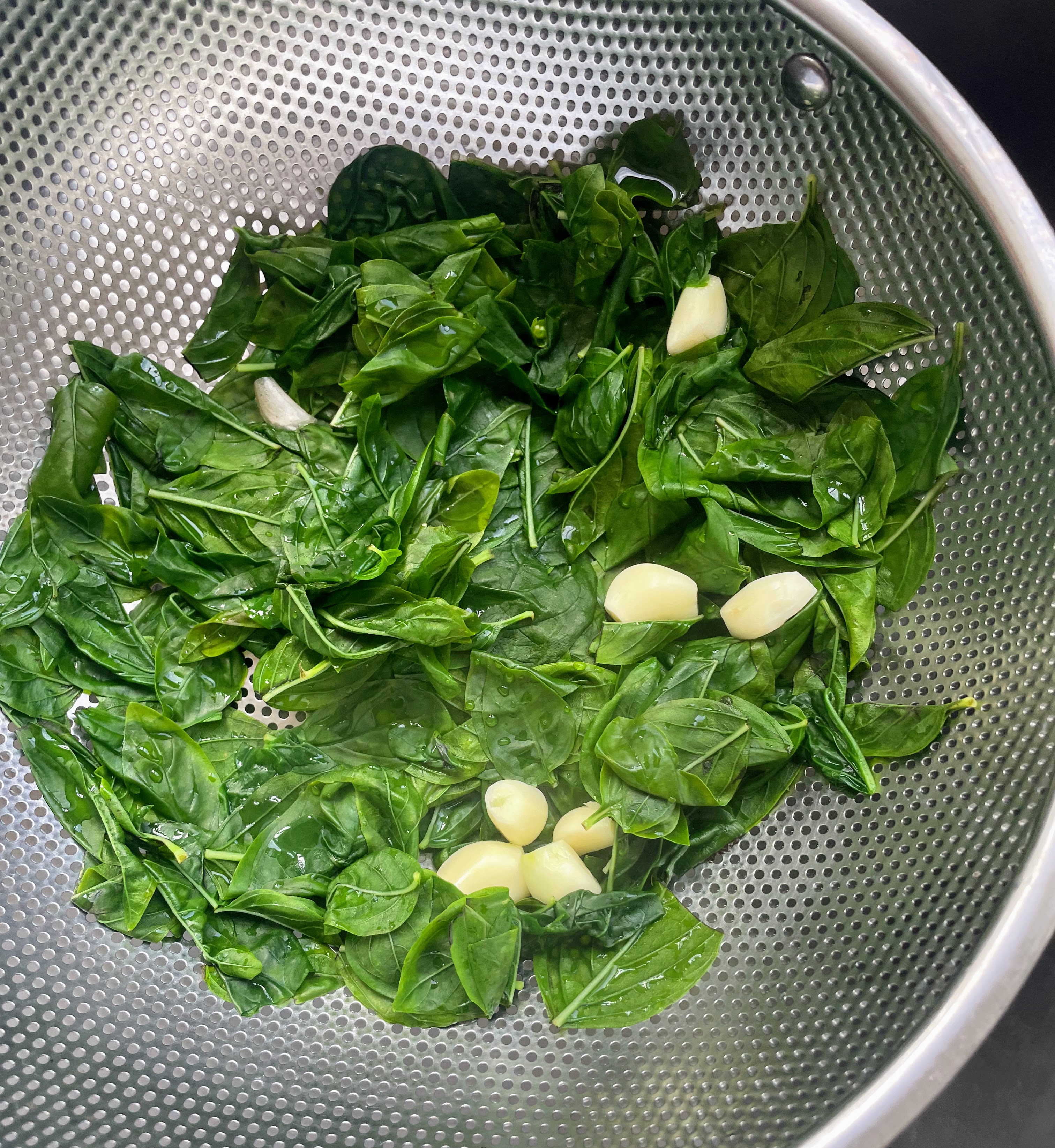
4. Once the spinach is cold, remove the colander from the bowl, set in the sink, and let the basil and garlic drain for a few minutes. Then place the basil and garlic on a clean dish towel and pat as dry as possible.

5. Put the basil and garlic in a food processor, add the pine nuts and salt, and pulse until the mixture is finely chopped and begins to come together. With the food processor still running, slowly pour in the olive oil and process until smooth.
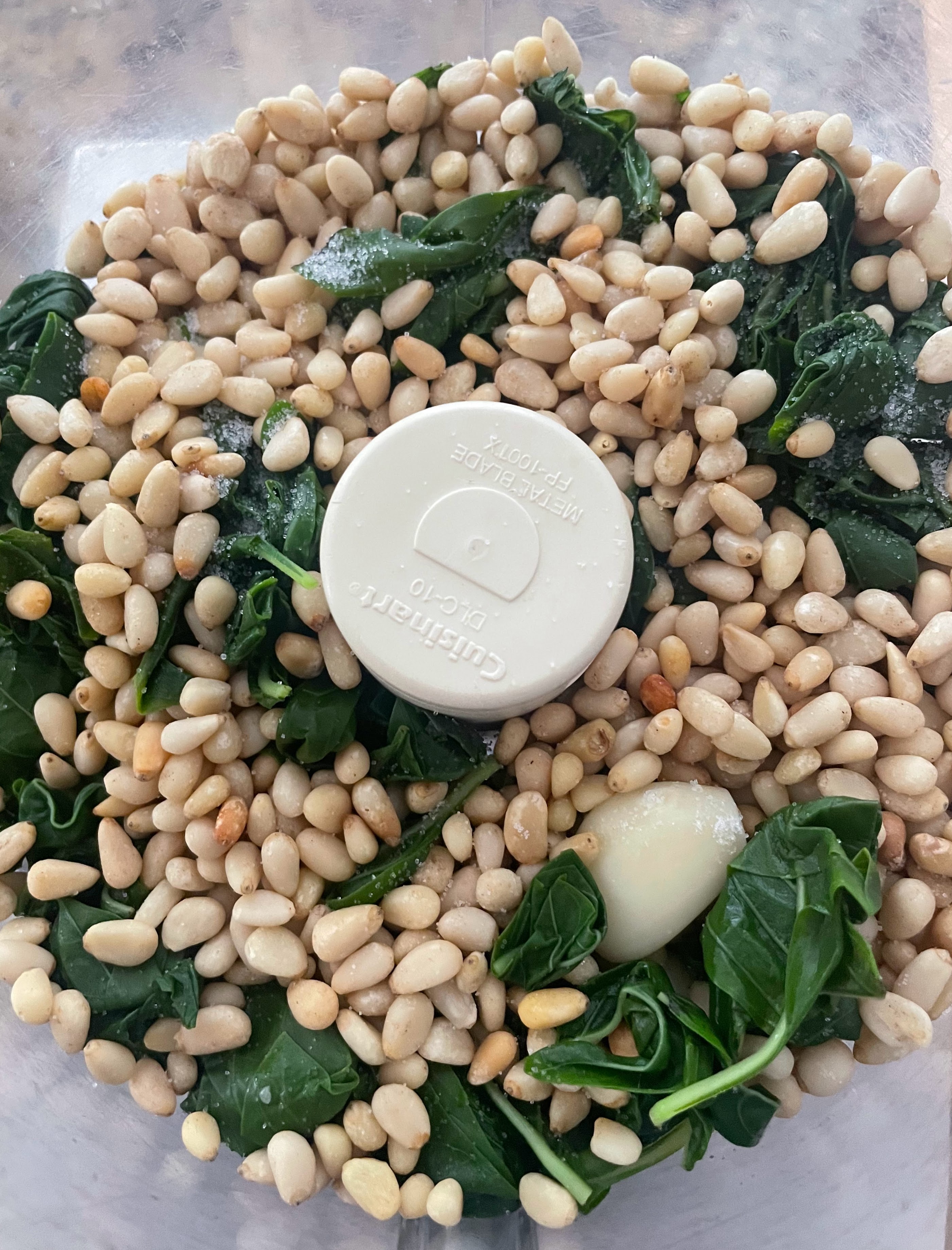
6. If using the pesto the same day, add the cheese and lemon juice, and pulse again very briefly, just long enough to combine. Do a quick taste test to gauge lemon and salt levels; add more if needed. You can also add a bit more olive oil if the pesto seems too thick.
*7. If freezing the pesto, omit the cheese and lemon juice, divide the pesto among three freezer-proof containers, and freeze. When you want to use a batch, thaw it fully and let it come to room temperature. Prior to using, add 1/2 cup grated cheese and a few drops of lemon juice, and mix well. Do a quick taste test to gauge lemon and salt levels; add more if needed. You can also add a bit more olive oil if the pesto seems too thick.
Recipe: Zucchini Carpaccio

26 Jun

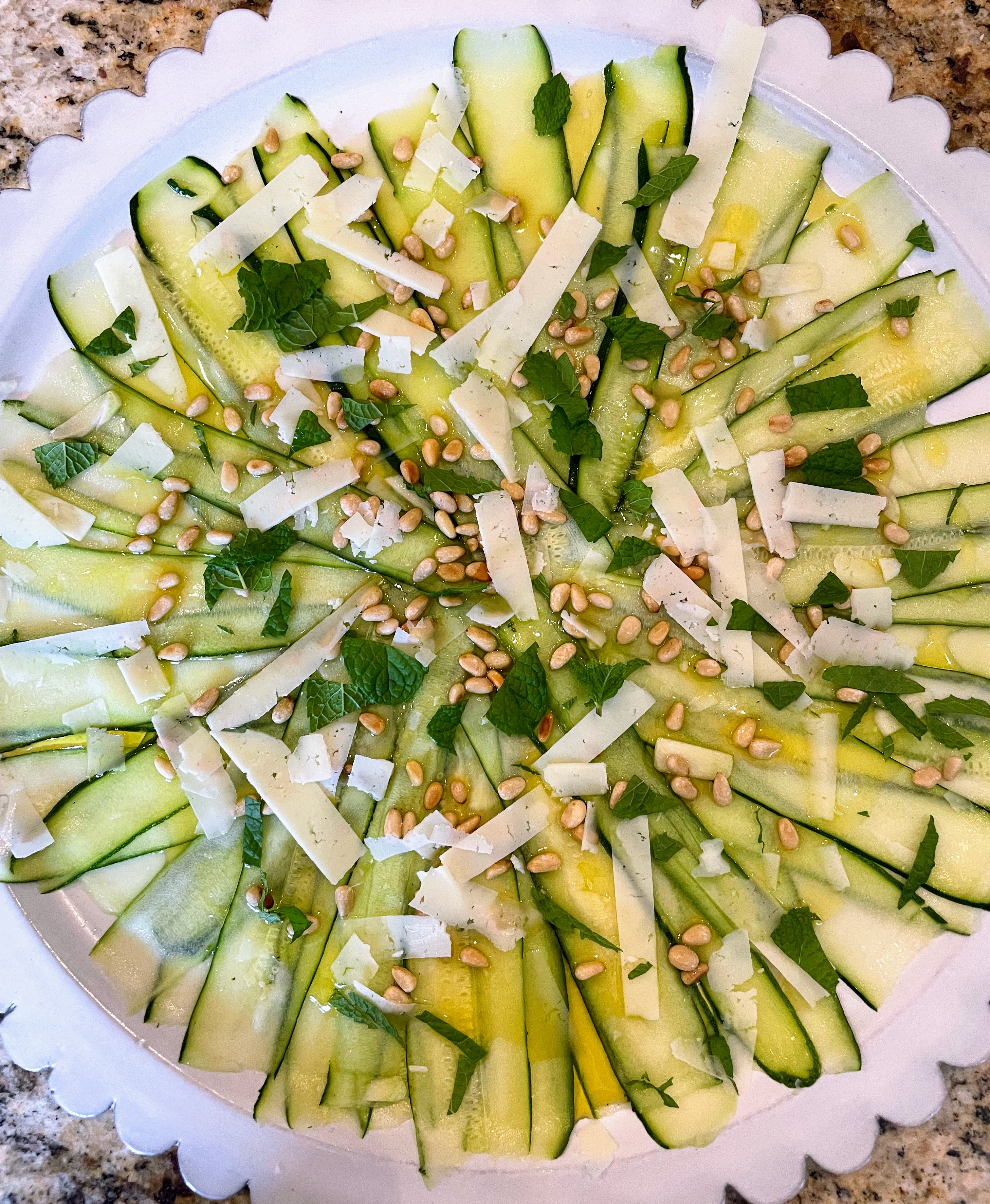
This refreshing, no-cook zucchini recipe (which I very slightly adapted from the New York Times) is just the thing when it’s hot outside, you have zucchini to use up, and you’d like to make an impression. It’s an unusual recipe in that the thinly-sliced zucchini is raw, though nicely marinated and softened in lemon juice (a bit like what happens with ceviche). Definitely worth a try.

Ingredients:
2 medium zucchini
salt
2 garlic cloves, thinly sliced
freshly squeezed juice of 1/2 lemon (or more, as needed)
2-3 tbsp. of the best olive oil you have
2 tbsp. toasted pine nuts
torn or chopped fresh mint, to taste
Optional: 1 tbsp. Parmesan (or Pecorino Romano) shavings, 1 tablespoon currants, 1 tsp. honey, and/or freshly ground black pepper

Directions:
1. Slice zucchini lengthwise with a mandoline or chef’s knife as thinly as you can, and sprinkle lightly with salt. Place in a colander for 30 minutes to remove the excess moisture, tossing occasionally.
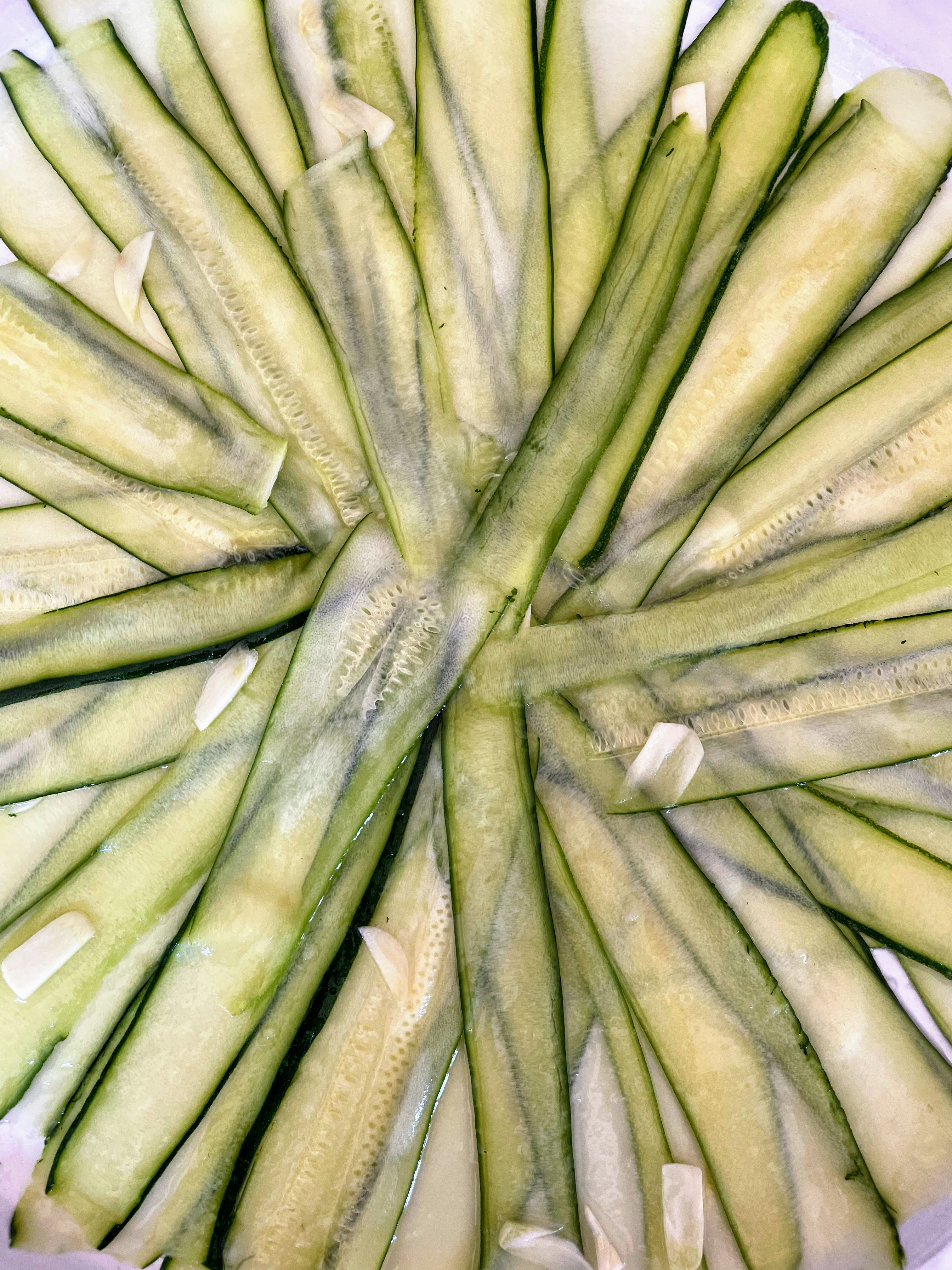
2. Dry the zucchini on paper towels and arrange the slices in layers on a shallow platter or serving dish, adding slices of garlic between the layers, and drizzling each layer with some of the lemon juice (if you run out, squeeze some juice from the other half of the lemon).

3. Marinate, refrigerated, for at least 15 minutes and up to 1 hour.
4. Drizzle olive oil over and top with pine nuts and mint (and any of the optional ingredients, if using).

Recipe: Spinach and Ricotta Gnudi in a Parmesan Cream Sauce with Crispy Prosciutto

16 Mar

If you like gnocchi, or spinach-ricotta ravioli, you may very well also like gnudi. Gnocchi and gnudi are similar, except gnocchi are made with potatoes and have some chewiness, whereas gnudi are made with ricotta and are quite light and soft, which I prefer. In Italian, “gnudi” means “naked ones;” these spinach-ricotta delights are essentially the filling for ravioli, without the pasta to cover it up.

You can eat them with a marinara sauce, which would keep them very light — but I first learned how to make gnudi in a cream sauce with crunchy prosciutto on top, which is what I’ll share here because it is delicious! You can easily omit the prosciutto for a vegetarian main, however.

Ingredients
4 servings

11 oz (300 gr) spinach leaves
2 garlic cloves, minced
extra-virgin olive oil
150 gr whole-milk ricotta (drained if very wet)
1 egg, lightly beaten
150 gr. ( about 2 c.) Parmesan or Pecorino Romano cheese, grated — and divided in half
2-3 tbsp. flour
500 gr. (2 c.) heavy cream
salt and freshly ground pepper, to taste
pinch ground nutmeg

Preparation

1. Preheat the oven to 400F (200C).
2. Rinse the spinach well and cook in a pot with only the water that is clinging to it, until soft and wilted. Remove, drain/squeeze dry, then chop. Put the spinach in a bowl with the garlic and a drizzle of olive oil; toss to combine.

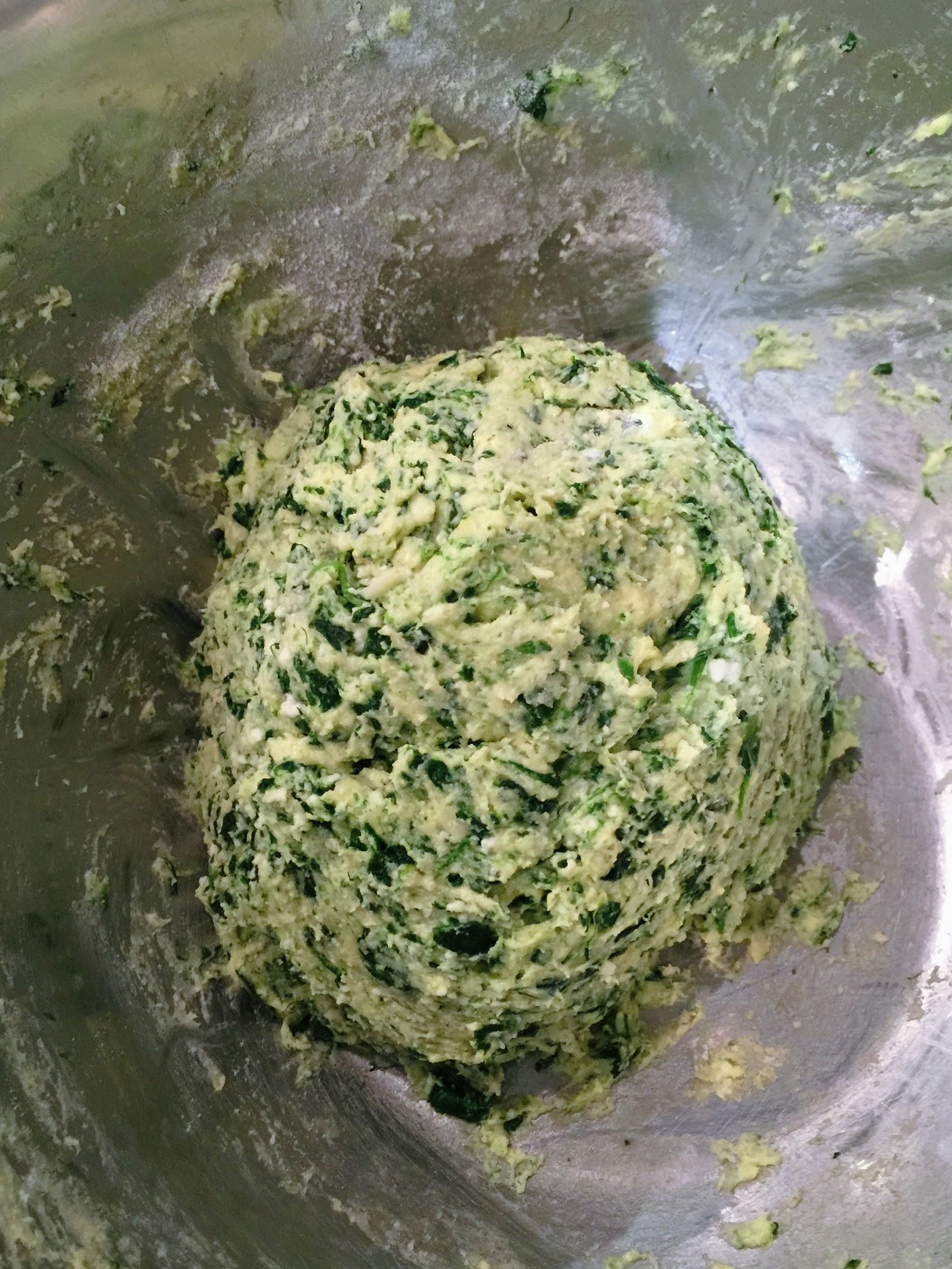
3. Add the ricotta, egg, 1 cup of the grated cheese, flour, a small pinch of salt (but not too much, due to the cheese), and pepper. Mix well, form the dough into a ball, and let rest for 30 minutes.

4. Meanwhile, place the prosciutto on a baking sheet and bake until crispy, keeping a close eye on it as it can go from crispy to burnt very quickly. Let the prosciutto cool, then break into pieces. Set aside.

5. Once the gnudi dough has rested, take pieces of it and roll into logs on flour-dusted parchment paper. Cut the logs into small pieces. Start a big pot of lightly salted water boiling.

6. Make the cream sauce: Bring the cream to a simmer for a couple minutes, stirring continuously. Take it off the heat and add the remaining cup of grated cheese, whisking to incorporate. Season to taste with salt, pepper, and nutmeg (if desired).
7. Gently slide the gnudi in the boiling water (you can take the parchment paper and slowly funnel them into the pot that way, or use a skimmer, spider, or slotted spoon). You may need to add the gnudi to the boiling water in batches; only put enough in to form a single layer across the top of the pot. The gnudi will be ready in just a few minutes — as soon as they float back up to the surface.

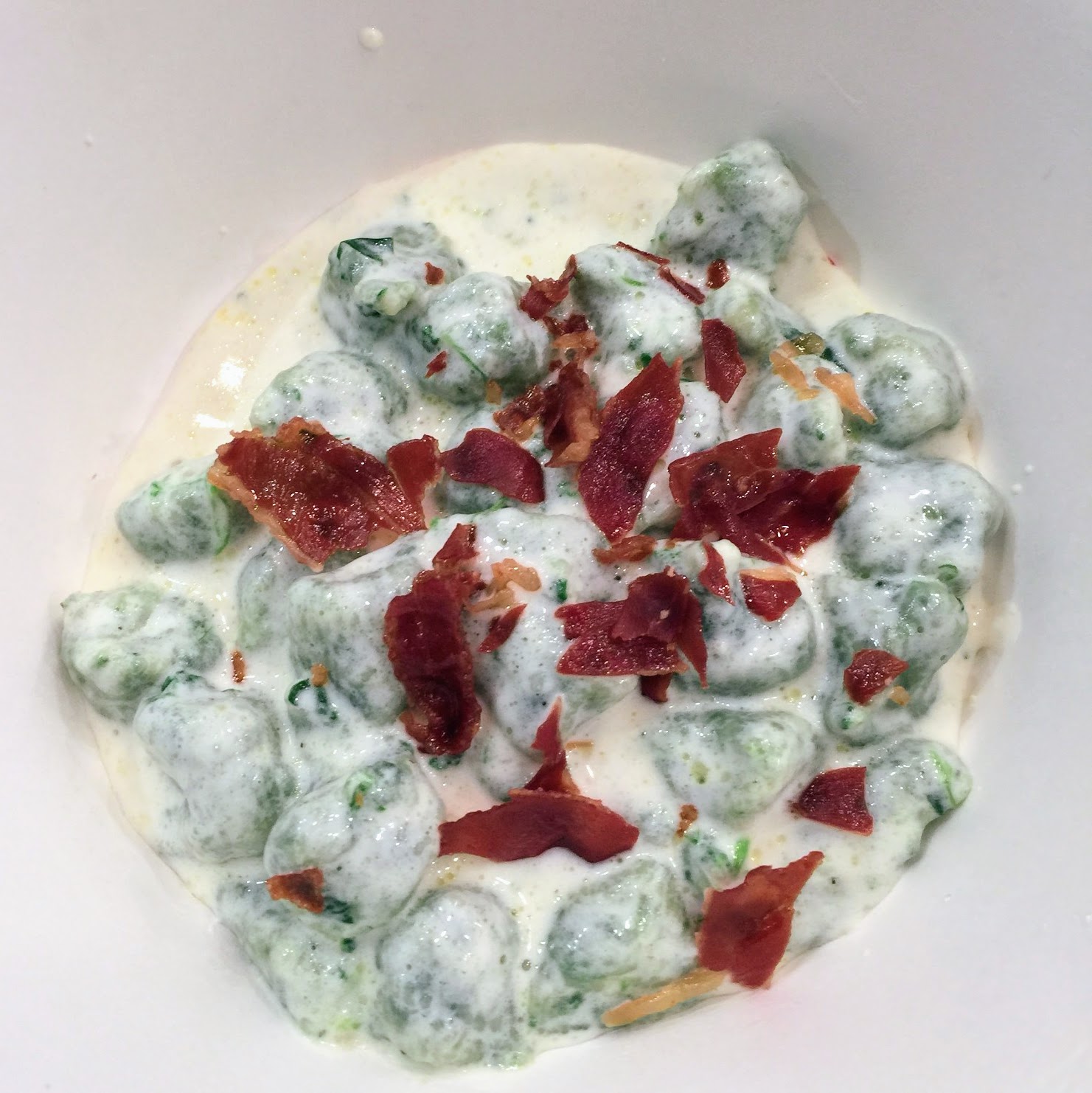
8. Remove the gnudi with the skimmer, spider, or slotted spoon and place them in a serving bowl (or another pot); pour the cream sauce over, adding more grated cheese if desired. Serve in individual bowls with crispy prosciutto on top. Enjoy!

Recipe: Minestrone

8 Oct

I remember a teacher in elementary school bringing our class a batch of “Everything But the Kitchen Sink” cookies, which I’d never had before. I didn’t quite understand the name, so the teacher explained that it meant she had put all sorts of things into the cookies, almost everything in her kitchen but the kitchen sink. That day, I tasted a new cookie and learned a new phrase.

For me, Minestrone is an “Everything but the Kitchen Sink” soup. When the leaves start turning colors in the fall — ie, when soup weather is upon us — and I have vegetables to use up, I immediately think “Minestrone.” In Italian, minestra means “soup;” minestrone means “big soup.” And it really is a big soup, full of so many good things.

Of those good things, there is one without which this cannot be Minestrone, in my view: the cheese rinds. We usually have a wedge of Pecorino Romano cheese in the fridge, and as we get to the last of each wedge, I save the rinds. Without some rind, the soup will not taste like Minestrone; the slow-simmered cheese is a huge part of what makes the broth so delicious.

Aside from the rinds and the soffritto ingredients (onion, carrot, celery; see below), I like to add canned tomatoes, zucchini, white beans, and cabbage or spinach or both (or any other leafy green). Plus pancetta when I have it, potatoes if I need to use some up, and small pasta if there is room.

Today this is what I had at hand:

Fridge:

  • two onion halves (one red, one white)
  • four stalks of celery
  • some leftover grated carrots (about 1.5 c.)
  • zucchini (I had 2, but ended up using only 1 big one)
  • some shredded cabbage, ie ‘cole slaw’ mix (about 4.5 oz/127 gr)
  • baby spinach (about 3-4 handfuls)
  • Some Pecorino Romano and Parmesan ‘heels’ (see photo)

Freezer:

  • Cubed pancetta (4 o oz/113 gr)

Pantry:

  • Yukon Gold potatoes (I had 3, but ended up using only 2)
  • Whole peeled tomatoes
  • Cannellini beans (2 cans, 15.5 oz/440 gr each, undrained)
  • Garlic (3 large cloves)
  • Bay leaves
  • Vegetable bouillon cubes
  • Salt and pepper

Perfect–I had everything I needed for Minestrone! I also had mini pasta sea shells, which I’ve used in Minestrone before, but I did not use them this time; by the time I got to the point where I would have added them, there was no more room in the pot! Plus, dry pasta keeps and I had to use up the potatoes. (If you have pasta but no potatoes or just prefer the pasta, add a handful of that instead.)

For me, Minestrone is a soup I make in ‘layers,’ meaning I start with the first ingredients and while they are cooking, I prep the others, adding them to the pot as I go. Today, I started by cooking the pancetta in olive oil in a large Dutch Oven until it got crispy. (If you are vegetarian, omit the pancetta).

While the pancetta was cooking, I diced the onions and celery, then added them–and the already-grated carrots and a couple bay leaves–to the pot along with a splash more olive oil. This mixture of onions, celery, and carrots is what the Italians call soffritto and the French call mirepoix, and it is the foundation of many great soups. When the veggies got soft, I crushed the garlic cloves straight into the pot, added some freshly ground black pepper, and cooked everything for a couple more minutes. This is what I consider to be Layer 1, made up of a few subparts. [I forgot to take a photo of this, however.]

To start building Layer 2, I added some hand-crushed tomatoes and their juices to the soup pot. If I’d had a can of diced tomatoes, I would have used that instead–but necessity is the mother of hand crushing. With a very clean hand, I gently took a whole peeled tomato from the can, and crushed it into the soup pot, repeating until I had crushed all the tomatoes. [Note: If you will also crush the tomatoes by hand, lower your hand as far as possible into the pot, and crush each tomato very slowly. Otherwise, the likelihood of having crushed tomato all over your back stove wall, and yourself, is extremely high–as I’ve learned from experience.]

Successfully hand-crushed tomatoes; all in the pot, none on me

Then I added the cheese rinds (trimmed of the outer, colored parts) and 4 cups of water and let everything simmer while I diced the potatoes. When the potatoes were ready, I added them, the canned cannellini beans with all their liquid, and a vegetable bouillon cube to the pot, along with more freshly ground pepper. This is Layer 2. I let this simmer, partially covered, for about 10 minutes while I prepped the zucchini for Layer 3.

Nestling cheese rinds into the soup

In Layer 3, I added the diced zucchini and the already-shredded cabbage, and continued to simmer the soup until the zucchini and potatoes were both soft. I also checked the seasonings and decided to add another bouillon cube and a little salt. At that point, my Minestrone was essentially done and ready to serve, so I did the very last thing: I put the handfuls of spinach on top and stirred until the spinach was wilted in.

Then I set the soup pot out for everyone to serve themselves (with everyone getting at least one piece of the now-soft cheese rinds–an absolute treat), along with some freshly grated Pecorino Romano to sprinkle on top. Mmmm. So good on a fall day.

Recipe: Pasta in Cream Sauce with Pancetta and Pecorino Romano

18 Jun

With three children away from home, and the fourth frequently out and about, my husband and I are adapting to eating dinner by ourselves. It is a necessary exercise; in one more year, we will be empty nesters. We have made some adjustments, but not all recipes for six translate easily into a meal for two, so I am beginning to rethink my approach to dinner. Luckily, this recipe is very adaptable and can easily be scaled down (or back up).

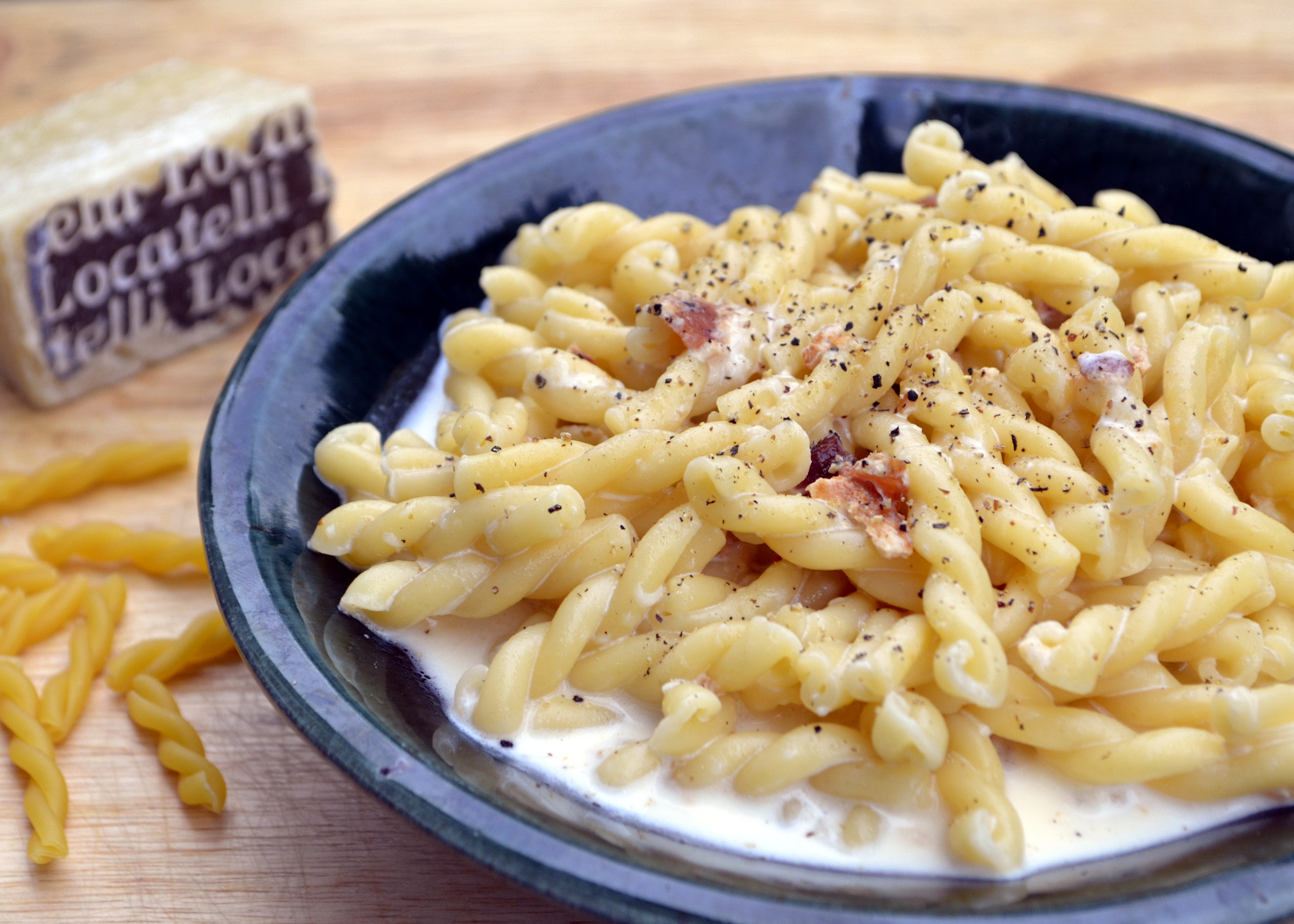
It’s also quick, which makes it perfect for a busy week night. But more importantly, it will satisfy proponents of the two different schools of thought on pasta cream sauces. When this dish is first put on the table, the cream sauce will be fairly thin (as in the photo). In our family, there are staunch supporters of a thinner cream sauce; they say a more liquid consistency allows for maximum “soppage” with a nice piece of crusty bread. Other family members prefer a thicker sauce, which coats the pasta very nicely. Luckily, it’s possible to have it both ways: thinner-sauce aficionados can dig right in; thicker-sauce advocates can nibble on salad or bread and let the sauce cool a bit. Regardless of their sauce philosophies, family members agree on one thing: this is good to the last bite, thick or thin.

Note: Feel free to substitute Parmesan cheese for the Pecorino Romano, and bacon for the pancetta (I used bacon this time, after discovering at the last moment that the pancetta I thought I had in the freezer was a figment of my imagination).

Pasta in Cream Sauce with Pancetta and Pecorino Romano
Serves 2-3

1/2 lb. (227 gr.) pasta; I used gemelli
2 oz. (57 gr.) cubed pancetta [in the U.S., Trader Joe’s sells a 4-oz. package*], or 4 slices bacon, chopped
1/2 tbsp. olive oil
1 small clove garlic, sliced
1 c. (237 ml.) half and half, which is half light cream and half milk (or you can use all light cream or heavy cream–the heavier the cream, the thicker the sauce)
small pinch salt
freshly ground pepper
1/2 c. (about 60 gr.) grated Pecorino Romano or Parmesan cheese

Preparation

1. Bring an ample amount of water to boil in a medium pot and cook the pasta just until it is al dente.
2. While the water is coming to a boil, heat the olive oil over medium heat in a medium saucepan and cook the pancetta/bacon until crisp; remove the pancetta/bacon, place on a paper towel to drain, and set aside. Leave about 1/2 tbsp. of oil/drippings in the saucepan; discard the rest. Add the sliced garlic to the pan and cook just until golden (you do not want the garlic to burn). Remove the garlic and discard. Turn heat to low and add the half and half (or cream). Grind black pepper over the surface of the sauce. Add a small pinch of salt (be conservative at this stage because you’ll be adding salty bacon and cheese to the dish; you can adjust the seasonings afterward). Keep the sauce warm without letting it boil.
3. When the pasta is done, drain it well, return it to the pot, and immediately toss with the cheese. Add the reserved pancetta/bacon, mix well, and then pour the cream sauce over. Stir well and adjust the seasonings (I usually add more pepper at this stage). The sauce will appear thin at first, but will thicken as it cools.
4. Serve with salad and crusty bread.

*I stock up on packages of cubed pancetta and freeze them. Then, I add the frozen, cubed pancetta directly to the hot oil. It cooks (and crisps up) beautifully, and is oh-so convenient.

Recipe: Sausage, Fennel, and Mushroom Pastry Puffs

6 Mar

Puff pastry is a magical ingredient. If you have some in the freezer, you will be able to pull together a savory meal or a sweet dessert in barely more time than it takes to cook the pastry once it has thawed. If you are someone who makes puff pastry from scratch, my hat is off to you. I may get there one day, but for now I am happy to rely on the prepared kind. In this recipe, the onion and fennel almost melt together, adding a subtle layer of flavor to the sausage and mushroom. And crisp, flaky pastry makes everything better.

Sausage, Fennel, and Mushroom Pastry Puffs
Yield: 12 puffs

1 pkg. puff pastry (about 17.5 oz. = 2 sheets), almost thawed
2 tbsp. olive oil
1 lg. onion, finely chopped
1 bulb fennel, trimmed, cored, and finely chopped
8 oz. mushrooms, trimmed and chopped
sprinkle red chili flakes
salt & pepper
6 links sweet Italian turkey sausage (1.5 lb.), casings removed
6 tbsp. grated Parmesan or Pecorino Romano cheese
chopped parsley (optional)

Preparation

1. Let puff pastry thaw while you make the filling — but before the pastry comes to room temperature, unfold it and slice each sheet vertically into three sections along the fold lines (each sheet is folded like a letter), then cut each section in half. After cutting up both sheets, you will have 12 small rectangles of pastry. It is easier to cut the pastry, and to maintain the rectangular shapes, when the dough is still a tiny bit frozen. Set the pastry rectangles to one side in a single layer (if they are touching each other, they may stick together).

2. Heat olive oil over medium heat in a large skillet and add onions and fennel. Cook until onion is soft; add chili flakes (if using) and season with salt and pepper. Add mushrooms to the onion/fennel mixture and cook until liquid is released and mixture is relatively dry. Add the sausage, and cook until all liquid has evaporated, breaking up sausage as much as possible. Check seasonings, then let mixture cool for a few minutes.

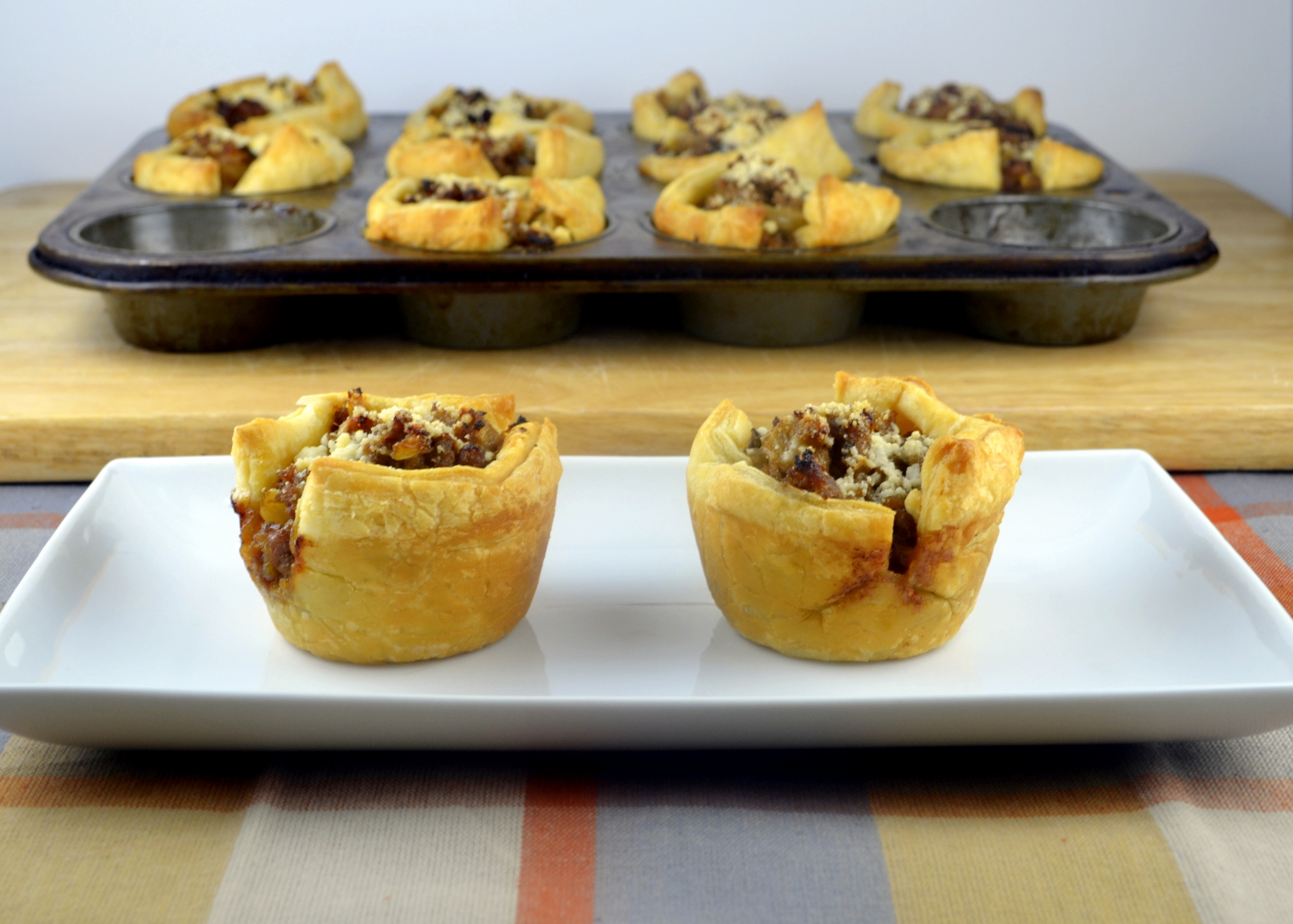
3. Preheat oven to 400 degrees. Spray a 12-cup muffin tin with cooking spray. Place one pastry rectangle into each muffin cup; the edges will drape over, which is fine–the end result will be somewhat free form. Distribute the filling among the muffin cups, sprinkle parsley (if using) and about 1/2 tbsp. Parmesan/Romano on top of each puff, and bring the pastry edges over the filling to loosely cover.

4. Bake until golden, about 30 minutes. Let cool for 5-10 minutes before serving.

Recipe: Savory Baked Salmon

26 Jan

Nine times out of ten when deciding how to prepare fish, I opt for lightly marinated or seasoned fish that is then broiled or grilled — a fresh and simple preparation.  It is a choice that makes me feel virtuous and happy (because, of course, a wise dinner decision opens up all sorts of possibilities for dessert).  But sometimes I find myself yearning for a slightly heartier fish dish that warms the soul in a different way. I don’t pretend this Savory Salmon is light, but it is good–the topping would work on almost any fish. And children like it. I serve it with oven-roasted asparagus and a cucumber-tomato salad.

Savory Baked Salmon
Serves 6

2.5 lb. (1.1 kg.) salmon or other fish fillets
salt and pepper

Topping
1/2 c. mayonnaise
2 tbsp. fresh lemon juice
2 tsp. paprika
sprinkle crushed red pepper (chilli flakes)–roughly 1/4. tsp. , or tiny pinch cayenne pepper
1 tbsp. finely chopped fresh parsley (or 1.5 tsp. parsley flakes)
3 tbsp. grated Parmesan cheese or Pecorino Romano cheese

Preparation

1. For Topping: Combine mayonnaise and lemon juice and stir until smooth; add remaining ingredients and mix well to combine.
2. For Salmon: Sprinkle each fillet with salt and pepper, then generously coat each fillet with topping. Bake at 400 degrees for about 20-30 minutes, or until salmon is cooked through and flakes easily. If topping is not golden, broil briefly, keeping a careful eye on the fish.