
A while back, I trained to be a docent at the US Botanical Garden. But before I could give my first tour, we moved overseas. I really liked the subject of the tour I developed, so I thought I would share part of it here for those of you who are also interested in leaves.
When entering a garden, most people’s eyes (mine included) gravitate toward the flowers. And how could they not? Flowers evolved to attract attention, and they do their job very well. But there are other really interesting plant parts, and leaves are one of them. In a tropical rainforest, leaves are everywhere, in all sorts of sizes, shapes, textures, and patterns:


The main functions of all these leaves are photosynthesis, respiration, and transpiration. Photosynthesis uses sunlight energy (which is absorbed by the chlorophyll found in green plants) to convert carbon dioxide and water into glucose (food for the plant) and oxygen. Respiration does the opposite: it converts oxygen and glucose into water and carbon dioxide; this gaseous exchange occurs via the many stomata (pores) found on leaves and other parts of the plant. Stomata are also the primary sites for transpiration (the process by which plants release water in the form of water vapor).
This post is about some of the many ways leaves in tropical rainforests have adapted to their conditions, in support of these and other functions.
A rainforest has four basic layers—a floor of exposed roots, seedlings, and debris; an understory of stunted trees and shrubs; a high and dense canopy of trees and vines that intercepts most of the sunlight; and an emergent layer, from which the tallest trees emerge to reach the light.
Plants in a rainforest face many challenges: Competition for light, excess moisture in the understory, insufficient moisture in the canopy, too much wind, poor nutrition, hungry insects and other predators, and a host of other nuisances. Leaves are there to help.
Space and light
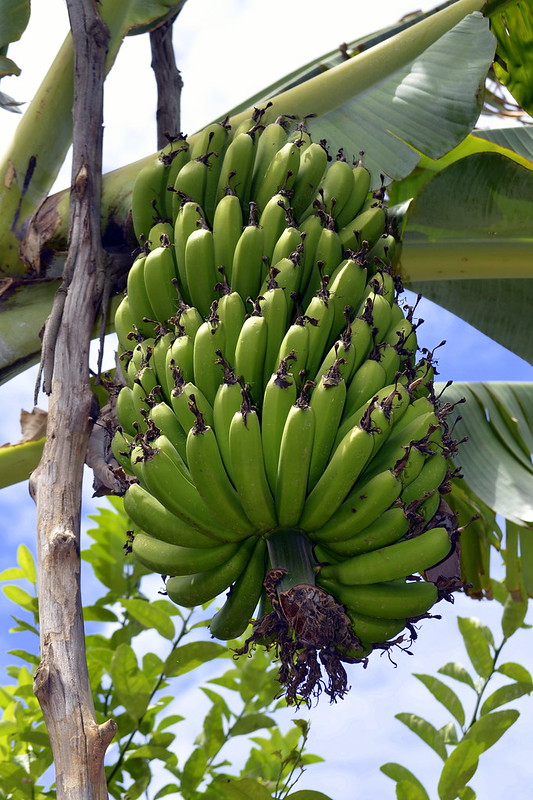
One advantage in the competition for light is to have big leaves, like the Taro and Banana plants below, which live in the understory of the rainforest where light is scarcer. Larges leaves help the plant absorb as much sunlight as possible.


Leaf size is determined to a certain extent by how wet or dry an area is. But as a recent study has shown, it is particularly dependent on temperature — especially cold temperatures. The biggest leaves in the world are found close to the Equator, which is warm and wet. The smallest leaves are found in 1) hot desert areas, which are warm, but not wet; think cactus spines, which are modified leaves, and 2) colder, higher-altitude areas, which can be wet, but are not very warm; think pine needles, which are also leaves. Basically, plants do not want to roast during the day and they really, really do not want to freeze at night. So their leaves have adapted to help them. Small leaves do not require as much water — nor are they as susceptible to frost — as bigger, thicker leaves. Hence their preponderance in deserts and colder areas. In contrast, plants in tropical rainforests have plenty of water and do not have to worry about getting too hot, so the sky is the limit in terms of leaf size. If that is, they can get enough light….
Shade (and protection from insects)
Those bigger-leafed plants make it hard for smaller plants to get the light they need for photosynthesis. Many smaller plants living in the understory of a tropical rainforest are just too little (in stature and leaf size) to compete with the big guys. But their smaller leaves have come to the rescue via pigmentary adaptation. If you see plants with leaves that are green on top and purply-red underneath, like the Calatheas below, they most likely live in low-light conditions. The purply-red undersides provide the plants with a second chance to reflect light energy back into the leaf by ‘catching’ the light that passes through the leaf from the green side, and sending it back through.
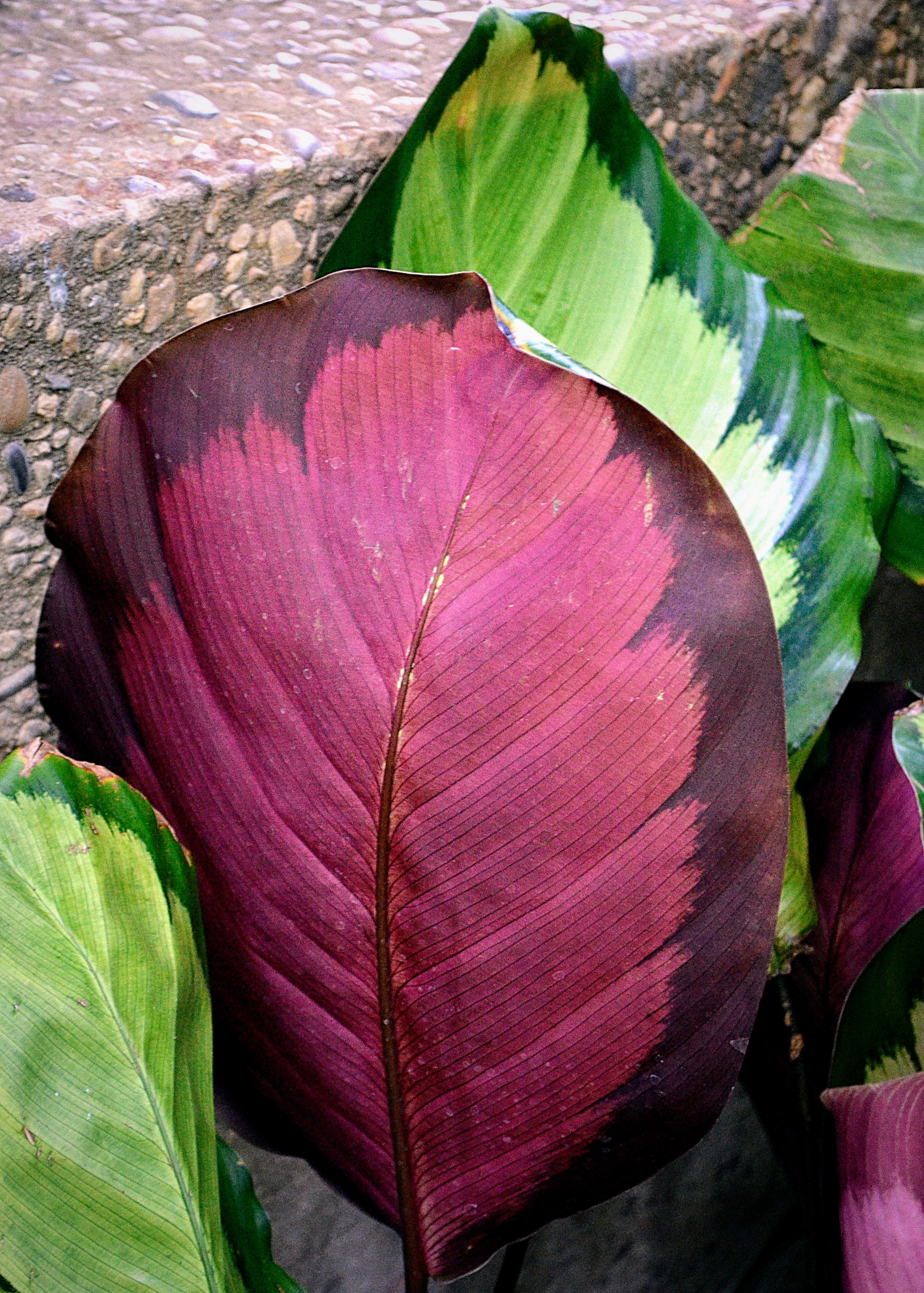


This fascinating adaptation aside, Calatheas are also worth another glance because of their distinctive leaf patterns, which are meant to fool insects. The pattern in the center photo looks like dark green leaves on top of lighter leaves; this confuses insects and tricks them into eating only a small part of the leaf. They see the dark green part as an appetizer and don’t realize they missed their chance to have a whole meal.
Light, wind, and more protection from insects
There are a number of theories as to why many tropical plant species with large leaves, like the Monstera deliciosa below, produce leaves with holes. Technically speaking, this is called fenestration, which means “having small perforations or transparent areas.” In Latin, the word for window is “fenestra,” similar to the Italian “finestra.” So Monstera are plants whose leaves have adapted to have windows in them. One theory is that fenestration helps the plant capture sunlight more efficiently because the plant spends less energy producing big, solid leaves. Another theory is that the holes help the plant withstand heavy wind and rain by letting both pass through more easily. And finally, fenestrated leaves may also be a form of camouflage; they make the plant look a little chewed up, thus discouraging insects who may want a more pristine meal. It’s a tough world out there for insects … sometimes.

Other tropical plants may not have fenestrated leaves, but they have something that serves a similar purpose: segmented leaves. The Ruffled Fan Palm (Licuala grandis) below is an example. It is a small palm that grows in the understory of the rainforest; it is native to Vanuatu island. There is one leaf in the photo below, and its fan shape provides a large area for light absorption. The leaf is cut into segments that can tilt to allow air to pass freely through the fan. During stormy weather, the fan moves with the wind and the segments shift into a more streamlined pattern that allows them to go with the flow, and emerge from the storm unharmed.

Water repulsion
As one would expect in a rainforest, conditions can be quite damp. Generally speaking, water is a great thing, but sometimes, it is just too much, especially if you are a plant living in the soggy understory. If you were getting wet all the time, you’d probably try to figure out how you could get drier. That’s what many leaves in a tropical rainforest have adapted to do, to prevent the plant from becoming susceptible to disease, and also to ensure photosynthesis is not affected (since the gaseous exchange that must occur during photosynthesis becomes difficult when leaves are wet). What are some ways in which leaves have adapted to sogginess? Waxiness and drip tips.
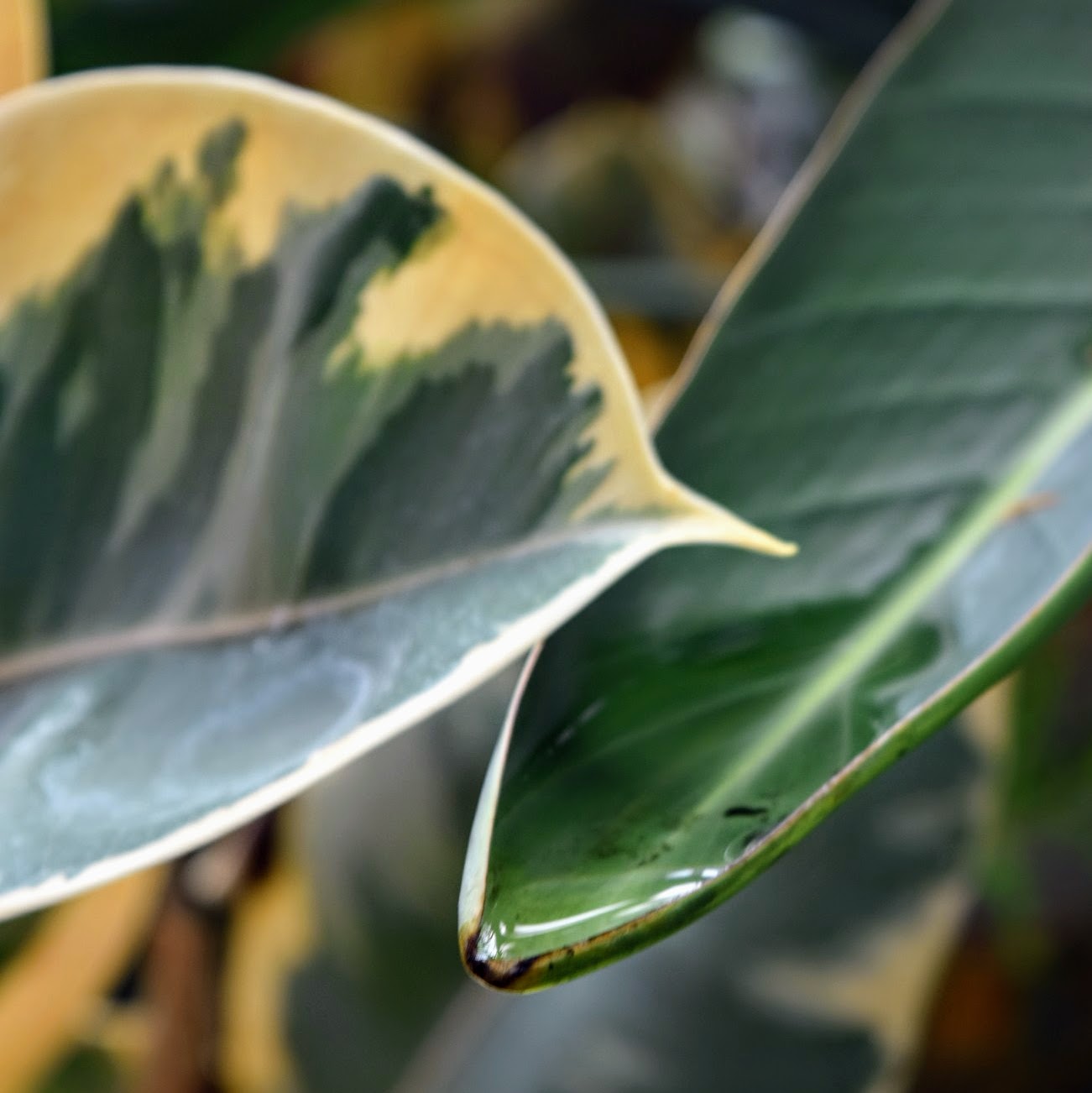

Many leaves in tropical rainforests have waxy coatings to repel water. Interestingly, this adaptation also occurs in arid areas, but for a different reason; the waxy covering on the leaves of some desert plants helps reduce water loss through the leaf surface. In tropical rainforests, many leaves also have a drip tip, the pointy part at the end of the leaf that helps guide water down, and off.
Water capture and wind protection
Other plants in the rainforest have the opposite problem; they need to keep water around. Neoregelia Bromeliads like the one below live in the rainforest canopy, where it is harder to capture water than in soggier areas below. They also have to worry about wind taking away any water that may fall on them. So, their long, stiff leaves have adapted to become channels that funnel water to a reservoir in the center of the plant. This reservoir captures the water and protects it against the wind. Some bromeliad bowls can contain up to several liters (3/4 gallon) of water, and can host a wide range of animals such as tree frogs, snails, flatworms, tiny crabs, and salamanders–many of whom spend their entire lives in the bromeliad bowls.

Nutrition
Though rainforests may have lots of water, they aren’t always able to offer plants the best nutrition. In addition to the food/energy plants get from photosynthesis, they also need other micronutrients and minerals, which they usually pull in through their roots. But rainforest soil is often nitrogen deficient, since nitrogen is easily leeched away by water. So, how to get nitrogen? Pitcher plants like the ones below have adapted in a fascinatingly way to trap insects, which are great sources of nitrogen. Those hanging “pitchers” that you see are modified leaves; the leaf tip elongates and begins to form a pitcher. Sometimes, insects seek shelter from the rain under the “lid” of the pitcher, which is designed to slip them right into a toxic brew. Or they are drawn in by the scent of nectar. Either way, once the hapless victims are caught, the enzymes inside the pitcher start to digest them and derive nitrogen and other nutrients from them. (Did I mention that sometimes, insects have a rough time?)


And that’s it: just a few of the many remarkable ways plant leaves have adapted to the multiple challenges of living in a tropical rainforest.
Read more about other tropical plants such as Strelitzia, Musa, and Heliconia and Banana Flowers or tropical plant parts such as Spathe and Spadix.
[Note: All Perennial Pastimes photos are licensed under a Creative Commons Attribution-NonCommercial 4.0 International License.]







 Perennial Pastimes