Archive | Recipes RSS feed for this section

Recipe: Eggplant with Garlic Vinaigrette

23 Apr

I love eggplant–any which way, shape, or form–and this recipe is one of my favorite ways of making it. Caveat: in addition to liking eggplant, you must really like garlic, too, and you must eat this with other garlic lovers, because this is not a subtle dish–it is very ‘aromatic.’  Nonetheless, it is a beloved dish at our house–my daughter ate almost half of this platter of eggplant by herself!

I have always pan-fried it, pouring liberal amounts of olive oil into the pan as needed–but you could also try grilling whole eggplant slices then drizzling with the vinaigrette. The eggplant is great on its own, but is lovely when combined with other things. For our Mediterranean antipasti/tapas/mezze meal this past weekend, we created mini open-faced sandwiches by slathering pieces of crusty baguette with Turkish Feta Dip with Paprika, then topping with the eggplant and some Roasted and Marinated Bell Peppers. The eggplant is great with pita and hummus, too.

Eggplant with Garlic Vinaigrette

2 eggplants
salt and pepper
olive oil

Vinaigrette:
3 cloves garlic, minced
4 tsp. red wine vinegar
2 tbsp. olive oil
sprinkle chili flakes/crushed red pepper

Preparation

1. Slice eggplant into 1/4-inch slices, sprinkle with salt, and set in colander in sink to drain for about 30 minutes.
2. In a small bowl, combine the vinaigrette ingredients.
3. Rinse eggplant with cold water and pat dry between two dish towels, then cut the slices into quarters. Sprinkle with pepper.
4. Heat a cast-iron frying pan on medium-to-high heat, add a liberal amount of olive oil, then add eggplant quarters in batches (a single layer at a time). Cook until eggplant is dark golden brown on all sides, turning eggplant over with tongs to ensure even cooking, and adding more olive oil as necessary.
5. When each batch is done, arrange on serving plate and use a small spoon to drizzle a tiny bit of the vinaigrette onto each piece of eggplant while the eggplant is still hot (try to get a bit of garlic on each piece). Continue cooking all eggplant in batches, drizzling each batch with the garlic vinaigrette. The eggplant will soak up the vinaigrette.
6. Serve at room temperature.

Adapted from Joanne Weir’s From Tapas to Meze.
Recipe: Roasted and Marinated Bell Peppers

21 Apr

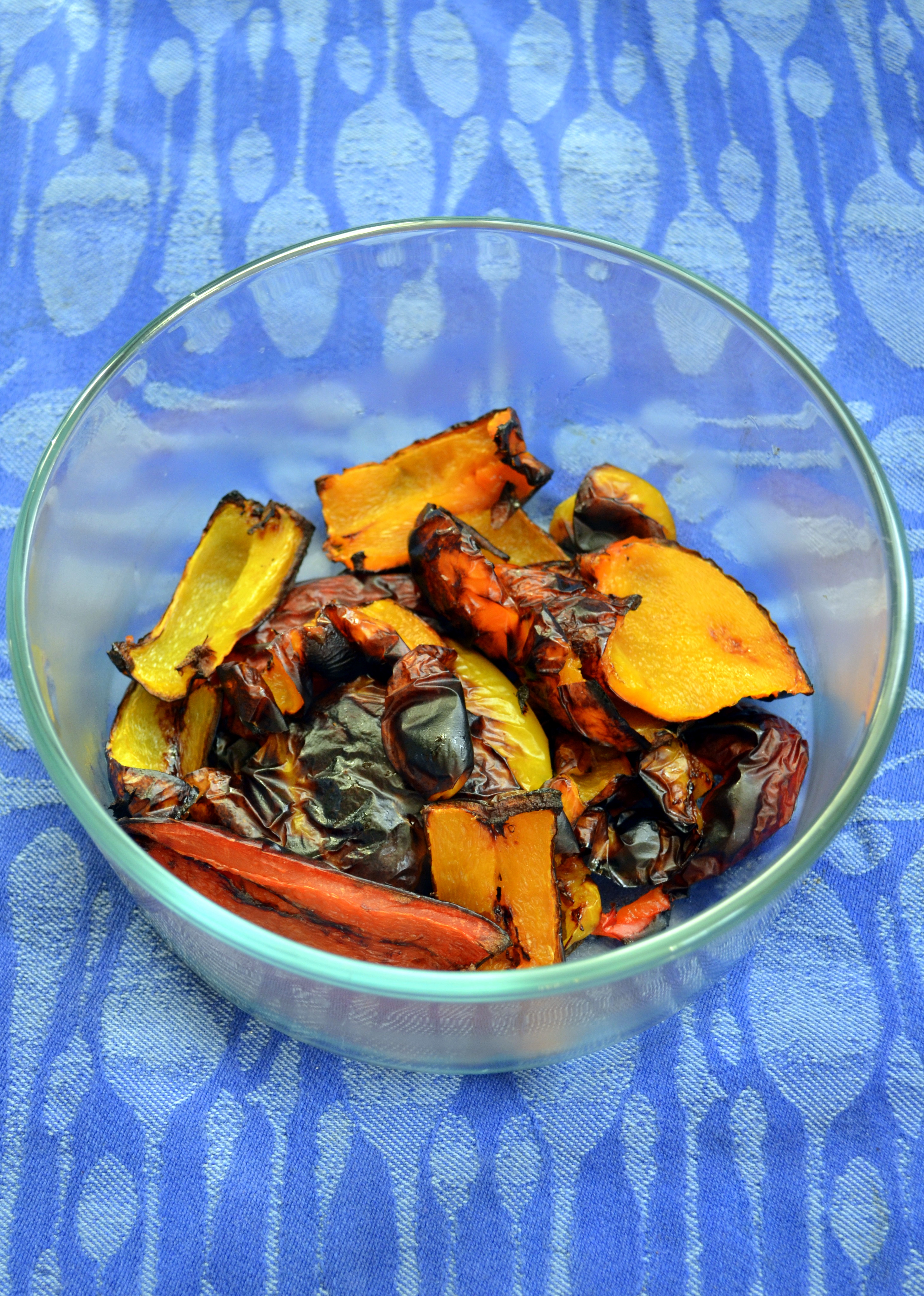
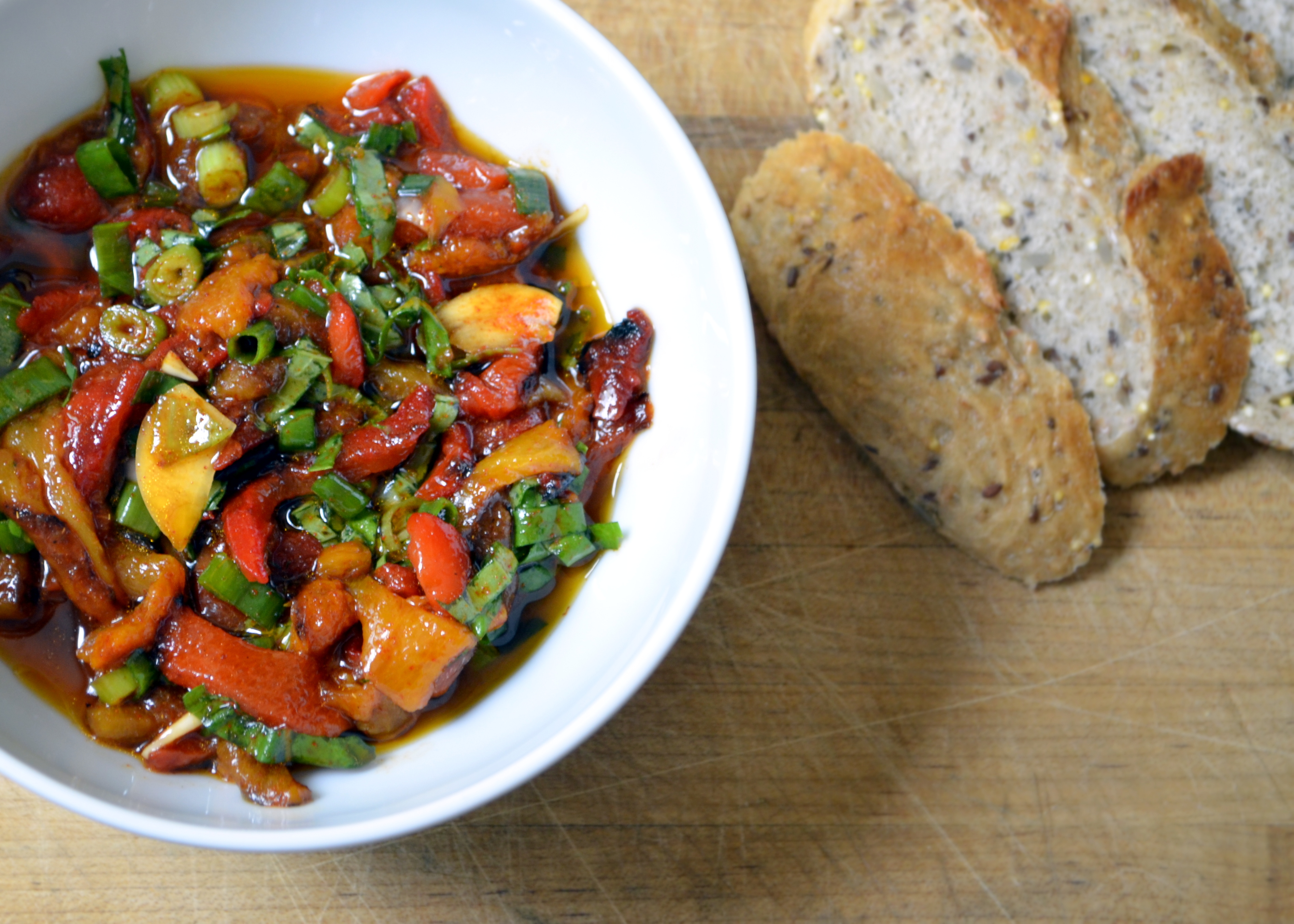
Fresh from my trip to Italy and with lots to do to get ready for the work week, I decided to prepare a Mediterranean antipasti-tapas-mezze meal made up of little dishes, simple ingredients, and nice bread. These Roasted and Marinated Bell Peppers are part of that meal, and they can be made ahead — they get better the longer they marinate. You can use all red peppers, or any combination of red, yellow, or orange that suits your fancy. In this case, I used one of each color.  I forgot the parsley before taking the photo, but will try to remember to sprinkle some on top before serving! With or without parsley, this is a nice addition to any Mediterranean multi-dish meal.

Roasted and Marinated Bell Peppers

3 large red, yellow, or orange (or combination) bell peppers
1/4 c. olive oil
2 tbsp. red wine vinegar
1 clove garlic, finely sliced
1 bay leaf
1 tsp. paprika
1 spring onion, sliced
5-6 leaves fresh basil
2 tsp. coarsely chopped parsley

Preparation

1. Turn on broiler.
2. Cut peppers into quarters; remove all seeds and membrane. Place peppers on baking sheet, skin-side up.

2. Broil until skin blackens, then put peppers into container with lid, cover tightly, and let cool.

3. When cool, carefully peel the skin off the peppers, and cut peppers diagonally into thin slices.

4. Add the remaining ingredients to the peppers, stir to combine, and marinate for at least 3 hours (or overnight) before serving.

Adapted from the Australian Family Circle Tapas booklet.

Recipe: Easy Weeknight Chili

27 Mar

The snow from a few days ago is now gone, but spring is taking its time getting here. The blustery weather means warm and comforting soups and stews are still on the menu, but I don’t usually get home from work until after 6 pm, so I need quick and easy options like this chili. I make other versions that require more ingredients, more prep time, and more cooking time and though they are well worth the effort, this is my go-to chili for busy weeknights. If you have ground beef or turkey on hand, and canned tomatoes and beans in your cupboards, then you are good to go. We like to top this chili with diced onions, shredded cheese, and crushed tortilla chips. It also goes very nicely with cornbread, which can be made while the various parts of the chili are cooking.

Easy Weeknight Chili
Serves 6

3 tbsp. olive oil, divided
1.25 lb. lean ground beef or turkey
1 large onion, diced
4 large garlic cloves, minced
1 tbsp. chili powder
1 tsp. ground cumin
1 tsp. dried oregano
2 (14.5-oz.) cans diced tomatoes with jalapeno (or use plain diced tomatoes and add a 4-oz. can of diced green chilies)
1 (14.5-oz.) can crushed tomatoes
1 (15.5-oz.) can dark red kidney beans, drained (but reserve liquid in case it is needed)
1 (15.5-oz.) can light red kidney beans, drained
pinch sugar
salt and pepper to taste

Preparation

1. Cook the ground beef or turkey in 1 tbsp. olive oil in a large heavy-bottomed pot until no longer pink; remove from pot, drain if needed, and set aside.
2. Add the remaining 2 tbsp. olive oil to the pot and cook the onion in the oil until it is translucent and beginning to turn golden at the edges. Add the garlic and cook for 2 more minutes. Add the chili powder, cumin, and oregano, and cook for another 2 minutes, stirring frequently.
3. Add the diced and crushed tomatoes, the reserved ground beef or turkey, and the beans; stir to combine. Add a pinch of sugar, then salt and pepper to taste.
4. Simmer for 20-30 minutes, stirring periodically. If the chili seems too thick, add some of the reserved bean liquid. Adjust seasonings as needed.
5. Serve with the accompaniments mentioned above, and perhaps a green salad and fruit.

Recipe: Cornbread

25 Mar

In our early marriage days, my husband and I used to make cornbread, corn muffins, and cornmeal pancakes from a well-known small-box mix.  But then we moved overseas, where there were no boxed mixes, and a whole new world opened up–we had to bake everything from scratch. Today, we still bake from scratch — no longer out of necessity, but because it tastes so good and requires very little extra effort. And of course, any excuse to bake is a good excuse. Here is a very basic but very good cornbread recipe, not out of the box.

Cornbread
9 servings

1 c. flour
1. c cornmeal
3 tbsp. sugar
4 tsp. baking powder
1 tsp. salt
1 c. milk
1/4 c. canola oil
1 egg, lightly beaten

Preparation

1. Heat oven to 425 degrees. Spray a 8- or 9-inch square pan with cooking spray.
2. In medium bowl, combine first 5 ingredients. Stir in remaining ingredients, beating by hand just until smooth.
3. Pour batter into prepared pan and bake for 20-25 minutes, or until toothpick inserted in center comes out clean.

Slightly adapted from Pillsbury Kitchens’ Cookbook.

Recipe: Baked Sweet Potato Fries

13 Mar

In the United States, grocery stores offer both sweet potatoes and yams, which are not botanically related. Except that here, they are one and the same.  The “yams” sold in the United States are orange-fleshed sweet potatoes. Real yams are starchy and drier than sweet potatoes and have a rough and shaggy exterior. The problem is that white-fleshed sweet potatoes arrived on American shores first, so when the orange-fleshed versions put in an appearance, they were labeled as “yams” to avoid confusion. In the end, Americans have become more confused than ever.

On the plus side, the orange-fleshed sweet potato (AKA “yam” in the United States) is an excellent source of beta-carotene, which is responsible for the orange color. Beta carotene protects cells from pesky free radicals and is also converted into Vitamin A.

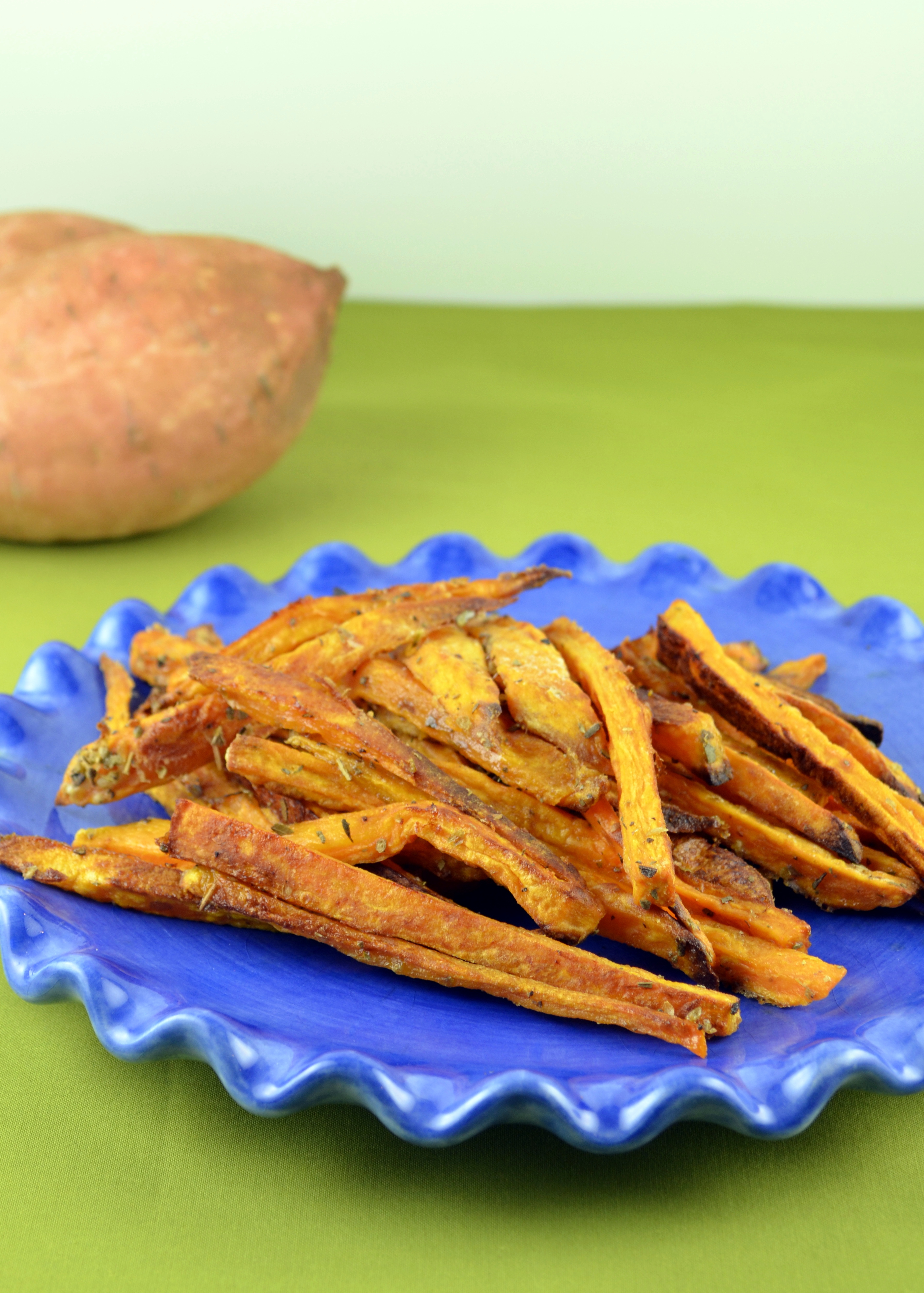
But all that aside, sweet potatoes are delicious — especially in the form of sweet potato fries, which make a regular appearance (and disappearance) at our house. These fries are crispy on the outside and soft, sweet, and rich on the inside. And since the olive oil they are tossed in enhances the absorption of the beta carotene, eating these super fries is a win-win situation all around.

Baked Sweet Potato Fries
Serves 4-6

4 sweet potatoes, peeled and sliced into thin strips
6 tbsp. olive oil
2 tbsp. cornstarch/arrowroot powder/wheat flour/rice flour
2 tsp. salt
2 tsp. dried oregano

Preparation

1. Heat oven to 450 degrees. Spray two large baking sheets with cooking spray.
2. Place sweet potato strips in large bowl; toss with olive oil.
3. Add remaining ingredients; toss well to combine.
4. Place the sweet potato strips on the baking sheets, in one layer.
5. Bake for 40-45 minutes, or until golden.
6. Enjoy!

Recipe: Sausage, Fennel, and Mushroom Pastry Puffs

6 Mar

Puff pastry is a magical ingredient. If you have some in the freezer, you will be able to pull together a savory meal or a sweet dessert in barely more time than it takes to cook the pastry once it has thawed. If you are someone who makes puff pastry from scratch, my hat is off to you. I may get there one day, but for now I am happy to rely on the prepared kind. In this recipe, the onion and fennel almost melt together, adding a subtle layer of flavor to the sausage and mushroom. And crisp, flaky pastry makes everything better.

Sausage, Fennel, and Mushroom Pastry Puffs
Yield: 12 puffs

1 pkg. puff pastry (about 17.5 oz. = 2 sheets), almost thawed
2 tbsp. olive oil
1 lg. onion, finely chopped
1 bulb fennel, trimmed, cored, and finely chopped
8 oz. mushrooms, trimmed and chopped
sprinkle red chili flakes
salt & pepper
6 links sweet Italian turkey sausage (1.5 lb.), casings removed
6 tbsp. grated Parmesan or Pecorino Romano cheese
chopped parsley (optional)

Preparation

1. Let puff pastry thaw while you make the filling — but before the pastry comes to room temperature, unfold it and slice each sheet vertically into three sections along the fold lines (each sheet is folded like a letter), then cut each section in half. After cutting up both sheets, you will have 12 small rectangles of pastry. It is easier to cut the pastry, and to maintain the rectangular shapes, when the dough is still a tiny bit frozen. Set the pastry rectangles to one side in a single layer (if they are touching each other, they may stick together).

2. Heat olive oil over medium heat in a large skillet and add onions and fennel. Cook until onion is soft; add chili flakes (if using) and season with salt and pepper. Add mushrooms to the onion/fennel mixture and cook until liquid is released and mixture is relatively dry. Add the sausage, and cook until all liquid has evaporated, breaking up sausage as much as possible. Check seasonings, then let mixture cool for a few minutes.

3. Preheat oven to 400 degrees. Spray a 12-cup muffin tin with cooking spray. Place one pastry rectangle into each muffin cup; the edges will drape over, which is fine–the end result will be somewhat free form. Distribute the filling among the muffin cups, sprinkle parsley (if using) and about 1/2 tbsp. Parmesan/Romano on top of each puff, and bring the pastry edges over the filling to loosely cover.

4. Bake until golden, about 30 minutes. Let cool for 5-10 minutes before serving.

Recipe: Raspberry Oatmeal Bars

25 Feb

Quick, easy, and full of oaty goodness, these bars work multiple jobs: they can be a snack, dessert, or even part of breakfast. They are also a good way to use up jam or preserves if, like us, you have a variety of half-full jam jars in the fridge (a state of affairs that arises when family members each have a favorite). Whenever I want to clear out the fridge, I make these bars. But truthfully, fridge clearing isn’t the main reason to make these; we quite frequently open new jars of jam just for this recipe, starting the cycle all over again. The bars are worth it.

This weekend, I actually did use up all that remained of a jar of regular raspberry preserves, but there wasn’t quite enough for the recipe. Solution? I topped up the measuring cup with a bit of black raspberry jam. That’s the other good thing about these oatmeal bars –they are very versatile: a blackberry, blueberry, cherry, or strawberry/rhubarb filling would work quite nicely, too.

Raspberry Oatmeal Bars
9 or 16 servings

3 c. quick-cooking oats
2/3 c. whole wheat flour
1/2 tsp. salt
2/3 c. canola oil
1/2 c. maple syrup
2 tsp. vanilla
2/3 c. raspberry (or other fruit) preserves/jam, stirred until smooth

Preparation

1. Preheat oven to 350 degrees. Spray a 9×9-inch baking pan with cooking spray (or lightly oil the pan).
2. Combine dry ingredients in a large bowl.
3. Combine wet ingredients, and add to dry ingredients, mixing well.
4. Put half of oat mixture into baking pan, and press firmly and evenly into place with the back of a spoon.
5. Spread the preserves/jam evenly over the oat layer. Loosely cover the filling with the remaining oat mixture.
6. Bake for 35-40 minutes; let cool 15 minutes before serving.
7. Cut into 9 squares for hearty servings, or 16 squares for smaller bites.

Recipe: Stuffed Grape Leaves

13 Feb

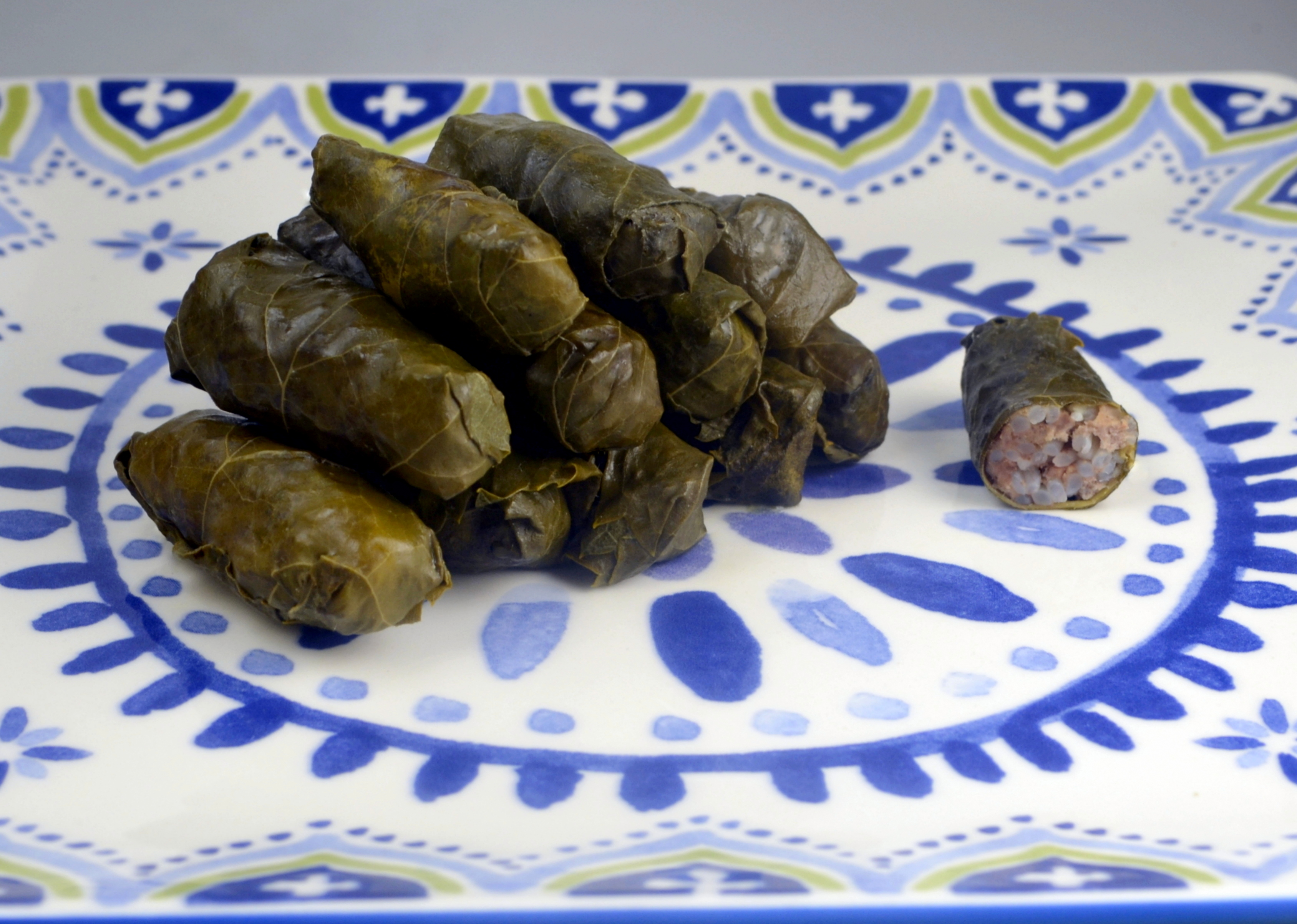
I would be hard pressed to come up with a last meal. I like so many foods, that I’d want something more along the lines of a smorgasbord. But one dish that would certainly be part of that smorgasbord would be stuffed grape leaves — the warm, simple, and oh so heavenly Lebanese version made with a lemony lamb and rice filling. In my very biased view, the versions of stuffed grape leaves that are meant to be eaten cold (usually meatless) cannot compare with their fragrant, hot-out-of the pot counterparts.

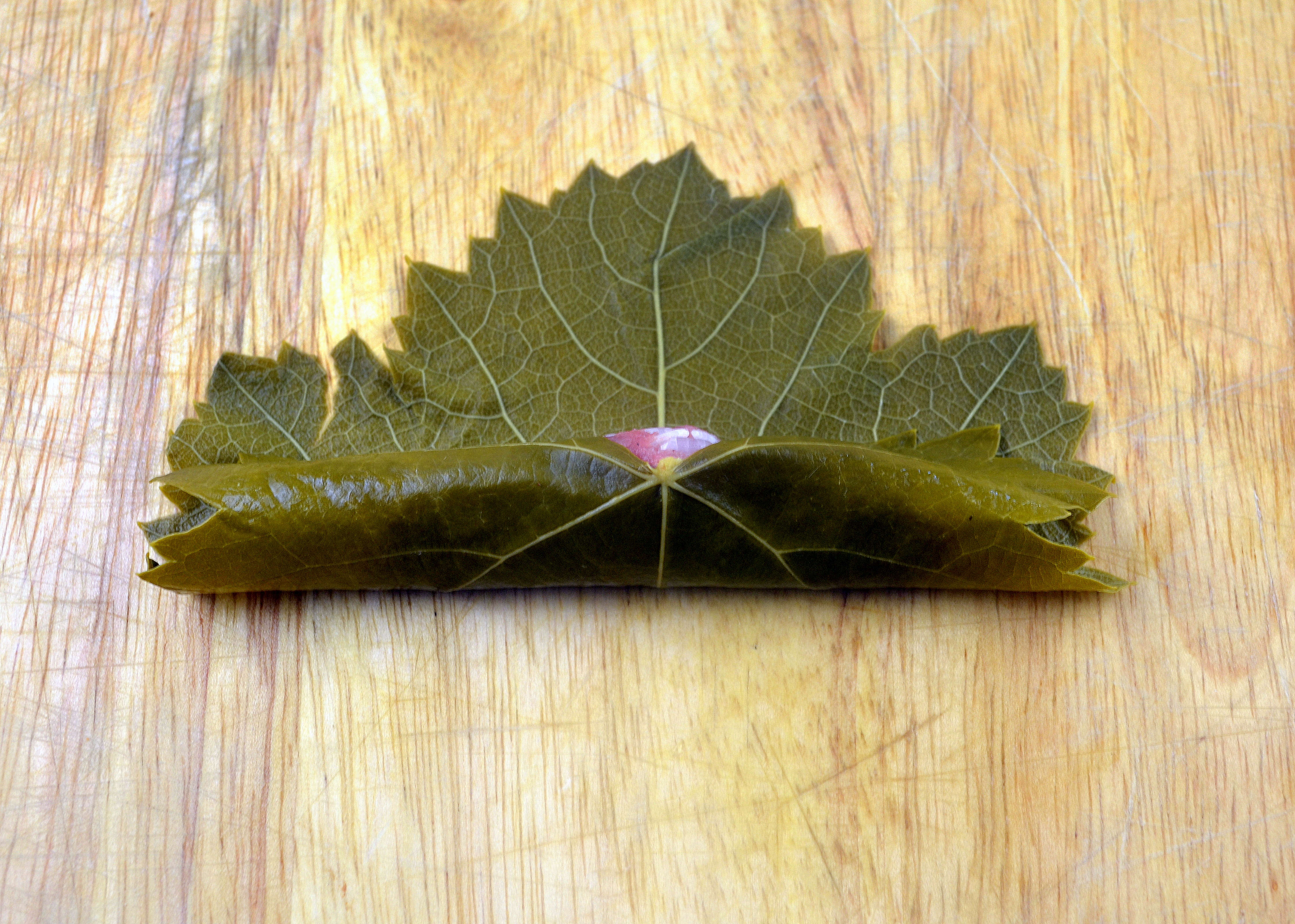
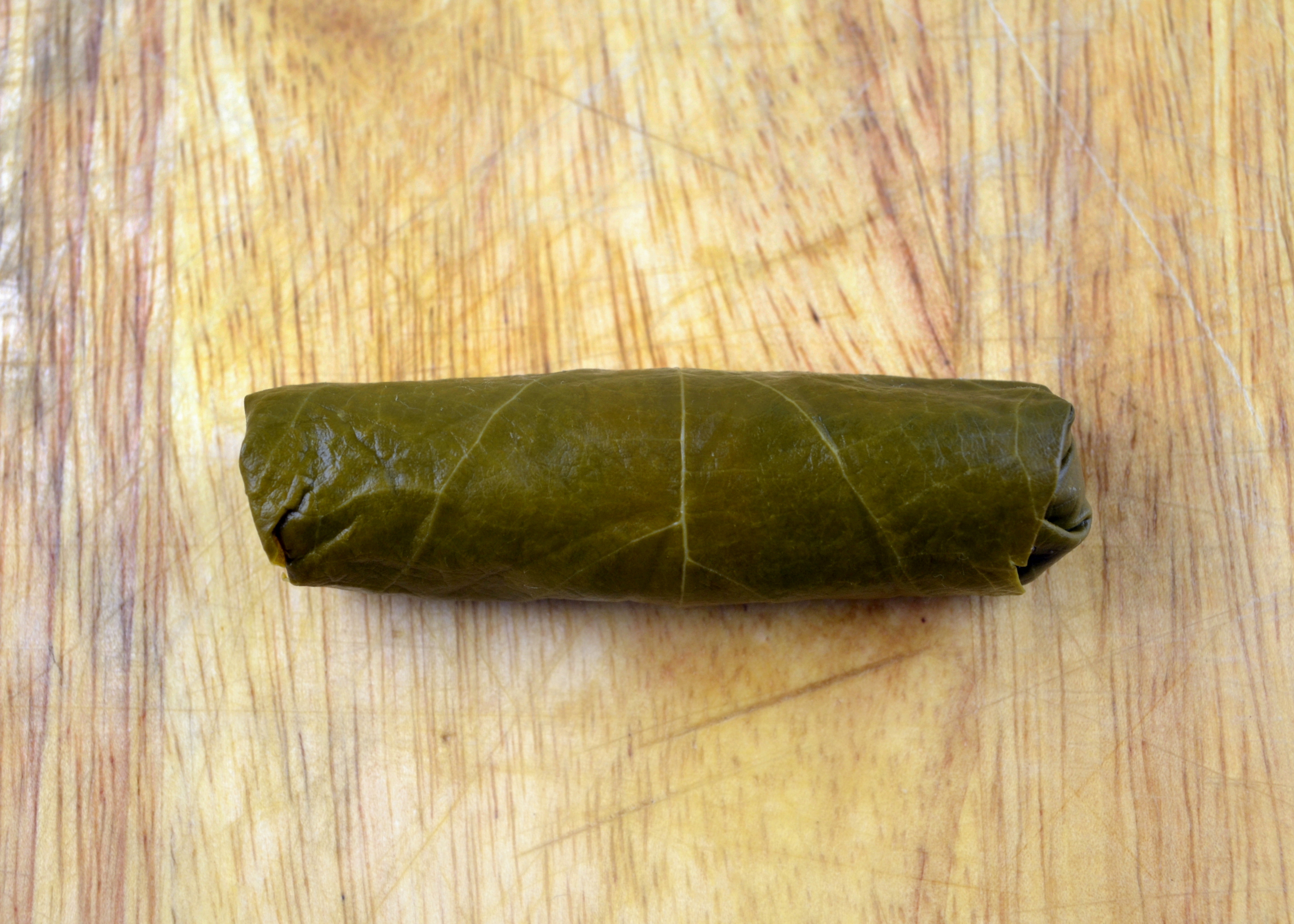
For a sublime gastronomic experience, dip these grape leaves in plain yogurt. The cool, smooth tanginess complements them perfectly. See photos below for step-by-step instructions on how to fill and roll grape leaves.

Stuffed Grape Leaves

1 (15-oz. ) jar grape leaves in vinegar brine
1 lb. ground lamb
1 c. white rice, such as jasmine
1/8 tsp. cinnamon
1/8 tsp. allspice
1 tbsp. salt
1/4 c. fresh lemon juice

Preparation

1. Open the jar of grape leaves, pour out the brine, and carefully ease the grape leaves out of the jar. (They will be tightly packed, in rolls.)
2. Put the grape leaves in warm water and let soak while making the filling.
3. For filling, combine lamb, rice, cinnamon, and allspice in a medium bowl, and mix well. Set aside.
4. Gently swish grape leaves around in the warm water, and slowly begin to separate as many as possible, taking care to not tear them. When most have come out of their rolls, drain the water.
5. Line the bottom of a medium saucepan with a layer of grape leaves (this is a good way to use any that are torn or too small).
6. Select a grape leaf and shake to remove any excess water that may be clinging to it. Place it on a cutting board glossy side down (veiny side up).  If there is a bit of stem still attached, cut it off (see photo below).

7. Take a bit of filling and shape into a small roll; lay horizontally across grape leaf, just above where the stem was.

8. Fold the bottom part of the grape leaf over the filling.

8. Tuck in each side, as if making a burrito.

9. Continue to roll the grape leaf, folding in the sides as you go.

10. Place the rolled grape leaf seam side down in the sauce pan, tucking tightly against the side of pan.

11. Repeat the process until you have run out of filling. Depending on the size of the saucepan, you should have about two layers of rolled grape leaves. Be sure to tuck them in tightly; you do not want them to unroll while cooking.
12. Sprinkle the 1 tbsp. salt on top of the grape leaves. Add enough water to the pan to just cover the grape leaves. Place an inverted heat-proof ceramic plate on top of the grape leaves (you can also use the lid of a smaller saucepan–you will need something that fits inside the main saucepan and can lay on top of the grape leaves to keep them from shifting while cooking). Cover the saucepan with a tight-fitting lid.
13.  Cook, covered, over medium heat for 15 minutes. Lift the lid, and pour in the lemon juice (you can pour it around the sides of the plate; it will seep underneath). Replace the lid, reduce heat to low/simmer, and cook for 15 more minutes, checking periodically to make sure the water has not completely dried up. Ideally, the water will be absorbed by the end of the cooking period, but you don’t want to run the risk of burning the grape leaves.
14. After 15 minutes, gently pour out any water that might remain, holding the grape leaves in place with the plate (or small lid).
15. Invert the sauce pan onto a serving platter, discard the grape leaves that lined the pan, and serve the stuffed grape leaves immediately, with plain yogurt as an accompaniment.

Adapted from Lebanese Cuisine, by Madelain Farah.

Recipe: Tortilla Soup

5 Feb

Twenty-four years ago today, my husband and I had our first date at an El Torito Mexican restaurant in Georgetown, Washington DC, whereupon I not only polished off a full platter of food, but found extra room for dessert, too. Ah, the joys of youth (and first dates). My future husband was amazed, but that was because he did not yet appreciate the magnitude of my sweet tooth — in my view, there’s always room for at least a little dessert.

The restaurant is now gone and my ability to eat that much dinner has gone with it. So on the anniversary of that first date, I present a light meal that was an El Torito favorite: Tortilla Soup. If you have this for dinner, you will certainly have room to satisfy any sweet cravings afterward.

This recipe calls for chicken, but a vegetarian version could easily be made without the chicken and using vegetable broth/bouillon instead of chicken broth/bouillon. A vegan version would also omit the cheese.

Tortilla Soup

[Updated instructions 2/7/2015]

3 chicken breast halves (about 1.5 lb.)
7 c. chicken broth
1 onion, diced
2 carrots, diced
2 stalks celery, diced
1/2 green bell pepper, seeded and diced
1 potato, diced
1/4 c. tomato paste
2 bay leaves
2 cloves garlic, sliced
1 tsp. oregano
1 tsp. cumin
salt and pepper to taste
1 zucchini, diced
1 tomato, diced
1/4 jalapeno pepper, seeded and thinly sliced
chicken (or vegetable) bouillon powder or cubes to taste
juice of 1/2 lime

Accompaniments:
corn tortilla strips (see cooking instructions below; will need 5 corn tortillas and canola oil)
1 1/2 c. shredded Monterey Jack cheese
2 avocados, sliced
3/4 jalapeno pepper, seeded and thinly sliced
chopped fresh cilantro

Preparation

1. Heat the broth in a large pot over medium heat. Add chicken breasts, reduce heat, and gently poach the chicken. [Note: Whenever possible, I like to poach the chicken ahead of time and let it cool in the broth: bring the chicken and broth to a simmer, turn down the heat so that the liquid ripples but doesn’t actually boil, cover the pot, poach the chicken for about 15 minutes–skimming the broth as needed–then turn off the heat and let the chicken breasts cool in the broth for about half an hour. If time is short, poach the chicken for 20-25 minutes, skimming as needed, remove from the pot, and transfer to a plate to cool.]
2. Add onion, carrots, celery, bell pepper, potato, tomato paste, bay leaf, garlic, oregano, cumin, and a dash of salt and pepper to the broth in the soup pot. Bring to a boil,  reduce heat and simmer, covered, 25 minutes.
3. While soup is simmering, cut the 5 corn tortillas into quarters and then cut each quarter into thin strips; leave the strips on the cutting board until ready to cook. Shred the cool chicken with a fork or clean fingers, and set aside.
4. Heat canola oil over high heat in heavy skillet (should be at least 1- to 1.5-inch depth of oil). When oil is very hot, add a layer of corn tortilla strips. Fry until golden, flipping as needed to ensure even coloring. Drain tortilla strips on a layer of paper towels. Repeat until all strips have been cooked; reserve.
5. Add zucchini, tomatoes, jalapeno, and shredded chicken to the soup pot, then simmer 10 more minutes. Check seasonings; if broth needs a bit more flavor, add chicken (or vegetable) bouillon powder or cubes and more pepper as needed. Add lime juice just before serving.
6. Serve soup in individual bowls, with avocado slices, jalapenos, tortilla strips, cheese, and cilantro as accompaniments.

Recipe: Light and Easy Cassoulet

29 Jan

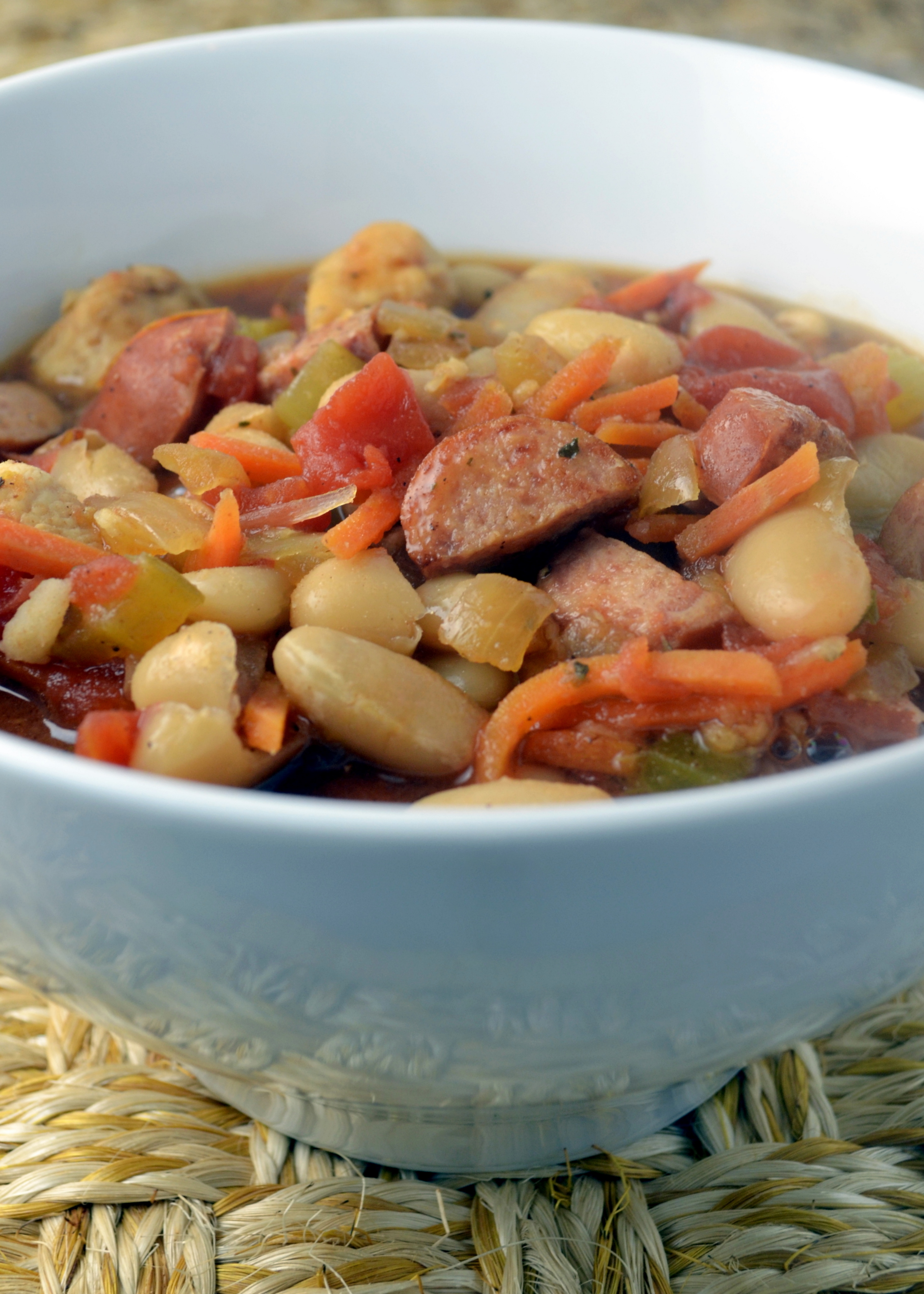
A cassoulet is a slow-cooked one-pot meal, originally from the south of France. It typically includes an assortment of meats, sausages, duck confit, and white beans, topped off with crispy bread crumbs. In essence, it is a hearty bean-based casserole meant to stick to your ribs.  But delicious as it may be, duck confit can be hard to come by. And while I appreciate hearty dishes as much as the next person, I wanted to see if I could make an equally flavorful version that was just a tiny bit lighter, relied upon easy-to-find ingredients appealing to all members of the family, and took less than a full day to make. So, out with the pork sausages and duck confit, and in with some turkey kielbasa and diced chicken breast. This cassoulet is also fantastic the next day, when the flavors have melded and the beans have thickened it a bit more.

Light and Easy Cassoulet

2 tbsp. olive oil, divided
1 lb. turkey kielbasa sausage, sliced  lengthwise and diced into quarters
1 lb. chicken breast, cubed
1 large onion, diced
3 carrots, diced (or 1.5 c. grated carrots)
3 celery stalks, diced
4 cloves garlic, crushed
3 (14-oz.) cans small white beans (cannellini), undrained (or one large, 1 lb. 13 oz. can, undrained)
1 (14.5-oz.) can diced tomatoes with olive oil and garlic (or plain–see note below)
1 (14.5-oz.) can diced tomatoes with basil, garlic, and oregano (or plain–see note below)
splash white wine (optional)
2 bay leaves
lots of freshly ground pepper

Preparation

1. Cook kielbasa in 1 tbsp. olive oil in Dutch Oven (or other heavy-bottomed pot) over medium-high heat until nicely browned. Add chicken and cook until no longer pink; remove kielbasa and chicken from pot.
2. Add the remaining 1 tbsp. olive oil to the pot, followed by the onion, carrot, celery, and a sprinkle of black pepper. Cook until soft, scraping the bottom of the pan with a wooden spoon to loosen the savory bits remaining from the kielbasa and chicken. Add the garlic and cook for 2-3 minutes.
3. Return kielbasa and chicken to pot; mix into the vegetables. Add tomatoes, wine (if using), and bay leaves, plus another dusting of black pepper. NOTE: if using plain diced tomatoes, sprinkle roughly 1 tsp. each dried basil and oregano over top of the tomatoes. Mix well, then layer beans on top.
4. Simmer on low heat for about an hour, stirring gently every so often.
5. Serve cassoulet with hearty bread and a salad.