Archive | Botany/Horticulture RSS feed for this section

Birds or Bananas? Strelitzia, Musa, and Heliconia

8 Apr

Is it a bird or a banana? When it comes to Bird of Paradise, False Bird of Paradise, Parrot or Parakeet Flower, Macaw Flower, Crane Flower, Banana, Wild Banana, or Wild Plantain–it can be hard to tell which is which. That’s because these tropical plants belong to three closely related families: Strelitiziaceae, Musaceae, and Heliconiaceae. And yes, some look like birds, others look like banana plants, and some actually are banana plants.

Though common plant names can be endearingly whimsical and creative, they often lead to confusion; many plants have multiple common names and the same common name can refer to more than one plant. Today, thanks to binomial nomenclature (and to Google and other easily accessible sources), it is fairly easy to figure out that one person’s Bird of Paradise is someone else’s Crane Flower, and that both, in fact, are the same Strelitizia reginae. 

Carl Linnaeus laid the foundations for binomial nomenclature in his 1753 Species Plantarum. According to the system, all living things must have a scientific name in Latin consisting of two basic parts. The first part identifies the genus; the second part identifies the species within the genus (if, as happened to me, the taxonomic ranks you learned in school have since retreated to the lesser-used recesses of your brain, they are: kingdom, phylum, class, order, family, genus, species.) As an example, the American Robin, a migratory bird in the thrush family, belongs to the genus Turdus (this somewhat unfortunate name means thrush in Latin…) and to the species migratorius within that genus. The European Robin, however, belongs to the genus Erithacus and to the species rubecula, which is derived from the Latin for “red.”

But back to plants that look like birds. In 1773, Sir Joseph Banks (then director of Kew Gardens) took advantage of the system of binomial nomenclature to give the exotic Bird of Paradise plant–with its orange sepals, purple petals, and beak-like spathe–its scientific name (Strelitzia reginae) in honor of Queen Charlotte of Mecklenburg-Strelitz. Queen Charlotte was the wife of King George III of England, an enthusiastic amateur botanist, and a strong supporter of Kew Gardens. The genus name Strelitzia refers to the Queen’s birthplace; the species name reginae comes from the Latin for “queen.” Strelitzia nicolai, on the other hand, refers to the Wild Banana, aka the Giant White Bird of Paradise. It received its species name in the 1800s, when two German-Russian botanists named the plant nicolai in honor of the Grand Duke Nikolai Nikolaievich, son of Czar Nicholas I of Russia. Birds or bananas–those are lofty names indeed. I’m just glad I now know which is which.
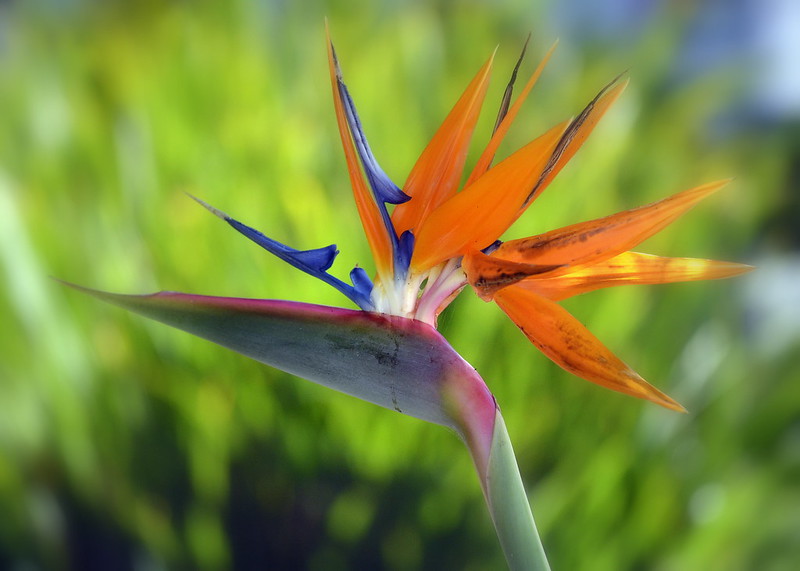

Strelitzia reginae (Bird of Paradise) aka Crane Flower in its native South Africa
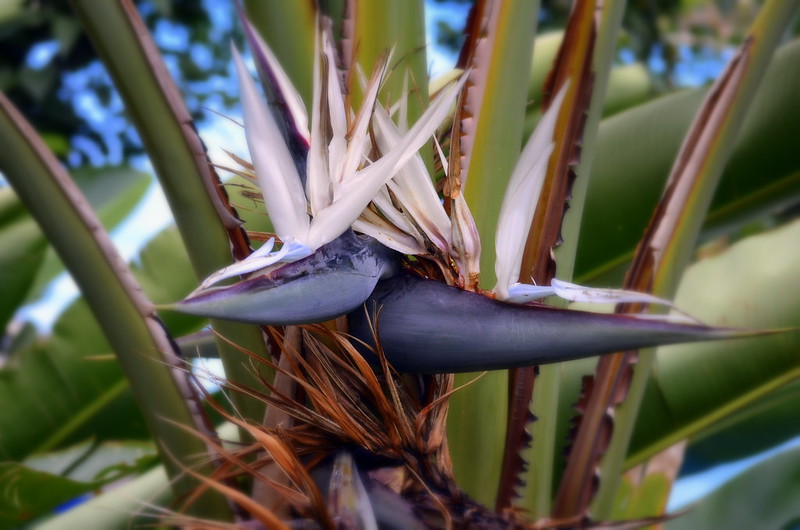

Strelitzia nicolai (Giant White Bird of Paradise) aka Wild Banana–though it does not produce edible fruit.

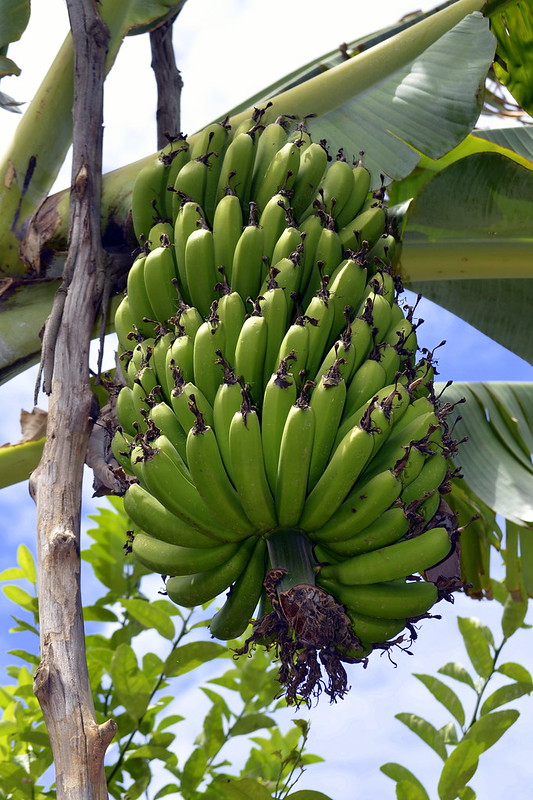
 
Strelitzia nicolai, left; an edible banana plant in the Musaceae family, right. They look very similar when not in flower–see the leaves.
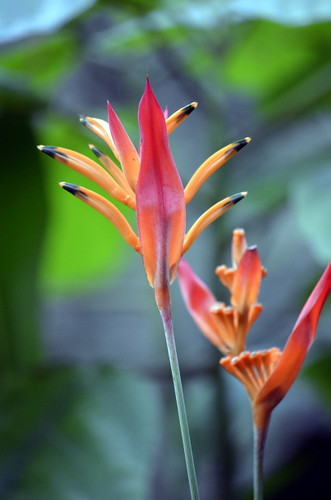
  
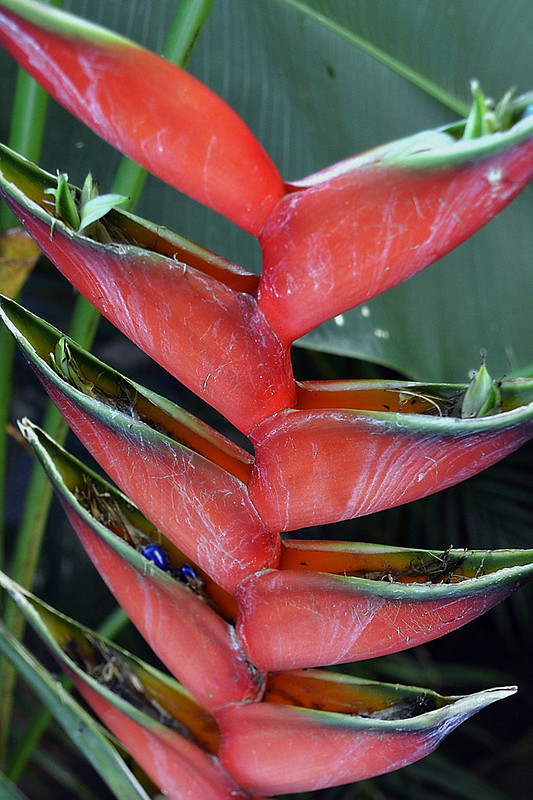
Heliconia psittacorum (Parakeet or Parrot Heliconia), left; Heliconia bihai (Macaw Flower), right. Heliconia are also known as False Bird of Paradise and Wild Plantains because their leaves are similar to the leaves of the Bird of Paradise and banana plants.
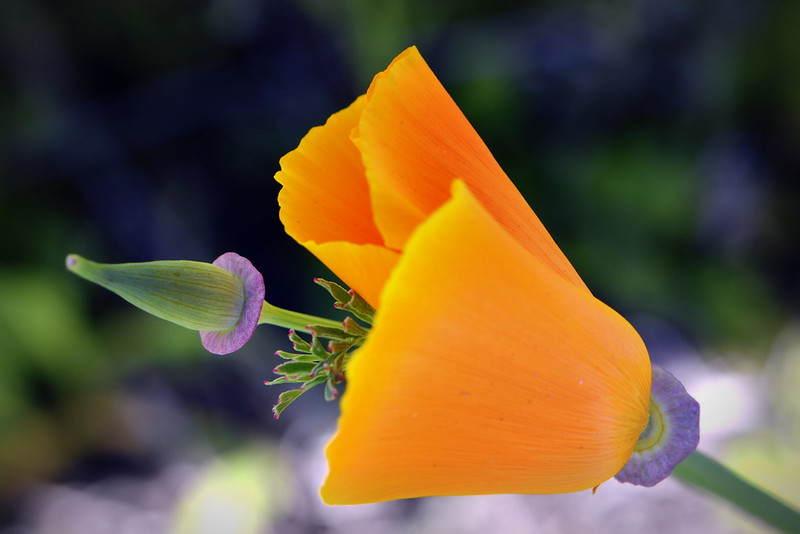
An Unexpected and (Re)Productive Study of the California Poppy

21 Mar

Sometimes, blown car tires lead to unexpected opportunities. While in California on our way to Monterey, our tire blew out on the freeway and very spectacularly separated itself from the rim. Our oldest son was driving and successfully steered the car to the side of the road, with the help of a kind truck driver, who stopped traffic in the right lane to let us over. While the spare tire was being put on, I noticed a cheery patch of poppies down a small hill, and headed there with my camera, whereupon I had an impromptu lesson in reproduction–of the floral kind.

The Golden State loves golden symbols, so it’s no surprise the California Poppy is the state flower. It’s a favorite of many gardeners, but also grows wild across California and elsewhere; masses of poppies make some Western mountains look as if they have been dusted with orange-yellow confetti. They also grow by the roadside, where I was lucky enough to get to study them for a little while. In that scraggly patch, there were poppies at all stages of development, from buds to full flowers, to seed pods.


The flower buds are encased in a calyx made up of two fused sepals; the papery cap slowly gets pushed off as the four overlapping poppy petals begin to unfurl.

  
Inside the cup-shaped flower itself are the stamens (pollen-tipped male reproductive organs) and the pistil (female organ), waiting for pollinators–usually bees, but also beetles and flies–to help ensure a new generation of Eschscholzia californica. This is the plant’s  very civilized (and somewhat passive) Plan A in terms of reproduction.


But, there’s a Plan B, too–and it’s a bit more lively. Once the poppy’s main flowering cycle comes to an end, the petals start dropping off, revealing an elongated seed pod (fruit) sitting on the disk-like torus. The pod gets longer and bigger, starts drying up in the sun, and finally bursts open, ejecting seeds as far as 6 feet away. This type of seed dispersal has a great name: explosive dehiscence.  Oh, how I wish I could have seen it in action.

  
So, what pollinators cannot achieve, the plant takes care of on its own, spreading its wealth just a bit further one seed pod at a time. Something to admire this April 6, which is California Poppy day.


Oh, Nuts: Chestnuts

19 Oct

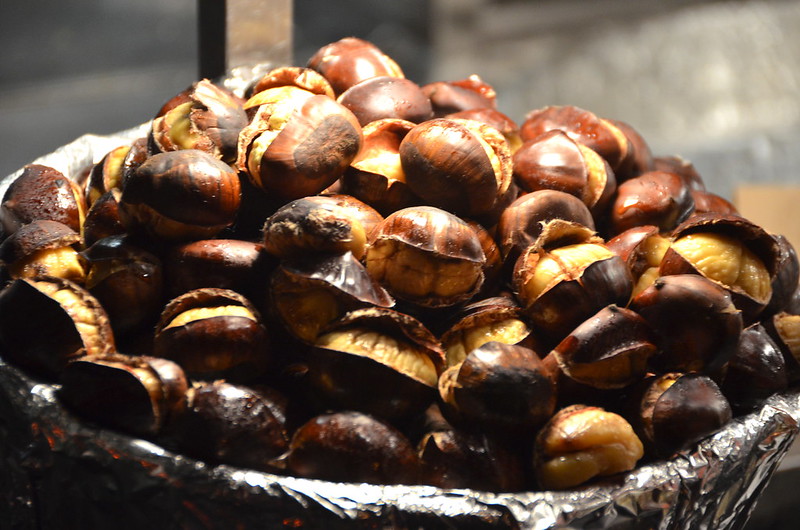
My father was a New Jersey boy who went to elementary school in Manhattan in the 1940s. He loved the smell of chestnuts roasting over open fires on city street corners, a snack available almost year round when he was young. By the time I was a teenager, roasted chestnuts were primarily a holiday season treat, due to changing tastes and a perception that chestnuts were a poor man’s food. (Amazingly, lobster was once viewed the same way; today, the lines that form in front of the lobster roll truck by my office at lunchtime are a sight to behold). Here is a photo of chestnuts roasting in NYC, courtesy of a fellow Flickr user:

Photo credit: Adam Fagen, Flickr

Chestnuts–which are chewier and starchier than, say, walnuts–have been a staple food in southern Europe and parts of Asia for millennia. They can be boiled, candied, eaten raw, mashed, roasted, sautéed, steamed, or ground into flour–and have long been a favored ingredient in stuffing, vegetables dishes, casseroles, porridge, and desserts. They have less calories than other nuts and are the only nut to contain significant amounts of Vitamin C. So, as often happens when nutritious traditional foods are “rediscovered,” chestnuts and the naturally gluten-free chestnut flour are making a comeback, especially in upscale U.S. restaurants and specialty stores. Demand for chestnuts in the United States outstrips supply.

There are four main species of chestnuts: European, Chinese, Japanese, and American. The American chestnut (Castanea dentata)–known as the sequoia of the east because of its height–was almost completely wiped out by blight in the first half of the twentieth century, right around the time my father was enjoying the roasted (and probably Italian) versions near his school in New York City. Four billion trees died. Before tragedy struck, American chestnut trees were highly valued not just for their nuts, which fed both people and animals, but also for their wood. Nowadays, most of the chestnuts we eat in the United States are imported, but efforts are underway by organizations such as the American Chestnut Foundation and others to breed blight-resistant American chestnuts and reintroduce them into the forests of the American east.

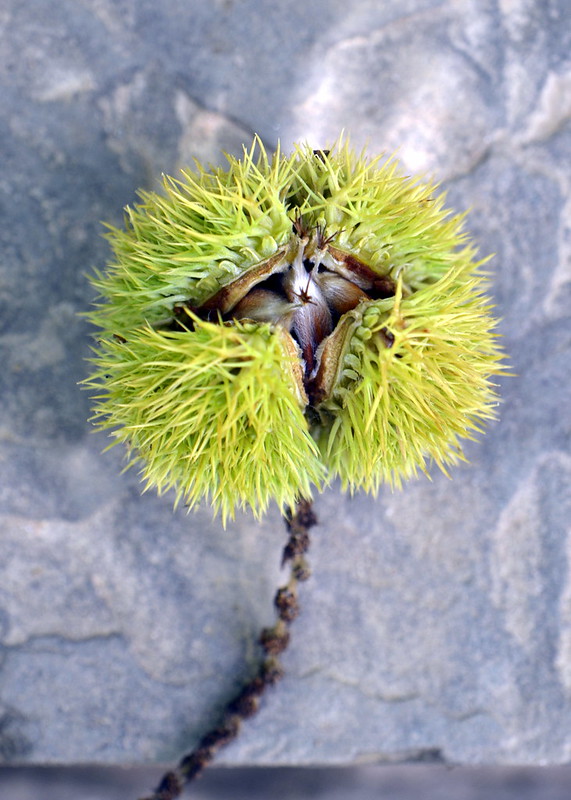
In the meantime, the most commonly seen chestnut trees in the United States are Chinese Chestnut trees (Castanaea mollisisma), which are resistant to blight. On a recent visit to the Audubon Naturalist Society’s Woodend Nature Sanctuary, Castanea mollisima burs carpeted the ground. Here are two burs (and boy, are they prickly and sharp), one of which is beginning to open.

  
Chestnuts are harvested once the burs have fallen from the tree. Typically, there are up to three nuts inside each bur; here is a photo with one nut inside a more mature (and browner) bur. The nuts are covered by two “skins”: a dark brown, hard seed coat (or husk) and a papery under layer.

Sweetness or Deceit? Attracting Pollinators

28 Sep

Plants are wily, in their own ways. Some beguile with sweetness, others lure with deceit. This weekend at the United States Botanic Garden, I saw examples of both.

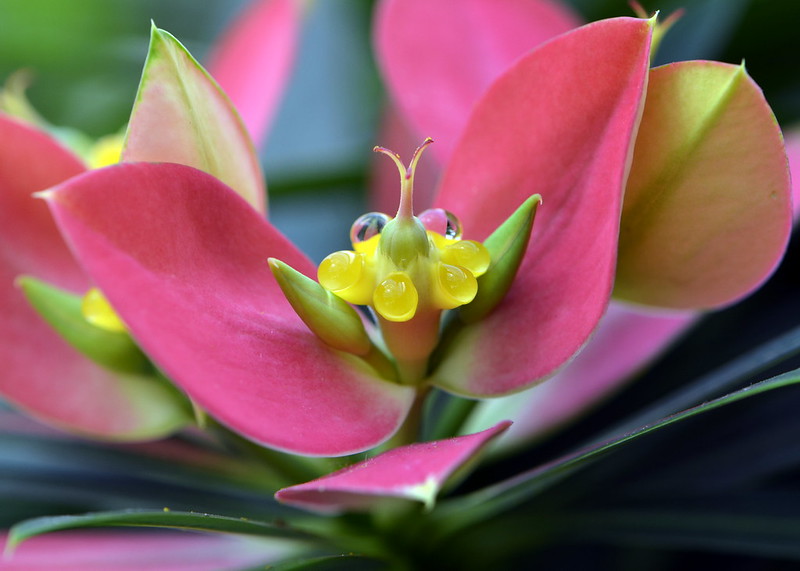
The Jamaican Poinsettia (Euphorbia punicea) takes the nicer approach. Below, you can see the brightly colored bracts, which are modified leaves, and a yellow, cup-like flower cluster called a cyathium. Insects are attracted to the clusters by the reddish-pink bracts and are then rewarded with the sugary nectar; in the photo, the glistening drops are almost overflowing from the cups. Arising from the center of the cluster is the pistil (the female reproductive organ), with three curved stigmas at the top, waiting to receive a dusting of pollen from the visiting pollinator.


Successful pollination leads to the development of a seed-bearing fruit. But if the plant has not been successfully pollinated, the fruit may wilt and never produce seeds.

Other plants, such as the Carrion Flower (Stapelia gigantea), attract pollinators by pretending to be (and smell like) something they are not: rotting flesh. You might think that if someone knows a flower smells like a decomposing mammal, s/he would avoid taking a sniff. But no. I partook of the putrid odor more than once, and can confirm that the flower does indeed smell vile. I pointed this out to other passersby, who also conducted repeated olfactory experiments of their own with identical results…. But back to the plant. In addition to its odor, this wrinkly and hairy flower is also meant to look like a decaying, oozing, leathery, peeling dead animal.


And boy, do some insects love that. Perfect spot to lay eggs, with plenty of food for the larvae, or so they think. They are mistaken; their reproductive efforts are futile. But they will have served their purpose: to help ensure the reproduction of the plant by taking and depositing pollen as they go about their business. A devious deception indeed. Here is a close up of the inside of the flower, complete with a green bottle fly circling around, and a pile of ill-fated eggs below.


Spathe and Spadix

9 Jun

There are two plant parts that are frequently found together whose names I quite like: “spathe” and “spadix.” The two words evoke something mysterious, almost like “cloak” and “dagger.” In fact, there is an element of danger when it comes to plants that have both spathes and spadices, such as Anthuriums, Calla Lilies, and the fabulous Titan Arum (also known as the Corpse Flower because it smells like rotting flesh): they are all poisonous. Their sap contains needle-like calcium oxalate crystals, which can cause significant pain and swelling if an unwitting animal happens to take a bite of the plant. Ingesting large amounts can be fatal because the swelling can make swallowing and breathing difficult–but most animals quickly learn to stay far away. The plants have an excellent defense system.

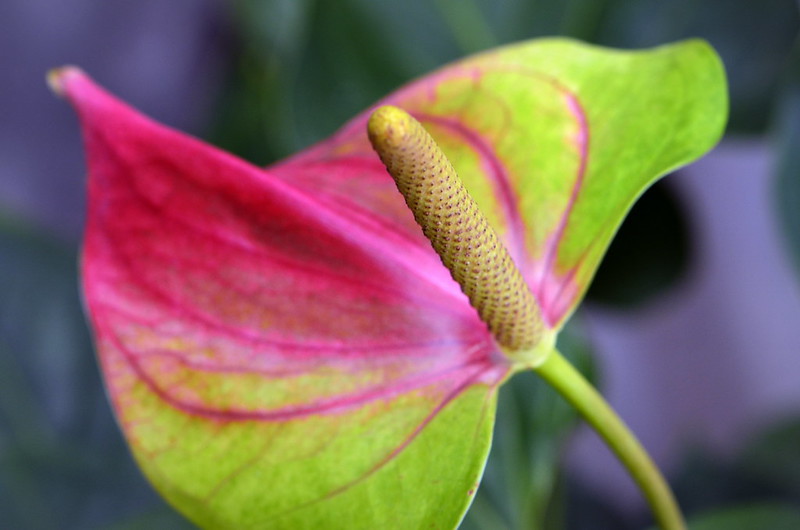
Toxicity aside, plants with spathes and spadices are striking, as evidenced by this Anthurium andreanum ‘Fantasy Love,’ which is a member of the Arum family (Araceae, aka the aroids). This Anthurium may want to repel herbivores, but it also wants to attract pollinators and one way to do that is via the colorful spathe.


The spathe looks like a petal, but it is actually a bract–a modified leaf. It helps get pollinators closer to the actual flowers, which are tiny and are located in spirals on the spadix. Here is a close-up view of an Anthurium spadix–the stigmas on the almost microscopic white female flowers are emitting a fluid that indicates the flowers are ready to be pollinated. If pollination is successful, the spadix will produce little fruits (or berries) containing seeds.


Sometimes spathes are open and fairly flat, as with the Anthurium above, but they can also encase the spadix and appear funnel like, as with Calla lilies. The photo below is an internal view of my neighbor’s ‘Calypso’ Calla lily–with the  deep-red spathe almost entirely surrounding the spadix.


One last fun fact: some spadices in the Arum family can produce a lot of heat in cold weather, reaching temperatures significantly warmer than the surrounding air temperature. The Titan Arum is one of them. This ability is yet another way the plants attract pollinators.  A warm spadix does two things: it provides pollinators with a bit of energy in chilly weather and it acts as a fragrance diffuser, wafting that delicious putrid odor just a bit further as an added enticement. So if you are a pollinator, you get a colorful, warm, and nice smelling (ok, odoriferous) welcome. If you are a herbivore, you come under chemical attack. Isn’t nature great?

Bearded Iris: ‘Spartan’

26 May

In Greek mythology, Iris was the goddess of the rainbow; the flower’s name pays homage to the many colors of irises that exist. In the language of flowers, an iris is viewed as the bearer of good tidings–a reflection of the goddess Iris’ other role as messenger to the gods. I was swayed to include irises in the garden solely because of their beautiful display–but if they also bring good luck, even better.

This year, I added a maroon-colored bearded Iris: ‘Spartan.’ Its name is a nod to ancient Greek history, though their enemies would probably not have equated Spartan warriors with good tidings. I at least hope the name means the three plants I now have in my garden will be hardy.

They are the first bearded irises I have had the pleasure to observe at close range, and though they are now at the end of their brief blooming season, I kept an eager eye on them from the moment they were first in bud:

  
Bud and emerging bloom.


Three upward-facing petals (standards); three downward-facing petals (falls), with the beards resting atop the falls.

  
Close-up of a beard, which helps to guides pollinators (bees) into the flower. With the standard removed and this section of the plant opened up a bit (right), it is easier to see how the beard–and the color pattern–point the way to the nectar at the inner base of the flower. The stamen (male reproductive organ) with its pollen-covered anther is visible at the back, just in front of another petal-like structure that is called the style arm. The style arm is a highly modified pistil (female reproductive organ). Normally it’s a tight squeeze for a bee to get to the nectar; as it heads downward, it will brush up against the anther and get dusted with pollen. When the bee visits another iris, the pollen on its back rubs off and attaches to the sticky stigmatic lip (the arched line toward the top of the style arm, below the upper crest), allowing pollination to begin.

Banana Flowers and Other Edible Parts

22 May

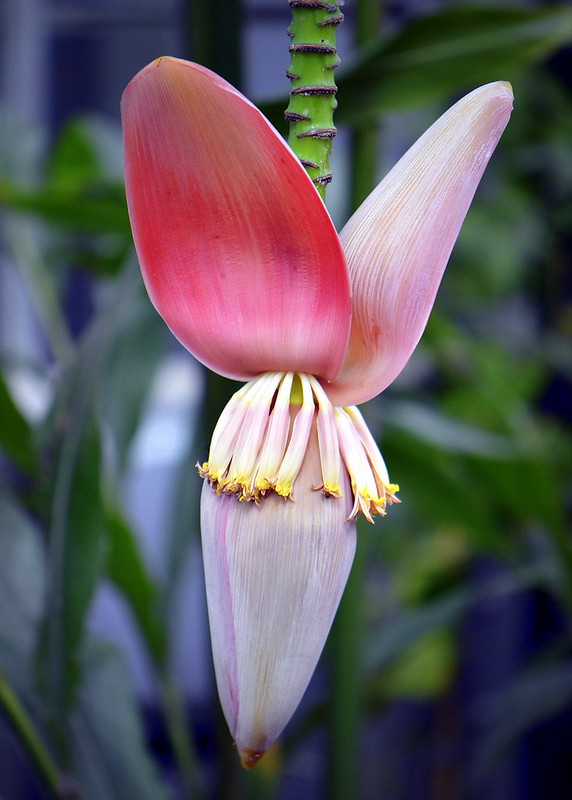
Being a bit less mobile than usual, I thought I’d use the opportunity to choose a photo I’ve previously taken and see if I can learn more about the subject. What you see below is commonly called a banana flower or banana blossom (photo taken at the United States Botanic Garden). I’ve always been struck by this part of the plant, a deep-red appendage that dangles below the bunches of bananas. Though we like to think of the banana plant as a tree, it is technically a perennial herb, albeit a really big one; it dies down to the ground after the plant flowers and produces fruit. The inner part of the stem of the plant (which is actually a false stem consisting of leaf sheaths) is edible, as are parts of the flowers–they are considered vegetables and are popular in Asian and tropical cuisines, where they are used in salads, curries, stir fries, and other dishes.


The banana “flower” seen in the photo above is actually the lowest part of an inflorescence consisting of layers of bracts (the petal- or leaf-like parts) that cover rows of  flowers. The female flowers are higher up and can develop into fruit (bananas). Once that happens, the inflorescence elongates and produces a terminal male bud. Here, the redder (and tougher) outermost bracts of that bud have opened upward, revealing yellow-tipped male flowers underneath and paler closed bracts below.

Different parts of the banana flower (or bud) can be eaten: the innermost bracts, the florets (once the stamens and tough covers have been removed), and the inner core, or heart. The tougher outer bracts are often used as serving plates for dishes made with the other parts of the banana flower. I don’t have easy access to banana flowers, but if you do and want to experiment with them, here are some resources:

To read about the ornamental Golden Lotus Banana/Chinese Dwarf Banana, see this post. To read about the difference between Musa (bananas), Strelitzia, and Heliconia, see this post.

And here are some additional banana-related photos:

1) A banana leaf unfurling at the Eden Project in England. Each leaf emerges from the center of the banana plant in the form of a rolled cylinder. Once the last leaf has emerged, the plant produces the inflorescence, which starts off pointing skyward, but then falls over and dangles as it gets heavier and the female flowers develop into bananas.
2 ) Banana bunches on the plant (with the terminal bud having fallen off). Some bunches can contain 200-300 bananas each; the largest one recorded by the Guinness Book of World Records contained 473 bananas and weighed 287 pounds.
3) Banana transport in Rwanda.


Birth of an Allium ‘Purple Sensation’

10 May

The thing I love most about this time of year is the process by which new flower buds slowly open up and reveal their hidden treasures. I particularly love watching my Allium hollandicum ‘Purple Sensation’ as the buds break free from the papery bracts protecting them and explode into a profusion of perky florets. The allium ‘flower’ is actually a cluster of much smaller flowers (florets) atop a stem–this type of arrangement is called an inflorescence.


The papery bract begins to split open under the strain of the growing florets.


The florets start to take on color.


The emerging inflorescence, seen from above.

  
Individual florets begin to bloom.                Close-up of a floret.


The newly emerged inflorescence, seen from above.


Allium hollandicum ‘Purple Sensation’ in bloom.


Weekly Photo Challenge: Spring

3 May

When I think of Spring, I think of flowers and new life.  This Tulipa “Ballerina” is one the the earliest and cheeriest flowers in my garden, and a look inside the tulip reveals some essentials about plant reproduction.


This close-up focuses on the three-lobed stigma (the top-most section of the tulip’s female reproductive parts, known collectively as the pistil), which catches pollen via its sticky and fuzzy surface. The pollen then travels down the tube-like style to the ovary where  fertilization takes place (if the pollen came from a tulip plant), ultimately leading to the production of seeds. The six pollen-covered anthers (the top-most parts of the male reproductive organs, known collectively as the stamens) are blurred in the background; the stamens emanate from the base of the pistil.

Tulips are considered “perfect” flowers because they contain both male and female reproductive organs. They can self pollinate, but can also cross pollinate in the wild with the help of bees and other pollinators. Alas, most commercial tulips, including this one, are sterile hybrids. But the good thing is that tulips also reproduce via their bulbs, which allows gardeners to enjoy them anew each spring.

Plants: Why it Pays to Be Prickly

5 Apr
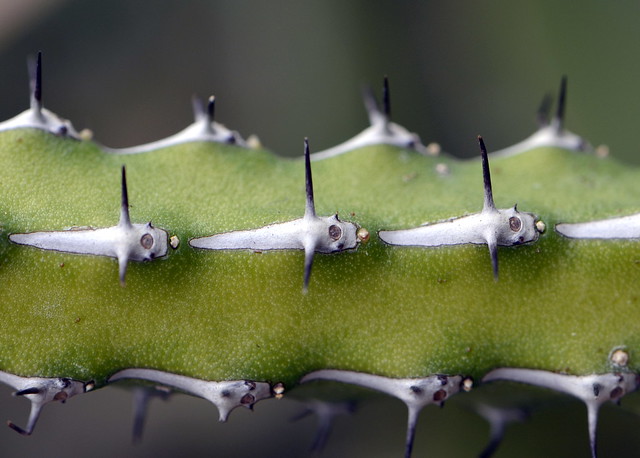
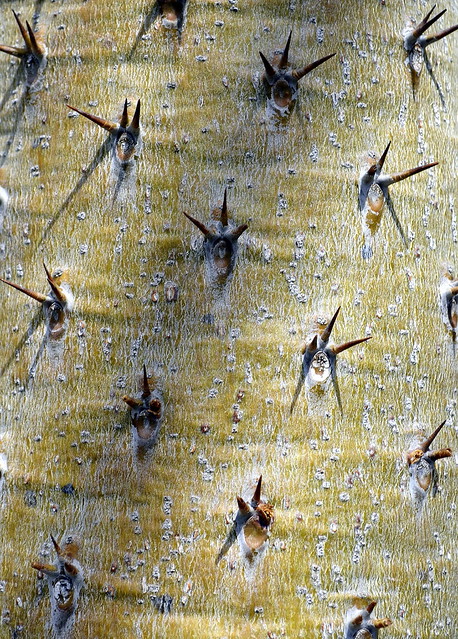
Didierea madagascariensis (Octopus Tree)

Didierea madagascariensis (Octopus Tree), close-up

While most people would bristle at the thought of being called prickly, a plant would consider it quite the compliment.

For us, prickliness has negative connotations. A prickly disposition means someone is easily irritated, a prickly sensation is one that is itchy and scratchy, and a prickly situation is one to avoid.

But for a plant, prickliness pays. It is a protective adaptation that allows the plant to survive while facing multiple challenges, the main one being herbivores hoping for a nice snack. In my garden, carnivores of the canine variety are the bigger problem; their rampages through the flower beds in pursuit of squirrels have felled less-protected plants. But even they now know not to tear through the rose garden.

In common parlance, the terms “prickles,” “thorns,” and “spines” are often used interchangeably, but botanically speaking, they are different things: prickles come from a plant’s epidermis (the outermost cell layer) and break off quite easily, thorns are modified plant stems, and spines are modified leaves or parts of leaves. Rose “thorns” are actually prickles.

In this post, I’ll focus on spines. Why? Because it still boggles my mind that spines are ….  (modified) leaves.

   
Didierea madagascariensis                                       Pachypodium lamerei

Aside from being a source of protection, spines serve an important function for xeric plants (xerophytes: plants that have adapted to survive in environments with little water; cacti, aloes, agaves and other succulents are xeric plants). In desert areas, most plants with large, thin, flat leaves wouldn’t last very long; they would lose too much water. So desert plants had to adapt, or die. One of their adaptations was the modification of leaves into spines. Compared to traditional leaves, spines have a very small surface area, which reduces water loss. They reflect sunlight, deflect drying winds, and provide shade to the plant. At night, when it’s cooler, spines collect and drip condensed water vapor.

Knowing all this has expanded my thinking about “prickliness;”  in this case, the pricklier the situation, the better!

Cleistocactus winteri (Golden Rat Tail cactus)