Archive | February, 2014

Recipe: Red Lentils with Coriander and Cumin (Masoor Dal)

27 Feb

The first time I ever cooked red lentils, they promptly turned yellow and fell apart–which is what they are meant to do, only I didn’t know it then. Red lentils are lentils with the hulls removed; in addition, they are also usually split in half, so they cook (and disintegrate) fairly quickly. I look forward to this transformation, because the resulting golden, buttery, and aromatic stew-like dish is the ultimate comfort food served on top of rice, or even eaten on its own.

Most dal recipes call for spices cooked in oil (a tadka) to be added to the lentils at the end of the cooking time. This recipe also calls for cooked onions, garlic, and spices to be added at the beginning, too. Mmm good. And even better because my husband made the version shown below (pictured with brown rice). This dal is great the second day because it thickens slightly and the flavors deepen, so it’s an excellent make-ahead dish.
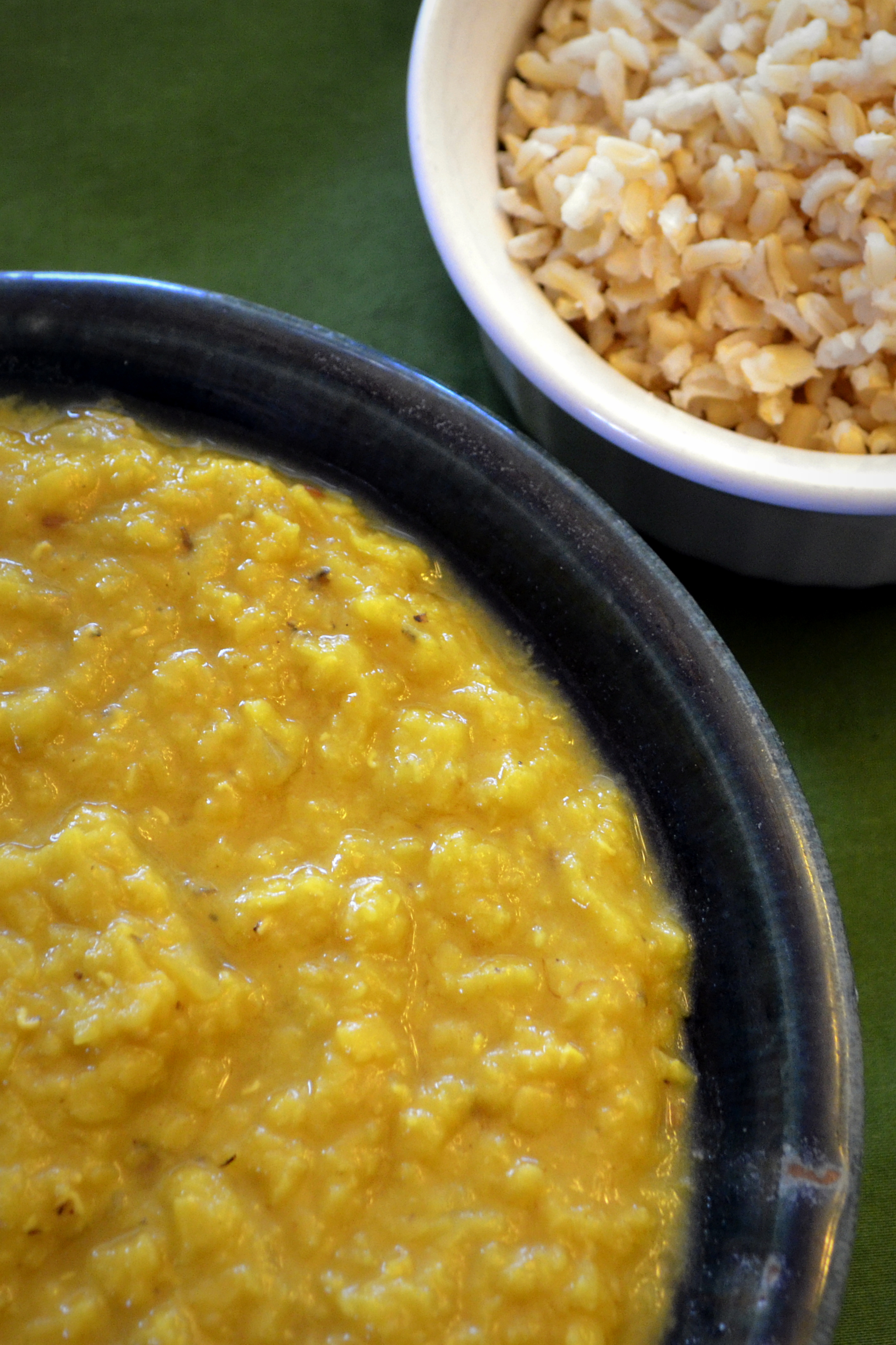
Red Lentils with Coriander and Cumin (Masoor Dal)

1 c. (200 gr.) red split lentils/masoor dal
4 c. (1 liter) water
2 tbsp. canola oil
1/2 large onion diced
3 cloves garlic
1 tsp. coriander seeds
1 tsp. ground ginger
1/2 tsp. ground turmeric
1 tsp. salt
2 tbsp. canola oil
1 tsp. whole cumin seeds
1 tsp. ground coriander
1 tbsp. butter (14 gr.), optional
finely chopped cilantro, optional
fried onions, optional

Preparation
1.  Pick over the lentils, rinse thoroughly in a fine-meshed colander, and place in a heavy-bottomed pot along with the 4 c. water. Bring to a boil over high heat and remove any foam that rises to the surface.
2. Heat the 2 tbsp. canola oil in a skillet over medium heat, add the onion and cook until it is soft and translucent. Add the garlic and cook for 2-3 minutes, stirring frequently. Add the coriander seeds, ginger, and turmeric, and cook for 1 more minute. Add this mixture to the lentils; set the skillet to one side for later use.
3. Reduce the heat to low, cover the pot, and cook for about 30 minutes or until lentils are tender. The lentils will turn yellow as they cook and will disintegrate.
4. Toward the end of the lentils’ cooking time, heat the other 2 tbsp. oil in the same skillet over medium heat and add the cumin seeds. Let sizzle for a few seconds, then add the ground coriander and salt. Cook for 1 minute, then add the spices and oil to the lentils, along with the butter (if using). Stir to mix well.
5. Before serving, garnish with chopped cilantro and/or fried onions  if desired.

Adapted from Madhur Jaffrey’s Indian Cooking.

A Symphony of Orchids

22 Feb

If I have a green thumb at all, it is mostly due to luck. But that luck always runs out when it comes to orchids, with my green thumb (and the orchids) turning a dreadful brown. My mother, on the other hand, is an orchid whisperer. She has only one orchid at the moment, but it is lovingly tended and reciprocates in kind. When she is away, it is my task to water it, and I live in fear of killing it. Thus far, that hasn’t happened. But I can’t help but think it is aware of (and does not appreciate) my inferior ministrations.

Despite my ineptitude, I very much appreciate the ethereal beauty of orchids. So today, my mother and I headed to the opening day of a two-month exhibit, Orchid Symphony, at the U.S. Botanic Garden. It features a dazzling array of orchids in the Garden Court, set against a backdrop of classical music and the sounds of water cascading from fountains. Combined with the fragrant smell emitted by many of the orchids, it is a feast for the senses. But the exhibit goes beyond the Garden Court, with different types of orchids (jungle orchids, desert orchids, and orchids used for medicinal and gastronomic purposes) scattered throughout the Conservatory. Yes, that’s right: orchids are used gastronomically–or at least, one type is used very widely: vanilla is a member of the orchid family!

Altogether, there are more than 20,000 species of orchids (they outnumber birds 2 to 1, and mammals 4 to 1). Here are just 10 of them (hover over the photos to see the names):


Wintery Visit to the Brooklyn Botanic Garden

15 Feb

There are all sorts of reasons people visit gardens, from learning more about the plants themselves, to getting ideas for home gardens, to simply being in a peaceful, aesthetically pleasing space that allows them to recharge while communing with Nature.

Botanic gardens are indoor/outdoor museums, and I love visiting them–for all of the reasons above. I like to explore wide and far, taking advantage of the brief respite these beautiful gardens can provide while seeing and learning something new. But in the winter, it becomes a bit more challenging to visit gardens–it is cold and many plants are in their dormant phases. There is great beauty in a winter garden, but there is also great joy in being able to leave the cold behind and enter a warm conservatory full of tropical plants. That is one of the great attractions of a botanic garden in the winter.

During a recent trip to New York City (just after a major snowfall), we made a point of stopping by the Brooklyn Botanic Garden. It looked like a white wonderland…


… with snow and ice, and


frozen crabapple fruits.

 
The conservatory beckoned, with its various houses and pavilions. We entered shortly before the gardens closed for the day, but were able to appreciate some very welcome sights: a Cape Aloe flower and a Cardinal’s Guard flower (above), as well as the lovely leaf of a Garden Croton (below). For a moment, we forgot all about the storm outside.

Recipe: White Chocolate Dulce de Leche Cake

8 Feb

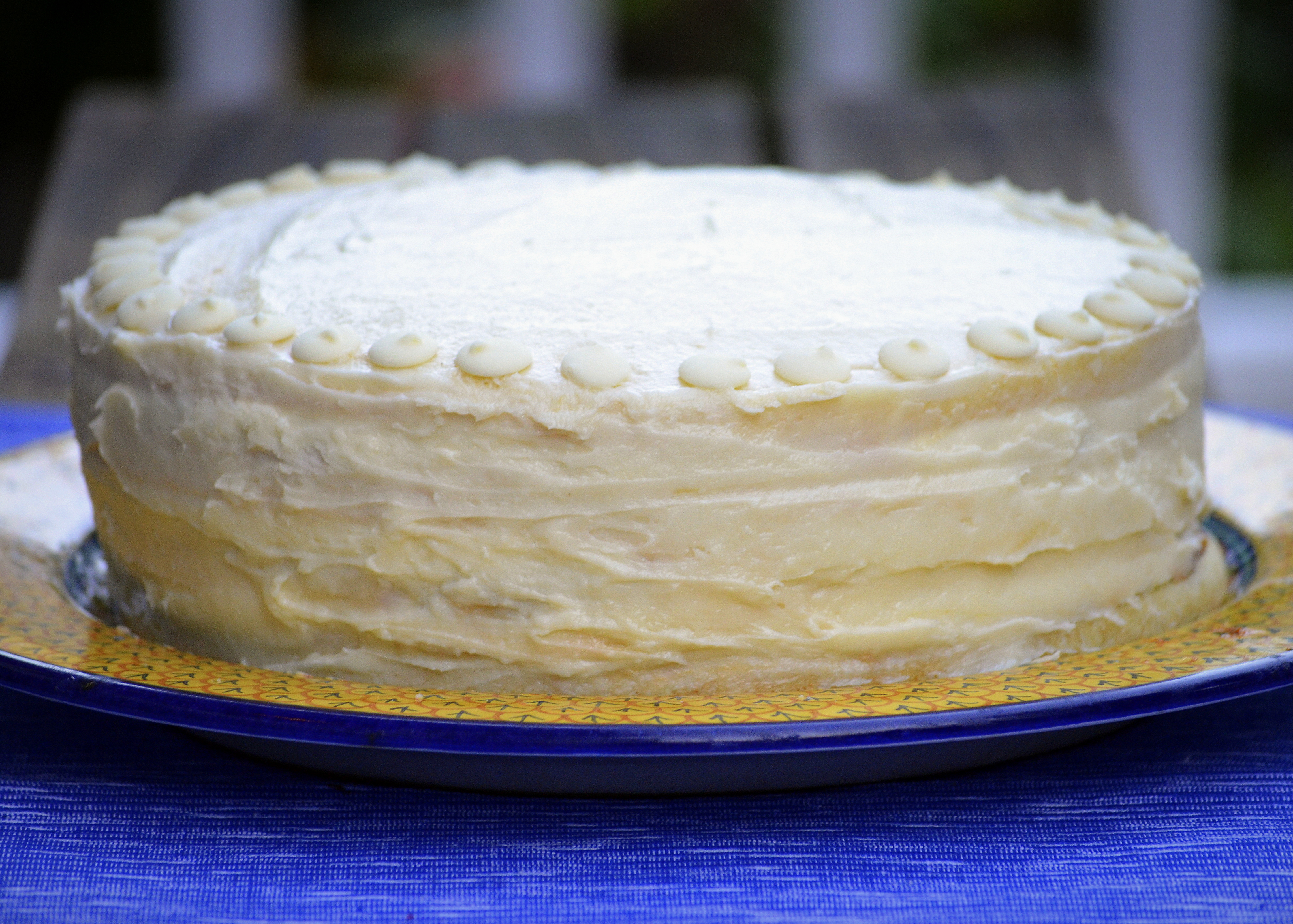
In our house, we love dulce de leche (we are not at all averse to eating it by the spoonful), and we really love the pastry cake known as Torta Chilena (delicate, crispy layers of pastry laced with the rich, caramelly spread–see the recipe here). But Torta Chilena is quite labor intensive (a labor of love, but laborious nonetheless). I wanted to make a slightly less time-consuming cake featuring dulce de leche–one that was special in its own right. The result: this White Chocolate Dulce de Leche Cake. It’s a more traditional cake-like cake (if that makes sense), but has lots in it to love. It does require more time than a box mix (though using ready-made dulce de leche will reduce the prep time), but it is so worth it.


White Chocolate Dulce de Leche Cake

–Cake
2 ½ c. flour
2 tsp. baking powder
½ tsp. salt
1 c. white chocolate chips, melted and cooled
1 c. butter
2/3 c. sugar
2 eggs
2 egg whites
1 c. buttermilk (or 1 tbsp. vinegar, plus enough milk to make 1 c.)

–Frosting
8 oz. cream cheese, softened
¼ c. butter, softened
1 c. confectioner’s sugar
1 c. white chocolate chips, melted and cooled

Filling 
1 recipe home-made dulce de leche (see directions below) — or use 1 (13.4-oz. can) prepared dulce de leche

Preparation
1. FILLING: To make dulce del leche, heat oven to 425º. Spray a glass casserole dish with cooking spray, pour both cans of condensed milk into it, cover the dish, and then set it in a bain marie (baño maria), which is a roasting pan filled with enough water to rise slightly above the level of the condensed milk in the casserole dish. Bake for about 2 hours, stirring periodically, until golden brown. Set aside and let cool. (This is the dulce de leche – there will be extra left over). If using prepared (canned) dulce de leche, proceed to making the cake. Note: you may need to vigorously stir (or even slightly heat) canned dulce de leche to make it spreadable.
2. CAKE: Reduce oven temperature to 350º.  In a glass bowl, heat the 1 c. white chocolate chips in a microwave in 30-second bursts, stirring after each, until chocolate is mostly melted. [Note: be careful with the melting process; overcooked white chocolate turns into a hard lump.] Stir the chocolate until it is completely smooth and let cool. Spray 4 cake pans with cooking spray, line with parchment paper, and spray the parchment paper. In a medium bowl, combine flour, baking powder, and salt. In a large bowl, beat butter and sugar until smooth. Gradually beat in the eggs and egg whites, then add the melted white chocolate and incorporate. Add half the flour mixture, mix in, add half of the buttermilk, mix in and repeat. Spread the cake batter evenly into the 4 pans. Bake for about 10-15 minutes, or until knife/toothpick inserted in middle comes out clean. Let cool.
3. FROSTING:  Beat cream cheese, butter, and confectioner’s sugar together in medium bowl until smooth, then stir in 1 c. melted white chocolate chips (see note in #2 about melting white chocolate).
4. ASSEMBLY: Place 1 cake layer on plate/stand. Frost the layer with 1/3 of the dulce de leche, then with 1/6 of the frosting–just enough for a very thin layer; you want to be sure to have enough frosting left for the outside of the cake. Continue stacking layers, and use remaining frosting to frost top and sides of cake. Chill 1 hour before serving.

What’s in a Name? Robin Redbreast

6 Feb

It’s February, which in the Northern hemisphere qualifies as being just about half way between Christmas and spring. So it’s appropriate to talk about robins right now. In some places, they are symbols of Christmas, and in others they are a sign of spring. Either way, the copper-chested birds are a cheery site to behold. Despite their burnt orange coloring, the birds were originally known as Robin Redbreasts–because 500 or so years ago in Europe, there was no name for the color orange. “Yellow-red” was as close as people got to describing that happy blend of the two primary colors. But when a certain citrus fruit became more widely eaten, the color found a new name: orange. The first recorded use of that word as a color was in 1512.

But back to robins. The color is named after the fruit, and the American Robin is named after the European one. Except that it is now clear they are not closely related. European robins are chats, while American Robins are members of the thrush family. One is smaller and rounder, while the other is longer and leaner looking. The only thing they share is  a spot of orange on the breast, and even then, one bird has a small copper patch high up while the other has a longer one most of the way down. And the rest of their markings are not very similar. But early Europeans encountering these birds in North America in the 17th and 18th centuries thought they looked like robins, and named them accordingly. 

blame these early settlers for the noteworthy bout of avian befuddlement I recently experienced. I repeatedly came across a very friendly little bird during the few days we were in Ireland at Christmas and took several photos of it, all the while wondering what it was and chiding myself for not knowing. It looked almost like a little sparrow, except for that orange coloring (and the beak… and probably a number of other things). What could that bird be? Imagine my chagrin when I discovered it was a robin–how is it possible to not recognize a robin when staring straight at one? I can only say that the robin I have always known is the American one, and I was unprepared to identify the European version. I offer up these photos as evidence: first a European Robin (Erithacus rubecula), then its American counterpart (Turdus migratorius).  And then I rest my case. (Not sure how much of a case it is, but I rest it anyway).