Tag Archives: zucchini

Recipe: Sausage Cheese Dip, Two Ways

4 Nov

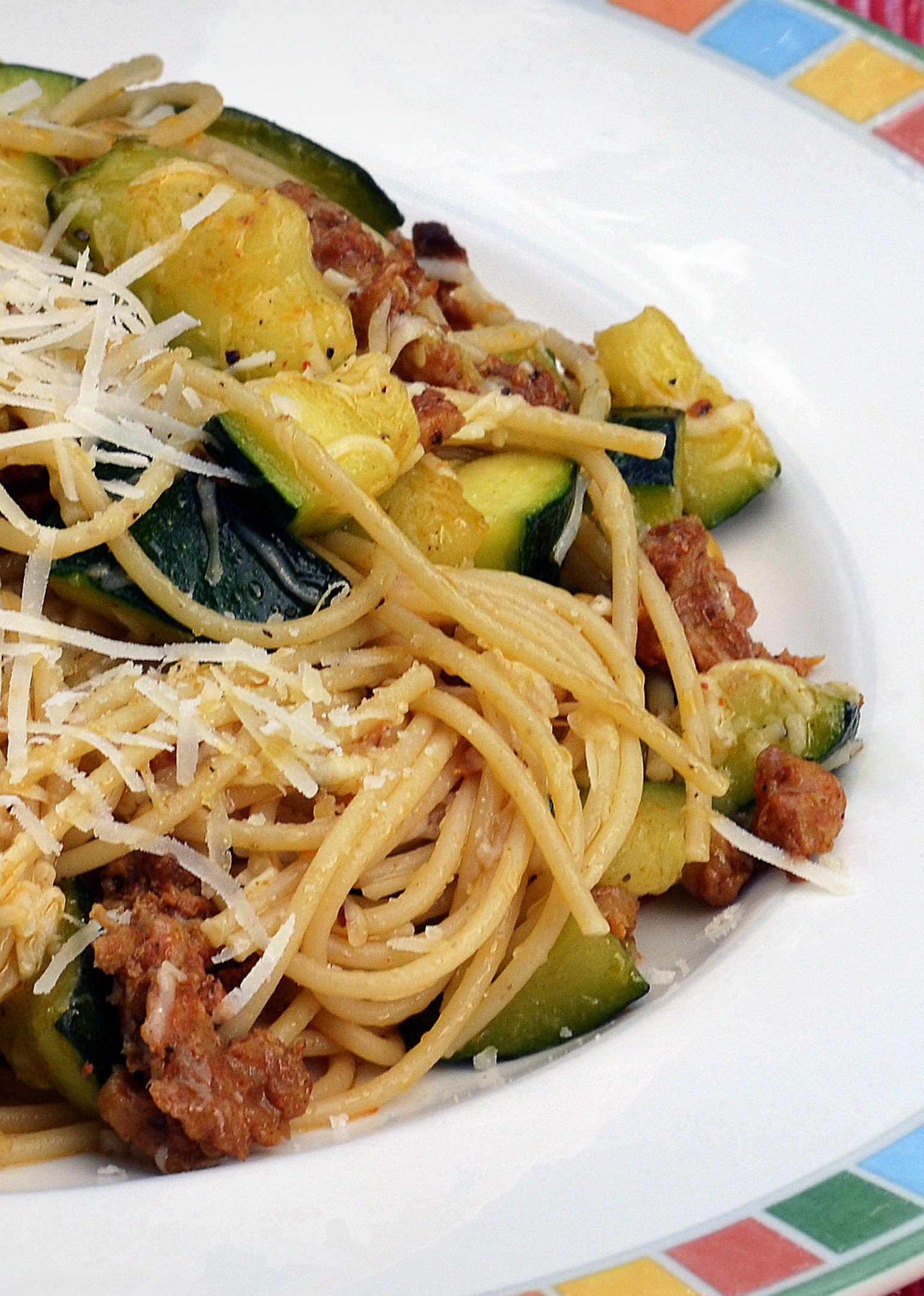
I love recipes that can do double duty. This one’s dual role came about by accident when I was pondering what to make for dinner one recent busy weeknight. We first had the very delicious sausage cheese dip on a weekend while watching a football game, but had some leftovers. So, when staring at the contents of my fridge a couple days later, I thought: “Sausage and cheese? Both those things go very well with pasta…. hmmm.” And I had a zucchini that I needed to use, too. Thus, Sausage Cheese Dip Rigatoni with Zucchini was born. And it was good! Both recipes follow.

Sausage Cheese Dip (based on a recipe from Natasha’s Kitchen)
Note: This serves 4 without leftovers (2 with leftovers)

Ingredients
1/2 lb. (226 gr) mild Italian sausage, removed from casing
2 garlic cloves, minced
pinch onion powder
salt and pepper to taste
4 oz (113 gr) cream cheese, cut into cubes (no need to soften)
10 oz (283 gr) can diced tomatoes with green chilies
1/2 cup corn (I cut the corn off one previously cooked cob, but frozen would also work)
4 oz (113 gr) sharp cheddar or similar cheese, shredded

Preparation
1. Drizzle a small amount of olive oil in a medium skillet. Brown sausage over med/high heat, breaking it apart with a wooden spoon, until browned. If the sausage generates a lot of grease, drain the grease.
2. Add the garlic, onion powder, and some pepper, and cook over medium heat for one more minute, stirring through.
3. Add the cream cheese cubes and stir until melted and incorporated.
4. Add the undrained tomatoes, corn, and shredded cheddar. Cook, stirring occasionally, just until bubbly and cheese is melted. Check seasonings, and add salt or pepper as needed.
5. Remove from heat and serve with tortilla chips. The kind that look like scoops are perfect for this dip. (Note: The photo below also includes Cumin-Scented Black Bean Salad.)

Sausage Cheese Dip Pasta with Zucchini
(serves 2 hungry people)

Ingredients
5.3 oz (150 gr) pasta of choice (I used mezzi rigatoni)
olive oil
1 zucchini, diced
1 cup Sausage Cheese dip
cream or milk (if needed)
Pecorino Romano or Parmesan cheese, grated
salt and pepper to taste

Preparation
1. Bring salted water to a boil and cook pasta as directed for al dente.
2. While water is coming to a boil, drizzle some olive oil into a large skillet. Add diced zucchini and cook over medium-high heat until zucchini starts to get golden around the edges.
3. Add the sausage cheese dip and stir until warm and melted. Check the consistency; add a splash of cream or milk if too thick. If too thin, add some grated Pecorino Romano or Parmesan cheese.
4. When pasta is ready, drain, and add to sauce in skillet, along with more grated cheese. Check the seasonings, and add salt or pepper as needed.
5. Serve immediately.

Recipe: Minestrone

8 Oct

I remember a teacher in elementary school bringing our class a batch of “Everything But the Kitchen Sink” cookies, which I’d never had before. I didn’t quite understand the name, so the teacher explained that it meant she had put all sorts of things into the cookies, almost everything in her kitchen but the kitchen sink. That day, I tasted a new cookie and learned a new phrase.

For me, Minestrone is an “Everything but the Kitchen Sink” soup. When the leaves start turning colors in the fall — ie, when soup weather is upon us — and I have vegetables to use up, I immediately think “Minestrone.” In Italian, minestra means “soup;” minestrone means “big soup.” And it really is a big soup, full of so many good things.

Of those good things, there is one without which this cannot be Minestrone, in my view: the cheese rinds. We usually have a wedge of Pecorino Romano cheese in the fridge, and as we get to the last of each wedge, I save the rinds. Without some rind, the soup will not taste like Minestrone; the slow-simmered cheese is a huge part of what makes the broth so delicious.

Aside from the rinds and the soffritto ingredients (onion, carrot, celery; see below), I like to add canned tomatoes, zucchini, white beans, and cabbage or spinach or both (or any other leafy green). Plus pancetta when I have it, potatoes if I need to use some up, and small pasta if there is room.

Today this is what I had at hand:

Fridge:

  • two onion halves (one red, one white)
  • four stalks of celery
  • some leftover grated carrots (about 1.5 c.)
  • zucchini (I had 2, but ended up using only 1 big one)
  • some shredded cabbage, ie ‘cole slaw’ mix (about 4.5 oz/127 gr)
  • baby spinach (about 3-4 handfuls)
  • Some Pecorino Romano and Parmesan ‘heels’ (see photo)

Freezer:

  • Cubed pancetta (4 o oz/113 gr)

Pantry:

  • Yukon Gold potatoes (I had 3, but ended up using only 2)
  • Whole peeled tomatoes
  • Cannellini beans (2 cans, 15.5 oz/440 gr each, undrained)
  • Garlic (3 large cloves)
  • Bay leaves
  • Vegetable bouillon cubes
  • Salt and pepper

Perfect–I had everything I needed for Minestrone! I also had mini pasta sea shells, which I’ve used in Minestrone before, but I did not use them this time; by the time I got to the point where I would have added them, there was no more room in the pot! Plus, dry pasta keeps and I had to use up the potatoes. (If you have pasta but no potatoes or just prefer the pasta, add a handful of that instead.)

For me, Minestrone is a soup I make in ‘layers,’ meaning I start with the first ingredients and while they are cooking, I prep the others, adding them to the pot as I go. Today, I started by cooking the pancetta in olive oil in a large Dutch Oven until it got crispy. (If you are vegetarian, omit the pancetta).

While the pancetta was cooking, I diced the onions and celery, then added them–and the already-grated carrots and a couple bay leaves–to the pot along with a splash more olive oil. This mixture of onions, celery, and carrots is what the Italians call soffritto and the French call mirepoix, and it is the foundation of many great soups. When the veggies got soft, I crushed the garlic cloves straight into the pot, added some freshly ground black pepper, and cooked everything for a couple more minutes. This is what I consider to be Layer 1, made up of a few subparts. [I forgot to take a photo of this, however.]

To start building Layer 2, I added some hand-crushed tomatoes and their juices to the soup pot. If I’d had a can of diced tomatoes, I would have used that instead–but necessity is the mother of hand crushing. With a very clean hand, I gently took a whole peeled tomato from the can, and crushed it into the soup pot, repeating until I had crushed all the tomatoes. [Note: If you will also crush the tomatoes by hand, lower your hand as far as possible into the pot, and crush each tomato very slowly. Otherwise, the likelihood of having crushed tomato all over your back stove wall, and yourself, is extremely high–as I’ve learned from experience.]

Successfully hand-crushed tomatoes; all in the pot, none on me

Then I added the cheese rinds (trimmed of the outer, colored parts) and 4 cups of water and let everything simmer while I diced the potatoes. When the potatoes were ready, I added them, the canned cannellini beans with all their liquid, and a vegetable bouillon cube to the pot, along with more freshly ground pepper. This is Layer 2. I let this simmer, partially covered, for about 10 minutes while I prepped the zucchini for Layer 3.

Nestling cheese rinds into the soup

In Layer 3, I added the diced zucchini and the already-shredded cabbage, and continued to simmer the soup until the zucchini and potatoes were both soft. I also checked the seasonings and decided to add another bouillon cube and a little salt. At that point, my Minestrone was essentially done and ready to serve, so I did the very last thing: I put the handfuls of spinach on top and stirred until the spinach was wilted in.

Then I set the soup pot out for everyone to serve themselves (with everyone getting at least one piece of the now-soft cheese rinds–an absolute treat), along with some freshly grated Pecorino Romano to sprinkle on top. Mmmm. So good on a fall day.

Recipe: Fried Zucchini Flowers and Sage Leaves

24 Jun

Fritti LR
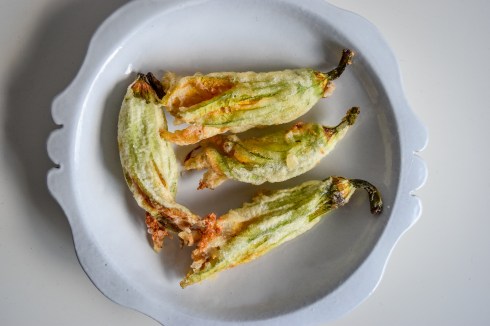
Zucchini flowers taste as good as they look, if not better. Stuffed with fresh mozzarella, a hint of anchovy (or not),  lightly battered and fried until crisp and golden, they are summer on a plate. Fresh sage leaves–encased in the same warm, crispy shell–will turn your thoughts to autumn. But the good news is, you can have them now. Two appetizers straight from the garden.


Fried Zucchini Flowers and Sage Leaves
4-6 servings

1 c. (250 ml.) water–regular or sparkling
1 c.  flour, spooned lightly into the measuring cup (about 133 gr.)
salt and pepper
12-14 zucchini flowers*
9 0z. (250 gr.) fresh mozzarella
2-3 anchovy fillets (salt-cured, packed in olive oil)–optional
canola or sunflower oil–enough to fill a medium sauce pan to about 2.5 inches (6 cm)
handful of fresh, firm sage leaves

*Use male zucchini flowers. They appear at the end of long stems, unlike female flowers, which appear at the end of the emerging zucchini.

Preparation

1. Prepare the batter: Put the water in a medium bowl and sift the flour over it, whisking to incorporate. Add a pinch of salt and some freshly ground pepper. The batter should be thick enough to coat the flowers, but not pasty. See the right consistency for a light batter below. Set aside the batter while prepping the flowers.

Fritti LR-9

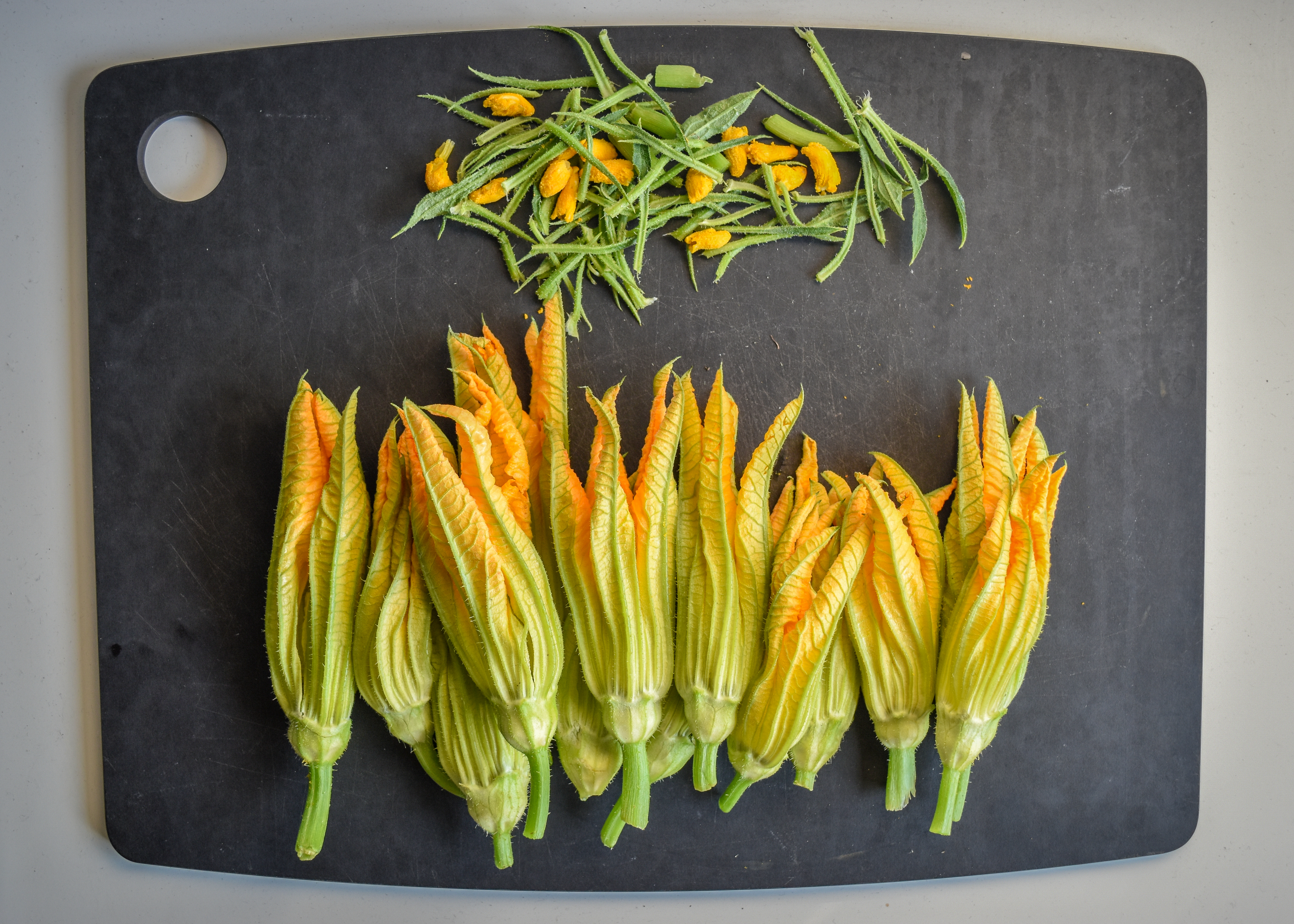
2. Lay out all the zucchini flowers, wipe them clean, and discard any that appear bruised or past their prime (they are quite perishable). Trim the stems to about 1 inch (2.5 cm), leaving enough stem to grasp and dip. Pull off the sepals (the spiky green parts at the base of the flower). Gently work your thumb and index finger into the flower and pinch off the pollen-topped stamen. You will probably tear the flower slightly; that’s ok, but try not to tear it too much, or shred it. See the prepped flowers and discarded sepals and stamens below:

Fritti LR-4

3. Mozzarella and Anchovies: Cut the mozzarella into as many 2.5-inch ( 6 cm) long rectangular pieces as you have flowers–or whatever size best fits into the flowers you have. You can omit the anchovies, you can go all in and lay a nice piece of anchovy fillet on top of each piece of mozzarella before placing both in the flower, or you can take a moderate approach. That entails placing the anchovy fillets in a bowl, drizzling them with some extra olive oil, mashing them with a fork, then placing the mozzarella pieces in the anchovy oil so they get a hint of the flavor rather than a wallop. Either way, you want to place the mozzarella pieces (with or without anchovy) into the flowers, covering them up as best as you can and twisting the ends of the flowers closed to create a mini pouch.

4. Bring the oil to high heat in a medium saucepan. Holding the stem end of a sealed zucchini flower, dip it into the batter in a twirling motion to keep it closed (sealing any open parts with your fingers and twisting the bottoms closed again if needed). When the flower is completely covered in batter, carefully lower it into the oil. Repeat for as many flowers as will fit into the saucepan in one layer without crowding; you will need to cook the flowers in batches. When one side is golden, turn the flower over (or push the flowers gently under the surface of the oil as they cook, to ensure both sides become golden).

Fritti LR-5

5. Drain the fried flowers on paper towels, sprinkle with a bit of salt, and eat as soon as possible!

Fritti LR-6

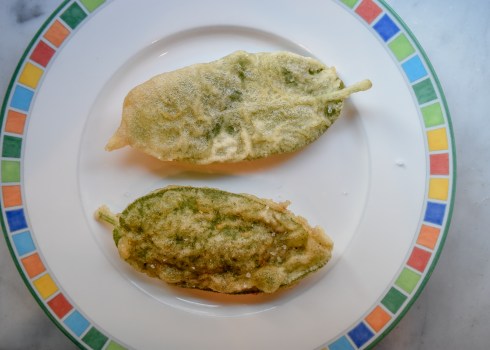
6. Now for the much-easier sage leaves: Wipe them clean, dip each one into the batter, and fry until golden. Drain on paper towels, sprinkle with a bit of salt, and…

Fritti LR-7

7. … enjoy!

Fritti LR-8

Recipe: Spaghetti with Chicken Chorizo, Zucchini, and Pine Nuts

5 Aug

Let me count the ways I love this dish:

  1. It is incredibly quick and easy,
  2. It is bold and zesty thanks to the spicy chicken chorizo and the tangy Pecorino Romano,
  3. It isn’t a typical tomato- or cream-based pasta dish,
  4. It contains pine nuts (a heavenly food, but one to be used sparingly because of the cost), and
  5. It is another way to use up some of that bumper crop of zucchini (… if you’ve had your fill of Chocolate Chunk Zucchini Squares).

I made this tonight in about 20 minutes–and yes, I did add the pine nuts, but they all went into hiding at photo time. If you have a bit more chorizo than you need for this recipe, add it to a delicious egg scramble in the morning, maybe with some poblano chilies, onions, and mushrooms. Mmmm.


Spaghetti with Chicken Chorizo, Zucchini, and Pine Nuts
Serves 4

3-4 tbsp. olive oil
2-3 links spicy chicken chorizo, removed from casings (about 2/3-1 lb.)
1 large zucchini, diced into small cubes (about 3 cups total)
2 cloves garlic, minced
3-4 tbsp. pine nuts
1/2 lb. spaghetti
1 tbsp. butter
1 c. Pecorino Romano cheese, grated
salt and freshly ground pepper

Preparation

1. Start preparing spaghetti according to “al dente” directions on the package (check for doneness about a minute before the minimum time listed).
2. While water is coming to a boil, cook chorizo in olive oil in large skillet over medium-high heat until chorizo is no longer pink, breaking up the chorizo as it cooks. Add zucchini and cook until it has softened and the chorizo is golden. Add garlic during last five minutes of cooking time. If chorizo/zucchini mixture seems dry, add a bit more olive oil.
3. Push chorizo/zucchini mixture to one side of the skillet and sprinkle pine nuts onto the cleared space; cook the pine nuts for a couple minutes or until they turn golden. Incorporate them into the chorizo/zucchini mixture. If the pasta is not yet done, turn off the heat under the chorizo mixture and keep warm.
4. Just before draining the spaghetti, remove about 1/2 c. of the cooking water (or dip a glass measuring cup right into the pasta pot); reserve the water.
5. Drain the spaghetti, toss the drained spaghetti with butter, then pour the chorizo/zucchini mixture on top of the spaghetti and mix in well. If the mixture seems a bit dry, add a small amount of pasta cooking water to moisten.
6. Mix in the Pecorino Romano cheese, add salt and freshly ground pepper to taste, and serve immediately.

Recipe: Chocolate Chunk Zucchini Squares

7 Jul

Okay, after my recent post about prolific zucchini plants, it was only a matter of time before some zucchini recipes started showing up on the blog. And seeing as I have a serious sweet tooth, I went straight for something chocolaty, moist, and doubly satisfying (because, after all, these Chocolate Chunk Zucchini Squares not only taste good, they also contain vegetables and nuts, so can almost be regarded as a health food….). Well, I’m planning on regarding them that way. If you use dark chocolate, even better: you’ll be adding some beneficial flavonoids to the mix. I dubbed this recipe “Chocolate Chunk” because I didn’t have any chocolate chips on hand today, but I did have some dark chocolate bars that I was happy to chop up and sacrifice to the greater good.

Chocolate Chunk Zucchini Squares
Servings: 9

4 tbsp. butter, room temperature
2/3 c. dark brown sugar, packed
1 egg, lightly beaten
1 tsp. vanilla
1 c. finely grated zucchini, squeezed as dry as possible (try to end up with 1 c. total)
1 c. all-purpose flour (can also use 1/4 c. whole wheat, 3/4 c. all-purpose)
3/4 tsp. baking soda
1/2 tsp. salt
1 tsp. cinnamon
1/2 c. chopped walnuts
1/2 c. chocolate chunks or chocolate chips (about 3 oz. total)

Preparation
1. Preheat oven to 350 degrees. Spray an 8×8 baking pan with baking spray.
2. In a large bowl, cream butter and sugar together; add egg and vanilla and stir until mixture is light and smooth. Add zucchini and mix in well.
3. In a medium bowl, stir together flour, baking soda, salt, cinnamon, walnuts, and chocolate chunks/chips.
4. Add dry mixture to wet mixture; stir just to combine. Pour batter into prepared pan and bake for 25-30 minutes, or until toothpick inserted in center comes out clean.
5. Let cool before cutting into squares.

Zucchini Flowers, Leaves, and Bees

3 Jul


Yes, it’s that time of year, a time when you realize you planted way too much zucchini. I have only one zucchini plant in the garden (not having much space for vegetables to begin with) — yet I find myself asking, how can one plant produce that much? And it’s barely gotten started.

Luckily, I love zucchini and am already thinking about what to do with my harvest. However, this post is not about cooking. It is about the plant itself, from flower to leaf. If you grow zucchini, you probably quite enjoy seeing the zucchini flowers/blossoms/blooms. I usually look at them and imagine them stuffed with a nice cheese, dipped in a light batter, and gently fried….heavenly! Some say the male flowers (which grow at the end of long stems, unlike female flowers, which grow at the end of the emerging zucchini) are the best for eating; I’ll happily sample either one. The flowers can also be eaten raw, sliced into salads or other dishes.

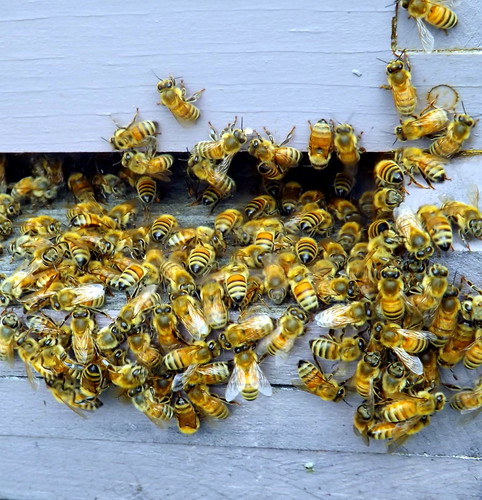
But I digress. My intention was to write about the plant–as a plant, not as a source of food. A couple of days ago, I was checking the status of the zucchini and was startled to see a fully open flower. I almost never see an open flower, which makes sense since they are only open for one day and usually from morning to early afternoon (when I am at work, or not paying sufficient attention). In order for any zucchini to be produced, bees must take advantage of this small window of opportunity and do their part by carrying pollen from the male flowers to the female flowers. [Ok, I have to digress again to show a completely unrelated photo of a friend’s beehive since I don’t have a photo of a bee on my zucchini flowers–and yes, honey bees are excellent pollinators of zucchini and many other fruits and vegetables. Go bees!]


Some of my baby zucchini seemed to wither on the stems and drop off before they even got going. I wondered if this was due to all the rain we’ve been having (or even worse, if it could possibly be the fault of our male dog–despite the barricades I erected). Luckily, I discovered it’s because the female flower didn’t get quite enough pollen from the male. Gardeners wishing to help the process along can try to hand pollinate by carefully removing the anther from the male flower and dabbing it onto the stigma of the open female flower (or by using cotton swabs to transfer the pollen). In my case, with plenty of zucchini already harvested and more to come, I may need to start tying all those flowers closed!

Here is a photo of a lovely, open zucchini flower (looks male)…

… and of another part of the plant that rarely gets mentioned: the leaf. I really like the way the leaves look, and I particularly like the downward angle in this photo. But zucchini leaves are a force of nature. They are so big and so prolific that they keep taking over the small space I allocated to the zucchini plant, and I have had to prune them several times. I felt guilty cutting them off at first, but then I learned that judicious pruning lets more light in and can help increase zucchini production. Wait–is that a plus?