Tag Archives: yellow

Garden Pests: Meeting a Soapy End

5 Jul

Turns out, while we were busy laying a patio and admiring our zucchini crop, certain nefarious activities were taking place in the garden. I must be a bit slow on the uptake, because I only noticed a day or so ago that many of the large leaves on our exploding Hibiscus (Kopper King) were being eaten into oblivion. Upon closer inspection (and these days, I have to get quite close to see anything that small), I noticed tiny green caterpillars happily chomping away.


The green “caterpillars” are actually the larvae of the Hibiscus Sawfly (Atomacera decepta). The adult female Sawfly very kindly lays eggs on the leaves, viewing them as a great source of food for the next generation. And those larvae sure know how to eat–they pick the leaf clean. How they can eat that much leaf without falling into the void is beyond me, but I am certainly not going to waste any time worrying about them. I also have bigger bugs to battle. Here is a Japanese Beetle on a Rose of Sharon leaf. Clearly, both pests have similar tastes, though in this case I cannot appreciate their discerning palates.


What to do? Battle Tactic #1: Put on the garden gloves and flick the larvae and beetles into a bowl of soapy water. I positioned the bowl under each Hibiscus leaf where larvae were visible, and pushed them straight in. I lost count of how many larvae met their fate this way, but I only came across one Japanese Beetle–on the Hibiscus, not the Rose of Sharon.  The two Rose of Sharon plants looked suspiciously pest free early this morning; will have to check up on them later.

This skirmish goes to me–but I came in a bit late in the game, so the victor of the battle itself remains to be seen.

Zucchini Flowers, Leaves, and Bees

3 Jul


Yes, it’s that time of year, a time when you realize you planted way too much zucchini. I have only one zucchini plant in the garden (not having much space for vegetables to begin with) — yet I find myself asking, how can one plant produce that much? And it’s barely gotten started.

Luckily, I love zucchini and am already thinking about what to do with my harvest. However, this post is not about cooking. It is about the plant itself, from flower to leaf. If you grow zucchini, you probably quite enjoy seeing the zucchini flowers/blossoms/blooms. I usually look at them and imagine them stuffed with a nice cheese, dipped in a light batter, and gently fried….heavenly! Some say the male flowers (which grow at the end of long stems, unlike female flowers, which grow at the end of the emerging zucchini) are the best for eating; I’ll happily sample either one. The flowers can also be eaten raw, sliced into salads or other dishes.

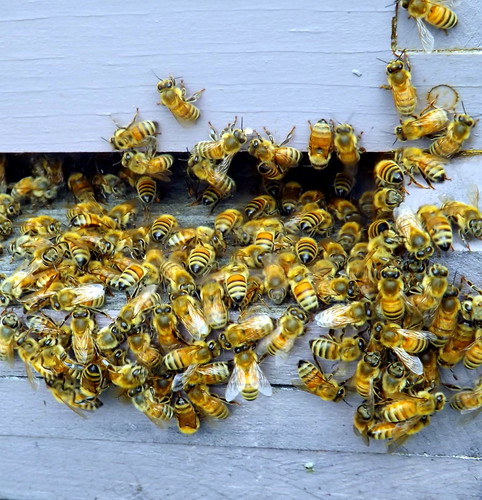
But I digress. My intention was to write about the plant–as a plant, not as a source of food. A couple of days ago, I was checking the status of the zucchini and was startled to see a fully open flower. I almost never see an open flower, which makes sense since they are only open for one day and usually from morning to early afternoon (when I am at work, or not paying sufficient attention). In order for any zucchini to be produced, bees must take advantage of this small window of opportunity and do their part by carrying pollen from the male flowers to the female flowers. [Ok, I have to digress again to show a completely unrelated photo of a friend’s beehive since I don’t have a photo of a bee on my zucchini flowers–and yes, honey bees are excellent pollinators of zucchini and many other fruits and vegetables. Go bees!]


Some of my baby zucchini seemed to wither on the stems and drop off before they even got going. I wondered if this was due to all the rain we’ve been having (or even worse, if it could possibly be the fault of our male dog–despite the barricades I erected). Luckily, I discovered it’s because the female flower didn’t get quite enough pollen from the male. Gardeners wishing to help the process along can try to hand pollinate by carefully removing the anther from the male flower and dabbing it onto the stigma of the open female flower (or by using cotton swabs to transfer the pollen). In my case, with plenty of zucchini already harvested and more to come, I may need to start tying all those flowers closed!

Here is a photo of a lovely, open zucchini flower (looks male)…

… and of another part of the plant that rarely gets mentioned: the leaf. I really like the way the leaves look, and I particularly like the downward angle in this photo. But zucchini leaves are a force of nature. They are so big and so prolific that they keep taking over the small space I allocated to the zucchini plant, and I have had to prune them several times. I felt guilty cutting them off at first, but then I learned that judicious pruning lets more light in and can help increase zucchini production. Wait–is that a plus?

In the Blink of an Eye

8 Jun

At this time of year, every day brings some new development in the garden. You take each change into account, bit by bit. But when you are away for an extended time, as I was recently for work, you come back and feel that those changes occurred far too quickly–how did that peony bloom in such a short time? Where did that red-hot poker come from?

All this was driven home to me yesterday, when my youngest son graduated from high school. How did that happen so quickly? Now, like his two brothers before him, he will follow his own path, and we will no longer see those day-to-day changes. But we will continue to admire the growth and the blooming. Luckily, our daughter is still at home for one more year. And the garden will remain, though it, too, undergoes constant and rapid metamorphoses.

Before I left for my two-week trip, the brand-new peonies I had planted were only in bud; when I returned, the blooms were already spent. I never did see what the full flowers looked like–I will have to save that treat for next year.

Peony (Kansas)
 
The new roses I had planted last month were also just beginning to bud, but since they bloom for months, I was able to see the flowers when I got back.

Hybrid Tea Rose (Love and Peace)
 
And finally, I caught the Red Hot Pokers just in time; now, their color is fading and the flower spikes are drying up. Here is one seen from above and in full bloom.

Red Hot Poker (Flamenco)
 

Recipe: Roasted and Marinated Bell Peppers

21 Apr

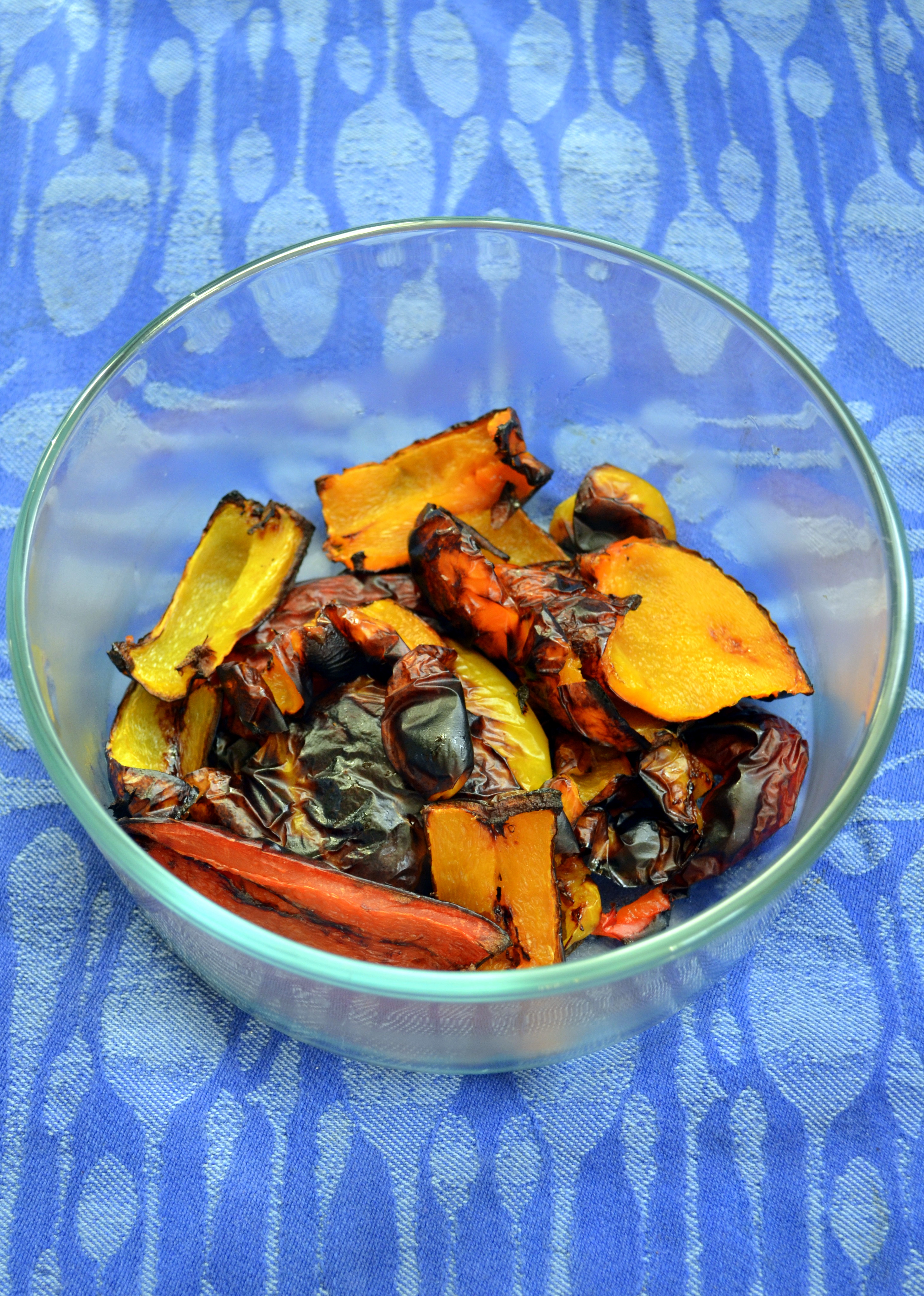
Fresh from my trip to Italy and with lots to do to get ready for the work week, I decided to prepare a Mediterranean antipasti-tapas-mezze meal made up of little dishes, simple ingredients, and nice bread. These Roasted and Marinated Bell Peppers are part of that meal, and they can be made ahead — they get better the longer they marinate. You can use all red peppers, or any combination of red, yellow, or orange that suits your fancy. In this case, I used one of each color.  I forgot the parsley before taking the photo, but will try to remember to sprinkle some on top before serving! With or without parsley, this is a nice addition to any Mediterranean multi-dish meal.

Roasted and Marinated Bell Peppers

3 large red, yellow, or orange (or combination) bell peppers
1/4 c. olive oil
2 tbsp. red wine vinegar
1 clove garlic, finely sliced
1 bay leaf
1 tsp. paprika
1 spring onion, sliced
5-6 leaves fresh basil
2 tsp. coarsely chopped parsley

Preparation

1. Turn on broiler.
2. Cut peppers into quarters; remove all seeds and membrane. Place peppers on baking sheet, skin-side up.

2. Broil until skin blackens, then put peppers into container with lid, cover tightly, and let cool.

3. When cool, carefully peel the skin off the peppers, and cut peppers diagonally into thin slices.

4. Add the remaining ingredients to the peppers, stir to combine, and marinate for at least 3 hours (or overnight) before serving.

Adapted from the Australian Family Circle Tapas booklet.

Photo of the Month: March 2013 (African Daisy)

30 Mar

This is the photo of the month for March because it reminds me of spring, which at long last seems to have arrived here in the Mid-Atlantic region of the United States. We took advantage of the glorious weekend to embark upon a much-needed garden cleanup,  which included creating a small rose garden, relocating numerous plants to better spots, and making multiple trips to the nursery.  And that is where I saw other African Daisies, which made me think of this photo I took during our trip to California at Christmas.

Witch Hazel

9 Mar

Until today, I knew next to nothing about Witch Hazel. I had a vague idea it could be found in a bottle at the pharmacy, but thought of it as something from a bygone era, like cod liver oil. Not that it didn’t have its uses –I just wasn’t sure what those uses were….

But an absolutely glorious day propelled me to nearby Brookside Gardens in Wheaton, Maryland to see what might be of interest there. Turns out, there was a great deal of interest, not the least of which was Witch Hazel (Hamamelis). As I came around a bend I noticed a tree (ok, technically a very large shrub) with the most delicate, spidery looking flowers on it. It was striking not only because it was in bloom, but because the flowers were almost ethereal. I bent to read the sign beneath and learned it was a Witch Hazel, something I had not see before. But once I saw that one, I noticed many others, in different colors, all equally stunning. I immediately experienced garden envy. Or perhaps garden regret–there is only so much I can pack into my own small garden, and Witch Hazel will just have to be admired from afar.

Below are a few photos of a remarkable plant, the extract of which helps control blemishes, soothe burns (including sunburns and razor burns) and cuts and bruises, relieve insect bites and itchy poison ivy/poison oak, and relieve tired eyes. Now that I know this, I will certainly get some extract from the pharmacy in the near future, but for now I will feast my eyes on the lovely Witch Hazel flowers and feel glad that I learned something new today.


‘Diane’


‘Diane’


‘Orange Peel’


‘Moonlight’

Ready for Spring

3 Mar

It is cold, windy, and grey here in the Mid-Atlantic United States, and I am ready for color and warmth. Where is spring? In my own yard, there a few small signs: tender shoots emerging from the ground, buds on trees, and increased bird activity. And though nothing has yet bloomed, I was encouraged today when I saw a few promising indicators from around the neighborhood, including a lone daffodil in flower. Here’s hoping my garden will not be too far behind.


Daffodils


Maple Buds


Magnolia Buds

Photo of the Month: February 2013 (Bark)

28 Feb

I love how flowers and foliage — and tree trunks and bark — look after it rains. The colors pop, and any beads of water that linger add nice visual interest. I recently walked around our neighborhood just after a rainy spell, and came across this very colorful, wet tree trunk with speckled bark. I’m not certain what kind of tree it is (any clarification on that is welcome), but the mossy green of the bark that remained on the trunk and the contrasting yellow-orange layer underneath really caught my eye.

Update 3-3-13: I think this may be either a Chinese or Lacebark Elm.