Taralli (or tarallini) are a delicious, crispy, unleavened, ring-shaped snack from the Puglia region of Italy, though they have spread well beyond their place of origin. In Rome, you may be served savory taralli along with your aperitivo (Aperol Spritz, anyone?)–but they are also available in local grocery shops in a variety of flavors, including plain (classico), pepper (al pepe), fennel seed (al finocchio), and chili-flavored (al peperoncino). We used to keep a stash at home when we lived in Italy.
Our kids (who, sadly, have not lived with us for while now as they are all grown) loved to have taralli when they would come visit us in Rome, and every time we returned to the U.S. to see them, we would make sure to stash several bags in our suitcases (along with vacuum-packed wedges of Pecorino Romano from Antica Caciara in Trastevere). Mmmm….
It became much more difficult to find taralli when we moved back to the U.S., at least where we currently live. So I decided to see how hard it was to make them. If you have ever made bagels at home, then you will have no problem making taralli. The technique is similar: make the dough, shape it, boil it, let it dry, then bake it. Being much smaller than bagels, taralli get nice and crispy–a perfect snack. I would sometimes also crumble them over a bowl of pureed vegetable soup.
This recipe is for a small batch (about 24-28) of the classic style; feel free to add any of the optional ingredients. When I made them, I added black pepper.
Ingredients:
1 3/4 c. (1/2 lb., 250 gr.) 00 flour 3/4 tsp. sea salt (about 4.5 gr.) 1/4 c. (75 ml. ) olive oil 3.5 oz. (3/8 c., 100 ml.) white wine
Optional (freshy ground black pepper, fennel seeds, chili flakes)
Preparation:
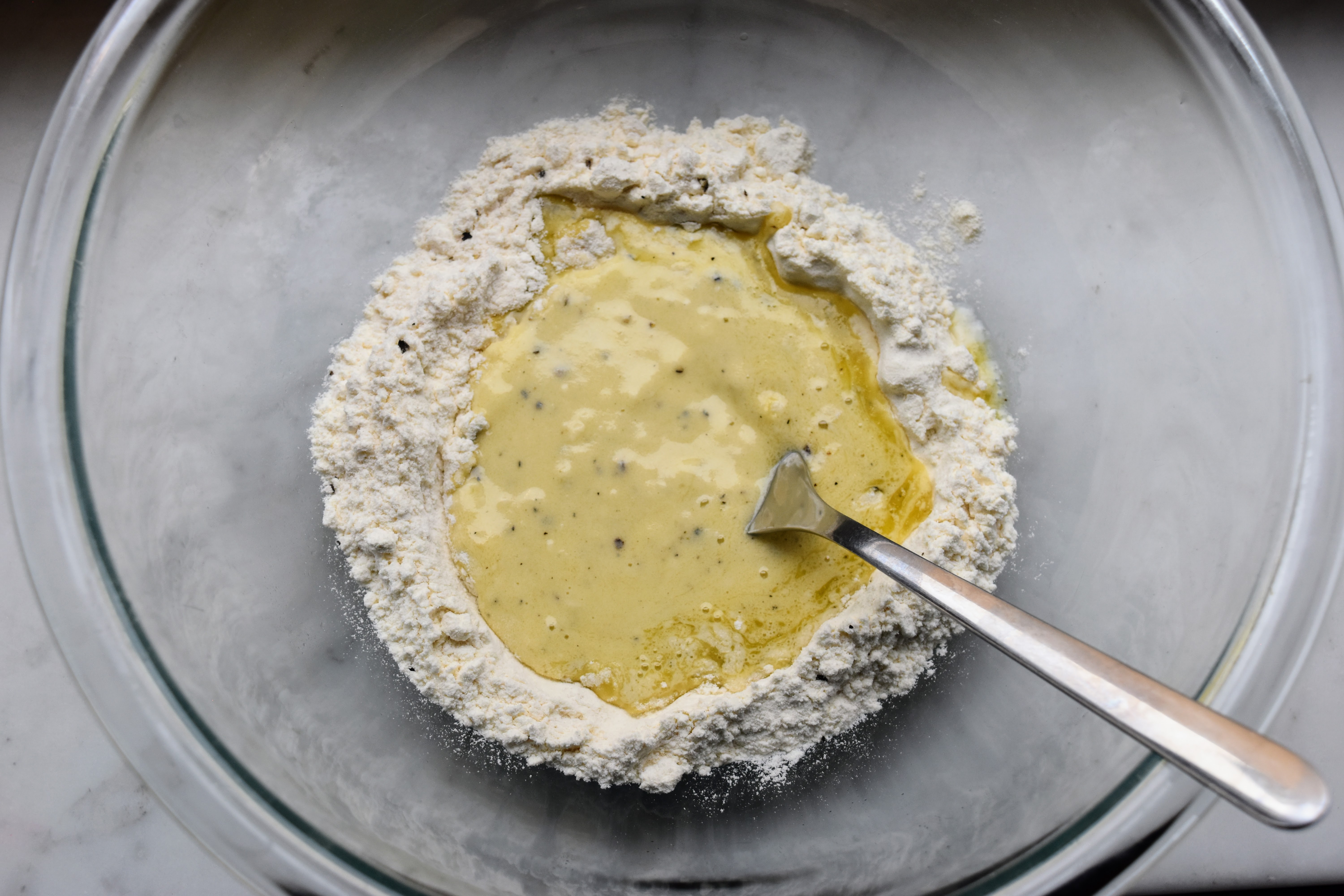
1. In a medium bowl, combine the flour and salt (and any other optional ingredients). Make a well, and add the olive oil and wine. Using a fork, slowly stir to incorporate.
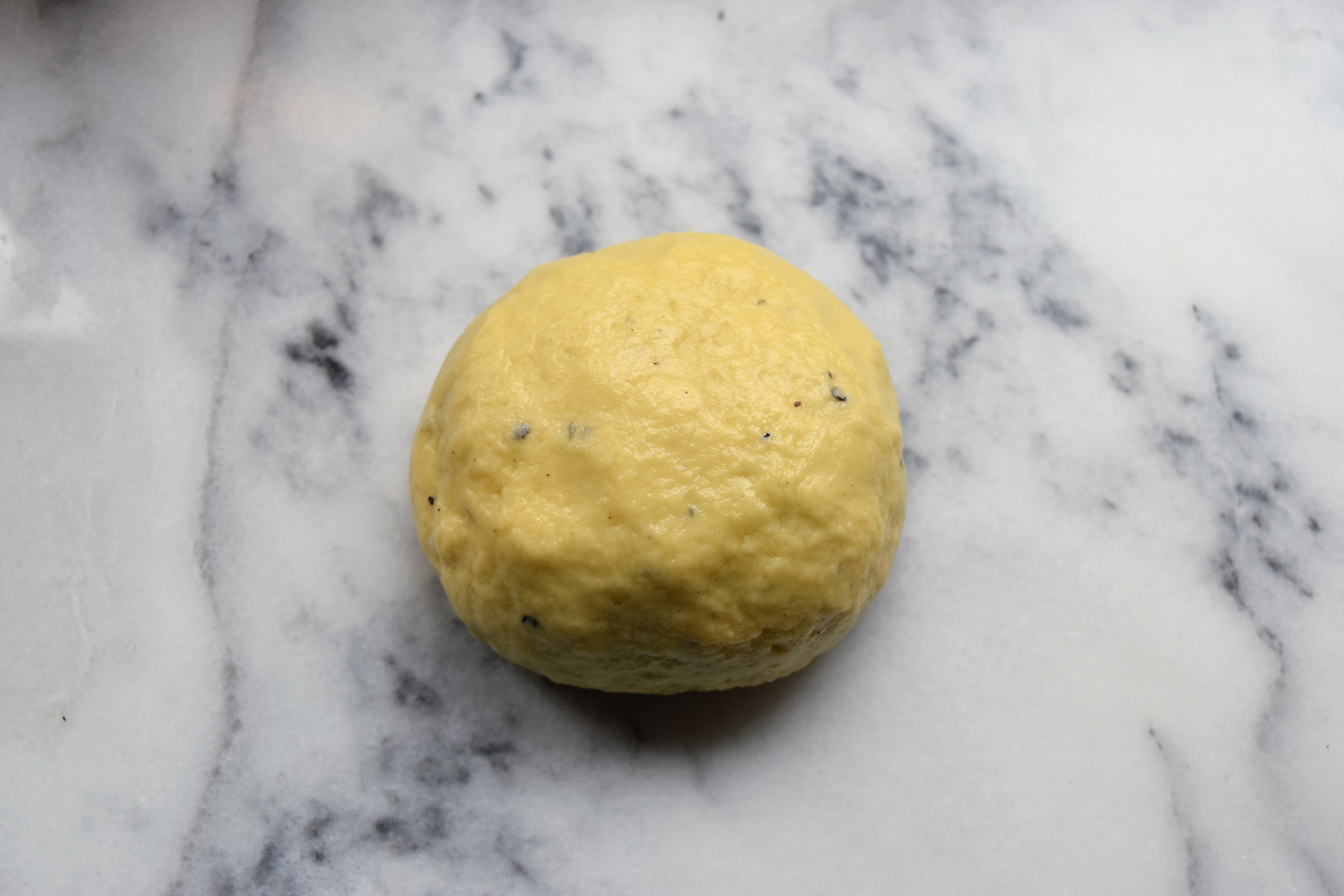
2. Knead the dough for about 10 minutes, until smooth. Shape into a ball, then cover with plastic wrap or place in a plastic bag, and let rest for half an hour.
3. Start a medium pot of water boiling. Add a pinch of salt to the pot. Place a clean dish towel on a baking sheet (or platter) near your stove.
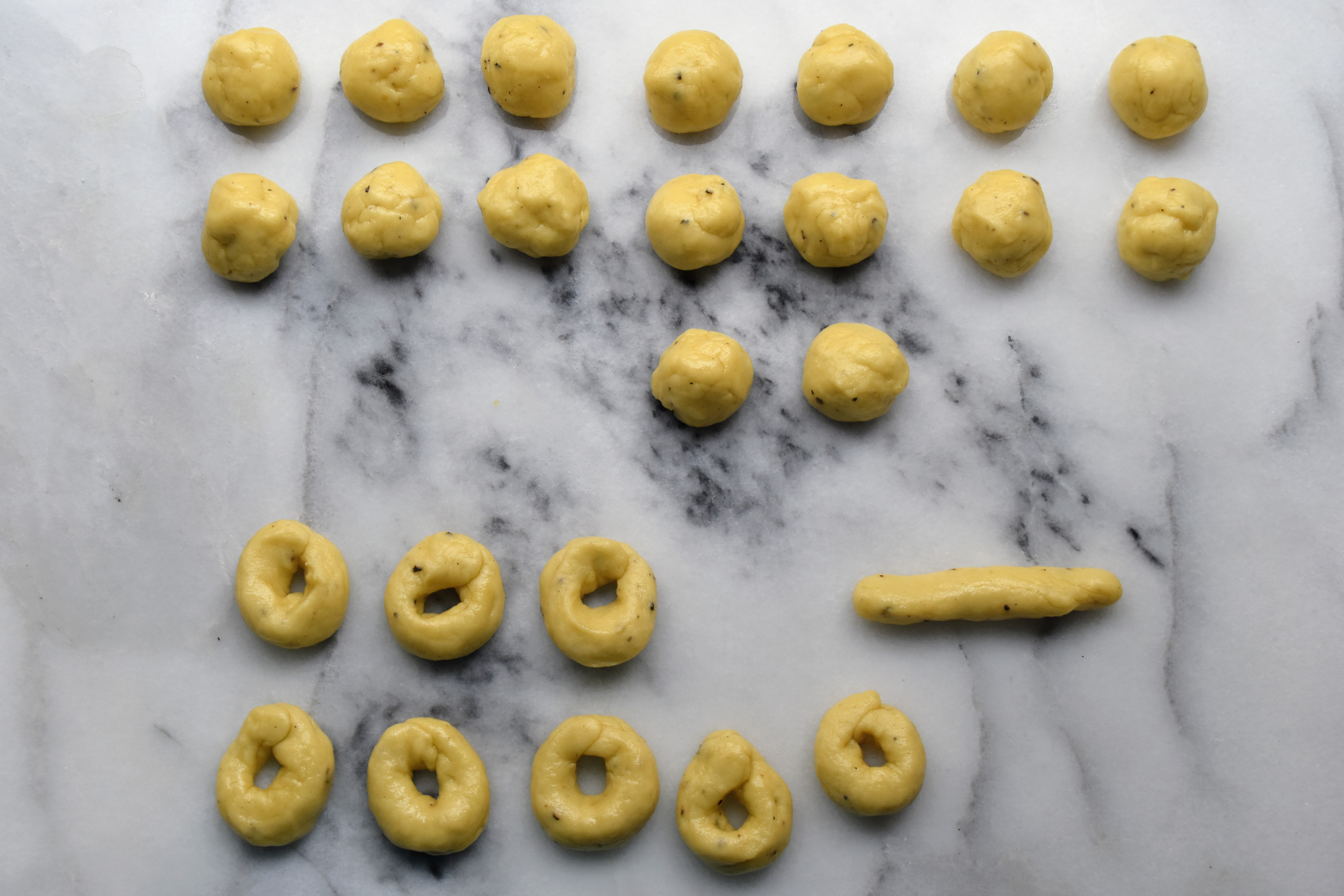
4. Divide the taralli dough into four equal pieces and roll into four equally sized logs. Cut each log into 6 or 7 pieces and shape each piece into a little ball.
5. Roll each little ball into a small, thin log shape. (Though, now that I think of it, I’m wondering why I made the little balls in the first place! I could have rolled each of the cut pieces into a small, thin log and skipped the ball part. I probably wanted to make sure everything was the same size… and, those little dough balls look cute. But, feel free to ignore the ball step.) Form each little log into a ring shape, pulling and pinching the ends together.
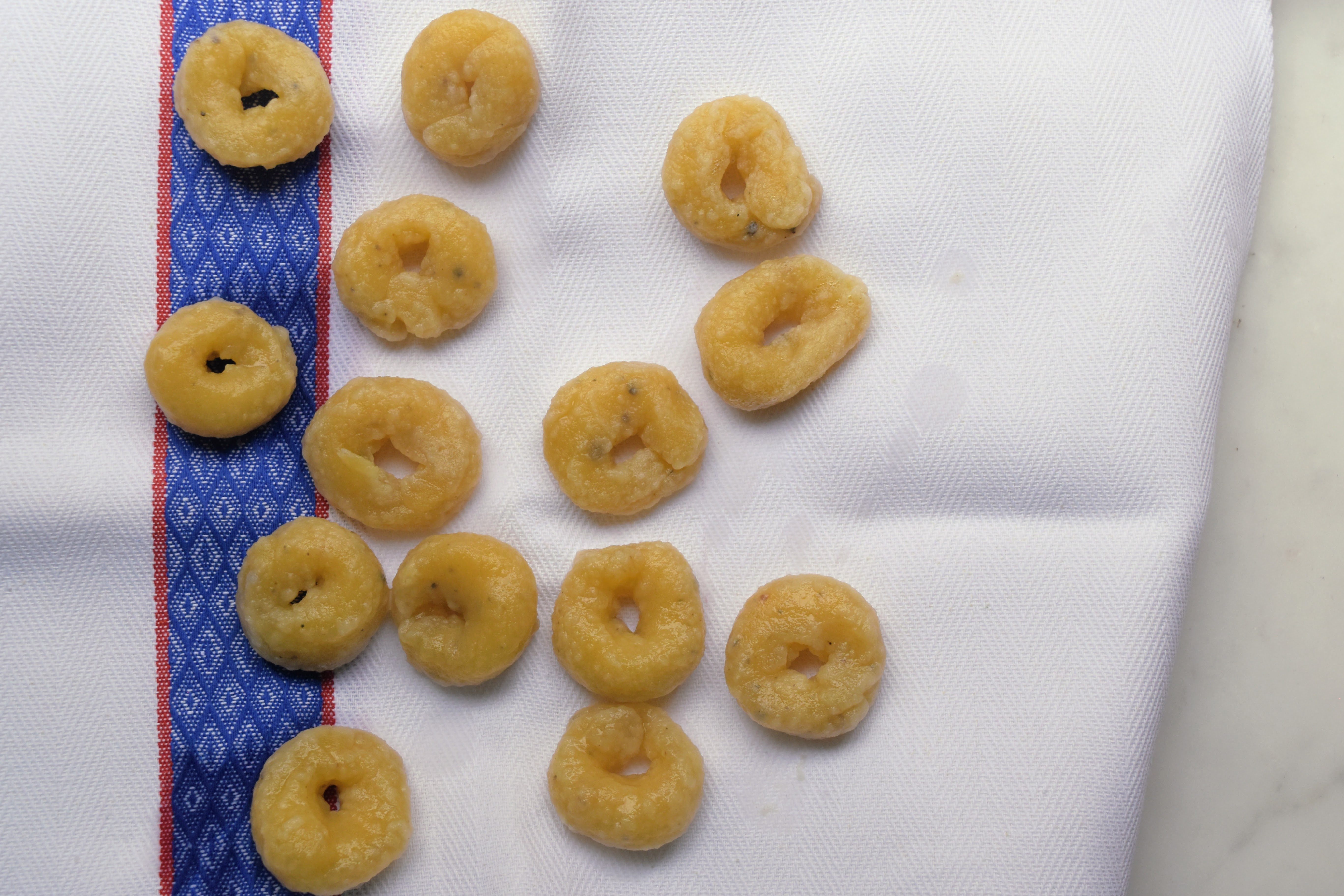
6. Boil the taralli, maybe 5-8 at a time depending on the size of your pot, until they float. Remove with a slotted spoon or skimmer, and place them on the clean dish towel to dry. Repeat until all the taralli are done; let them dry thoroughly. (You could, at this stage, leave them out for a few hours and bake them later; the extra drying time will not hurt at all.)
7. Preheat the oven to 400F/200C. Place the taralli on a baking sheet lined with parchment paper and bake on the center rack for about 30 minutes, or until the taralli are deeply golden brown; the longer they bake, the crispier they become. Enjoy!
Ruined dome of Western Palestra (gymnasium), Baths of Caracalla, Rome
The Ancient Romans were master architects, builders, and innovators. That we can still see the remains of many 2,000+-year-old structures is a testament to the Romans’ skill and to the materials they used. And also to the happy fact that in subsequent millennia, rather than be destroyed, many ancient buildings and structures were built over or incorporated into other buildings, or simply left where they were as the effort involved in removing them would be too great. Here is one example I’ve always enjoyed seeing: apartments built right into and around the ruins of the Baths of Agrippa near the Pantheon:
In contrast, I am certain that in 2,000 years, there will be nary a trace of my house here in the Midwest or any of the modern buildings nearby. So, how did the Romans make structures that have lasted so long? The answer is that they made excellent concrete and great bricks, and combined the two in various ways to construct extremely strong and long-lasting walls and other structures.
Of course, walls and buildings were also built with blocks carved from rock. In Rome, some of the earliest examples you can see are “dry walls,” built with blocks of volcanic rock called tufa without any mortar between the blocks. This technique of using blocks is called opus quadratum (also, ashlar or cuboidal masonry):
1) Part of the Temple of Capitoline Jupiter, Juno, and Minerva in the Capitoline Museums, 6th century BC; 2) Portion of the Servian Wall on the Aventine Hill, 4th century BC; 3) Wall behind the Forum of Augustus, circa 27 BC-AD 14.
If you are walking around Rome and see these types of tufa-block walls, you can be sure they are quite old. They deserve a nod of appreciation, because cutting large blocks cleanly and evenly, hoisting them, and placing them perfectly with just their weight and position to keep them in place — that is a feat requiring a lot of hard work and skill.
Building techniques began to change in the second century BC, when the Romans discovered they could substitute volcanic ash (pozzolana) for the sand in concrete mixtures, yielding much stronger and more weather-resistant concrete. This super concrete turned out to be a perfect material for the inner core of walls (opus caementicium). Plus, it did not require as much hard work or skill to make, compared to the large block walls. The idea was that the concrete core would be covered (ie, faced) with stone or brick, and then, depending on the structure, faced again with stucco, paint, or polished stone veneers like marble.
One of the first ways of using this concrete core involved a construction technique called opus incertum: randomly inserting irregularly shaped, uncut stones and/or small tufa blocks into the concrete. This technique was used in building the Porticus Aemilia, a storehouse complex built in 193 BC along the Tiber river by Testaccio:
Though fired bricks had been around for a long time, the Romans did not really begin to use them significantly until the cusp of the first century AD. Two of the first structures to be made of fired brick in Rome were the Theatre of Marcellus (Teatro di Marcello) and the Tomb of Caecelia Metella on the Appian Way. The Teatro di Marcello was completed in 13 BC; miraculously, it still has its facade, though apartments were built on top of it in the 16th century. The Tomb of Caecilia Metella is thought to have been built somewhere between 30-10 BC.
Teatro di MarcelloTomb of Caecila Metella
After these two structures were built, fired bricks began to be used all across the Roman Empire, in various ways. The most basic was a technique that involved facing the concrete core of a wall with courses of brick. It was called opus testaceum. The cut-away section in the photo below shows an inner concrete core and brick facing, from a wall at Portus, the ancient port of Rome, built around 50 AD. (Portus is about 35 minutes from central Rome, near Fiumicino Airport, and is definitely worth a visit if you can make it there.)
Inside view of ancient Roman wall, Portus.
Though bricks had come into fashion, tufa and other materials were still used as building materials. The photo below is of a section of the Aurelian Wall (270-275 AD) made with both brick and tufa. The technique used is called opus vittatum(ie, banded work, when the bricks and tufa are placed in alternating rows):
Opus vittatum, Aurelian Wall at Porta Tiburtina
Roman bricks came in different sizes: round, square, oblong, triangular, or rectangular. And walls were also built in different patterns. A pattern of pure brick rows (courses) was called opus testaceum, as mentioned above. Though it is hard to see, the skinny flat bricks used in these types of walls were often triangular, with the longest side lined up on the outside of the wall and the pointy side of the brick embedded in the concrete. A diamond or net-like pattern was called opus reticulatum. It consisted of small tufa blocks carved like little pyramids, with the square base being visible and the pointy part embedded in the concrete. When two techniques were used together, that was called opus mixtum.
The photos below show a wall in the Portico of Claudius, at Portus. On the right side of each photo is a section of opus testaceum (OT), ie, uninterrupted rows of bricks. The left part of the photo shows a section of opus mixtum (OM) consisting of a couple rows of brick (opus testaceum) interspersed with diamond-shaped sections of tufa blocks (opus reticulatum, OR).
Sometimes, the opus reticulatum was made with a combination of brick and black basalt instead of tufa to achieve a more distinct polychrome coloring, as in the first photo below from Ostia Antica (which is also an example of opus mixtum). Fun fact: The black cobblestones of Rome are also made out of black basalt.
Sometimes you will see brick arches in the walls. They are called relieving arches and they were used on tall walls, and above doors or windows or other openings, to help distribute weight and maintain structural integrity. The square holes you often see, too, are where the scaffolding was inserted when the wall was being built. They are called putlog (or putlock) holes. Other holes are where the exterior facades were attached.
Capitolium at Ostia Antica, circa 120 AD.Putlog holes, facade holes, and a few remaining bits of a marble frieze, Baths of Caracalla, 216 AD.
I hope these notes on bricks, stones, structures, walls, and holes will help as you walk around Rome, take day trips, or find yourself seeing Roman ruins anywhere else in the world.
I’ll sign off with a question about a longstanding mystery. I have always loved the look of this wall in the Cortile Biblioteche at Hadrian’s Villa in Tivoli (about 40 min. drive from Rome). But I have never been able to figure out why it was constructed this way, with pointy bricks sticking out. So if anyone knows, please do tell!
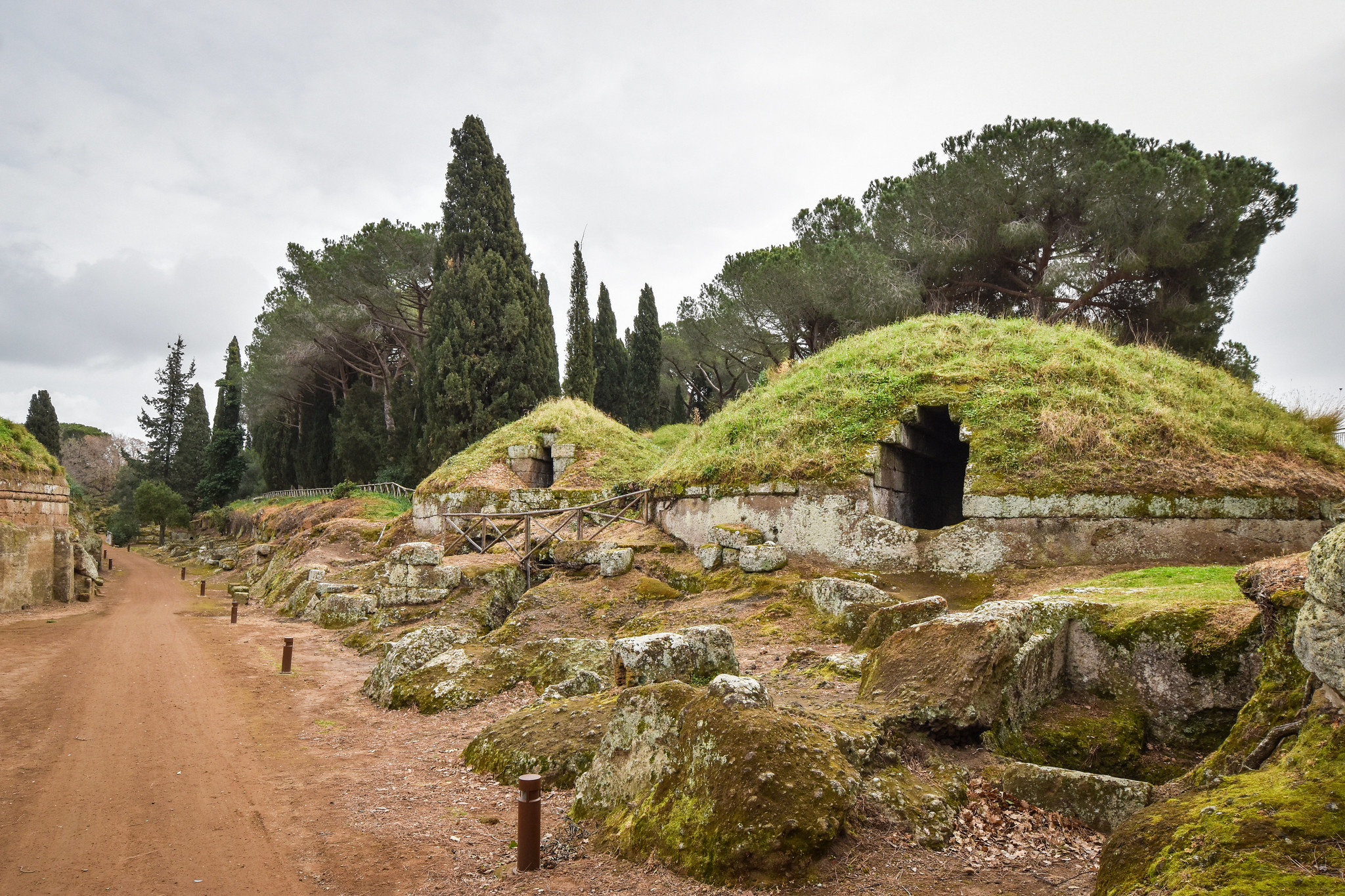
If you are in Rome and fancy a day trip to a place unlike any other you will see in Italy, then you should visit the Etruscan burial complex known as Necropoli della Banditaccia. It is about 45 km (28 miles) from Rome, along the western central coast. If you happen to be lucky enough to go when no one else is there, you will experience an almost Indiana Jones-like feeling as you walk among, and into, tombs that are even older than Rome. (The tombs date from the ninth to the third centuries BC, when the Etruscans were conquered and then assimilated by the Romans.)
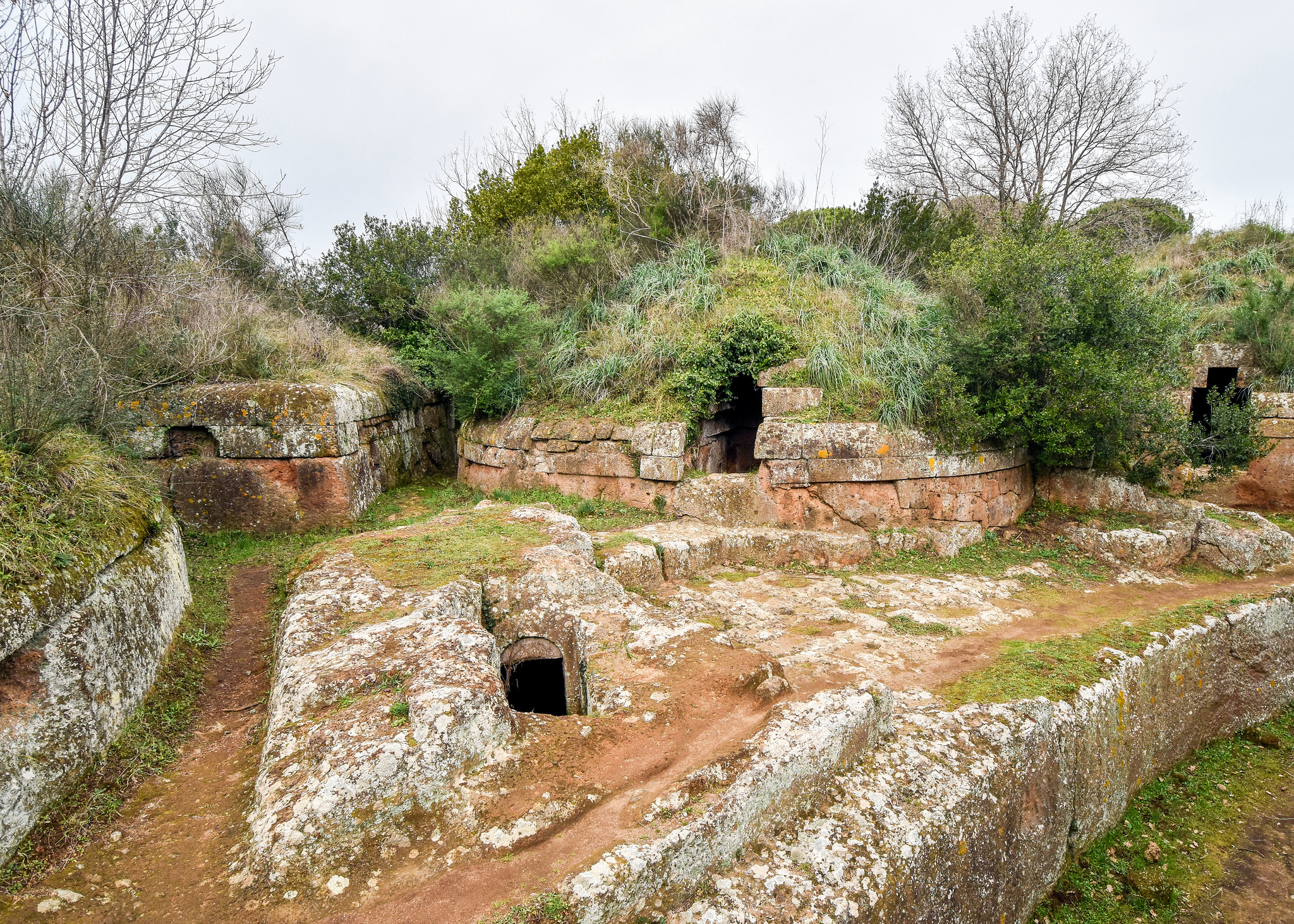
The necropolis at Cerveteri is quiet, thick with vegetation, and full of thousands of ancient tombs–many of which are underground. The complex itself is organized like a city, with streets, open areas, and even neighborhoods; it was meant to emulate how the Etruscans lived in life. But as you walk around, you feel it was always a city of the dead.
Ancient road rutted by wagon wheels, Necropoli della Banditaccia, Cerveteri
Both the Necropoli della Banditaccia and another Etruscan burial complex in Tarquinia (about 45km further northwest than Cerveteri) are UNESCO World Heritage sites, and each is worth a visit. The landscape and setting of each necropolis is stunning…
1) Tarquinia, 2) Cerveteri
… and the tombs themselves are fascinating, reflecting different burial practices over the centuries. The earliest (and simplest) tombs were just small pits where the ashes of the dead were kept; over time, the tombs evolved into circular burial mounds known as tumuli, which are carved out of the volcanic rock (tufa):
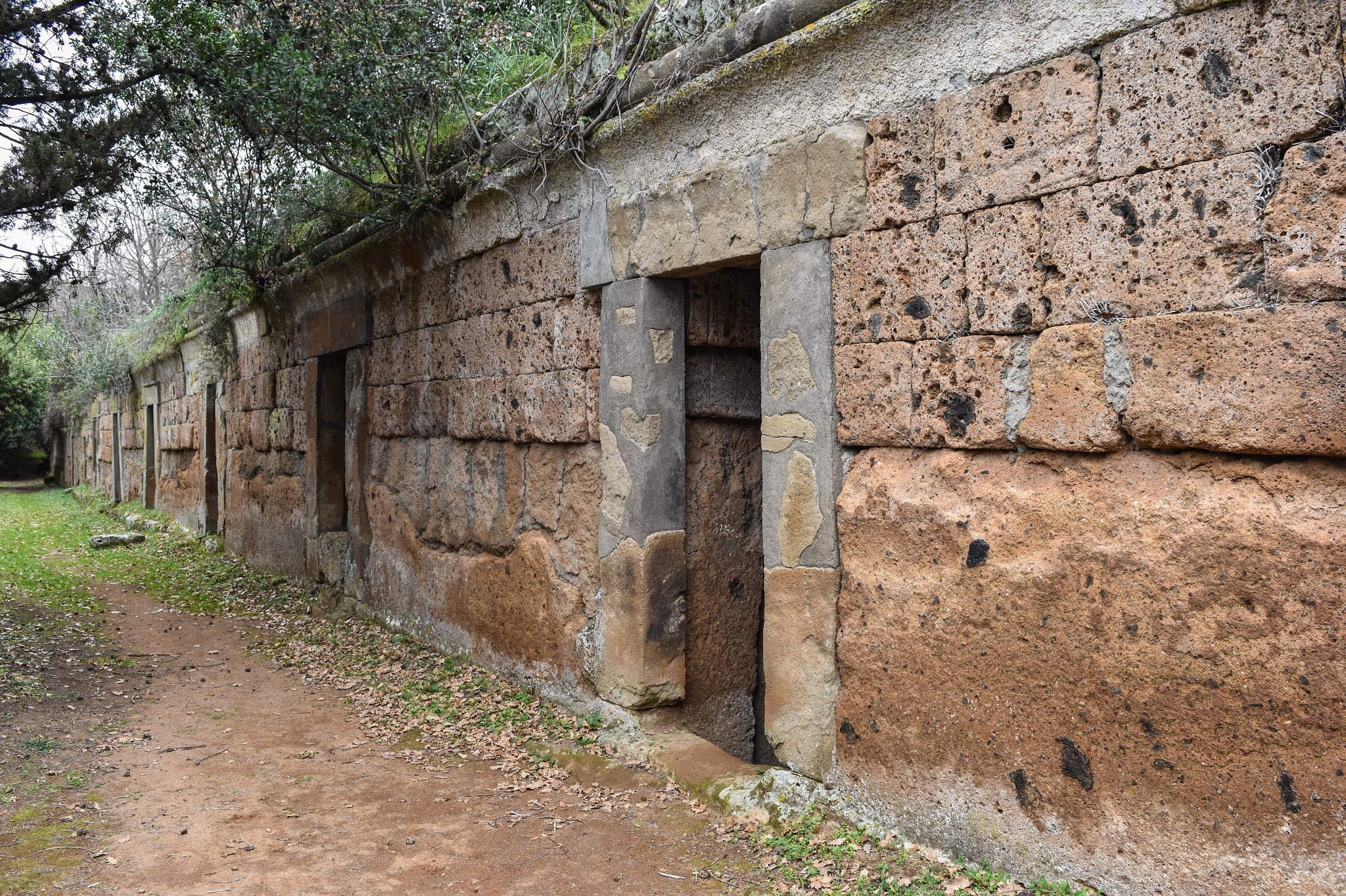
As the complex grew and more streets appeared, “square tombs” were built in long rows along the ancient roads:
Square tombs along Via dei Monti Ceriti, Necropolis of the Banditaccia, Cerveteri
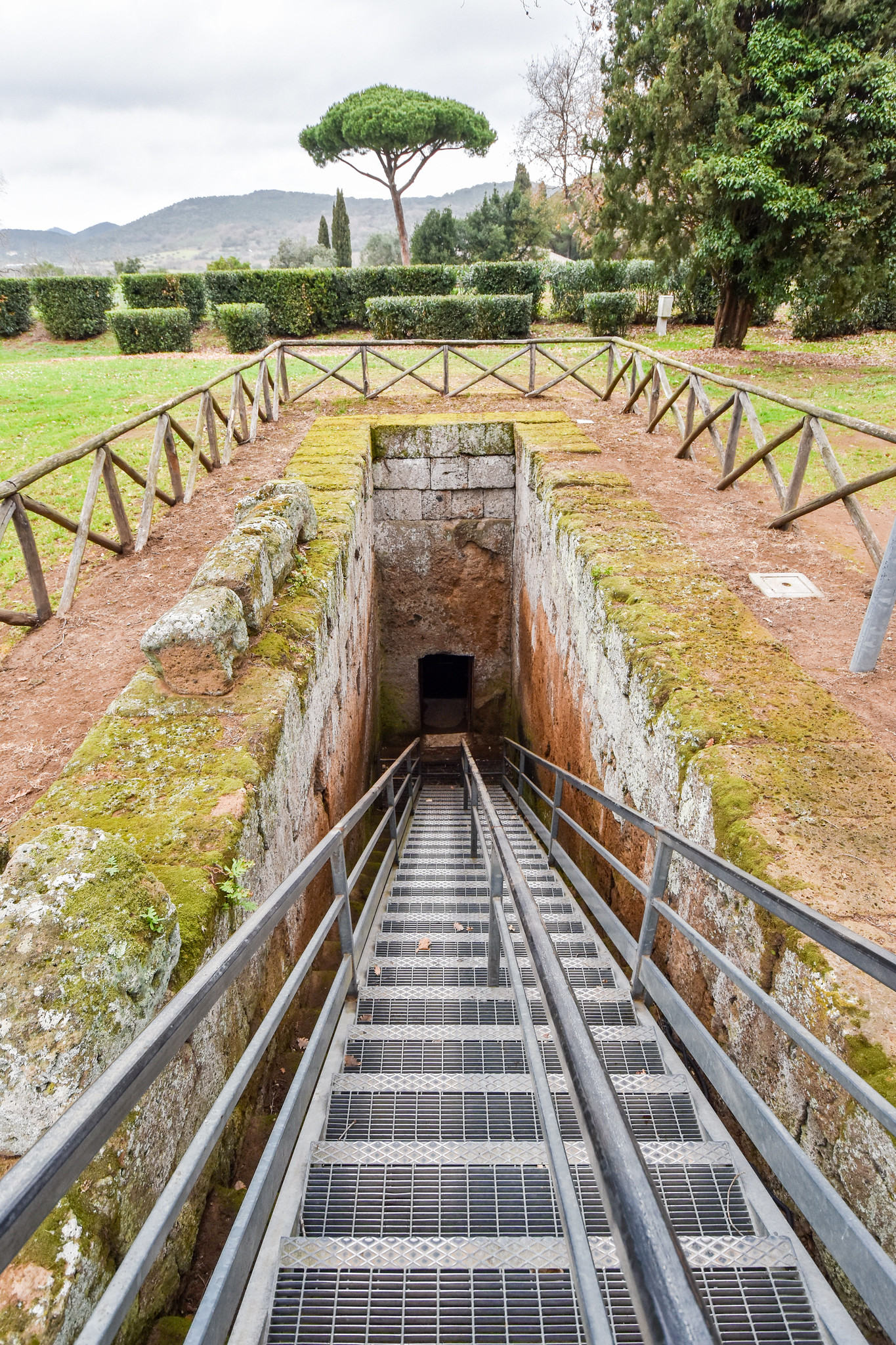
Other tombs were fully underground:
Cerveteri: 1) Stairs down to Tomba dei Relievi, 2) Interior of Tomba della Casetta
The Tarquinia site is also particularly known for its painted tombs:
1) Tombe delle Leonesse, 2) Tomba Bartoccini
As well as its group of funerary urns, which are believed to have housed the cremated remains of a pre-Etruscan, Early Iron Age community dating from 1020 to 750 BC:
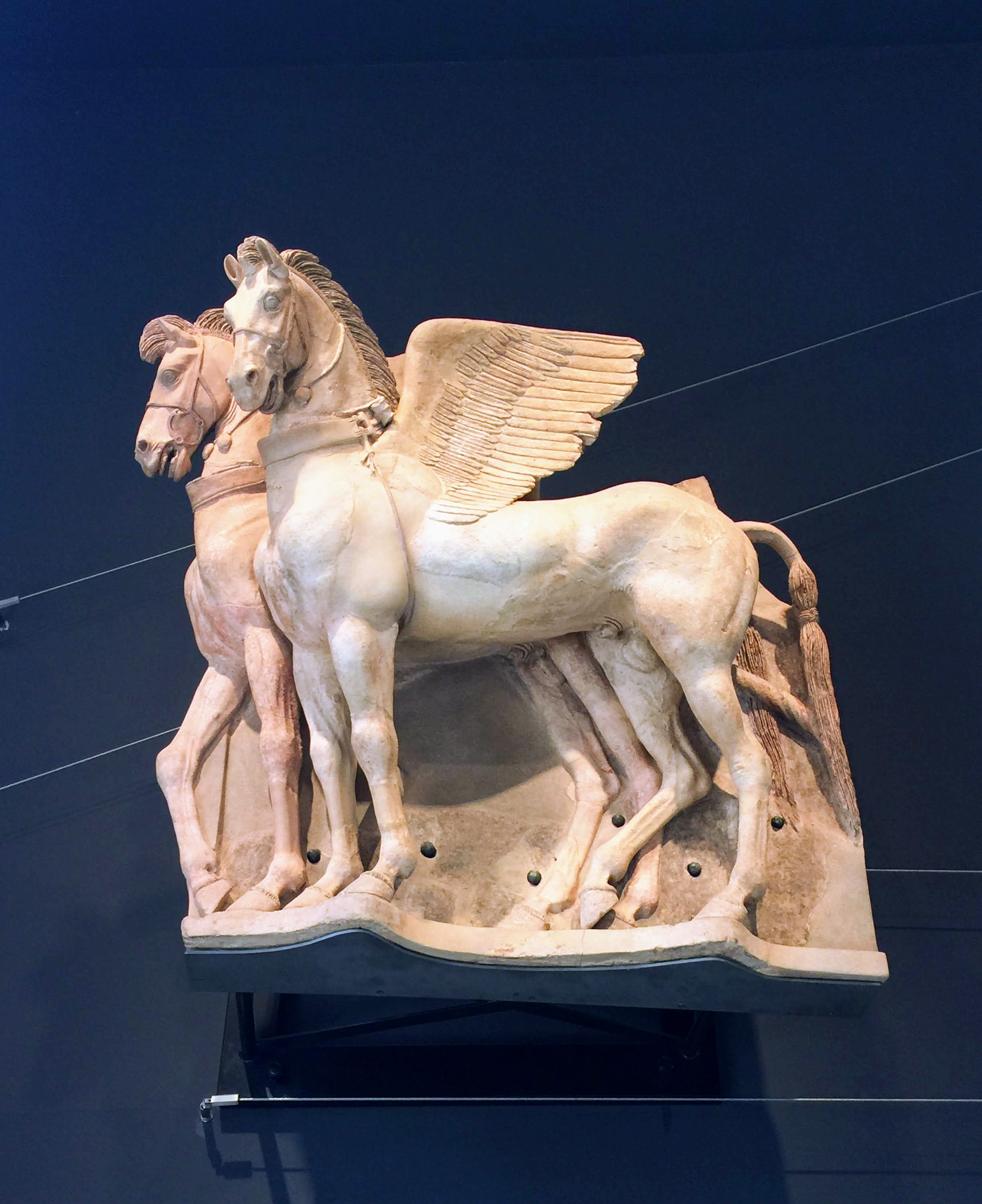
If you visit the Tarquinia site, make time to also go into town and also see the National Archeological Museum, with some spectacular works of art:
If you are ever ambitious (or, in my case, clueless) enough to take the stairs from Minori up to Ravello on Italy’s Amalfi Coast, you will not regret it. You may leave one or even both lungs along the way, but a piece of your heart will remain, too. You will marvel at the views, the lemons groves, the mountainside terraces, and the churches–and at the people who live along the path, many of whom go up and down with a spryness that comes with long practice. It is a bit disconcerting to be passed up by septuagenarians carrying multiple bags of groceries, but if you persevere, there are two tremendous rewards to be had in Ravello: Villa Rufalo and Villa Cimbrone.
Minori, at sea level
We started out one morning in February, finding the path on Google Maps (though any shopkeeper can also point the way). Luckily, I didn’t have a good idea of what I was in for; the distance on the map didn’t look too bad at all. But up and up we went, roughly 1,500 steps by some counts–though not by ours; we didn’t have sufficient oxygen flow to keep up an accurate count. Ok, I’m exaggerating slightly–the climb is tough but doable, especial in cooler months and at cooler times of the day. It’s not all stairs, there are stretches of pathway and places to stop, too. But I wouldn’t recommend it at high noon in the middle of the summer, or for anyone who generally has trouble with lots of stairs. If you are game, however, it will be unlike almost anything else you do in Italy. And you can always do it in reverse–go down instead of up. We did both.
Signpost
Stairs going up; man trimming Mimosa tree
Altar along pathway; sea view
Mountain view
Last stretch of pathway between Minori and Ravello
When you finally make it to the top, you are in for a few more spectacular views. But first, a cappuccino or cold drink in the main piazza may be in order. After that, head to Villa Rufalo, home to the Rufalo family in the 13th century, restored by the Scottish businessman Francis Nevile Reid at the turn of the 20th century, and–since the 1950s–the venue for the famous Ravello Festival. Though how those musicians sit on a specially erected platform that appears to be dangling over the cliff, I do not know. The gardens and views are spectacular, but the villa itself is also worth a look.
Giardino
Umbrella pine; Torre Maggiore
Interior doorways; Tiled floors
After seeing Villa Rufalo, grab some lunch, then head to Villa Cimbrone, restored in the 19th century by the Englishman Ernest William Beckett (Lord Grimthorpe) and now a luxe hotel. The gardens, which can be seen separately from the hotel, were influenced by Edwin Lutyens and Gertrude Jekyll and benefited from the advice of Vita Sackville West, who chose many of the trees and plants. If you are afraid of heights, beware the Terrace of Infinity, a stunning spot from which to experience a vertiginous view of the sea 1200 ft (365 m) below. Yes, it’s a slab of concrete dangling on the cliff, but it has lasted this long and appears very sturdy. Just don’t lean too far over the dainty, waist-high, wrought-iron fencing….
Entryway to Villa Cimbrone; Cloister
Rose Terrace
Avenue of Immensity; Statue of Ceres
Terrace of Infinity
Sea view from Terrace of Infinity
So, after a good day in which we climbed a mountain and saw two spectacular gardens, we decided to treat ourselves to a cab back down to Minori. Except there wasn’t one; the lone cab driver working in February had gone on an extended lunch break. So, back down the 1,500 steps we went. My knees and calves were sore for a few days afterward, but I’d do it again in a heartbeat. Plus, there was a sweet reward at the bottom….
Pathway down; Lemon trees behind protective fencing
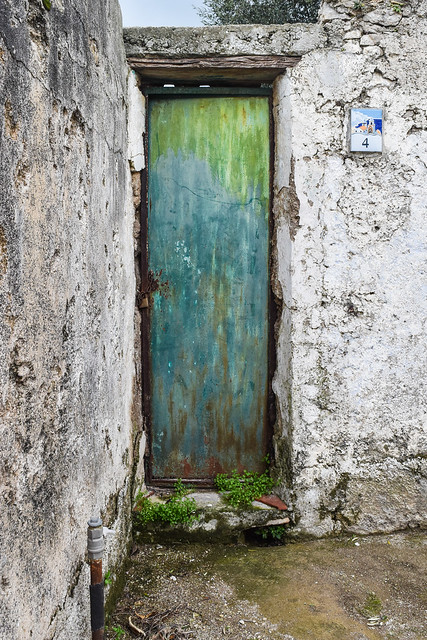
Rusted doorway; Donkey and cart decor along pathway
View of Ravello atop the cliff
Reward at the bottom; cake at Pasticceria Sal De Riso in Minori
Spring is in the air and that means the Garden of Ninfa, which has been called the most romantic garden in the world, will soon be open for its limited 2017 season. Ninfa is the Italian word for nymph. It is an apt name for this sylvan place that time forgot, with its flowers, trees, and gurgling streams, and its ruins covered in vines.
Located near Cisterna Latina 75 km (46 miles) southeast of Rome, Ninfa has a long and colorful history. A thousand years ago, it was a small town by a flowing stream, home to a temple dedicated to the water nymphs from whence it got its name. By 1100 it had become an important and wealthy place next to the only north-south road that was passable when the Appia Antica was flooded.
Pope Alexander III was crowned there in 1159, but the town’s honor and glory would not last long; the Pope’s enemy the Emperor Barbarossa sacked the town. It eventually passed into the hands of the Caetani family, though it suffered a long and steady decline starting in the 1300s. During subsequent centuries, nature took its course, engulfing the abandoned medieval town, which faded from sight.
But not from memory. In the early 1920s, Gelasio Caetani decided to reclaim the swampy land via a custom-built drainage and irrigation system, and establish a garden amid the ruined town with the help of his English-born mother and American-born sister-in-law. Gelasio’s’ niece Leilia Caetani and husband Hubert Howard continued the family’s work. They imported plants from all over the world; the 8-hectacre (20-acre) site is home to more than 1,000 plant species, including dozens of roses, clematis, climbing hydrangea, water irises, ornamental cherry trees, cypress, magnolias, oaks, and poplars, among many others.
Today, a foundation maintains the garden, which is only open on certain dates and is accessible only via a guided tour. In 2017, visiting season kicks off on April 1. The majority of open days are in the spring, though the season runs through November 5. Check online for dates and to buy tickets–and if you are going to go, get there early. If you have a few minutes before your tour starts (or after it ends), you can cross the road and visit the Horti Nympharum, a classic citrus garden across the lane complete with fountain, a family of swans, and castle ruins to wander through. There is a separate entry fee for that garden, but it is worth the price.
Finally, if you are making a day of it, head up to the walled hill town of Sermoneta for lunch; the town itself is charming, and the views of the valley from above are gorgeous.
Last weekend, we took our first road trip. Destination: Umbria–specifically the Truffle Festival (Sagra del Tartufo) in Fabro. This medieval town is just under two hours away from Rome (slightly less if you can make it out of Rome without getting lost…). And its woods (below) are full of truffles.
The Festival is in the higher, older part of town and consists of about 50 stalls, many selling truffles, truffle sauces, truffled cheeses, truffled sausages, and almost anything else that can be truffled. Unfortunately, we were a day late to see (and taste) what was billed as the world’s biggest truffle omelette. But we did sample our way up and down the stalls; being equal-opportunity eaters, we devoted attention to non-truffled items, too:
I did a double take when I saw the sign below, thinking mule salame was on offer along with the wild boar and venison versions. But no–it was just salame shaped like mule testicles….
After visiting the festival, we stopped at a nearby restaurant for lunch (because really, the festival was just a long snack…), where we ordered truffled pasta to share and I had pheasant with a sauce made from truffles, pate, and cognac. That may sound expensive, but it wasn’t; during truffle season in Italy you can get all sort of truffle-relateddishes for very reasonable prices. Of course, if you are hoping to buy a whole, hefty, wrinkled, earthy, deeply aromatic truffle–that’s an entirely different proposition. But we weren’t. I was happy with the few tastes I had. A blasphemous statement, I know–but I find that a very little truffle goes a very long way. Now, porcini mushrooms, on the other hand….
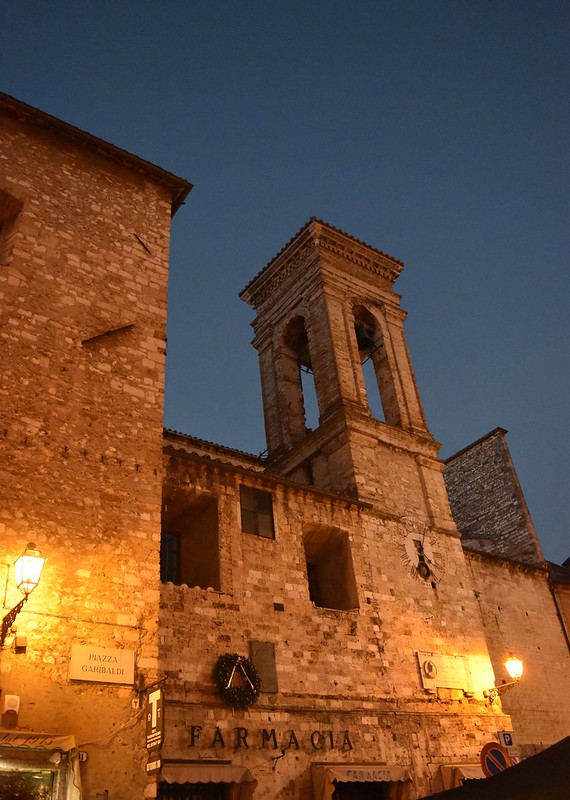
After our very late lunch, we could have gone back to Rome, but we decided to (literally and figuratively) squeeze in one more festival–the Chestnut Festival (Sagra della Castagna) in Narni. The Festival itself was very small, with not much on offer. But Narni was striking at twilight and night, and we did happen upon chestnuts roasting over an open fire:
Taking a page from Keats, who is buried in the cemetery near our apartment, this post is dedicated to a single beautiful object: not a Grecian urn, but an Italian sandwich.
The object of my affection can be found at the Testaccio Market, a wondrous place away from the usual madding crowds of Rome, a veritable feast for the senses and the stomach. Fantastic produce? Check. Meat, poultry, fish, cheese, nuts? Check. Honey, preserves, pastries, gelato, and all other delicious sweet things? Check. Coffee and wine? Check. Plus housewares, vintage clothes, flowers, and more, including the panini at Mordi e Vai (which means “Bite and Go,” or slightly less literally, “Grab and Go”).
You cannot miss the stall; the heady aromas wafting around it will help guide the way to this bastion of Roman street food. Proprietor Sergio Esposito, a proud native son, wanted to offer his customers serious Roman panini–panini with fillings born from Testaccio’s history as the city’s meat-packing district. And more, he wanted to engender an appreciation for this authentic fare. He succeeded, judging by the devout following Mordi e Vai has cultivated.
As it was my first time there, I asked Signor Esposito’s son for his recommendation. He said the most popular panino (panini is plural) is the one made with Allesso di Scottona and chicory:
Allesso comes from cotto a lesso, which means “boiled,” though “simmered” might be more accurate; the preparation is similar to a French pot-au-feu. A scottona is a heifer, a female bovine that has not yet had a calf and is no more than 15 or so months old. (A “cow” has had at least one calf.) Scottona meat is marbled with small flecks of fat and is very, very tender. As the meat simmers, the fat melts and gives additional flavor to the meat.
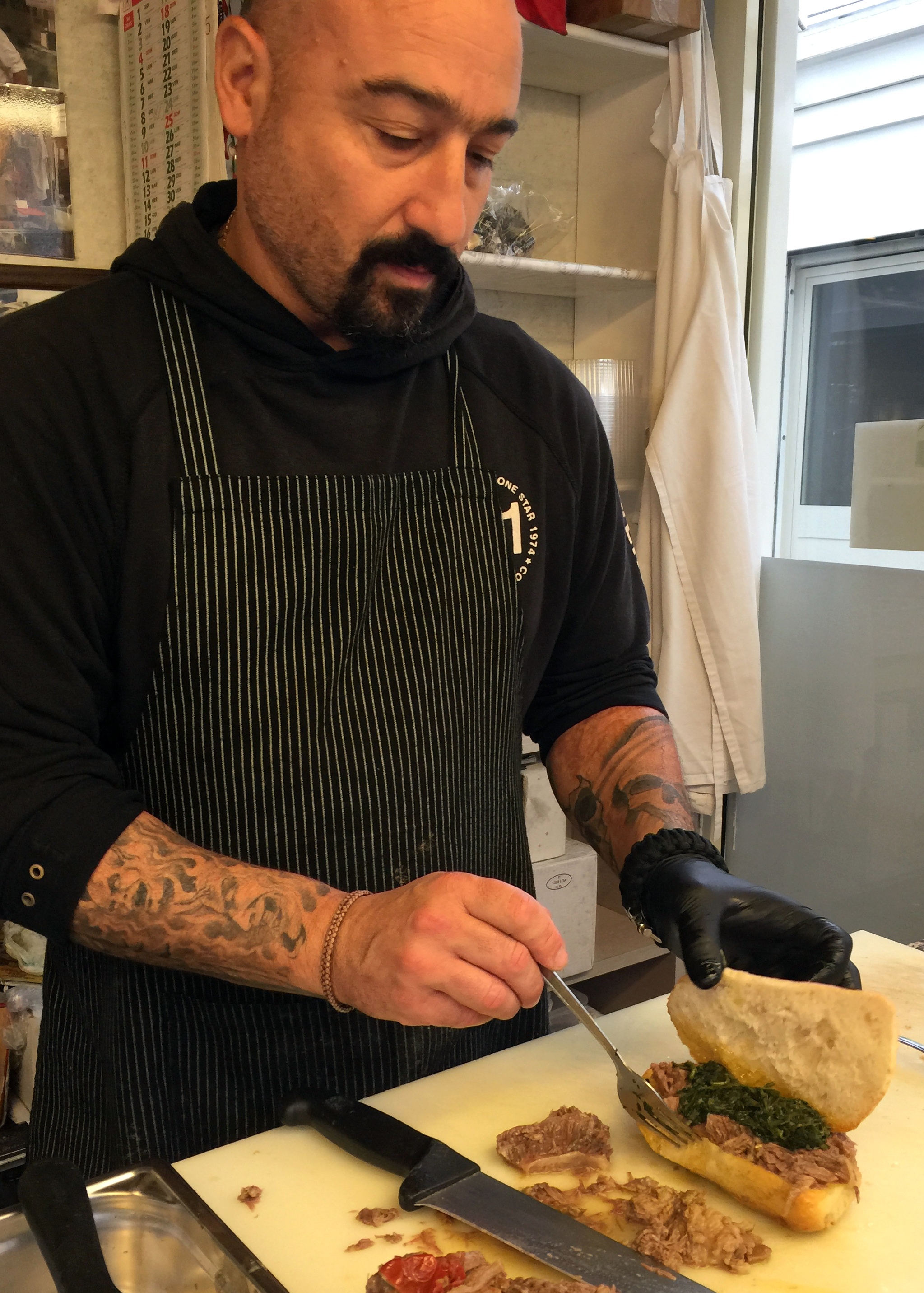
To prepare the panino, Signor Esposito’s son took a piece of the fork-tender meat from the simmering liquid and placed it on a cutting board, where he carefully (I would say almost lovingly) cut it into smaller pieces. He sliced a crusty ciabatta roll in half, dipped an open side into the simmering liquid, and then gently placed the meat on top. He followed it with some braised chicory–a somewhat bitter leafy green that is related to dandelions, endive, escarole, and radicchio. Finally, he added the other half of the bread, pressed the sandwich lightly together, wrapped it in a translucent wrapper, and handed it over. Cost: 3.5 euro.
What a triumph. The crusty bread balanced the tender savoriness of the meat while the chicory countered its richness. It was the perfect panino for a fall lunch, and the perfect introduction to Mordi e Vai’s offerings, which include panini with fillings ranging from meatballs and sausage to tripe and bits of liver, lung, and heart–as well as other fare.
If you get there early, you may be doubly lucky: you may not have to wait long for your panino and you may be able to find a table in the central courtyard of the market, where you can give this delectable Roman sandwich all the attention it deserves.
Mordi e Vai
Box 15
Testaccio Market
Open 8am-2:30pm.
I have discovered I will need to imbue my cooking in Rome with a hefty dose of gratitude. When I first saw our kitchen, with its cream cabinets, red shelves and drawers, built-in refrigerator, stove with the perfect size burner for a small espresso maker (it would not be an Italian stove without one, after all) and even a dishwasher, I liked it immediately. It was light-filled, modern, and had the essentials. Plus the colors reminded me of the kitchen I just left. I did make note of the tiny oven and the lack of counter space, but I knew I could find solutions for both those things.
What I did not know was how lucky we were to have any kitchen at all. Turns out that in the world of Roman apartment rentals, “unfurnished” very often means “apartment comes with absolutely nothing but walls and doors–no appliances, no cabinets, no closets–nothing.” Friends of ours who also recently moved here saw an apartment they liked, but the kitchen belongs to the previous renters, who are willing to sell it to them for a hefty price. Otherwise, the appliances and cabinets will be removed. I didn’t ask about the kitchen sink; I’m sure it will go, too.
In the United States, kitchens usually come fully stocked, so to speak. Not in Rome. Upon seeing the kitchen in our new apartment, two different Italian friends asked 1) if we had brought it with us from the United States (ie, dismantled and reassembled from our old house), or 2) how we had managed to buy the appliances and cabinets here–and have them installed–in such a short time. They were quite surprised to discover everything came with the apartment. So whatever differences there may be between this kitchen and our previous one in the United States (and I will list some below)–I am, above all, very happy to have any kitchen at all.
Drying Cabinet All of the Roman kitchens in which we have lived (four to date) have had drying cabinets, which I love. They are cabinets with internal racks, set over the sinks, and are immensely useful for a quick washing up (especially when there are just a few dishes), for items that can’t go in a dishwasher, and also for storage:
Aforementioned Oven I was delusional to think I could fit half-sheet baking pans into a typical Roman oven, but I brought them anyway as they were the only ones I had. Though I knew I probably could not use them, it was still disappointing to have it confirmed: the baking sheets hit the edges of the oven, which is roughly 17.5 inches (44.5 cm) wide on the inside. But then inspiration struck and I discovered if I took out the racks, I could slide the sheets right into the grooves. It’s a tight, slightly warped fit, but it fits. I haven’t actually baked anything this way yet, but for the sake of research, will soon experiment with some cookies.
Garbage Disposal (or lack thereof) Ok, I admit I do miss having a garbage disposal just a tiny bit, as I’m not super fond of fishing food out of the sink traps. But of all the things to miss, this really doesn’t rank very highly (unlike, say, Zip-Loc bags). And as I fish things out of the traps, I find myself admiring the rapidity with which calcium makes its presence known here–on the base of the faucet, even in drops of water as they dry in the sink. That is why we use bottled water in the espresso maker and tea kettle, and why I occasionally throw an anti-calcium tablet into the washing machine.
Washing and Drying Clothes… I realize this post was meant to be about kitchens, and that kitchens and washing machines don’t always go together (except that I’ve seen and lived in apartments with washing machines in kitchens). But I wanted to mention our washing machine, which is unfortunately located in a closet that is right behind a door in a small room–it’s not possible to open the door to the closet without closing the door to the room, meaning there’s a lot of banging of doors on laundry days.
First, of course, I’m grateful the washing machine came with the apartment. Second, it’s not so much the washing machine that is different (thought it is smaller), but rather, it’s the fact that there is no dryer. While hanging clothes to dry is quite common here and in many, many other parts of the world, it is less common in the United States. But I have always liked it. I don’t experience many Zen moments when it comes to housework, but hanging fresh-smelling, damp clothes to dry is one of the few tasks I actually enjoy–despite not having a yard, terrace, or balcony, and only being able to use a small clothes rack. Part of it is sensory, but part is intellectual (yes, my family thinks I have gone off the deep end): deciding how to arrange the clothes in such a way to optimize the available space while ensuring maximum airflow and minimal wrinkliness….
Perhaps part is also the novelty. This process of working out a new modus vivendi in the house and in Rome is something I quite enjoy. I know the pleasure I currently take in even the smallest of tasks may turn into something else later, but I will appreciate this time while it lasts.






















 m
m


 Perennial Pastimes