Cicadas as Meteorologists?

5 Oct

The much-hyped cicada Swarmageddon turned out to be a bust this past spring–at least in our area. Far from being a plague of biblical proportions, not a single Brood II cicada graced our yard. Local pundits suggested that perhaps the cicadas were put off by Washington, DC traffic….

But just because periodical cicadas (like the Brood IIs, which appear every 17 years) didn’t put in much of an appearance, that doesn’t mean other cicadas haven’t been going about their usual business. This morning, as I sat sipping my coffee, I glanced out the window and saw a visitor hanging on our screen.


It was an annual (or Dog-Day) cicada, and the visit was brief. Possibly because it was rushing to complete its checklist amid a rapidly ticking biological clock. Dog-Day cicadas are supposed to show up during the long, hot days of July and August.  This is October–though admittedly, it’s been an unusually warm October so far. Today, temperatures are expected to hit 84 degrees F. And since it does feel like summer has dragged on and on, that Dog-Day cicada seems to be right on target.

According to folklore, these cicadas are seasonal barometers in one other way, too: once you hear them singing, you can expect the first frost of the season in six weeks. I’ll be on the lookout.

Photo of the Month: September 2013 (Velvet Plant)

30 Sep

There are all sorts of reasons a photo may catch someone’s eye: the lighting, the composition, the subject, the colors. I liked the way this one showed texture.

Weekly Photo Challenge: Saturated

29 Sep

This week’s photo challenge calls for rich, saturated images. This is a Baby Darling Daylily. The pale blue background makes the colors in the flower–the deep plum petals, spring green stalks and buds, and gold-tipped anthers–appear even more vivid and intense.

Iris Seeds

28 Sep

Last weekend, I was ambling down a woody path at Brookside Gardens when I glanced to my left, and then glanced again. What I saw was a small patch of irises, blooms long gone, but with seed pods at the end of the stalks. And one of the pods had split open, revealing bright orange seeds.


Those of you who grow lots of irises may be very familiar with iris seeds, but I had never seen them before. After going home and doing a little research, I now know why: I only have two Japanese irises in my garden; one rarely flowers and the other produces just a couple blooms each year. So it isn’t surprising I haven’t seen any seed pods–my irises aren’t making it easy for bees to pollinate them, and there can’t be any seed pods without successful pollination.

There also can’t be any if each spent iris bloom is carefully removed, which is fairly common practice. Why would a gardener do this? To allow the plant to conserve all its energy for next year rather than spending some of it creating seed pods, which could lead to fewer future blooms on the parent plant. But those seeds could eventually lead to other blooms, and for me, part of the fun in gardening is encountering the occasional nice surprise.

So, assuming a miracle occurs and I do spot an iris seed pod in my garden one year, I would have two options (after letting the pod turn brown and split, harvesting the mature seeds, and drying them out):

  1. plant the seeds in the ground later in the fall (so they can chill throughout winter and so the rain and melting snow can help remove the seeds’ germination inhibitor), or
  2. soak the seeds in daily changes of water for up to two weeks (to get rid of the inhibitor), store them in a plastic bag in the refrigerator (with damp peat moss or potting mix to keep them moist), start them in pots in early spring, and then plant the seedlings. This moist/cold process is known as stratification.

All things considered, I’ll go straight for Option 1. Either way, it may be a year or two before the irises bloom since it takes a while for them to form mature rhizomes. The resulting irises may not look like the parent plant at all, and they may not be quite as fine specimens as other irises–or they might. I like a good mystery.

Recipe: Crackers with Cheddar and Fig

24 Sep

The pairing of sharp cheddar and sweet fig is another match made in gastronomic heaven. This recipe–though it hardly deserves to be called that–is an embarrassingly simple way to bring the two together. Take out a few crackers or crispy flatbreads (or cut a few slices off a baguette), top with a small wedge of cheddar, and add a dollop of fig spread or jam* for a delicious snack. Or, put some of the fig spread in a tiny bowl and place it on a larger cheese board, along with the cheddar.

For a Spanish variation on the theme, pair Manchego cheese with membrillo, a lovely fruit paste made with quince.

*  I can get fig spread at my local store, and now always keep a jar in the fridge; if you make your own spread or jam, even better!

Weekly Photo Challenge: From Lines to Patterns

22 Sep

Most days, as I walk to the metro and then to my office, or repeat the process in reverse, I don’t think to look upward. The route holds very few surprises any more and I am often lost in thought, mentally cataloging what needs to be done at work, or what can be turned into dinner when I get home. But when I travel, or even when I walk somewhere new in my own neighborhood, I look up more. Delightful discoveries can be found above.

This is one of them–a ceiling in Canterbury Cathedral in England. The lines and patterns here are a sight to behold; the thought and effort that must have gone into creating this visual feast is mind boggling. Photo is in soft focus.

Rudbeckia maxima: A Natural Bird Feeder

21 Sep

Last year I discovered that while my two bird feeders were quite popular, there was another very attractive source of seeds in the yard that was equally as appealing to certain birds: the Rudbeckia maxima (Giant Coneflowers) I had planted near a wrought-iron fence. I watched one day as a small bird flew by, grabbed a stalk in its little talon, pulled the stalk over to the fence, and perched there, nibbling seeds off the cone.

Since then, I have been happy to share the flowers with the birds. I can see the attraction; the Rudbeckia are stunning–they are tall (about 7 ft.) and cheerful, with clumps of silvery-blue foliage and lovely yellow ray flowers pointing down from the base of the cone. The cone starts off light green but then turns dark brown as the plant matures and the seeds come in. And then, it’s buffet time for finches, chickadees, and other birds. A self-service seed bar, courtesy of Mother Nature.
 
Even after the petals have dried up and fallen off, Rudbeckia maxima seed heads can play a striking role in the autumn garden: here is a whole one and a section in close-up.


Weekly Photo Challenge: Inside

16 Sep

How to picture the inside of something? I first thought of showing the inside of a flower, but I just did that. Various family members offered to open their mouths so I could take a nice photo of their uvulas, but I felt I could surely find something slightly more appealing…. A fruit? A vegetable? I found a tomato outside that had fallen to the ground, with a beautiful hole bored right into the top. If I squinted at just the right angle, I could see all the way inside the tomato.  Unfortunately, my camera was not able to replicate the same feat (did I mention I wish I had a macro lens?). So I turned to the time-honored tradition of rummaging through the refrigerator. And there, in all its glory, was half of a red bell pepper.  I took it outside (ignoring the raised eyebrows of family members who were convinced I had finally gone off the deep end), balanced it on my lap, and took a photo of its insides.

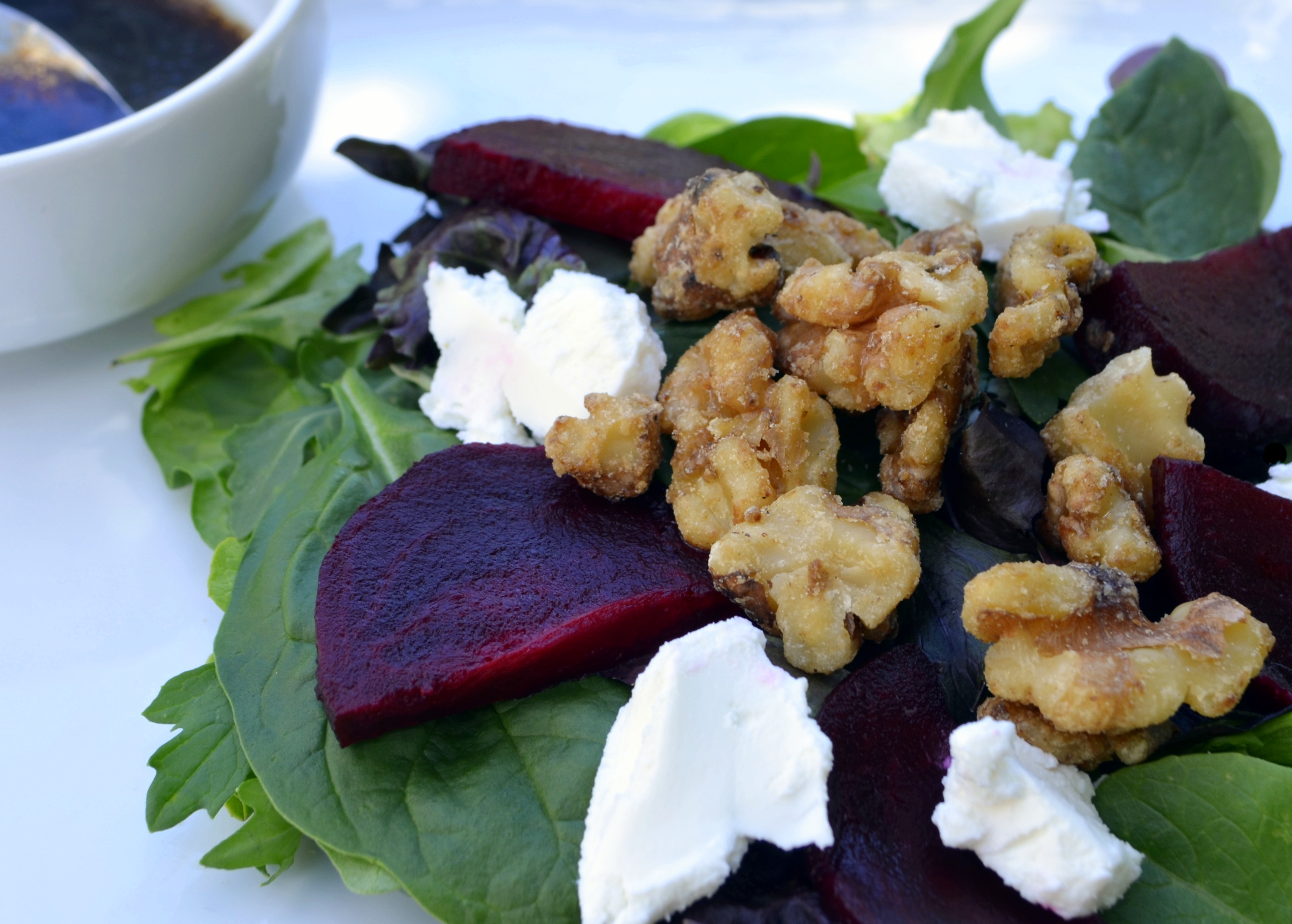
Recipe: Beet and Goat Cheese Salad with Maple Walnuts and Balsamic Glaze

14 Sep

When it comes to beets, people either love them or hate them. I’ve been in both camps. I didn’t develop a taste for beets until I was an adult–specifically, until I had been an adult for a couple decades…. But now, I love the combination of beets and goat cheese.

I’ve eaten many delicious salads featuring those two ingredients, and wanted to see if I could come up with a version at home that was quick and easy to make. The solution, I discovered, is to have some already-cooked beets on hand. If you don’t happen to have any left over from a previous meal, you should be able to find steamed beets in your local grocery store (roughly 8 oz./4 beets per vacuum pack)–they are perfect when you need cooked beets, fast. I also wanted a quick way to glaze walnuts so that they ended up dry and crispy, not sticky or overly sweet. The key to achieving this is a trusty cast-iron skillet or other heavy-bottomed pan (see directions below).

This recipe makes two servings, but it is very free-form; it can be adapted to as many people and tastes as needed–just adjust the amount of each ingredient as needed. Note: To save time, make the balsamic glaze and toast the walnuts simultaneously; once those are underway, slice the beets and cut the goat cheese.

Beet and Goat Cheese Salad with Maple Walnuts and Balsamic Glaze
Serves 2

1/2 c. balsamic vinegar
1/2 c. extra-virgin olive oil
freshly ground pepper
1/2 c. walnut pieces
1-2 tsp. pure maple syrup
4 c. “spring mix” salad greens
2 small steamed beets, cut in half horizontally, then thinly sliced
2 oz. goat cheese, cut into small pieces

Preparation

1. Heat the balsamic vinegar in a small heavy-bottomed saucepan over high heat. Once it comes to a boil, reduce the heat and let the vinegar simmer until it is reduced by half (to 1/4 c.) and has become syrupy. The best way to tell how much it has reduced is to pour the vinegar back into a heat-proof measuring cup to check. This whole process should take about 15 minutes. Pour the balsamic glaze into a bowl and let cool completely. When cool, add the olive oil, grind some black pepper over the surface to taste, and whisk to emulsify; you will need to re-whisk before serving.
2. Heat a small cast-iron skillet over medium-high heat, add the walnut pieces to the dry skillet, and toast until fragrant. Drizzle maple syrup over the walnuts, mixing well to coat all the walnuts evenly, and keep cooking (stirring constantly) just until the walnuts begin to turn golden brown. Immediately spread the walnuts onto a plate to cool; they will end up dry and crispy after a few minutes.
3. Put about 2 c. salad greens on each of two plates. Top each with half the sliced beets, half the pieces of goat cheese, and half the walnuts. Drizzle with a bit of balsamic glaze, then serve extra glaze on the side.

Feathery Parachutes

8 Sep

There are a variety of ways unexpected plants can crop up in your garden, but often, you can thank the wind for it. If bees play a vital role in pollination, then wind plays a similar role when it comes to seed dispersal. Think of the dandelion, the bane of many gardeners’ existence. It has developed a perfect way of ensuring a next generation by encasing its seeds in balls of fluff. What the wind doesn’t carry away (or lawnmowers cut down and disperse), young children will happily blow into the air–all but guaranteeing a new crop of the ubiquitous yellow flowers right in the middle of your lawn, or your neighbors’.

The Butterfly Weed plant disperses seeds in a similar fashion, but its seeds reside in pods that dry out and then crack open, allowing the feathery parachutes to travel hither and yon (if the Milkweed Bugs that love the seeds and tissue of Butterfly Weed plants don’t get to all the seeds first…). Luckily, there are many, many seeds to go around. And then, it’s up to wind, luck, and Mother Nature. In the bottom two photos, the Butterfly Weed seed parachutes have gotten stuck on 1) a Verbena Bonariensis and 2) a spider web near our brick staircase. I hold out more hope for the former’s prospects than for the latter’s.