Collegiality, Competition, and Lotuses

29 Jun

Early this morning, my mother and I stumbled upon an other-worldly scene: thousands of lotus flowers in bloom at Kenilworth Aquatic Gardens in Washington, DC. We arrived at 7:30 am to see the lotus flowers while they are open. The lotuses were indeed gorgeous, but the most striking aspect of our visit was seeing all the photographers who had arrived before us to stake their claims. The ones I spoke with were amateurs–but they were serious amateurs, with lenses almost as big as my leg, tripods, reflectors, step ladders, rolling equipment cases, and assistants. Some came from as far as New York. I had no idea Kenilworth’s lotus blooms attracted this much attention. I showed up with my camera, a small case containing three lenses (the largest of which is smaller than my hand), and my mother. No tripod, no reflector, no ladder. I looked glaringly out of place, unencumbered by the accoutrements of the trade, with not even a flak jacket to my name.
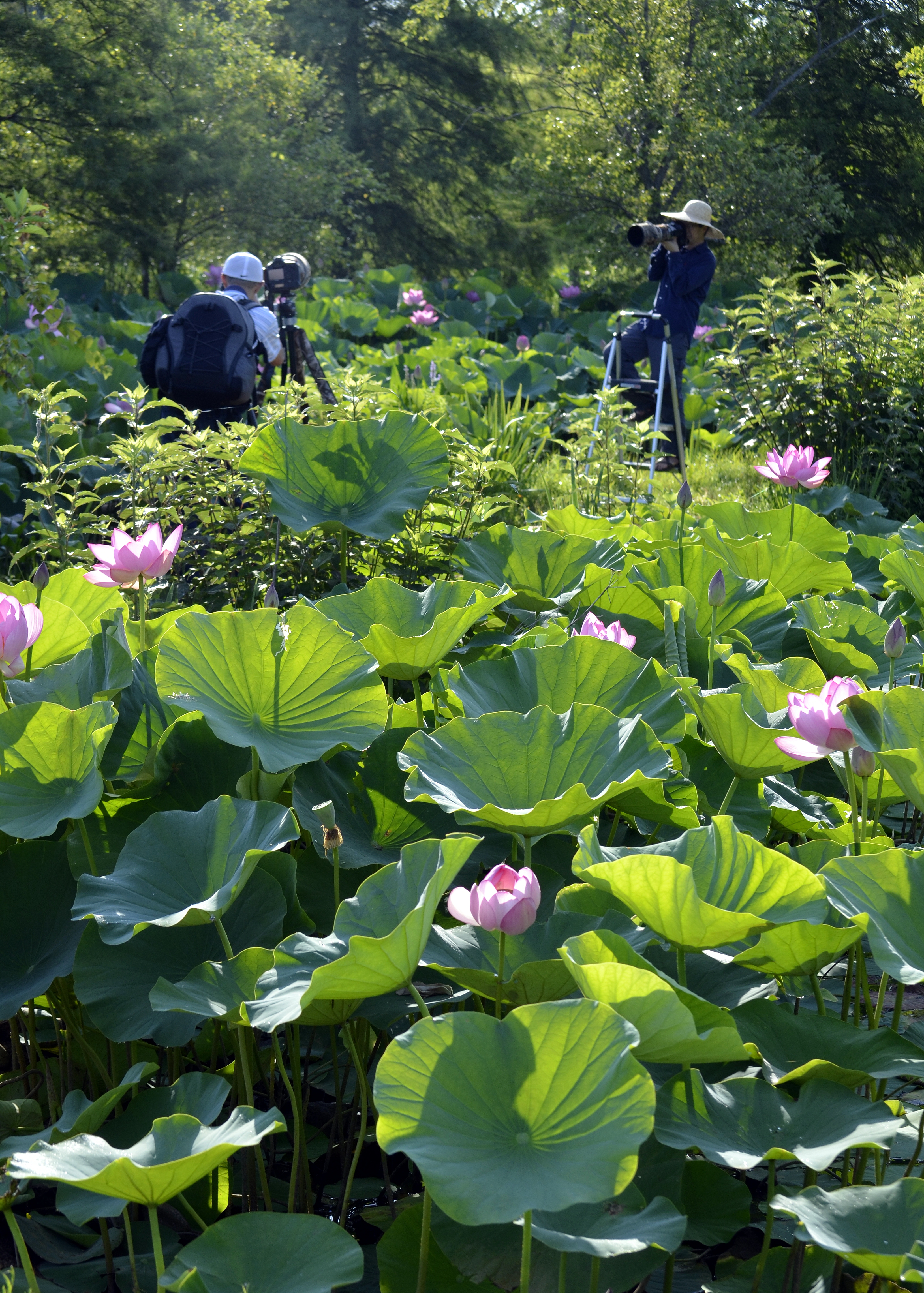
Photographers
For the most part, there was a great spirit of collegiality–sharing of tips, patient waiting for good spots, etc. But everyone was there to get a good shot, and as the sun bore down and the light became trickier, some competitiveness emerged. One photographer and her friend/assistant had spent some time setting up tripod and camera, and were focusing on a particularly lovely lotus flower. Another photographer stopped close by, but not in the first photographer’s line of vision, to see if he could get a differently angled shot of the same flower. He asked if that was okay. Female photographer: “I can’t tell you where you can or can’t stand, but there are lots of other flowers here.”  Male photographer got the hint and moved on. I’d like to think that was the exception, rather than the rule.

I was using a macro lens to capture a dragonfly on a lotus bud when another photographer came by, took a second look to see what I was shooting so close up, and got very excited when he saw the dragonfly. I stepped aside to give him a  turn. The good thing about dragonflies is that once they find a spot they like, they often spend some time there, so I knew I would probably get another chance. Plus, the gentleman I ceded the spot to had a huge lens and I knew he would be able to get a really, really nice close-up shot. If I got any closer with my little macro lens, I’d fall into the pond.

Later, I was admiring some lotuses, but ruing the fact they were in direct sunlight–and hence, beyond my ability to shoot them properly–when the same gentleman stopped by again, and had his friend hold up a huge reflector that allowed both of us to take the shot (third photo below). In the end, I like to think that though we are all photographers of varying abilities, we are kindred spirits nonetheless–out there to capture fleeting moments of beauty. Below are lotus buds and blooms, with close-ups of a lotus receptacle, and of water pooling on a lotus leaf.


Recipe: Roasted Tomatoes, Onions, and Garlic with Basil

28 Jun

This year, I planted three tomato plants, which are beginning to completely take over the vegetable garden. If that weren’t enough, a fourth rogue plant sprung from the seeds of  last year’s tomatoes is giving them a run for their money. Which means I’m soon going to be faced with a bumper crop of tomatoes and the challenge of figuring out what to do with the ones I keep. This recipe is one of my all-time favorites for tomatoes, and I often serve it at brunches as an accompaniment to cold roasted meats. It is a very flexible recipe: it can be made ahead, served warm or at room temperature–and you can play around with the ingredients depending on what you have on hand. However you tweak it, it’s hard to go wrong with tomatoes, red onions, garlic, basil, and pine nuts.


Roasted Tomatoes, Onions, and Garlic with Basil
12 servings

3 lb. roma tomatoes (other smaller types work well, too)
2 large red onions, cut in half, each half cut into eight wedges
30 cloves garlic /2 bulbs, peeled (slice large cloves in half)
2/3 c. olive oil
2 tsp. sambal oelek (or sweet chilli sauce)
1 tbsp. sugar
2 tbsp. bottled pesto (or fresh, if you have it)
1 tsp. salt
2 tbsp. balsamic vinegar
1/2 c. shredded fresh basil
2 tbsp. chopped fresh oregano
1/2 c. pine nuts, toasted

Preparation

1. Heat oven to 400º.
2. Cut the tomatoes in half lengthwise. Place tomatoes, cut side up, in large baking dish, then nestle the onions and garlic around the tomatoes.
3. In a small bowl, combine the olive oil, sambal oelek, sugar, pesto, and salt. Pour over the vegetables.
4. Bake uncovered for about 30 minutes or until tomatoes, onions, and garlic are soft.
5. Meanwhile, dry toast the pine nuts in a small skillet over medium-high heat (watching carefully), until they start to turn golden. Remove them from the skillet and reserve.
6. Once the tomatoes come out of the oven, add the vinegar, herbs, and pine nuts, and mix gently. Serve warm or cold.

Weekly Photo Challenge: Between

24 Jun

Sunset at San Clemente Pier, California–a brief moment between day and night. Photo taken through train window–a transparent barrier between photographer and scene.

The Birds and the Bees

22 Jun

I’ve written quite a lot about flora lately, so today it’s all about showcasing some local fauna: a few of the birds and bees (and a bug and a chipmunk) that I have had the pleasure to encounter in the past couple of months.


A cardinal in flight in our backyard…

  
A robin at Brookside Gardens in an optimistic (but ultimately futile) bid to score twine for its nest; a makeshift bird beach at the US Botanical Garden

  
A Canada Goose guarding his territory at Kenilworth Aquatic Gardens; and a bee coming…


…and going.

  
And finally, a dragonfly and a chipmunk, each going about their business earlier today at Brookside.

Weekly Photo Challenge: Extra, Extra

14 Jun

This week, the challenge is for a photo with something extra–an unexpected detail. This photo was an experiment. I was sitting in our living room on a rainy morning earlier this spring, looking out at our deciduous azaleas and wondering what would happen if I took a photo of them through the window screen. Here is the result. The “something extra” is the pattern of the screen in the background (or is it the foreground?).

Spathe and Spadix

9 Jun

There are two plant parts that are frequently found together whose names I quite like: “spathe” and “spadix.” The two words evoke something mysterious, almost like “cloak” and “dagger.” In fact, there is an element of danger when it comes to plants that have both spathes and spadices, such as Anthuriums, Calla Lilies, and the fabulous Titan Arum (also known as the Corpse Flower because it smells like rotting flesh): they are all poisonous. Their sap contains needle-like calcium oxalate crystals, which can cause significant pain and swelling if an unwitting animal happens to take a bite of the plant. Ingesting large amounts can be fatal because the swelling can make swallowing and breathing difficult–but most animals quickly learn to stay far away. The plants have an excellent defense system.

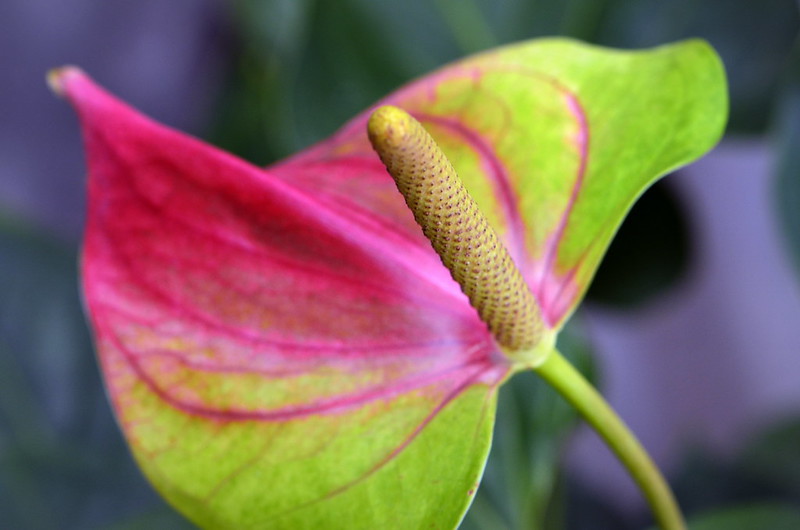
Toxicity aside, plants with spathes and spadices are striking, as evidenced by this Anthurium andreanum ‘Fantasy Love,’ which is a member of the Arum family (Araceae, aka the aroids). This Anthurium may want to repel herbivores, but it also wants to attract pollinators and one way to do that is via the colorful spathe.


The spathe looks like a petal, but it is actually a bract–a modified leaf. It helps get pollinators closer to the actual flowers, which are tiny and are located in spirals on the spadix. Here is a close-up view of an Anthurium spadix–the stigmas on the almost microscopic white female flowers are emitting a fluid that indicates the flowers are ready to be pollinated. If pollination is successful, the spadix will produce little fruits (or berries) containing seeds.


Sometimes spathes are open and fairly flat, as with the Anthurium above, but they can also encase the spadix and appear funnel like, as with Calla lilies. The photo below is an internal view of my neighbor’s ‘Calypso’ Calla lily–with the  deep-red spathe almost entirely surrounding the spadix.


One last fun fact: some spadices in the Arum family can produce a lot of heat in cold weather, reaching temperatures significantly warmer than the surrounding air temperature. The Titan Arum is one of them. This ability is yet another way the plants attract pollinators.  A warm spadix does two things: it provides pollinators with a bit of energy in chilly weather and it acts as a fragrance diffuser, wafting that delicious putrid odor just a bit further as an added enticement. So if you are a pollinator, you get a colorful, warm, and nice smelling (ok, odoriferous) welcome. If you are a herbivore, you come under chemical attack. Isn’t nature great?

Bearded Iris: ‘Spartan’

26 May

In Greek mythology, Iris was the goddess of the rainbow; the flower’s name pays homage to the many colors of irises that exist. In the language of flowers, an iris is viewed as the bearer of good tidings–a reflection of the goddess Iris’ other role as messenger to the gods. I was swayed to include irises in the garden solely because of their beautiful display–but if they also bring good luck, even better.

This year, I added a maroon-colored bearded Iris: ‘Spartan.’ Its name is a nod to ancient Greek history, though their enemies would probably not have equated Spartan warriors with good tidings. I at least hope the name means the three plants I now have in my garden will be hardy.

They are the first bearded irises I have had the pleasure to observe at close range, and though they are now at the end of their brief blooming season, I kept an eager eye on them from the moment they were first in bud:

  
Bud and emerging bloom.


Three upward-facing petals (standards); three downward-facing petals (falls), with the beards resting atop the falls.

  
Close-up of a beard, which helps to guides pollinators (bees) into the flower. With the standard removed and this section of the plant opened up a bit (right), it is easier to see how the beard–and the color pattern–point the way to the nectar at the inner base of the flower. The stamen (male reproductive organ) with its pollen-covered anther is visible at the back, just in front of another petal-like structure that is called the style arm. The style arm is a highly modified pistil (female reproductive organ). Normally it’s a tight squeeze for a bee to get to the nectar; as it heads downward, it will brush up against the anther and get dusted with pollen. When the bee visits another iris, the pollen on its back rubs off and attaches to the sticky stigmatic lip (the arched line toward the top of the style arm, below the upper crest), allowing pollination to begin.

Banana Flowers and Other Edible Parts

22 May

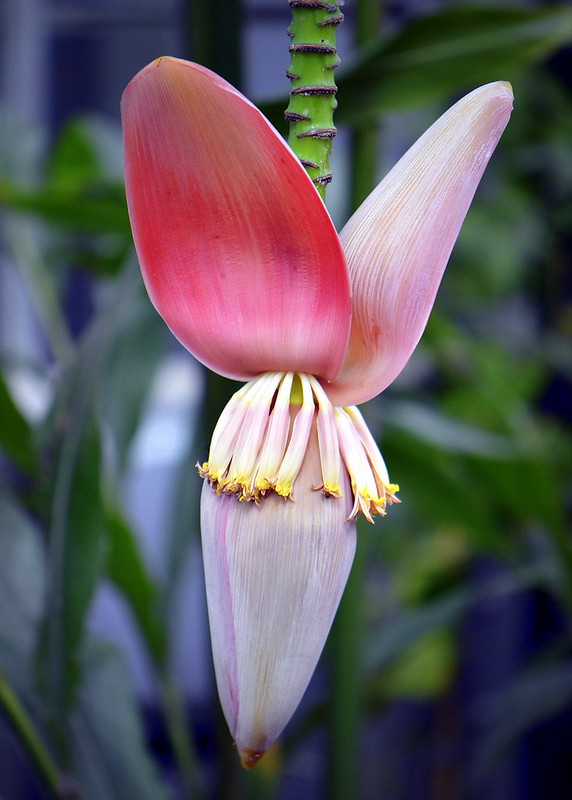
Being a bit less mobile than usual, I thought I’d use the opportunity to choose a photo I’ve previously taken and see if I can learn more about the subject. What you see below is commonly called a banana flower or banana blossom (photo taken at the United States Botanic Garden). I’ve always been struck by this part of the plant, a deep-red appendage that dangles below the bunches of bananas. Though we like to think of the banana plant as a tree, it is technically a perennial herb, albeit a really big one; it dies down to the ground after the plant flowers and produces fruit. The inner part of the stem of the plant (which is actually a false stem consisting of leaf sheaths) is edible, as are parts of the flowers–they are considered vegetables and are popular in Asian and tropical cuisines, where they are used in salads, curries, stir fries, and other dishes.


The banana “flower” seen in the photo above is actually the lowest part of an inflorescence consisting of layers of bracts (the petal- or leaf-like parts) that cover rows of  flowers. The female flowers are higher up and can develop into fruit (bananas). Once that happens, the inflorescence elongates and produces a terminal male bud. Here, the redder (and tougher) outermost bracts of that bud have opened upward, revealing yellow-tipped male flowers underneath and paler closed bracts below.

Different parts of the banana flower (or bud) can be eaten: the innermost bracts, the florets (once the stamens and tough covers have been removed), and the inner core, or heart. The tougher outer bracts are often used as serving plates for dishes made with the other parts of the banana flower. I don’t have easy access to banana flowers, but if you do and want to experiment with them, here are some resources:

To read about the ornamental Golden Lotus Banana/Chinese Dwarf Banana, see this post. To read about the difference between Musa (bananas), Strelitzia, and Heliconia, see this post.

And here are some additional banana-related photos:

1) A banana leaf unfurling at the Eden Project in England. Each leaf emerges from the center of the banana plant in the form of a rolled cylinder. Once the last leaf has emerged, the plant produces the inflorescence, which starts off pointing skyward, but then falls over and dangles as it gets heavier and the female flowers develop into bananas.
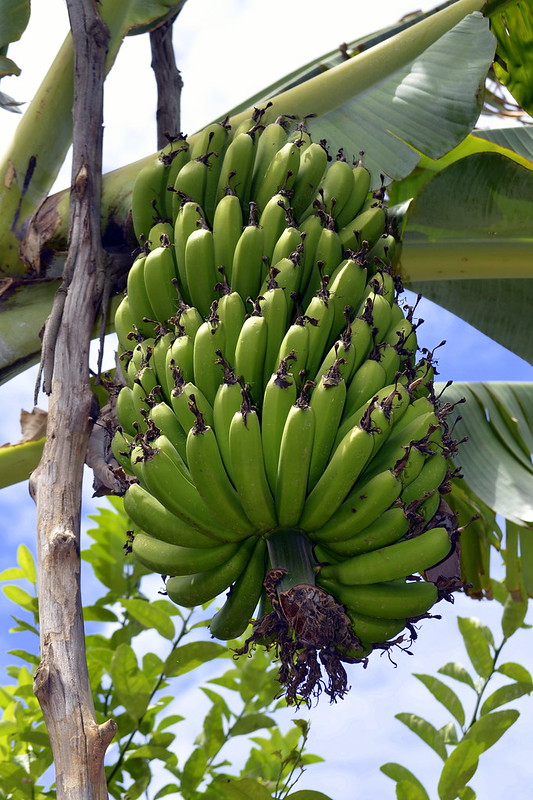
2 ) Banana bunches on the plant (with the terminal bud having fallen off). Some bunches can contain 200-300 bananas each; the largest one recorded by the Guinness Book of World Records contained 473 bananas and weighed 287 pounds.
3) Banana transport in Rwanda.


The Challenges of Gardening and Cooking on Crutches

17 May

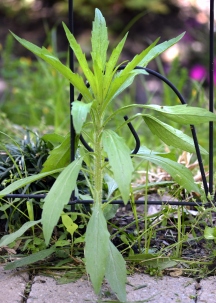
This title is misleading because it sounds like I actually have been able to do some gardening and cooking since breaking my ankle three weeks ago and being diagnosed with deep vein thrombosis three days ago. Sadly, that has not been the case. Hence this lovely photo of one of the many weeds that have now taken up residence in the garden. And the absence of any photos (or blog posts) pertaining to new garden initiatives or new dishes. But I can write about things happening in the garden of their own accord (future posts), as well as recent lessons learned, many of which involve crutches (this post).

Weeds

1. When crossing a street, look left, right, and DOWN. Or else your ankle could go one way and you could go the other, with unhappy results.
2. You will develop a love-hate (mostly hate) relationship with your crutches.
3. Crutches are made to transport mainly one thing–you. But you have been used to transporting multiple things yourself with the help of both your hands and feet, one of which can no longer be used and the other three of which are valiantly trying to to keep you upright and semi-mobile. This poses certain challenges.
4. Namely, how to transport hot beverages. A beverage tray for crutches would really come in handy. I was able to carry a number of things on crutches via the-tuck-the-item-into-my-waistband-and-hope-my-pants-don’t-fall-down method, but I didn’t dare try that with a cup of tea.
5. Not being able to use one foot means you will develop really good balancing skills on the other one. This came in handy when I leaned over on one foot to pull a few weeds from the edge of our patio the other day, though the neighbors may have thought I was practicing some bizarre new form of Tai Chi. The downside to all this balancing on one foot: your injured leg muscles will disappear while the muscles on your other leg will fill out quite nicely, leading to a lovely asymmetrical look.
6. If you are like me, crutches will also allow you to discover muscles in your arms that you didn’t know existed. That’s another plus: increased upper body strength for improved gardening efficiency. But if the muscles in your injured leg ever start aching, pay attention. What I thought was a calf muscle that was strained from limping around too much three weeks post fracture turned out to be a blood clot.
7. If you should ever have the misfortune to end up with deep vein thrombosis after a fracture, you will find that all things considered, the fracture might actually be the less painful/scary of the two. Part of the reason is the blood-thinning medication you have to inject into your own stomach twice a day, which feels as if you were being stung by a bee each time. It is really not fair to bees.
8. Finally and most importantly, be immensely thankful when your body works well. All the many parts, including the humble foot, make even the simplest things possible–yet it’s so easy to take those parts for granted.
9. Ditto for the family members and friends/coworkers who turned into nurses, chauffeurs, and advocates at a moment’s notice. They make everything possible, too.

Birth of an Allium ‘Purple Sensation’

10 May

The thing I love most about this time of year is the process by which new flower buds slowly open up and reveal their hidden treasures. I particularly love watching my Allium hollandicum ‘Purple Sensation’ as the buds break free from the papery bracts protecting them and explode into a profusion of perky florets. The allium ‘flower’ is actually a cluster of much smaller flowers (florets) atop a stem–this type of arrangement is called an inflorescence.


The papery bract begins to split open under the strain of the growing florets.


The florets start to take on color.


The emerging inflorescence, seen from above.

  
Individual florets begin to bloom.                Close-up of a floret.


The newly emerged inflorescence, seen from above.


Allium hollandicum ‘Purple Sensation’ in bloom.