Recipe: Easy Lahm bi Ajin (Lebanese Lamb Pizza)

5 Oct

In Arabic, lahm means “meat,” and ajin means dough or pastry. Many cultures pair meat with pastry, and while I like just about every iteration of that theme, this Lebanese version is one of my favorites. This recipe is slightly easier and quicker to make than some traditional versions because it uses a pita-bread base instead of one requiring home-made dough. These Lahm bi Ajin are pretty hearty, and go quite nicely with Tabouli or other salads.

lahm bi Ajin3
Lahm bi Ajin
Serves 4

1 lb. (454 gr.) ground lamb
3 tbsp. olive oil
1 large onion, finely chopped
5 cloves garlic, crushed
1/2 tsp. cinnamon
1/4 tsp. allspice
1/8 tsp. chili flakes
1/3 c. (85 gr.) tomato paste
1 tbsp. pomegranate molasses, or juice of 1/2 a small lemon
1/4 c. (61 gr.) yogurt
salt and pepper to taste

1/4 c. (34 gr.) pine nuts, optional
extra 2 tbsp. olive oil
4 medium-sized pitas, unopened
1 tbsp. each of chopped fresh mint and parsley, or 1/2 tsp. dried mint and dried parsley

Preparation
1. Heat a heavy-bottomed skillet over medium-high heat, drizzle with a bit of olive oil, and cook the lamb until it is no longer pink, breaking it up as finely as possible. Remove the lamb from the pan, drain in a colander, and set aside.
2. Wipe the skillet, add the 3 tbsp. of olive oil, and when hot, add the onion and cook until translucent and slightly golden.
3. Add the garlic and spices, and cook for a few more minutes. Return the lamb to the pan along with the tomato paste and the pomegranate molasses/lemon juice; mix well to combine. Cook the lamb mixture for 5 minutes over low heat, mashing periodically with the back of a wooden spoon.
4. Turn off the heat, and add the yogurt to the lamb mixture in two batches, incorporating well after each batch. Season with salt and pepper to taste. Set the lamb mixture aside.
5. Heat the oven to 400 degrees. Take out one large (or two medium) rimmed baking sheets–to accommodate the four pitas.
6. Toast the pine nuts in a small skillet until they start to turn golden; remove from skillet.
7. To assemble: pour the extra 2 tbsp. olive oil into a very small bowl; brush the top of each unopened pita with the olive oil. Place the pitas on the baking sheet(s).
8. Divide the lamb mixture among the four pitas, patting it down and spreading it to the edge of each pita. Sprinkle each pita with the mint, parsley, and pine nuts, pressing the pine nuts into the lamb mixture. Drizzle the pitas with any remaining olive oil from the small bowl.
9. Bake in the oven until the edges of the pitas start to get crisp and the lamb topping begins to brown, about 15 minutes.
10. Eat immediately.
Sweetness or Deceit? Attracting Pollinators

28 Sep

Plants are wily, in their own ways. Some beguile with sweetness, others lure with deceit. This weekend at the United States Botanic Garden, I saw examples of both.

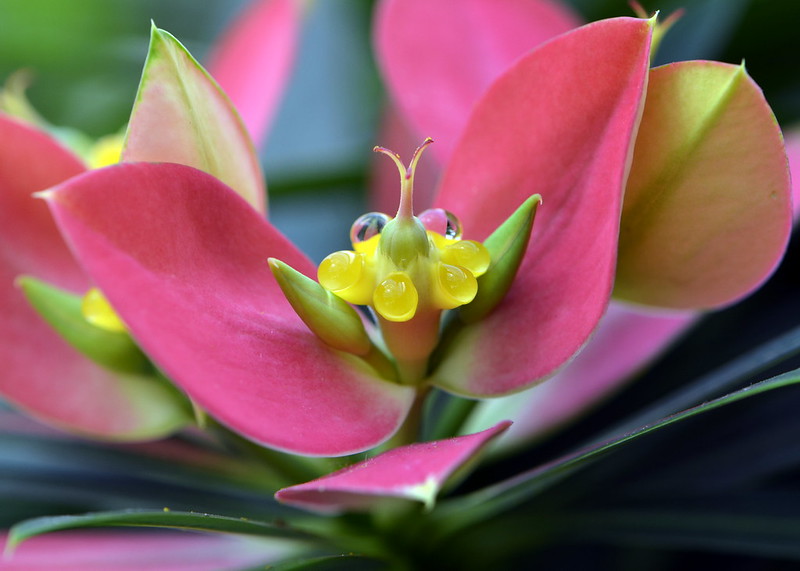
The Jamaican Poinsettia (Euphorbia punicea) takes the nicer approach. Below, you can see the brightly colored bracts, which are modified leaves, and a yellow, cup-like flower cluster called a cyathium. Insects are attracted to the clusters by the reddish-pink bracts and are then rewarded with the sugary nectar; in the photo, the glistening drops are almost overflowing from the cups. Arising from the center of the cluster is the pistil (the female reproductive organ), with three curved stigmas at the top, waiting to receive a dusting of pollen from the visiting pollinator.


Successful pollination leads to the development of a seed-bearing fruit. But if the plant has not been successfully pollinated, the fruit may wilt and never produce seeds.

Other plants, such as the Carrion Flower (Stapelia gigantea), attract pollinators by pretending to be (and smell like) something they are not: rotting flesh. You might think that if someone knows a flower smells like a decomposing mammal, s/he would avoid taking a sniff. But no. I partook of the putrid odor more than once, and can confirm that the flower does indeed smell vile. I pointed this out to other passersby, who also conducted repeated olfactory experiments of their own with identical results…. But back to the plant. In addition to its odor, this wrinkly and hairy flower is also meant to look like a decaying, oozing, leathery, peeling dead animal.


And boy, do some insects love that. Perfect spot to lay eggs, with plenty of food for the larvae, or so they think. They are mistaken; their reproductive efforts are futile. But they will have served their purpose: to help ensure the reproduction of the plant by taking and depositing pollen as they go about their business. A devious deception indeed. Here is a close up of the inside of the flower, complete with a green bottle fly circling around, and a pile of ill-fated eggs below.


Recipe: Mousse de Mango

10 Sep

I love mangoes in any way, shape, or form–and so do my children, who used to line up for a chance to get the pit after I was done slicing the rest of the fruit. For years, I vowed to make mango mousse–but I always let myself be lured by the siren call of the chocolate version instead. Until recently, when I was making a Latin American dinner and wanted a Latin American dessert to go with it. And now I’ve been asking myself, why didn’t I try this sooner? This recipe, very slightly adapted from The South American Table by Maria Baez Kijac, calls for fresh mangoes, and like many other mousses, includes raw egg whites (so use the freshest eggs possible). It serves 8 regular dessert lovers, or 6 serious mango lovers. Note: the original recipe suggests serving the mousse with a raspberry coulis, but I am a purist who prefers an unadulterated mango flavor.

Mango Mousse

Mousse de Mango

1/4 c. fresh orange juice
1 envelope unflavored gelatin
2 large, ripe but firm mangoes, peeled, seeded, and chopped (2 c.)
3/4 c. sugar
2 tbsp. orange liqueur or rum
1 c. whipping cream
2 large egg whites
1/4 tsp. cream of tartar

Preparation
1. Place the orange juice in a small heat-proof bowl, sprinkle the gelatin over top, and let soften for 5 minutes. Set the bowl in a small saucepan with 1 inch of simmering water and heat until the gelatin is completely dissolved. Remove the bowl containing the gelatin mixture from the saucepan.
2. Place the mangoes in a blender or food processor and process until smooth. Add the sugar, liqueur/rum, and dissolved gelatin, and process again until smooth. Place the mango puree into a large bowl.
3. Whip the cream in a medium-size mixing bowl until soft peaks form. Beat the egg whites with the cream of tartar in another medium-sized bowl until soft peaks form.
4. Very gently fold half the whipped cream into the mango puree, followed by half the egg whites. Repeat, and mix gently until all the cream and egg whites have been incorporated.
5. Distribute the mousse among 6-8 dessert cups, cover, and refrigerate until thickened–about 30 minutes.
6. Enjoy!

Recipe: Peruvian-Style Peanut Chicken (Pollo Arequipeño)

31 Aug

There are two signature Peruvian dishes consisting of boiled potatoes topped with a spicy, creamy, cheese sauce:  Papas a la Huancaina and Ocopa Arequipeña. They both feature yellow chilies, cheese, and milk–and frequently, onions and garlic. An Ocopa sauce often contains nuts as a thickener, while a Huancaina sauce usually includes crackers (and an herb that is difficult to find: huacatay, sometimes referred to as black mint). However, I’ve seen Ocopa made with crackers, too…. Regardless, both sauces and their many variations are delicious!

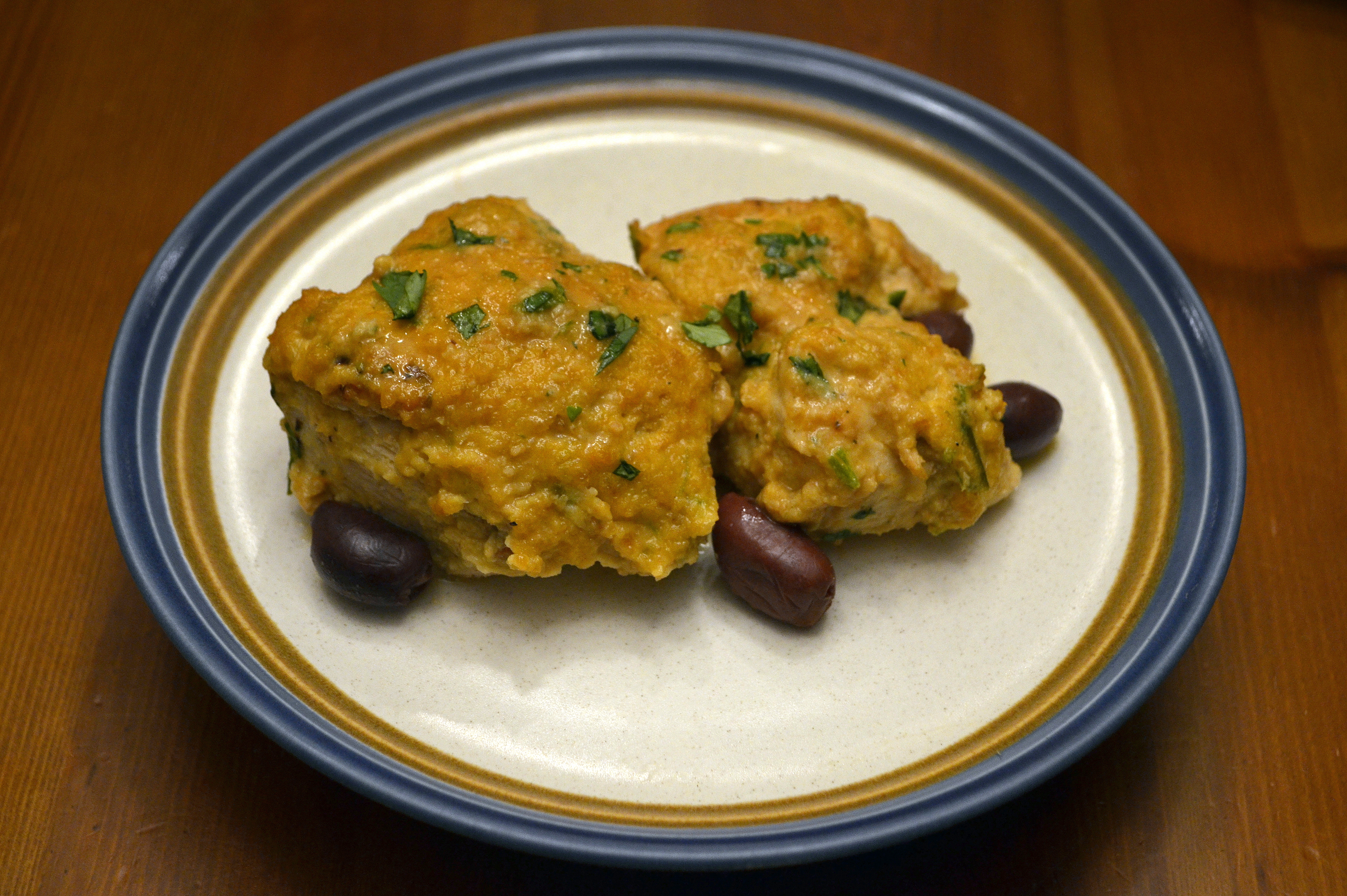
The following recipe departs from the norm: it features an Ocopa-style sauce over chicken rather than potatoes, and it is broiled in the oven until the sauce begins to turn golden brown.

Peruvian Peanut Chicken

Peruvian-Style Peanut Chicken (Pollo Arequipeño)
Serves 8

6 boneless, skinless chicken breast halves
juice of 2 lemons or limes
2 tbsp. olive oil
salt and pepper

Sauce:
3 tbsp. olive oil
1 small red onion, chopped
2 scallions (green onions), trimmed and sliced
5 cloves garlic, crushed
1 tbsp. aji amarillo (yellow chili) paste –add more if you like your sauce hot
1/2 c. roasted, salted peanuts
1/2 c. grated Münster cheese (or feta or queso fresco)
3/4-1 c. evaporated milk
1/4 tsp. salt, or to taste

chopped cilantro
Kalamata (or other black) olives

Preparation

1. Trim the chicken breasts and cut each into two pieces.
2. Combine the lime juice and olive oil in a glass container and add the chicken. Sprinkle the chicken with salt and pepper to taste, mix well, cover, and refrigerate for a couple of hours.
3. Meanwhile, make the sauce. Heat the olive oil in a large skillet over medium-high heat; add the red onion and scallion and cook until soft. Add the garlic and aji amarillo paste (and huacatay puree if available/desired) and cook for another couple of minutes. Turn off the heat. Put the onion mixture into a blender along with remaining sauce ingredients; blend until smooth. If the sauce appears very thick, add a bit more milk. Place the sauce in a  covered container and refrigerate until needed. Set the skillet to the side on the stove; do not clean or rinse.
4. After the chicken has marinated, heat the skillet over high heat and cook the chicken (in two batches if needed) until the pieces are golden brown on both sides (no need to add extra oil to the skillet first, since the marinade contains oil). Place the chicken pieces in a single layer in a baking dish, top each piece with an ample amount of the peanut sauce, cover with aluminum foil and bake at 350 degrees for about 20-30 minutes. Remove the aluminum foil, sprinkle Kalamata olives around the chicken, and broil until sauce begins to turn golden brown in spots.
5. Remove the chicken from the oven, sprinkle with cilantro, and serve.

Vibrating Whiskers, or Finding One’s Way

23 Aug

The pier in Santa Cruz, California is a favorite sunbathing spot for sea lions.  Up close, you can identify the marine mammals by their ear flaps, which seals lack. But, like seals, they have whiskers. The sea lion below has a particularly fine set; even Hercule Poirot would be envious. Sea lions use their smooth and rotating whiskers to sense what’s around them. The whiskers, called vibrissae, pick up vibrations in the water or air, and are immensely useful when the sea lion is looking for food or is trying to avoid being food. Essentially, whiskers help sea lions find their way through the undercurrents of life.

Our youngest child is now in college. Looking back on 24 years of child rearing and looking ahead to a new modus vivendi, I, too, am envious of a sea lion’s whiskers.


Landscapes from a Moving Car

17 Aug

It’s been a while since my last post, due to a wedding (our oldest son’s–we are delighted to welcome a lovely daughter-in-law to our family), a two-week road trip across the country, and some college prep (our youngest heads off next week to start her college adventure). So this post will be brief–just a glance at some of the sights we saw in Northern California, Oregon, Washington state, and Montana, which I shot through the car window while my husband was at the wheel.

  
Northern California                                                 Oregon, near Klamath


Oregon


Washington


Washington


Montana


Montana


Little Bighorn Battlefield National Monument, Montana


Supermoon Fun

13 Jul

There are some fantastic photos out there of last night’s supermoon–but the B&W one I took just after midnight wasn’t one of them. It showed the moon and the aura around it (which, upon further contemplation, may have been the result of shooting through a window…), but was otherwise pretty boring. So I decided to have a little fun with the photo. The result is a bit over the top, but oh so much more interesting that what I started out with; thank goodness for color! This collage shows the heat-map spectrum from beginning to end.

Black-Eyed Susan: Inspiration for a Horticultural Adventure

12 Jul

Not  far from a mailbox near our house is a cheery patch of yellow flowers commonly known as Black-Eyed Susans.  When I went to confirm their scientific name (Rudbeckia hirta), I discovered that–much to my chagrin–they are the state flower of Maryland, which has been our home for the past 12 years. I have no excuse. I really had no idea, despite having some Black-Eyed Susans in the garden of our old house (also in Maryland). My current garden does feature a close cousin: some tall and graceful Rudbeckia maximas. I’m hoping I get some bonus points for that family connection….

This bout of state-related ignorance has inspired me to go from having no idea to having a nice idea: in two weeks, we will drive across the United States (from the West Coast back home to the East Coast). So my admittedly joyful task will now be to make note of each state flower along the route and see if I can take a picture of it. In the meantime, here is the lovely state flower of Maryland:


Summertime Bliss: Sun-Warmed Cherry Tomatoes

6 Jul

Few things beat the taste of a tomato that’s come straight from the garden. And cherry tomatoes offer that extra, satisfying little pop as you bite into them. The photo below shows our first harvest of the season, but the tomatoes in this bowl won’t make it into any recipe; these sun-warmed beauties are all going to be eaten just as they are–as a snack straight from Nature. However, there is a reason these tomatoes are called Sweet 100s: before long, I’ll be wondering what to do with all of them. I see lots of salads on the horizon, as well as our favorite Pasta with Cherry Tomatoes, Fresh Mozzarella, and Basil. And cherry tomatoes would also work in Roasted Tomatoes, Onions, and Garlic with Basil–though I’d start cooking the onions and garlic first, adding the cherry tomatoes toward the end of the roasting time. I detect a common theme in both recipes: basil. And now that I recall, last I saw it, our basil was in danger of being overtaken by the flowering oregano that has run riot in the herb garden…. Time for some triage in the name of good eats!


Red, White, and Blue 2014

4 Jul

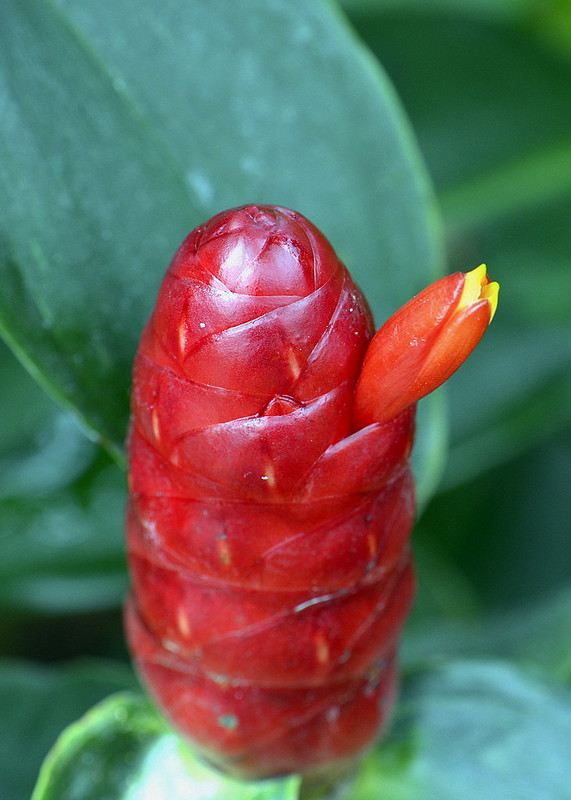
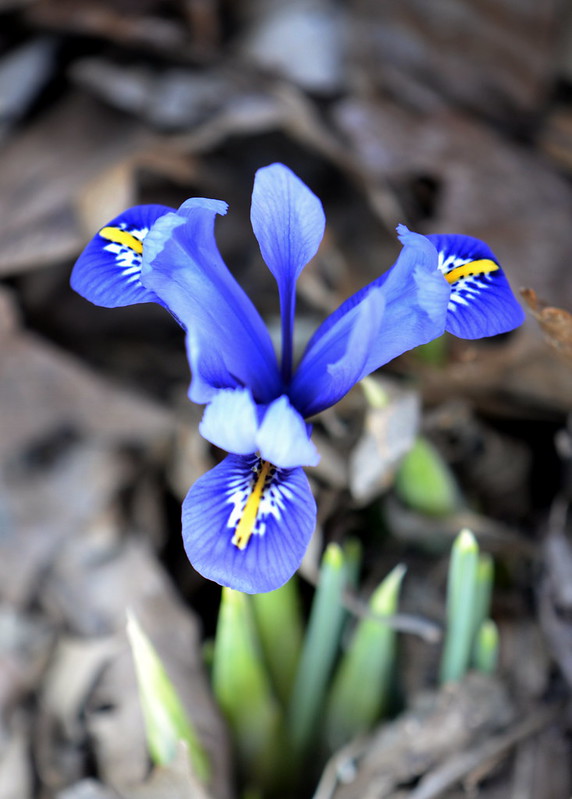
A few photos for US Independence Day. Red: Costus woodsonii (Indian Head Ginger) and Hibiscus. White: Cornus kousa (Kousa Dogwood). Blue: Echium candicans (Pride of Madeira) and Iris reticulata (Dwarf Dutch Iris).