Archive | Travel RSS feed for this section

Vibrating Whiskers, or Finding One’s Way

23 Aug

The pier in Santa Cruz, California is a favorite sunbathing spot for sea lions.  Up close, you can identify the marine mammals by their ear flaps, which seals lack. But, like seals, they have whiskers. The sea lion below has a particularly fine set; even Hercule Poirot would be envious. Sea lions use their smooth and rotating whiskers to sense what’s around them. The whiskers, called vibrissae, pick up vibrations in the water or air, and are immensely useful when the sea lion is looking for food or is trying to avoid being food. Essentially, whiskers help sea lions find their way through the undercurrents of life.

Our youngest child is now in college. Looking back on 24 years of child rearing and looking ahead to a new modus vivendi, I, too, am envious of a sea lion’s whiskers.


Landscapes from a Moving Car

17 Aug

It’s been a while since my last post, due to a wedding (our oldest son’s–we are delighted to welcome a lovely daughter-in-law to our family), a two-week road trip across the country, and some college prep (our youngest heads off next week to start her college adventure). So this post will be brief–just a glance at some of the sights we saw in Northern California, Oregon, Washington state, and Montana, which I shot through the car window while my husband was at the wheel.

  
Northern California                                                 Oregon, near Klamath


Oregon


Washington


Washington


Montana


Montana


Little Bighorn Battlefield National Monument, Montana


Black-Eyed Susan: Inspiration for a Horticultural Adventure

12 Jul

Not  far from a mailbox near our house is a cheery patch of yellow flowers commonly known as Black-Eyed Susans.  When I went to confirm their scientific name (Rudbeckia hirta), I discovered that–much to my chagrin–they are the state flower of Maryland, which has been our home for the past 12 years. I have no excuse. I really had no idea, despite having some Black-Eyed Susans in the garden of our old house (also in Maryland). My current garden does feature a close cousin: some tall and graceful Rudbeckia maximas. I’m hoping I get some bonus points for that family connection….

This bout of state-related ignorance has inspired me to go from having no idea to having a nice idea: in two weeks, we will drive across the United States (from the West Coast back home to the East Coast). So my admittedly joyful task will now be to make note of each state flower along the route and see if I can take a picture of it. In the meantime, here is the lovely state flower of Maryland:


Banana Flowers and Other Edible Parts

22 May

Being a bit less mobile than usual, I thought I’d use the opportunity to choose a photo I’ve previously taken and see if I can learn more about the subject. What you see below is commonly called a banana flower or banana blossom (photo taken at the United States Botanic Garden). I’ve always been struck by this part of the plant, a deep-red appendage that dangles below the bunches of bananas. Though we like to think of the banana plant as a tree, it is technically a perennial herb, albeit a really big one; it dies down to the ground after the plant flowers and produces fruit. The inner part of the stem of the plant (which is actually a false stem consisting of leaf sheaths) is edible, as are parts of the flowers–they are considered vegetables and are popular in Asian and tropical cuisines, where they are used in salads, curries, stir fries, and other dishes.
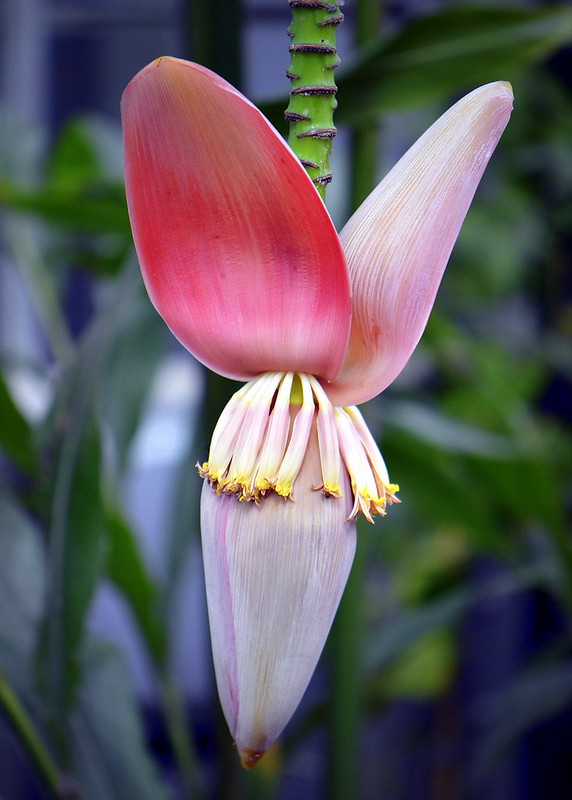

The banana “flower” seen in the photo above is actually the lowest part of an inflorescence consisting of layers of bracts (the petal- or leaf-like parts) that cover rows of  flowers. The female flowers are higher up and can develop into fruit (bananas). Once that happens, the inflorescence elongates and produces a terminal male bud. Here, the redder (and tougher) outermost bracts of that bud have opened upward, revealing yellow-tipped male flowers underneath and paler closed bracts below.

Different parts of the banana flower (or bud) can be eaten: the innermost bracts, the florets (once the stamens and tough covers have been removed), and the inner core, or heart. The tougher outer bracts are often used as serving plates for dishes made with the other parts of the banana flower. I don’t have easy access to banana flowers, but if you do and want to experiment with them, here are some resources:

To read about the ornamental Golden Lotus Banana/Chinese Dwarf Banana, see this post. To read about the difference between Musa (bananas), Strelitzia, and Heliconia, see this post.

And here are some additional banana-related photos:

1) A banana leaf unfurling at the Eden Project in England. Each leaf emerges from the center of the banana plant in the form of a rolled cylinder. Once the last leaf has emerged, the plant produces the inflorescence, which starts off pointing skyward, but then falls over and dangles as it gets heavier and the female flowers develop into bananas.
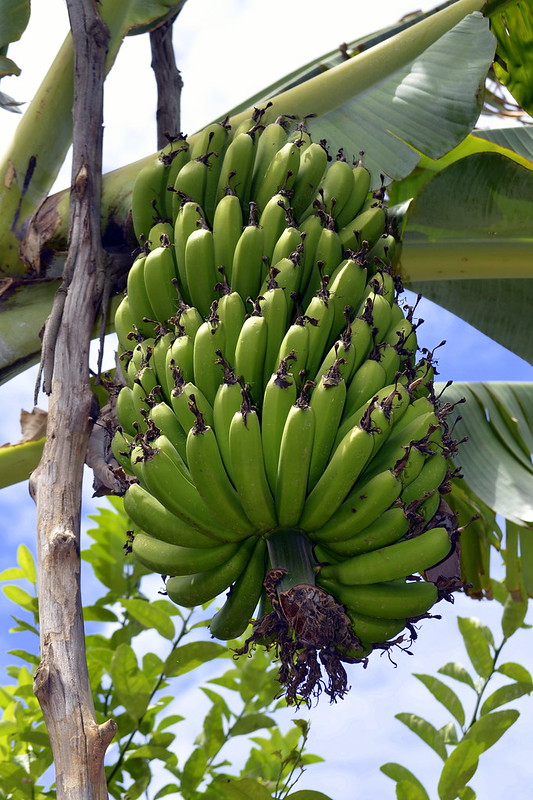
2 ) Banana bunches on the plant (with the terminal bud having fallen off). Some bunches can contain 200-300 bananas each; the largest one recorded by the Guinness Book of World Records contained 473 bananas and weighed 287 pounds.
3) Banana transport in Rwanda.


Weekly Photo Challenge: Perspective

9 Mar

When I saw this challenge, I immediately thought of the Long Room at Trinity College Library in Dublin. It is a beautiful space, more than 200 ft long (hence the name). The high, barrel-vaulted wooden ceiling is truly awe inspiring, curving gracefully downward to the second-floor galleries holding some of the library’s oldest books. Standing in the room, your perspective changes completely depending on whether you are looking straight ahead, straight up, or tilting your head from side to side.


What’s in a Name? Robin Redbreast

6 Feb

It’s February, which in the Northern hemisphere qualifies as being just about half way between Christmas and spring. So it’s appropriate to talk about robins right now. In some places, they are symbols of Christmas, and in others they are a sign of spring. Either way, the copper-chested birds are a cheery site to behold. Despite their burnt orange coloring, the birds were originally known as Robin Redbreasts–because 500 or so years ago in Europe, there was no name for the color orange. “Yellow-red” was as close as people got to describing that happy blend of the two primary colors. But when a certain citrus fruit became more widely eaten, the color found a new name: orange. The first recorded use of that word as a color was in 1512.

But back to robins. The color is named after the fruit, and the American Robin is named after the European one. Except that it is now clear they are not closely related. European robins are chats, while American Robins are members of the thrush family. One is smaller and rounder, while the other is longer and leaner looking. The only thing they share is  a spot of orange on the breast, and even then, one bird has a small copper patch high up while the other has a longer one most of the way down. And the rest of their markings are not very similar. But early Europeans encountering these birds in North America in the 17th and 18th centuries thought they looked like robins, and named them accordingly. 

blame these early settlers for the noteworthy bout of avian befuddlement I recently experienced. I repeatedly came across a very friendly little bird during the few days we were in Ireland at Christmas and took several photos of it, all the while wondering what it was and chiding myself for not knowing. It looked almost like a little sparrow, except for that orange coloring (and the beak… and probably a number of other things). What could that bird be? Imagine my chagrin when I discovered it was a robin–how is it possible to not recognize a robin when staring straight at one? I can only say that the robin I have always known is the American one, and I was unprepared to identify the European version. I offer up these photos as evidence: first a European Robin (Erithacus rubecula), then its American counterpart (Turdus migratorius).  And then I rest my case. (Not sure how much of a case it is, but I rest it anyway).

Discovering Dartmoor, UK

21 Jan

During our recent trip to the UK, we were eager to see the English moors, the setting of many a fine novel, including Wuthering Heights and The Secret Garden in the Yorkshire moors, Lorna Doone in Exmoor, Jamaica Inn in Bodmin Moor, and The Hound of the Baskervilles in Dartmoor. On our way south to Cornwall, we drove through Bodmin Moor at night and passed by Jamaica Inn, which actually exists. But there wasn’t much to see in the thick, dark, fog. Not much to see, but a lot to think about–namely, that the moors are not a place one wants to be wandering about in at night (driving through them in the dark being only marginally better). Had Daphne du Maurier’s heroine Mary Yellan been real, I would have shuddered in empathy as we passed the Inn.

On our way north from Cornwall a few days later, we drove through Dartmoor National Park–during the day. Dartmoor rose up before us, a vast, damp, hilly area of spongy, sodden ground, complete with bogs, streams, rocks, holes, exposed granite hilltops (crossword puzzle lovers will know these craggy formations as tors), and the shaggy but ever-persevering Dartmoor ponies. We stopped here and there to soak in the atmosphere (soak being a good adjective in this particular case, as a light rain was falling, gently lashing us in the face).

It was other worldly: overcast grey skies against a striking green, reddish-brown, rocky landscape–and total solitude and total silence, except for the sound of the rain and of the water in the streams gurgling its way downward. It was also breathtakingly beautiful.


Eden Project, Cornwall, UK

16 Jan

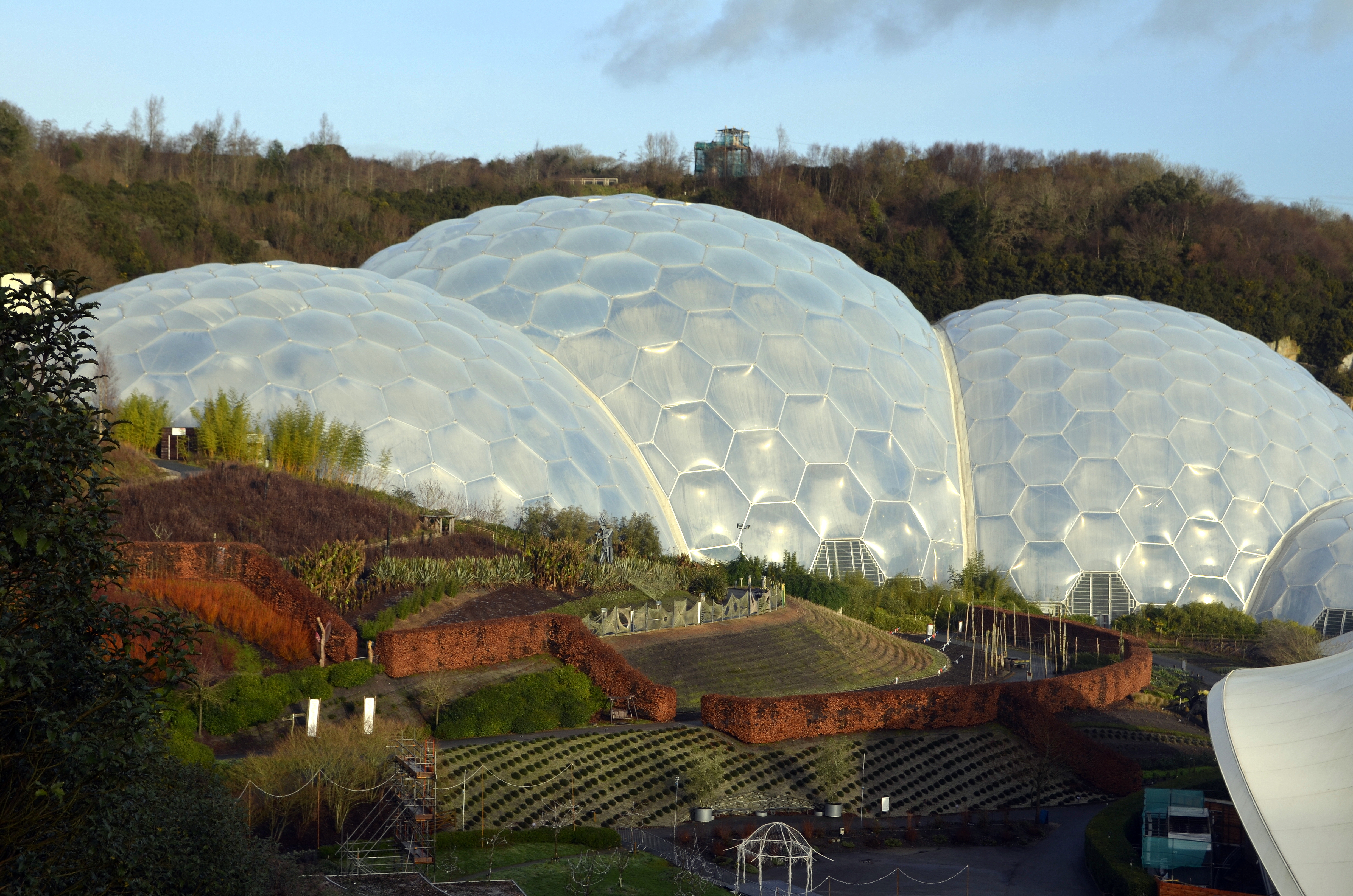
For a gardener, England is a magical place, full of lovingly designed and tended gardens–from the formal and majestic to the whimsical and intimate.  Alas, December isn’t the best time to visit gardens in England, but for hardier aficionados, there are many things to see even in winter. And then, for the rest of us, there are indoor gems like the Eden Project in Cornwall, which features huge covered biomes built on the site of an old china clay pit:

It was my one request on our recent trip to the British Isles: a few days in Cornwall to see the Eden Project and explore some of the natural beauty of the area. I was tempted to stop in at the Lost Gardens of Heligan (having read Tim Smit’s fascinating book on the restoration of the famous gardens there), but wanted to save that experience for a future summer, should I ever have the opportunity.

The Eden Project was a novelty, mostly because it is such an unusual space. Taking advantage of a fine morning, we walked through the outdoor gardens first, then made our way inside –to the Rainforest and Mediterranean biomes.

Here are just a few of the sights that were a pleasure to behold in December: Golden Chalice Vine, Parakeet Heliconia, a striking plant with red stems and lobed green fruits that I have not been able to identify (so if anyone happens to know what it is, enlightenment would be much appreciated!*), the unfurling leaf of a banana tree  (I never quite thought about how that happened before–it was a revelation), and finally, a lizard that almost completely blended into the background until one of our sharp-eyed friends spotted it.

*Update Feb 2014: I now know what the previously  unidentified plant is — it is a Glory Bower (Clerodendrum speciosissimum);  the third photo below shows the fruits of the plant.


Meditation on a Fine Cup of Tea

13 Jan

During the holidays, we hurtled around parts of England, Wales, and Ireland. December in the British Isles is just a wee bit grey, windy, and wet. But it was a lovely trip–not the least because at every turn,  there was a cup of tea: early morning, mid morning, afternoon, and evening. The perfect antidote to a wintery climate, the perfect reward for a long day out and about, and the perfect way to transition from activity to rest. In my admittedly biased view, nothing beats the rich, deep, reddish brown of a fine cup of  black tea (“black” tea being a slight misnomer). And there is no better way to have a strong cup of tea than milky and sweet.

Ok, there is a better way– having it milky and sweet, and accompanied by scones, clotted cream, and strawberry  jam. The ecstasies engendered among our family members at the sight of a proper cream tea cannot be adequately described. Suffice to say, we partook, and then partook some more (and then a bit more). 

All photos taken at the delectable Lucy’s Tearoom in Stow-on-the-Wold, Cotswolds, England.

Historic London Town, Maryland

11 Dec

Last weekend, we had to drop our daughter off at an event in Edgewater, Maryland. The name Edgewater stirred something in the deep recesses of my memory (but alas, the stirring failed to produce anything that my brain could actually retrieve on its own). Thankfully, Google provided the answer:  Historic London Town, a bustling colonial-era settlement on the South River. Today, the current 23-acre complex known as  Historic London Town & Gardens covers just a small part of the original town, but features original and reconstructed buildings, an archaeological area, learning activities, and gardens. (It was the garden part that had sparked my original interest.)

December isn’t always the ideal time to visit open-air gardens in the Northern Hemisphere, but duty called. And we were rewarded for our efforts:

Holiday window decoration, William Brown House

American Holly

Cut end of old log, Tobacco Barn, built in 1700s

Lord Mayor’s Tenement                      Posts near Pier, South River  
  

Red-Twig Dogwood                               Roundleaf Greenbrier