Archive | Botany/Horticulture RSS feed for this section

Tassels and Silks: The Beautiful Anatomy of a Corn Plant

7 Jul
Corn tassel consisting of individual spikelets, with anthers hanging from filaments

Last year, I carved out a patch in the vegetable garden, planted some corn kernels, and was very excited when the sprouts emerged. But a few days later, all the sprouts were severed, laying forlornly on their sides where they had fallen. Upon closer inspection, the sprouts had been pulled up and the corn kernels had been chomped off at the base — clearly the work of chipmunk commandos who had infiltrated the garden at the crack of dawn. Chipmunks 1, me 0.

This year, I planted seedlings instead of kernels, crossed my fingers, and hoped for the best. As of yet, there haven’t been any corn massacres, so I’ve been able to watch corn plants grow for the first time — and admire their constituent parts. There is a lot to notice, from the stripy leaves…

Macro view of corn leaf

… to the beguilingly named tassels and silks. The highly recognizable tassel at the top of every corn plant is the male part of the plant, and consists of about 1,000 spikelets, each containing 3 pollen-producing anthers and their filaments (collectively, the stamens). With 6,000 pollen-producing units on each corn plant, that’s a lot of pollen to be wind dispersed (read more about pollen shed in this great article on “sex in the corn field“).

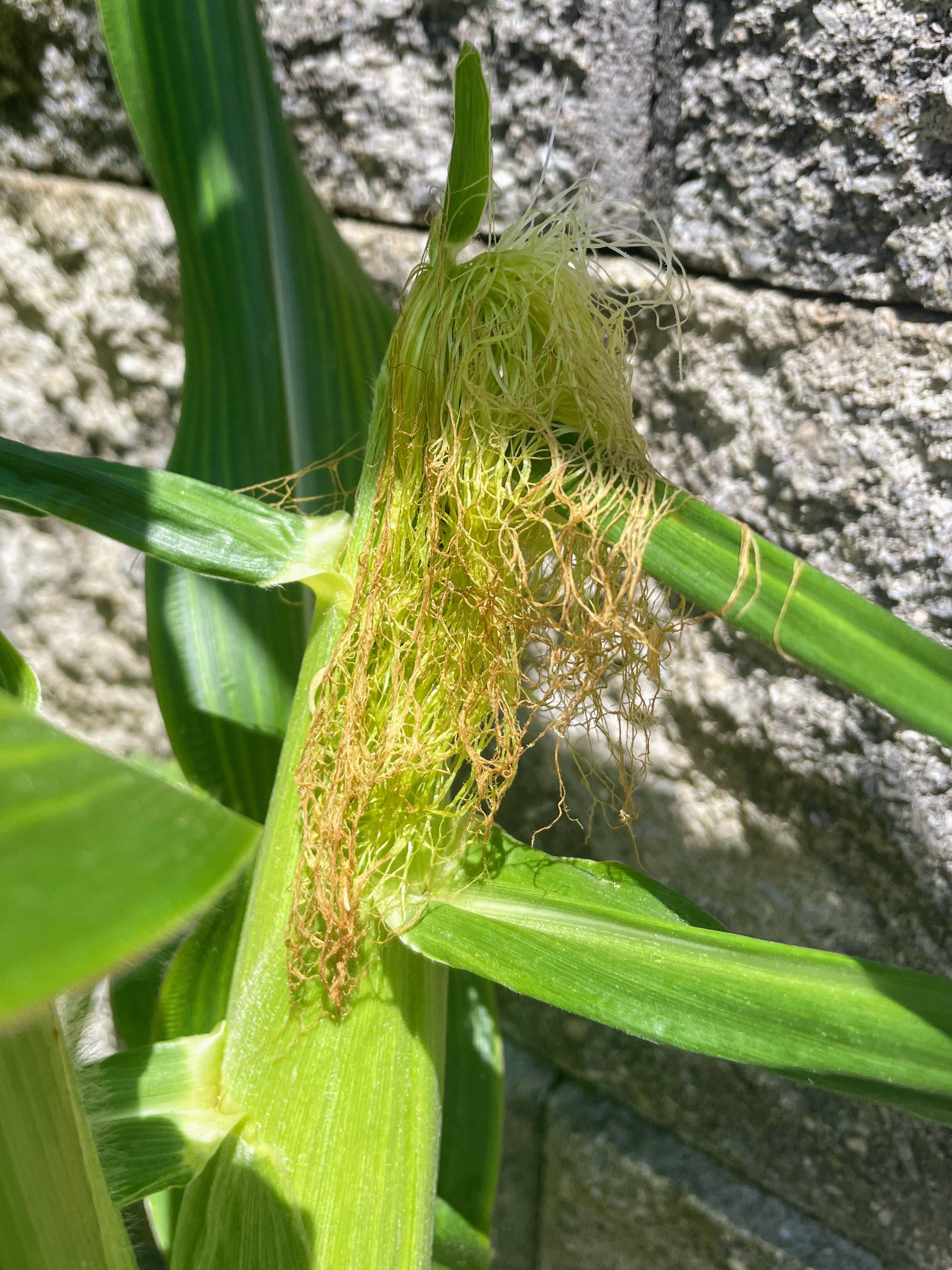
The silks are the female part of the corn plant. They form at the base of the ear but are most visible at the tip, emerging from the husk. Their job is to catch the pollen and guide it down to the unfertilized corn kernels (ovules) on the ear. Here’s the fascinating part: Each silk is connected to a kernel (or what would be a kernel if successfully pollinated). As not every ovule gets pollinated, most ears produce about 400 to 600 kernels.

You can tell when pollination has occurred because the silks dry up, turn brown, and often fall off. You can also tell when pollination hasn’t been very successful if your ear of corn has missing or misshapen kernels. That’s why it’s important for home gardeners to plant corn in a block rather than a single row, so the pollen has more chance of falling on nearby silks rather than being completely blown away from the row.

I don’t have any photos of pollen on the silks, but this is what the tiny yellow pollen grains look like on a corn leaf, along with some spent anthers (they drop off the tassel after the pollen is shed).
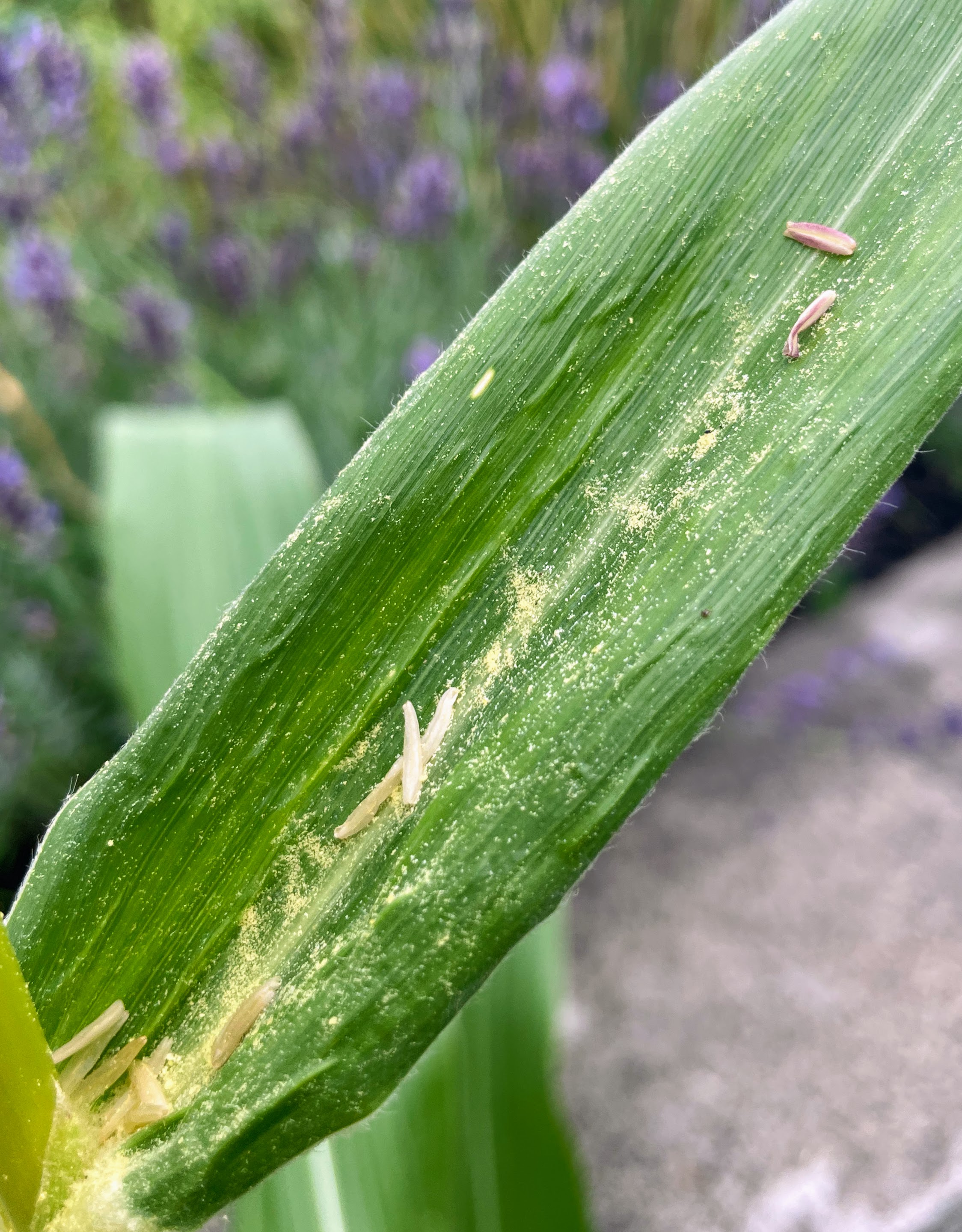
Some of the 2-5 million pollen grains produced by each corn tassel (and some anthers)

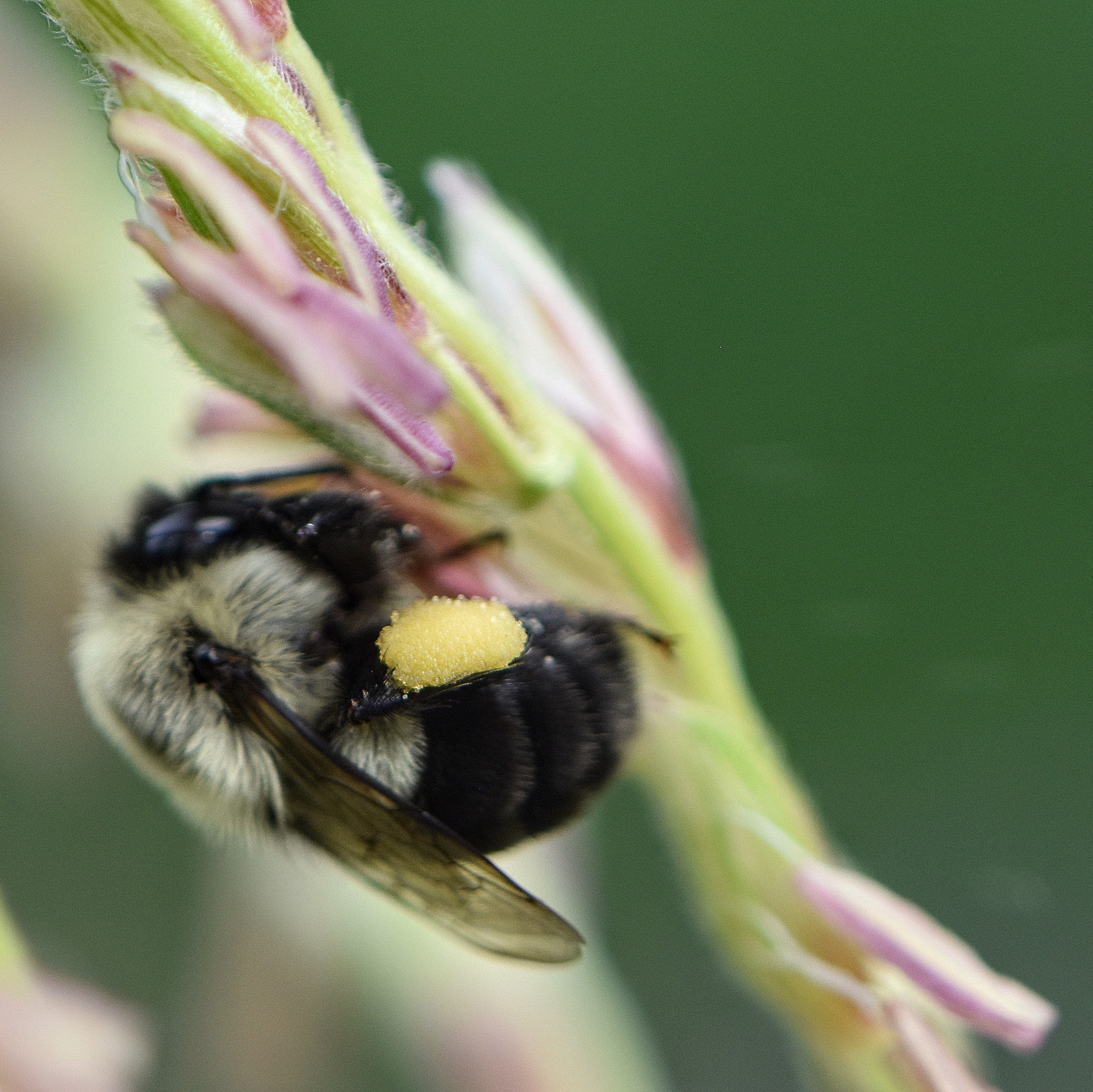
Though corn is pollinated by the wind (anemophily), pollination can also occur with the help of insects (entomophily). Luckily for me, as I was taking photos of the tassels, a bumble bee appeared. Or, more specifically, a female bumble bee appeared–as the females are the only ones to have pollen baskets (corbiculae) on their hind legs.
The Differences Between Cycads, Palms, and Ferns

25 Jun

There are certain plants with pointy pinnate leaves (ie, leaves connecting to the stalk like quills on a feather) that look very alike, even though they are not at all related: cycads, palms, and ferns. For one, they evolved millions of years apart. Ferns, which reproduce by dispersing spores, appeared at least 360 million years ago, long before seed-bearing plants. Cycads are among the earliest of the seed-bearing plants and have been around for about 280 million years. The evolution from spores to seeds was one of two dramatic land-plant developments. The other was the emergence of flowers about 100 million years ago, after which palms arrived on the scene. At a mere 60 million years old, palms are botanical babies compared to the other two, though all three shared time and space with dinosaurs.

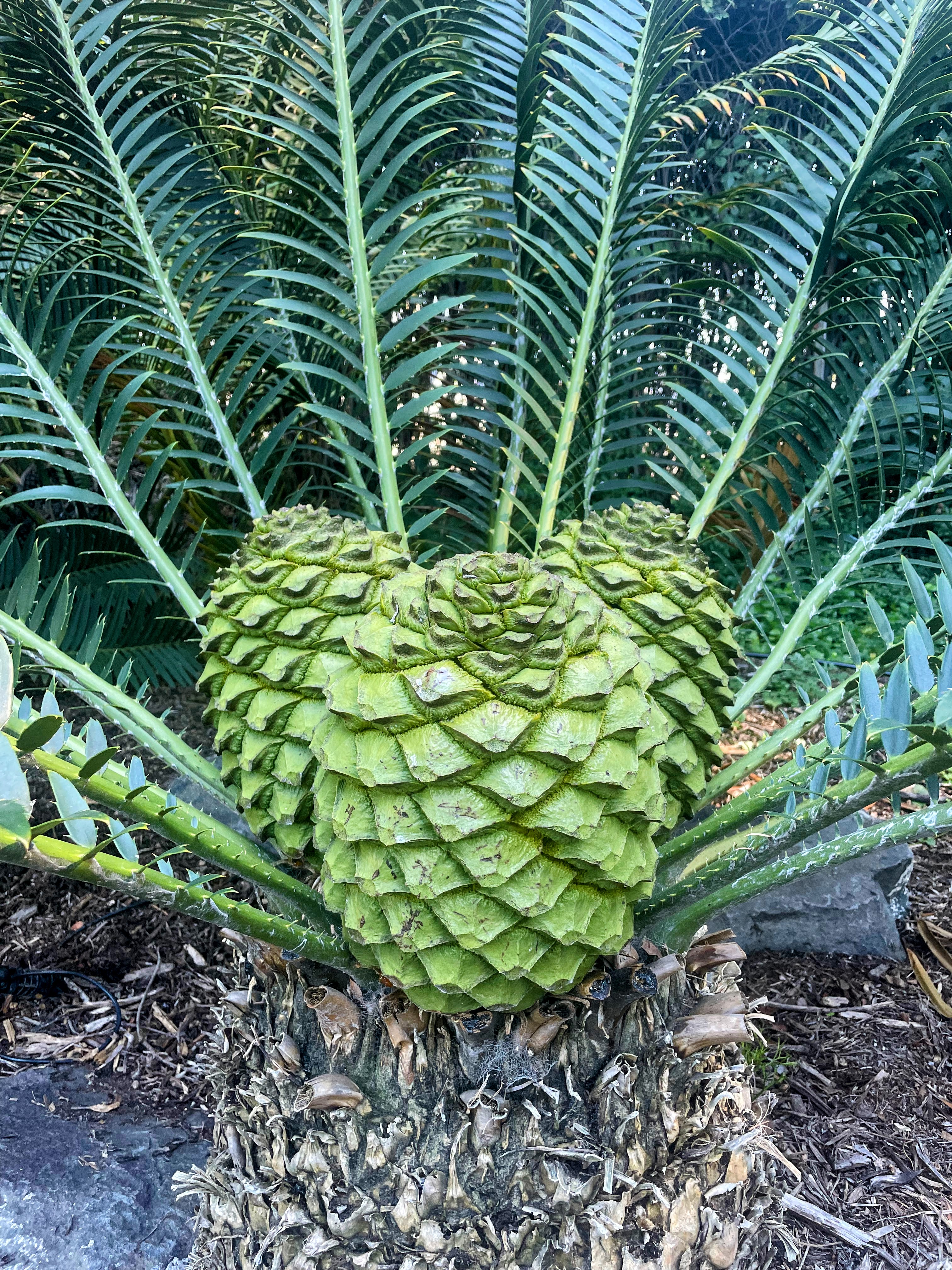
There are many ways to tell the three plants apart. Cycads and palms have woody trunks; ferns do not. And fern fronds are much softer and more delicate than stiff and spiky palm fronds or cycad leaves (some of which look positively lethal):

Alexandria cycad (Encephalartos arenarius), UC Berkeley Botanical Garden

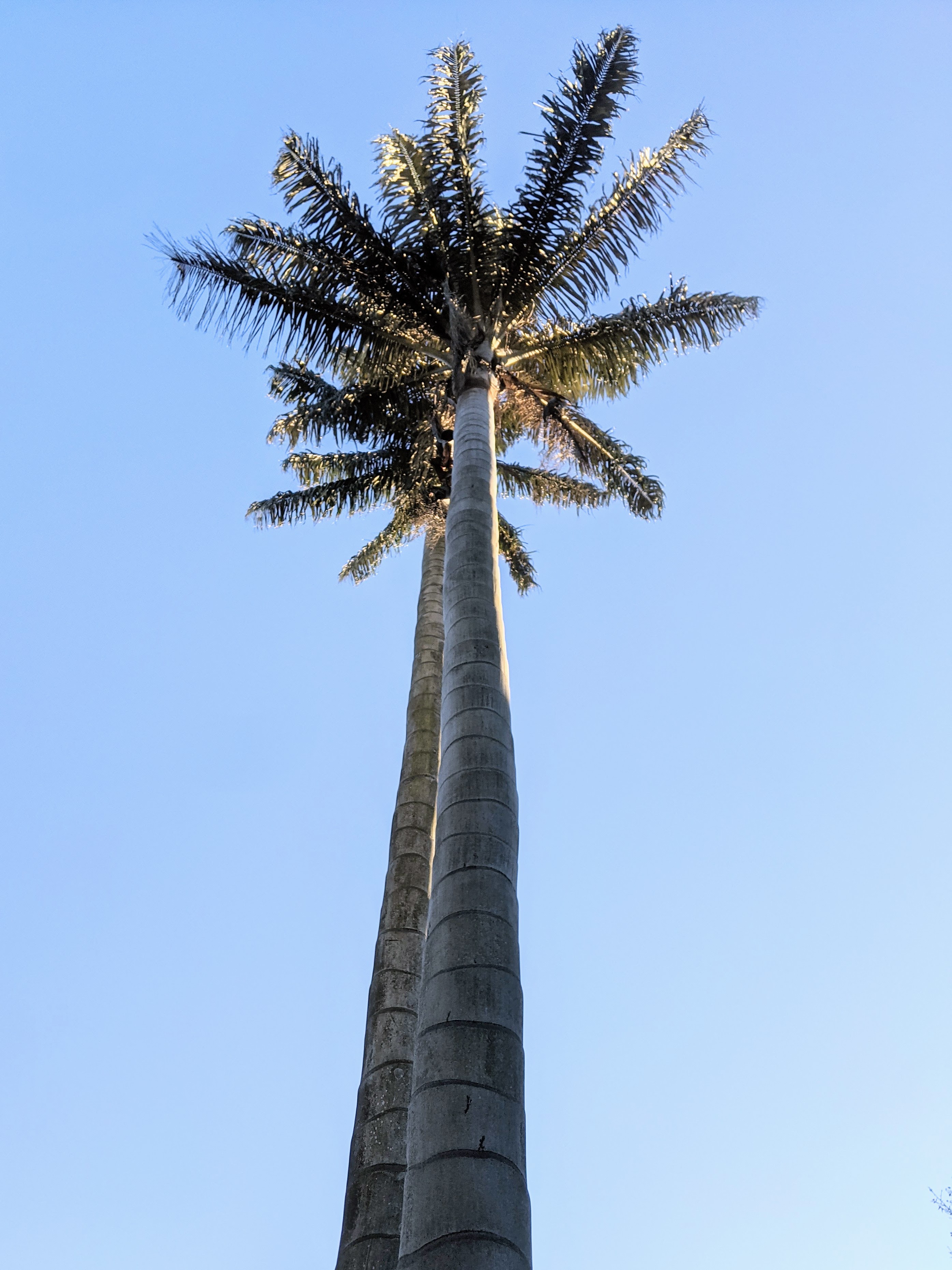
Distinguishing between cycads and palms can sometimes be tricky as they both have crowns of pointy leaves atop a woody trunk. For a while, I assumed if it was tall and tree-like, it was a palm, and if it was closer to human height and a bit bushier, it was a cycad. Then I saw the Albany Cycad at the San Diego Zoo (at 500 years old, it is the Zoo’s oldest plant); it is taller than I am and looks a lot like a palm tree.

But there is a way to tell tall cycads and palm trees apart: look at the trunks. Cycad trunks are rough and stocky while palm trunks are slimmer. Also, while both plants have scarring on their trunks where the leaves have fallen off, cycad leaf scars appear in a spiral pattern, while palm leaf scars often look like rings around the trunk. So if you see ringed scarring on a tall and elegant trunk, that’s a good clue that you are looking at a palm and not a cycad.

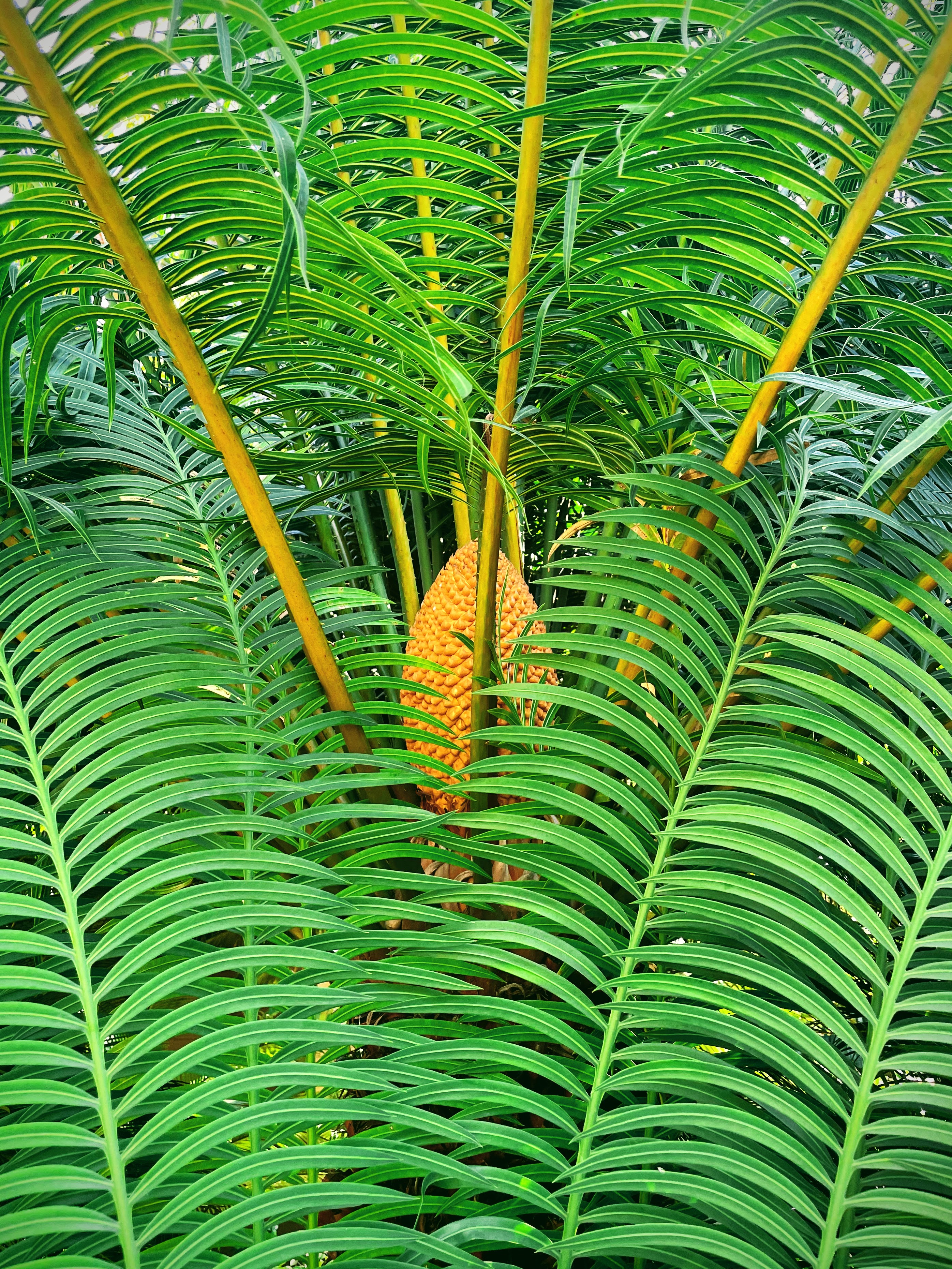
Another difference is that cycads are gymnosperms and palms are angiosperms, but those terms aren’t very helpful unless you know that gymnosperms = cones, and angiosperms = flowers and fruits. So if you are looking at an as-of-yet-unidentified plant with stiff and spiky pinnated leaves and see a cone at the center of those leaves, it’s a cycad. And that cone is why cycads are most closely related to conifers.

If you see any flowers at all (or fruits such as coconuts, dates, or berries), it’s a palm. Ferns are neither gymnosperms nor angiosperms; they are primordial, vascular plants and do not produce flowers, fruits, or cones. So if you are looking into what you think is a clump of ferns and see a cone, it’s not a fern. If you see a woody trunk, it’s also not a fern. But, if you see spores on the underside of the fronds, it IS a fern!

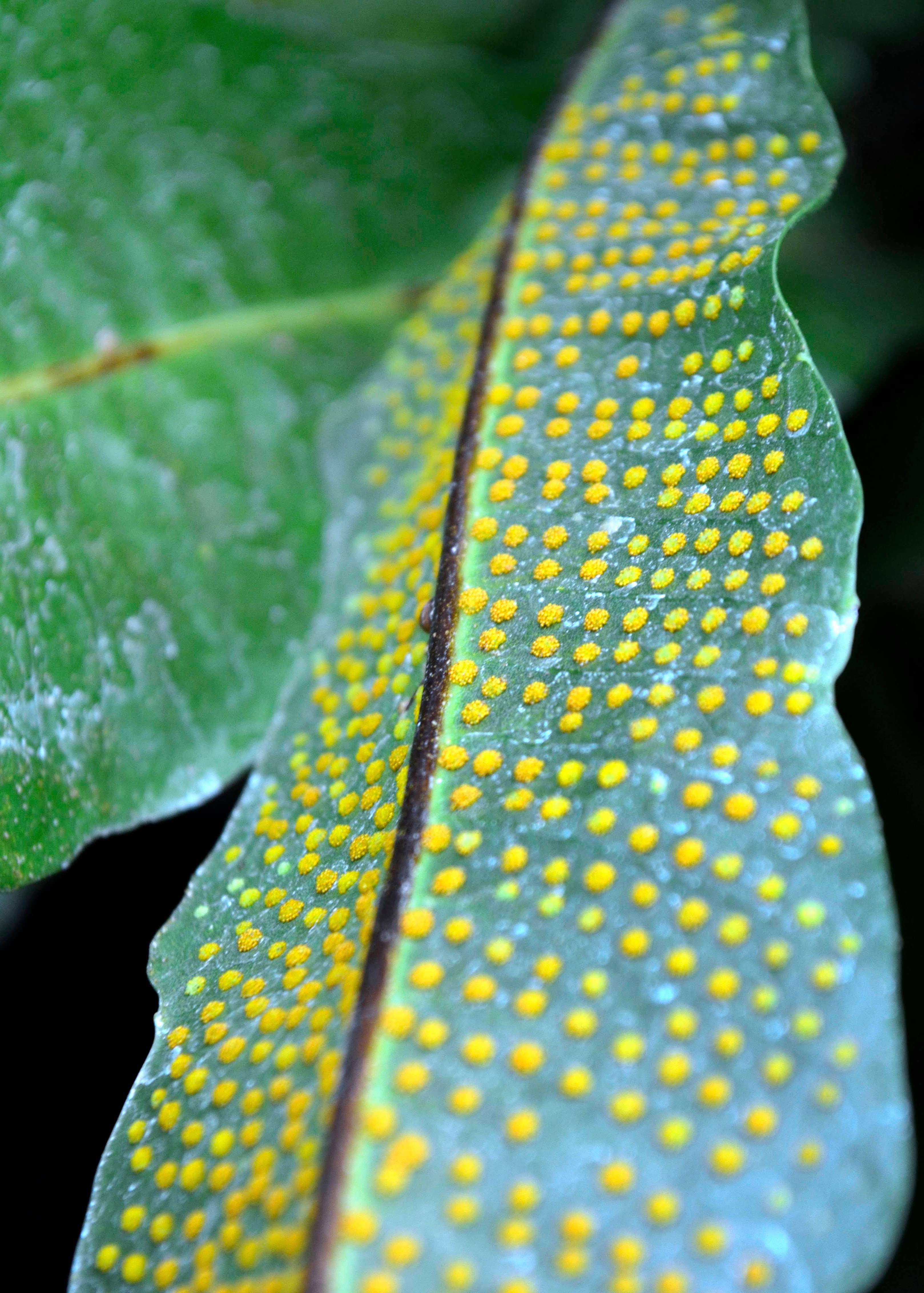
Spores on the underside of Florida Strap Fern

Finally, a word about Sago Palms, a group of palm-like plants that are actually cycads. They got their name because way back when, someone else had a hard time telling them apart. (So glad I am in good company.)

Misnamed Cycad: Cycas circinalis (Queen Sago Palm), Garfield Park Conservatory, Chicago

A final twist to this tale: though cycads can look like palms, their young, emerging leaves look remarkably similar to unfurling fern fronds. I don’t have a photo of a cycad leaf unfurling (unfortunately), so the first photo below is kindly borrowed. I’ve added a fern photo I do have for comparison. One could easily be forgiven for mistaking an unfurling cycad for a fern. But take a careful look at the rest of the plant. Touch the mature leaves to see how hard or soft they are and whether there are any spores underneath, see if there is a woody trunk (if so, look at leaf scarring), check for cones or fruits. All those things will point you in the right direction.

The Hidden Parts of Lupines

26 May

I had bad luck growing lupines from seed last year; the resulting plants started out well but didn’t make it past spring. I’d like to blame the local rabbits, except for the fact that lupines are poisonous, so maybe a very brave rabbit could have eaten one of my small lupines, but certainly not all of them. So it was probably the fault of a human who shall not be named, not a leporid.

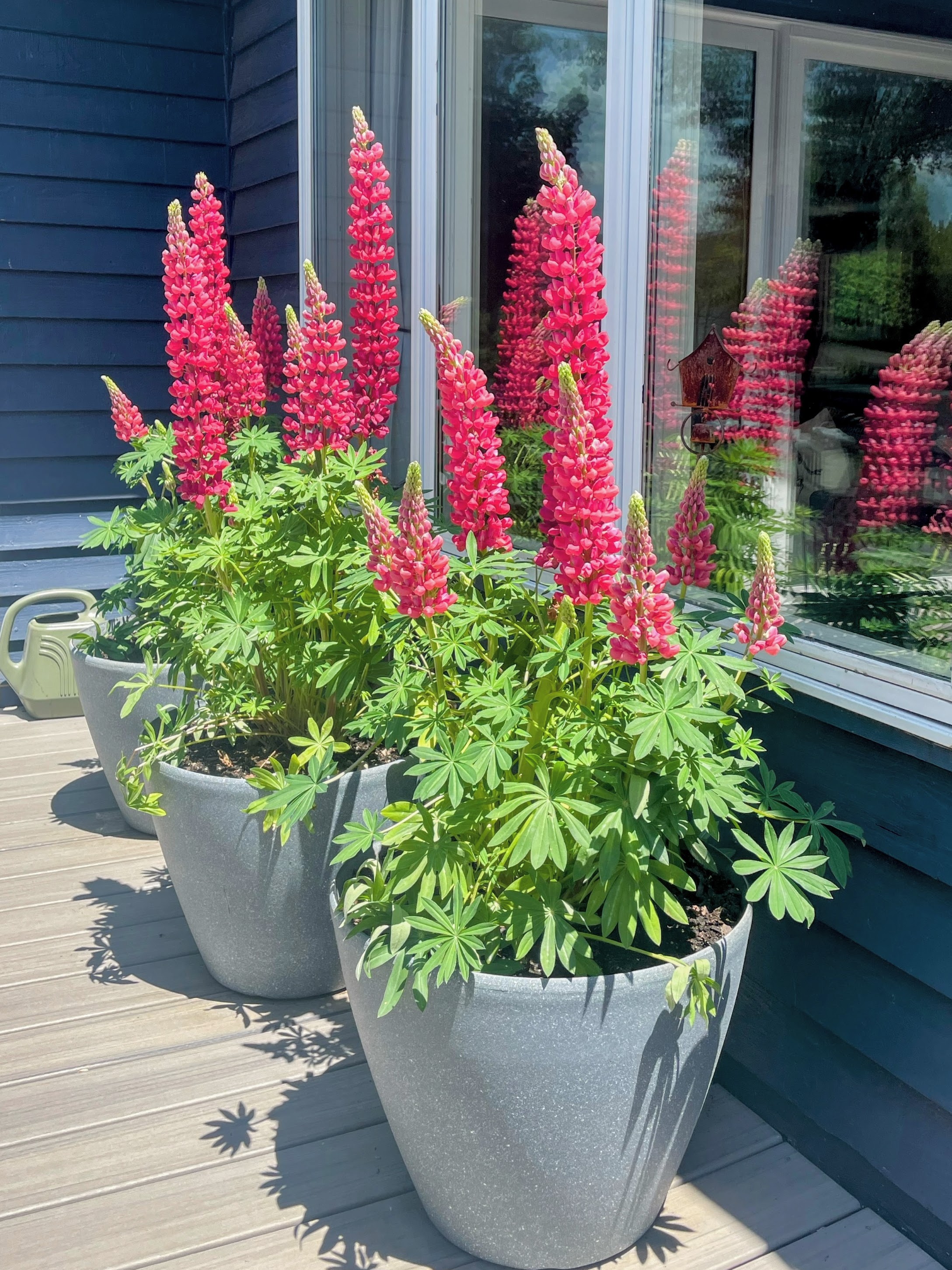
Still traumatized from last year’s lackluster lupine experience, I decided I would not start any from seed this year. In fact, I would not have any lupines at all. But then, while at a garden center for something else entirely, I walked past three magnificent specimens in full bloom (with many more blooms to come) and couldn’t resist. They were far more spectacular than my seed-started lupines had ever been, and I had three large, empty deck pots back home. So I decided to try them as container plants. If that doesn’t work, I’ll need a Plan C.

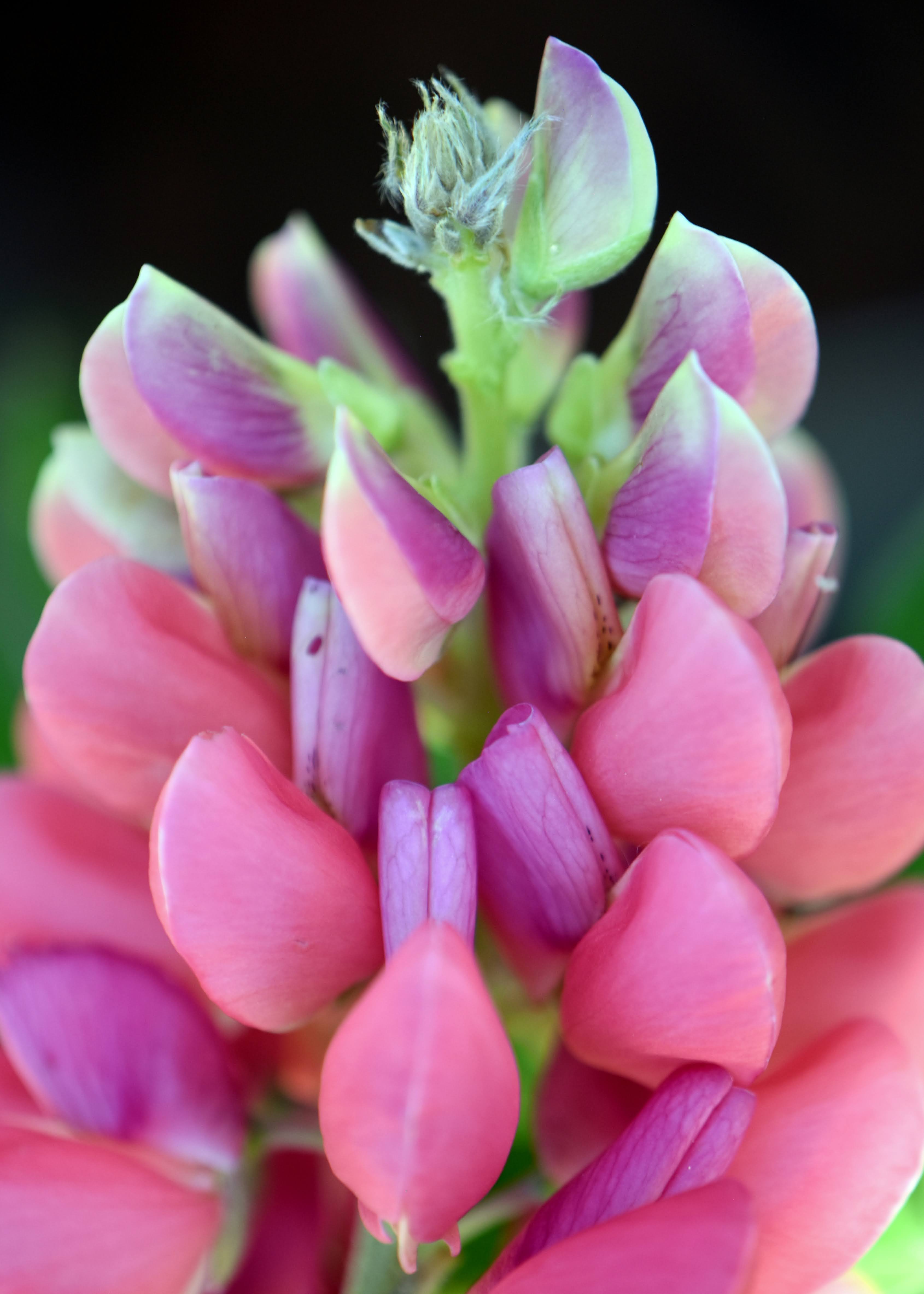
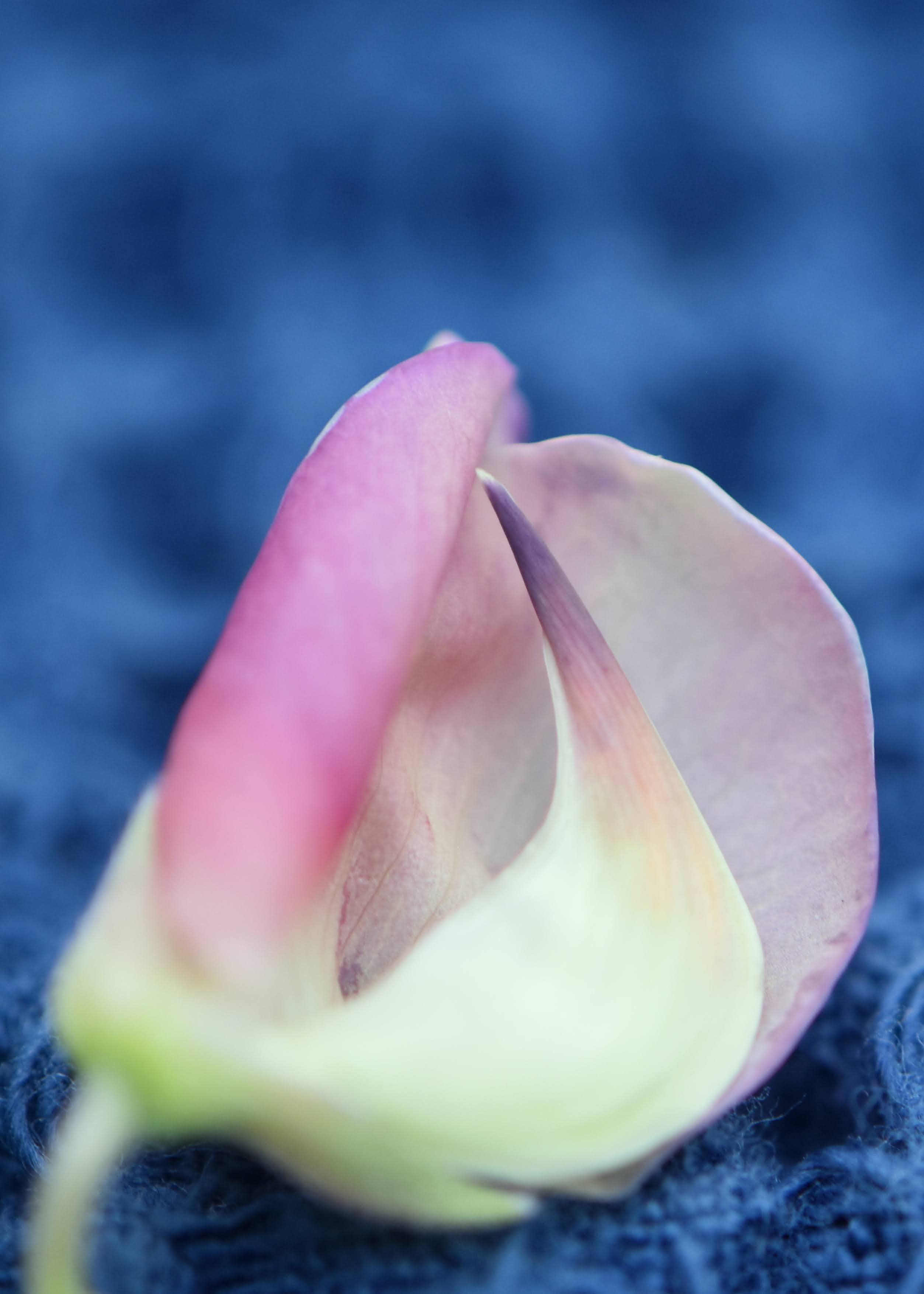
Lupines are part of the Pea family (Fabaceae) along with baptisia,* broom, clover, milkvetch, trefoil, and others. The flowers grow on long spikes called racemes, with the flowers blooming from the bottom of the spike on up. The flowers themselves are distinctive, consisting of five petals. One forms an upright banner, two are lateral wings, and two are fused together to form a curved keel (so called because it resembles a boat’s keel).

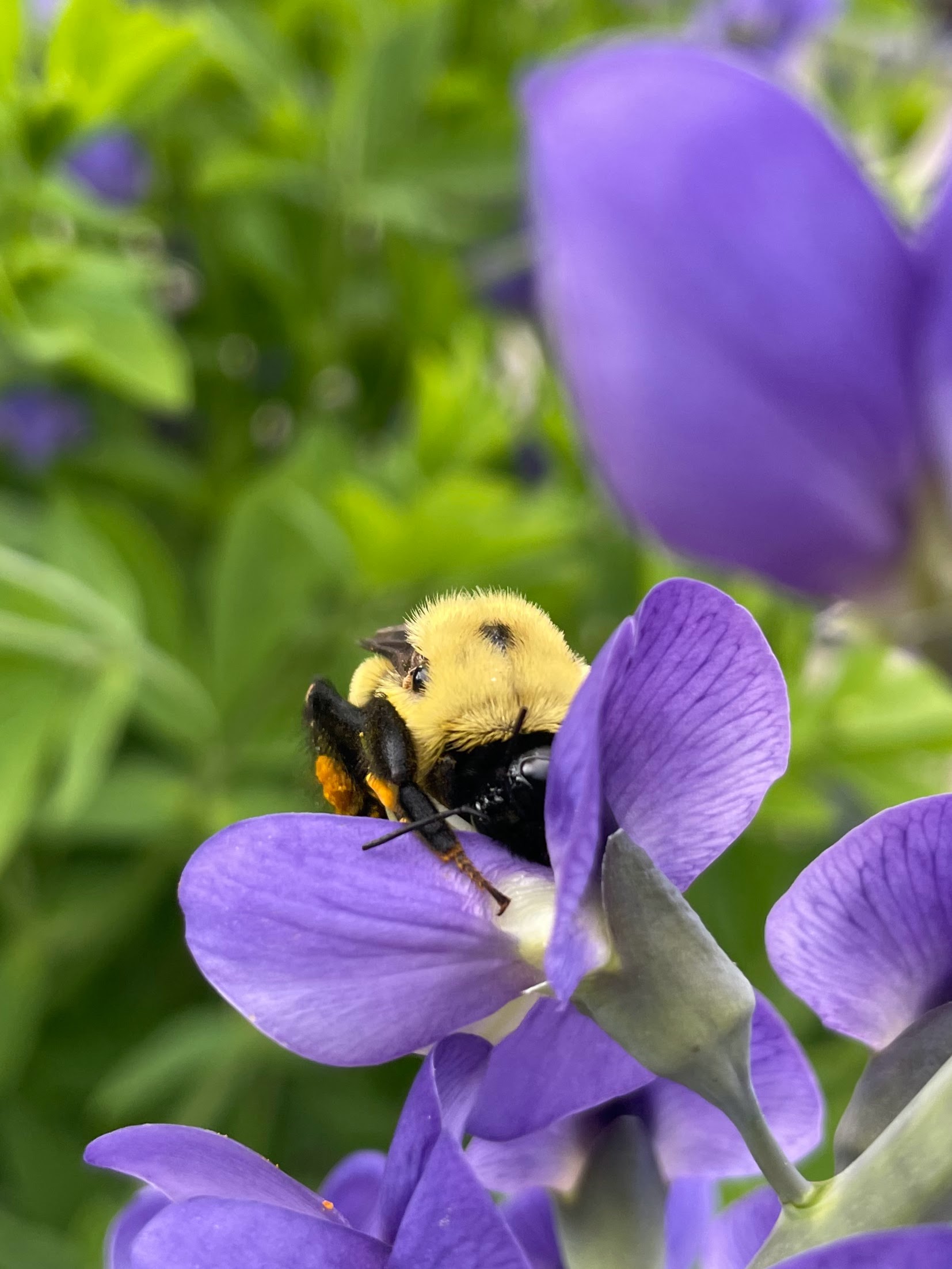
With their lighter-colored center markings, the banners act as sign posts to attract pollinators, ie, bees. (Though most lupines can self pollinate, bees can also help). The two wings form the distinct pea-flower shape and surround the keel, making it hard to see; in the middle photo above, I peeled away one of the wings. The keel protects the flower’s reproductive parts, which are tucked inside it. When a bee lands on the wings, they open up like a clam and expose the keel, which also opens slightly. The bee pollinates the flower by knocking the stigma and anthers together, and in the process collects pollen to feed to its young. The banner then does a really cool thing: it changes color after pollination, to let the bees know there is no more pollen to be had at that particular flower.

So, while the beautiful exteriors of these flowers deserve all the admiration they receive, what they have going on within is pretty fascinating, too!

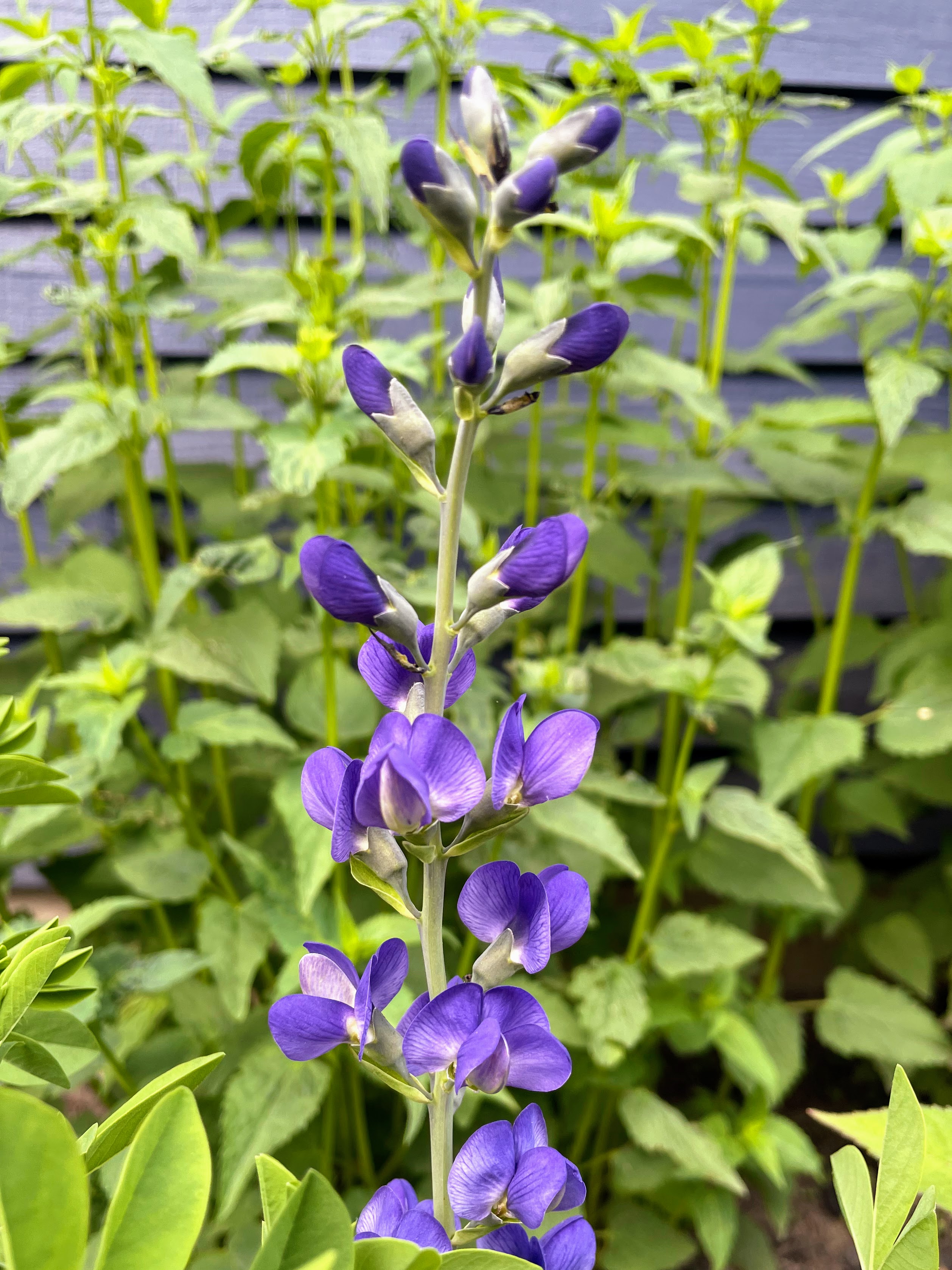
*For flower-comparison sake, here are two photos of Baptisia australis, which also belongs to the Pea family and has banners, wings, and keels. In the last photo, a bee has found its way to the pollen thanks to the banner markings.

The Unusual Jaboticaba Fruit Tree

20 Apr

Ok, if you live in any of the tree’s native habitat areas in South America, the Jaboticaba and its fruit may not be so unusual to you. But for the rest of us, the tree is a sight to behold:

Jaboticaba; photo taken at the Missouri Botanical Garden in St. Louis.

The Jaboticaba (Plinia cauliflora, aka Jaboticabeira, aka Brazilian Grape Tree) is a showstopper because it exhibits an unusual botanical trait, ie, its fragrant white flowers and sweet/tangy fruits grow directly on the trunk of the tree, rather than from new growth or shoots. In botanical terms, this is called cauliflory; hence the “cauliflora” part of the Jaboticaba’s Latin name. (“Plinia” refers to a genus of flowering plants in the myrtle family, Myrtaceae, to which the Jaboticaba belongs.) Other cauliflory plants include Durian, Cacao, Jackfruit, Papaya, and the lesser-known Cannonball Tree — which, though they all share this same botanical trait of cauliflory, are not actually related to the Jaboticaba.

Cauliflory is most common in tropical areas; in the United States, the Jaboticaba can be grown in Zones 9-11. Botanists believe cauliflory evolved for a couple reasons: 1) accessibility: insects and fruit-eating animals that can’t easily get to the highest parts of trees can access the flowers and fruits on the lower parts of the trunk of a cauliflory plant, thus helping ensure the tree’s reproduction via cross-pollination and seed dispersal. Another reason for cauliflory may be due to 2) structural support: the trunks and main stems can more easily bear the weight of heavy fruits like Durians, Jackfruits, and Papayas.

Though Jaboticabas are very slow growing, once they reach maturity, they can produce up to 100 pounds of berries, which look like very large grapes and come in different varieties and colors (purply-black, red, and white). The skins are a bit thick and tannic; some people eat the berries skin and all for a nice “pop,” while others squeeze the juicy pulp into their mouths and discard the skin. The pulp is translucent and jelly-like, with a few seeds. It looks a little like the inside of a lychee or blueberry. Depending on the “jabo” variety, the berries are said to taste like Muscadine grapes, blueberries, and/or lychees — or a combo of all those flavors — with slight acidic undertones. Jaboticaba berries are also quite nutritious; they contain lots of Vitamin C and other antioxidants, as well as amino acids and nutrients such as calcium, phosphorus, and iron.

In addition to being eaten fresh, the Jaboticaba fruits can be made into juice, syrup, jam, and other usually sweet concoctions. The important thing is to use the fruit quickly after picking it, as it has a very short shelf life (which explains why those of us who cannot grow this tree also cannot find the fruit in our local supermarkets).

Recipes:
Jaboticaba Juice (video)
Jaboticaba Syrup
Jaboticaba Liqueur
Jaboticaba Jam w/Pectin
Jaboticaba Jam w/o Pectin
Jaboticaba Sorbet
Jaboticaba Cheesecake
Jaboticaba Sparkling Wine

Sunflower Power

10 Mar

Lately, we have been lulled into thinking spring is around the corner, with a warm day or two and lots of sun — only to be brought back to our cold, overcast, wet or sometimes snowy reality. This state of affairs got me thinking about (ie, longing for) flowers, and sunflowers in particular. If you grow sunflowers, you may know all there is to know about them. I did not, though I did learn very early on that our intrepid squirrels could scale our giant sunflowers under cover of darkness and chew off the beautiful heads, leaving decapitated 9-foot stalks in their scheming rodent wake.

I did know a few other things, such as the origins of the scientific name for the common sunflower: Helianthus annuus. Helianthus comes from the Greek “helios,” meaning sun, and “anthos,” meaning flower. Sunflowers are also heliotropic, ie, young sunflowers follow the sun’s position from sunrise to sunset. They do this until they reach maturity, at which point they stay facing East, which allows the sunflowers to get warmer more quickly (and thus, to attract more pollinators).

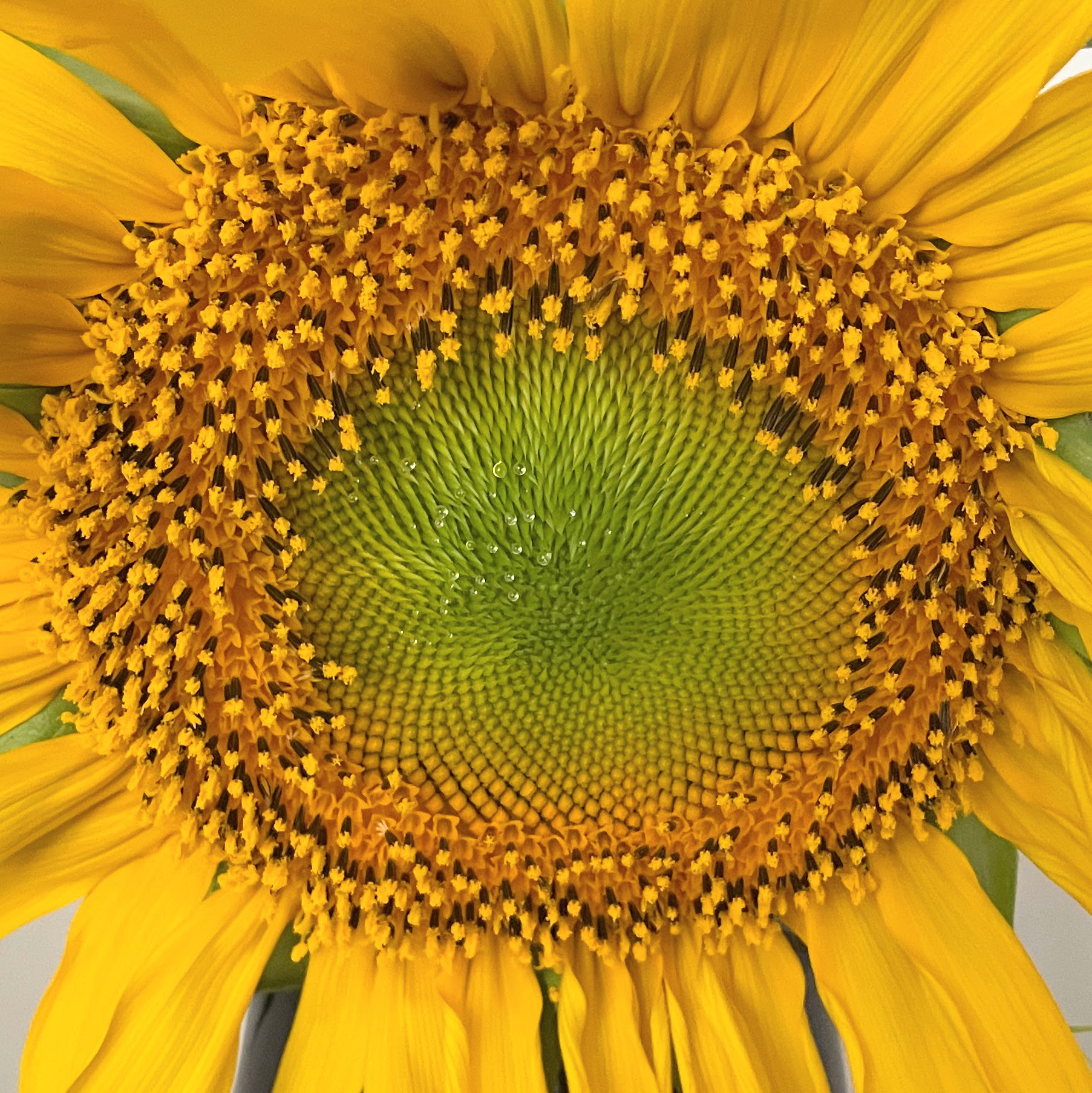
Another thing I knew was that each sunflower head is made of hundreds and maybe thousands of smaller flowers, which means it is an inflorescence (same as alliums). The bright yellow (or sometimes, red or rusty orange) petals surrounding the sunflower head are called ray florets. The real, tiny flowers are in the central part of the flower head and are called disc florets. In the photos below, you can see the dark brown anthers of the disc florets topped with pollen; each of these flowers will produce a sunflower seed.

Finally, one last thing I knew, but did not really think about until now is that the sunflower’s disc florets are arranged in a spiral pattern that follows the Fibonacci sequence, a mathematical sequence in which each number is the sum of the two preceding ones. If you count the spirals in a sunflower head (which can be done in different ways), you will usually end up with a Fibonacci number (0, 1, 1, 2, 3, 5, 8, 13, 21, 34, 55, …). Why? Because the pattern makes efficient use of available space for seed formation. The growing seeds press on each other, creating geometric patterns. The Fibonacci sequence is found everywhere in nature (such as in pineapples, pinecones, broccolo romanesco, sea shells, tree branches, storms, galaxies, and even the distribution of seeds in a raspberry, to name just a few occurrences).

This is where my knowledge of sunflowers ended. Then, I discovered a couple more reasons to admire them:

    1. Every part of a sunflower — not just the seeds — can be eaten:

    • Sunflower sprouts can be used in the same way as alfalfa or bean sprouts, in a stir fry or a spring salad or Thai salad.
    • Jerusalem artichokes (aka sunroots, sunchokes) are a type of sunflower whose roots are edible; prepare them as you would other root vegetables: roast, sauté, fry, mash, or puree them — or shred or slice them raw.
    • Sunflower stalks can be eaten like celery when small and slender. You can also make flour from the stalks. (OR… dry the stalks and use them to support other plants in the garden the following year.)
    • Younger, smaller sunflower leaves can be eaten in salads, and older, bigger leaves can be boiled and sauteed like collards or other leafy greens; removing the central rib may make them a little less bitter. Some people also prepare tea from dried sunflower leaves and/or petals.
    • The flowers (ie, ray florets) are edible; try them in a salad.
    • The opened (giant) sunflower heads (not fully mature, with seeds that are still white) can be grilled, if you are feeling particularly adventurous.
    • The unopened sunflower heads can be prepared in a way similar to artichokes.

    2. Sunflowers can absorb some serious toxins. Because of this ability, they are called hyperaccumulators. When a reactor exploded at the Chernobyl Nuclear Power Plant in Ukraine in 1986, it released radioactive elements into the environment; thousands of sunflowers were planted to help remove these elements from the soil and ponds near the disaster site. Using plants to cleanse the environment is called phytoremediation. Today, sunflowers are the international symbol for nuclear disarmament (and as the national flower of Ukraine, they are also symbols of solidarity, resilience, and hope).

    Unraveling the Mystery (and History) of the Crocodile Fern

    14 Jan

    I like ferns. Whenever I am at a botanic garden, I take a close look at them. I love the elegance of the leaves (fronds), the way the fronds unfurl, and the polka-dot patterns of the sori (spore cases) on the underside of the fronds.

    During the recent winter holidays, we went to the Garfield Park Conservatory in Chicago — a magical place any time of the year, but a fantastic one to visit during the colder months. My attention was caught by a fern I had never seen before, with an intriguing leaf pattern:

    This fern is called a Microsorum musifolium (or Polypodium musifolium). ‘Microsorum’ means ‘small sori’ and ‘musifolium’ means ‘banana-like leaves,’ because of the fern’s long, strap-like leaves. ‘Polypodium’ means ‘many-feet’ and refers to the growth pattern of the fern’s underground, horizontal stems (see the lithograph at the bottom of this post).

    In recent years, this plant has also become known as a Crocodile Fern because some people think the texture and pattern of the fronds looks reptilian. (And because some clever house-plant marketers decided “Crocodile Fern’ would sell better than, say, ‘Banana-Leaf Fern’ — or worse, ‘Wart Fern,’ as it is sometimes also called.) Because of this new-ish twist on the plant’s name, it is now common to see the fern [mis]labelled as Microsorum musifolium ‘Crocodylus,’ the latter part of which signals an animal genus, not a botanical one.

    I don’t have any crocodile photos, but I do have some close-ups of an alligator’s back. And while I can see that the fern does look reptilian in a way, it may be a stretch to say it looks like the patterns on the back of a crocodile (or alligator):

    Common names aside, the fern is native to Southeast Asia and the Pacific Islands, and is an epiphyte; it grows on trees for support but it does not take any nutrients from them. Instead, it forms a half-basket against the tree trunk that catches falling leaves and debris, which give the plant moisture as well as nutrients as the leaves and debris decompose. As a houseplant (ie, when it is not tucked against a tree trunk), the fern will form a full, circular basket. Plants that do this — including Bromeliads — are called ‘trash-basket plants,’ which is not the nicest name for a great adaptation. Luckily, many ferns in this category are called Bird’s Nest ferns, which sounds much better.

    Microsorum musifolium was first described by the German-Dutch botanist Carl Ludwig Blume in his famous 19th-century work, Flora Javae (Plants of Java), written after he had served as a director at the botanic garden in Bogor (then known as Buitenzorg), Java. There is some confusion over when, precisely, Flora Javae was published, as different sections were added between 1828-1858.

    I saw a hand-colored lithograph of ‘Polypodium Musaefolium’ attributed to Blume’s 1829 edition of the book for sale online, and wanted to confirm that it was, in fact, from that book (not that I wanted to buy it; I just wanted to know when the fern was first mentioned). I looked at the list of sections added to Flora Javae over the years, which notes all the ones added in 1829, but there were no sections called Polypodium or Polypodiopsida. I wondered if ferns were called something else back in the day. Sure enough, ferns were traditionally classified as Filices — and that was the title of one of the 1829 sections. So I knew Blume had devoted a sizeable section of Flora Javae to ferns, and I hoped Microsorum musifolium was among them.

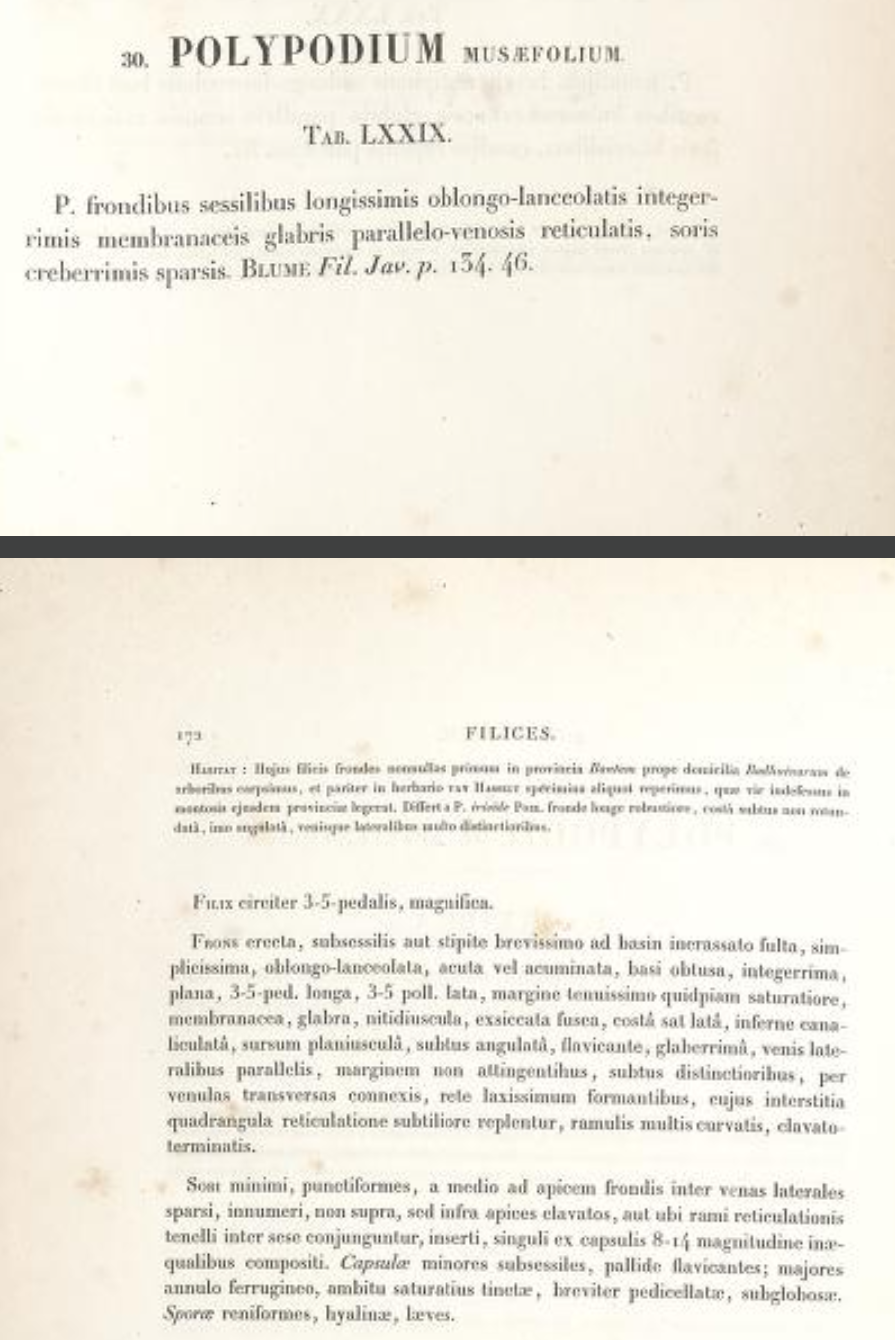
    Motivated by this discovery, I kept looking and — amazingly — found a full-text 1858 version of Flora Javae, thanks to the Biodiversity Heritage Library; it is from an edition held by the Peter H. Raven Library at the Missouri Botanical Garden. The 1858 version includes all the sections added previously, including the one on ferns. I searched the text for ‘Microsorum musifolium,’ but no luck. Then I remembered Blume’s lithograph was labeled ‘Polypodium.’ That worked; there are a LOT of Polypodium entries in Flora Javae. But the search did not turn up any entries for Polypodium musifolium or musaefolium (at the time, I did not realize that this result – POLYPODIUM MUSffiF0LIU3L — was the one I was looking for). So I tried to scroll through all the entries manually to find it . No luck, again. Until I came across another clue: the lithograph was described online as being Tab. LXXIX, and using that as a guide, I finally found the entry for ‘Polypodium Musaefolium’ on pp. 171-72 of Flora Javae:

    And there you have it. Should you be lucky enough to see this unusually patterned fern in a botanic garden, or grow it as a houseplant, you will be able to say it was first immortalized in print almost 200 years ago! And that it kind of, sort of — from a certain angle and at a certain distance — could resemble a crocodile’s back.

    The Elusive ‘Kintzley’s Ghost’ Honeysuckle

    12 Nov

    I am lucky in that I have a neighbor who loves plants and gardening as much (if not more) than I do. She has a number of unusual plants in her garden, but one of my favorites is a vine I have never seen anywhere else. Nor had I ever heard of it before, either: a “Kintzley’s Ghost” honeysuckle (Lonicera reticulata). And doubly lucky for me, it grows against the fence between our two houses, so I get to see it in all its glory.

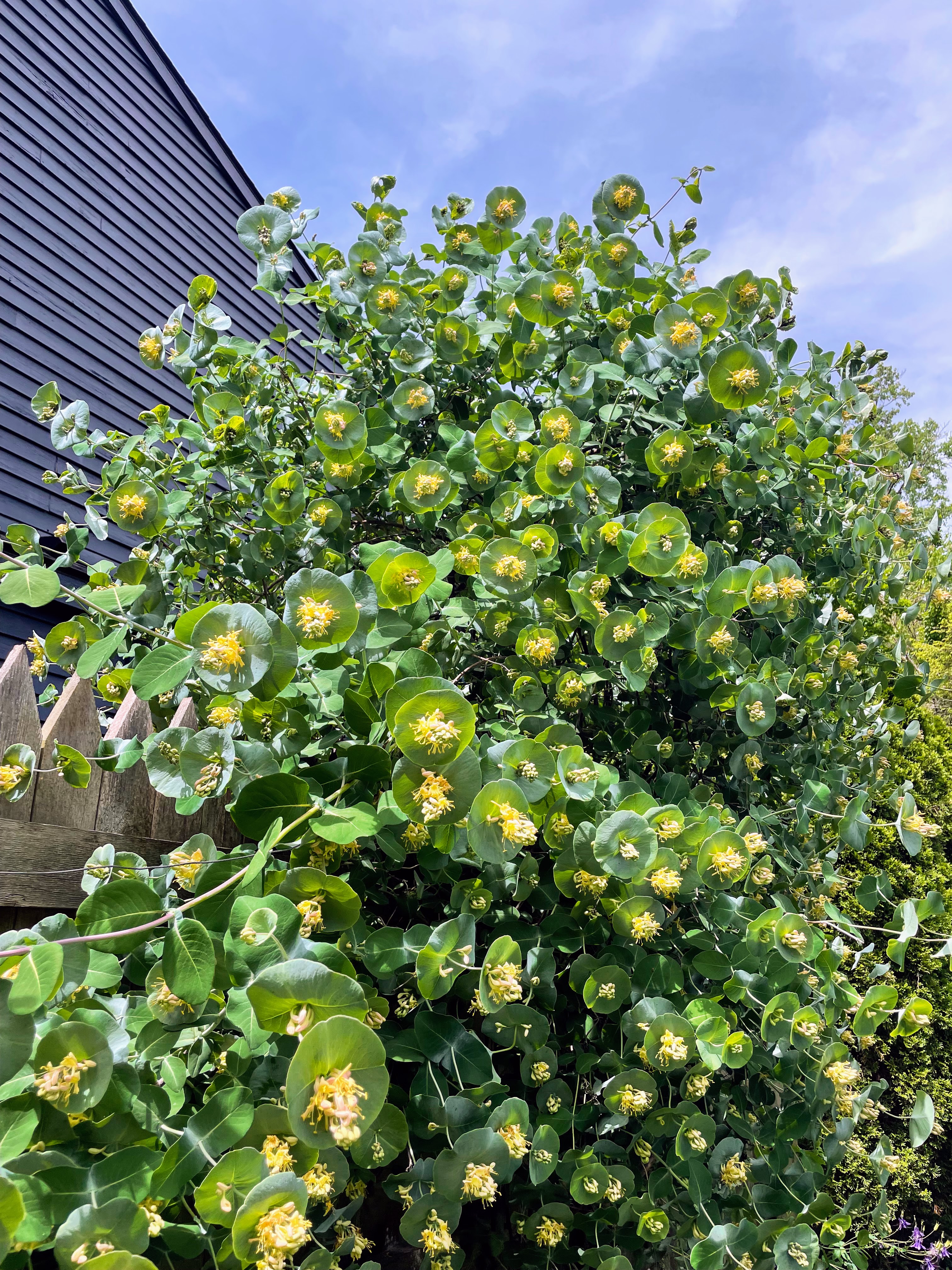
    This photo was taken at the end of May. Its tubular yellow flowers are quite pretty and though they are slightly fragrant, they don’t have that full honeysuckle aroma. What sets “Kintzley’s Ghost” apart, though, are the circular bracts surrounding those flowers. Bracts are modified leaves; in this case, the circular bracts are different from the plant’s other, more usual-looking leaves. Since bracts often help play a reproductive role, perhaps these round bracts serve as a sort of bullseye, drawing pollinators’ attention to the center of the circles, where the flowers are, and later, drawing birds’ attention to where the berries have developed. Butterflies and hummingbirds are among the “Kintzley’s Ghost” many admirers, as are humans.

    Not only are the bracts eye catching because of their shape, but also because they taken on a silvery-white cast that reminds some people of a Silver Dollar eucalyptus. Because of this coloration, the vine has been described as being “a galaxy of full moons” when it is in its silvery phase later in the season. Unfortunately I don’t have a photo of the full galaxy, just a couple moons (first photo below, taken in October). Eventually, the silvery-white green color gives way to yellow as winter approaches (second photo below).

    There is a bit of mystery to the history of this heirloom native honeysuckle, which adds to its allure. It was propagated in the 1880s by William Kintzley, who worked in the greenhouses at Iowa State University, but it was never released commercially. Instead, Mr. Kintzley gave cuttings of the vine to family members. Over time, the plant dropped out of other people’s sight and minds. It was rediscovered in 2001, when someone from a local nursery in Fort Collins, Colorado saw the masses of yellow flowers and round bracts down a side street. As the story goes, he walked up to the house to ask about this very unusual honeysuckle vine and found himself speaking with the elderly grandson of William Kintzley.

    The vine is now offered for sale, but can be hard to find. My neighbor was visiting a nursery in Wisconsin about five years ago, when she, too, was mesmerized by her first sight of a mature “Kintzley’s Ghost” vine growing up a barn at the nursery; they can get up to 12 feet high. She bought a small 8-inch clipping and brought it home; it clearly likes the mini ecosystem between our two houses, because it is now more than 8 feet tall.

    In general, this honeysuckle variety is pretty happy-go-lucky. It will grow in almost any soil as long as it is relatively moist. And it is very cold tolerant; “Kintzley’s Ghost” is hardy to Zone 4 in the United States, which means it can tolerate temperatures as low as -30°F (-34.4°C). Since it is a vine, it needs some structural support such as a trellis, fence, or wall.

    Should you be lucky enough to find one and to be able to grow it in your region, you will be forever grateful–as I am to my neighbor who shares it with me.

    ROYGBIV: Orange

    7 Apr

    Depending on who you ask, the color orange brings to mind many things: amusement, danger, encouragement, energy, enjoyment, enthusiasm, extroversion, fascination, fire, happiness, heat, sunshine, and warmth.

    It is one of my favorite colors, because it is so cheery (and because it goes so well with blue, its complementary color). I particularly like that it is associated with joy and creativity, and I love this description: “Orange oozes with delight.”

    Interestingly, people did not have a good way to describe the color at first, sometimes calling it (in English) “yellow-red” or “saffron.” It wasn’t until oranges made their way around the world from their native Southeast Himalayan foothills that the color began to be associated with the ripe fruit. The first recorded use of orange as a color name in English was in 1512.

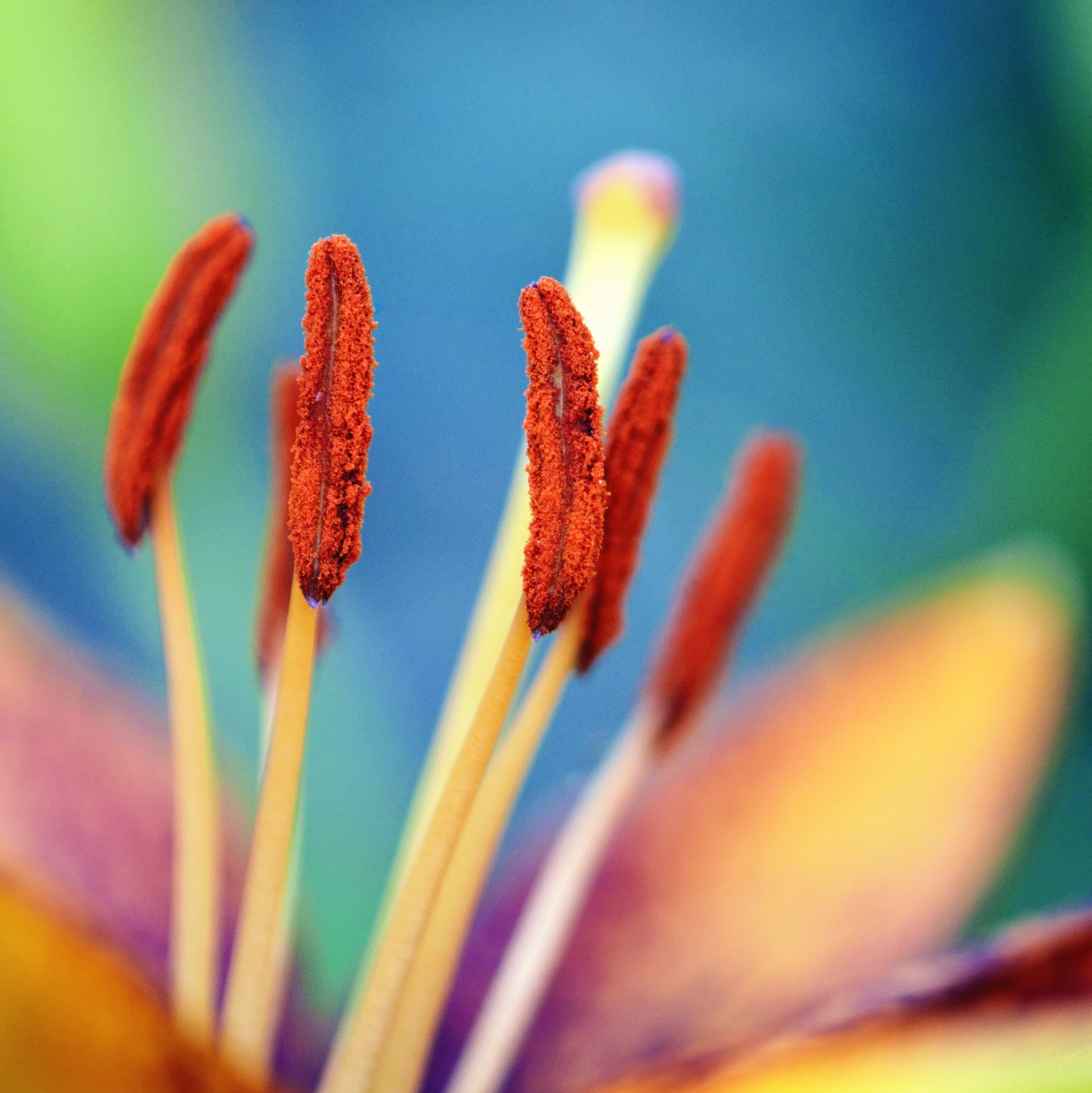
    This week’s color, orange, appears on the six stamens of an Asiatic Lily ‘Tiny Sensation.’ The stamens are the male reproductive organs of flowers, consisting of anthers coated in pollen resting atop slim filaments. The female part of the flower, the pistil, can be seen rising blurrily in the back. Though not visible in the photo, the top part (the stigma) has three lobes and is sticky, to better catch the pollen.

    Here is a better view of the pistil and its three-lobed stigma, surrounded by the six stamens. This photo is from a different lily, but luckily the pollen here is also orange, fitting in with this week’s theme.

    Pollination occurs when bees, butterflies, and other pollinators carry the pollen from the lily’s anthers to the female parts of other lilies. Successful sexual reproduction leads to seeds that ripen in pods and are dispersed when the pods start to open in the fall. Unfortunately, I do not have any good photos of lily seed pods (though will now be on the lookout this fall), but did stumble upon iris seeds one autumn, as described here.

    And of course, as lilies come from bulbs, another great way to get more lilies is via bulb division.

    A Mania for Tulips at Keukenhof

    22 Mar

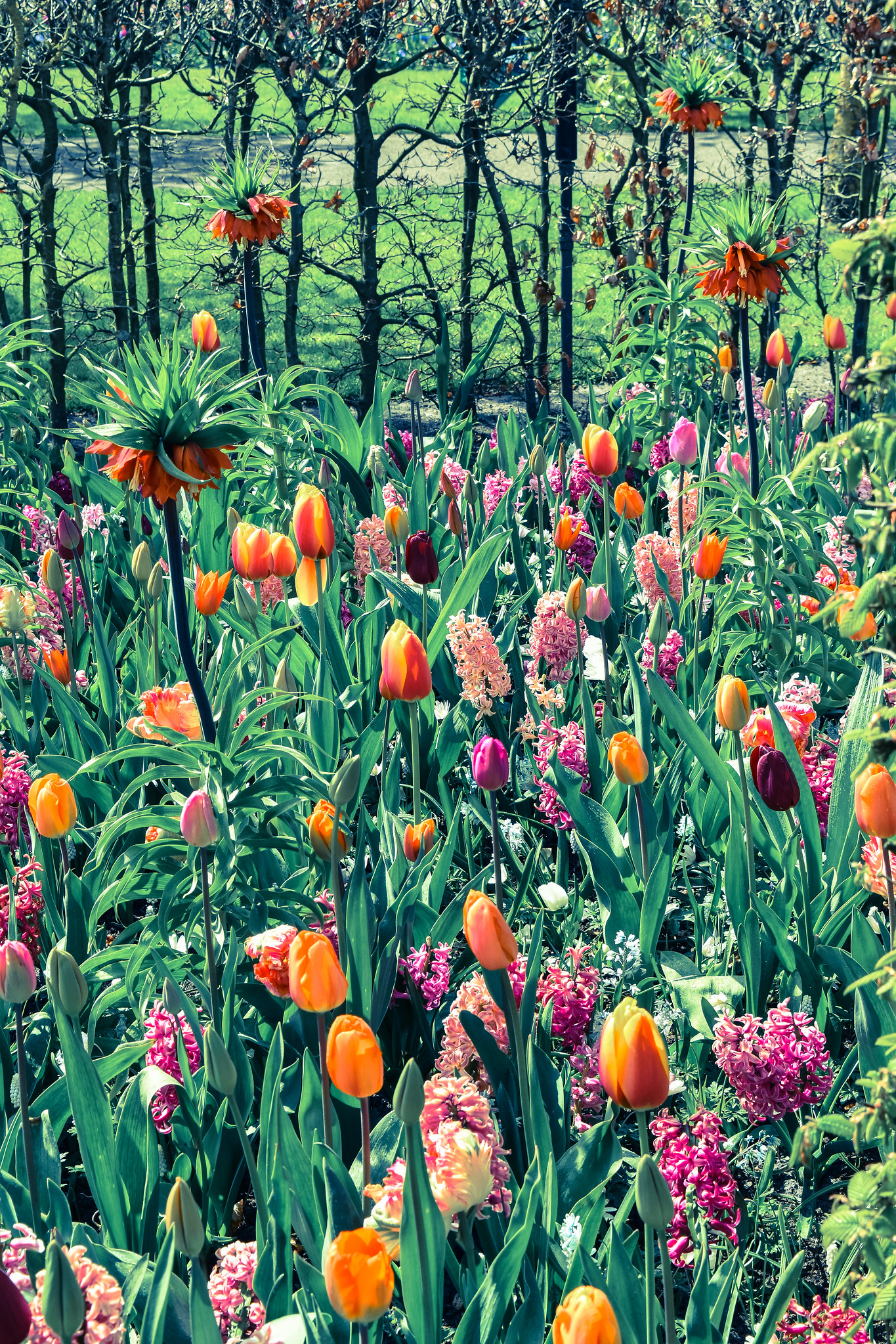
    Anyone interested in passion and heartbreak need look no further than a flower garden. And there is no better place to look than Keukenhof (in Lisse, the Netherlands), which opens tomorrow for its 2017 season. It is the largest flower garden in the world and it specializes in tulips–which, like orchids, have driven people to distraction, debt, and death.


    Keukenhof means ‘kitchen garden, but don’t let the name fool you into thinking it’s unobtrusively tucked round the back of a manor house; it covers 32 hectares (79 acres) and  is known as the Garden of Europe. This botanic wonderland features 7 million bulbs in bloom, including 800 varieties of tulips: botanical tulips; Greigii tulips; parrot tulips; single early, double early, single late, and double late tulips…. The list goes on.

      
    Mixed beds; Double Late Tulip ‘Uncle Tom’

      
    Tulip ‘Doll’s Minuet’; ‘Mysterious Parrot’ Tulip


    A view of Keukenhof

    High on that list are “broken” tulips, which originally were cultivars infected with a tulip breaking virus that  “broke” the plant’s single-color code, causing streaks, stripes, and flames of different colors to appear on the petals. Today, the same effects are achieved through breeding; only a few varieties of truly “broken” tulips still exist. But 380 years ago, the virus and those tulips caused people to lose their heads. While tip-toeing through the crowds at Keukenhof may not be for the faint-hearted, neither was the tulip trade in 17th-century Amsterdam.

      
    Tulips are believed to have originated in current-day Iran; in fact, some scholars suggest the name “tulip” comes from the Persian word for “turban.” The flowers were highly prized by the Ottomans, and it is from ambassadors and visitors to the Ottoman courts that the flowers likely made their way to Northern Europe, and to the Netherlands. Carolus Clusius, a Flemish botanist and professor at the University of Leiden, planted the Netherlands’ first tulip bulbs in the university’s botanical garden in 1593.

    Clusius’ tulips received a great deal of attention. Tulips were already considered an exotic flower in the Netherlands, and the virus only made them more so. As a result, there were regular raids on Clusius’ gardens and the market for tulips began to heat up, leading to the infamous Tulip Mania of 1634-37. At its height, a single, prized tulip bulb was worth exponentially more than the average person’s annual income, and more than a luxurious canal-side house. The tulip had become the ultimate status symbol. Some people put mirrors in their gardens to suggest there were more tulips than they actually had. Those who could not afford the bulbs bought furniture, art, and tableware decorated with tulips instead. And then the world’s first—but not last–speculative bubble burst, leaving a trail of shattered dreams and destitution in its wake. (This animated  Ted Ed video puts it in perspective.)


    If you want to see the flowers that inspired these events, Keukenhof’s 2017  season runs from March 23 to May 21. As you wander the grounds, you will see that modern-day tulips still have the power to inspire; it is not unusual to see visitors climbing into the flower beds to pose for photos while lying among the blooms. But spare a moment for the many other flowers you are likely to see, too, because they are also worth the attention:


    River of Muscari (Grape Hyacinth) ‘Blue Magic’ 


    Fritillaria ‘Early Magic’


    Anthurium bouquet

      
    Lilium ‘Blushing Joy,’ Medinilla magnifica

    Golden Lotus Banana

    8 Apr

    On a recent visit to Rome’s Botanical Garden, I walked past an elbow-high plant with a stunning yellow orb unfurling on top of a sturdy stem, and did a double take.


    The foliage looked like that of a banana plant, but I had never seen a banana plant with such a glorious eminence perched atop layers of golden yellow “petals” before. It didn’t like look at all like the growing tip of a regular banana plant, or even like the part most people think of as the flower:

      
    Upon closer inspection, however, it did have a familiar feature–the tiny flowers characteristic of banana plants. That’s because the Ensete lasiocarpa (also known as Musa/Musella lasiocarpa* and commonly known as Golden Lotus Banana, Chinese Dwarf Banana) is closely related to the edible banana we know, though it does not produce edible fruit. It is an ornamental banana native to the Yunnan province in China. As mentioned in a previous post, what looks like a flower is actually an inflorescence consisting of layers of bracts (the golden yellow petal-like parts), with rows of the actual, very small  flowers nestled in between. You can see the small, elongated banana flowers in photos 1, 3, and 4.

    The ornamental banana is known as a Golden Lotus Banana because its unfurled, ethereal brachts are said to resemble the petals of a lotus flower, which is known as a Sacred Lotus. I think the closed inflorescence of the Ensete lasiocarpa  and the closed bud of a lotus flower also look alike. And it may be no coincidence that the Golden Lotus Banana was a sacred plant of Buddhist monks.


    * There have been some disagreements as to nomenclature.