Tag Archives: pancetta

Recipe: Minestrone

8 Oct

I remember a teacher in elementary school bringing our class a batch of “Everything But the Kitchen Sink” cookies, which I’d never had before. I didn’t quite understand the name, so the teacher explained that it meant she had put all sorts of things into the cookies, almost everything in her kitchen but the kitchen sink. That day, I tasted a new cookie and learned a new phrase.

For me, Minestrone is an “Everything but the Kitchen Sink” soup. When the leaves start turning colors in the fall — ie, when soup weather is upon us — and I have vegetables to use up, I immediately think “Minestrone.” In Italian, minestra means “soup;” minestrone means “big soup.” And it really is a big soup, full of so many good things.

Of those good things, there is one without which this cannot be Minestrone, in my view: the cheese rinds. We usually have a wedge of Pecorino Romano cheese in the fridge, and as we get to the last of each wedge, I save the rinds. Without some rind, the soup will not taste like Minestrone; the slow-simmered cheese is a huge part of what makes the broth so delicious.

Aside from the rinds and the soffritto ingredients (onion, carrot, celery; see below), I like to add canned tomatoes, zucchini, white beans, and cabbage or spinach or both (or any other leafy green). Plus pancetta when I have it, potatoes if I need to use some up, and small pasta if there is room.

Today this is what I had at hand:

Fridge:

  • two onion halves (one red, one white)
  • four stalks of celery
  • some leftover grated carrots (about 1.5 c.)
  • zucchini (I had 2, but ended up using only 1 big one)
  • some shredded cabbage, ie ‘cole slaw’ mix (about 4.5 oz/127 gr)
  • baby spinach (about 3-4 handfuls)
  • Some Pecorino Romano and Parmesan ‘heels’ (see photo)

Freezer:

  • Cubed pancetta (4 o oz/113 gr)

Pantry:

  • Yukon Gold potatoes (I had 3, but ended up using only 2)
  • Whole peeled tomatoes
  • Cannellini beans (2 cans, 15.5 oz/440 gr each, undrained)
  • Garlic (3 large cloves)
  • Bay leaves
  • Vegetable bouillon cubes
  • Salt and pepper

Perfect–I had everything I needed for Minestrone! I also had mini pasta sea shells, which I’ve used in Minestrone before, but I did not use them this time; by the time I got to the point where I would have added them, there was no more room in the pot! Plus, dry pasta keeps and I had to use up the potatoes. (If you have pasta but no potatoes or just prefer the pasta, add a handful of that instead.)

For me, Minestrone is a soup I make in ‘layers,’ meaning I start with the first ingredients and while they are cooking, I prep the others, adding them to the pot as I go. Today, I started by cooking the pancetta in olive oil in a large Dutch Oven until it got crispy. (If you are vegetarian, omit the pancetta).

While the pancetta was cooking, I diced the onions and celery, then added them–and the already-grated carrots and a couple bay leaves–to the pot along with a splash more olive oil. This mixture of onions, celery, and carrots is what the Italians call soffritto and the French call mirepoix, and it is the foundation of many great soups. When the veggies got soft, I crushed the garlic cloves straight into the pot, added some freshly ground black pepper, and cooked everything for a couple more minutes. This is what I consider to be Layer 1, made up of a few subparts. [I forgot to take a photo of this, however.]

To start building Layer 2, I added some hand-crushed tomatoes and their juices to the soup pot. If I’d had a can of diced tomatoes, I would have used that instead–but necessity is the mother of hand crushing. With a very clean hand, I gently took a whole peeled tomato from the can, and crushed it into the soup pot, repeating until I had crushed all the tomatoes. [Note: If you will also crush the tomatoes by hand, lower your hand as far as possible into the pot, and crush each tomato very slowly. Otherwise, the likelihood of having crushed tomato all over your back stove wall, and yourself, is extremely high–as I’ve learned from experience.]

Successfully hand-crushed tomatoes; all in the pot, none on me

Then I added the cheese rinds (trimmed of the outer, colored parts) and 4 cups of water and let everything simmer while I diced the potatoes. When the potatoes were ready, I added them, the canned cannellini beans with all their liquid, and a vegetable bouillon cube to the pot, along with more freshly ground pepper. This is Layer 2. I let this simmer, partially covered, for about 10 minutes while I prepped the zucchini for Layer 3.

Nestling cheese rinds into the soup

In Layer 3, I added the diced zucchini and the already-shredded cabbage, and continued to simmer the soup until the zucchini and potatoes were both soft. I also checked the seasonings and decided to add another bouillon cube and a little salt. At that point, my Minestrone was essentially done and ready to serve, so I did the very last thing: I put the handfuls of spinach on top and stirred until the spinach was wilted in.

Then I set the soup pot out for everyone to serve themselves (with everyone getting at least one piece of the now-soft cheese rinds–an absolute treat), along with some freshly grated Pecorino Romano to sprinkle on top. Mmmm. So good on a fall day.

Recipe: Pasta Carbonara for Two

7 Mar
DSC_0047

In Rome, there are four classic pasta dishes: Amatriciana, Carbonara, Cacio e Pepe, and Gricia. The two base ingredients that are constant across all four sauces are Pecorino cheese and black pepper. Cacio e Pepe, which means cheese and pepper, is a perfect example of the magic that occurs when the two base ingredients are combined with pasta cooking water. Gricia omits the water and adds guanciale (pork cheek/jowl). The purest version of Amatriciana (from the town of Amatrice itself) also omits water, but adds tomatoes to the guanciale. (Note: the black pepper can be a very controversial ingredient in an Amatriciana sauce, depending on who you ask. I include it, as I was taught.) Carbonara is Gricia with eggs; it never, ever includes cream. Essentially, a small handful of ingredients trade places across the four classic Roman pasta sauces.

This Carbonara recipe came about when we were living in Rome as true empty nesters. It took me a few years to adjust from cooking for 6 to cooking for 2 (even though our children left home in phases), but I finally did it. This is a recipe my husband and I enjoyed often, one that can be easily doubled (or tripled) when guests arrive. The photos below show guanciale (pork cheek/jowl), which typically has a peppery outer coating. If you cannot find guanciale, look for pancetta (pork belly). If you cannot find pancetta, use bacon. Pancetta and bacon may not be authentic, but you should use what is available and make something that tastes good to you. The beauty of recipes such as this one is their ability to be translated in a way that still preserves their essence. I will never speak Italian like an Italian, but what I do speak is still recognizably Italian and I hope it demonstrates my love for (if not my complete mastery of) the language.

Note: This recipe uses raw egg yolks. They are cooked by being tossed with the hot pasta, but if this may be a problem for you, try Pasta in Cream Sauce as an alternative.

Pasta Carbonara for Two

Ingredients

  • 100 gr. (about 1/4 lb.) guanciale, cubed or diced
  • 1 tbsp. olive oil
  • 3 large egg yolks
  • 225 gr. rigatoni (1/2 lb)
  • freshly ground black pepper
  • 30 gr. (about 1/4 heaping cup) finely grated Pecorino Romano cheese, plus more for garnish

Preparation

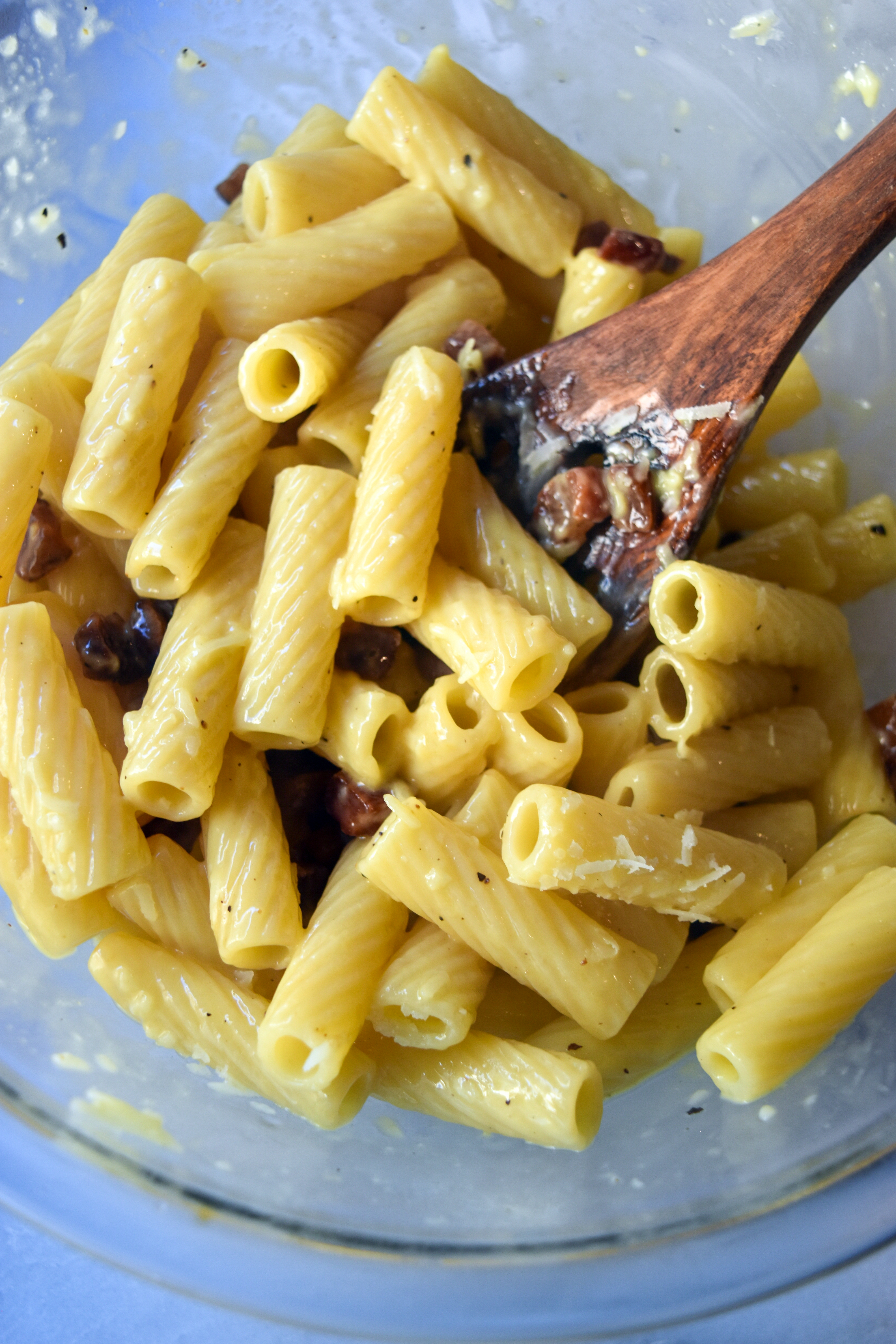
Cook guanciale in olive oil in a heavy skillet over medium-high heat, stirring frequently until crispy. Remove the guanciale to a plate. Put 1-2 tbsp. of the guanciale drippings in a large bowl; let cool. Add egg yolks, grind a healthy amount of pepper over the yolks, then mix with a fork to emulsify.

DSC_0035

Meanwhile, cook the pasta in a large pot of boiling, salted water, stirring occasionally until al dente (according to package directions). Before draining, reserve ½ cup of the pasta cooking liquid— and place a tbsp. measuring spoon into the reserved pasta water.

When the pasta is ready, drain it and immediately add it and 1 tbsp. of the reserved pasta water to the egg mixture; tossing vigorously to coat and to make sure the egg yolks don’t scramble. Add the Pecorino in batches, stirring and tossing until the cheese is mostly melted and the sauce thickens. (Add more pasta water or pepper if desired.) Just before serving, mix in the crispy guanciale.

Divide among bowls. Serve with more grated Pecorino Romano.

DSC_0040

Recipe: Pasta in Cream Sauce with Pancetta and Pecorino Romano

18 Jun

With three children away from home, and the fourth frequently out and about, my husband and I are adapting to eating dinner by ourselves. It is a necessary exercise; in one more year, we will be empty nesters. We have made some adjustments, but not all recipes for six translate easily into a meal for two, so I am beginning to rethink my approach to dinner. Luckily, this recipe is very adaptable and can easily be scaled down (or back up).

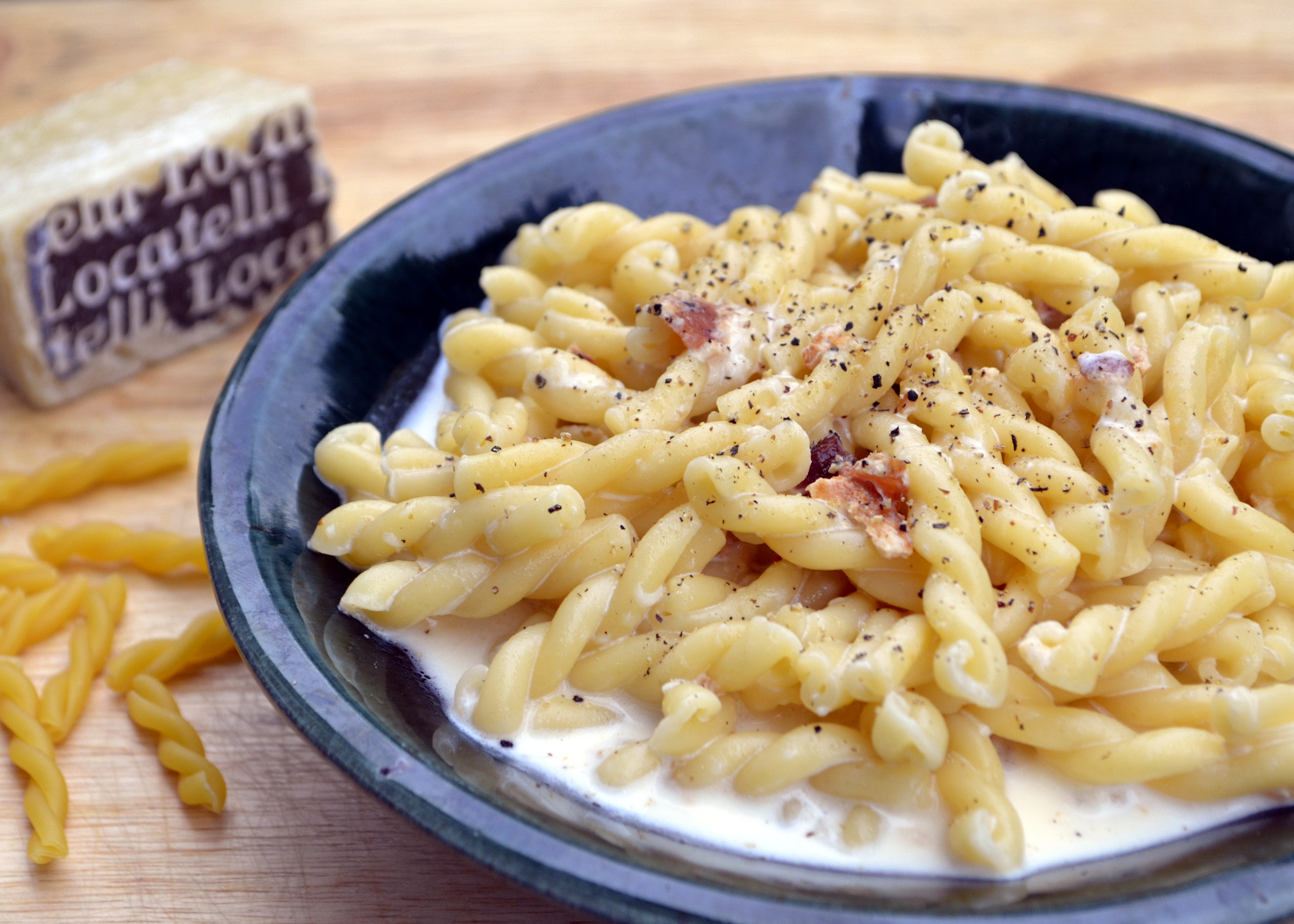
It’s also quick, which makes it perfect for a busy week night. But more importantly, it will satisfy proponents of the two different schools of thought on pasta cream sauces. When this dish is first put on the table, the cream sauce will be fairly thin (as in the photo). In our family, there are staunch supporters of a thinner cream sauce; they say a more liquid consistency allows for maximum “soppage” with a nice piece of crusty bread. Other family members prefer a thicker sauce, which coats the pasta very nicely. Luckily, it’s possible to have it both ways: thinner-sauce aficionados can dig right in; thicker-sauce advocates can nibble on salad or bread and let the sauce cool a bit. Regardless of their sauce philosophies, family members agree on one thing: this is good to the last bite, thick or thin.

Note: Feel free to substitute Parmesan cheese for the Pecorino Romano, and bacon for the pancetta (I used bacon this time, after discovering at the last moment that the pancetta I thought I had in the freezer was a figment of my imagination).

Pasta in Cream Sauce with Pancetta and Pecorino Romano
Serves 2-3

1/2 lb. (227 gr.) pasta; I used gemelli
2 oz. (57 gr.) cubed pancetta [in the U.S., Trader Joe’s sells a 4-oz. package*], or 4 slices bacon, chopped
1/2 tbsp. olive oil
1 small clove garlic, sliced
1 c. (237 ml.) half and half, which is half light cream and half milk (or you can use all light cream or heavy cream–the heavier the cream, the thicker the sauce)
small pinch salt
freshly ground pepper
1/2 c. (about 60 gr.) grated Pecorino Romano or Parmesan cheese

Preparation

1. Bring an ample amount of water to boil in a medium pot and cook the pasta just until it is al dente.
2. While the water is coming to a boil, heat the olive oil over medium heat in a medium saucepan and cook the pancetta/bacon until crisp; remove the pancetta/bacon, place on a paper towel to drain, and set aside. Leave about 1/2 tbsp. of oil/drippings in the saucepan; discard the rest. Add the sliced garlic to the pan and cook just until golden (you do not want the garlic to burn). Remove the garlic and discard. Turn heat to low and add the half and half (or cream). Grind black pepper over the surface of the sauce. Add a small pinch of salt (be conservative at this stage because you’ll be adding salty bacon and cheese to the dish; you can adjust the seasonings afterward). Keep the sauce warm without letting it boil.
3. When the pasta is done, drain it well, return it to the pot, and immediately toss with the cheese. Add the reserved pancetta/bacon, mix well, and then pour the cream sauce over. Stir well and adjust the seasonings (I usually add more pepper at this stage). The sauce will appear thin at first, but will thicken as it cools.
4. Serve with salad and crusty bread.

*I stock up on packages of cubed pancetta and freeze them. Then, I add the frozen, cubed pancetta directly to the hot oil. It cooks (and crisps up) beautifully, and is oh-so convenient.