Tag Archives: leaves

Sunflower Power

10 Mar

Lately, we have been lulled into thinking spring is around the corner, with a warm day or two and lots of sun — only to be brought back to our cold, overcast, wet or sometimes snowy reality. This state of affairs got me thinking about (ie, longing for) flowers, and sunflowers in particular. If you grow sunflowers, you may know all there is to know about them. I did not, though I did learn very early on that our intrepid squirrels could scale our giant sunflowers under cover of darkness and chew off the beautiful heads, leaving decapitated 9-foot stalks in their scheming rodent wake.

I did know a few other things, such as the origins of the scientific name for the common sunflower: Helianthus annuus. Helianthus comes from the Greek “helios,” meaning sun, and “anthos,” meaning flower. Sunflowers are also heliotropic, ie, young sunflowers follow the sun’s position from sunrise to sunset. They do this until they reach maturity, at which point they stay facing East, which allows the sunflowers to get warmer more quickly (and thus, to attract more pollinators).

Another thing I knew was that each sunflower head is made of hundreds and maybe thousands of smaller flowers, which means it is an inflorescence (same as alliums). The bright yellow (or sometimes, red or rusty orange) petals surrounding the sunflower head are called ray florets. The real, tiny flowers are in the central part of the flower head and are called disc florets. In the photos below, you can see the dark brown anthers of the disc florets topped with pollen; each of these flowers will produce a sunflower seed.
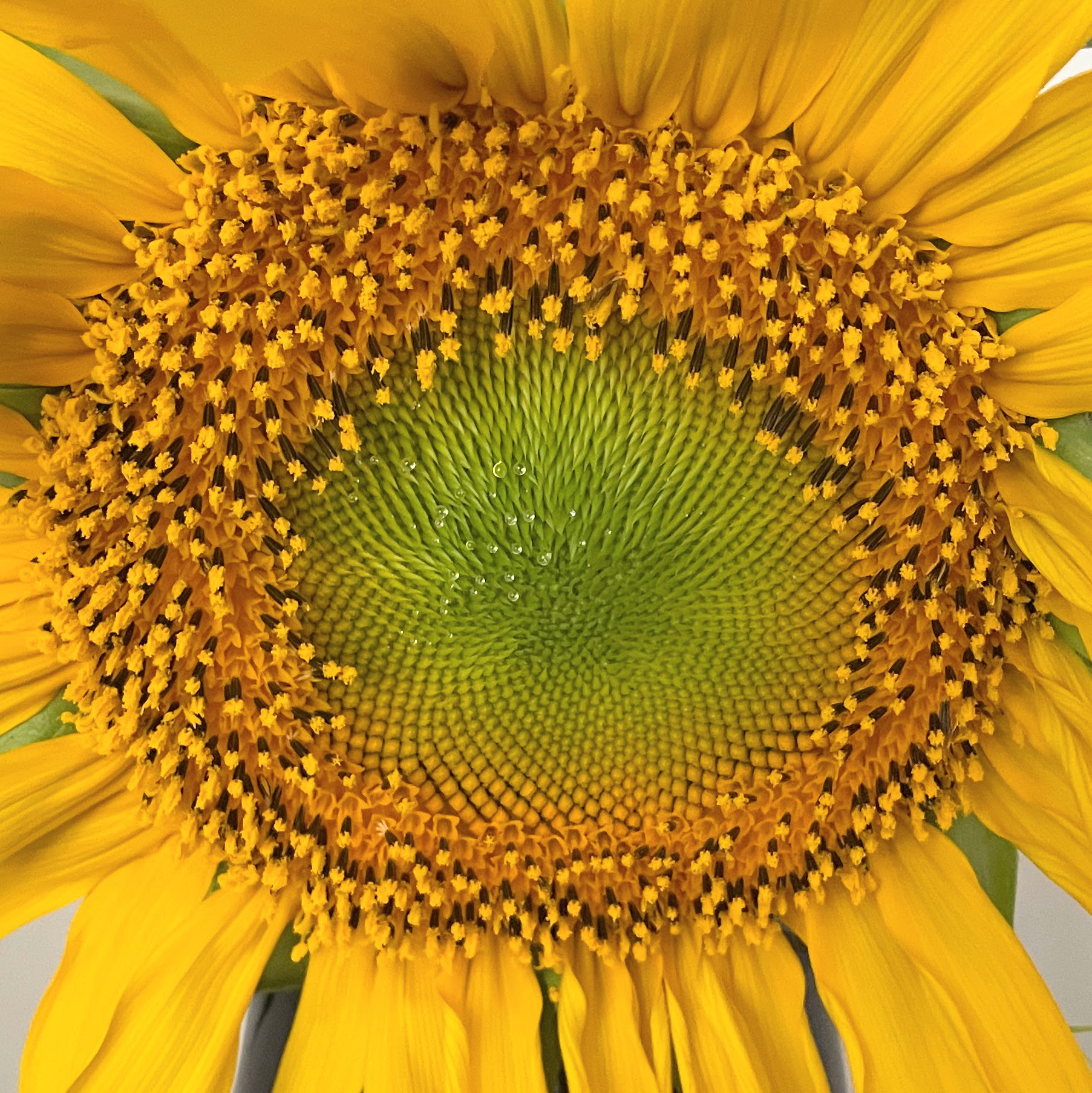
Finally, one last thing I knew, but did not really think about until now is that the sunflower’s disc florets are arranged in a spiral pattern that follows the Fibonacci sequence, a mathematical sequence in which each number is the sum of the two preceding ones. If you count the spirals in a sunflower head (which can be done in different ways), you will usually end up with a Fibonacci number (0, 1, 1, 2, 3, 5, 8, 13, 21, 34, 55, …). Why? Because the pattern makes efficient use of available space for seed formation. The growing seeds press on each other, creating geometric patterns. The Fibonacci sequence is found everywhere in nature (such as in pineapples, pinecones, broccolo romanesco, sea shells, tree branches, storms, galaxies, and even the distribution of seeds in a raspberry, to name just a few occurrences).

This is where my knowledge of sunflowers ended. Then, I discovered a couple more reasons to admire them:

    1. Every part of a sunflower — not just the seeds — can be eaten:

    • Sunflower sprouts can be used in the same way as alfalfa or bean sprouts, in a stir fry or a spring salad or Thai salad.
    • Jerusalem artichokes (aka sunroots, sunchokes) are a type of sunflower whose roots are edible; prepare them as you would other root vegetables: roast, sauté, fry, mash, or puree them — or shred or slice them raw.
    • Sunflower stalks can be eaten like celery when small and slender. You can also make flour from the stalks. (OR… dry the stalks and use them to support other plants in the garden the following year.)
    • Younger, smaller sunflower leaves can be eaten in salads, and older, bigger leaves can be boiled and sauteed like collards or other leafy greens; removing the central rib may make them a little less bitter. Some people also prepare tea from dried sunflower leaves and/or petals.
    • The flowers (ie, ray florets) are edible; try them in a salad.
    • The opened (giant) sunflower heads (not fully mature, with seeds that are still white) can be grilled, if you are feeling particularly adventurous.
    • The unopened sunflower heads can be prepared in a way similar to artichokes.

    2. Sunflowers can absorb some serious toxins. Because of this ability, they are called hyperaccumulators. When a reactor exploded at the Chernobyl Nuclear Power Plant in Ukraine in 1986, it released radioactive elements into the environment; thousands of sunflowers were planted to help remove these elements from the soil and ponds near the disaster site. Using plants to cleanse the environment is called phytoremediation. Today, sunflowers are the international symbol for nuclear disarmament (and as the national flower of Ukraine, they are also symbols of solidarity, resilience, and hope).

    Unraveling the Mystery (and History) of the Crocodile Fern

    14 Jan

    I like ferns. Whenever I am at a botanic garden, I take a close look at them. I love the elegance of the leaves (fronds), the way the fronds unfurl, and the polka-dot patterns of the sori (spore cases) on the underside of the fronds.

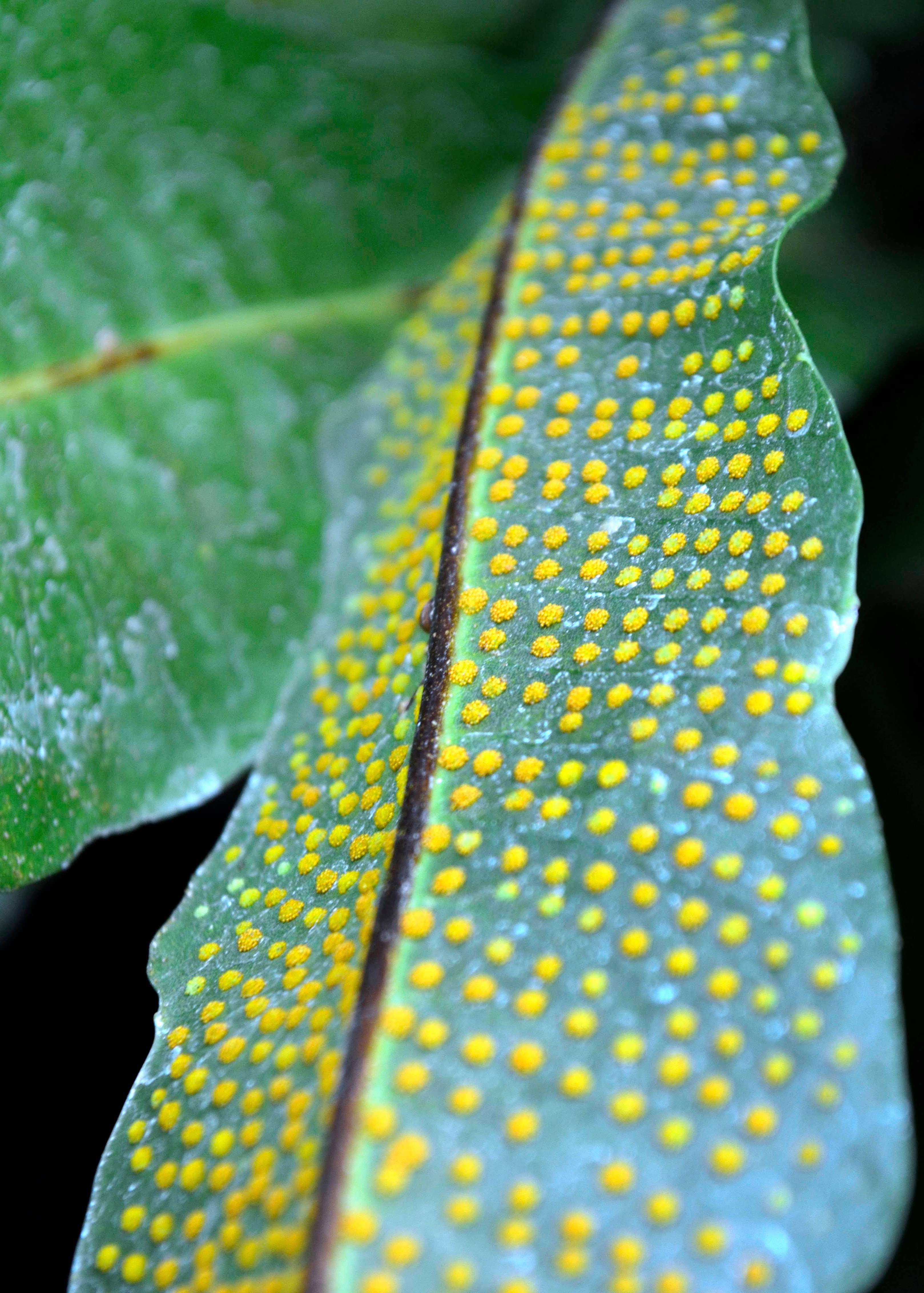
    During the recent winter holidays, we went to the Garfield Park Conservatory in Chicago — a magical place any time of the year, but a fantastic one to visit during the colder months. My attention was caught by a fern I had never seen before, with an intriguing leaf pattern:

    This fern is called a Microsorum musifolium (or Polypodium musifolium). ‘Microsorum’ means ‘small sori’ and ‘musifolium’ means ‘banana-like leaves,’ because of the fern’s long, strap-like leaves. ‘Polypodium’ means ‘many-feet’ and refers to the growth pattern of the fern’s underground, horizontal stems (see the lithograph at the bottom of this post).

    In recent years, this plant has also become known as a Crocodile Fern because some people think the texture and pattern of the fronds looks reptilian. (And because some clever house-plant marketers decided “Crocodile Fern’ would sell better than, say, ‘Banana-Leaf Fern’ — or worse, ‘Wart Fern,’ as it is sometimes also called.) Because of this new-ish twist on the plant’s name, it is now common to see the fern [mis]labelled as Microsorum musifolium ‘Crocodylus,’ the latter part of which signals an animal genus, not a botanical one.

    I don’t have any crocodile photos, but I do have some close-ups of an alligator’s back. And while I can see that the fern does look reptilian in a way, it may be a stretch to say it looks like the patterns on the back of a crocodile (or alligator):

    Common names aside, the fern is native to Southeast Asia and the Pacific Islands, and is an epiphyte; it grows on trees for support but it does not take any nutrients from them. Instead, it forms a half-basket against the tree trunk that catches falling leaves and debris, which give the plant moisture as well as nutrients as the leaves and debris decompose. As a houseplant (ie, when it is not tucked against a tree trunk), the fern will form a full, circular basket. Plants that do this — including Bromeliads — are called ‘trash-basket plants,’ which is not the nicest name for a great adaptation. Luckily, many ferns in this category are called Bird’s Nest ferns, which sounds much better.

    Microsorum musifolium was first described by the German-Dutch botanist Carl Ludwig Blume in his famous 19th-century work, Flora Javae (Plants of Java), written after he had served as a director at the botanic garden in Bogor (then known as Buitenzorg), Java. There is some confusion over when, precisely, Flora Javae was published, as different sections were added between 1828-1858.

    I saw a hand-colored lithograph of ‘Polypodium Musaefolium’ attributed to Blume’s 1829 edition of the book for sale online, and wanted to confirm that it was, in fact, from that book (not that I wanted to buy it; I just wanted to know when the fern was first mentioned). I looked at the list of sections added to Flora Javae over the years, which notes all the ones added in 1829, but there were no sections called Polypodium or Polypodiopsida. I wondered if ferns were called something else back in the day. Sure enough, ferns were traditionally classified as Filices — and that was the title of one of the 1829 sections. So I knew Blume had devoted a sizeable section of Flora Javae to ferns, and I hoped Microsorum musifolium was among them.

    Motivated by this discovery, I kept looking and — amazingly — found a full-text 1858 version of Flora Javae, thanks to the Biodiversity Heritage Library; it is from an edition held by the Peter H. Raven Library at the Missouri Botanical Garden. The 1858 version includes all the sections added previously, including the one on ferns. I searched the text for ‘Microsorum musifolium,’ but no luck. Then I remembered Blume’s lithograph was labeled ‘Polypodium.’ That worked; there are a LOT of Polypodium entries in Flora Javae. But the search did not turn up any entries for Polypodium musifolium or musaefolium (at the time, I did not realize that this result – POLYPODIUM MUSffiF0LIU3L — was the one I was looking for). So I tried to scroll through all the entries manually to find it . No luck, again. Until I came across another clue: the lithograph was described online as being Tab. LXXIX, and using that as a guide, I finally found the entry for ‘Polypodium Musaefolium’ on pp. 171-72 of Flora Javae:

    And there you have it. Should you be lucky enough to see this unusually patterned fern in a botanic garden, or grow it as a houseplant, you will be able to say it was first immortalized in print almost 200 years ago! And that it kind of, sort of — from a certain angle and at a certain distance — could resemble a crocodile’s back.

    Recipe: Fried Zucchini Flowers and Sage Leaves

    24 Jun

    Fritti LR
    Zucchini flowers taste as good as they look, if not better. Stuffed with fresh mozzarella, a hint of anchovy (or not),  lightly battered and fried until crisp and golden, they are summer on a plate. Fresh sage leaves–encased in the same warm, crispy shell–will turn your thoughts to autumn. But the good news is, you can have them now. Two appetizers straight from the garden.


    Fried Zucchini Flowers and Sage Leaves
    4-6 servings

    1 c. (250 ml.) water–regular or sparkling
    1 c.  flour, spooned lightly into the measuring cup (about 133 gr.)
    salt and pepper
    12-14 zucchini flowers*
    9 0z. (250 gr.) fresh mozzarella
    2-3 anchovy fillets (salt-cured, packed in olive oil)–optional
    canola or sunflower oil–enough to fill a medium sauce pan to about 2.5 inches (6 cm)
    handful of fresh, firm sage leaves

    *Use male zucchini flowers. They appear at the end of long stems, unlike female flowers, which appear at the end of the emerging zucchini.

    Preparation

    1. Prepare the batter: Put the water in a medium bowl and sift the flour over it, whisking to incorporate. Add a pinch of salt and some freshly ground pepper. The batter should be thick enough to coat the flowers, but not pasty. See the right consistency for a light batter below. Set aside the batter while prepping the flowers.

    Fritti LR-9

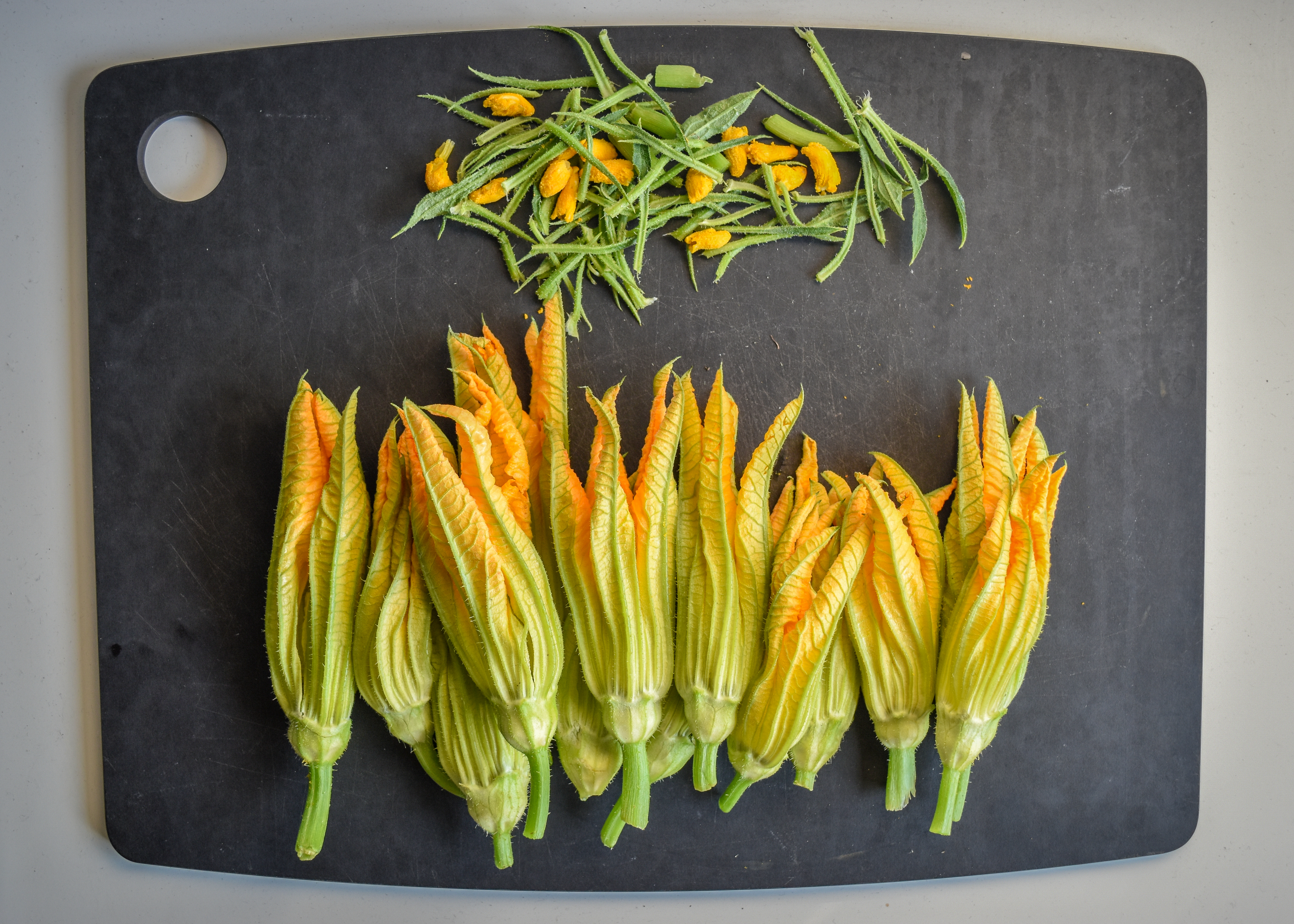
    2. Lay out all the zucchini flowers, wipe them clean, and discard any that appear bruised or past their prime (they are quite perishable). Trim the stems to about 1 inch (2.5 cm), leaving enough stem to grasp and dip. Pull off the sepals (the spiky green parts at the base of the flower). Gently work your thumb and index finger into the flower and pinch off the pollen-topped stamen. You will probably tear the flower slightly; that’s ok, but try not to tear it too much, or shred it. See the prepped flowers and discarded sepals and stamens below:

    Fritti LR-4

    3. Mozzarella and Anchovies: Cut the mozzarella into as many 2.5-inch ( 6 cm) long rectangular pieces as you have flowers–or whatever size best fits into the flowers you have. You can omit the anchovies, you can go all in and lay a nice piece of anchovy fillet on top of each piece of mozzarella before placing both in the flower, or you can take a moderate approach. That entails placing the anchovy fillets in a bowl, drizzling them with some extra olive oil, mashing them with a fork, then placing the mozzarella pieces in the anchovy oil so they get a hint of the flavor rather than a wallop. Either way, you want to place the mozzarella pieces (with or without anchovy) into the flowers, covering them up as best as you can and twisting the ends of the flowers closed to create a mini pouch.

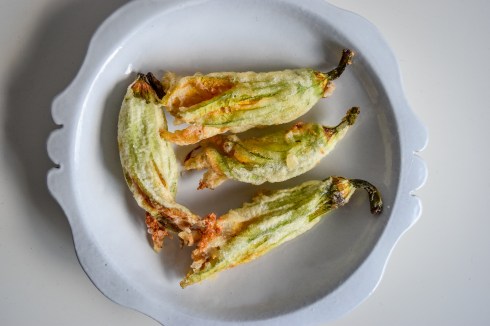
    4. Bring the oil to high heat in a medium saucepan. Holding the stem end of a sealed zucchini flower, dip it into the batter in a twirling motion to keep it closed (sealing any open parts with your fingers and twisting the bottoms closed again if needed). When the flower is completely covered in batter, carefully lower it into the oil. Repeat for as many flowers as will fit into the saucepan in one layer without crowding; you will need to cook the flowers in batches. When one side is golden, turn the flower over (or push the flowers gently under the surface of the oil as they cook, to ensure both sides become golden).

    Fritti LR-5

    5. Drain the fried flowers on paper towels, sprinkle with a bit of salt, and eat as soon as possible!

    Fritti LR-6

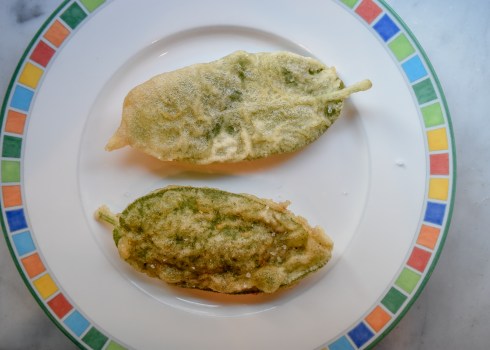
    6. Now for the much-easier sage leaves: Wipe them clean, dip each one into the batter, and fry until golden. Drain on paper towels, sprinkle with a bit of salt, and…

    Fritti LR-7

    7. … enjoy!

    Fritti LR-8

    Collegiality, Competition, and Lotuses

    29 Jun

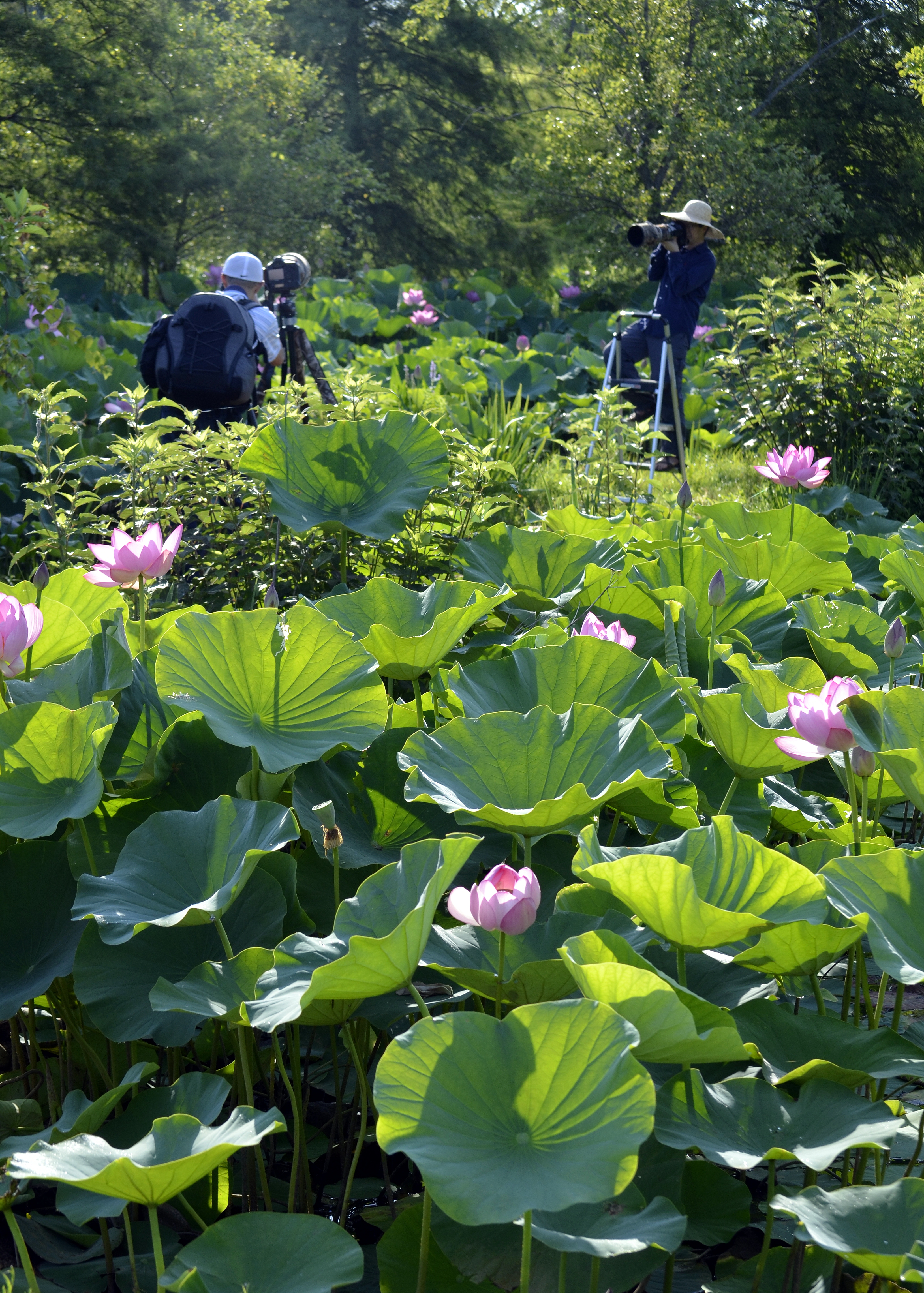
    Early this morning, my mother and I stumbled upon an other-worldly scene: thousands of lotus flowers in bloom at Kenilworth Aquatic Gardens in Washington, DC. We arrived at 7:30 am to see the lotus flowers while they are open. The lotuses were indeed gorgeous, but the most striking aspect of our visit was seeing all the photographers who had arrived before us to stake their claims. The ones I spoke with were amateurs–but they were serious amateurs, with lenses almost as big as my leg, tripods, reflectors, step ladders, rolling equipment cases, and assistants. Some came from as far as New York. I had no idea Kenilworth’s lotus blooms attracted this much attention. I showed up with my camera, a small case containing three lenses (the largest of which is smaller than my hand), and my mother. No tripod, no reflector, no ladder. I looked glaringly out of place, unencumbered by the accoutrements of the trade, with not even a flak jacket to my name.

    Photographers
    For the most part, there was a great spirit of collegiality–sharing of tips, patient waiting for good spots, etc. But everyone was there to get a good shot, and as the sun bore down and the light became trickier, some competitiveness emerged. One photographer and her friend/assistant had spent some time setting up tripod and camera, and were focusing on a particularly lovely lotus flower. Another photographer stopped close by, but not in the first photographer’s line of vision, to see if he could get a differently angled shot of the same flower. He asked if that was okay. Female photographer: “I can’t tell you where you can or can’t stand, but there are lots of other flowers here.”  Male photographer got the hint and moved on. I’d like to think that was the exception, rather than the rule.

    I was using a macro lens to capture a dragonfly on a lotus bud when another photographer came by, took a second look to see what I was shooting so close up, and got very excited when he saw the dragonfly. I stepped aside to give him a  turn. The good thing about dragonflies is that once they find a spot they like, they often spend some time there, so I knew I would probably get another chance. Plus, the gentleman I ceded the spot to had a huge lens and I knew he would be able to get a really, really nice close-up shot. If I got any closer with my little macro lens, I’d fall into the pond.

    Later, I was admiring some lotuses, but ruing the fact they were in direct sunlight–and hence, beyond my ability to shoot them properly–when the same gentleman stopped by again, and had his friend hold up a huge reflector that allowed both of us to take the shot (third photo below). In the end, I like to think that though we are all photographers of varying abilities, we are kindred spirits nonetheless–out there to capture fleeting moments of beauty. Below are lotus buds and blooms, with close-ups of a lotus receptacle, and of water pooling on a lotus leaf.


    Weekly Photo Challenge: Unexpected

    27 Nov

    This photo is of something I was not expecting. During my recent trip to Rwanda, this gorgeous leaf formation caught my eye. I had never seen anything quite like it. It was a striking burst of color on an otherwise fairly bare branch. When I asked someone what it was, I was surprised to discover that it was a poinsettia, and that poinsettias can grow into small trees up to about 10 feet in height. I had no idea, because to my untrained eye this looks nothing like the potted poinsettias that abound at Christmastime (except perhaps for the red leaves). I’ll take the tree!

    So an unexpected encounter led to an unexpected discovery — and I couldn’t be more delighted. The red leaves are called brachts; the actual poinsettia flowers are tiny and yellow.

    Fall Colors

    24 Oct

    It’s that time of year–a time where I am loath to leave the warmth of my bed in the dark and chill of the morning, a coat is becoming a necessity, and the thermostat beckons. It is fall. But this crispness in the air brings with it a relief from the hot, muggy, dog days of summer and, even better, it brings vivid autumnal colors.

    Here are some photos from a recent walk around my neighborhood and Rock Creek Park.

    Zucchini Flowers, Leaves, and Bees

    3 Jul


    Yes, it’s that time of year, a time when you realize you planted way too much zucchini. I have only one zucchini plant in the garden (not having much space for vegetables to begin with) — yet I find myself asking, how can one plant produce that much? And it’s barely gotten started.

    Luckily, I love zucchini and am already thinking about what to do with my harvest. However, this post is not about cooking. It is about the plant itself, from flower to leaf. If you grow zucchini, you probably quite enjoy seeing the zucchini flowers/blossoms/blooms. I usually look at them and imagine them stuffed with a nice cheese, dipped in a light batter, and gently fried….heavenly! Some say the male flowers (which grow at the end of long stems, unlike female flowers, which grow at the end of the emerging zucchini) are the best for eating; I’ll happily sample either one. The flowers can also be eaten raw, sliced into salads or other dishes.

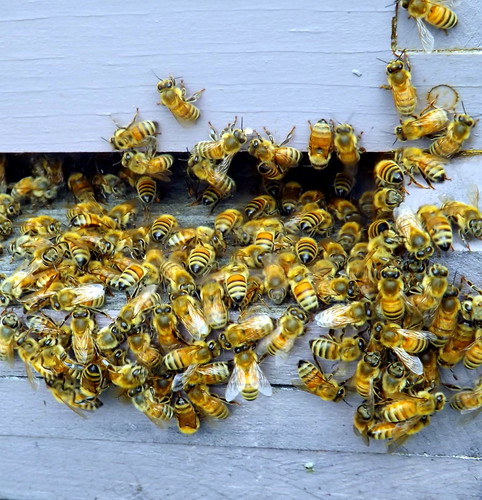
    But I digress. My intention was to write about the plant–as a plant, not as a source of food. A couple of days ago, I was checking the status of the zucchini and was startled to see a fully open flower. I almost never see an open flower, which makes sense since they are only open for one day and usually from morning to early afternoon (when I am at work, or not paying sufficient attention). In order for any zucchini to be produced, bees must take advantage of this small window of opportunity and do their part by carrying pollen from the male flowers to the female flowers. [Ok, I have to digress again to show a completely unrelated photo of a friend’s beehive since I don’t have a photo of a bee on my zucchini flowers–and yes, honey bees are excellent pollinators of zucchini and many other fruits and vegetables. Go bees!]


    Some of my baby zucchini seemed to wither on the stems and drop off before they even got going. I wondered if this was due to all the rain we’ve been having (or even worse, if it could possibly be the fault of our male dog–despite the barricades I erected). Luckily, I discovered it’s because the female flower didn’t get quite enough pollen from the male. Gardeners wishing to help the process along can try to hand pollinate by carefully removing the anther from the male flower and dabbing it onto the stigma of the open female flower (or by using cotton swabs to transfer the pollen). In my case, with plenty of zucchini already harvested and more to come, I may need to start tying all those flowers closed!

    Here is a photo of a lovely, open zucchini flower (looks male)…

    … and of another part of the plant that rarely gets mentioned: the leaf. I really like the way the leaves look, and I particularly like the downward angle in this photo. But zucchini leaves are a force of nature. They are so big and so prolific that they keep taking over the small space I allocated to the zucchini plant, and I have had to prune them several times. I felt guilty cutting them off at first, but then I learned that judicious pruning lets more light in and can help increase zucchini production. Wait–is that a plus?