Tag Archives: gardening

Tassels and Silks: The Beautiful Anatomy of a Corn Plant

7 Jul
Corn tassel consisting of individual spikelets, with anthers hanging from filaments

Last year, I carved out a patch in the vegetable garden, planted some corn kernels, and was very excited when the sprouts emerged. But a few days later, all the sprouts were severed, laying forlornly on their sides where they had fallen. Upon closer inspection, the sprouts had been pulled up and the corn kernels had been chomped off at the base — clearly the work of chipmunk commandos who had infiltrated the garden at the crack of dawn. Chipmunks 1, me 0.

This year, I planted seedlings instead of kernels, crossed my fingers, and hoped for the best. As of yet, there haven’t been any corn massacres, so I’ve been able to watch corn plants grow for the first time — and admire their constituent parts. There is a lot to notice, from the stripy leaves…

Macro view of corn leaf

… to the beguilingly named tassels and silks. The highly recognizable tassel at the top of every corn plant is the male part of the plant, and consists of about 1,000 spikelets, each containing 3 pollen-producing anthers and their filaments (collectively, the stamens). With 6,000 pollen-producing units on each corn plant, that’s a lot of pollen to be wind dispersed (read more about pollen shed in this great article on “sex in the corn field“).

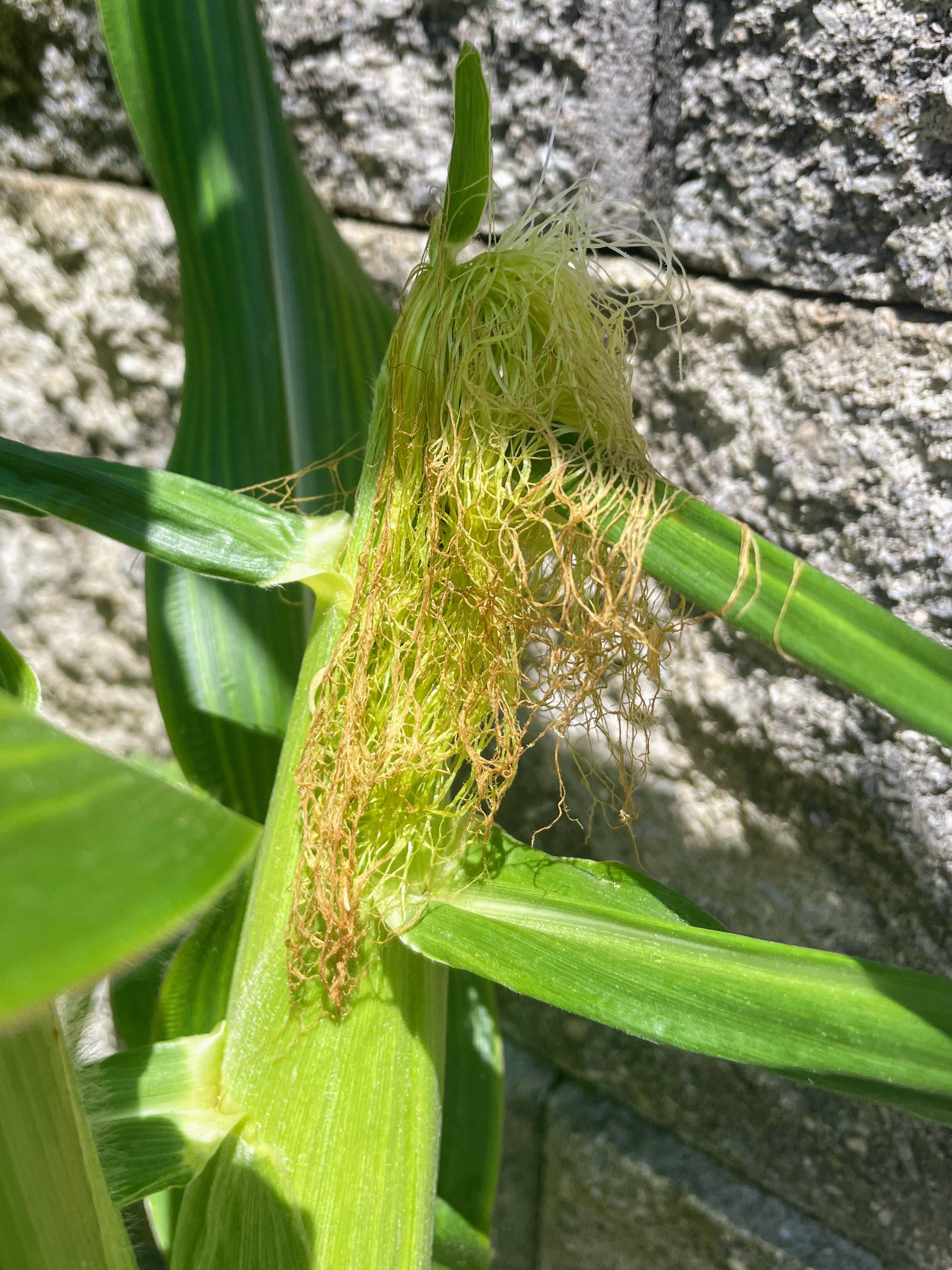
The silks are the female part of the corn plant. They form at the base of the ear but are most visible at the tip, emerging from the husk. Their job is to catch the pollen and guide it down to the unfertilized corn kernels (ovules) on the ear. Here’s the fascinating part: Each silk is connected to a kernel (or what would be a kernel if successfully pollinated). As not every ovule gets pollinated, most ears produce about 400 to 600 kernels.

You can tell when pollination has occurred because the silks dry up, turn brown, and often fall off. You can also tell when pollination hasn’t been very successful if your ear of corn has missing or misshapen kernels. That’s why it’s important for home gardeners to plant corn in a block rather than a single row, so the pollen has more chance of falling on nearby silks rather than being completely blown away from the row.

I don’t have any photos of pollen on the silks, but this is what the tiny yellow pollen grains look like on a corn leaf, along with some spent anthers (they drop off the tassel after the pollen is shed).
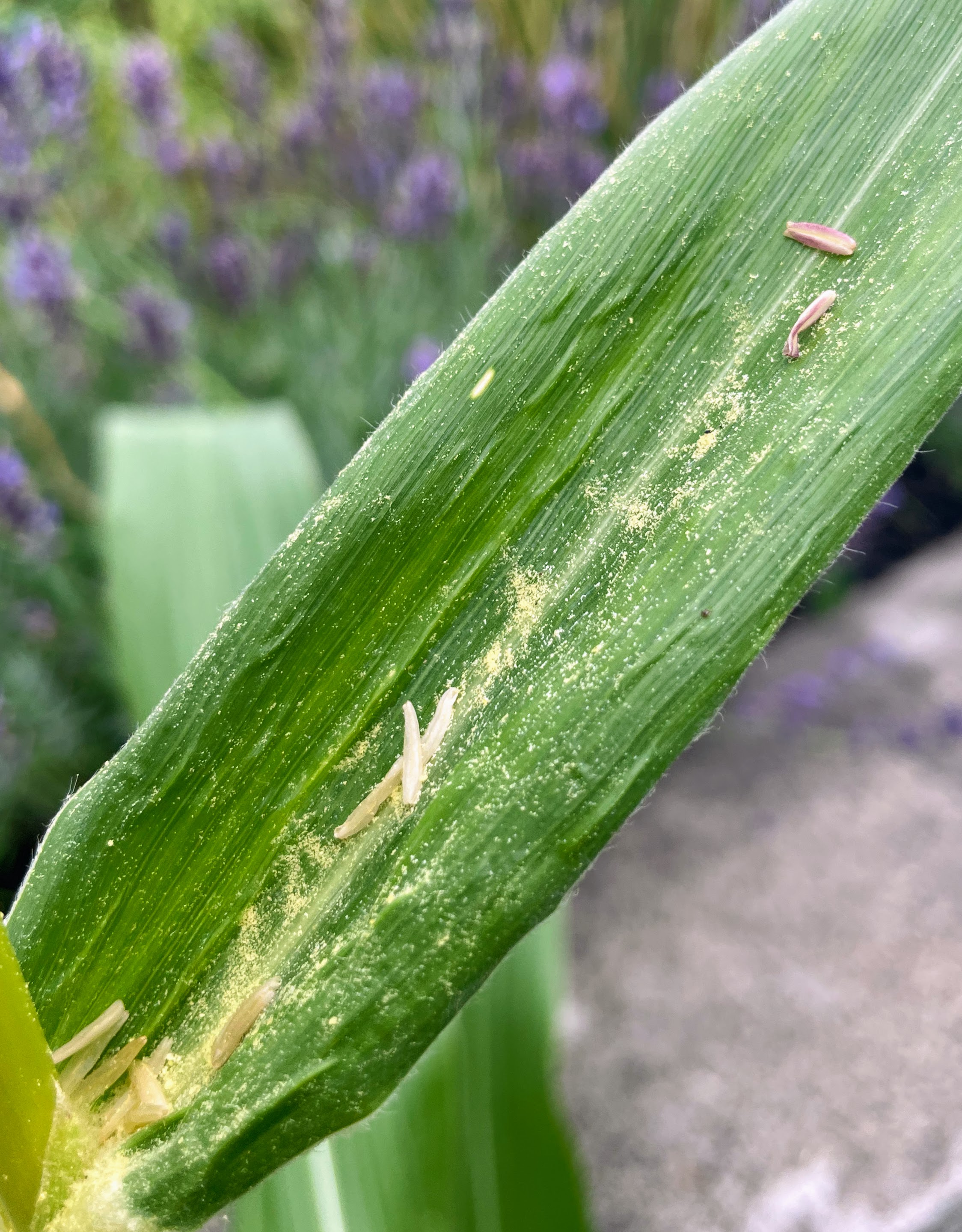
Some of the 2-5 million pollen grains produced by each corn tassel (and some anthers)

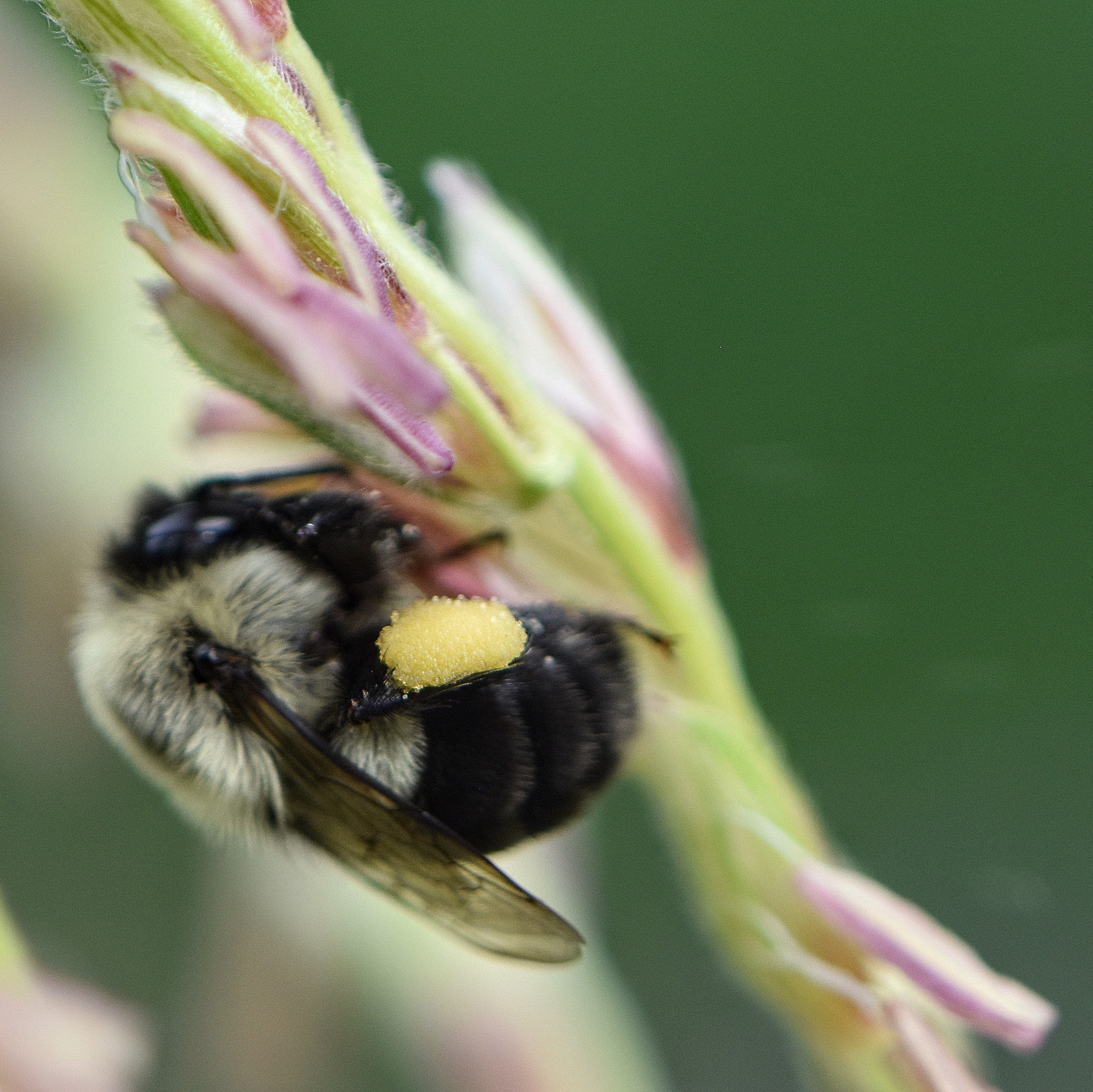
Though corn is pollinated by the wind (anemophily), pollination can also occur with the help of insects (entomophily). Luckily for me, as I was taking photos of the tassels, a bumble bee appeared. Or, more specifically, a female bumble bee appeared–as the females are the only ones to have pollen baskets (corbiculae) on their hind legs.
Sunflower Power

10 Mar

Lately, we have been lulled into thinking spring is around the corner, with a warm day or two and lots of sun — only to be brought back to our cold, overcast, wet or sometimes snowy reality. This state of affairs got me thinking about (ie, longing for) flowers, and sunflowers in particular. If you grow sunflowers, you may know all there is to know about them. I did not, though I did learn very early on that our intrepid squirrels could scale our giant sunflowers under cover of darkness and chew off the beautiful heads, leaving decapitated 9-foot stalks in their scheming rodent wake.

I did know a few other things, such as the origins of the scientific name for the common sunflower: Helianthus annuus. Helianthus comes from the Greek “helios,” meaning sun, and “anthos,” meaning flower. Sunflowers are also heliotropic, ie, young sunflowers follow the sun’s position from sunrise to sunset. They do this until they reach maturity, at which point they stay facing East, which allows the sunflowers to get warmer more quickly (and thus, to attract more pollinators).

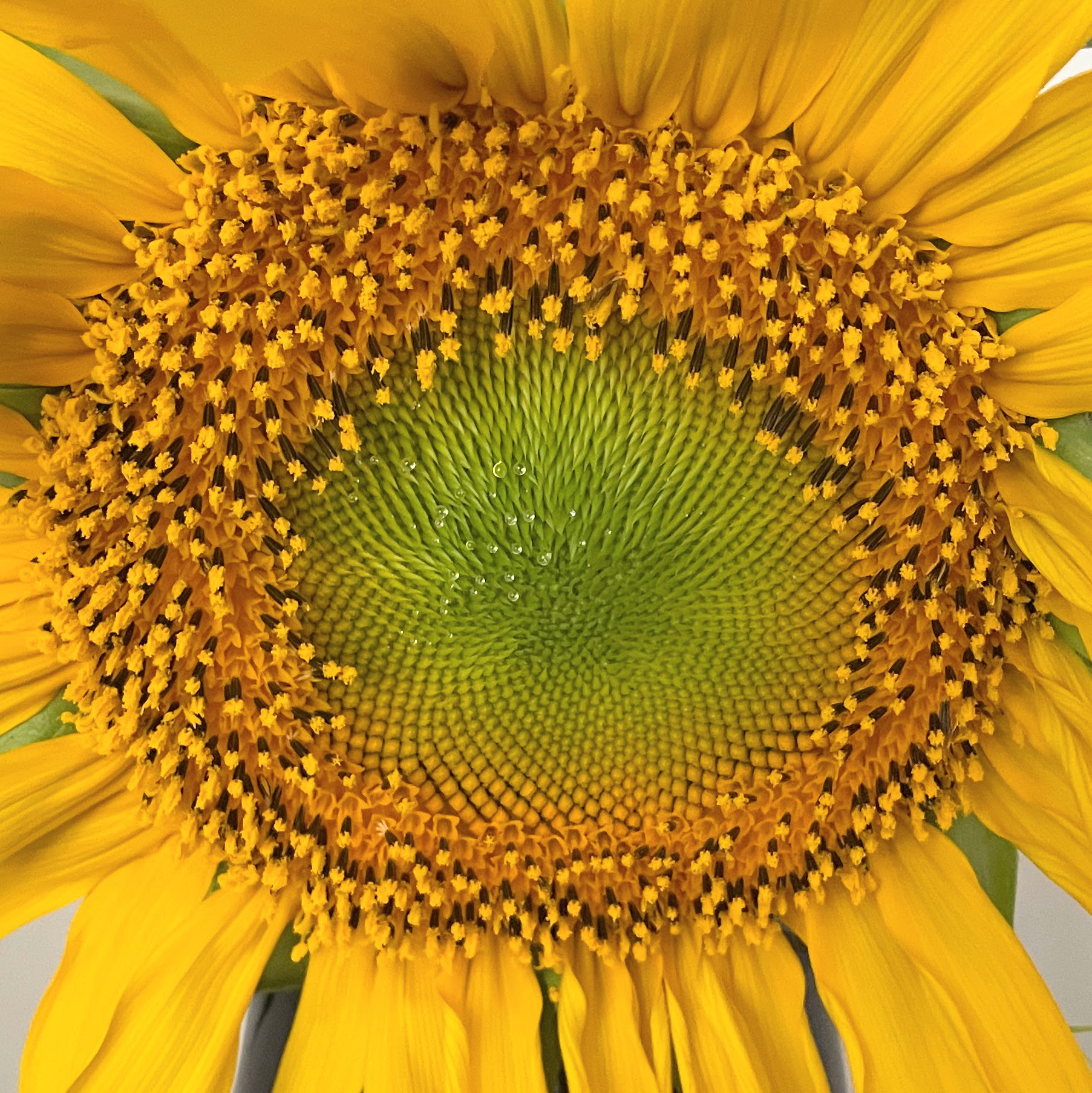
Another thing I knew was that each sunflower head is made of hundreds and maybe thousands of smaller flowers, which means it is an inflorescence (same as alliums). The bright yellow (or sometimes, red or rusty orange) petals surrounding the sunflower head are called ray florets. The real, tiny flowers are in the central part of the flower head and are called disc florets. In the photos below, you can see the dark brown anthers of the disc florets topped with pollen; each of these flowers will produce a sunflower seed.

Finally, one last thing I knew, but did not really think about until now is that the sunflower’s disc florets are arranged in a spiral pattern that follows the Fibonacci sequence, a mathematical sequence in which each number is the sum of the two preceding ones. If you count the spirals in a sunflower head (which can be done in different ways), you will usually end up with a Fibonacci number (0, 1, 1, 2, 3, 5, 8, 13, 21, 34, 55, …). Why? Because the pattern makes efficient use of available space for seed formation. The growing seeds press on each other, creating geometric patterns. The Fibonacci sequence is found everywhere in nature (such as in pineapples, pinecones, broccolo romanesco, sea shells, tree branches, storms, galaxies, and even the distribution of seeds in a raspberry, to name just a few occurrences).

This is where my knowledge of sunflowers ended. Then, I discovered a couple more reasons to admire them:

    1. Every part of a sunflower — not just the seeds — can be eaten:

    • Sunflower sprouts can be used in the same way as alfalfa or bean sprouts, in a stir fry or a spring salad or Thai salad.
    • Jerusalem artichokes (aka sunroots, sunchokes) are a type of sunflower whose roots are edible; prepare them as you would other root vegetables: roast, sauté, fry, mash, or puree them — or shred or slice them raw.
    • Sunflower stalks can be eaten like celery when small and slender. You can also make flour from the stalks. (OR… dry the stalks and use them to support other plants in the garden the following year.)
    • Younger, smaller sunflower leaves can be eaten in salads, and older, bigger leaves can be boiled and sauteed like collards or other leafy greens; removing the central rib may make them a little less bitter. Some people also prepare tea from dried sunflower leaves and/or petals.
    • The flowers (ie, ray florets) are edible; try them in a salad.
    • The opened (giant) sunflower heads (not fully mature, with seeds that are still white) can be grilled, if you are feeling particularly adventurous.
    • The unopened sunflower heads can be prepared in a way similar to artichokes.

    2. Sunflowers can absorb some serious toxins. Because of this ability, they are called hyperaccumulators. When a reactor exploded at the Chernobyl Nuclear Power Plant in Ukraine in 1986, it released radioactive elements into the environment; thousands of sunflowers were planted to help remove these elements from the soil and ponds near the disaster site. Using plants to cleanse the environment is called phytoremediation. Today, sunflowers are the international symbol for nuclear disarmament (and as the national flower of Ukraine, they are also symbols of solidarity, resilience, and hope).

    Echinacea or Rudbeckia hirta? The Clues I Failed to Notice

    6 Aug

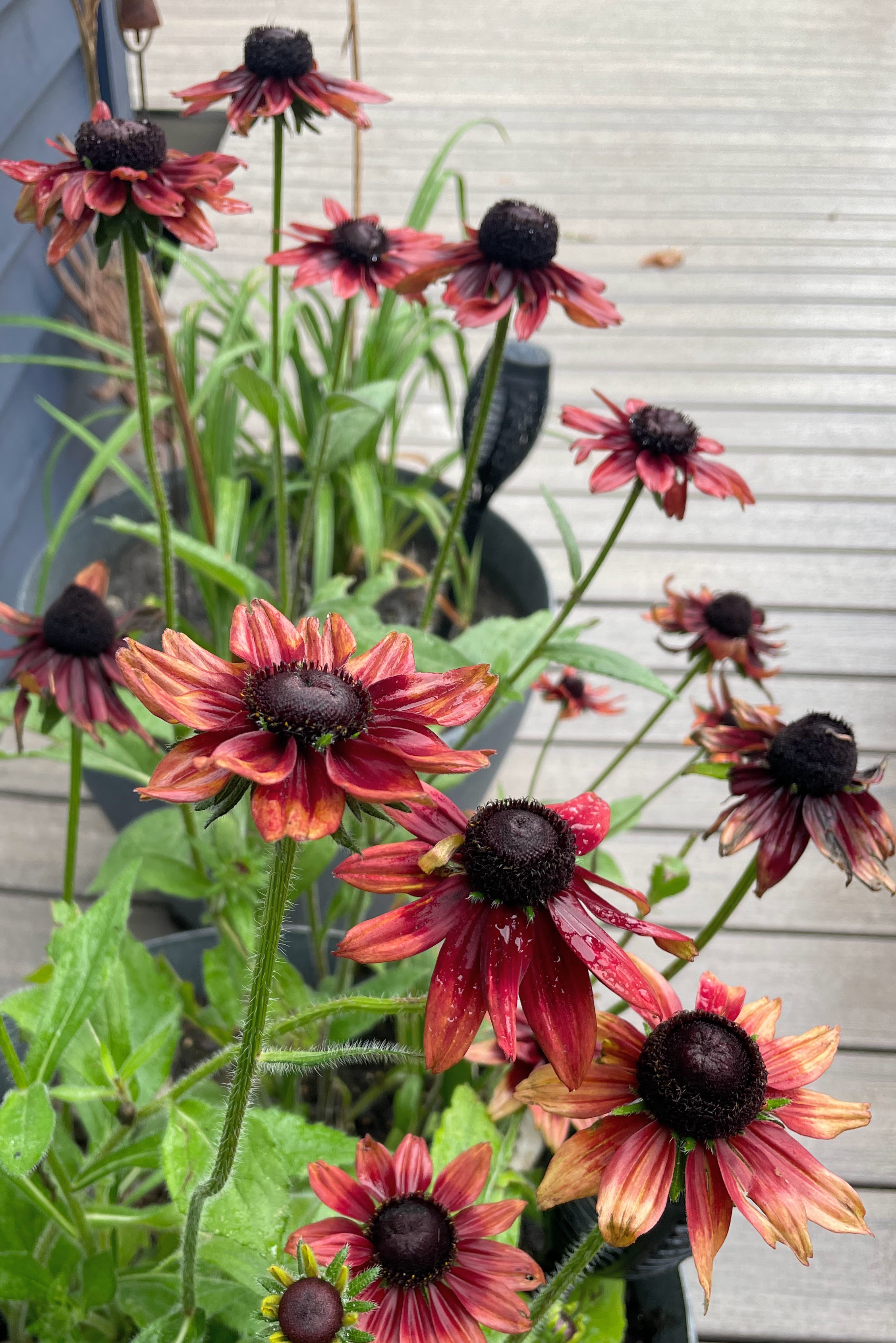
    You may look at the beautiful potted flowers above and know right away what they are. When I look at them now, I also know. And forever more, I will know. But for the past couple of weeks, every time I walked by this part of the deck, I reveled in how beautiful these ‘echinacea’ were, and what an unusual color, too. I would then glance over to a different part of the garden and marvel at how many other beautiful varieties of echinacea existed:

    But I was wrong about the potted flowers in the first photo, despite abundant evidence. My disregard for the facts started when I forgot what was written on the original plant tags and did not feel I needed to re-check; it spiraled from there and led me to overlook the obvious.

    Mostly, it was hubris; I thought I knew, so I failed to observe properly, or fact check. What clues did I miss? Many. As this blogger stated, a gardener confusing a rudbeckia with an echinacea is like a farmer confusing a sheep with a goat. Ouch. In my defense, sheep and goats are very closely related genetically– as are rudbeckia and echinacea. And until a couple of weeks ago, I did not have this ‘Cherry Brandy’ rudbeckia in my garden. But I get the point, and now I can see the obvious differences between the “sheep” and “goats” in my garden.

    Here’s how to tell them apart:

    1. First, it’s not by how hairy one plant is, vs the other. I read that one way to tell them apart is that echinacea have hairier leaves. But both plants have hairy leaves; echinacea leaves feel rough like a cat’s tongue, while Rudbeckia hirta leaves are softer and more velvety (see photo below):

    Since both plants have hairy leaves, it’s not the best test. There is a better one (in fact, the best and easiest one):

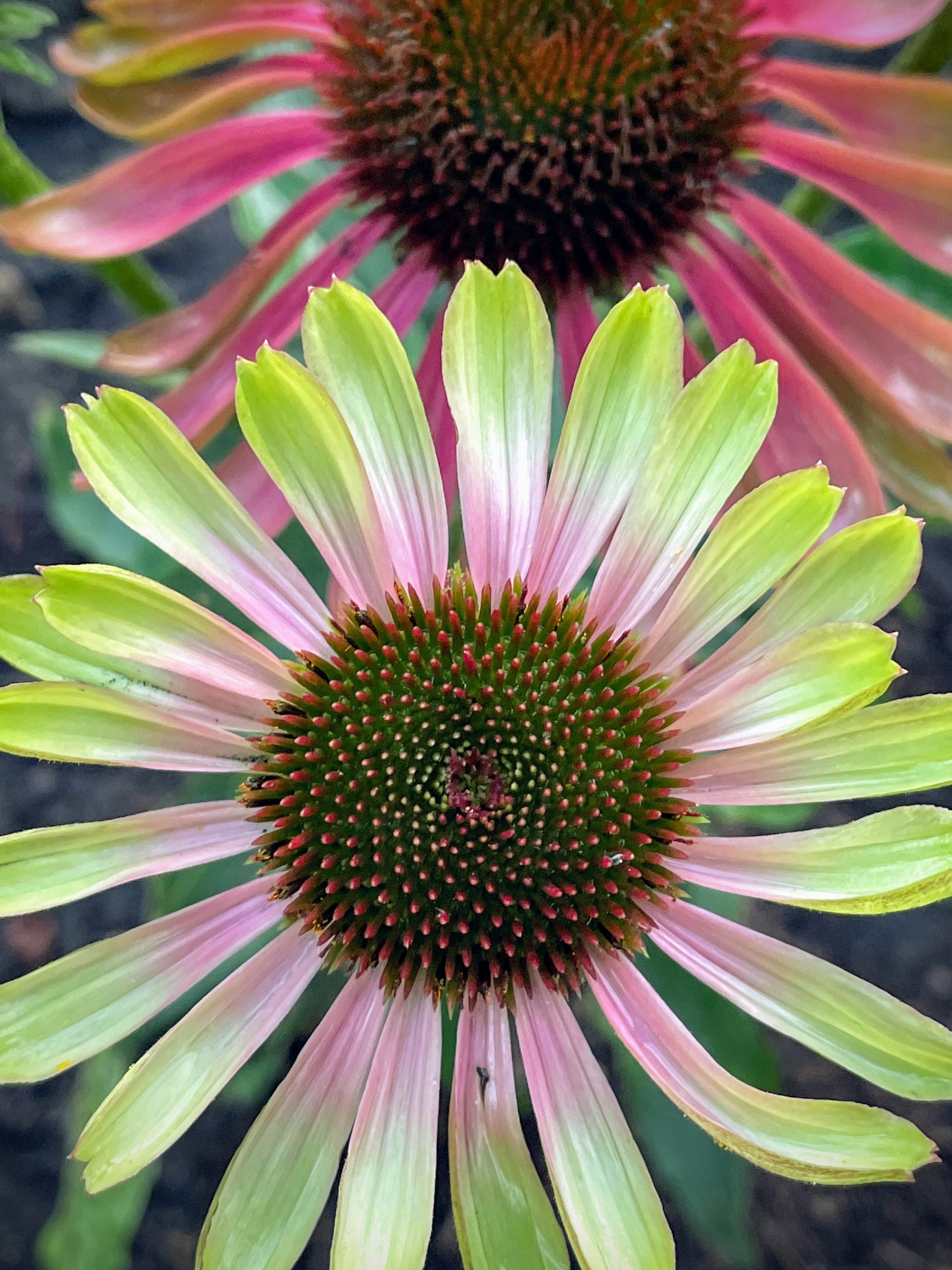
    2. Examine the cones. Rudbeckia hirta cones (l) are relatively soft and usually look like black button tufts (hence the name Black-Eyed Susans), while echinacea cones (r) are harder and pricklier and more conical — and are not black, but orange or green or brown.

    3. Look at the “petals” (though technically, they are ray florets, not petals): This can often help, but not always. According to this way of telling the difference between the two plants, echinacea petals tend to droop and point downward while rudbeckia petals tend to stick straight out. But in the photo below, some of the echinacea petals are drooping and some are sticking straight out. It depends on the variety and the plant’s stage of development. So use the “petal” test as a first form of evidence gathering if you like, but be sure to confirm with the cone test; it will give you the right answer.

    In seeking the right answer today, I learned something new. Not just about the difference between Rudbeckia hirta and echinacea, but about assumptions and facts. And about taking the time to stop and smell the roses — and see the petals and leaves, and touch the cones.

    The Challenges of Gardening and Cooking on Crutches

    17 May

    This title is misleading because it sounds like I actually have been able to do some gardening and cooking since breaking my ankle three weeks ago and being diagnosed with deep vein thrombosis three days ago. Sadly, that has not been the case. Hence this lovely photo of one of the many weeds that have now taken up residence in the garden. And the absence of any photos (or blog posts) pertaining to new garden initiatives or new dishes. But I can write about things happening in the garden of their own accord (future posts), as well as recent lessons learned, many of which involve crutches (this post).

    Weeds

    1. When crossing a street, look left, right, and DOWN. Or else your ankle could go one way and you could go the other, with unhappy results.
    2. You will develop a love-hate (mostly hate) relationship with your crutches.
    3. Crutches are made to transport mainly one thing–you. But you have been used to transporting multiple things yourself with the help of both your hands and feet, one of which can no longer be used and the other three of which are valiantly trying to to keep you upright and semi-mobile. This poses certain challenges.
    4. Namely, how to transport hot beverages. A beverage tray for crutches would really come in handy. I was able to carry a number of things on crutches via the-tuck-the-item-into-my-waistband-and-hope-my-pants-don’t-fall-down method, but I didn’t dare try that with a cup of tea.
    5. Not being able to use one foot means you will develop really good balancing skills on the other one. This came in handy when I leaned over on one foot to pull a few weeds from the edge of our patio the other day, though the neighbors may have thought I was practicing some bizarre new form of Tai Chi. The downside to all this balancing on one foot: your injured leg muscles will disappear while the muscles on your other leg will fill out quite nicely, leading to a lovely asymmetrical look.
    6. If you are like me, crutches will also allow you to discover muscles in your arms that you didn’t know existed. That’s another plus: increased upper body strength for improved gardening efficiency. But if the muscles in your injured leg ever start aching, pay attention. What I thought was a calf muscle that was strained from limping around too much three weeks post fracture turned out to be a blood clot.
    7. If you should ever have the misfortune to end up with deep vein thrombosis after a fracture, you will find that all things considered, the fracture might actually be the less painful/scary of the two. Part of the reason is the blood-thinning medication you have to inject into your own stomach twice a day, which feels as if you were being stung by a bee each time. It is really not fair to bees.
    8. Finally and most importantly, be immensely thankful when your body works well. All the many parts, including the humble foot, make even the simplest things possible–yet it’s so easy to take those parts for granted.
    9. Ditto for the family members and friends/coworkers who turned into nurses, chauffeurs, and advocates at a moment’s notice. They make everything possible, too.