Tag Archives: flowers

The Differences Between Cycads, Palms, and Ferns

25 Jun

There are certain plants with pointy pinnate leaves (ie, leaves connecting to the stalk like quills on a feather) that look very alike, even though they are not at all related: cycads, palms, and ferns. For one, they evolved millions of years apart. Ferns, which reproduce by dispersing spores, appeared at least 360 million years ago, long before seed-bearing plants. Cycads are among the earliest of the seed-bearing plants and have been around for about 280 million years. The evolution from spores to seeds was one of two dramatic land-plant developments. The other was the emergence of flowers about 100 million years ago, after which palms arrived on the scene. At a mere 60 million years old, palms are botanical babies compared to the other two, though all three shared time and space with dinosaurs.

There are many ways to tell the three plants apart. Cycads and palms have woody trunks; ferns do not. And fern fronds are much softer and more delicate than stiff and spiky palm fronds or cycad leaves (some of which look positively lethal):

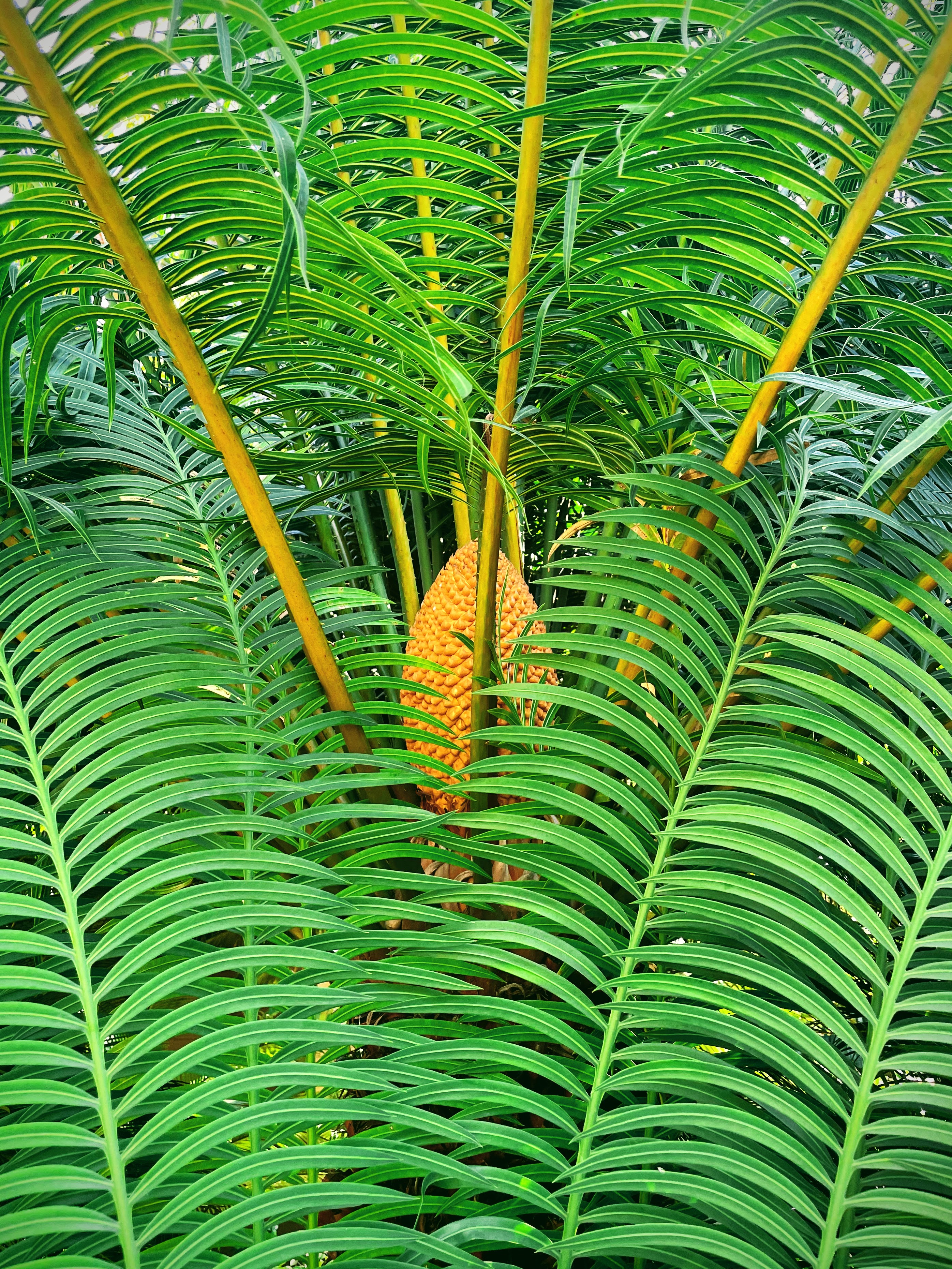
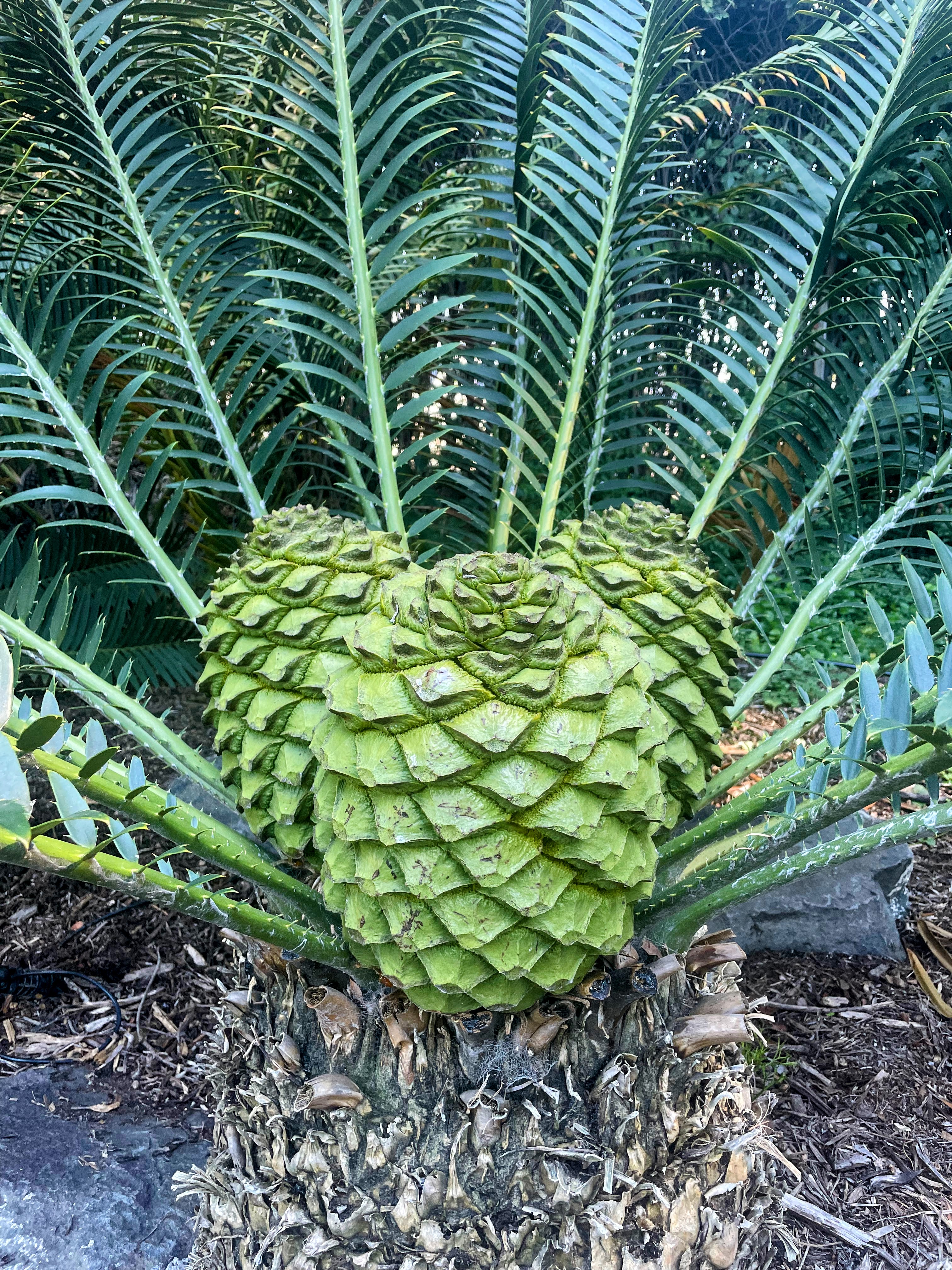
Alexandria cycad (Encephalartos arenarius), UC Berkeley Botanical Garden

Distinguishing between cycads and palms can sometimes be tricky as they both have crowns of pointy leaves atop a woody trunk. For a while, I assumed if it was tall and tree-like, it was a palm, and if it was closer to human height and a bit bushier, it was a cycad. Then I saw the Albany Cycad at the San Diego Zoo (at 500 years old, it is the Zoo’s oldest plant); it is taller than I am and looks a lot like a palm tree.

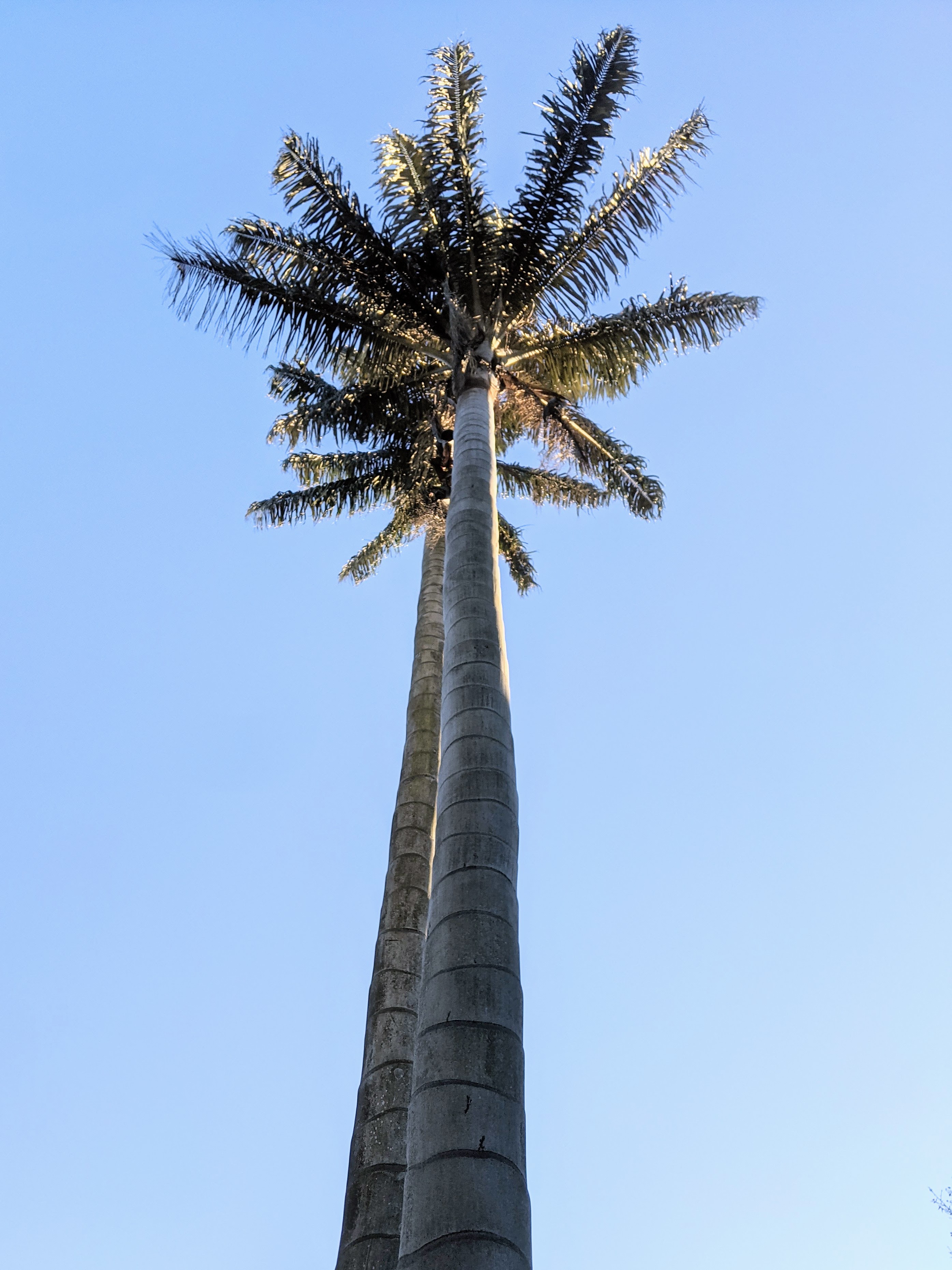
But there is a way to tell tall cycads and palm trees apart: look at the trunks. Cycad trunks are rough and stocky while palm trunks are slimmer. Also, while both plants have scarring on their trunks where the leaves have fallen off, cycad leaf scars appear in a spiral pattern, while palm leaf scars often look like rings around the trunk. So if you see ringed scarring on a tall and elegant trunk, that’s a good clue that you are looking at a palm and not a cycad.

Another difference is that cycads are gymnosperms and palms are angiosperms, but those terms aren’t very helpful unless you know that gymnosperms = cones, and angiosperms = flowers and fruits. So if you are looking at an as-of-yet-unidentified plant with stiff and spiky pinnated leaves and see a cone at the center of those leaves, it’s a cycad. And that cone is why cycads are most closely related to conifers.

If you see any flowers at all (or fruits such as coconuts, dates, or berries), it’s a palm. Ferns are neither gymnosperms nor angiosperms; they are primordial, vascular plants and do not produce flowers, fruits, or cones. So if you are looking into what you think is a clump of ferns and see a cone, it’s not a fern. If you see a woody trunk, it’s also not a fern. But, if you see spores on the underside of the fronds, it IS a fern!

Spores on the underside of Florida Strap Fern

Finally, a word about Sago Palms, a group of palm-like plants that are actually cycads. They got their name because way back when, someone else had a hard time telling them apart. (So glad I am in good company.)

Misnamed Cycad: Cycas circinalis (Queen Sago Palm), Garfield Park Conservatory, Chicago

A final twist to this tale: though cycads can look like palms, their young, emerging leaves look remarkably similar to unfurling fern fronds. I don’t have a photo of a cycad leaf unfurling (unfortunately), so the first photo below is kindly borrowed. I’ve added a fern photo I do have for comparison. One could easily be forgiven for mistaking an unfurling cycad for a fern. But take a careful look at the rest of the plant. Touch the mature leaves to see how hard or soft they are and whether there are any spores underneath, see if there is a woody trunk (if so, look at leaf scarring), check for cones or fruits. All those things will point you in the right direction.

Sunflower Power

10 Mar

Lately, we have been lulled into thinking spring is around the corner, with a warm day or two and lots of sun — only to be brought back to our cold, overcast, wet or sometimes snowy reality. This state of affairs got me thinking about (ie, longing for) flowers, and sunflowers in particular. If you grow sunflowers, you may know all there is to know about them. I did not, though I did learn very early on that our intrepid squirrels could scale our giant sunflowers under cover of darkness and chew off the beautiful heads, leaving decapitated 9-foot stalks in their scheming rodent wake.

I did know a few other things, such as the origins of the scientific name for the common sunflower: Helianthus annuus. Helianthus comes from the Greek “helios,” meaning sun, and “anthos,” meaning flower. Sunflowers are also heliotropic, ie, young sunflowers follow the sun’s position from sunrise to sunset. They do this until they reach maturity, at which point they stay facing East, which allows the sunflowers to get warmer more quickly (and thus, to attract more pollinators).

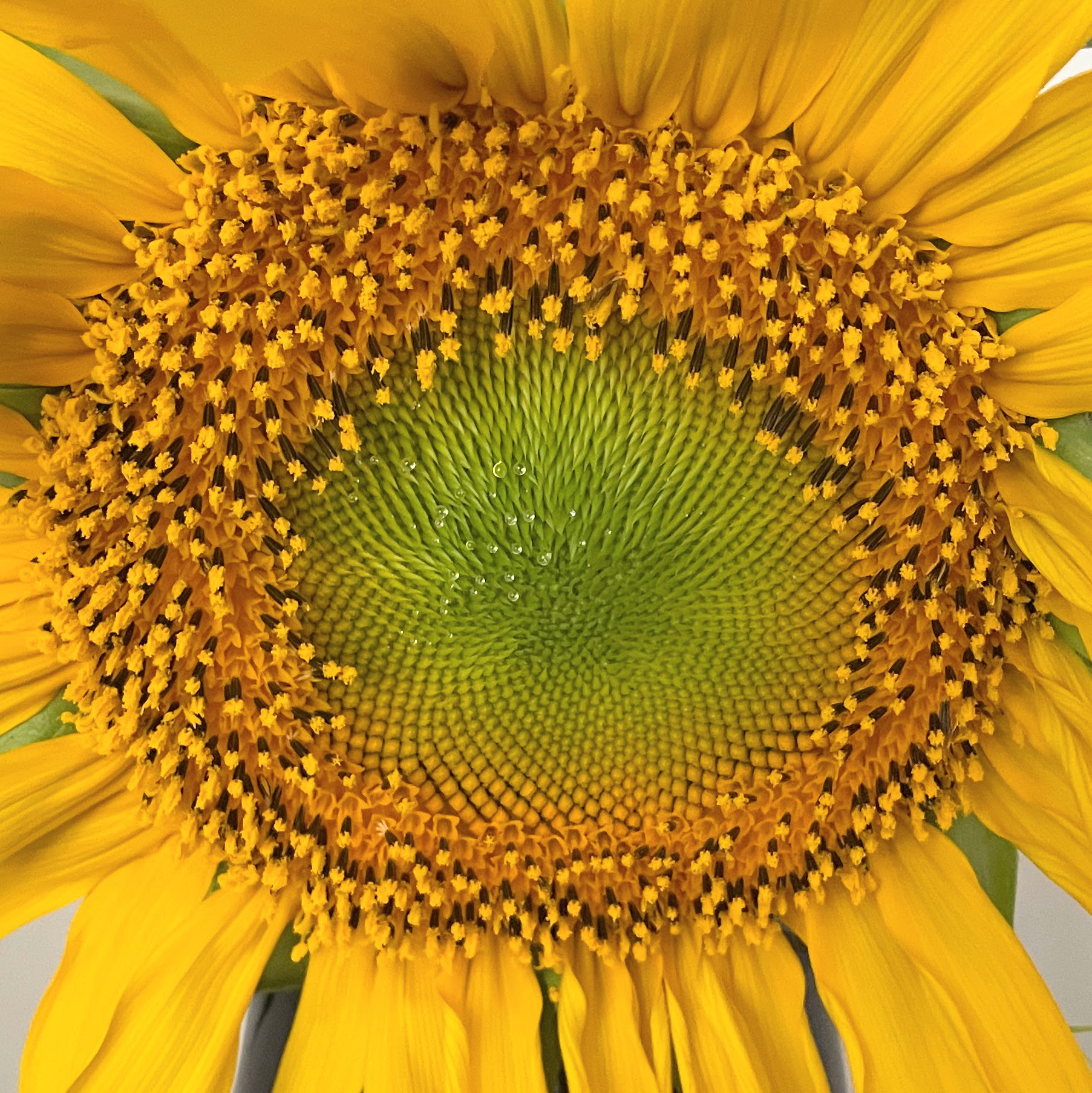
Another thing I knew was that each sunflower head is made of hundreds and maybe thousands of smaller flowers, which means it is an inflorescence (same as alliums). The bright yellow (or sometimes, red or rusty orange) petals surrounding the sunflower head are called ray florets. The real, tiny flowers are in the central part of the flower head and are called disc florets. In the photos below, you can see the dark brown anthers of the disc florets topped with pollen; each of these flowers will produce a sunflower seed.

Finally, one last thing I knew, but did not really think about until now is that the sunflower’s disc florets are arranged in a spiral pattern that follows the Fibonacci sequence, a mathematical sequence in which each number is the sum of the two preceding ones. If you count the spirals in a sunflower head (which can be done in different ways), you will usually end up with a Fibonacci number (0, 1, 1, 2, 3, 5, 8, 13, 21, 34, 55, …). Why? Because the pattern makes efficient use of available space for seed formation. The growing seeds press on each other, creating geometric patterns. The Fibonacci sequence is found everywhere in nature (such as in pineapples, pinecones, broccolo romanesco, sea shells, tree branches, storms, galaxies, and even the distribution of seeds in a raspberry, to name just a few occurrences).

This is where my knowledge of sunflowers ended. Then, I discovered a couple more reasons to admire them:

    1. Every part of a sunflower — not just the seeds — can be eaten:

    • Sunflower sprouts can be used in the same way as alfalfa or bean sprouts, in a stir fry or a spring salad or Thai salad.
    • Jerusalem artichokes (aka sunroots, sunchokes) are a type of sunflower whose roots are edible; prepare them as you would other root vegetables: roast, sauté, fry, mash, or puree them — or shred or slice them raw.
    • Sunflower stalks can be eaten like celery when small and slender. You can also make flour from the stalks. (OR… dry the stalks and use them to support other plants in the garden the following year.)
    • Younger, smaller sunflower leaves can be eaten in salads, and older, bigger leaves can be boiled and sauteed like collards or other leafy greens; removing the central rib may make them a little less bitter. Some people also prepare tea from dried sunflower leaves and/or petals.
    • The flowers (ie, ray florets) are edible; try them in a salad.
    • The opened (giant) sunflower heads (not fully mature, with seeds that are still white) can be grilled, if you are feeling particularly adventurous.
    • The unopened sunflower heads can be prepared in a way similar to artichokes.

    2. Sunflowers can absorb some serious toxins. Because of this ability, they are called hyperaccumulators. When a reactor exploded at the Chernobyl Nuclear Power Plant in Ukraine in 1986, it released radioactive elements into the environment; thousands of sunflowers were planted to help remove these elements from the soil and ponds near the disaster site. Using plants to cleanse the environment is called phytoremediation. Today, sunflowers are the international symbol for nuclear disarmament (and as the national flower of Ukraine, they are also symbols of solidarity, resilience, and hope).

    Crocosmia: Flower or Weed?

    24 Sep

    I came across this poem recently, by Ian Emberson:

    A weed is a flower in the wrong place,
    a flower is a weed in the right place,
    if you were a weed in the right place
    you would be a flower;
    but seeing as you’re a weed in the wrong place
    you’re only a weed –
    it’s high time someone pulled you out.

    I suspect some difficult interpersonal dynamics led to the last few lines, so I won’t dwell on those. But I quite like the first two lines. They summarize my feelings about a beautiful flower in my garden, which I love when it’s in the right place and frown over when it pops up (again and again) in the wrong place(s): Crocosmia.

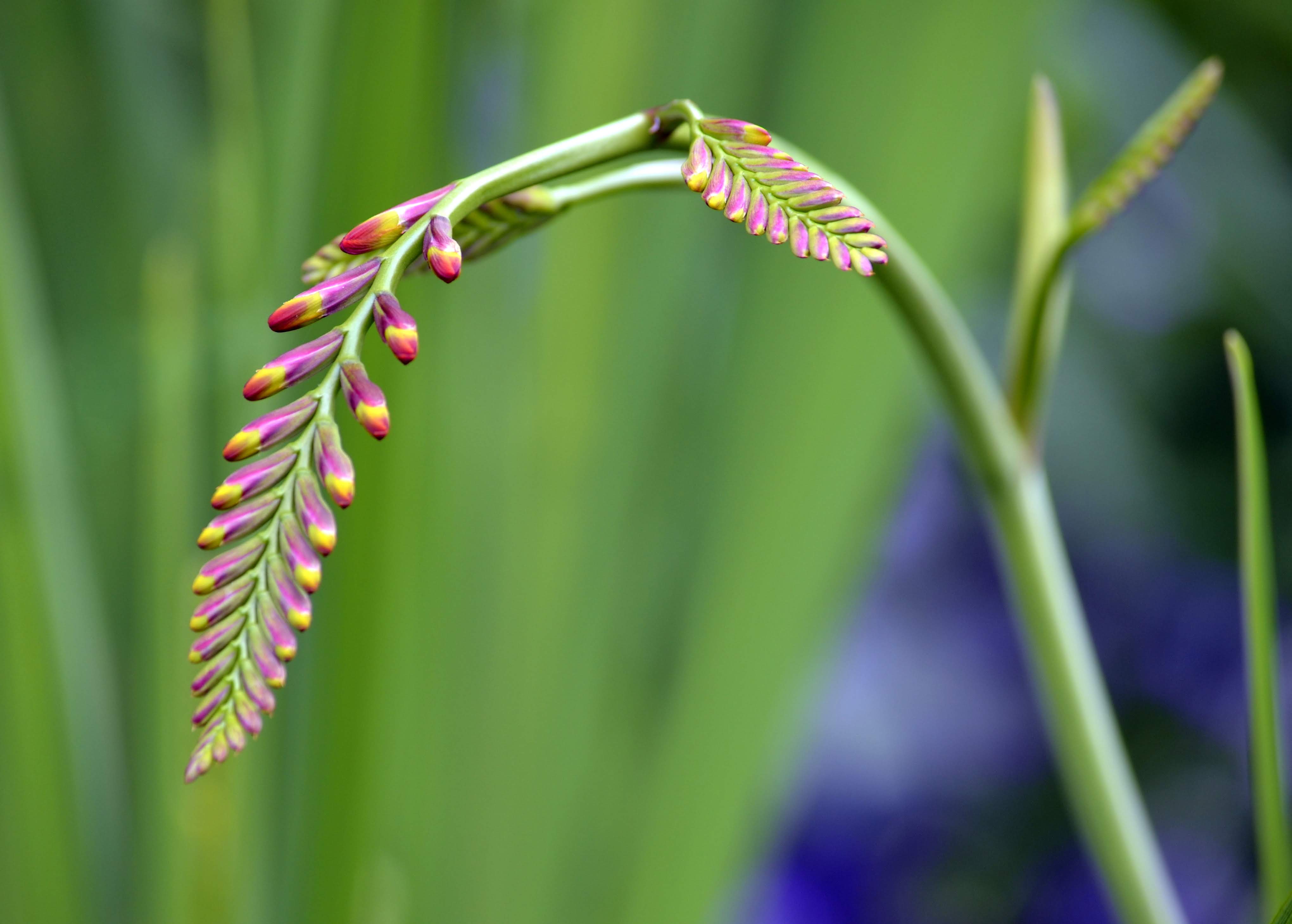
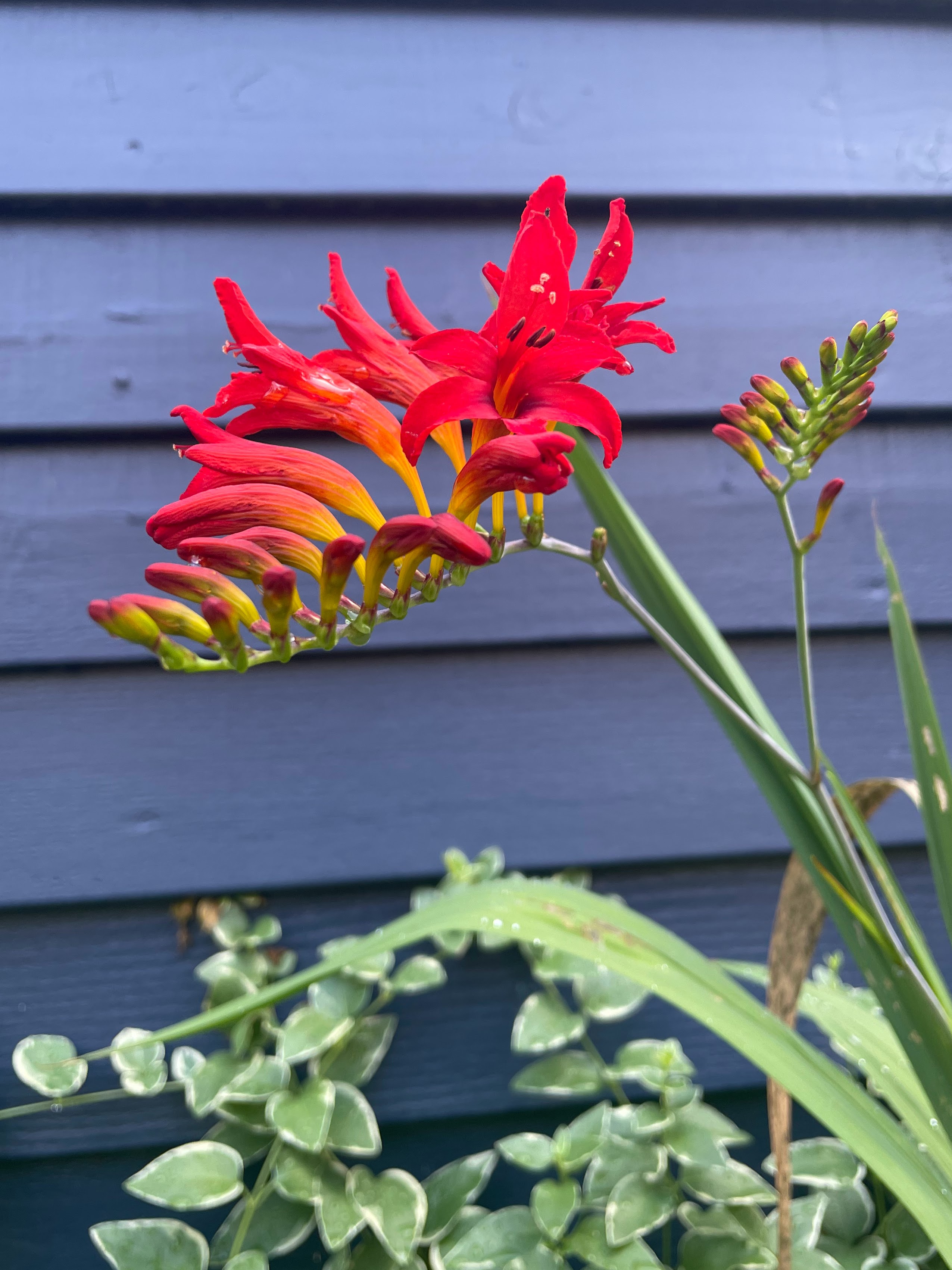
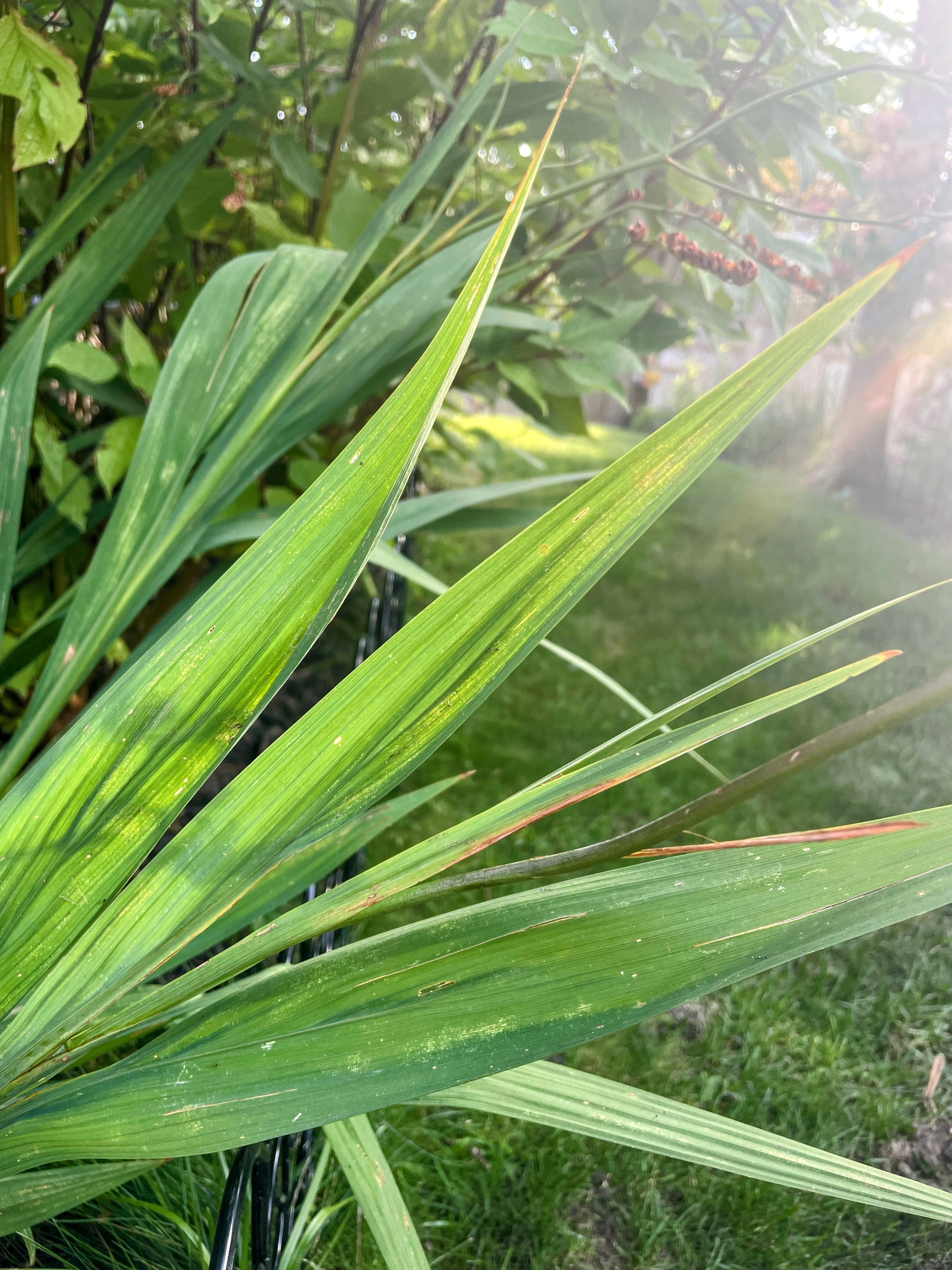
    Crocosmia is a member of the Iris (Iridaceae) family, along with its gladiolus and crocus cousins. Plants in this family are perennial, and grow from bulbs, corms, or rhizomes. They have tall, upright foliage; Crocosmia leaves have been called “sword-like” and are easily spotted and admired in the garden.

    The tubular, scarlet-red flowers are spectacular as well, and are wildly attractive to hummingbirds, who have been known to defend their Crocosmia patch against any and all interlopers. For hummingbirds, a Crocosmia is the proverbial Lady in Red.

    So, what’s not to love? Crocosmia has great flowers, great leaves, and brings hummingbirds to the garden. How could it be a problem? Well, in the U.S. and other parts of the world, this Southern African native is considered an invasive species because of how well it grows, to the detriment of other plants. It really can grow almost anywhere; the ‘Lucifer’ cultivar (which has made itself a regular feature of my garden) is hardy to Zone 4. In the words of the California Invasive Plant Council:

    “It prefers disturbed areas, including roadsides, coastal scrub, prairie and forests. Crocosmia is a superior competitor for water, light and nutrients, and it excludes native plants by growing in dense patches.”

    I’ve seen mass plantings of Crocosmia, which can be stunning:

    Intentional Crocosmia planting, Japanese Tea Garden, San Francisco

    But where not controlled, Crocosmia could run riot. It is a determined grower whose corms multiply and multiply. You may think you’ve gotten them all, but you haven’t. In my own garden, no matter how often I have tried to transfer rogue Crocosmia from where I do not want it to grow, to where I do, it keeps cropping up in the old spots — and in new ones.

    Crocosmia in yet another unplanned spot

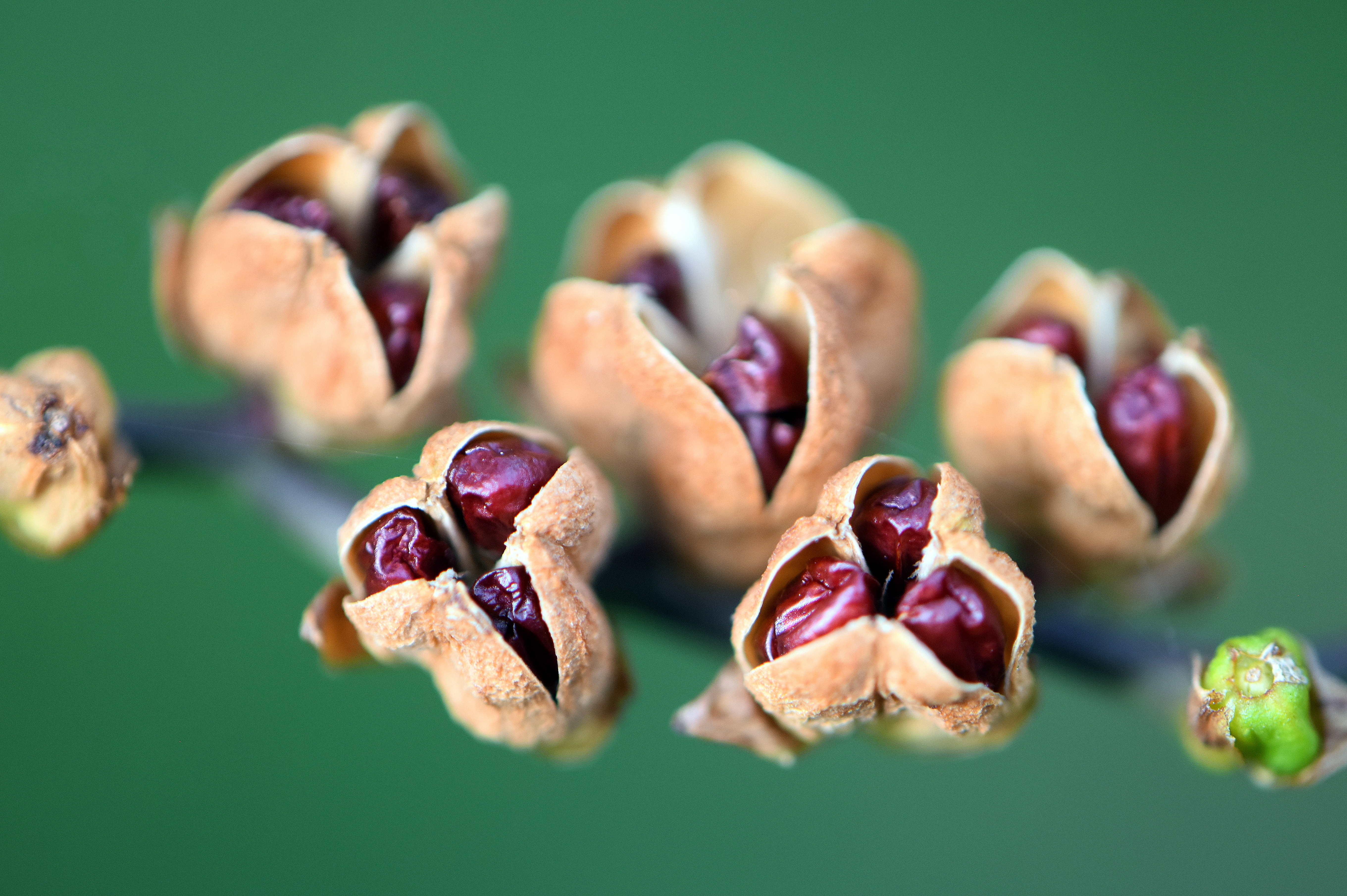
    The reason I am finding it in new spots in my garden, is that — in addition to propagation by corms — Crocosmia can also grow from seed. I did not realize how sneaky and able Crocosmia was until now, so I naively let the seed pods develop and scatter, mostly because I did not perceive them as a threat. In my skirmishes with this flower (or weed?), it has outwitted me each time. I’ve been focused on battling corm-spreading Crocosmia, without realizing my garden was also being strafed by airborne seeds. Now I know I should have been cutting Crocosmia off at the pass, literally; I should have been cutting the flower stems at their base as soon as the flowers were spent. Instead, I have allowed the (admittedly beautiful) seed pods to develop, along with the mini paratroopers housed therein, just waiting to spread further red cheer throughout my garden. Clearly, I am no military strategist.

    But… lesson learned for next year. I vow to be ruthless. Really.

    Starting Over: The Joys of a New Garden

    3 Sep

    When we moved back to the U.S. three years ago, we bought a house with a big grassy backyard, sloping down to a wooden fence along the property line. It was a great backyard, but other than a small flower bed off the (old) deck, there wasn’t much active “gardening” space. There was a walkway border garden out front and a few roses scattered around there, too, but that was it. After living in apartments in Rome for five years, we wanted to enjoy the outside — and I really wanted to garden again. Luckily, the spaces around our new house had great potential to become places of joy not just for us, but also for the local bees, butterflies, and birds. I won’t dwell on the chipmunks, squirrels–and for a short while, rabbits–who have also found great joy here, too. Who knew squirrels could climb up giant sunflowers and take the heads right off? I didn’t. Lesson learned, though; no giant sunflowers next year.

    But I digress. The hope we had for our outdoor spaces–which we thought about for a year before getting started–included flower beds, an herb garden, a vegetable garden, and a couple patios to provide more gathering space. As they say, beware what you wish for, because what followed took three years and a LOT of work. But it kept us busy during COVID and beyond, when we were glad to have something productive to do during the weekends.

    Original sale photo of the backyard, taken Summer 2019, six months before we bought the house.

    Today we have 12 separate garden beds, including a pollinator garden that looks like a wild English border garden, an herb garden, a vegetable garden, a rose garden, and new areas for all the plants we moved around, plus many new ones. This required completely redoing the backyard, rethinking a lot of the front yard, and lots of digging, weeding, transplanting/planting, weeding, seed starting, weeding, and finger crossing that everything we shifted around (often more than once) would survive.

    We started Phase 1 by taking out most of the grass in the back and terracing the sloping plot, with help–as we could not move tons of soil on our own, nor could we install all the hardscaping alone. We toyed with the idea of laying down the patios ourselves (as we’ve done in the past), but knew we did not have the skills to build retaining walls, nor the necessary time, seeing as we both have actual other jobs requiring our daily attention. And this was not a weekend task.

    Once all soil was out and the hardscaping was in, our work began: filling it all in. But it was early September (autumn) by then, so mostly we transplanted things from around the front, back, and side yards, and made a list of the new plants that would go in next spring. The top bed in the first photo below would be the future Pollinator Garden (I had saved plants from the old flower bed before we redid the yard, so got a head start by putting those back into the new bed). The second level would become the Herb Garden (ready to be planted with some perennial herbs I had grown in fabric bags during the summer), and the bottom level (barely visible) would be the Vegetable Garden. These were the first three of the 12 garden beds we would put in (or redo) around the house!

    Note the missing deck section in the first photo above; we replaced the old deck entirely in Phase 2–with help from our children, family, and friends; but mostly done solo by my husband all through Fall 2021.

    Finished deck and hardscaping, early Spring 2022

    Backyard terrace beds: Top = Pollinator Garden, Middle = Herb Garden, Bottom = Vegetable Garden

    In the two top beds above were the “skeleton plants” we had in Spring 2021. I added other plants to fill out the Pollinator and Herb Gardens, and grew some veggies from seed for the vegetable garden, though I also bought some more mature plants to jump start the process a bit. Here’s how the terraced garden beds evolved:

    And here are some photos of the front yard garden beds, which were part of Phase 3:

    Below is what the front Walkway Garden looked like before (first photo taken while house was being painted). The bed was filled with yellow daylilies and magenta Campion Rose flowers, and I wanted to redo it from Day One. First, I am not fond of magenta and yellow as a color combination. As part of a riot of bold colors, yes, but not by themselves. Secondly, Campion Rose spreads everywhere. I needed to isolate it to a very small section of the yard. Thirdly, and most importantly, the Walkway Garden is in view of the Rose Garden, and I wanted to plant it with flowers that complemented the colors of the roses.

    Here are some of the transplanted flowers that are happy in their new spots: 1) Spiky Giant Hyssop now along the southernmost part of the new deck, popping above the railings and attracting bees far and wide (though they are very friendly bees; I stick my head among the flowers to tie them up periodically, and the bees pay me no mind at all). 2) Panicle Hydrangea turning a dusty pink from its initial white, now in its third and final resting place, and 3) the yellow daylilies from the front yard, now in the back along with some Spiderwort ( a much more pleasing combination in my very biased opinion!).

    Some of the many newcomers to the garden: Hollyhock, Allium Schubertii, Astilbe, Baptisia Australis, Black-Eyed Susans (Rudbeckia hirta), Aquilegia

    And finally, a few things from the garden other than flowers:

    Echinacea or Rudbeckia hirta? The Clues I Failed to Notice

    6 Aug

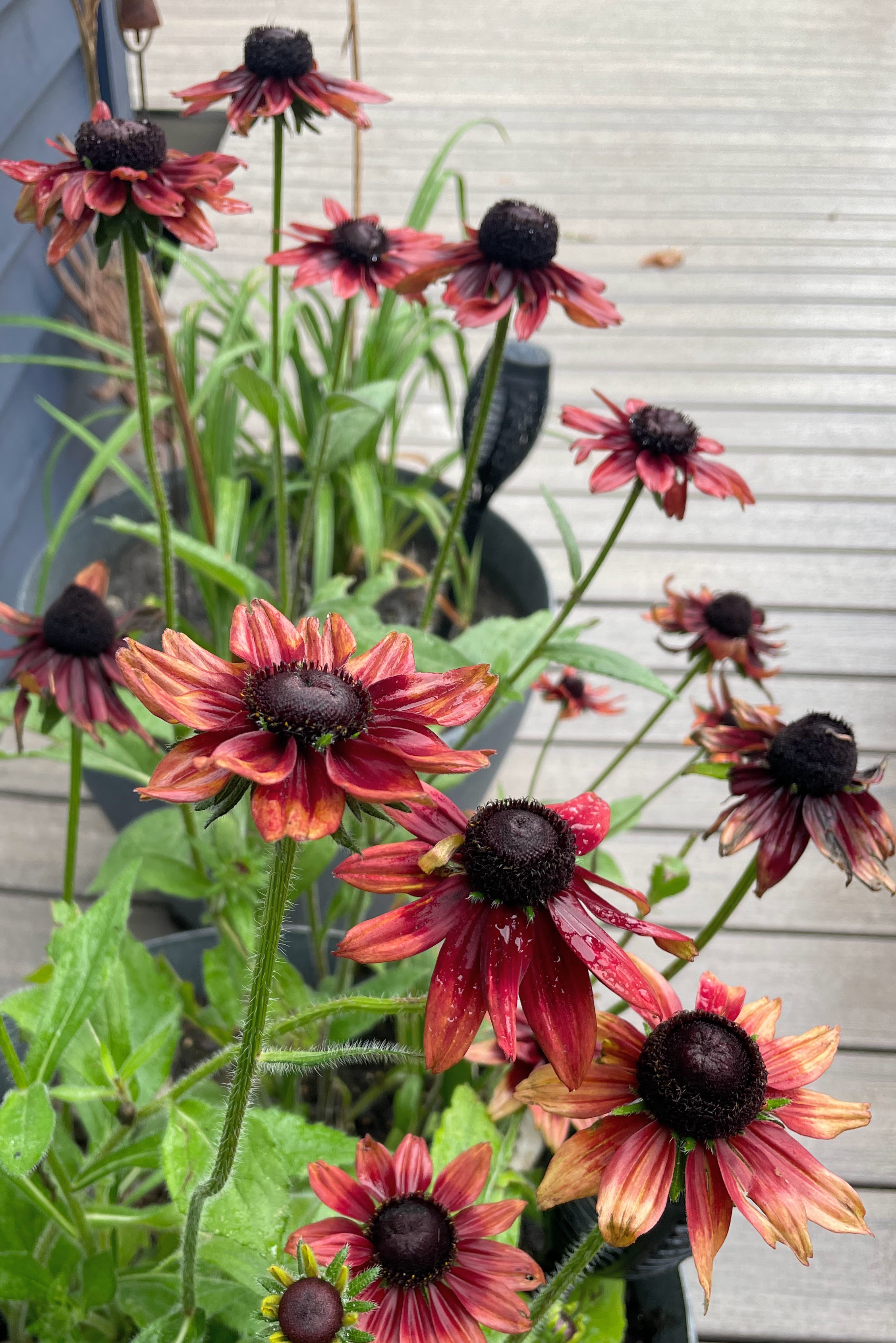
    You may look at the beautiful potted flowers above and know right away what they are. When I look at them now, I also know. And forever more, I will know. But for the past couple of weeks, every time I walked by this part of the deck, I reveled in how beautiful these ‘echinacea’ were, and what an unusual color, too. I would then glance over to a different part of the garden and marvel at how many other beautiful varieties of echinacea existed:

    But I was wrong about the potted flowers in the first photo, despite abundant evidence. My disregard for the facts started when I forgot what was written on the original plant tags and did not feel I needed to re-check; it spiraled from there and led me to overlook the obvious.

    Mostly, it was hubris; I thought I knew, so I failed to observe properly, or fact check. What clues did I miss? Many. As this blogger stated, a gardener confusing a rudbeckia with an echinacea is like a farmer confusing a sheep with a goat. Ouch. In my defense, sheep and goats are very closely related genetically– as are rudbeckia and echinacea. And until a couple of weeks ago, I did not have this ‘Cherry Brandy’ rudbeckia in my garden. But I get the point, and now I can see the obvious differences between the “sheep” and “goats” in my garden.

    Here’s how to tell them apart:

    1. First, it’s not by how hairy one plant is, vs the other. I read that one way to tell them apart is that echinacea have hairier leaves. But both plants have hairy leaves; echinacea leaves feel rough like a cat’s tongue, while Rudbeckia hirta leaves are softer and more velvety (see photo below):

    Since both plants have hairy leaves, it’s not the best test. There is a better one (in fact, the best and easiest one):

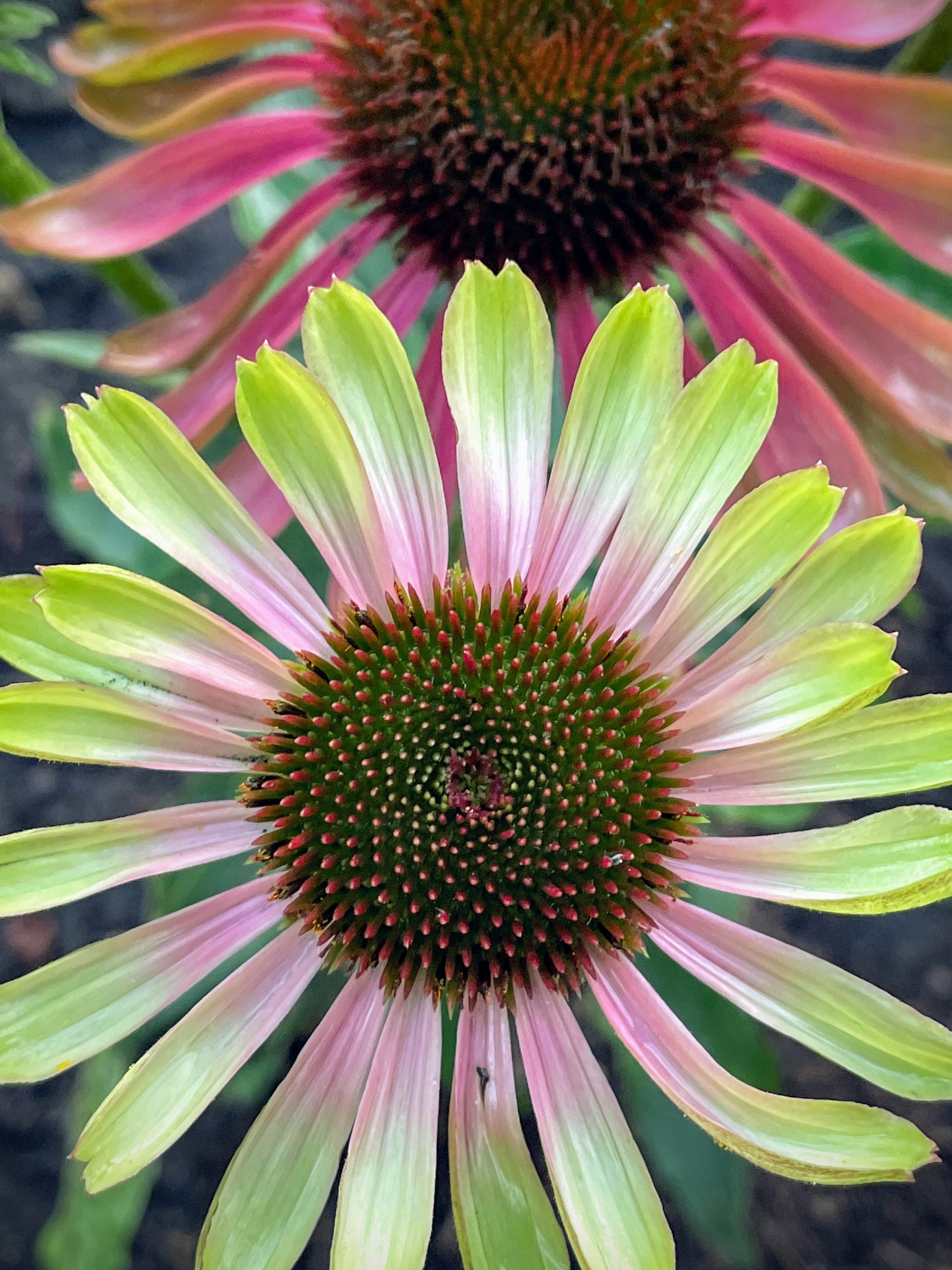
    2. Examine the cones. Rudbeckia hirta cones (l) are relatively soft and usually look like black button tufts (hence the name Black-Eyed Susans), while echinacea cones (r) are harder and pricklier and more conical — and are not black, but orange or green or brown.

    3. Look at the “petals” (though technically, they are ray florets, not petals): This can often help, but not always. According to this way of telling the difference between the two plants, echinacea petals tend to droop and point downward while rudbeckia petals tend to stick straight out. But in the photo below, some of the echinacea petals are drooping and some are sticking straight out. It depends on the variety and the plant’s stage of development. So use the “petal” test as a first form of evidence gathering if you like, but be sure to confirm with the cone test; it will give you the right answer.

    In seeking the right answer today, I learned something new. Not just about the difference between Rudbeckia hirta and echinacea, but about assumptions and facts. And about taking the time to stop and smell the roses — and see the petals and leaves, and touch the cones.

    Recipe: Fried Zucchini Flowers and Sage Leaves

    24 Jun

    Fritti LR
    Zucchini flowers taste as good as they look, if not better. Stuffed with fresh mozzarella, a hint of anchovy (or not),  lightly battered and fried until crisp and golden, they are summer on a plate. Fresh sage leaves–encased in the same warm, crispy shell–will turn your thoughts to autumn. But the good news is, you can have them now. Two appetizers straight from the garden.


    Fried Zucchini Flowers and Sage Leaves
    4-6 servings

    1 c. (250 ml.) water–regular or sparkling
    1 c.  flour, spooned lightly into the measuring cup (about 133 gr.)
    salt and pepper
    12-14 zucchini flowers*
    9 0z. (250 gr.) fresh mozzarella
    2-3 anchovy fillets (salt-cured, packed in olive oil)–optional
    canola or sunflower oil–enough to fill a medium sauce pan to about 2.5 inches (6 cm)
    handful of fresh, firm sage leaves

    *Use male zucchini flowers. They appear at the end of long stems, unlike female flowers, which appear at the end of the emerging zucchini.

    Preparation

    1. Prepare the batter: Put the water in a medium bowl and sift the flour over it, whisking to incorporate. Add a pinch of salt and some freshly ground pepper. The batter should be thick enough to coat the flowers, but not pasty. See the right consistency for a light batter below. Set aside the batter while prepping the flowers.

    Fritti LR-9

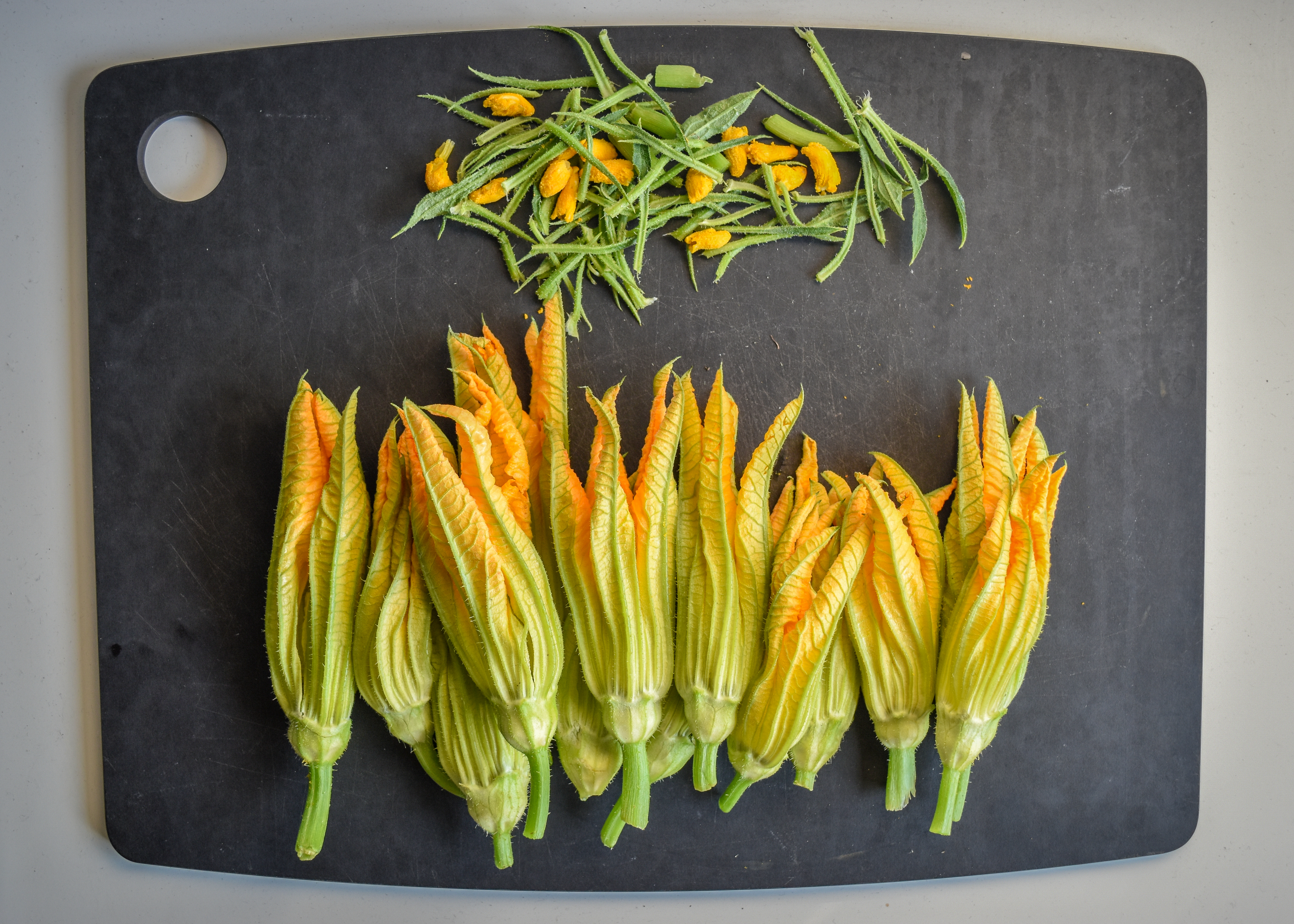
    2. Lay out all the zucchini flowers, wipe them clean, and discard any that appear bruised or past their prime (they are quite perishable). Trim the stems to about 1 inch (2.5 cm), leaving enough stem to grasp and dip. Pull off the sepals (the spiky green parts at the base of the flower). Gently work your thumb and index finger into the flower and pinch off the pollen-topped stamen. You will probably tear the flower slightly; that’s ok, but try not to tear it too much, or shred it. See the prepped flowers and discarded sepals and stamens below:

    Fritti LR-4

    3. Mozzarella and Anchovies: Cut the mozzarella into as many 2.5-inch ( 6 cm) long rectangular pieces as you have flowers–or whatever size best fits into the flowers you have. You can omit the anchovies, you can go all in and lay a nice piece of anchovy fillet on top of each piece of mozzarella before placing both in the flower, or you can take a moderate approach. That entails placing the anchovy fillets in a bowl, drizzling them with some extra olive oil, mashing them with a fork, then placing the mozzarella pieces in the anchovy oil so they get a hint of the flavor rather than a wallop. Either way, you want to place the mozzarella pieces (with or without anchovy) into the flowers, covering them up as best as you can and twisting the ends of the flowers closed to create a mini pouch.

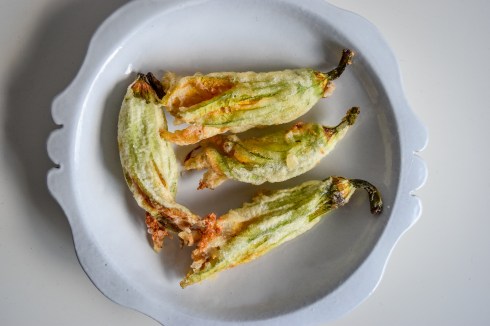
    4. Bring the oil to high heat in a medium saucepan. Holding the stem end of a sealed zucchini flower, dip it into the batter in a twirling motion to keep it closed (sealing any open parts with your fingers and twisting the bottoms closed again if needed). When the flower is completely covered in batter, carefully lower it into the oil. Repeat for as many flowers as will fit into the saucepan in one layer without crowding; you will need to cook the flowers in batches. When one side is golden, turn the flower over (or push the flowers gently under the surface of the oil as they cook, to ensure both sides become golden).

    Fritti LR-5

    5. Drain the fried flowers on paper towels, sprinkle with a bit of salt, and eat as soon as possible!

    Fritti LR-6

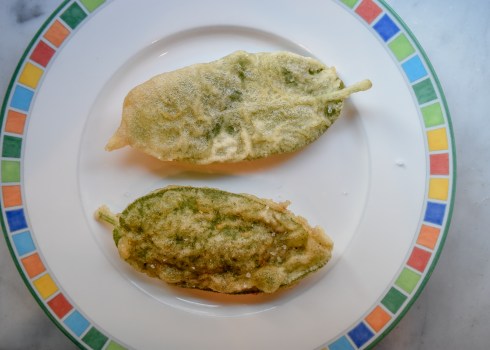
    6. Now for the much-easier sage leaves: Wipe them clean, dip each one into the batter, and fry until golden. Drain on paper towels, sprinkle with a bit of salt, and…

    Fritti LR-7

    7. … enjoy!

    Fritti LR-8

    Virginia is for (Flower) Lovers

    7 May

    Having a college student in Virginia means having a good excuse to visit the Lewis Ginter Botanical Garden. A previous visit was bittersweet; a recent one this past weekend was just sweet. I love spring, and flowers, and being outside on a glorious day. Here are a few of the horticultural (and aquatic) sights that significantly increased my happiness quotient last Saturday.


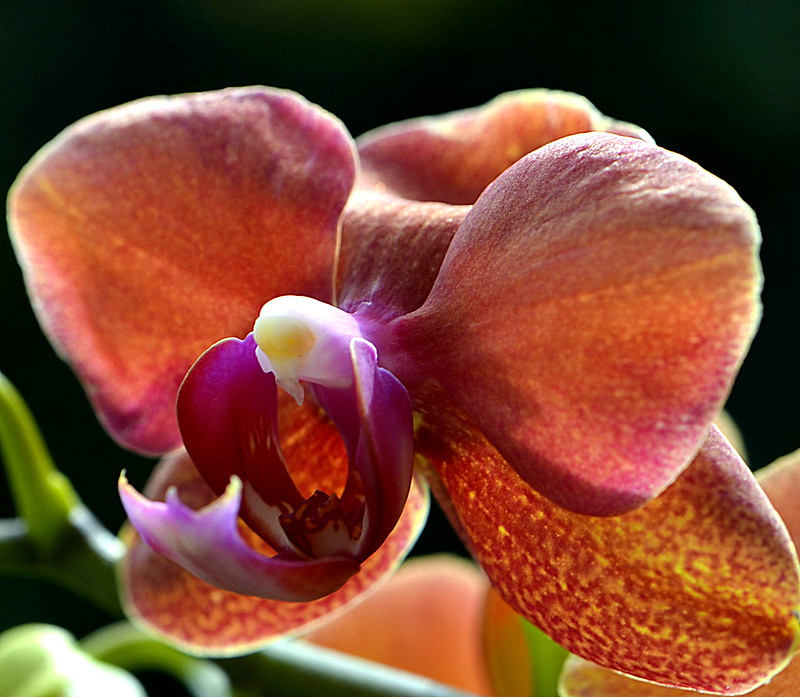
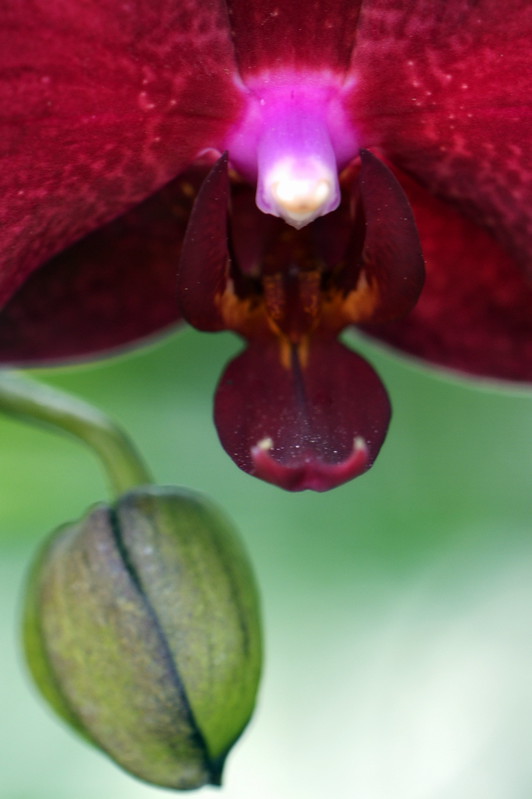
                                                                Moth Orchid

      
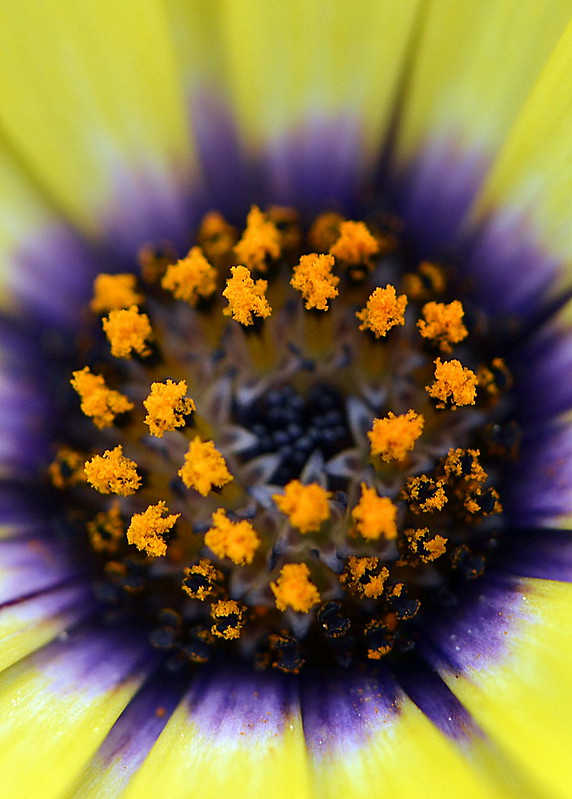
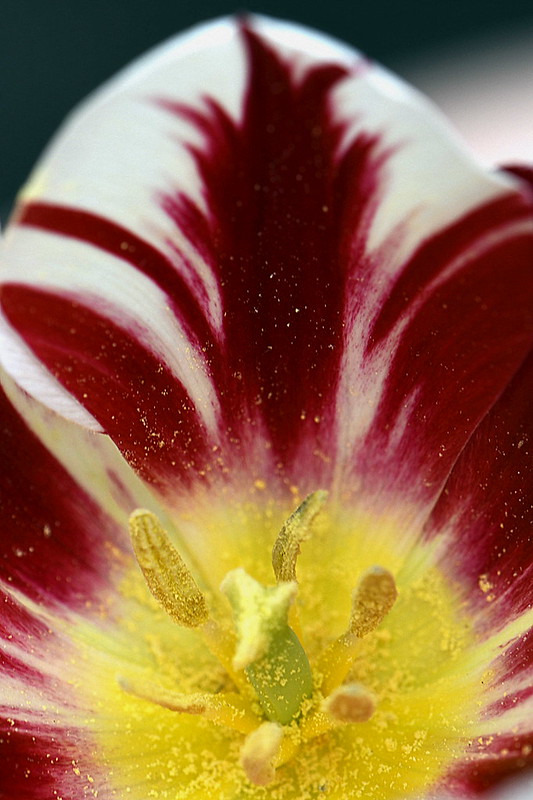
                              Tulip                                                             African Daisy

      
                           Moth Orchid                                                        Tulip


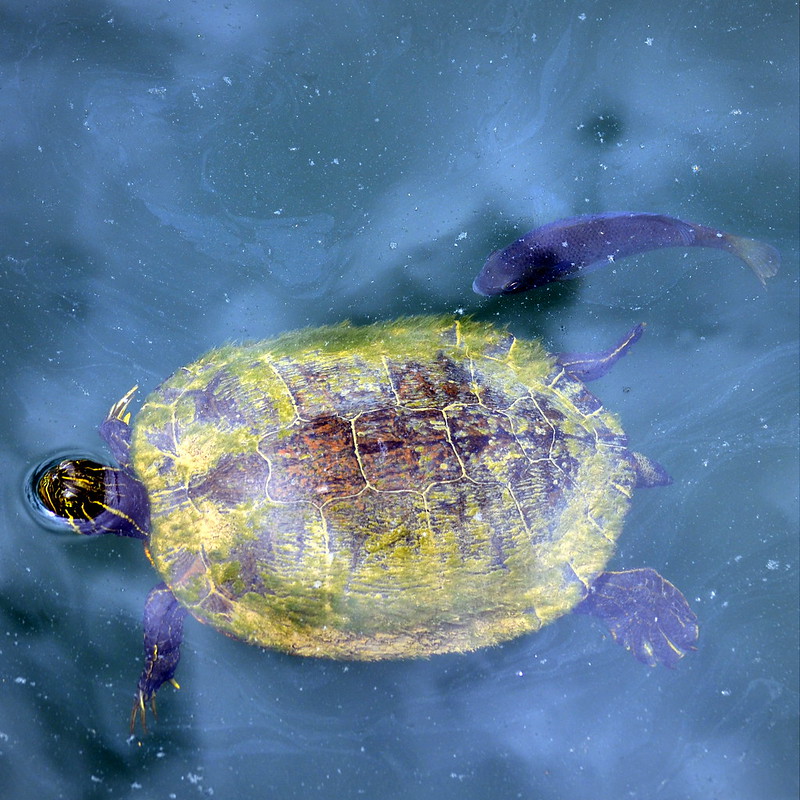
    The turtle’s shell is the pond’s equivalent of a lunch counter, providing fish with a nice algae snack.

    Collegiality, Competition, and Lotuses

    29 Jun

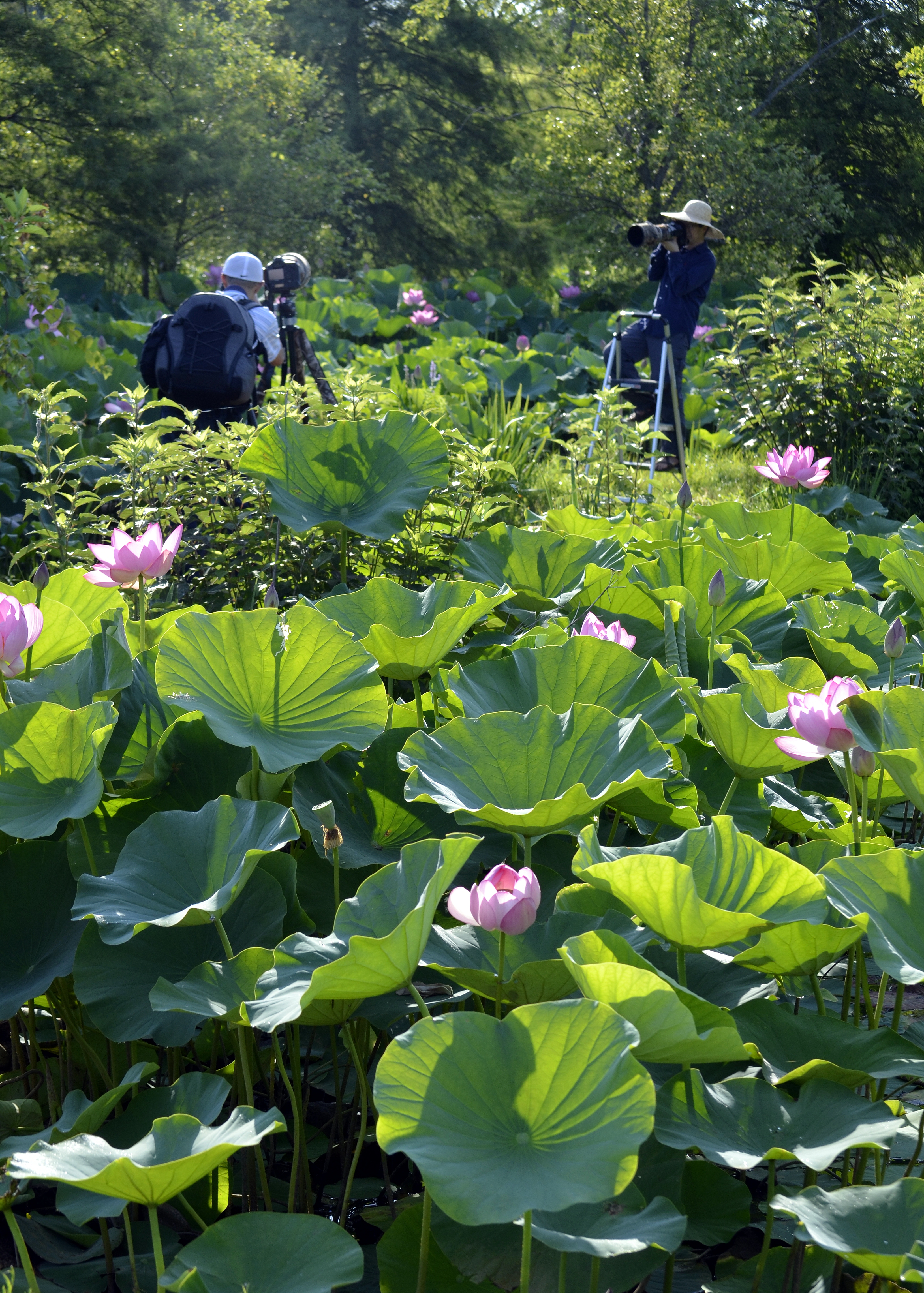
    Early this morning, my mother and I stumbled upon an other-worldly scene: thousands of lotus flowers in bloom at Kenilworth Aquatic Gardens in Washington, DC. We arrived at 7:30 am to see the lotus flowers while they are open. The lotuses were indeed gorgeous, but the most striking aspect of our visit was seeing all the photographers who had arrived before us to stake their claims. The ones I spoke with were amateurs–but they were serious amateurs, with lenses almost as big as my leg, tripods, reflectors, step ladders, rolling equipment cases, and assistants. Some came from as far as New York. I had no idea Kenilworth’s lotus blooms attracted this much attention. I showed up with my camera, a small case containing three lenses (the largest of which is smaller than my hand), and my mother. No tripod, no reflector, no ladder. I looked glaringly out of place, unencumbered by the accoutrements of the trade, with not even a flak jacket to my name.

    Photographers
    For the most part, there was a great spirit of collegiality–sharing of tips, patient waiting for good spots, etc. But everyone was there to get a good shot, and as the sun bore down and the light became trickier, some competitiveness emerged. One photographer and her friend/assistant had spent some time setting up tripod and camera, and were focusing on a particularly lovely lotus flower. Another photographer stopped close by, but not in the first photographer’s line of vision, to see if he could get a differently angled shot of the same flower. He asked if that was okay. Female photographer: “I can’t tell you where you can or can’t stand, but there are lots of other flowers here.”  Male photographer got the hint and moved on. I’d like to think that was the exception, rather than the rule.

    I was using a macro lens to capture a dragonfly on a lotus bud when another photographer came by, took a second look to see what I was shooting so close up, and got very excited when he saw the dragonfly. I stepped aside to give him a  turn. The good thing about dragonflies is that once they find a spot they like, they often spend some time there, so I knew I would probably get another chance. Plus, the gentleman I ceded the spot to had a huge lens and I knew he would be able to get a really, really nice close-up shot. If I got any closer with my little macro lens, I’d fall into the pond.

    Later, I was admiring some lotuses, but ruing the fact they were in direct sunlight–and hence, beyond my ability to shoot them properly–when the same gentleman stopped by again, and had his friend hold up a huge reflector that allowed both of us to take the shot (third photo below). In the end, I like to think that though we are all photographers of varying abilities, we are kindred spirits nonetheless–out there to capture fleeting moments of beauty. Below are lotus buds and blooms, with close-ups of a lotus receptacle, and of water pooling on a lotus leaf.


    Spathe and Spadix

    9 Jun

    There are two plant parts that are frequently found together whose names I quite like: “spathe” and “spadix.” The two words evoke something mysterious, almost like “cloak” and “dagger.” In fact, there is an element of danger when it comes to plants that have both spathes and spadices, such as Anthuriums, Calla Lilies, and the fabulous Titan Arum (also known as the Corpse Flower because it smells like rotting flesh): they are all poisonous. Their sap contains needle-like calcium oxalate crystals, which can cause significant pain and swelling if an unwitting animal happens to take a bite of the plant. Ingesting large amounts can be fatal because the swelling can make swallowing and breathing difficult–but most animals quickly learn to stay far away. The plants have an excellent defense system.

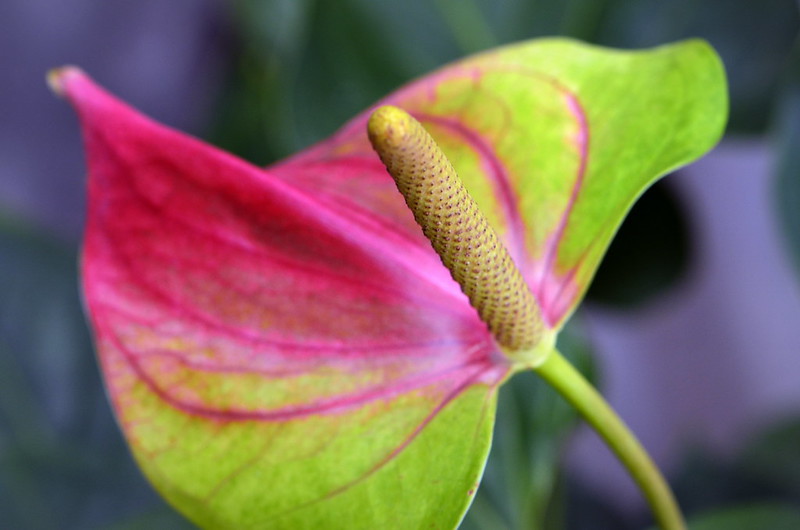
    Toxicity aside, plants with spathes and spadices are striking, as evidenced by this Anthurium andreanum ‘Fantasy Love,’ which is a member of the Arum family (Araceae, aka the aroids). This Anthurium may want to repel herbivores, but it also wants to attract pollinators and one way to do that is via the colorful spathe.


    The spathe looks like a petal, but it is actually a bract–a modified leaf. It helps get pollinators closer to the actual flowers, which are tiny and are located in spirals on the spadix. Here is a close-up view of an Anthurium spadix–the stigmas on the almost microscopic white female flowers are emitting a fluid that indicates the flowers are ready to be pollinated. If pollination is successful, the spadix will produce little fruits (or berries) containing seeds.


    Sometimes spathes are open and fairly flat, as with the Anthurium above, but they can also encase the spadix and appear funnel like, as with Calla lilies. The photo below is an internal view of my neighbor’s ‘Calypso’ Calla lily–with the  deep-red spathe almost entirely surrounding the spadix.


    One last fun fact: some spadices in the Arum family can produce a lot of heat in cold weather, reaching temperatures significantly warmer than the surrounding air temperature. The Titan Arum is one of them. This ability is yet another way the plants attract pollinators.  A warm spadix does two things: it provides pollinators with a bit of energy in chilly weather and it acts as a fragrance diffuser, wafting that delicious putrid odor just a bit further as an added enticement. So if you are a pollinator, you get a colorful, warm, and nice smelling (ok, odoriferous) welcome. If you are a herbivore, you come under chemical attack. Isn’t nature great?

    Banana Flowers and Other Edible Parts

    22 May

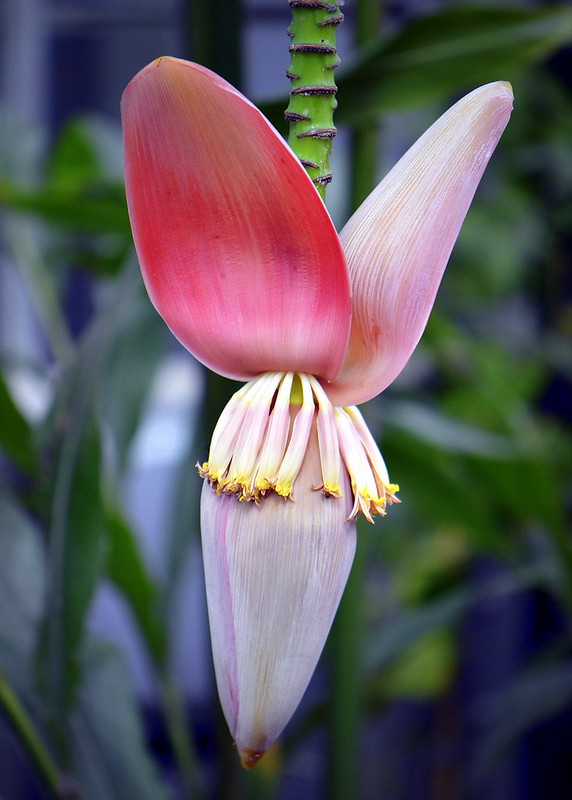
    Being a bit less mobile than usual, I thought I’d use the opportunity to choose a photo I’ve previously taken and see if I can learn more about the subject. What you see below is commonly called a banana flower or banana blossom (photo taken at the United States Botanic Garden). I’ve always been struck by this part of the plant, a deep-red appendage that dangles below the bunches of bananas. Though we like to think of the banana plant as a tree, it is technically a perennial herb, albeit a really big one; it dies down to the ground after the plant flowers and produces fruit. The inner part of the stem of the plant (which is actually a false stem consisting of leaf sheaths) is edible, as are parts of the flowers–they are considered vegetables and are popular in Asian and tropical cuisines, where they are used in salads, curries, stir fries, and other dishes.


    The banana “flower” seen in the photo above is actually the lowest part of an inflorescence consisting of layers of bracts (the petal- or leaf-like parts) that cover rows of  flowers. The female flowers are higher up and can develop into fruit (bananas). Once that happens, the inflorescence elongates and produces a terminal male bud. Here, the redder (and tougher) outermost bracts of that bud have opened upward, revealing yellow-tipped male flowers underneath and paler closed bracts below.

    Different parts of the banana flower (or bud) can be eaten: the innermost bracts, the florets (once the stamens and tough covers have been removed), and the inner core, or heart. The tougher outer bracts are often used as serving plates for dishes made with the other parts of the banana flower. I don’t have easy access to banana flowers, but if you do and want to experiment with them, here are some resources:

    To read about the ornamental Golden Lotus Banana/Chinese Dwarf Banana, see this post. To read about the difference between Musa (bananas), Strelitzia, and Heliconia, see this post.

    And here are some additional banana-related photos:

    1) A banana leaf unfurling at the Eden Project in England. Each leaf emerges from the center of the banana plant in the form of a rolled cylinder. Once the last leaf has emerged, the plant produces the inflorescence, which starts off pointing skyward, but then falls over and dangles as it gets heavier and the female flowers develop into bananas.
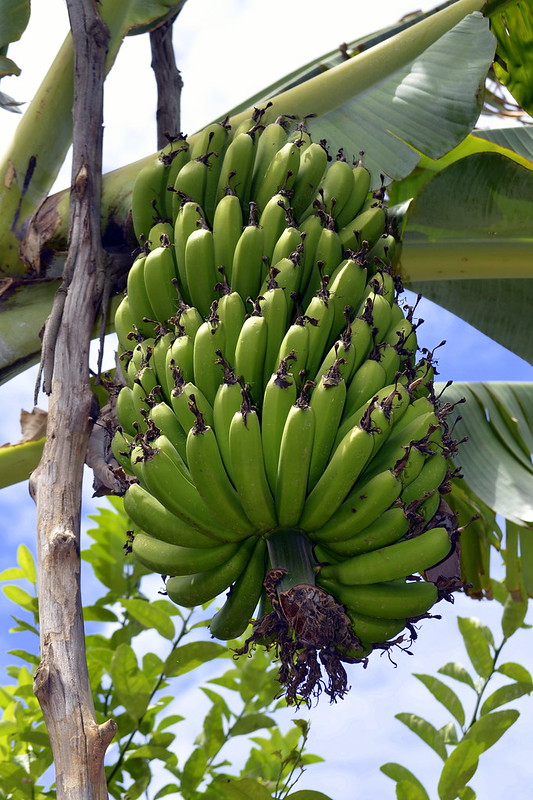
    2 ) Banana bunches on the plant (with the terminal bud having fallen off). Some bunches can contain 200-300 bananas each; the largest one recorded by the Guinness Book of World Records contained 473 bananas and weighed 287 pounds.
    3) Banana transport in Rwanda.