Aphids before the Storm

9 May

At the moment, the main insects on my radar are the 17-year cicadas that will crawl out of the ground any day now, cover everything in sight, deafen us with their mating songs, lay eggs, and then drop dead. They have yet to emerge from hibernation, at least in my neighborhood. I’m happy to delay the moment as long as possible, even if it is an historic event. Raking a blanket of cicada carcasses off the lawn isn’t among my favorite gardening activities.

Capitalizing on this lull before the storm, however, another insect group took up residence in the rose garden — aphids.  I am a welcoming sort, but not when it comes to critters trying to suck the life out of my newly planted roses, which are just beginning to bud.

 
So I squirted them. As carefully and naturally as possible. I added 2 tbsp. dishwashing liquid and 2 tbsp. vegetable oil to 32 oz. of water in a spray bottle and then sprayed each of the roses — buds and foliage together, sliding off as many aphids as I could with my fingers (that’s where the oil comes in handy).


Victory! The aphids are all gone (for now), but success came at a price: the soap slightly burned the foliage.


Should the aphids put in another appearance, I may need to reduce the amount of soap in the solution — and/or rinse the roses afterward. I didn’t rinse this time because I knew it would rain later that day and it did, but obviously not before the damage was done. On the plus side, the roses are pest free, though some of the leaves are a bit speckled. Safe to say, gardening is a never-ending learning process, and I have a lot to learn….

Next task: watching for the aphids’ cousins to emerge — yes, cicadas are related to aphids.

Weekly Photo Challenge: From Above

7 May

WordPress, which is the platform that hosts this blog, offers a Weekly Photo Challenge through the Daily Post. Most weeks I don’t have anything quite compatible to offer, but this week the challenge was “From Above.” And coincidentally, I had recently taken a photo from above, of one my Alliums (Purple Sensation) that was just beginning to open. So here is a bird’s-eye view.

2013: Garden Phase 4

4 May

Winter is a time of reflection, and spring is a time of action. During the past couple of months in the garden, it’s been all about putting everything in order (weeding, pruning, weeding, relocating, more weeding, planting, edging, weeding, expanding, mulching, and a bit more weeding).

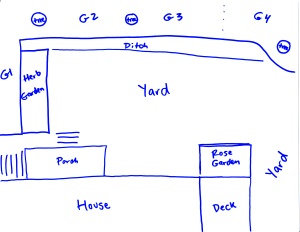
As I mentioned when I started the blog last year, we live in a townhouse and are lucky to have a tiny bit of land surrounding it in which to plant things. A large portion of the available space for flower beds is long and straight, bordered by a wooden fence we share with a neighbor on one side, and a drainage ditch on the other (county mandated). Luckily, the space is broken up by three trees.  When we moved in, there was nothing but grass. The first spring in our townhouse (2010, Phase 1), we created a narrow flower bed  (G1) along a short side of our yard and put in two flower beds parallel to the long wooden fence (G2 and G3). In 2011 (Phase 2), the children built a small herb garden on Mother’s Day  next to G1, and I filled out G2 a bit more. In 2012, I built upon lessons learned in 2011, and continued to add to the three flower beds (especially G3) and the herb garden. That was Phase 3.
Garden_0001
Chicken-scratch version of main parts of Garden Layout, hopelessly out of scale….

Phase 4 (Spring 2013) has thus far entailed a lot of transplanting–moving plants to locations better suited to their temperaments and space requirements.  The feisty Porcupine Grass plants on either side of the Crape Myrtle (G2) were in danger of smothering it, so we dug them up and moved them  a couple feet farther away in each direction while they were still dormant. They are now happily growing away in their new spots.  The Montauk Daisies (G2) were also smothering everything in their paths, so we repositioned them so they were perpendicular to the fence rather than parallel to it; there was plenty of space in the back for them to do their thing, and that opened up space at the front of the flower bed. I fell in love with the Witch Hazels at Brookside Gardens and contrary to what I said, I decided not to admire them from afar. For better or worse, there is now a fine specimen growing in G1, though that meant moving a few plants to G3.

In Spring 2013, we also welcomed in the new. The entire family was here just before Easter (one son home from graduate school along with his girlfriend, another son back from college, and the two high-schoolers and a professor husband on spring break), and what did they do? They all spent part of their vacation helping to build a small Rose Garden along one side of the raised deck (the deck, porch, and entrance to the house are about 4 feet above garden level). I transplanted two existing roses into the new garden, and added four more. To top it off, last weekend I planted some vegetables in and around the roses. An odd combination, I know, but the Rose Garden is in a prime sunny spot, and it was looking a bit bare with just the roses, so I decided to be unconventional and go with vegetables: eggplant, tomatoes at the very back against the wall of the deck, and zucchini–everything I need for a nice ratatouille. (In my defense, tomatoes are supposed to help prevent black spot….). I’ll see what lessons I learn from this experiment. But a very huge thank you to my husband and the younger generation for making it all possible.

Adding to our expansion efforts, we removed a hammock that was along the far back portion of the fence adjacent to G3, dug up the earth and added manure, compost, and gypsum (since our house essentially sits on a mound of clay), and started a new flower bed there (G4), which wraps around a corner where the third tree is. It is still under construction, but I did get some bulbs in (Gladioli and Lilies), plus a Camellia, some Hostas, more Echinacea to accompany the lone surviving Double Scoop Bubble Gum, and some Astilbe, with two peonies still waiting to be planted (today, I hope).

As a finishing touch (though no garden is ever finished), I dug out the leaf- and old mulch-filled drainage ditch, lined the garden side with stones to prevent the mulch from falling into the ditch (the stones all emerged when we created the various flower beds–so our house actually sits on a clay and stone base), and then set up a small fence all around the flower gardens to keep the rampaging Schnauzers from killing the emerging and new plants. And that’s all for now…. Probably far more than you ever wanted to know. But the end result is and will be a pleasure to behold for those of us who are happy just watching things grow.
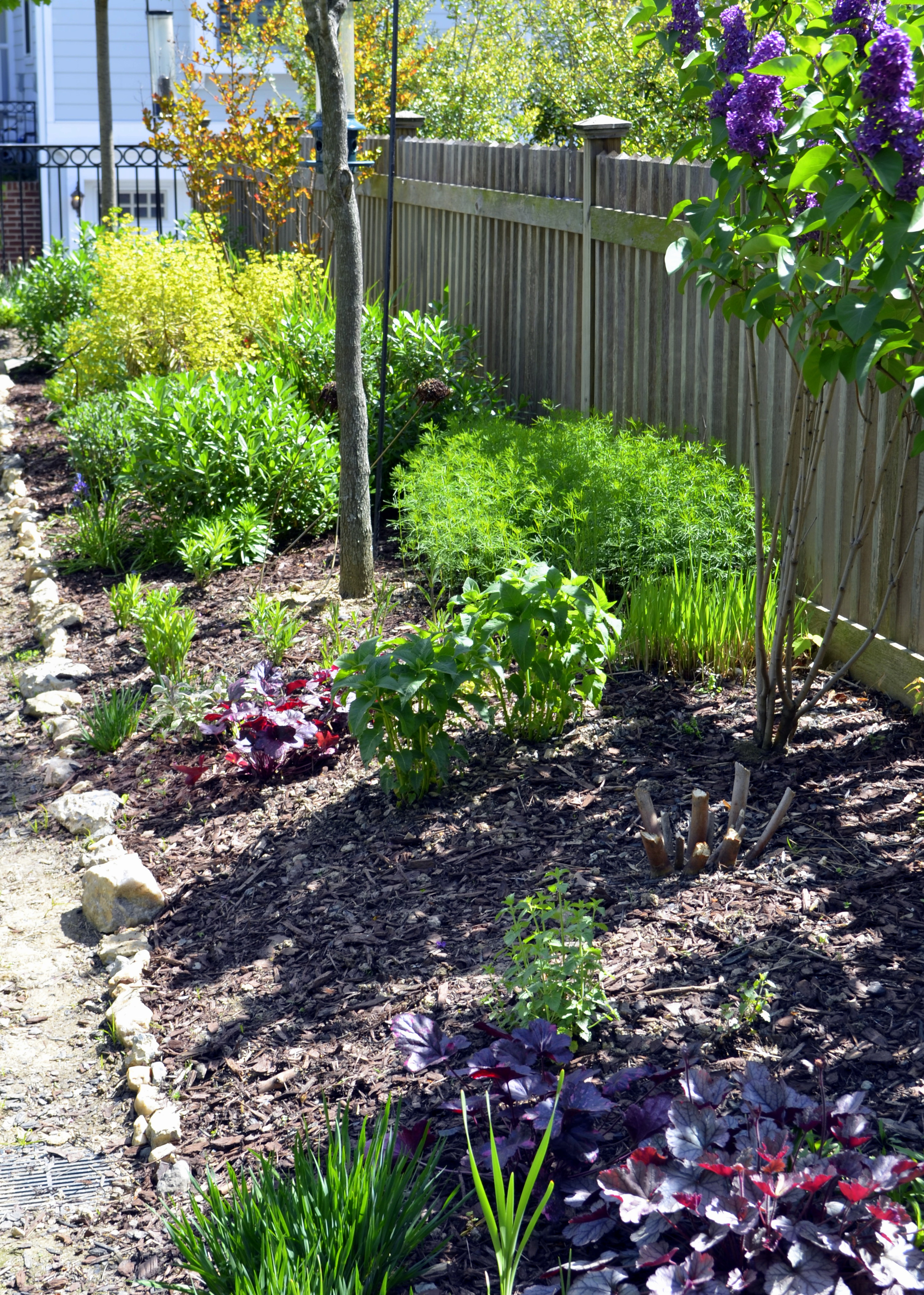
G2 and G3
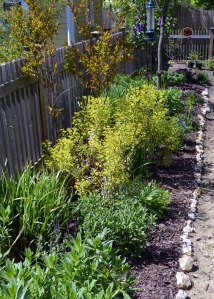
G2 (with G3 and new G4 in background), ditch to right:
Montauks, Salvia, Gaillardia, Porcupine Grass, Crape Myrtle,
Euphorbia
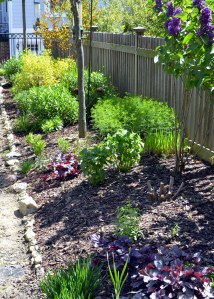
G3 and G2
G3 (with G2 in background): Heuchera, Blue-eyed Grass, Variegated
Sage, Aster, Lilacs, Hyssop, Butterfly Weed, Tickseed, Verbena
Bonariensis, and old Hibiscus (Kopper King) stumps
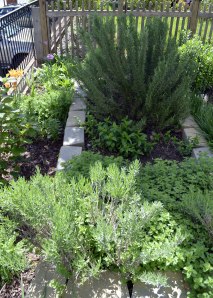
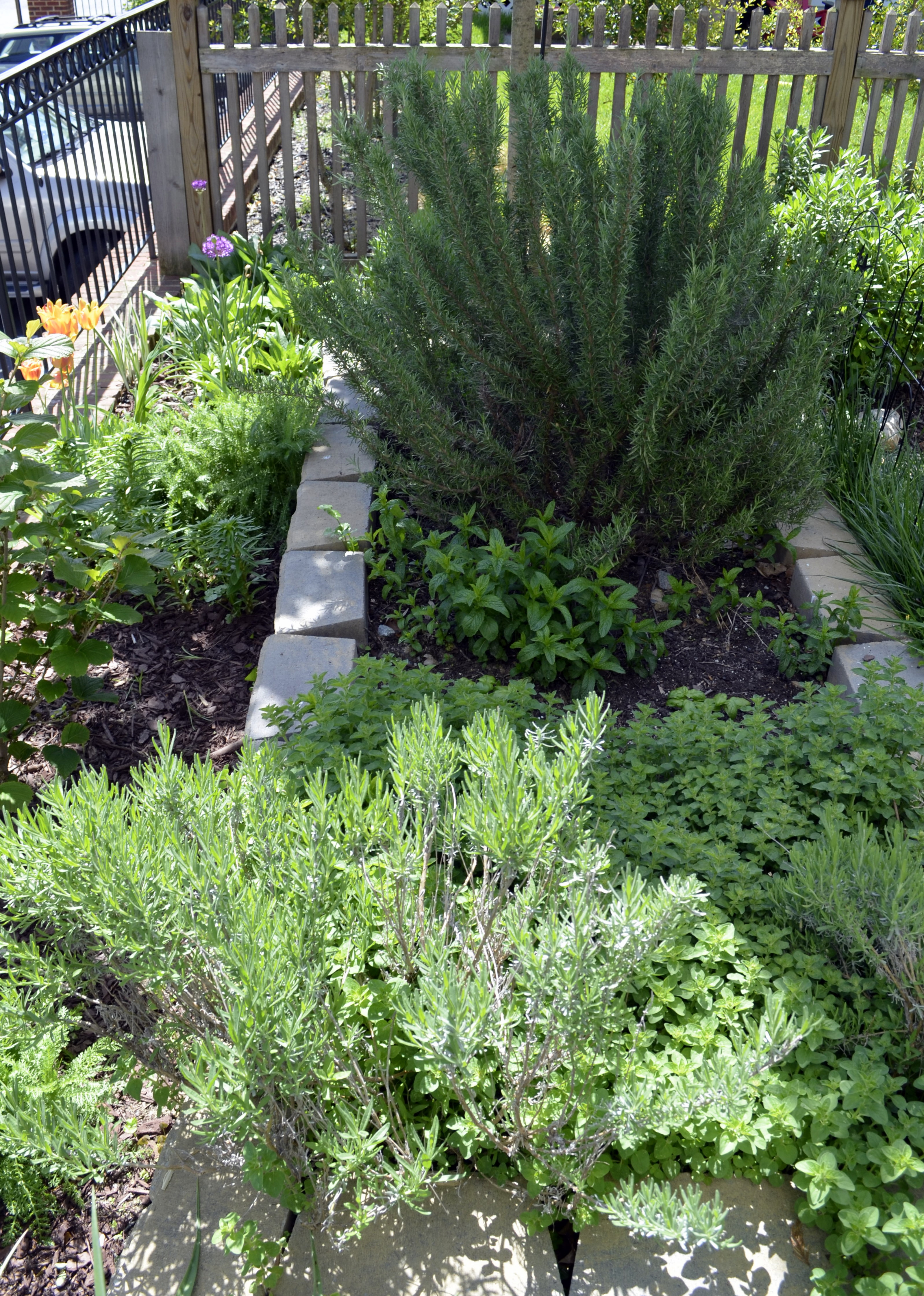
Herb Garden
Herb Garden (with G1 to the left): Lavender, Oregano, invisible but
newly planted Basil, Mint, exploding Rosemary, and wayward Cilantro
growing in G1

Photo of the Month: April 2013 (Wallflower)

30 Apr

I have a thing for the color orange, and I especially love how it combines with blue. So when I had to decide where to put this potted Wallflower (Apricot Twist), there was no question: it had to be on the porch, against the blue wall of our house. And then I stepped back and let the magic happen.

Recipe: Turkish Feta Dip with Paprika

27 Apr

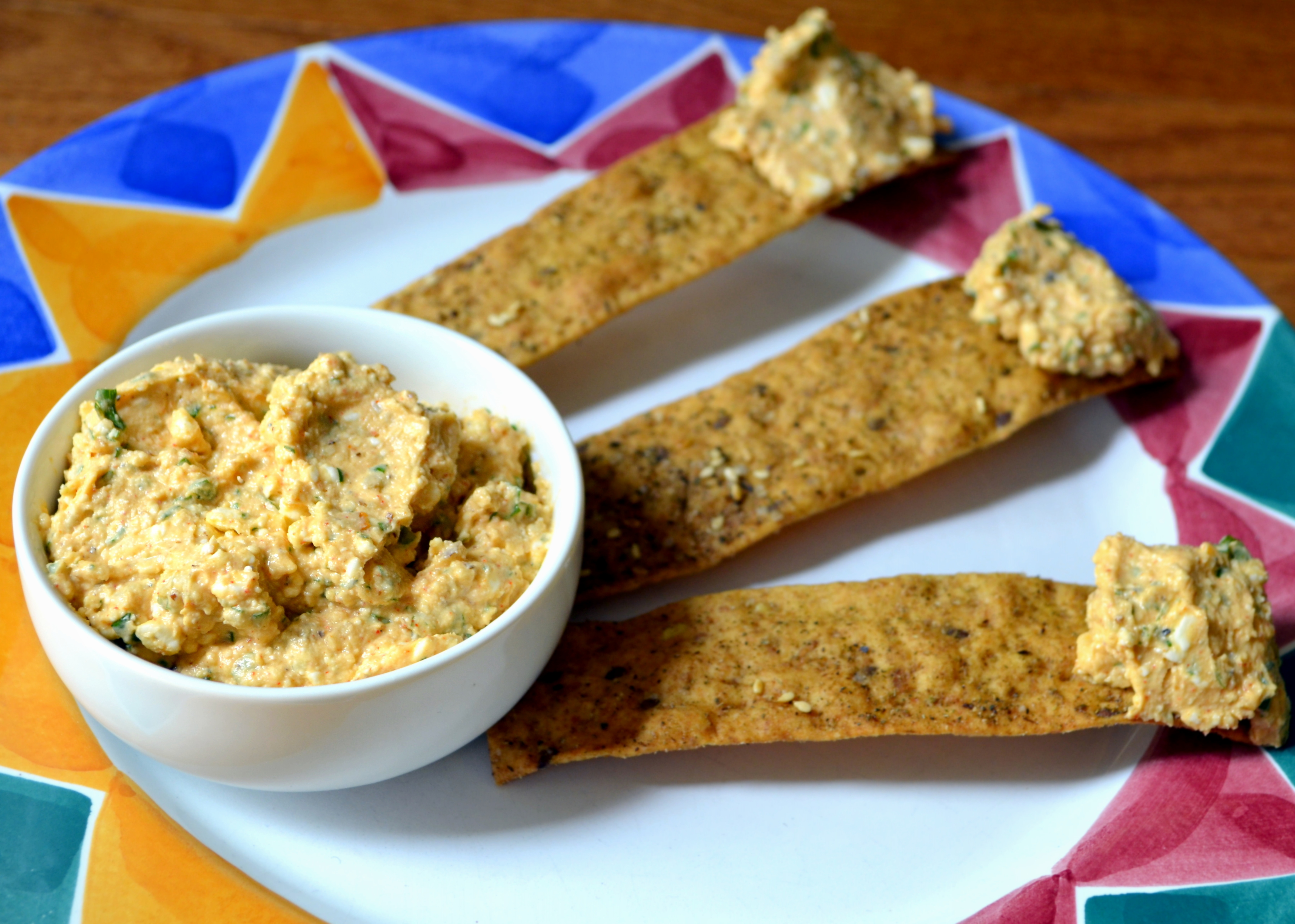
Fantastic on its own, this dip is even better as the basis for many delectable creations, from mini appetizer stacks to a range of sandwiches (try it on some crusty bread or a cracker, topped with Eggplant with Garlic Vinaigrette and some Roasted and Marinated Bell Peppers). The cheese, yogurt, and walnuts provide a protein boost, but that’s not why you’ll want to eat this. You’ll want it for the nice tang and the endless possibilities. You can adapt it any way you like: more or less garlic or chili flakes, mint instead of parsley, walnuts or no walnuts, etc. Now that I think of it, this dip would probably be nice with some chopped Kalamata olives mixed in, too.

Turkish Feta Dip with Paprika

8 oz. feta cheese, crumbled
1 tsp. paprika
1 clove garlic, minced
1/4 c. chopped walnuts
1 tbsp. olive oil
4 tbsp. plain yogurt
1 tsp. fresh lemon juice
sprinkle red chilli flakes (crushed red pepper)
1 tbsp. chopped fresh parsley (or 1 tsp. dried mint)

Preparation

1. Place the feta in a medium bowl and mask with a fork. Sprinkle with paprika and mix in garlic.
2. Toast the walnuts in a 350-degree oven for about 5 minutes. Remove and crush finely with a mortar and pestle (or in a bag using a rolling pin), then add to feta mixture in bowl.
3. Add remaining ingredients and mix well to combine. If dip appears too thick, add a bit more yogurt.
4. Optional: drizzle with olive oil before serving.
5. Serve with crusty bread, pita bread, pita chips, toasted pita with zaatar, or any other cracker.

A Time for Tulips

25 Apr


Once upon a time, tulips were the most expensive flower in the world, the basis for a speculative bubble in the 1600s that later burst. Lucky for those of us who like tulips, we no longer have to fork over a small fortune to own just a single bulb; today, mere mortals can now choose from thousands of varieties. And while tulips are associated with the Dutch, the flower actually originated in Central Asia — the Ottomans were the first to cultivate it commercially.


The photos above are from a recent stroll around my neighborhood (which is, alas, not in the Netherlands or Turkey). I planted three varieties of tulips when I started my garden a couple of years ago, but now only have one variety left. Those miserable squirrels are tulip-bulb connoisseurs. But I have had the last laugh — the variety they did not manage to steal is my absolute favorite: a flame-colored, graceful, lily-flowering tulip, Tulipa Ballerina. It is aptly named. When I look at the photo below, I can almost see a group of ballerinas, gracefully bending to the right, holding their arms above their heads as they prepare for the next movement.

Recipe: Eggplant with Garlic Vinaigrette

23 Apr

I love eggplant–any which way, shape, or form–and this recipe is one of my favorite ways of making it. Caveat: in addition to liking eggplant, you must really like garlic, too, and you must eat this with other garlic lovers, because this is not a subtle dish–it is very ‘aromatic.’  Nonetheless, it is a beloved dish at our house–my daughter ate almost half of this platter of eggplant by herself!

I have always pan-fried it, pouring liberal amounts of olive oil into the pan as needed–but you could also try grilling whole eggplant slices then drizzling with the vinaigrette. The eggplant is great on its own, but is lovely when combined with other things. For our Mediterranean antipasti/tapas/mezze meal this past weekend, we created mini open-faced sandwiches by slathering pieces of crusty baguette with Turkish Feta Dip with Paprika, then topping with the eggplant and some Roasted and Marinated Bell Peppers. The eggplant is great with pita and hummus, too.

Eggplant with Garlic Vinaigrette

2 eggplants
salt and pepper
olive oil

Vinaigrette:
3 cloves garlic, minced
4 tsp. red wine vinegar
2 tbsp. olive oil
sprinkle chili flakes/crushed red pepper

Preparation

1. Slice eggplant into 1/4-inch slices, sprinkle with salt, and set in colander in sink to drain for about 30 minutes.
2. In a small bowl, combine the vinaigrette ingredients.
3. Rinse eggplant with cold water and pat dry between two dish towels, then cut the slices into quarters. Sprinkle with pepper.
4. Heat a cast-iron frying pan on medium-to-high heat, add a liberal amount of olive oil, then add eggplant quarters in batches (a single layer at a time). Cook until eggplant is dark golden brown on all sides, turning eggplant over with tongs to ensure even cooking, and adding more olive oil as necessary.
5. When each batch is done, arrange on serving plate and use a small spoon to drizzle a tiny bit of the vinaigrette onto each piece of eggplant while the eggplant is still hot (try to get a bit of garlic on each piece). Continue cooking all eggplant in batches, drizzling each batch with the garlic vinaigrette. The eggplant will soak up the vinaigrette.
6. Serve at room temperature.

Adapted from Joanne Weir’s From Tapas to Meze.

Recipe: Roasted and Marinated Bell Peppers

21 Apr

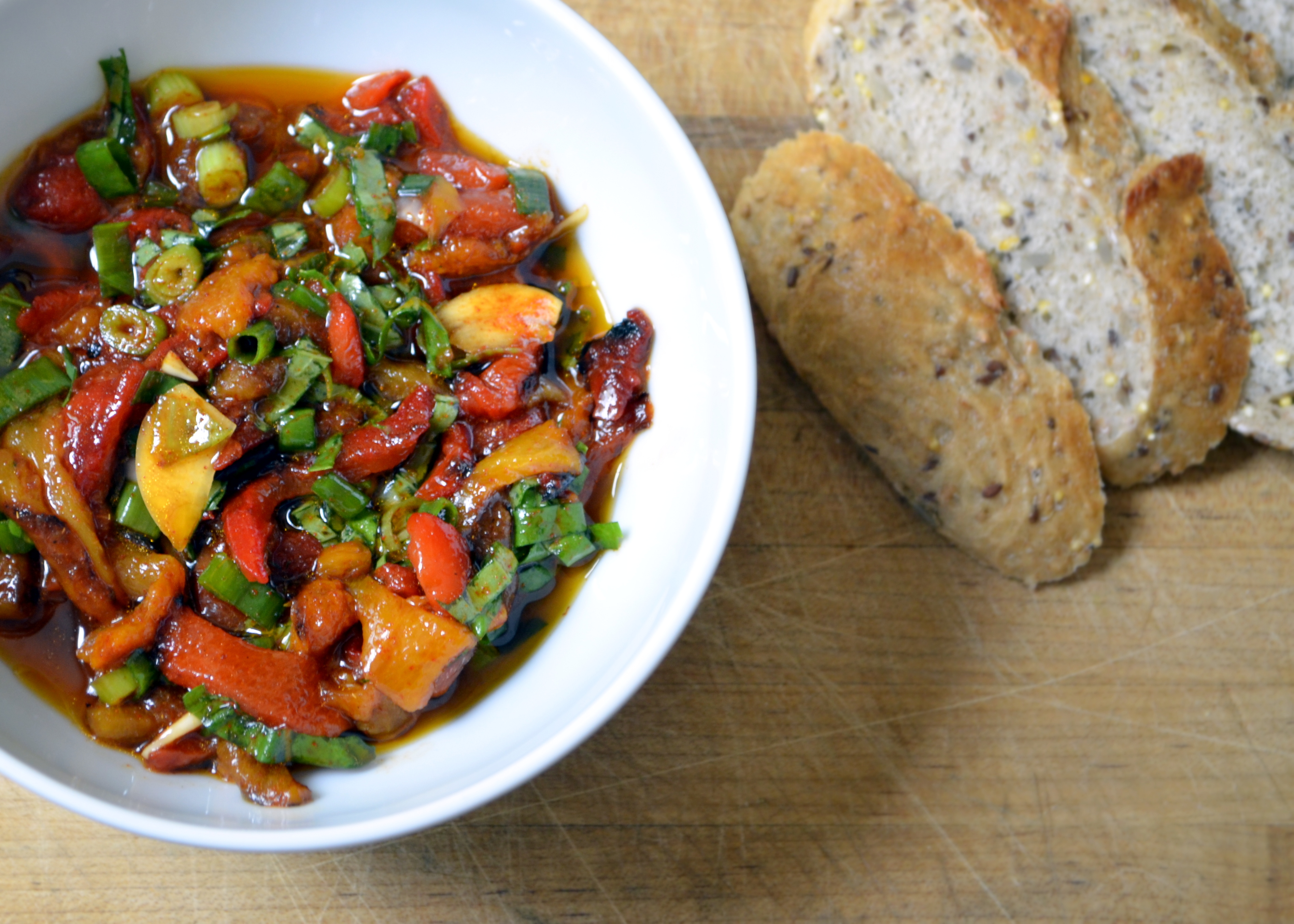
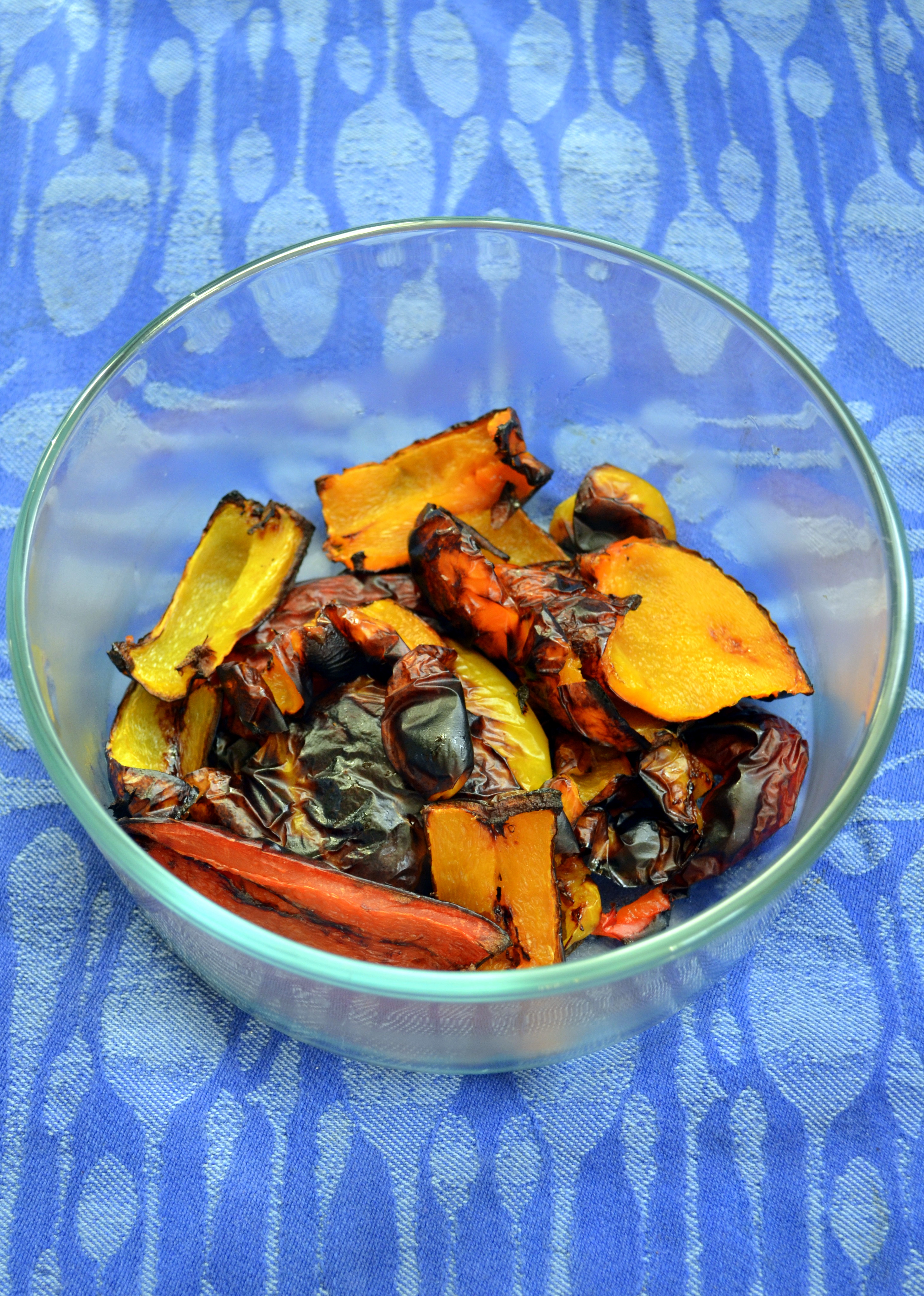
Fresh from my trip to Italy and with lots to do to get ready for the work week, I decided to prepare a Mediterranean antipasti-tapas-mezze meal made up of little dishes, simple ingredients, and nice bread. These Roasted and Marinated Bell Peppers are part of that meal, and they can be made ahead — they get better the longer they marinate. You can use all red peppers, or any combination of red, yellow, or orange that suits your fancy. In this case, I used one of each color.  I forgot the parsley before taking the photo, but will try to remember to sprinkle some on top before serving! With or without parsley, this is a nice addition to any Mediterranean multi-dish meal.

Roasted and Marinated Bell Peppers

3 large red, yellow, or orange (or combination) bell peppers
1/4 c. olive oil
2 tbsp. red wine vinegar
1 clove garlic, finely sliced
1 bay leaf
1 tsp. paprika
1 spring onion, sliced
5-6 leaves fresh basil
2 tsp. coarsely chopped parsley

Preparation

1. Turn on broiler.
2. Cut peppers into quarters; remove all seeds and membrane. Place peppers on baking sheet, skin-side up.

2. Broil until skin blackens, then put peppers into container with lid, cover tightly, and let cool.

3. When cool, carefully peel the skin off the peppers, and cut peppers diagonally into thin slices.

4. Add the remaining ingredients to the peppers, stir to combine, and marinate for at least 3 hours (or overnight) before serving.

Adapted from the Australian Family Circle Tapas booklet.

Postcard from Rome

20 Apr

Apologies for the silence–I was on a jam-packed work trip last week. But the meeting was near Rome, so I can’t complain!

Immediately after arriving in Rome on Sunday morning, I headed to a delicious lunch at the home of some dear friends, where I was treated to chicken rollatini and a ricotta mousse topped with melted Nutella. It was the start of a fantastic eating fest. After lunch, we headed to Eataly for coffee and to have a look around. Of all the beautiful things to see there, here is just one that struck me because of its appearance and name:  Ox Heart (or Beef Heart) ribbed tomatoes (Pomodori Cuore di Bue). On the way back to the hotel, I counted myself very lucky to be in Rome at just the right time to see all the wisteria in bloom.

[Please note that these blog photos were taken with my iPhone — the day-time/outdoor ones turned out a bit better than night-time/indoor ones….]

 
Pomodori Cuore di Bue                         Wisteria

I had very limited in Rome itself and since we had lived there before, I eliminated any sightseeing and focused solely on the gastronomic. And of the wealth of options on that front, I was miraculously able to eat two of my favorite things in Rome (ok, in the world). The easier of the two involved a lightening-quick pilgrimage to Della Palma gelateria near the Pantheon for a scoop of Roché gelato– dark chocolate base with crushed hazelnuts and wafer pieces, like the famous chocolates — topped off with a scoop of Duplo gelato, a rich caramel base interlaced with liberal swirls of Nutella.  There are many gelaterias in Rome, including some very famous ones, but this is the one I like best because it is where we always used to go as a family. And because of the Roché and Duplo…. I am sighing now, knowing it will be some time before I taste either again.

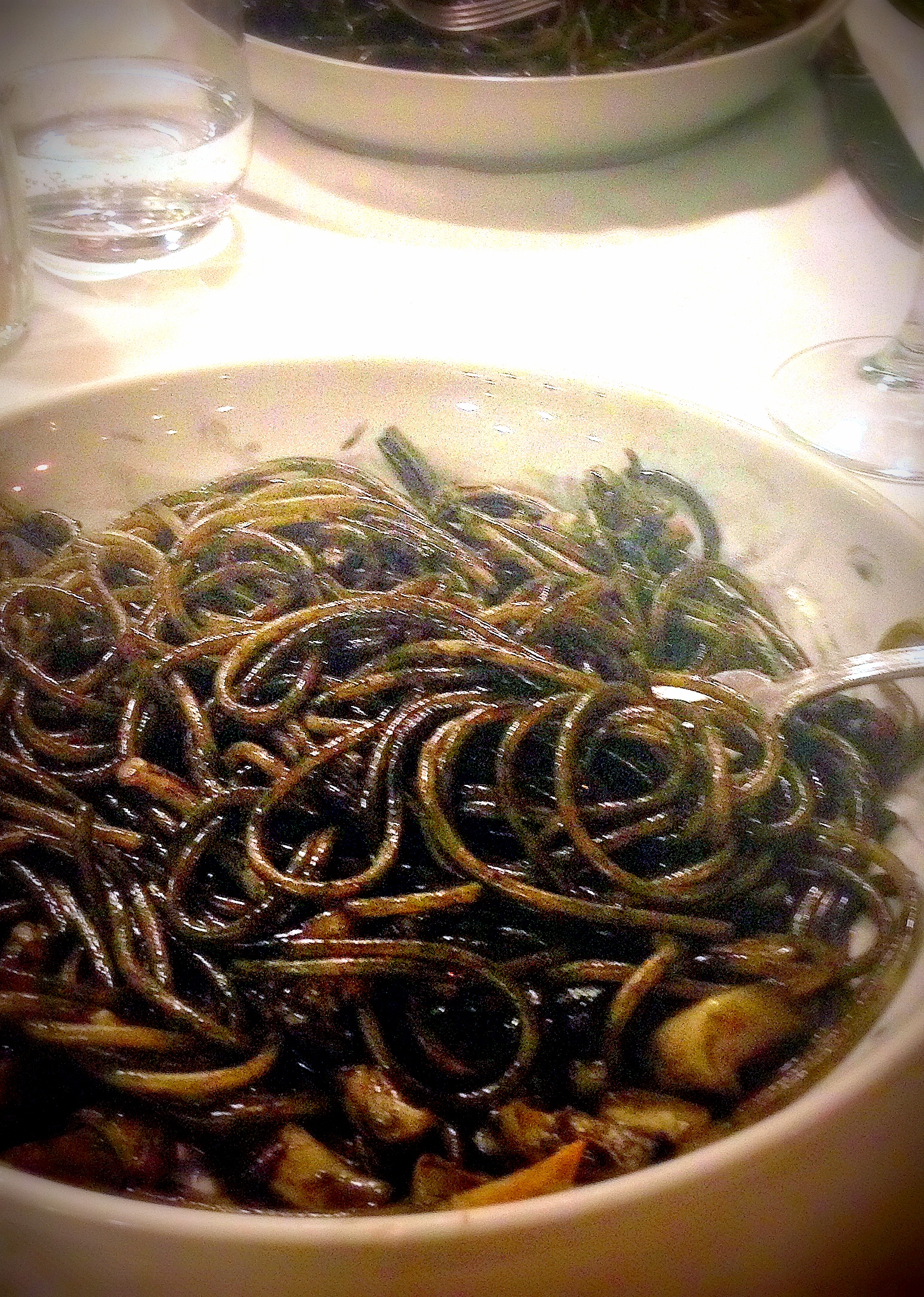
The other dish I was hoping to have was Spaghetti al Nero di Seppia (Spaghetti in Squid Ink) — a dish that would be a serious contender on my last-meal list. The problem is that very few Roman restaurants offer it. So I owe a deep debt of gratitude to a kind friend who told a restaurant owner that an overseas visitor had a serious craving for the dish, and to the owner for going out and buying the squid-ink sacs just to prepare the meal for us on the evening of my arrival. The jet-black sauce is made with squid ink, garlic, white wine, olive oil, red chilies, and tiny pieces of squid. It is dish that tastes as if it came straight from the sea, and it’s fantastic. But it turns your lips black; you will end up looking like Cruella De Vil. It is so worth it, however.

 
Gelato at Della Palma                          Spaghetti al Nero di Seppia

The very last night, after non-stop meetings in a suburb of Rome where there was not a lot to see, another lovely friend suggested an outing to Bracciano, a charming town with a beautiful lake and an old castle. I loved the many flower pots the residents had everywhere: on stoops, staircases, walls, lattices, etc.  And I was struck by the hardiness of the fig tree; the ones I saw were all growing straight out of high walls, having found a tiny foothold and enough nutrients to somehow survive.

 
Flower Pots, Bracciano                       Fig Tree by Lake Bracciano

Euphorbia: A Chameleon in the Garden

11 Apr

This winter most of my perennials died back, conserving resources in order to make a reappearance in warmer weather.  One notable exception was Euphorbia “Ascot Rainbow,” a stoic plant that carried on through frosts, snow, and months of reduced sunlight. It did so by undergoing a transformation of sorts — turning from a mostly yellow and green plant in the summer, to being a much pinker plant in the winter. The colder it got, the darker the Euphorbia became–especially in the cold depths of March when it was a very dusky, reddish rose. And then, after just a few days of glorious sun and high temperatures (after we jumped straight from winter to summer with no spring in between), it rapidly became quite yellow again. These photos are all from the same plant during the past four months.

      
December                                                                    January

 
February                                                                 April