Zucchini Flowers, Leaves, and Bees

3 Jul


Yes, it’s that time of year, a time when you realize you planted way too much zucchini. I have only one zucchini plant in the garden (not having much space for vegetables to begin with) — yet I find myself asking, how can one plant produce that much? And it’s barely gotten started.

Luckily, I love zucchini and am already thinking about what to do with my harvest. However, this post is not about cooking. It is about the plant itself, from flower to leaf. If you grow zucchini, you probably quite enjoy seeing the zucchini flowers/blossoms/blooms. I usually look at them and imagine them stuffed with a nice cheese, dipped in a light batter, and gently fried….heavenly! Some say the male flowers (which grow at the end of long stems, unlike female flowers, which grow at the end of the emerging zucchini) are the best for eating; I’ll happily sample either one. The flowers can also be eaten raw, sliced into salads or other dishes.

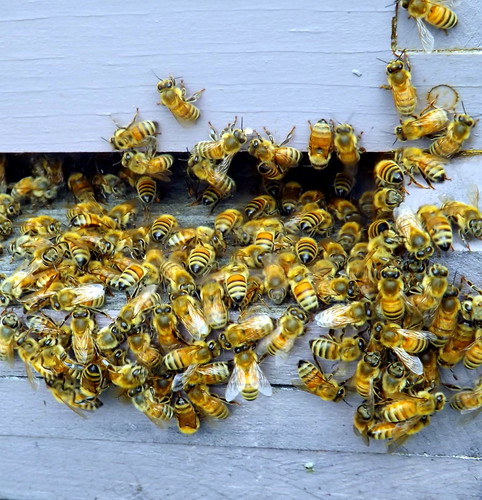
But I digress. My intention was to write about the plant–as a plant, not as a source of food. A couple of days ago, I was checking the status of the zucchini and was startled to see a fully open flower. I almost never see an open flower, which makes sense since they are only open for one day and usually from morning to early afternoon (when I am at work, or not paying sufficient attention). In order for any zucchini to be produced, bees must take advantage of this small window of opportunity and do their part by carrying pollen from the male flowers to the female flowers. [Ok, I have to digress again to show a completely unrelated photo of a friend’s beehive since I don’t have a photo of a bee on my zucchini flowers–and yes, honey bees are excellent pollinators of zucchini and many other fruits and vegetables. Go bees!]


Some of my baby zucchini seemed to wither on the stems and drop off before they even got going. I wondered if this was due to all the rain we’ve been having (or even worse, if it could possibly be the fault of our male dog–despite the barricades I erected). Luckily, I discovered it’s because the female flower didn’t get quite enough pollen from the male. Gardeners wishing to help the process along can try to hand pollinate by carefully removing the anther from the male flower and dabbing it onto the stigma of the open female flower (or by using cotton swabs to transfer the pollen). In my case, with plenty of zucchini already harvested and more to come, I may need to start tying all those flowers closed!

Here is a photo of a lovely, open zucchini flower (looks male)…

… and of another part of the plant that rarely gets mentioned: the leaf. I really like the way the leaves look, and I particularly like the downward angle in this photo. But zucchini leaves are a force of nature. They are so big and so prolific that they keep taking over the small space I allocated to the zucchini plant, and I have had to prune them several times. I felt guilty cutting them off at first, but then I learned that judicious pruning lets more light in and can help increase zucchini production. Wait–is that a plus?

Photo of the Month: June 2013 (Echinacea Ruby Star)

30 Jun

An Echinacea (Ruby Star), petals just beginning to open–in soft focus.

The Perils of Putting in a Patio

29 Jun

For the past couple of years, we have bemoaned the state of the grass in our yard (two dogs + small yard = eyesore).


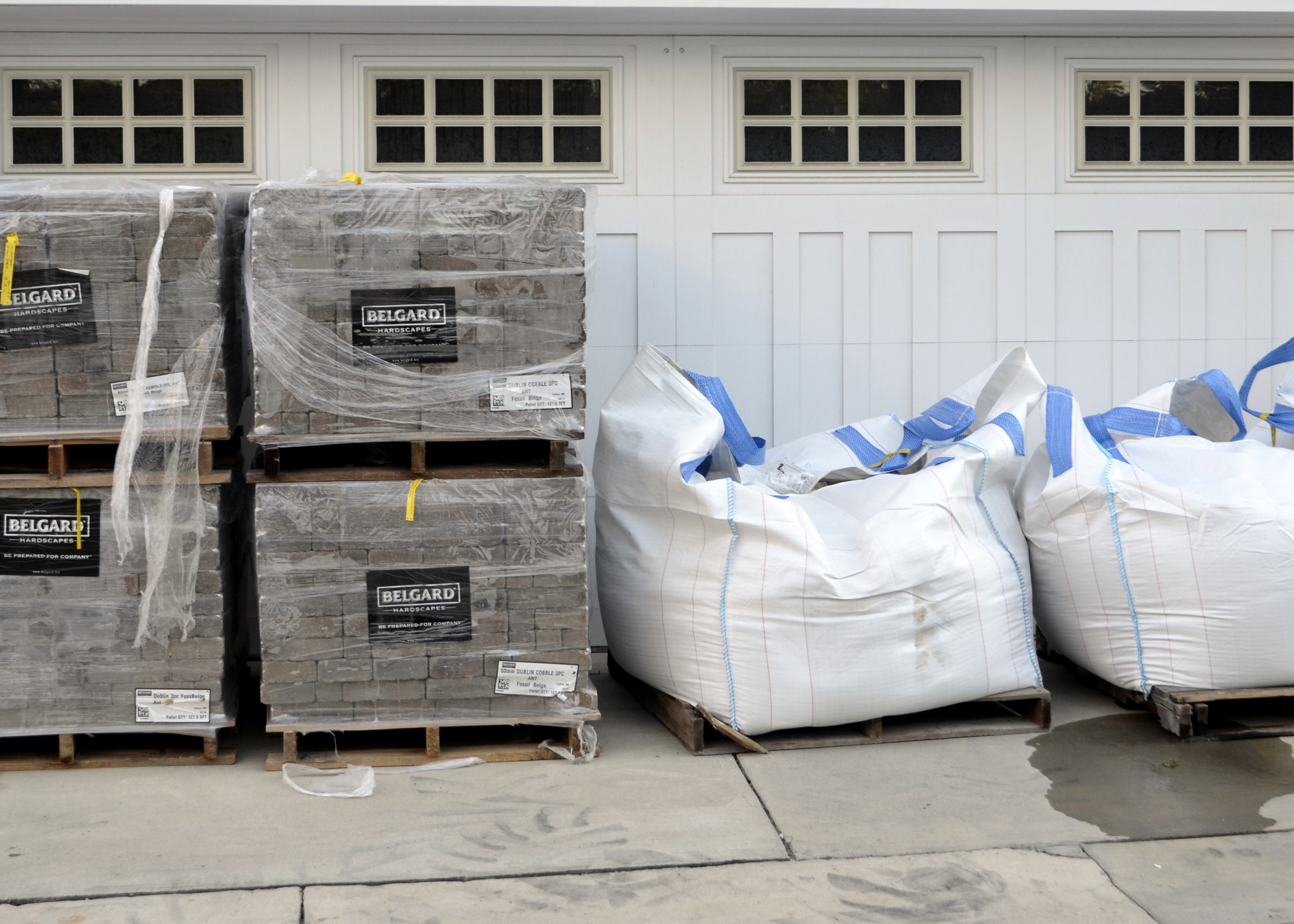
Each spring, we vowed to replace the grass with a patio. But until last week, we were all talk and no action. At that point, we realized we had a very small window in which to do it, or we would have to wait yet another year. So we decided to go for it — just after our last child headed off for a summer adventure. That left me and my husband, 400+ sq. ft. of yard to dig up, 4 pallets of pavers, two tons of sand, and a two-week timeframe (during which we both needed to go to our actual day jobs).


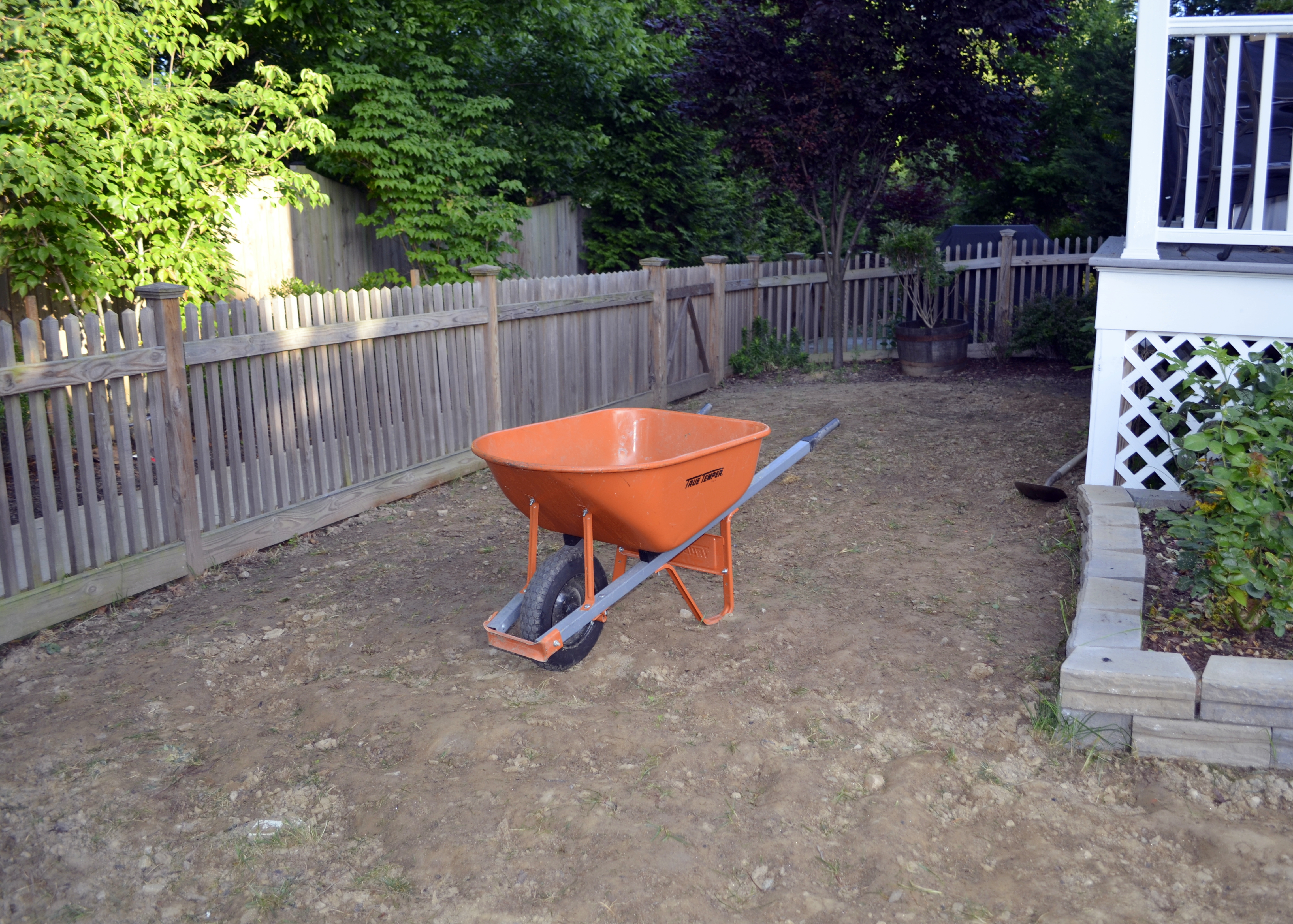
Clearly we were suffering from temporary insanity. The first week, my husband took some time off, dug up all the grass, and took it in several loads to our local dump. Very shortly, every single employee at the dump would come to know my husband well.
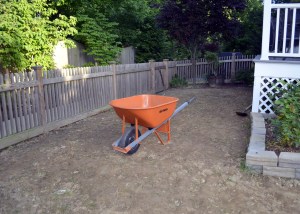

Using the pavers as a guide to depth, we realized we had to dig up 3 inches of the dirt from all over the yard. That task also fell to my husband–who during the next 1.5 weeks dug up and took roughly 5 tons of dirt to the dump–seven trips total. Had we known 3 inches of dirt = 5 tons, we may have thought twice about this whole proposition.
–Lesson 1: Do not try this by yourself at home unless you are a lunatic or have a source of strapping, teenage/20-something, happy-to-help child labor (or, frankly, anyone else willing to help). Since my husband actually did not mind the grueling manual labor, he is clearly a lunatic (several of our neighbors, who stopped by to comment, probably agree).

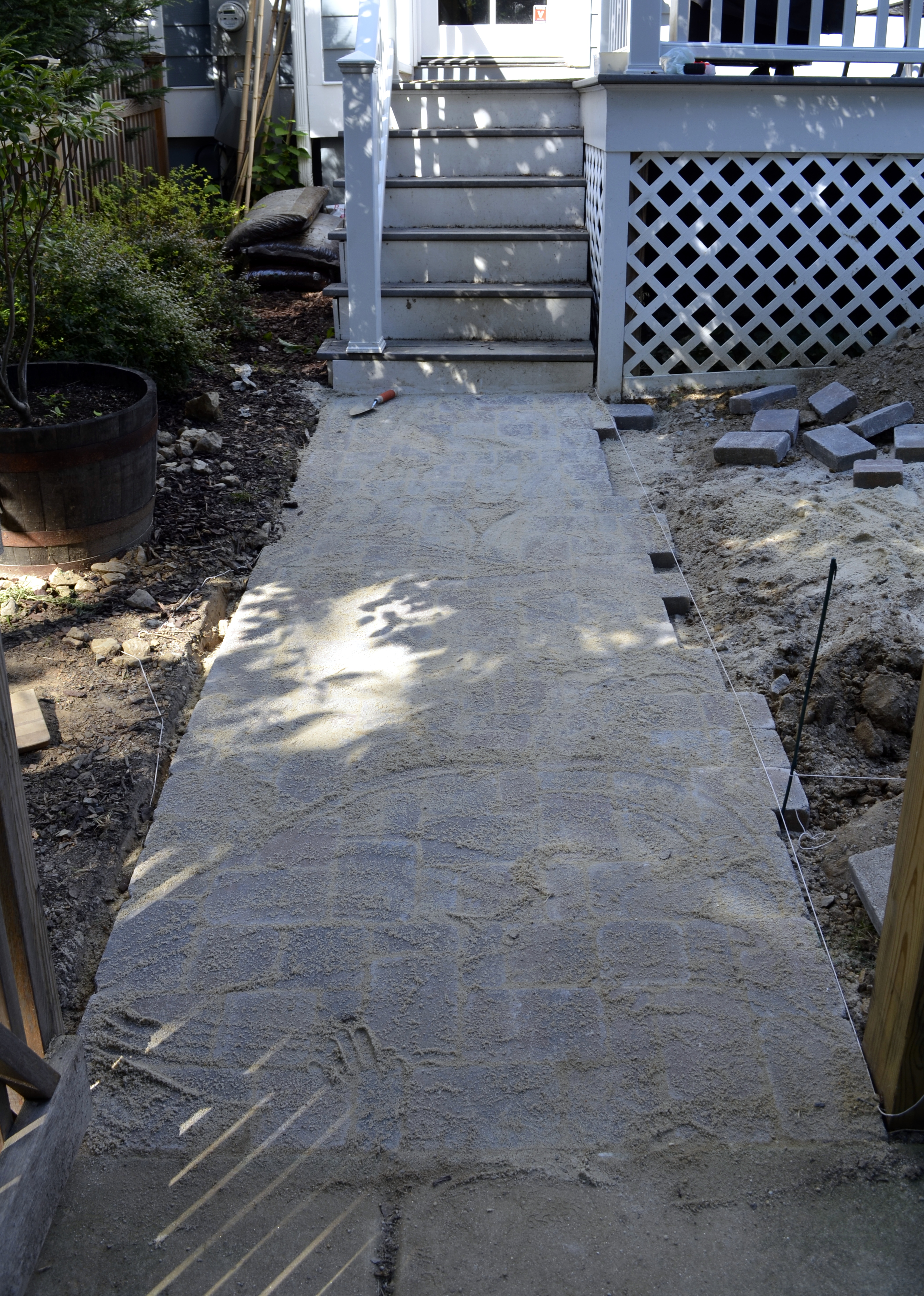
In between trips to the dump, my husband scattered a few loads of sand on the dug-up sections of the yard and set up the slope lines with some string; my job was smoothing the sand, laying the pavers and tamping them while maintaining the slope (turns out our yard slopes in multiple directions at once, so now the patio does, too–some of it intentional, some not). On Saturday–at the end of the first week of our project–I started laying the path between the back steps and the back gate, and managed to get it done in one broiling-hot day. I was very proud of myself, but I shouldn’t have been. Why? Because on Sunday, we turned to the biggest, highest part of the patio and began working our way downward toward the path.
Lesson 2: Building a patio from two separate ends is a mistake. Start in one place and go from there, or you will end  up boxing yourself in with limited space for adjustments should all the pavers not line up properly (as will surely be the case). We discovered that our rectangular yard was a complete illusion, forcing multiple adjustments as we went.
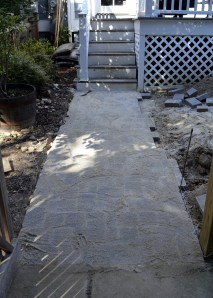

Unfortunately, we didn’t get very far on Sunday morning due to a torrential rainfall. With my husband at the dump, I soldiered on, laying pavers as long as possible (reminding myself rain is just water, really), but after sliding through the mud on a trip to get more pavers, I gave up.
Lesson 3: Check the weather forecast, or cover the bare dirt with a tarp (or dig up the grass and dirt in sections so you don’t end up with a vast mud pit should it rain).

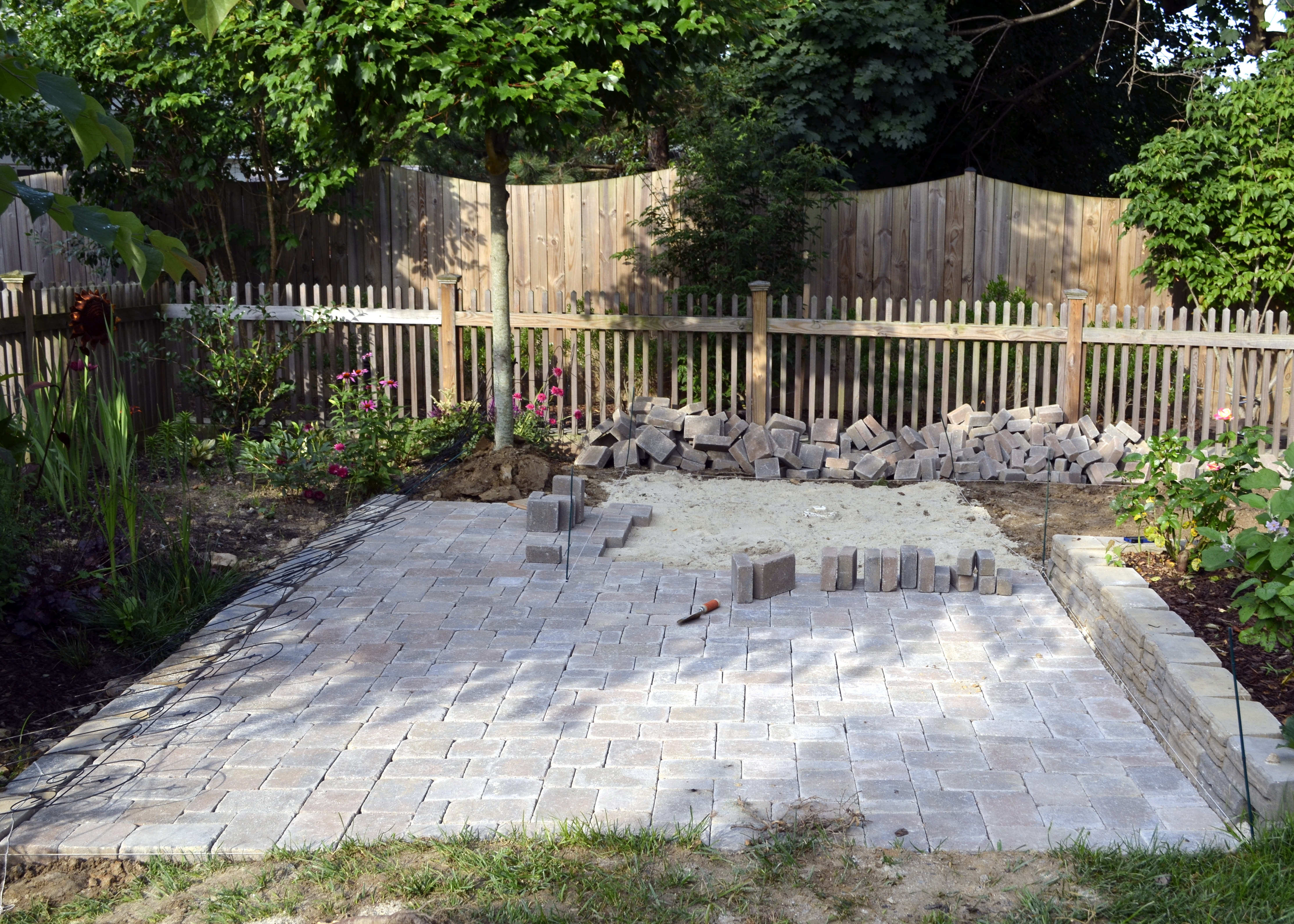
But the sun came out later that afternoon, so I managed to get a bit more done. In the photo below, you can see the emerging top section of patio, plus the piles of pavers and slope lines (the string between the green stakes), though they are hard to see. My trusty sledge hammer/wood for tamping is hidden behind a pile of pavers. 
Lesson 4:
Despite all the effort, and the heat, rain, and mosquitoes–and the fact that perfection is rarely attainable–it is important to occasionally stop and acknowledge an achievement. This almost looks like a patio!

On Monday, my husband and I went back to work (ie, at our day jobs). On Wednesday, he  took time off and dug up the next section of dirt, and on Thursday, we both spent 12 hours working on the patio, since the patio had to be done sometime on Friday, the last day of our short window of opportunity. We managed to get almost all the way done on Thursday, except for a small section. It was a marathon day.
–Lesson 5.1: You will discover muscles you never knew you had (or forgot you had). Turns out lifting pavers and swinging a sledge hammer is great for the triceps–by great, I mean that if you hadn’t previously used your triceps very much, you may not be able to lift your arms over your head by nightfall. Also, gripping pavers does wonders for your hand muscles; your hands will want to curl up afterward and stay that way for hours.
Lesson 5.2: Wear sturdy gloves. I was wearing my favorite gardening gloves, which are quite thin with a latex-like coating on the palms–perfect for smoothing sand and clearing it out of crevices. But by the end of the day Thursday, I was wondering why my thumb was sore, whereupon I realized the pavers had torn through my right-hand glove, taking a bit of my thumb with them. No comparison at all to the cuts and blisters on my husband’s hands (despite his very heavy gloves). But in both our cases, our hands showed us what they could accomplish, despite adversity. [Note: the animal in the photo below is an ungroomed Schnauzer, not a sheepdog. I have been talking about grooming the dogs for some time now, too, but not acting upon it–it’s almost on par with laying a patio….]

I took a few hours vacation time Friday morning  (I can think of other ways to spend vacation time, but we were down to the wire) and by about 10:30 am had almost finished the patio, after boxing myself into a small space:

I say almost, because it turns out that this section of the yard was not actually rectangular, and so the pavers did not end up perfectly aligned–meaning I was left with a few sizeable gaps at the very end–too large to fill with sand and too small to fit any of the three sizes of pavers we had. Now, we are not professional brick layers (as is painfully obvious), so we do not have cobblestone-cutting equipment–but a friend of ours does, and he is stopping by tomorrow morning to see if he can cut a few pavers to fit. And then, we will have a patio!
Lesson 6.1:  See Lesson 2. But also, have a back-up plan for how to fix unexpected gaps. For the most part, I was able to adjust as I went, either by  decreasing the depth of the flower bed running along the left side of the patio, or by inserting the occasional small paver vertically instead of horizontally (for a narrower fit). But it’s good to have handy friends.
–Lesson 6.2: Be prepared for odd tan lines and other reminders of your brick-laying adventure. Though I slathered myself with sunscreen, I noticed when I went back in to work on Friday that I had tan lines where white hands (gloves) met darker forearms, and where white feet (socks) met darker legs. Plus, there was a nice indent in my forehead from my straw hat. I’m hoping no one else at the meeting noticed!

Final note: it was all worth it. And huge thanks to my husband for his superhuman efforts.

Garden Update: Monarda, Milkweed, and a Moon

25 Jun

My husband and I began a very optimistic plan to lay a 450 sq. ft. patio this past weekend. The two of us. By ourselves (since our kids have all scattered far and wide). Our intention was to make a good start and to try to finish by next weekend, in and amongst working full time during the week. One tiny setback: a torrential downpour that occurred on Sunday morning, turning our denuded (but not yet paved) patio area into a mud pit. More on our venture later–but on the plus side, while we were toiling away I had multiple opportunities to admire how full and lush the garden has become (and to remind myself, repeatedly, of how much nicer the whole yard will look when swathes of dog-worn grass have been replaced with cobblestone pavers).

I have always loved the garden in June, when many of my favorite plants are in bloom. The photo on the left shows a small section containing a neglected bird feeder and (clockwise from top left) variegated Porcupine Grass, Montauk Daisy (not yet in bloom), yellow Tickseed (Golden Gain), tall lilac Verbena Bonariensis, a tiny bit of pink Monarda (Raspberry Wine), wine red Asiatic Lily (Tiny Ghost), small purple spikes of Veronica (Royal Candles), and orange Butterfly Weed. To the right is a close-up of the Monarda, which is new to the garden this year.
 
I added a couple more Butterfly Weed plants this year to fill in the space a bit and also because I love orange and Butterfly Weed is so cheerful and such a magnet for, well, butterflies–including Monarchs. I will be on the lookout this year and will bring in any Monarch caterpillars I see, to avoid the unknown fate that befell their 2012 counterparts. (I do not really blame the Nuthatch….).

And finally, after a grueling day digging dirt and laying bricks, we were rewarded with a lovely sight in the night sky: the Supermoon. I definitely did not have the right lens to do it justice–but here is a very rough view of the moon looming over a neighbor’s house, with a passing cloud absorbing some of the lunar glow.

Postcard from Montpellier, France: Part II

20 Jun

As much as I enjoyed the Jardin des Plantes in Montpellier (France’s oldest botanic garden), there were other sights to be seen. After leaving the gardens, I wound my way through central Montpellier by way of the Cathedral of St. Pierre.

It was closed when I passed by, but I quite liked the red doors …

… and the amazing porch (this photo looks straight up into the arch of the porch).

I was also lucky enough to meet up with a friend of a friend, who took me on a lovely outing to Villeneuve-lès-Maguelone on the coast. We passed a field of poppies on the way, and I managed to get a photo just before a farmer passed by on a tractor, plowing them up.


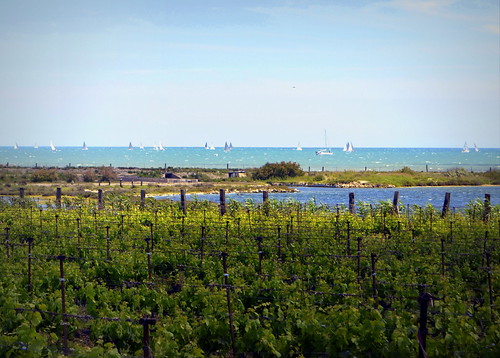
Then we arrived at the coast, a place where vineyards meet the sea…

… and white birds scamper in the water (egret) and roost in trees (peacock)…
 
… near the old Cathedral of Maguelone.

Recipe: Pasta in Cream Sauce with Pancetta and Pecorino Romano

18 Jun

With three children away from home, and the fourth frequently out and about, my husband and I are adapting to eating dinner by ourselves. It is a necessary exercise; in one more year, we will be empty nesters. We have made some adjustments, but not all recipes for six translate easily into a meal for two, so I am beginning to rethink my approach to dinner. Luckily, this recipe is very adaptable and can easily be scaled down (or back up).

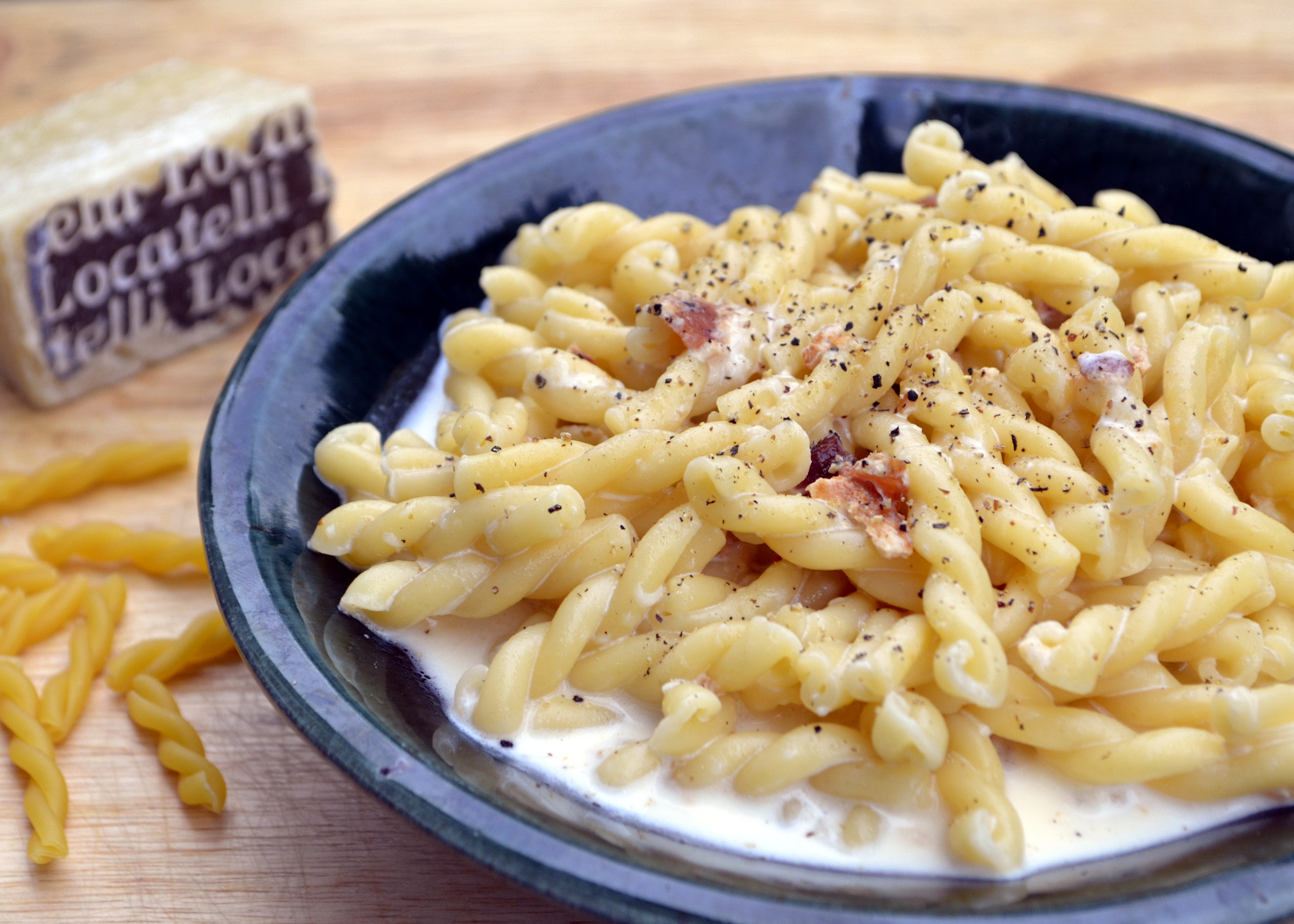
It’s also quick, which makes it perfect for a busy week night. But more importantly, it will satisfy proponents of the two different schools of thought on pasta cream sauces. When this dish is first put on the table, the cream sauce will be fairly thin (as in the photo). In our family, there are staunch supporters of a thinner cream sauce; they say a more liquid consistency allows for maximum “soppage” with a nice piece of crusty bread. Other family members prefer a thicker sauce, which coats the pasta very nicely. Luckily, it’s possible to have it both ways: thinner-sauce aficionados can dig right in; thicker-sauce advocates can nibble on salad or bread and let the sauce cool a bit. Regardless of their sauce philosophies, family members agree on one thing: this is good to the last bite, thick or thin.

Note: Feel free to substitute Parmesan cheese for the Pecorino Romano, and bacon for the pancetta (I used bacon this time, after discovering at the last moment that the pancetta I thought I had in the freezer was a figment of my imagination).

Pasta in Cream Sauce with Pancetta and Pecorino Romano
Serves 2-3

1/2 lb. (227 gr.) pasta; I used gemelli
2 oz. (57 gr.) cubed pancetta [in the U.S., Trader Joe’s sells a 4-oz. package*], or 4 slices bacon, chopped
1/2 tbsp. olive oil
1 small clove garlic, sliced
1 c. (237 ml.) half and half, which is half light cream and half milk (or you can use all light cream or heavy cream–the heavier the cream, the thicker the sauce)
small pinch salt
freshly ground pepper
1/2 c. (about 60 gr.) grated Pecorino Romano or Parmesan cheese

Preparation

1. Bring an ample amount of water to boil in a medium pot and cook the pasta just until it is al dente.
2. While the water is coming to a boil, heat the olive oil over medium heat in a medium saucepan and cook the pancetta/bacon until crisp; remove the pancetta/bacon, place on a paper towel to drain, and set aside. Leave about 1/2 tbsp. of oil/drippings in the saucepan; discard the rest. Add the sliced garlic to the pan and cook just until golden (you do not want the garlic to burn). Remove the garlic and discard. Turn heat to low and add the half and half (or cream). Grind black pepper over the surface of the sauce. Add a small pinch of salt (be conservative at this stage because you’ll be adding salty bacon and cheese to the dish; you can adjust the seasonings afterward). Keep the sauce warm without letting it boil.
3. When the pasta is done, drain it well, return it to the pot, and immediately toss with the cheese. Add the reserved pancetta/bacon, mix well, and then pour the cream sauce over. Stir well and adjust the seasonings (I usually add more pepper at this stage). The sauce will appear thin at first, but will thicken as it cools.
4. Serve with salad and crusty bread.

*I stock up on packages of cubed pancetta and freeze them. Then, I add the frozen, cubed pancetta directly to the hot oil. It cooks (and crisps up) beautifully, and is oh-so convenient.

Weekly Photo Challenge: Curves

16 Jun

This week’s theme is “Curves.” Though I fight against it, I like straight lines, squares, rectangles, and symmetry in the house and garden–all part of an orderly organizational structure. But linear tidiness often translates into aloofness and unapproachability. Curves are looser, less formal, and more inviting. The key is finding the right balance.

This photo of our wrought-iron fence–which shows curvy, almost mesmerizing circles contained within a rectangular panel–shows that sometimes it is possible to have both allure and order at the same time.

Recipe: Triple Lemon Cake

14 Jun

When the kids were little, I used to make them specially decorated cakes: a pick-up truck cake with candy in the back (as if the cake and ice cream weren’t enough), a dinosaur cake, a cake that looked like a pumpkin (two Bundt cakes on top of each other,  covered with orange frosting, with a bit of stem coming out the top), a soccer field cake, etc. As the children got older, the decorations decreased–but not the cake requests.

Of all the cake options available, this Triple Lemon Cake is the most requested (with the Mexican Chocolate Cake with Chocolate Glaze offering stiff competition). It has triple the tang because lemon appears in the batter, syrup, and glaze. If I could find a fourth way to get more lemon into the cake, I would. But it is really nice just the way it is, and is a good cake for spring/summer.

Triple Lemon Cake

Cake
1/2 lb. butter, at room temperature
2 c. sugar
3 eggs, at room temperature
3 c. flour
1/2 tsp. baking soda
1/2 tsp. salt
1 c. buttermilk (a good substitute: put 1 tbsp. vinegar in a measuring cup, then add milk to make 1 c.)
2 tbsp. tightly packed grated lemon zest (from about 4 lemons)
3 tbsp. fresh lemon juice (the 4 lemons should provide enough juice for the batter, syrup, and glaze)

Syrup
1 c. confectioners’ sugar
½ c. butter, melted
1/3 c. fresh lemon juice

Glaze
fresh lemon juice
confectioner’s sugar

Preparation

1. Preheat oven to 325°.
2. Carefully and very thoroughly grease and flour a Bundt pan.
3. Cream the butter and sugar until light and fluffy. Beat in the eggs, one at a time, blending well each time.
4. Sift the flour, baking soda, and salt together. Add about 1/3 of the flour mixture to the egg mixture, stir to combine, add about 1/2 of the buttermilk, stir, and repeat, ending with last bit of flour mixture and ensuring it is well incorporated. Gently stir in the lemon zest and juice. Note: The batter will be thick.
5. Pour the batter into the prepared Bundt pan, smoothing the top as evenly as possible. Cook for an hour in the middle of the oven, or until a toothpick inserted in the center comes out clean. Sometimes, it may take longer than an hour to cook.
6. Toward the end of the baking time, prepare the syrup: melt the butter and lemon juice in a small saucepan over medium heat, then stir in the confectioner’s sugar. Bring to a quick boil just before using.
7. When the cake is done, remove from oven. Poke holes in the cake with a long skewer, then pour the hot syrup over the cake. Let the cake sit for about 20-30 minutes.
8. Put a large plate (or platter) upside down on top of the cake pan and invert the pan and plate together so the cake drops neatly onto the plate. Actually, I have rarely had the cake drop neatly onto the plate; I just always hope it will. It usually requires a lot of jiggling and careful loosening of the sides. And even then, the cake doesn’t always come out of the pan cleanly. So, grease and flour the Bundt pan heavily beforehand, and use a liberal amount of glaze on the cake afterward, to cover up any less-than-perfect parts (as I did for the cake in the phot0).
9. Glaze the cake: the amount of glaze is entirely up to you; I start off with about 2-3 c. of confectioner’s sugar, then add a few drops of lemon juice at a time until the glaze is a good consistency (and then if it looks like I don’t have enough glaze or if it is too thin, I add more sugar and keep going). Sometimes, I drizzle a thicker glaze on the cake first (also good for filling in rough spots), then add a slightly thinner one for contrast.

Weekly Photo Challenge: Fleeting

11 Jun

This week’s theme is “Fleeting.” This photo was taken on a windy day in the garden. The Hidcote lavender danced to and fro, evading capture; the moment was fleeting, the result ephemeral.

Postcard from Montpellier, France: Jardin des Plantes

10 Jun

The second leg of my work trip involved going to Montpellier, France for another round of meetings. I headed there straight from Senegal, which meant I arrived a bit early and could do some sightseeing. Montpellier has many lovely things to see, but I had to prioritize. And truthfully, my heart was set on one main attraction: the Jardin des Plantes–France’s oldest botanic garden, established in 1593 by King Henry IV and managed by the University of Montpellier. Armed with a bottle of water and my camera, I explored every inch of the Garden, spending almost 5 hours there; in fact, I was the first person to arrive that morning. It was so peaceful and beautiful (and a very welcome change from sitting in meetings all day). As the day wore on, people arrived to picnic on grassy areas, read books in shady nooks, and wander around admiring the plants–all in an environment that seemed far removed from the normal bustle of Montpellier life.

Here are a few sights from the Jardin des Plantes: the Garden’s arches, benches, staircases, and pathways; the famous Wish Tree (a phylliria) where lovers leave messages; and a few other plants (a pink Cistus, a spiky Agave stricta Salm-Dyck, and a close-up of the polka-dotted Opuntia microdasys cactus).