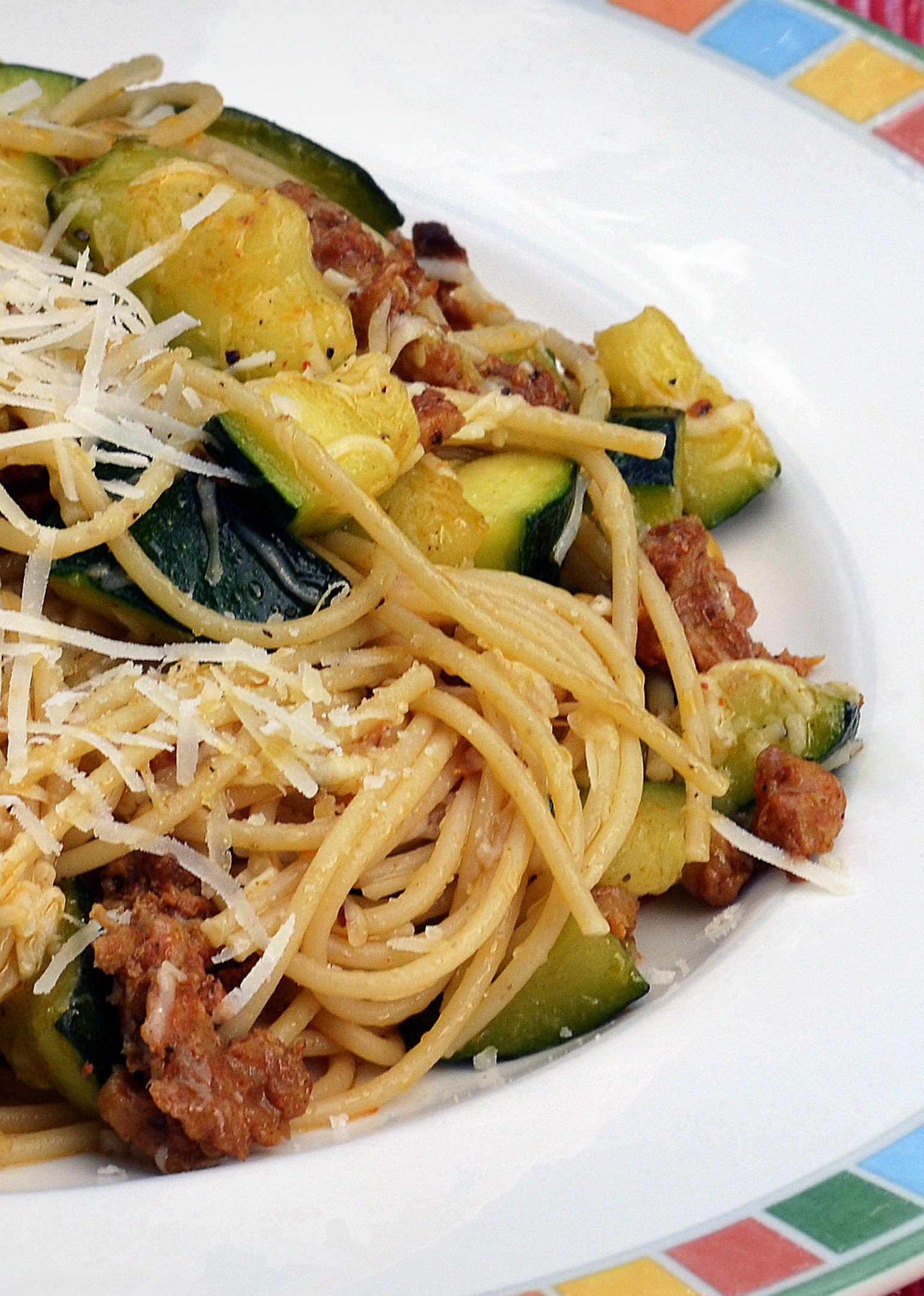
Recipe: Spaghetti with Chicken Chorizo, Zucchini, and Pine Nuts

5 Aug

Let me count the ways I love this dish:

  1. It is incredibly quick and easy,
  2. It is bold and zesty thanks to the spicy chicken chorizo and the tangy Pecorino Romano,
  3. It isn’t a typical tomato- or cream-based pasta dish,
  4. It contains pine nuts (a heavenly food, but one to be used sparingly because of the cost), and
  5. It is another way to use up some of that bumper crop of zucchini (… if you’ve had your fill of Chocolate Chunk Zucchini Squares).

I made this tonight in about 20 minutes–and yes, I did add the pine nuts, but they all went into hiding at photo time. If you have a bit more chorizo than you need for this recipe, add it to a delicious egg scramble in the morning, maybe with some poblano chilies, onions, and mushrooms. Mmmm.

Spaghetti with Chicken Chorizo, Zucchini, and Pine Nuts
Serves 4

3-4 tbsp. olive oil
2-3 links spicy chicken chorizo, removed from casings (about 2/3-1 lb.)
1 large zucchini, diced into small cubes (about 3 cups total)
2 cloves garlic, minced
3-4 tbsp. pine nuts
1/2 lb. spaghetti
1 tbsp. butter
1 c. Pecorino Romano cheese, grated
salt and freshly ground pepper

Preparation

1. Start preparing spaghetti according to “al dente” directions on the package (check for doneness about a minute before the minimum time listed).
2. While water is coming to a boil, cook chorizo in olive oil in large skillet over medium-high heat until chorizo is no longer pink, breaking up the chorizo as it cooks. Add zucchini and cook until it has softened and the chorizo is golden. Add garlic during last five minutes of cooking time. If chorizo/zucchini mixture seems dry, add a bit more olive oil.
3. Push chorizo/zucchini mixture to one side of the skillet and sprinkle pine nuts onto the cleared space; cook the pine nuts for a couple minutes or until they turn golden. Incorporate them into the chorizo/zucchini mixture. If the pasta is not yet done, turn off the heat under the chorizo mixture and keep warm.
4. Just before draining the spaghetti, remove about 1/2 c. of the cooking water (or dip a glass measuring cup right into the pasta pot); reserve the water.
5. Drain the spaghetti, toss the drained spaghetti with butter, then pour the chorizo/zucchini mixture on top of the spaghetti and mix in well. If the mixture seems a bit dry, add a small amount of pasta cooking water to moisten.
6. Mix in the Pecorino Romano cheese, add salt and freshly ground pepper to taste, and serve immediately.

Photo of the Month: July 2013 (Japanese Holly Fern)

31 Jul

Japanese Holly Fern (Cyrtomium falcatum). Bright green foliage against a dark background, from the UC Botanical Garden at Berkeley.

Bay Area 3: UC Botanical Garden at Berkeley

30 Jul

What is it about botanical gardens or other large, planned gardens that makes them magical places? The kind of place where you can wander in relative silence, revel in the beauty of plants that you have never seen before (or even ones you have seen, though now viewed in a different light), where you can stop and sit on a bench in a hidden spot to soak it all in, or even read, or think? Who designed the spaces, mapped out what types of plants would be featured where, and planned the spots that would lure people and bees and butterflies and birds? They, and the current-day keepers of those gardens, are magicians.

If not already obvious, I love wandering in those kinds of gardens. I like everything about them: the flora, the fauna, the paths and stairs and benches and arches and bridges and streams. The University of California Botanical Garden has many of those features, and is a veritable outdoor museum. It is home to collections of plants from nine major geographic regions around the world, including a large area devoted to California–a biodiversity hotspot that contains more than 40 percent of the world’s plant species. To all this, add special collections including orchids, ferns, cycads, palms, roses, and herbs.

A plant lover could spend days roaming the 34 acres. I only had 5 hours, but I made the best of it; I signed up for a 1.5-hour tour that was being offered (Secret Paths of the Garden), which got me off to a great start via paths less traveled, and then I spent the remaining time wandering to my heart’s content. It really was a magical day.

Here are some of my favorite photos (and plants) from the Garden:

 
Manzanita Tree Bark

   
Dudleya Pulverulenta (Chalk Lettuce, Chalk Liveforever)

 
Encephalartos arenarius (Alexandria cycad)

 
Opuntia Kuehnrichiana                               Opuntia microdasys (Polka-dot cactus)

Bay Area 2: Fruit and Vegetable Envy

25 Jul

While in Berkeley,  I was able to spend a lovely day with long-time family friends, and admire (ok, envy) their garden. It is a productive one–full of fruit trees and tomatoes and other vegetables–with not a rampaging dog in sight. The fruit trees–apple, fig, pear, persimmon, and plum–were all bearing fruit or on the verge of doing so, and the tomatoes were glistening. The sun was shining, the air was crisp, the birds were chirping–and everything I saw appeared jewel like. The contrast to my own garden was stark: the sun shines here, too, but the air is hot and thick, the neighborhood birds chirp only when the dogs are inside, I have no fruit trees, and my tomatoes have run wild (along with the zucchini plants–after just one week away, I came back to discover that two finger-sized zucchinis I had left behind were suddenly longer and thicker than my forearm–or anyone else’s forearm for that matter). Sigh.

But back to our friends’ garden. The photos below are of Satsuma plums, Seckel pears, and Sungold cherry tomatoes. This year was the first bearing year for the Satsuma plums, so jam making is on hold until next year when there is more of a crop. But how our friends will manage to set aside any plums for jam making is beyond me–I’d barely be able to get the plums from the tree to the kitchen without eating all of them. Perhaps when there are many, many plums to be had, the law of diminishing returns kicks in and people find the willpower to think longer term….


Satsuma plums

The Seckel pears also looked gorgeous, though I did not taste one since they were not quite ready to be picked. Last year was the first bearing year for the pears, so our friends ate what they harvested, gave some away, and did not have any left to store. This year, they will have a bumper crop and are trying to come up with a plan for what to do with them. Canning suggestions? Recommended pear recipes? We usually just eat them as they are or cut them into a fruit salad drizzled with a light honey-lime syrup. (Now that I think of it, I haven’t made that in a while; it would be perfect for a summer weekend brunch.) But I’d be happy to expand my pear repertoire if any suggestions come in.


Seckel pears

The Sungold cherry tomatoes really caught my eye. With multiple orbs of various colors (from green to gold to deep orange) hanging on each vine, they looked like garlands. There were also some Principe Borghese tomatoes in the garden, though I didn’t get a good photo. Those tomatoes are destined for sun drying — by pulling up the whole plant at the end of the season and hanging it upside down to dry in the sun. Our friend has not tried this before, but is counting down the days until she can conduct this natural experiment.  I’m counting down, too, since I’d like to know how that experiment works. My own non-cherry tomatoes have exploded (did I mention the 90+degree weather?), but my plants are not nearly as neat and tidy as their Berkeley counterparts because I didn’t know what I was doing when I planted them. The stakes I put in are not nearly tall enough, the space the tomatoes are in is too crowded (and there are roses there, too–a very bad idea of mine since thorns make tomato harvesting a tricky proposition). But, I may still try to sun dry some of the Romas, if I can get my act together and build a black box with glass lid in which to put them. Our neighbor in Australia did this every summer, and it worked like a charm.

 
Sungold cherry tomatoes

Until then, I will live vicariously through our friends, and wonder whether I can squeeze in a Satsuma plum tree somewhere in my own garden….

Weekly Photo Challenge: Fresh

22 Jul

This week’s theme is “fresh”– perfect for the dog days of summer we are experiencing here on the East Coast of the United States, a time of year when even the dogs don’t want to be outside.

When I think of “fresh,” I tend to think of water in some form or another: morning dew, mountain-fed streams, that spot in an ocean or lake that signals greater depth — a crisp cucumber, chilled watermelon, iced tea, and sorbet.

But to see the pure joy of freshness in motion, nothing quite beats the spray of water from a fountain. The droplets are momentarily suspended in the sun, sparkling with bits of color and beating a staccato on the surface of the water before gravity exerts its final pull.

Bay Area 1: Berkeley–Town and Gown

22 Jul

I just spent a beautiful vacation week in Northern California, our former home of 6 years. During those years, diapers and baby bottles featured more prominently than flower beds and vegetable gardens, though I did manage to always have some lantana growing in a barrel in our courtyard–it looked just like this (I took many photos of lantana while on my trip for old time’s sake–I can’t grow it in Maryland):


I didn’t have much time for gardening in those days (I recall I foolishly signed up for a community garden plot while pregnant, spent days/weeks getting all the weeds out with two toddlers playing alongside me in the dirt, planted some vegetables, then had to hand the plot over to a neighbor when the baby came). The lantanas, which require no attention, were all I could manage.

But once the kids got bigger, my thumb got a bit greener–helped along by the lovely friends and neighbors who were so generous with advice during our time in Australia, which is a land of avid gardeners.  Armed with a perspective I did not have when we lived in Berkeley, I spent this visit looking at things with a new eye, admiring all the plants in bloom and taking full advantage of the wealth of botanic offerings on hand. In Berkeley alone there is the University of California Botanical Garden, the Botanic Garden at Tilden Park, and the Rose Garden. I made a pilgrimage to all those places, but found that there were beautiful things everywhere (yes, I did include a few non-botanical items….). Here are some highlights from Berkeley proper (to be followed later by highlights from the various gardens in Berkeley,  plus Sonoma Valley and Stanford/Palo Alto) :

A view of San Francisco Bay from Cesar Chavez Park,

a close up of the scroll work on Sather Gate on campus, as well as some Blue Salvia and
 

a Blue Potato Bush near Walden School in town, and

a copper Kangaroo Paw and a Redwood tree on campus.
 

Weekly Photo Challenge: The Golden Hour

12 Jul

This photo captures not so much a golden hour, as a golden moment. Winter in San Diego: the sun has just set but its light still lingers, casting a golden glow along the horizon, silhouetting the few hardy surfers remaining in the water, and reflecting off the wet sand. This is twilight. Four minutes later, it is gone.

Ode to a Flower That Could Have Been

11 Jul

It is a truth universally acknowledged, that a gardener in possession of flower beds and dogs must be in want of good sense. Or at least, must be prepared for disaster.

Earlier this year, we cleared a new flower bed in front of a section of our wooden fence. I carefully planted multiple gladiolus bulbs (my first foray into the fine art of growing gladioli), set up a small powder-coated steel garden fence in front of the bed to keep the dogs out, and sat back with eager anticipation. I watched the tiny shoots emerge and kept track as they grew, and was finally delighted to see the first spike beginning to bloom…

… and then I did two things that sealed the fate of that gladiolus and all its sisters. First, we built a patio, raising the level of earth (and patio) in front of the gladiolus bed. Meaning the distance from the ground to the top of the small steel garden fence protecting the gladioli was now shorter (just above knee height), with no way to compensate since the steel fence was set in lower ground. Second, I tidied up the garden after the patio was finished and attended to some long-neglected duties, including refilling the bird feeders for the first time in months. Within a day, the sounds of birds chirping filled the garden and I looked upon the scene with great satisfaction. And then the squirrels arrived.

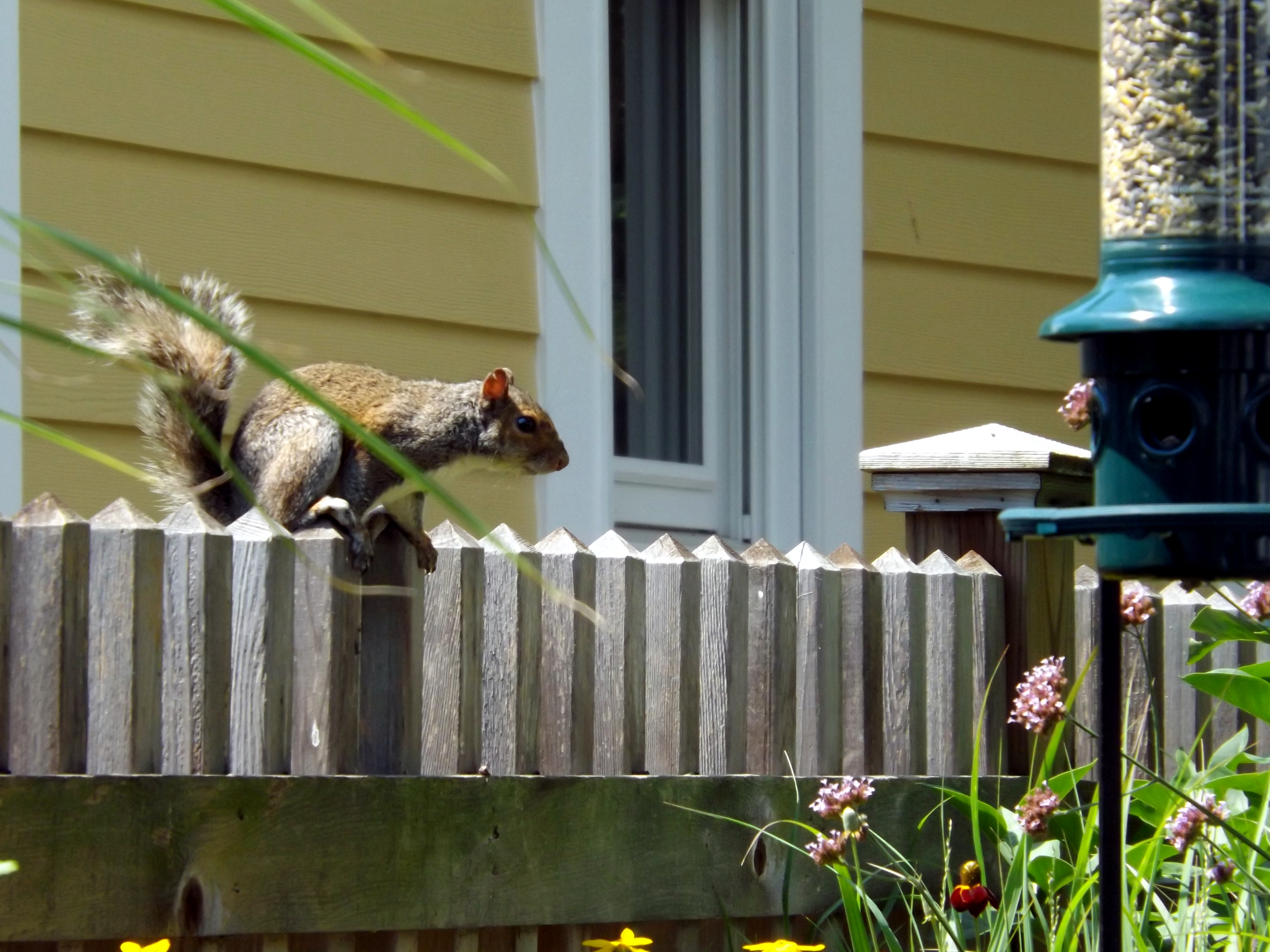
Here is a photo from last year, which sums up the situation quite nicely:

If there is one thing that drives our dogs (Schnauzer 1 and Schnauzer 2) to utter distraction, it’s  s-q-u-i-r-r-e-l-s. Yes, our dogs recognize the word. In fact, they almost may be able to spell it by now, too. The gladiolus bed was (note use of past tense) in front of the wooden fence to the right of the bird feeder; squirrels hoping to get close to the feeder have to scramble across the top of that section of wooden fence. For our dogs, this is akin to waving a red cape in front of a mad bull. They go nuts. A day or so after I took the photo of the gladiolus, Schnauzer 1 (the smaller of the two dogs but the most zealous squirrel chaser) saw a squirrel dancing along the top of the wooden fence and immediately realized the new patio allowed her to clear the small steel garden fence quite easily, putting her within jaw-snapping distance of the squirrel. After an elegant leap landed her squarely on top of the gladiolus plants, she crashed through them, launching herself against the wooden fence in the hopes of shaking the squirrel off.

The gladioli survived this first game of rodent roulette, but just barely; they were all knocked over. So I propped them back up with stakes, set up a barricade of patio chairs in front of the flower bed, and yelled at the dogs. But instinct trumps all. Within another day, all the gladiolus plants were shredded; Schnauzer 1 went around, under, and over the chairs, or simply leapt the garden fence a bit further down the garden and trampled her way to the gladioli. Schnauzer 2 offered abundant vocal support. Here is a photo of the sorry scene–a couple of lilies were also leveled:


And here are the culprits, scanning the trees and fence lines for more enemy combatants. Wretched dogs…. I’m not quite ready to go the electric fence route, though each decimated plant moves me closer in that direction. So for now, it’s a choice between moving the bird feeder or filling it up only in the winter (which many people advocate anyway). I hope that with these additional precautions, I might actually see a gladiolus in bloom next year.

Recipe: Chocolate Chunk Zucchini Squares

7 Jul

Okay, after my recent post about prolific zucchini plants, it was only a matter of time before some zucchini recipes started showing up on the blog. And seeing as I have a serious sweet tooth, I went straight for something chocolaty, moist, and doubly satisfying (because, after all, these Chocolate Chunk Zucchini Squares not only taste good, they also contain vegetables and nuts, so can almost be regarded as a health food….). Well, I’m planning on regarding them that way. If you use dark chocolate, even better: you’ll be adding some beneficial flavonoids to the mix. I dubbed this recipe “Chocolate Chunk” because I didn’t have any chocolate chips on hand today, but I did have some dark chocolate bars that I was happy to chop up and sacrifice to the greater good.

Chocolate Chunk Zucchini Squares
Servings: 9

4 tbsp. butter, room temperature
2/3 c. dark brown sugar, packed
1 egg, lightly beaten
1 tsp. vanilla
1 c. finely grated zucchini, squeezed as dry as possible (try to end up with 1 c. total)
1 c. all-purpose flour (can also use 1/4 c. whole wheat, 3/4 c. all-purpose)
3/4 tsp. baking soda
1/2 tsp. salt
1 tsp. cinnamon
1/2 c. chopped walnuts
1/2 c. chocolate chunks or chocolate chips (about 3 oz. total)

Preparation
1. Preheat oven to 350 degrees. Spray an 8×8 baking pan with baking spray.
2. In a large bowl, cream butter and sugar together; add egg and vanilla and stir until mixture is light and smooth. Add zucchini and mix in well.
3. In a medium bowl, stir together flour, baking soda, salt, cinnamon, walnuts, and chocolate chunks/chips.
4. Add dry mixture to wet mixture; stir just to combine. Pour batter into prepared pan and bake for 25-30 minutes, or until toothpick inserted in center comes out clean.
5. Let cool before cutting into squares.

Garden Pests: Meeting a Soapy End

5 Jul

Turns out, while we were busy laying a patio and admiring our zucchini crop, certain nefarious activities were taking place in the garden. I must be a bit slow on the uptake, because I only noticed a day or so ago that many of the large leaves on our exploding Hibiscus (Kopper King) were being eaten into oblivion. Upon closer inspection (and these days, I have to get quite close to see anything that small), I noticed tiny green caterpillars happily chomping away.


The green “caterpillars” are actually the larvae of the Hibiscus Sawfly (Atomacera decepta). The adult female Sawfly very kindly lays eggs on the leaves, viewing them as a great source of food for the next generation. And those larvae sure know how to eat–they pick the leaf clean. How they can eat that much leaf without falling into the void is beyond me, but I am certainly not going to waste any time worrying about them. I also have bigger bugs to battle. Here is a Japanese Beetle on a Rose of Sharon leaf. Clearly, both pests have similar tastes, though in this case I cannot appreciate their discerning palates.


What to do? Battle Tactic #1: Put on the garden gloves and flick the larvae and beetles into a bowl of soapy water. I positioned the bowl under each Hibiscus leaf where larvae were visible, and pushed them straight in. I lost count of how many larvae met their fate this way, but I only came across one Japanese Beetle–on the Hibiscus, not the Rose of Sharon.  The two Rose of Sharon plants looked suspiciously pest free early this morning; will have to check up on them later.

This skirmish goes to me–but I came in a bit late in the game, so the victor of the battle itself remains to be seen.