Archive | Gardening RSS feed for this section

Mad for Monarchs

12 Aug

Yesterday, having vowed to clean up my act (and the yard, too), I discovered that one of our Butterfly Weeds had become home to two Monarch caterpillars:


Butterfly Weed is a type of milkweed, which Monarch Butterflies love. The butterflies lay their eggs on the underside of the leaves and not long afterward, a caterpillar emerges, snacking away on the leaves until it is nice and plump, whereupon it attaches itself to a nice spot, hangs upside down in a sort of J shape, and turns into the pupa from which a new butterfly emerges, completing the cycle.

Judging by their size, the two caterpillars in our yard will pupate fairly soon. I’m hoping they stay put on the Butterfly Weed, though some caterpillars wander off and undergo their metamorphosis elsewhere. If these two are happy where they are (and if predators do not get to them), I may be able to post a pupa update in the near future. I am going to let nature takes its course this time around, but if I lose track of the caterpillars, I may consider bringing the 2013 generation indoors so they can pupate in safer quarters.

In the meantime, here is another critter that loves milkweed–the Milkweed Bug. There are two types, both of which are orange and black: the Large Milkweed Bug (Oncopeltus fasciatus) has a distinctive black band across its back, while the Small Milkweed Bug (Lygaeus kalmii) has an orange X on its back. We have both, which may not be a good thing. These bugs multiply like rabbits and can denude a Butterfly Weed very quickly; right now, there are only a few of each type hanging out on our plants, but I’ll have to monitor them to make sure they don’t reach critical mass and chomp away the leaf under which a Monarch pupa might be hanging….


Summer Sloth

11 Aug

The sad fact about gardens  is that it takes work to look good. The flowers and herbs in my garden have a great deal of natural beauty, but that beauty requires maintenance — and those poor plants have only me to provide it. So, at the moment, the garden is looking a bit sorry. I am trying to figure out where to apportion the blame for this state of affairs, and have settled on 1) intense heat, 2) mosquitoes, and 3) the Olympics, combined with a houseful of vacationing children, guests, and a couple of impromptu trips. But the reality is, I have slacked off in my gardening duties due to summer sloth.

For starters, a spectacular weed has taken up residence and is now taller than I am;  I left it in place partially out of curiosity to see just how far it would go (whereupon it proved that it can outgrow anything else in the yard, even without water) — but the truth of the matter is procrastination: I assured myself I would take care of it “next time.”  However, even I acknowledge that its time is now, though it did put on an impressive display.

But that’s not all: I need to cut down spent plants, yank out the grass that is trying to creep into the flower beds, do some more preventative edging, resuscitate the latest dog-trampled plants, undertake an emergency transplant operation, and do a lot of dead-heading: roses, gaillardia, echinacea, oregano, and basil to name just a few plants in need of a trim. Here is the flowering basil–the bees love it, but if I don’t pluck off the basil flowers soon, the plant will put its energy into the flowers rather than the leaves, and there goes our pesto.

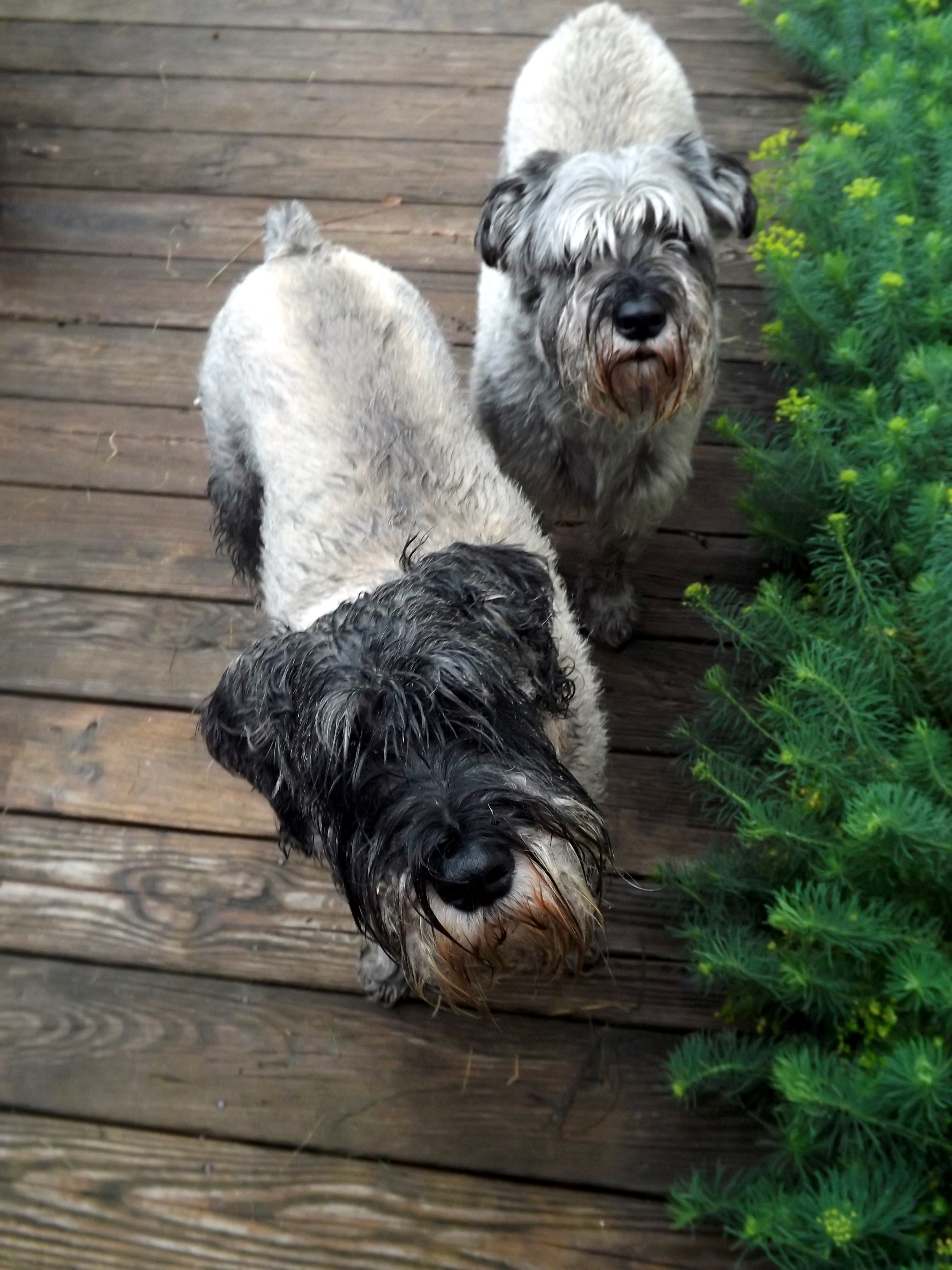
Following on this theme of neglect, our garden has become pretty quiet. Why? Because I have failed to refill the bird feeders. I am a sad friend to the local avian community. And this slump has extended to the canine members of the family as well–Shaggy Schnauzers 2 and 1, who by now must be embarrassed to be seen by other, perfectly coiffed members of their breed. So, by the end of this weekend, I hope to have made significant headway on the garden, lured the birds back, and cornered at least one of the dogs for a buzz cut.

A Lot to Learn About Allium

4 Aug

During our very brief visit to Vermont a couple of weekends ago, I was not only fortunate enough to see Beth’s asparagus forest, but I discovered that ignorance can lead to bliss.  In my case, I was admiring a clump of flowers at another friend’s house. Nan’s flowers had been battered by rain and were horizontal instead of vertical, and though they were a bit past their glory days, they still caught my eye. Maybe it was the charming way in which they were now peering over an old stone wall. Or perhaps it was because they were a color and shape I liked. Or maybe it was because unbeknownst to me, they were the same genus of plant I had in my own yard: Allium.


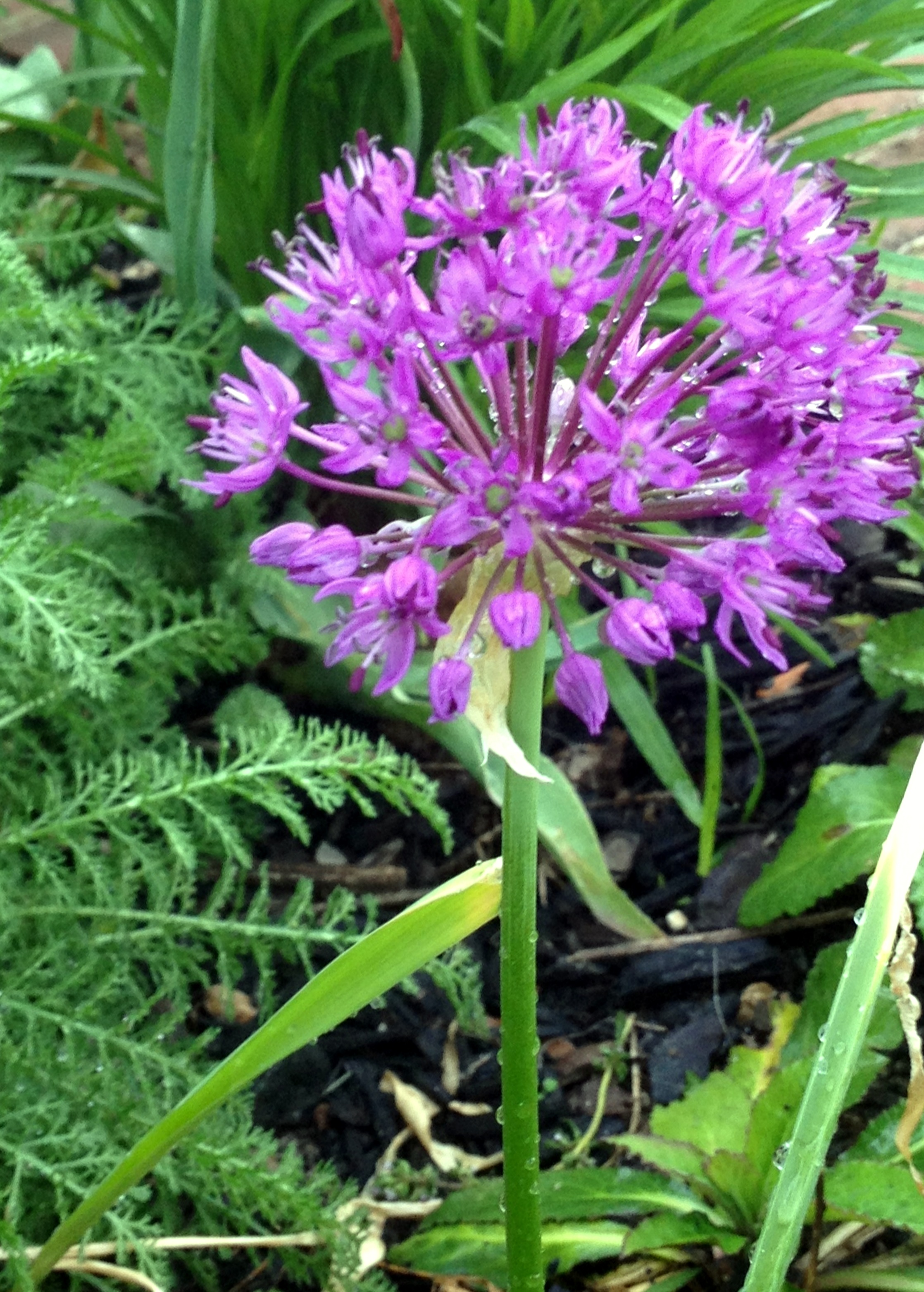
I like to think that had I looked more closely, I would have  known that. But when something appears so wholly out of context, it is sometimes hard to “see” it. Nan’s variety is called Drumstick Allium, and it was in bloom in July. The one I have in my garden is called Purple Sensation, and it blooms in early spring, like the few other alliums I know. The photo below shows the Purple Sensation on May 1.  In my defense, it is more open and fluffier than the Drumstick, and a different shade of purple, and upright….

What I discovered at Nan’s was that I had just spent two years thinking I could only have Allium in the spring, when in fact, it is possible for these ornamental onions to brighten any garden for almost three seasons of the year.

I am quite ready to admit that I am only an amateur gardener, which should by now be quite obvious to anyone reading this. But my ignorance led to such great delight at the discovery that I could have alliums in my garden for much longer than I thought, that I hope to never become jaded by the significant amount of gardening knowledge that awaits me.

Tis the Season for…Crape Myrtle

31 Jul

It’s that time of year. All over our neighborhood, Crape Myrtles (also known as Crepe Myrtles) are in bloom.  The long-flowering trees and shrubs originated in Asia, but made their way to the southeastern part of the United States more than 200 years ago after a pit stop in Europe. With so many different sizes and colors to choose from, there is bound to be a Crape Myrtle for almost every garden.

Our Siren Red is a relatively small variety–it will only be about 10 feet tall when fully mature, which is just right for our townhouse yard.  Of course, I also thought the Porcupine Grass was just right for our yard, but failed to adequately imagine what 8-foot tall clumps of  vibrant ornamental grass would look like at their peak; with two of them on either side of the Crape Myrtle, it is in danger of becoming the filling in a Porcupine Grass sandwich. I’m hoping the Crape Myrtle will soon outgrow the Porcupine Grass. If not, I’ll have to think of a Plan B.

I chose the Siren Red because of its size, and also because of its beautiful deep-red flowers. With crimson-colored new-growth foliage that turns green, and berry-like buds, every part of Siren Red is a pleasure to behold:


Asparagus Forest

29 Jul

Come spring, and for as long as it’s available, asparagus holds a place of honor in our house. We are especially fond of very thin stalks, tossed in olive oil, sprinkled with salt and pepper, and roasted at about 425 degrees until golden and slightly crispy at the tips. Cooked this way, asparagus never lasts more than a few minutes on our dining table and no matter how much I make, there is always at least one child looking mournfully at the empty platter. But… until this weekend, we had never seen asparagus growing, and it is as lovely to look at as it is to eat.

We made a whirlwind trip to Vermont and were lucky enough to see an old family friend, Beth, who has an asparagus forest. All it took was one look, and I decided that I absolutely have to try planting some asparagus next year, even if we will not be able to sample any of it for a while as it gets established.

Normally, the tender shoots that people eat are snapped or cut off just above ground level. But left to their own devices, the shoots grow tall and get woodier, the buds on the tips of the asparagus open and produce a wispy mass of branches and berries that turn bright red when ripe (though note that the berries should not be eaten). The little berries set against feathery foliage look ethereally festive, and when I saw the asparagus plants after a rainy afternoon, they were glistening.


The Understated Elegance of Switchgrass

23 Jul

This is the time in my garden when the show-stoppers from June have faded away and the autumn-flowering beauties have yet to burst forth.  I have not quite been able to ensure a completely steady stream of new blooms from March through October. A few troopers are still hanging in there, but this is when the ornamental grasses shine. There are two grasses in my garden: Porcupine Grass and Switchgrass  (Shenandoah). If plants can be categorized according to personality type, then there is no question as to which is the extrovert and which is the introvert.

Porcupine Grass grows like mad, has beautiful stripes, and is more than 6′ tall; it rarely gets overlooked. Here is a photo of it at eye level — it is tall, lush, and spectacular, a show-off in a garden of  show-offs:

But there comes a point at which the Porcupine Grass is too much: too tall, too bold, too loud.  And it is precisely then that the slower-growing Switchgrass comes into its own. Tucked away in a far part of the garden, it rarely gets much attention. But it is a gorgeous grass, with burgundy tips and delicate spikelets (flowers)–the epitome of elegance.  Proof, again, that quieter personalities have a great deal to offer any garden.

Yarrow: Here today…

12 Jul

Sometimes, gardening is not about what you put in to the earth, but what you take out. I move plants around if I think they would look better (or grow better) elsewhere.  And sometimes, only a few times in my gardening life, I have had to give up on a plant and tear it out completely because it won’t work anywhere. I hate to do it. But not quite as much as I would hate not doing it.

I wrote about Yarrow before, most notably in Lessons Learned from 2011. Yarrow has many good qualities. It blooms for a long time and when it is at its peak, it is glorious:

But Yarrow does not fade softly into the night. It attempts to hold on to its former glory as long as possible and then it collapses into a ungainly heap, with stalks splayed open:


This is the point at which I lop off all the spent blooms and cut the plant way back–simply because I cannot abide the messiness.  Is it possible to be a gardener who likes orderly chaos?

So I have come to a decision.  I have Yarrows in Garden 1 (G1) and Garden 3 (G3).  G1 is a very full flower bed, and the plants surrounding the Yarrow help hold  it up and then take over the space it vacates after I decapitate it. For that reason, Yarrow can stay in G1.  But in G3, the two Yarrow plants are on their own; no supporting cast can help them look better. So out they will go in a couple of months, to be replaced by something with a bit more backbone next year.

Two Unexpected Appearances

9 Jul

There are few things cheerier than the color orange. In the garden, one of my favorite orange flowers is Butterfly Weed, which as its name suggests, is just as attractive to butterflies as it is to me. Here is a close up from early June:

Now, most of the blooms are gone, and the Butterfly Weed is creating seeds, housed in the pods you can see here:

The pods dry out and crack open, and the seeds disburse in search of new homes.  [Note: People who know about these things (ie, real gardeners) collect the pods and keep the seeds for the following year instead of letting them blow all over the neighborhood. Now that I have finally figured this out, I will attempt to do the same.]

Last year, the seeds I neglected to harvest went their merry ways. One of them floated across the yard and over the fence, where it softly descended into a small patch of mulched earth near our garage. And there, it settled in for the winter, popping up unexpectedly as a new plant this year. I just discovered it a few weeks ago — a very nice surprise indeed. So this evening, I went to take a photo of it, and what did I find? A second unexpected appearance–in this case, a baby rabbit.

True Grit

8 Jul

Who would ever have thought that a very small, fluffy pink flower called Echinacea Double Scoop Bubble Gum could stand up to all the other plants in my yard and put them to shame? I planted four of them late in the season last year in a fool-hardy attempt to create some interest around a tree trunk. Fool hardy because trees notoriously take all the water that comes their way, leaving little for any other plants hoping to survive in close proximity, and also because the tiny plants were directly in the favored path of our two garden-wrecking, squirrel-chasing dogs.  If that were not enough, I barely watered or otherwise cared for these little echinaceas because they weren’t  in any of the three flower beds that commanded most of my attention.  I readily admit I forgot all about them.

So this spring, I was not surprised to find they had all died. I looked at the barren earth where they had been, and felt a twinge of guilt.  I should have taken better care of them. I expect all my plants to be hardy, but no plant could have survived under those circumstances; I should have recognized that before it was too late. And then I shook off my regret and turned my thoughts to my flower beds without a backward glance at the tree trunk.

Not too long after that, I almost stepped on two tiny shoots by the tree.  Weeds, I thought. They grow under any conditions. As I had too much weeding to do elsewhere, I ignored them and put them on my future to-do list.  They got a bit taller.  I still ignored them,  spending my limited time making the rest of the garden shine, paying attention to what was already beautiful.  And then, despite thirst,  canine assault, sheer neglect, and ridiculous heat, two tiny echinaceas bloomed, showing they had more grit than any other coddled plant in my yard. Here is one of them, looking a bit worse for the wear, but outshining its peers in every measure.

Tall, Colorful, and Handsome

5 Jul

In an earlier post, I included a photo of Garden 2 (G2) in 2011. Here is a photo of G2 last month:

As you can see, G2 has exploded. The focal plant, Crape Myrtle (Siren Red) is now well over fence height, with the Porcupine Grass on either side towering more than 6′. Ultimately, the Crape Myrtle will be taller than the Porcupine Grass; I just hope it doesn’t get suffocated before it gets there. A recurring lesson: check the spread (width) of your plants before planting them.  I only had eyes for height; width wasn’t really a consideration. I was looking for tall, colorful, and handsome, and in some cases ended up with fat and jolly instead. But it’s hard to be upset with a happy plant.

The new Gauras (Passionate Rainbow) on both sides in the front filled in quite nicely, but have yet to bloom. I suspect they will not this year. Maybe I am fated to not have Gauras, though I love them. But the yellow Euphorbia is still pulling its weight, as it has been since March. And new this year are two Azaleas–the two lighter green plants at the far left- and right-hand sides of the photo, just below fence level. I planted them in April, and am already fairly certain they are getting too much sun, so a relocation may be in the works. Another lesson worth repeating from 2011: don’t be afraid to move plants around. Of course, it would be best not to do it at high noon in 100+ degree weather (of the kind we have been experiencing lately); even the hardiest plant would have a rough time under those conditions. In fact, I can’t blame them. I’d wilt, too, if I were unceremoniously dumped into a hot hole with the sun beating down on my head. So I will keep my eye on the azaleas  and move them if needed–on a cooler, overcast day when rain is predicted.

I leave you with a couple other photos of the garden from June: a corner of Garden 1 (G1) featuring some pink and orange Echinacea, as well as Rudbeckia Giant Coneflower, which is stunningly tall, colorful, and handsome, and a total bird magnet.

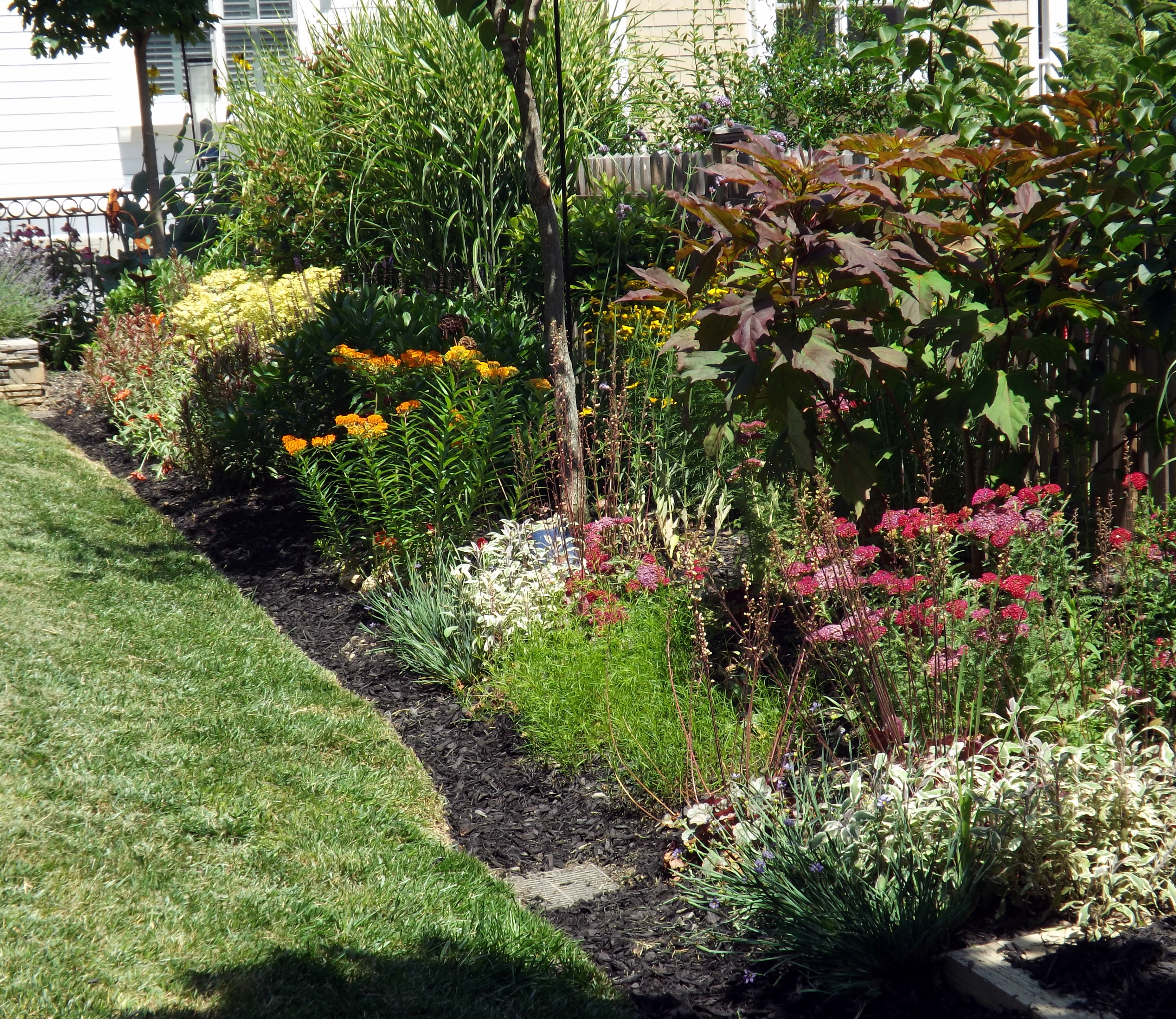
And Garden 3 (G3) looking down toward G2, with the coppery Hibiscus and crimson-colored Yarrow in the foreground, and orange Butterfly Weed by the tree. Don’t be fooled by the Yarrow, however. It is proving to be all show and no substance. More on that soon.