Archive | Gardening RSS feed for this section

Itsy Bitsy Spider

11 Oct

This is the story of a small spider in my garden. It being a cloudy and rainy morning, I grabbed my camera and headed for the yard. When it’s wet outside, colors pop and raindrops pearl on flowers and foliage—a gorgeous sight. But I only got as far as the sole remaining bloom on a Hybrid Tea Rose “Perfume Delight,” because I discovered that a small but industrious spider had established a new home there.


For perspective, see the lone bloom below (amid some Montauk Daisies), and a close-up of the spider on it.

Rose 1  
It’s hard to see, but for a good part of the morning, that spider was busy making silk threads; the first photo below shows a thread at top left, and the other is a not-very good photo of the spider spinning  (I managed to focus on the thread and a few rain drops, but alas, not on the spider…).

    spider4
That rose bloom wasn’t there a couple weeks ago. The spider could only have happened upon it recently, not knowing it had chosen an ever-evolving and ultimately doomed home. Even in the few hours between this morning and this afternoon, the rose bloom unfurled a bit more, breaking some of the spider’s newly spun threads. In a couple weeks, the bloom won’t be there at all. And yet, the spider remains, a Don Quixote in disguise.

Black-Eyed Susan: Inspiration for a Horticultural Adventure

12 Jul

Not  far from a mailbox near our house is a cheery patch of yellow flowers commonly known as Black-Eyed Susans.  When I went to confirm their scientific name (Rudbeckia hirta), I discovered that–much to my chagrin–they are the state flower of Maryland, which has been our home for the past 12 years. I have no excuse. I really had no idea, despite having some Black-Eyed Susans in the garden of our old house (also in Maryland). My current garden does feature a close cousin: some tall and graceful Rudbeckia maximas. I’m hoping I get some bonus points for that family connection….

This bout of state-related ignorance has inspired me to go from having no idea to having a nice idea: in two weeks, we will drive across the United States (from the West Coast back home to the East Coast). So my admittedly joyful task will now be to make note of each state flower along the route and see if I can take a picture of it. In the meantime, here is the lovely state flower of Maryland:


Summertime Bliss: Sun-Warmed Cherry Tomatoes

6 Jul

Few things beat the taste of a tomato that’s come straight from the garden. And cherry tomatoes offer that extra, satisfying little pop as you bite into them. The photo below shows our first harvest of the season, but the tomatoes in this bowl won’t make it into any recipe; these sun-warmed beauties are all going to be eaten just as they are–as a snack straight from Nature. However, there is a reason these tomatoes are called Sweet 100s: before long, I’ll be wondering what to do with all of them. I see lots of salads on the horizon, as well as our favorite Pasta with Cherry Tomatoes, Fresh Mozzarella, and Basil. And cherry tomatoes would also work in Roasted Tomatoes, Onions, and Garlic with Basil–though I’d start cooking the onions and garlic first, adding the cherry tomatoes toward the end of the roasting time. I detect a common theme in both recipes: basil. And now that I recall, last I saw it, our basil was in danger of being overtaken by the flowering oregano that has run riot in the herb garden…. Time for some triage in the name of good eats!


Red, White, and Blue 2014

4 Jul

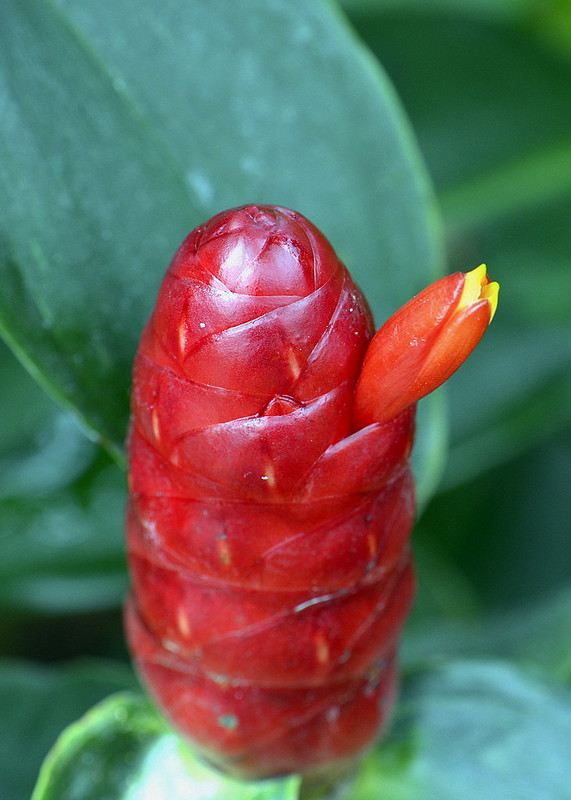
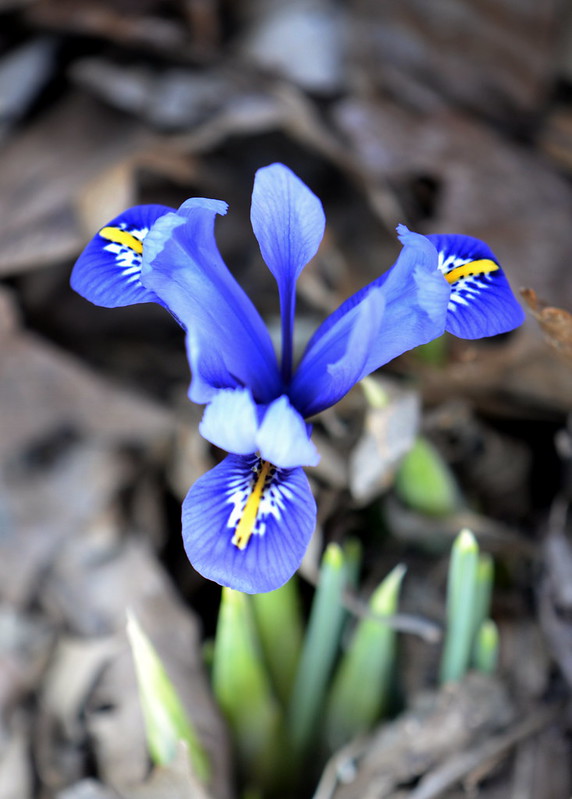
A few photos for US Independence Day. Red: Costus woodsonii (Indian Head Ginger) and Hibiscus. White: Cornus kousa (Kousa Dogwood). Blue: Echium candicans (Pride of Madeira) and Iris reticulata (Dwarf Dutch Iris).


Weekly Photo Challenge: Extra, Extra

14 Jun

This week, the challenge is for a photo with something extra–an unexpected detail. This photo was an experiment. I was sitting in our living room on a rainy morning earlier this spring, looking out at our deciduous azaleas and wondering what would happen if I took a photo of them through the window screen. Here is the result. The “something extra” is the pattern of the screen in the background (or is it the foreground?).

Bearded Iris: ‘Spartan’

26 May

In Greek mythology, Iris was the goddess of the rainbow; the flower’s name pays homage to the many colors of irises that exist. In the language of flowers, an iris is viewed as the bearer of good tidings–a reflection of the goddess Iris’ other role as messenger to the gods. I was swayed to include irises in the garden solely because of their beautiful display–but if they also bring good luck, even better.

This year, I added a maroon-colored bearded Iris: ‘Spartan.’ Its name is a nod to ancient Greek history, though their enemies would probably not have equated Spartan warriors with good tidings. I at least hope the name means the three plants I now have in my garden will be hardy.

They are the first bearded irises I have had the pleasure to observe at close range, and though they are now at the end of their brief blooming season, I kept an eager eye on them from the moment they were first in bud:

  
Bud and emerging bloom.


Three upward-facing petals (standards); three downward-facing petals (falls), with the beards resting atop the falls.

  
Close-up of a beard, which helps to guides pollinators (bees) into the flower. With the standard removed and this section of the plant opened up a bit (right), it is easier to see how the beard–and the color pattern–point the way to the nectar at the inner base of the flower. The stamen (male reproductive organ) with its pollen-covered anther is visible at the back, just in front of another petal-like structure that is called the style arm. The style arm is a highly modified pistil (female reproductive organ). Normally it’s a tight squeeze for a bee to get to the nectar; as it heads downward, it will brush up against the anther and get dusted with pollen. When the bee visits another iris, the pollen on its back rubs off and attaches to the sticky stigmatic lip (the arched line toward the top of the style arm, below the upper crest), allowing pollination to begin.

Banana Flowers and Other Edible Parts

22 May

Being a bit less mobile than usual, I thought I’d use the opportunity to choose a photo I’ve previously taken and see if I can learn more about the subject. What you see below is commonly called a banana flower or banana blossom (photo taken at the United States Botanic Garden). I’ve always been struck by this part of the plant, a deep-red appendage that dangles below the bunches of bananas. Though we like to think of the banana plant as a tree, it is technically a perennial herb, albeit a really big one; it dies down to the ground after the plant flowers and produces fruit. The inner part of the stem of the plant (which is actually a false stem consisting of leaf sheaths) is edible, as are parts of the flowers–they are considered vegetables and are popular in Asian and tropical cuisines, where they are used in salads, curries, stir fries, and other dishes.
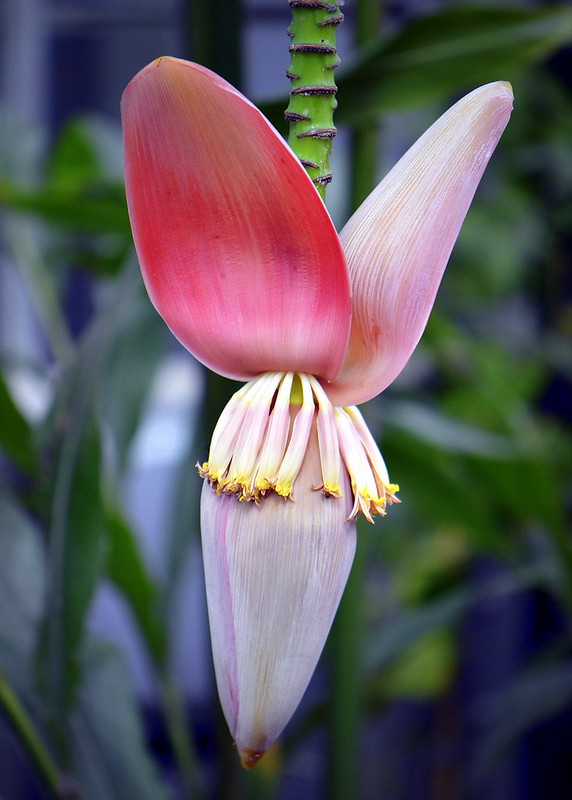

The banana “flower” seen in the photo above is actually the lowest part of an inflorescence consisting of layers of bracts (the petal- or leaf-like parts) that cover rows of  flowers. The female flowers are higher up and can develop into fruit (bananas). Once that happens, the inflorescence elongates and produces a terminal male bud. Here, the redder (and tougher) outermost bracts of that bud have opened upward, revealing yellow-tipped male flowers underneath and paler closed bracts below.

Different parts of the banana flower (or bud) can be eaten: the innermost bracts, the florets (once the stamens and tough covers have been removed), and the inner core, or heart. The tougher outer bracts are often used as serving plates for dishes made with the other parts of the banana flower. I don’t have easy access to banana flowers, but if you do and want to experiment with them, here are some resources:

To read about the ornamental Golden Lotus Banana/Chinese Dwarf Banana, see this post. To read about the difference between Musa (bananas), Strelitzia, and Heliconia, see this post.

And here are some additional banana-related photos:

1) A banana leaf unfurling at the Eden Project in England. Each leaf emerges from the center of the banana plant in the form of a rolled cylinder. Once the last leaf has emerged, the plant produces the inflorescence, which starts off pointing skyward, but then falls over and dangles as it gets heavier and the female flowers develop into bananas.
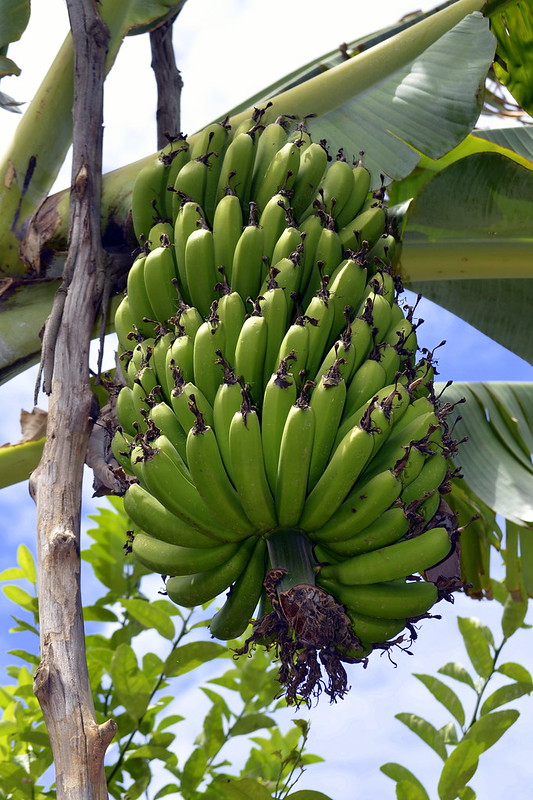
2 ) Banana bunches on the plant (with the terminal bud having fallen off). Some bunches can contain 200-300 bananas each; the largest one recorded by the Guinness Book of World Records contained 473 bananas and weighed 287 pounds.
3) Banana transport in Rwanda.


The Challenges of Gardening and Cooking on Crutches

17 May

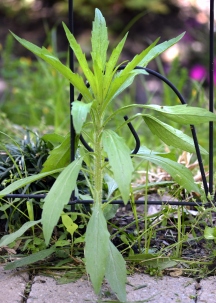
This title is misleading because it sounds like I actually have been able to do some gardening and cooking since breaking my ankle three weeks ago and being diagnosed with deep vein thrombosis three days ago. Sadly, that has not been the case. Hence this lovely photo of one of the many weeds that have now taken up residence in the garden. And the absence of any photos (or blog posts) pertaining to new garden initiatives or new dishes. But I can write about things happening in the garden of their own accord (future posts), as well as recent lessons learned, many of which involve crutches (this post).

Weeds

1. When crossing a street, look left, right, and DOWN. Or else your ankle could go one way and you could go the other, with unhappy results.
2. You will develop a love-hate (mostly hate) relationship with your crutches.
3. Crutches are made to transport mainly one thing–you. But you have been used to transporting multiple things yourself with the help of both your hands and feet, one of which can no longer be used and the other three of which are valiantly trying to to keep you upright and semi-mobile. This poses certain challenges.
4. Namely, how to transport hot beverages. A beverage tray for crutches would really come in handy. I was able to carry a number of things on crutches via the-tuck-the-item-into-my-waistband-and-hope-my-pants-don’t-fall-down method, but I didn’t dare try that with a cup of tea.
5. Not being able to use one foot means you will develop really good balancing skills on the other one. This came in handy when I leaned over on one foot to pull a few weeds from the edge of our patio the other day, though the neighbors may have thought I was practicing some bizarre new form of Tai Chi. The downside to all this balancing on one foot: your injured leg muscles will disappear while the muscles on your other leg will fill out quite nicely, leading to a lovely asymmetrical look.
6. If you are like me, crutches will also allow you to discover muscles in your arms that you didn’t know existed. That’s another plus: increased upper body strength for improved gardening efficiency. But if the muscles in your injured leg ever start aching, pay attention. What I thought was a calf muscle that was strained from limping around too much three weeks post fracture turned out to be a blood clot.
7. If you should ever have the misfortune to end up with deep vein thrombosis after a fracture, you will find that all things considered, the fracture might actually be the less painful/scary of the two. Part of the reason is the blood-thinning medication you have to inject into your own stomach twice a day, which feels as if you were being stung by a bee each time. It is really not fair to bees.
8. Finally and most importantly, be immensely thankful when your body works well. All the many parts, including the humble foot, make even the simplest things possible–yet it’s so easy to take those parts for granted.
9. Ditto for the family members and friends/coworkers who turned into nurses, chauffeurs, and advocates at a moment’s notice. They make everything possible, too.

Birth of an Allium ‘Purple Sensation’

10 May

The thing I love most about this time of year is the process by which new flower buds slowly open up and reveal their hidden treasures. I particularly love watching my Allium hollandicum ‘Purple Sensation’ as the buds break free from the papery bracts protecting them and explode into a profusion of perky florets. The allium ‘flower’ is actually a cluster of much smaller flowers (florets) atop a stem–this type of arrangement is called an inflorescence.


The papery bract begins to split open under the strain of the growing florets.


The florets start to take on color.


The emerging inflorescence, seen from above.

  
Individual florets begin to bloom.                Close-up of a floret.


The newly emerged inflorescence, seen from above.


Allium hollandicum ‘Purple Sensation’ in bloom.


Weekly Photo Challenge: Spring

3 May

When I think of Spring, I think of flowers and new life.  This Tulipa “Ballerina” is one the the earliest and cheeriest flowers in my garden, and a look inside the tulip reveals some essentials about plant reproduction.


This close-up focuses on the three-lobed stigma (the top-most section of the tulip’s female reproductive parts, known collectively as the pistil), which catches pollen via its sticky and fuzzy surface. The pollen then travels down the tube-like style to the ovary where  fertilization takes place (if the pollen came from a tulip plant), ultimately leading to the production of seeds. The six pollen-covered anthers (the top-most parts of the male reproductive organs, known collectively as the stamens) are blurred in the background; the stamens emanate from the base of the pistil.

Tulips are considered “perfect” flowers because they contain both male and female reproductive organs. They can self pollinate, but can also cross pollinate in the wild with the help of bees and other pollinators. Alas, most commercial tulips, including this one, are sterile hybrids. But the good thing is that tulips also reproduce via their bulbs, which allows gardeners to enjoy them anew each spring.