Tag Archives: seed dispersal

The Unusual Jaboticaba Fruit Tree

20 Apr

Ok, if you live in any of the tree’s native habitat areas in South America, the Jaboticaba and its fruit may not be so unusual to you. But for the rest of us, the tree is a sight to behold:

Jaboticaba; photo taken at the Missouri Botanical Garden in St. Louis.

The Jaboticaba (Plinia cauliflora, aka Jaboticabeira, aka Brazilian Grape Tree) is a showstopper because it exhibits an unusual botanical trait, ie, its fragrant white flowers and sweet/tangy fruits grow directly on the trunk of the tree, rather than from new growth or shoots. In botanical terms, this is called cauliflory; hence the “cauliflora” part of the Jaboticaba’s Latin name. (“Plinia” refers to a genus of flowering plants in the myrtle family, Myrtaceae, to which the Jaboticaba belongs.) Other cauliflory plants include Durian, Cacao, Jackfruit, Papaya, and the lesser-known Cannonball Tree — which, though they all share this same botanical trait of cauliflory, are not actually related to the Jaboticaba.

Cauliflory is most common in tropical areas; in the United States, the Jaboticaba can be grown in Zones 9-11. Botanists believe cauliflory evolved for a couple reasons: 1) accessibility: insects and fruit-eating animals that can’t easily get to the highest parts of trees can access the flowers and fruits on the lower parts of the trunk of a cauliflory plant, thus helping ensure the tree’s reproduction via cross-pollination and seed dispersal. Another reason for cauliflory may be due to 2) structural support: the trunks and main stems can more easily bear the weight of heavy fruits like Durians, Jackfruits, and Papayas.

Though Jaboticabas are very slow growing, once they reach maturity, they can produce up to 100 pounds of berries, which look like very large grapes and come in different varieties and colors (purply-black, red, and white). The skins are a bit thick and tannic; some people eat the berries skin and all for a nice “pop,” while others squeeze the juicy pulp into their mouths and discard the skin. The pulp is translucent and jelly-like, with a few seeds. It looks a little like the inside of a lychee or blueberry. Depending on the “jabo” variety, the berries are said to taste like Muscadine grapes, blueberries, and/or lychees — or a combo of all those flavors — with slight acidic undertones. Jaboticaba berries are also quite nutritious; they contain lots of Vitamin C and other antioxidants, as well as amino acids and nutrients such as calcium, phosphorus, and iron.

In addition to being eaten fresh, the Jaboticaba fruits can be made into juice, syrup, jam, and other usually sweet concoctions. The important thing is to use the fruit quickly after picking it, as it has a very short shelf life (which explains why those of us who cannot grow this tree also cannot find the fruit in our local supermarkets).

Recipes:
Jaboticaba Juice (video)
Jaboticaba Syrup
Jaboticaba Liqueur
Jaboticaba Jam w/Pectin
Jaboticaba Jam w/o Pectin
Jaboticaba Sorbet
Jaboticaba Cheesecake
Jaboticaba Sparkling Wine
An Unexpected and (Re)Productive Study of the California Poppy

21 Mar

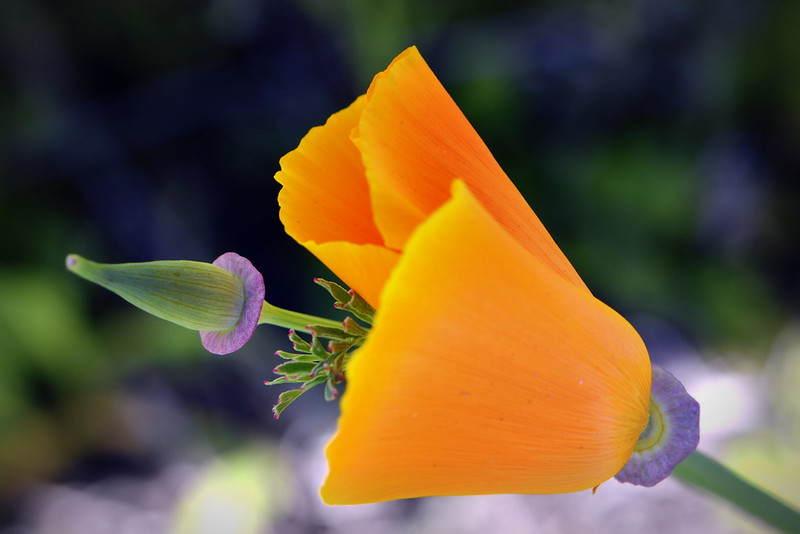
Sometimes, blown car tires lead to unexpected opportunities. While in California on our way to Monterey, our tire blew out on the freeway and very spectacularly separated itself from the rim. Our oldest son was driving and successfully steered the car to the side of the road, with the help of a kind truck driver, who stopped traffic in the right lane to let us over. While the spare tire was being put on, I noticed a cheery patch of poppies down a small hill, and headed there with my camera, whereupon I had an impromptu lesson in reproduction–of the floral kind.

The Golden State loves golden symbols, so it’s no surprise the California Poppy is the state flower. It’s a favorite of many gardeners, but also grows wild across California and elsewhere; masses of poppies make some Western mountains look as if they have been dusted with orange-yellow confetti. They also grow by the roadside, where I was lucky enough to get to study them for a little while. In that scraggly patch, there were poppies at all stages of development, from buds to full flowers, to seed pods.


The flower buds are encased in a calyx made up of two fused sepals; the papery cap slowly gets pushed off as the four overlapping poppy petals begin to unfurl.

  
Inside the cup-shaped flower itself are the stamens (pollen-tipped male reproductive organs) and the pistil (female organ), waiting for pollinators–usually bees, but also beetles and flies–to help ensure a new generation of Eschscholzia californica. This is the plant’s  very civilized (and somewhat passive) Plan A in terms of reproduction.


But, there’s a Plan B, too–and it’s a bit more lively. Once the poppy’s main flowering cycle comes to an end, the petals start dropping off, revealing an elongated seed pod (fruit) sitting on the disk-like torus. The pod gets longer and bigger, starts drying up in the sun, and finally bursts open, ejecting seeds as far as 6 feet away. This type of seed dispersal has a great name: explosive dehiscence.  Oh, how I wish I could have seen it in action.

  
So, what pollinators cannot achieve, the plant takes care of on its own, spreading its wealth just a bit further one seed pod at a time. Something to admire this April 6, which is California Poppy day.


Seed Transport: A Hairy Situation?

22 Oct

When I think of autumn, I think of brilliant, jewel-toned foliage: rich reds, oranges, and yellows. But fall is also a time for brown–and specifically, for really interesting seed pods that have dried up, split open, and offered up their treasures.

In a recent post, I wrote about wind dispersal of seeds via feathery parachutes. Seeds attached to or encased in balls of fluff can travel quite far on a good breeze. But there are other ways for seeds to get around. Catching a ride on a passing animal is one of them. And that is why some seeds are sticky — or hairy, as in the case of Rose of Sharon seeds, which are encircled by a fuzzy ring.

Despite this transport mechanism, however, Rose of Sharon plants are really, really good at self seeding, with dozens of seedlings springing up around the base of the parent plant each year. So while those seeds are designed for adventure, they are really homebodies at heart. And I’ll take a homebody any day, if it puts on a good show (see below).

Rose of Sharon seed pods

Rose of Sharon seeds

Rose of Sharon flower

Feathery Parachutes

8 Sep

There are a variety of ways unexpected plants can crop up in your garden, but often, you can thank the wind for it. If bees play a vital role in pollination, then wind plays a similar role when it comes to seed dispersal. Think of the dandelion, the bane of many gardeners’ existence. It has developed a perfect way of ensuring a next generation by encasing its seeds in balls of fluff. What the wind doesn’t carry away (or lawnmowers cut down and disperse), young children will happily blow into the air–all but guaranteeing a new crop of the ubiquitous yellow flowers right in the middle of your lawn, or your neighbors’.

The Butterfly Weed plant disperses seeds in a similar fashion, but its seeds reside in pods that dry out and then crack open, allowing the feathery parachutes to travel hither and yon (if the Milkweed Bugs that love the seeds and tissue of Butterfly Weed plants don’t get to all the seeds first…). Luckily, there are many, many seeds to go around. And then, it’s up to wind, luck, and Mother Nature. In the bottom two photos, the Butterfly Weed seed parachutes have gotten stuck on 1) a Verbena Bonariensis and 2) a spider web near our brick staircase. I hold out more hope for the former’s prospects than for the latter’s.