Tag Archives: quick

Recipe: How to Make Bright Green Pesto

5 Oct

The very last of my basil has flowered, so today I headed out and harvested all the remaining good leaves. It took a while, but the sun was warm on my back, the bees were buzzing gently by, and the smell of the basil as I plucked each leaf one by one, was intoxicating. There are worse ways to spend part of an October morning.

My aim? To make a few batches of pesto to freeze. But the end result looked (and smelled) so good, I couldn’t wait; I decided to use one batch tonight. It will get drizzled over a Sausage, Kale and Bean soup, the thought of which is already making me hungry!

This recipe calls for blanching the basil, which I find is a key way to get the greenest color. Today, I used another trick, too: I added a handful of baby spinach leaves that needed using up as spinach also amplifies the emerald factor. The addition of a few drops of lemon juice makes the pesto a bit brighter, too; I almost feel like it makes the pesto taste greener (is that possible?).

Note: When I am making pesto to freeze, I do not add the cheese or lemon juice. Instead, I add both those things later on to the thawed pesto. So the photos below are pre-cheese, and thus, represent a vegan version that would be delicious on its own, too.

Bright Green Pesto
(makes 2 cups total = 3 batches)

6 c. (slightly compressed but not packed) fresh basil leaves (about 120 gr.); can substitute up to 1 c. baby spinach leaves
3/4 c. toasted pine nuts
6 large garlic cloves
1/2 tsp. salt
1 c. extra-virgin olive oil
*1.5 c. freshly grated Pecorino Romano cheese (preferred) or Parmesan
*lemon juice, to taste

Preparation

1. Set a large pot of water to boil.
2. Pick over the basil leaves to make sure there are no blemishes (or stems). Fill a large bowl with ice water and set aside. When the water in the pot is boiling, add the basil and garlic, and push down on the basil leaves with a slotted spoon (to submerge them), just until they turn bright green. This blanching process should take less than a minute.

3. Immediately drain the basil and garlic in a colander, and then set the colander in the bowl of ice water to stop the cooking.
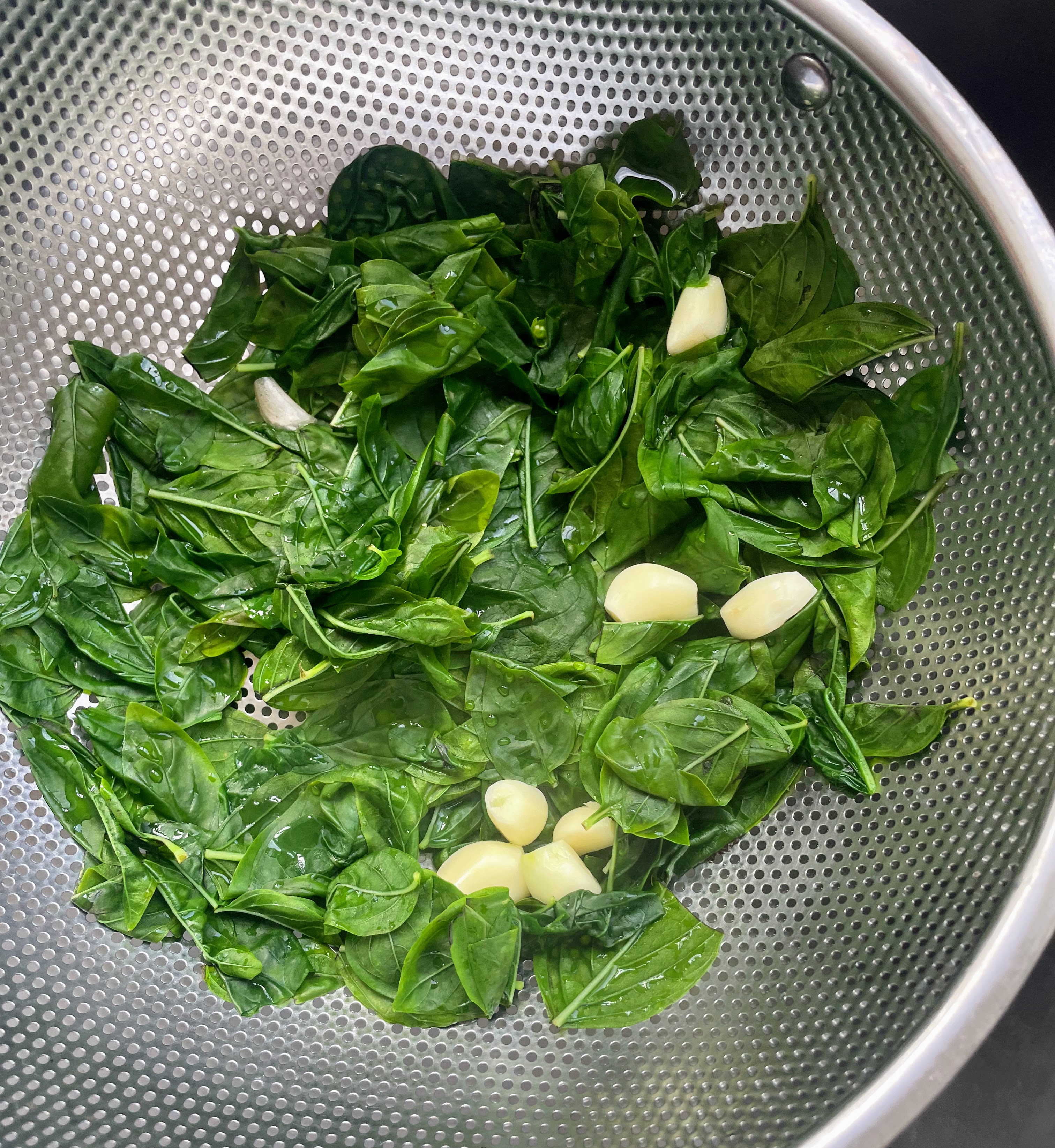
4. Once the spinach is cold, remove the colander from the bowl, set in the sink, and let the basil and garlic drain for a few minutes. Then place the basil and garlic on a clean dish towel and pat as dry as possible.

5. Put the basil and garlic in a food processor, add the pine nuts and salt, and pulse until the mixture is finely chopped and begins to come together. With the food processor still running, slowly pour in the olive oil and process until smooth.
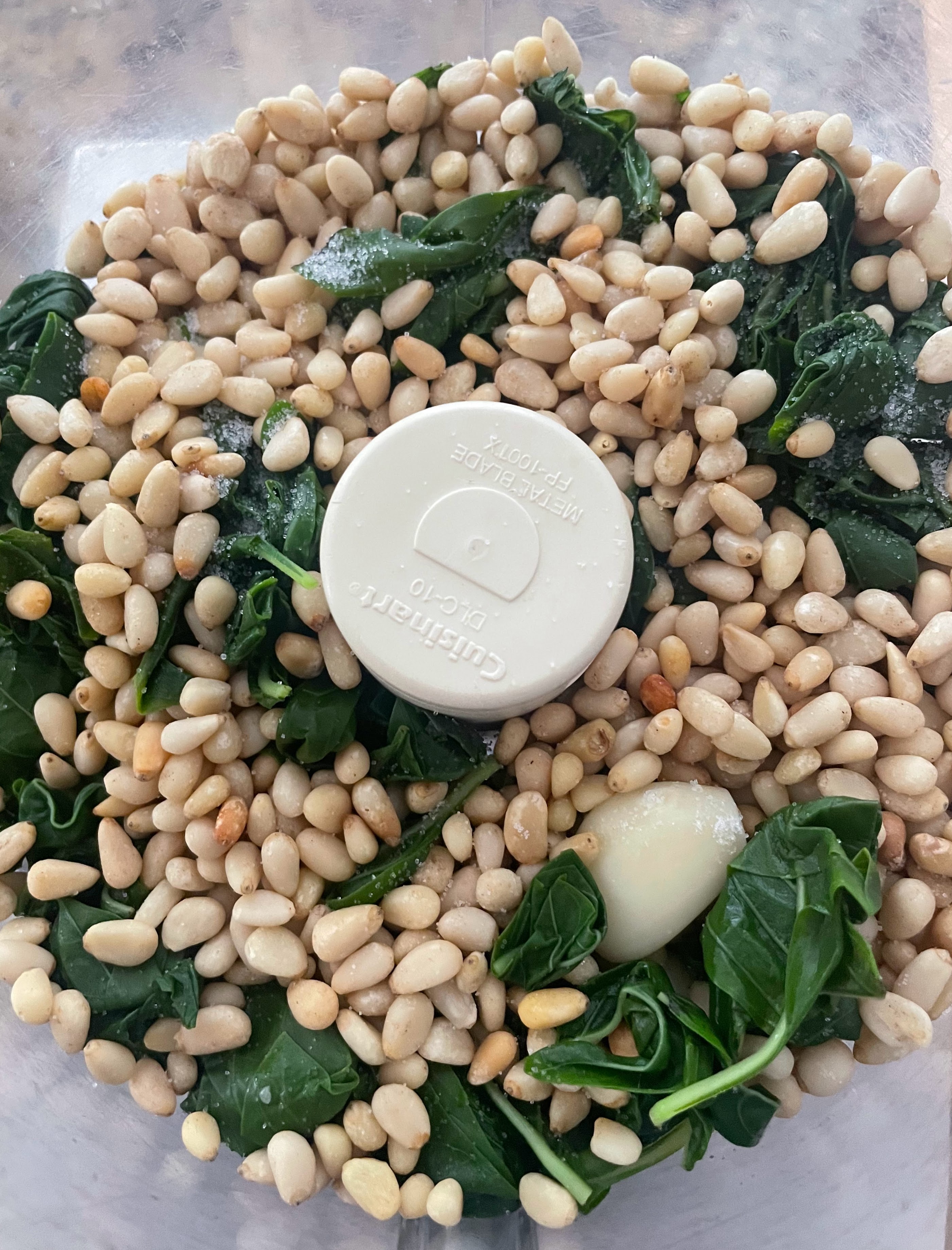
6. If using the pesto the same day, add the cheese and lemon juice, and pulse again very briefly, just long enough to combine. Do a quick taste test to gauge lemon and salt levels; add more if needed. You can also add a bit more olive oil if the pesto seems too thick.

*7. If freezing the pesto, omit the cheese and lemon juice, divide the pesto among three freezer-proof containers, and freeze. When you want to use a batch, thaw it fully and let it come to room temperature. Prior to using, add 1/2 cup grated cheese and a few drops of lemon juice, and mix well. Do a quick taste test to gauge lemon and salt levels; add more if needed. You can also add a bit more olive oil if the pesto seems too thick.

Recipe: Spaghetti with Ricotta and Pecorino Romano

3 Mar

Sometimes, you need comfort food. While home today with a very sore throat and not much food in the fridge, I wondered what to make for lunch. It needed to be soft. It needed to make me feel better. It needed to be made from the few items I could scrounge up, and it needed to be prepared quickly. There was only one possibility: Spaghetti with Ricotta and Pecorino Romano, a double dose of sheep-milk heaven — and ready in less than 15 minutes. Perfect.

dsc_0115

Spaghetti with Ricotta and Pecorino Romano

This is a free-form recipe; you can adjust any of the ingredients to suit your tastes. The quantities below are for one hungry pasta lover, but this dish could serve two people if part of a multi-course meal.

  • ¼ lb. (113 grams) spaghetti, fettucine, tonnarelli, or other pasta
  • 1 tbsp. (14 grams) butter, cut into small pieces
  • ¼-1/3 cup (28-38 grams) grated Pecorino Romano cheese
  • fresh, coarsely ground black pepper, to taste
  • 2 ¼ oz. (64 grams) sheep’s-milk ricotta, crumbled or cut into small pieces (* use the best, freshest ricotta you can find)

Preparation

  1. Start boiling lightly salted water in a generously sized pot. When the water comes to a boil, add the spaghetti and cook just until al dente—often that’s about 1 minute less than indicated on the package.
  2. Meanwhile, place the pieces of butter in an unheated skillet or large bowl next to the pasta pot. Add the Pecorino Romano cheese,  grind black pepper over  top (to your liking), and sprinkle 2 tbsp. cooking water around the sides of the skillet or bowl.
  3. When the spaghetti is done, quickly scoop it out of its cooking water with a pasta ladle and drop it into the skillet or bowl. Don’t shake off all the cooking water; it is an essential ingredient. Stir and swirl the spaghetti vigorously to melt the butter, the Pecorino Romano cheese, and the cooking water into a light sauce. Add more cooking water if the pasta appears too dry.
  4. Check the seasonings (adding salt and more ground  pepper if needed), gently fold in the ricotta, and serve immediately, with additional grated Pecorino Romano on the side.

Recipe: Coffee Ricotta Mousse with Gianduia (Chocolate Hazelnut Spread)

19 Feb

PHOTO2
Since moving to Italy, I have become obsessed with fresh, soft ricotta. Ricotta is made from the whey left over from making other cheese (so, the second cooking–and hence the name ricotta, which means twice cooked). It can be made from cow’s milk, sheep’s milk, goat’s milk, or buffalo’s milk. Cow’s milk ricotta is more common, but I love the taste and texture of sheep’s milk ricotta (ricotta di pecora), which has a very high fat content and is a bit softer than the cow milk version.

Cow's milk ricotta  Sheep milk ricotta
Despite this slight preference, I have yet to meet a ricotta I do not like. I love it in pastas and in any savory incarnation–but I really, really love it sweet: in the ricotta cakes here in Rome, in Sicilian cannoli, in the Neopolitan sfogliatelle…the list goes on. Basically, I love sweet ricotta here, there, and everywhere. So for the past few weeks, I’ve been experimenting with making a ricotta dessert at home: mousse. It has been tough work.

This version is currently my husband’s favorite: coffee-flavored with ripples of gianduia, a dark chocolate-hazelnut spread that is a sleek, grown-up version of Nutella. The recipe is for two servings (based on 1/2 c. ricotta per person)–and can easily be multiplied. It yields a subtly flavored mousse that is not overly sweet, but the ingredients can easily be adjusted to your taste. Note: delicious as this is, it has one other thing going for it–it is a very quick dessert that can be made ahead and put in the refrigerator until later.

Coffee Ricotta Mousse with Gianduia
Two servings

Mousse
1 tsp. instant espresso powder or instant coffee granules
1 tsp. vanilla
1 c. fresh, soft ricotta (preferably sheep’s milk ricotta–but use whatever is the best ricotta you can find)
2 rounded tbsp. sugar
3 tbsp. whole milk

Filling
2 heaping tbsp. gianduia (chocolate-hazelnut spread)

Garnish
2 or more whole hazelnuts
chocolate-coated cookie sticks

Pernigotti  Mikado
Preparation
1. Dissolve the instant espresso powder (or instant coffee granules) in the vanilla.
2. Place the remaining mousse ingredients in a bowl and mash with a fork until soft and mousse-like; add the coffee/vanilla mixture and whisk to combine, eliminating as many lumps as possible.
3. Leave with a few lumps for a more rustic mousse, or, for a finer texture, use an electric whisk (such as a whisk attachment on an immersion blender) or a hand mixer and whisk until velvety smooth.
4. Place 2 heaping tbsp. mousse in the bottom of each mousse cup, dot with about 1 heaping tsp. gianduia, and swirl slightly. Repeat, for three layers total, using up all remaining ingredients in the final layer.
5. If preparing in advance, cover each mousse cup with aluminum foil and refrigerate.
6. Just before serving, garnish each mousse with a whole hazelnut and chocolate-coated cookie stick.

Mousse1
mousse2