Tag Archives: corn

Tassels and Silks: The Beautiful Anatomy of a Corn Plant

7 Jul
Corn tassel consisting of individual spikelets, with anthers hanging from filaments

Last year, I carved out a patch in the vegetable garden, planted some corn kernels, and was very excited when the sprouts emerged. But a few days later, all the sprouts were severed, laying forlornly on their sides where they had fallen. Upon closer inspection, the sprouts had been pulled up and the corn kernels had been chomped off at the base — clearly the work of chipmunk commandos who had infiltrated the garden at the crack of dawn. Chipmunks 1, me 0.

This year, I planted seedlings instead of kernels, crossed my fingers, and hoped for the best. As of yet, there haven’t been any corn massacres, so I’ve been able to watch corn plants grow for the first time — and admire their constituent parts. There is a lot to notice, from the stripy leaves…

Macro view of corn leaf

… to the beguilingly named tassels and silks. The highly recognizable tassel at the top of every corn plant is the male part of the plant, and consists of about 1,000 spikelets, each containing 3 pollen-producing anthers and their filaments (collectively, the stamens). With 6,000 pollen-producing units on each corn plant, that’s a lot of pollen to be wind dispersed (read more about pollen shed in this great article on “sex in the corn field“).

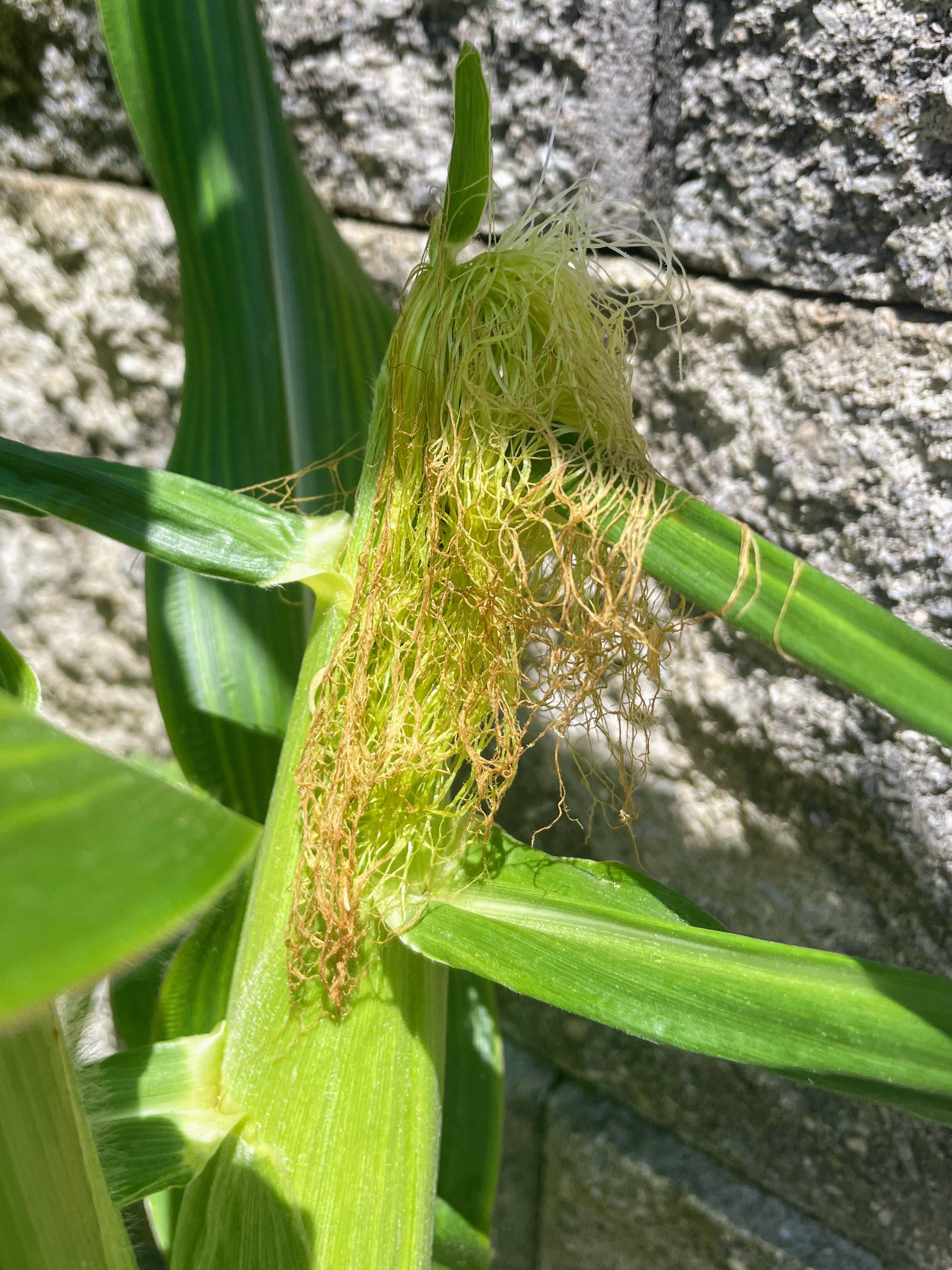
The silks are the female part of the corn plant. They form at the base of the ear but are most visible at the tip, emerging from the husk. Their job is to catch the pollen and guide it down to the unfertilized corn kernels (ovules) on the ear. Here’s the fascinating part: Each silk is connected to a kernel (or what would be a kernel if successfully pollinated). As not every ovule gets pollinated, most ears produce about 400 to 600 kernels.

You can tell when pollination has occurred because the silks dry up, turn brown, and often fall off. You can also tell when pollination hasn’t been very successful if your ear of corn has missing or misshapen kernels. That’s why it’s important for home gardeners to plant corn in a block rather than a single row, so the pollen has more chance of falling on nearby silks rather than being completely blown away from the row.

I don’t have any photos of pollen on the silks, but this is what the tiny yellow pollen grains look like on a corn leaf, along with some spent anthers (they drop off the tassel after the pollen is shed).
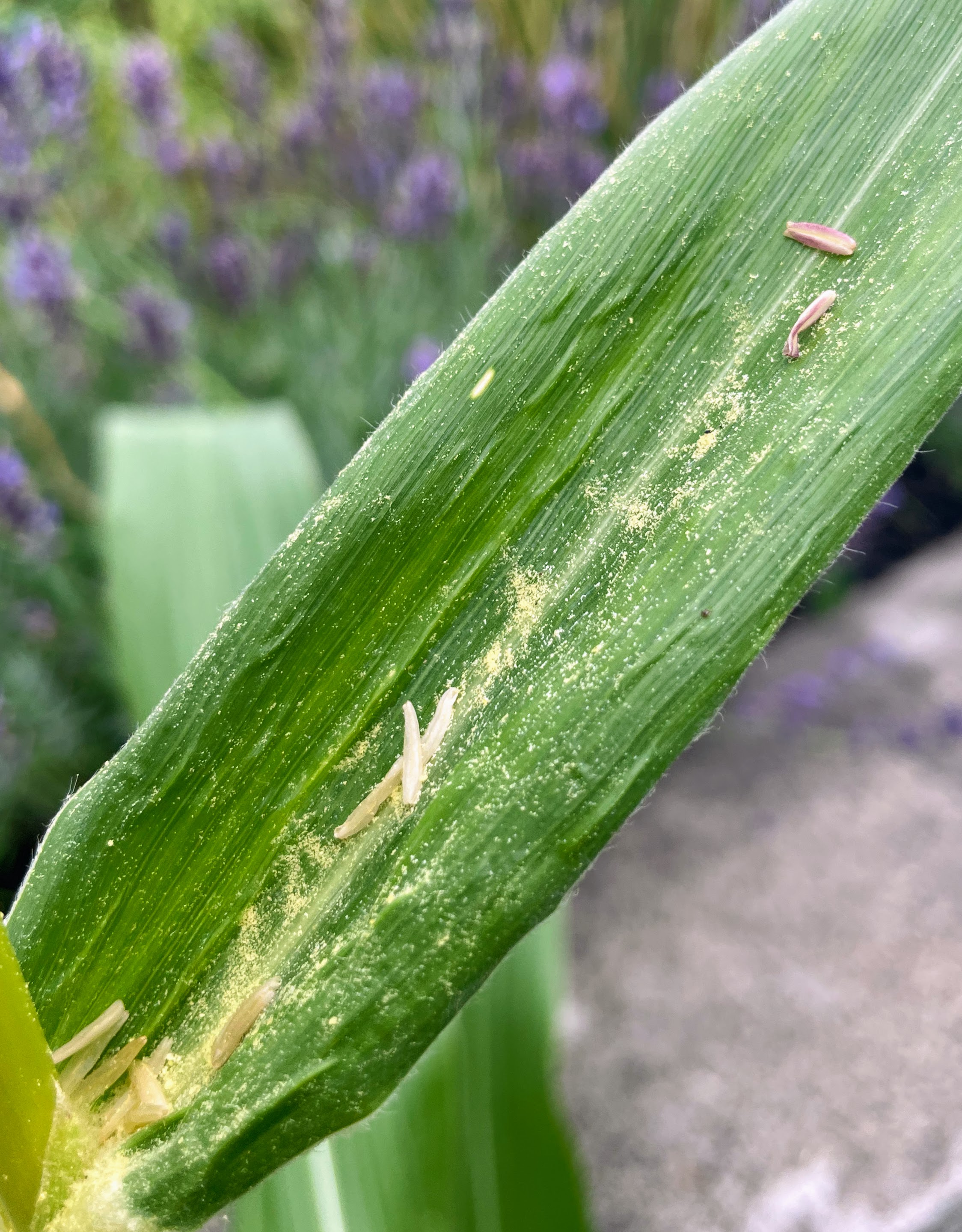
Some of the 2-5 million pollen grains produced by each corn tassel (and some anthers)

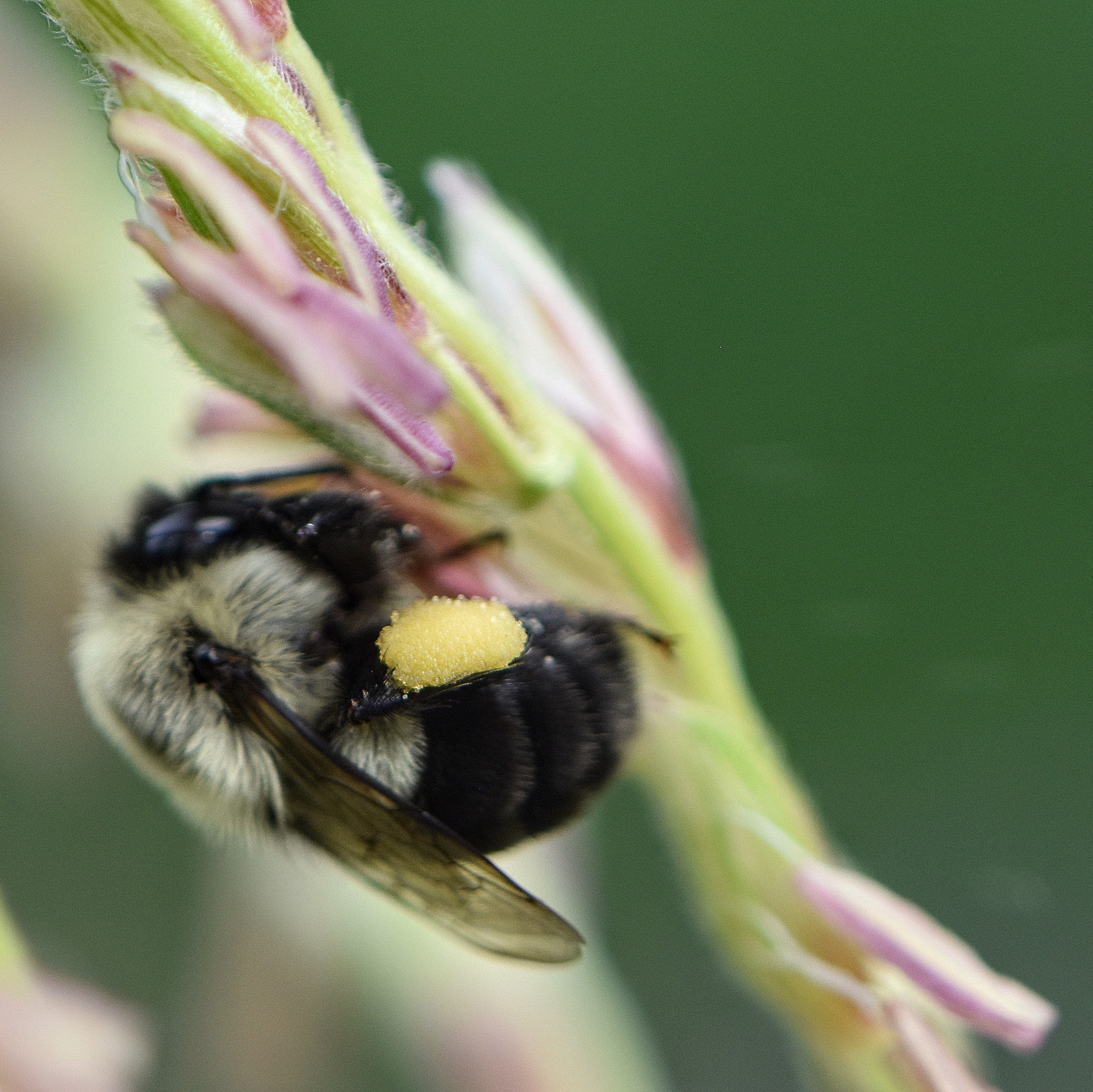
Though corn is pollinated by the wind (anemophily), pollination can also occur with the help of insects (entomophily). Luckily for me, as I was taking photos of the tassels, a bumble bee appeared. Or, more specifically, a female bumble bee appeared–as the females are the only ones to have pollen baskets (corbiculae) on their hind legs.
Recipe: Sausage Cheese Dip, Two Ways

4 Nov

I love recipes that can do double duty. This one’s dual role came about by accident when I was pondering what to make for dinner one recent busy weeknight. We first had the very delicious sausage cheese dip on a weekend while watching a football game, but had some leftovers. So, when staring at the contents of my fridge a couple days later, I thought: “Sausage and cheese? Both those things go very well with pasta…. hmmm.” And I had a zucchini that I needed to use, too. Thus, Sausage Cheese Dip Rigatoni with Zucchini was born. And it was good! Both recipes follow.

Sausage Cheese Dip (based on a recipe from Natasha’s Kitchen)
Note: This serves 4 without leftovers (2 with leftovers)

Ingredients
1/2 lb. (226 gr) mild Italian sausage, removed from casing
2 garlic cloves, minced
pinch onion powder
salt and pepper to taste
4 oz (113 gr) cream cheese, cut into cubes (no need to soften)
10 oz (283 gr) can diced tomatoes with green chilies
1/2 cup corn (I cut the corn off one previously cooked cob, but frozen would also work)
4 oz (113 gr) sharp cheddar or similar cheese, shredded

Preparation
1. Drizzle a small amount of olive oil in a medium skillet. Brown sausage over med/high heat, breaking it apart with a wooden spoon, until browned. If the sausage generates a lot of grease, drain the grease.
2. Add the garlic, onion powder, and some pepper, and cook over medium heat for one more minute, stirring through.
3. Add the cream cheese cubes and stir until melted and incorporated.
4. Add the undrained tomatoes, corn, and shredded cheddar. Cook, stirring occasionally, just until bubbly and cheese is melted. Check seasonings, and add salt or pepper as needed.
5. Remove from heat and serve with tortilla chips. The kind that look like scoops are perfect for this dip. (Note: The photo below also includes Cumin-Scented Black Bean Salad.)

Sausage Cheese Dip Pasta with Zucchini
(serves 2 hungry people)

Ingredients
5.3 oz (150 gr) pasta of choice (I used mezzi rigatoni)
olive oil
1 zucchini, diced
1 cup Sausage Cheese dip
cream or milk (if needed)
Pecorino Romano or Parmesan cheese, grated
salt and pepper to taste

Preparation
1. Bring salted water to a boil and cook pasta as directed for al dente.
2. While water is coming to a boil, drizzle some olive oil into a large skillet. Add diced zucchini and cook over medium-high heat until zucchini starts to get golden around the edges.
3. Add the sausage cheese dip and stir until warm and melted. Check the consistency; add a splash of cream or milk if too thick. If too thin, add some grated Pecorino Romano or Parmesan cheese.
4. When pasta is ready, drain, and add to sauce in skillet, along with more grated cheese. Check the seasonings, and add salt or pepper as needed.
5. Serve immediately.

Recipe: Beef Barley Mushroom Soup

19 Jan

One thing to appreciate about winter is that it is soup weather. Take a steaming bowl of hearty soup, add a crusty baguette and a crisp salad, and you’re set: both body and soul will sigh in appreciation. This soup features some whole-grain goodness in the form of barley, plus that deeply satisfying umami taste from the beef and mushrooms. More flavor comes from searing the beef and bones (which results in the rich crusty drippings known as sucs, or also in the United States as fond). That is followed by deglazing the pot with aromatic vegetables and a dash of soy sauce until the vegetables are also golden and offering up their own richness, and then continuing to build the soup from there.

*See note below for how to make a vegetarian/vegan version of this soup.

Beef Barley Mushroom Soup
Serves 8

2-3 tbsp. olive oil
1 1/2 lb. beef stew meat, trimmed of fat, and cut into small cubes
1 lb. beef bones
1 lg. onion, diced
2 carrots, diced
3 celery stalks, diced
1 tbsp. soy sauce
8 oz.  mushrooms, diced
6 garlic cloves, crushed
2 bay leaves
1 tsp. dried thyme
freshly ground pepper
1 c. tomato puree
8 c. beef stock or broth (if using prepared stock/broth, find a low-fat, low-sodium brand)
2 c. water
2 beef bouillon cubes (optional, but if using, find a brand without MSG)
2/3 c. pearl barley
1 c. frozen corn kernels
1/2 c. frozen petite peas

chopped parsley as a garnish

Preparation

1. Heat a Dutch oven or other heavy-bottomed pot over high heat. Add the olive oil, and when hot, brown the meat and bones; you want to get golden-brown crusty drippings on the bottom of the pot. Remove the meat and bones and reserve.
2. Add the onions, carrots, and celery to the pot and sauté for a few minutes, stirring often to deglaze the pot (to loosen the crusty drippings), until the onions begin to soften and turn golden brown at the edges. (If the vegetable mixture gets too dry at any stage, add a tiny bit of olive oil.)
3. Add the soy sauce to the vegetables in the pot; cook for a couple minutes, then add the mushrooms. Cook until the mushrooms have released their liquid and the liquid has mostly evaporated. Add the garlic, bay leaves, and thyme, and grind a generous amount of black pepper over the vegetables; cook for three to five minutes. Add the tomato puree; mix well.
4. Return the beef and bones to the pot, add the stock/broth, the water, and the bouillon cubes (if using); bring to a boil. Lower the heat, cover the pot, and begin simmering the soup.
5. Meanwhile, toast the barley on a baking sheet in a 450-degree oven for about 10 minutes, checking every few minutes, until the barley is golden brown. Carefully add the barley to the soup; there will be a very satisfying hissing and bubbling when you do this. Note: this step is optional; you can also add the barely to the soup without having toasted it. But toasted barley adds a nice nutty flavor.
6. Continue simmering the soup for about 30 minutes to an hour  — until the beef and barley are tender (the timing will depend on the size of the beef cubes). If needed, skim the top of the soup during the simmering stage  to remove any extra oil. Add the corn and peas for the last 15 minutes or so of the cooking time.
7. Remove the bones and bay leaves from the soup, and discard. If the beef cubes are on the larger side, you may want to take them out of the soup once they are tender and shred them (as I did for the accompanying photo).
8. If the soup has gotten too thick, add additional water or stock/broth. Check seasonings, garnish with chopped parsley if desired, and serve immediately.

Note: To make this vegetarian/vegan, omit the beef and bones and begin with Step 2 (sauteing the onions, carrots, and celery in olive oil). Double the amount of mushrooms used in Step 3. In Step 4, add two diced potatoes to the pot (instead of the beef/bones) and substitute vegetable broth for the beef stock/broth and vegetable bouillon cubes (or some nutritional yeast) for the beef bouillon cubes. Total simmering time should be about 30 minutes.