Tag Archives: chicken

Recipe: Mediterranean Chicken with Feta and Olives

25 Aug

Necessity is the mother of invention. In this case, I had recently purchased a pack of chicken thighs, without a clear idea of what to do with them — except that now I was home from work and dinner time was looming, I needed an easy solution, and a fairly quick one. So I opened the fridge and cupboards to see what my options were. I guess I could have asked ChatGPT to come up with a recipe, but that would have meant inputting the available ingredients into a prompt, which 1) I was too lazy to do, and also, 2) I like to think that the non-artificial intelligence center within my cranium is still capable of putting 1+1, or 2+3, together to come up with something to eat. (But ask me next week…).

The result of my kitchen scan? I had cherry tomatoes that definitely needed using and some yellow squash from the garden that was now languishing in the crisper bin. Hmmm. What else was in the fridge? There was feta, kalamata olives, and cream. And rosemary outside. An idea began to form. So, what follows is a non-recipe recipe, without actual amounts. I’m confident that no matter how you yourself approach this dish, you can’t go wrong. The ingredients combine into something really, really good!

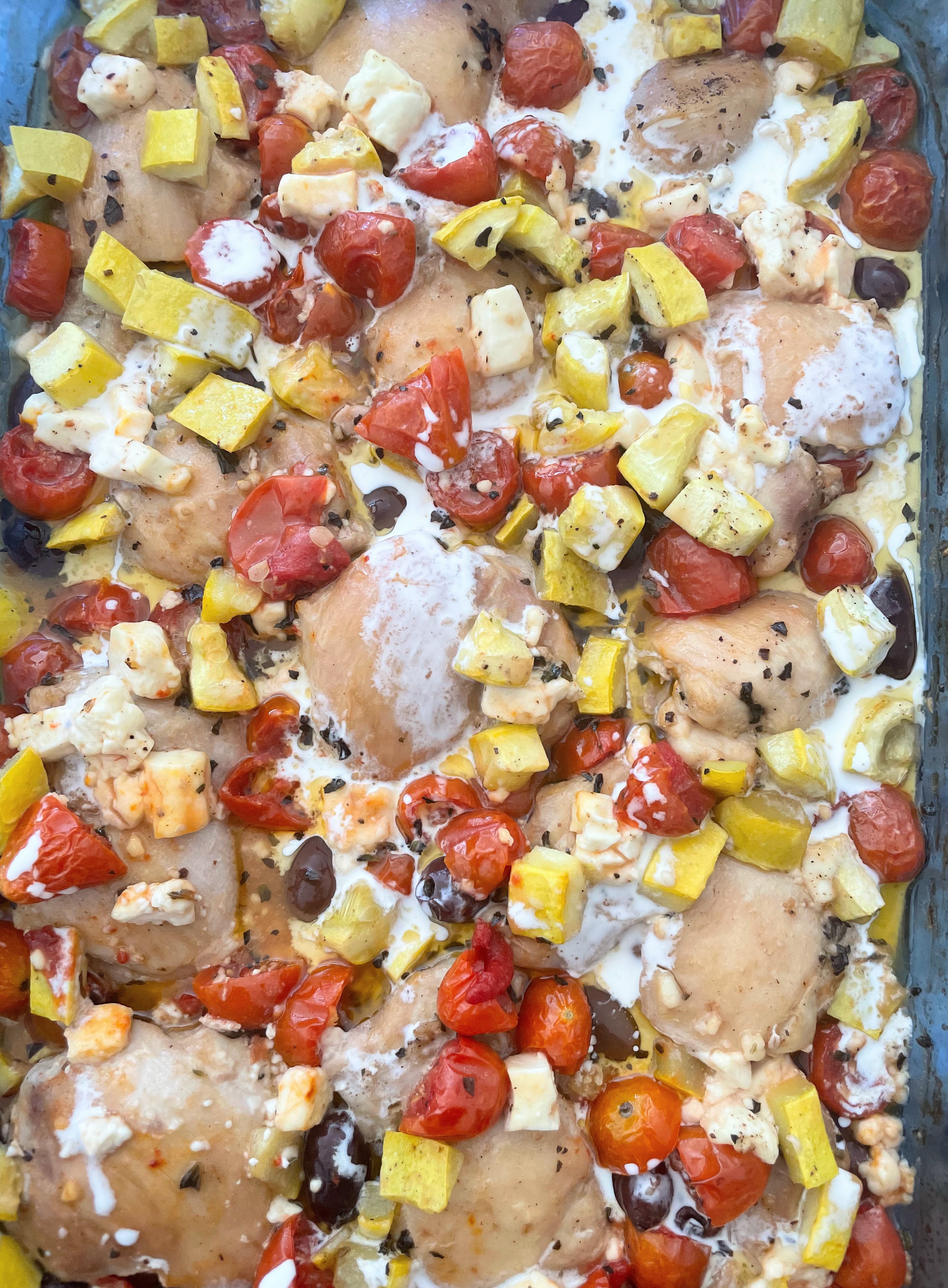
Mediterranean Chicken with Feta and Olives

Boneless, skinless chicken thighs
Salt and pepper
Dried oregano
Fresh rosemary, finely chopped
Olive oil (I used garlic-infused olive oil)
Cherry tomatoes, cut in half
Yellow summer squash (or zucchini if you have it), diced
Kalamata olives
Feta cheese (cubed or crumbled)
Heavy cream
Oregano (dried or fresh)

Preparation

  1. Preheat oven to 350 F (180C).
  2. Sprinkle both sides of the chicken thighs with salt, pepper, oregano, and rosemary.
  3. In a large heavy-bottomed pot, saute the thighs in olive oil over high heat until they are no longer pink on the outside and have picked up a bit of color.
  4. Place the thighs, and any juices or crispy bits from the pot, into a casserole dish large enough to fit the thighs in one layer.
  5. Sprinkle the olives, tomatoes, squash, and feta around the thighs, drizzle with some cream, and sprinkle a little more salt, pepper, and oregano over top.

6. Bake, covered, for about 30 minutes, or until the tomatoes and squash are soft.

    You can serve this multiple ways: with crusty bread to soak up the creamy, tomato-ey broth, over quinoa or rice, with potatoes or other roast vegetables, etc.

    Recipe: Japchae with Chicken (Korean Stir-Fried Sweet Potato Noodles)

    27 Aug

    (Serves 4)

    Let me start by saying that chicken is not traditional in this recipe, but it’s what I had on hand when I got the urge to make this; japchae takes a bit of effort and I didn’t have time to add a grocery trip into the mix, too. Amazingly, though, I had almost all the other ingredients, and had been dreaming of this dish for a while. I’ve loved it since my college days, when there was a hole-in-the-wall Korean restaurant around the corner from where I lived (what bliss). But what made me have to make this dish, right now, was watching a K-Drama one weekend that had tantalizing views of the protagonists eating japchae…. After salivating through a few episodes, I knew what we had to have for dinner.

    If you haven’t ever had japchae (jap means to mix, and chae means vegetables), you are in for a treat. The glassy, sweet potato starch noodles (dangmyeon) are slippery, chewy, savory and a bit sweet, and are tossed with so many good things.

    If that weren’t enough, this dish gives you options: you can make the japchae a day or two ahead of time (quickly stir-frying before serving), and you can serve it warm or at room temperature.

    I used a recipe from the incomparable Maangchi, with a few alterations:

    • First, I substituted chicken for the beef or pork. Plus, I used 1.5 times what the original recipe called for (6 oz vs 4 oz).
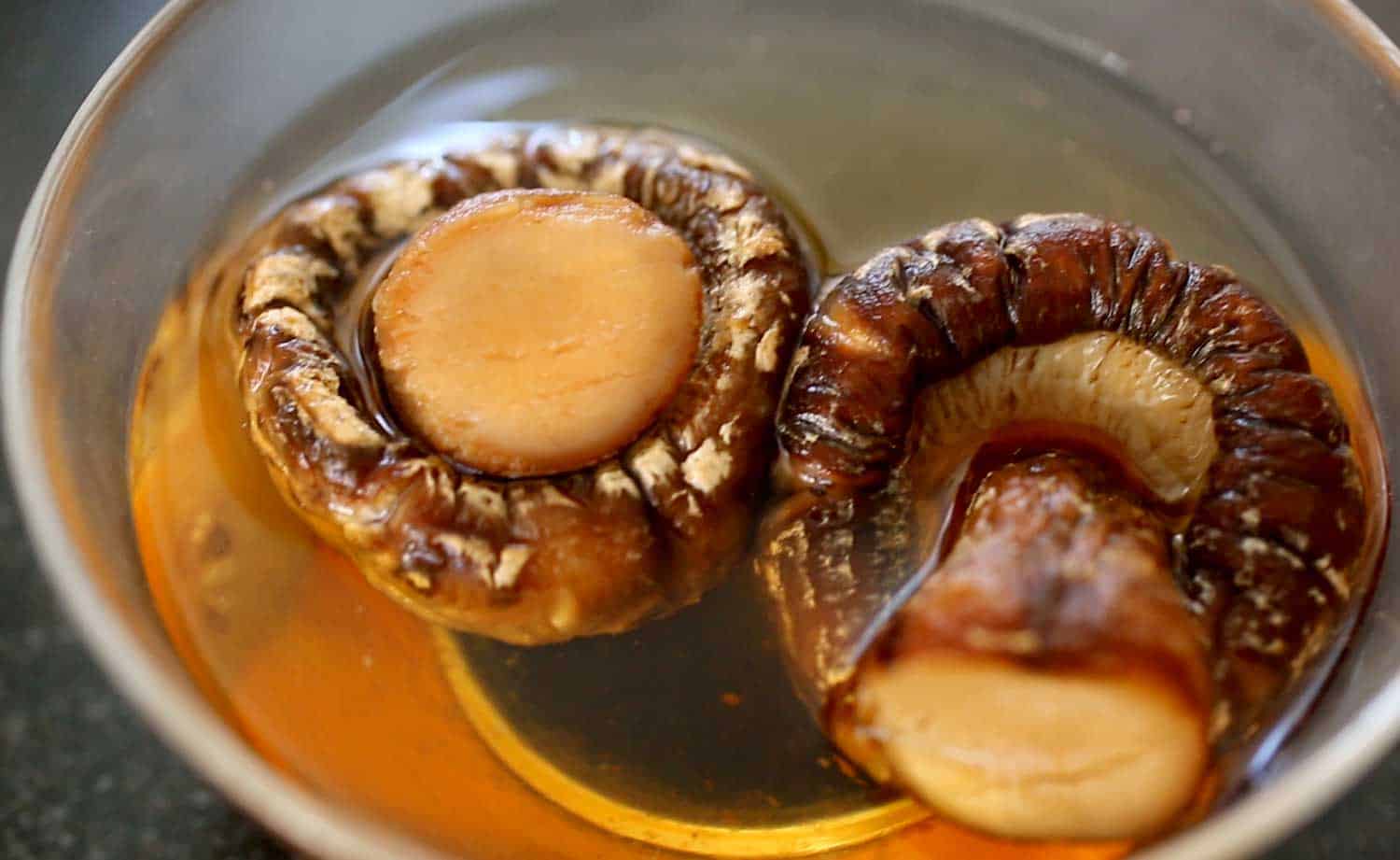
    • Then, just when I was patting myself on the back for having everything else, I realized I had dried porcini mushrooms, vs dried shitake. Still delicious in this dish.
    • Finally, I made 1.5 times the final sauce ingredients (a mixture of garlic, soy sauce, sugar, black pepper, and toasted sesame oil) as that sauce is my favorite and I had to have a little more of it. And I also drizzled a little of the strained porcini soaking liquid into the sauce, too, for extra umami.

    Note: This recipe is killer. But this is not Maangchi’s easy version of japchae; this version takes commitment to cook all the veggies separately. So plan on making it when you have the time to give it the loving attention it deserves.

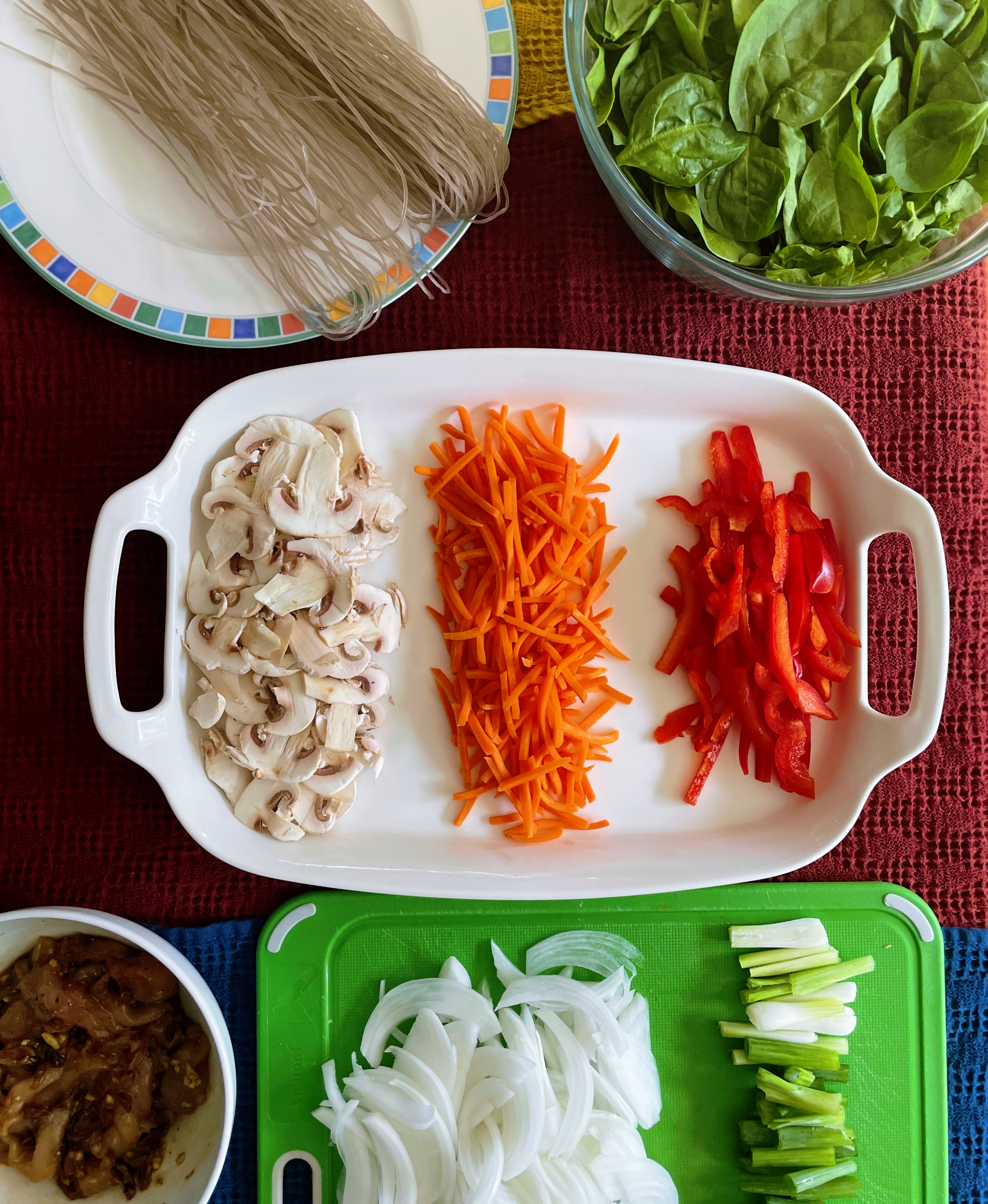
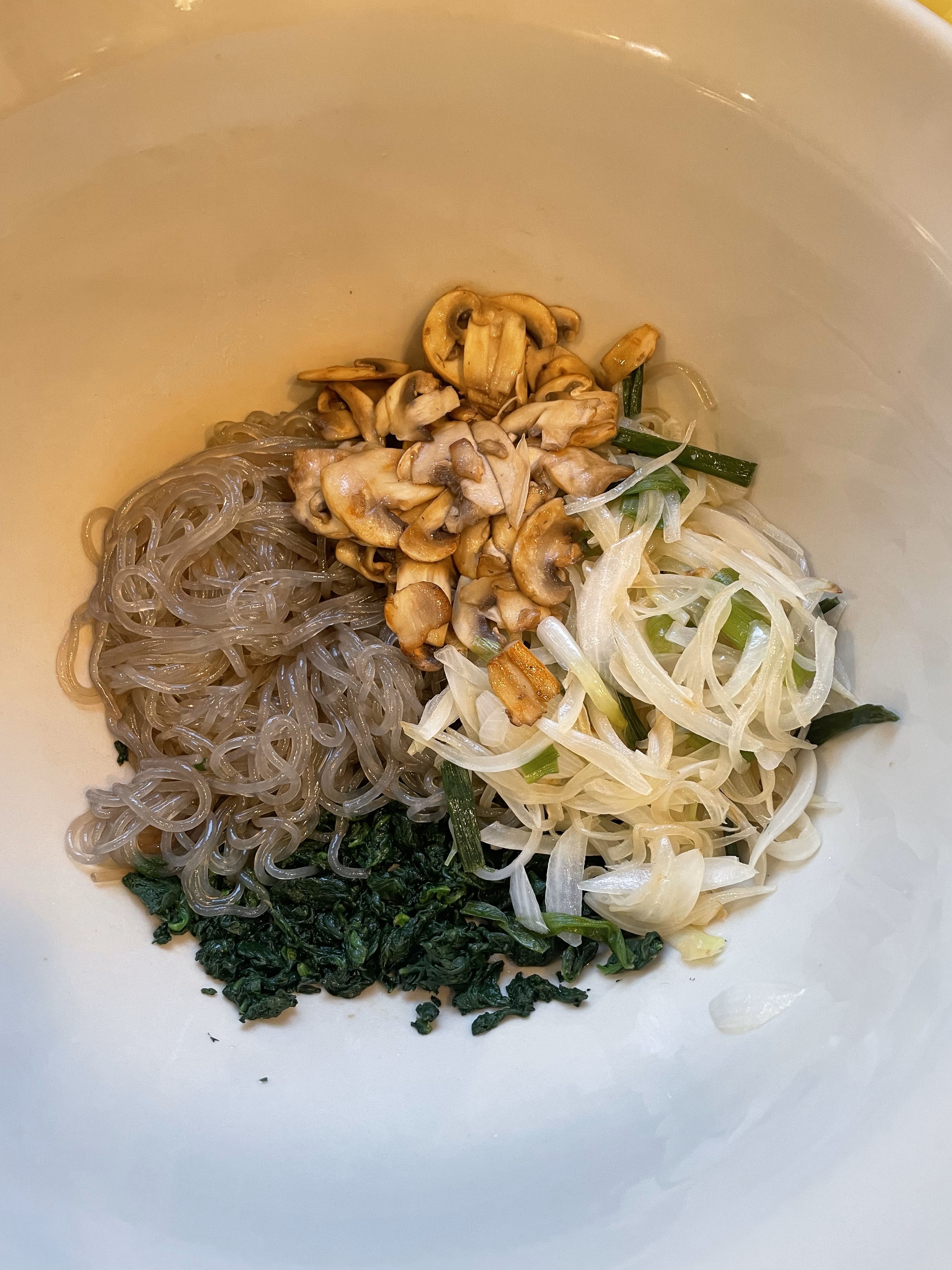
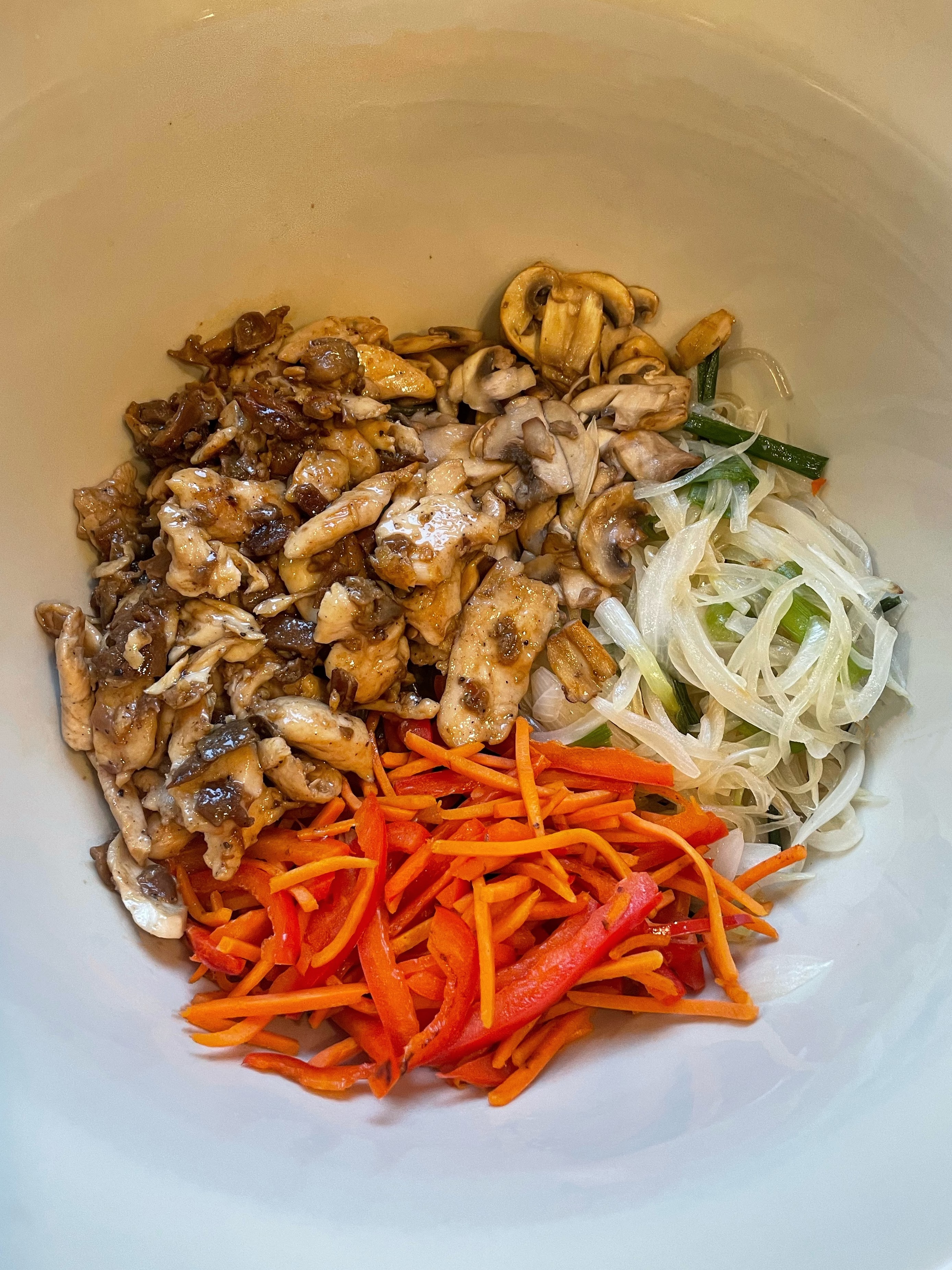
    Original recipe from Maangchi as follows (with photos from Perennial Pastimes):

    Ingredients

    • 4 ounces beef, filet mignon (or pork shoulder), cut into ¼ inch wide and 2½ inch long strips
    • 2 large dried shiitake mushrooms, soaked in warm water for 2 to 3 hours, cut into thin strips
    • 2 garlic cloves, minced
    • 1 tablespoons plus 2 teaspoons sugar
    • 2 tablespoons plus 1 teaspoon soy sauce
    • 2 tablespoons toasted sesame oil
    • 1 tablespoon toasted sesame seeds
    • 1 large egg
    • 4 ounces spinach, washed and drained
    • 4 ounces of dangmyeon (sweet potato starch noodles)
    • 2 to 3 green onions, cut crosswise into 2 inch long pieces
    • 1 medium onion (1 cup), sliced thinly
    • 4 to 5 white mushrooms, sliced thinly
    • 1 medium carrot (¾ cup), cut into matchsticks
    • ½ red bell pepper, cut into thin strips (optional)
    • ground black pepper
    • kosher salt
    • vegetable oil

    Directions

    Marinate the beef and mushrooms:

    1. Put the beef and shiitake mushrooms into a bowl and mix with 1 clove of minced garlic, 1 teaspoon sugar, ¼ teaspoon ground black pepper, 2 teaspoons soy sauce, and 1 teaspoon of toasted sesame oil with a wooden spoon or by hand. Cover and keep it in the fridge.

    Make the egg garnish (jidan):

    1. Crack the egg and separate the egg yolk from the egg white. Remove the white stringy stuff (chalaza) from the yolk. Beat in a pinch of salt with a fork.
    2. Add 1 teaspoon of vegetable oil to a heated nonstick pan. Swirl the oil around so it covers the pan, and then wipe off the excess heated oil with a kitchen towel so only a thin layer remains on the pan.
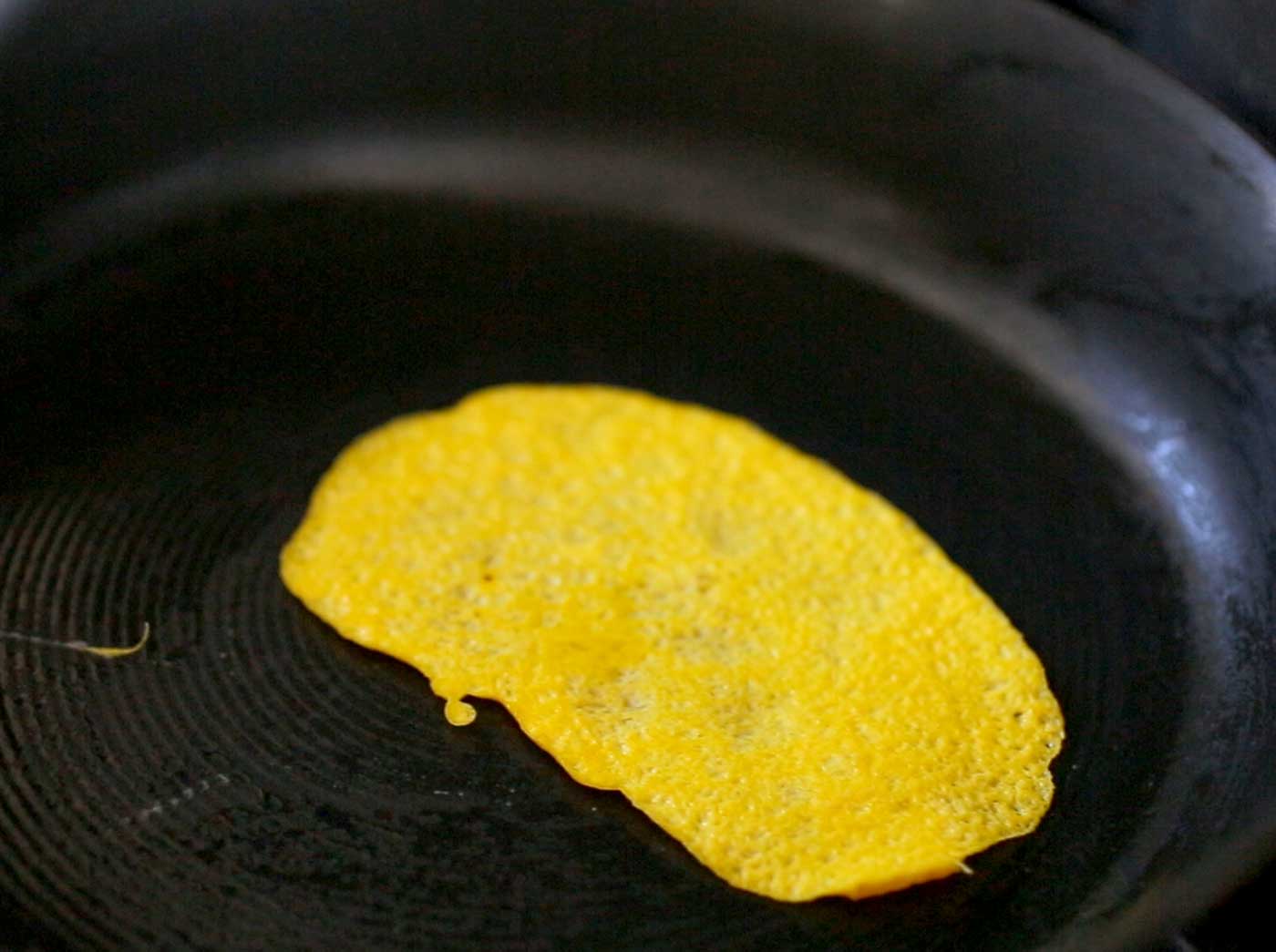
    3. To keep the jidan as yellow as possible, turn off the heat and pour the egg yolk mixture into the pan. Tilt it around so the mixture spreads thinly. Let it cook using the remaining heat in the pan for about 1 minute. Flip it over and let it sit on the pan for 1 more minute.
    4. Let it cool and slice it into thin strips.

    Prepare the noodles and vegetables:

    1. Bring a large pot of water to a boil. Add the spinach and blanch for 30 seconds to 1 minute, then take it out with a slotted spoon or strainer. Let the water keep boiling to cook the noodles.
    2. Rinse the spinach in cold water to stop it from cooking. Squeeze it with your hands to remove any excess water. Cut it a few times and put it into a bowl. Mix with 1 teaspoon soy sauce and 1 teaspoon toasted sesame oil. Put it into a large mixing bowl.
    3. Put the noodles into the boiling water, cover and cook for 1 minute. Stir them with a wooden spoon so they don’t stick together. Cover and keep cooking for another 7 minutes until the noodles are soft and chewy.
    4. Strain and cut them a few times with kitchen scissors. Put the noodles into the large bowl next to the spinach. Add 2 teaspoons toasted sesame oil, 1 teaspoon soy sauce, and 1 teaspoon sugar. Mix well by hand or a wooden spoon. This process will season the noodles and also keep the noodles from sticking to each other.
    5. Heat up a skillet over medium high heat. Add 2 teaspoons vegetable oil with the onion, the green onion, and a pinch of salt. Stir-fry about 2 minutes until the onion looks a little translucent. Transfer to the noodle bowl.
    6. Heat up the skillet again and add 2 teaspoons vegetable oil. Add the white mushrooms and a pinch of salt. Stir-fry for 2 minutes until softened and a little juicy. Transfer to the noodle bowl.
    7. Heat up the skillet and add 1 teaspoon vegetable oil. Add the carrot and stir-fry for 20 seconds. Add the red bell pepper strips and stir-fry another 20 seconds. Transfer to the noodle bowl.
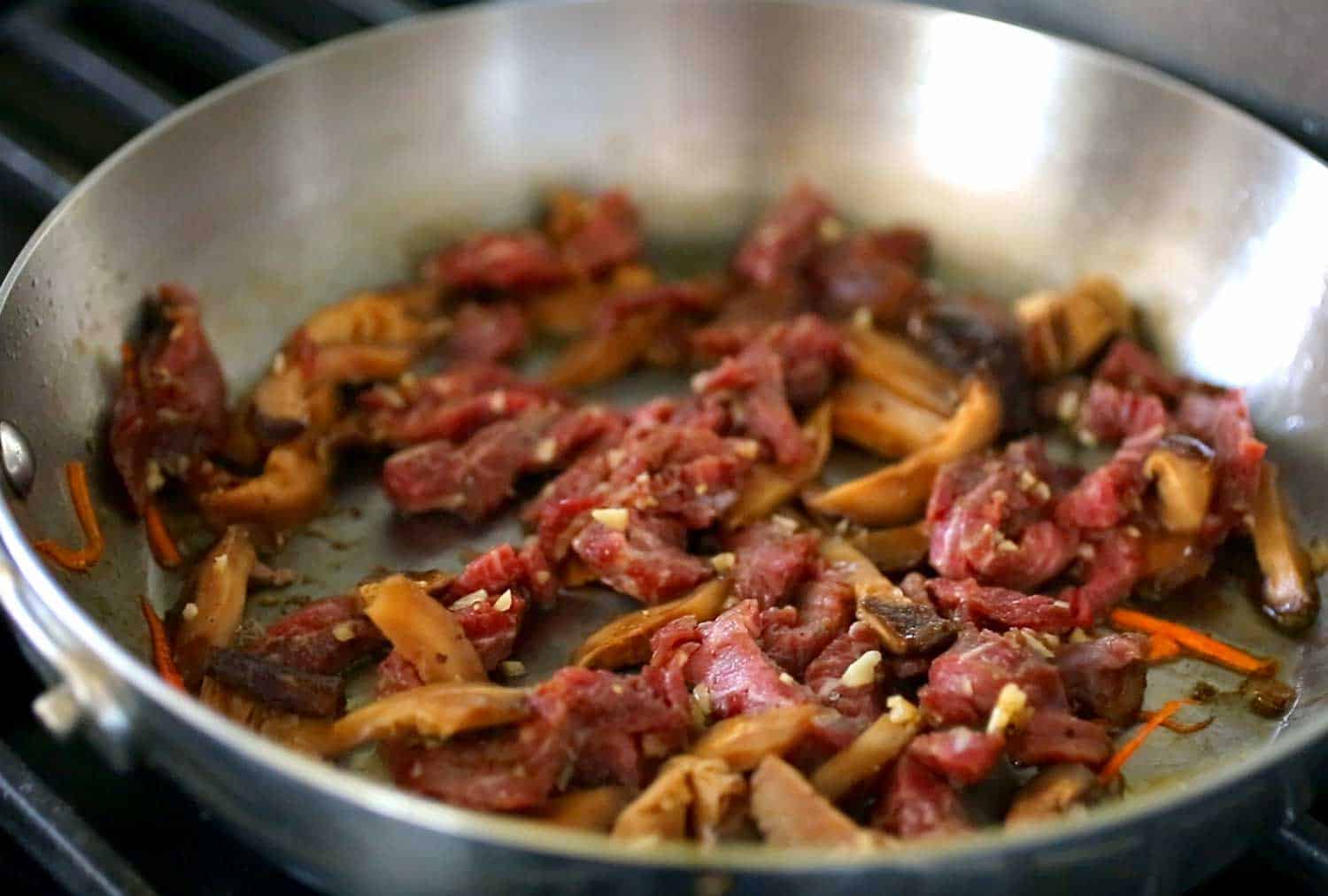
    8. Heat up the skillet and add 2 teaspoons vegetable oil. Add the beef and mushroom mixture and stir fry for a few minutes until the beef is no longer pink and the mushrooms are softened and shiny. Transfer to the noodle bowl.

    Mix and serve:

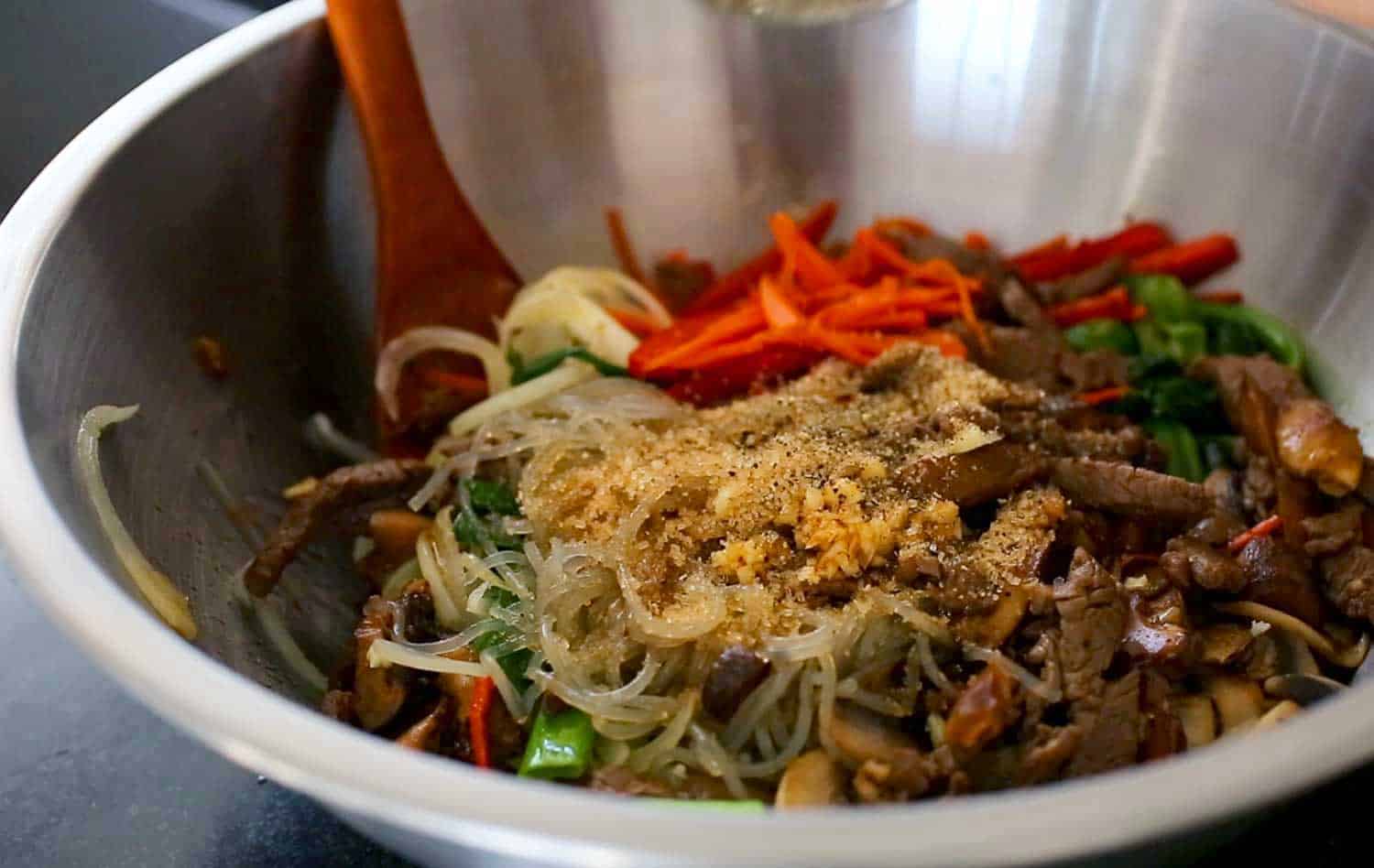
    1. Add 1 minced garlic clove, 1 tablespoon soy sauce, 1 tablespoon sugar, ½ teaspoon ground black pepper, and 2 teaspoons of toasted sesame oil to the mixing bowl full of ingredients. Mix all together by hand.
    2. Add the egg garnish and 1 tablespoon sesame seeds. Mix it and transfer it to a large plate and serve.

    Recipe: Peruvian-Style Peanut Chicken (Pollo Arequipeño)

    31 Aug

    There are two signature Peruvian dishes consisting of boiled potatoes topped with a spicy, creamy, cheese sauce:  Papas a la Huancaina and Ocopa Arequipeña. They both feature yellow chilies, cheese, and milk–and frequently, onions and garlic. An Ocopa sauce often contains nuts as a thickener, while a Huancaina sauce usually includes crackers (and an herb that is difficult to find: huacatay, sometimes referred to as black mint). However, I’ve seen Ocopa made with crackers, too…. Regardless, both sauces and their many variations are delicious!

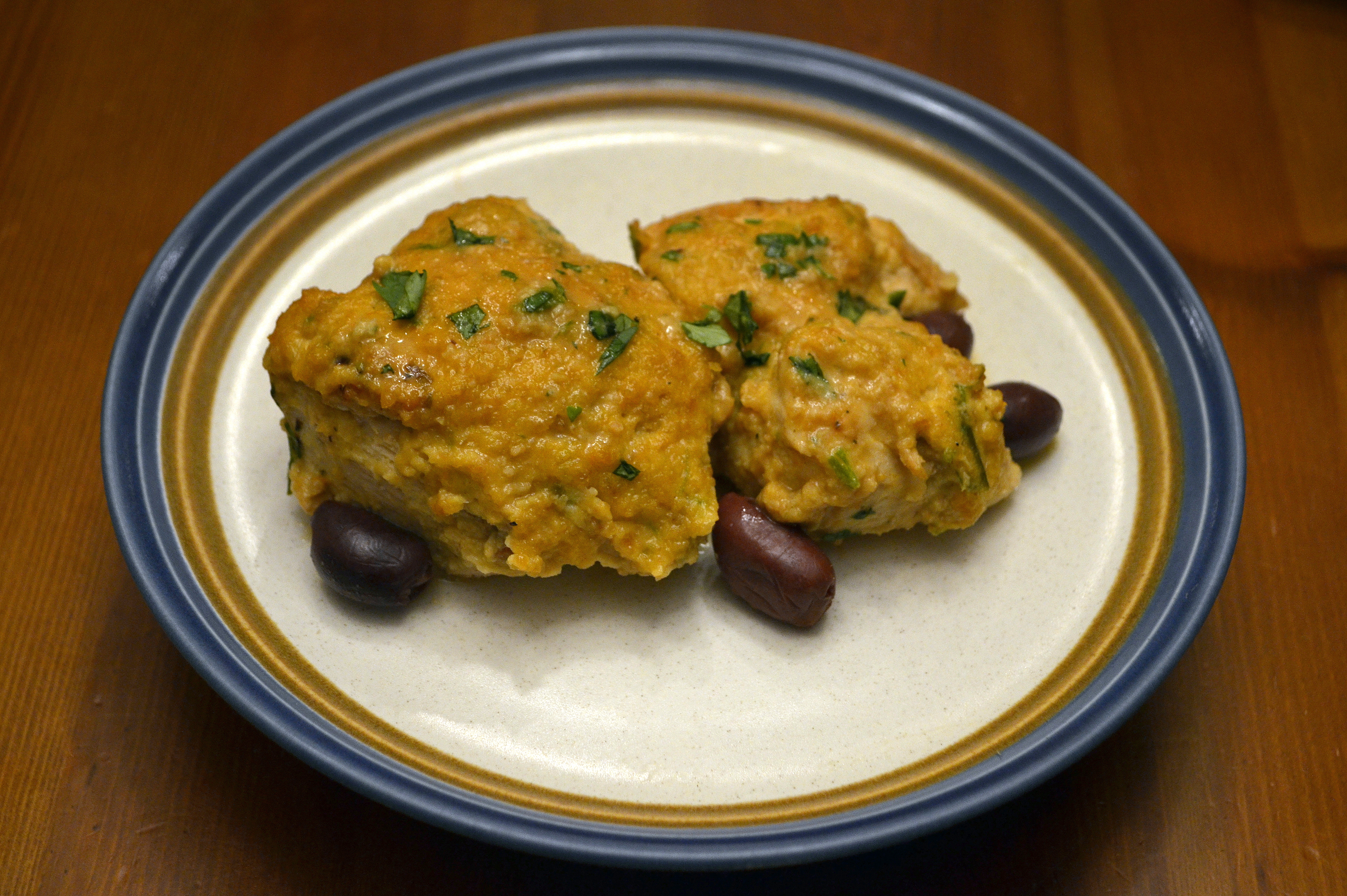
    The following recipe departs from the norm: it features an Ocopa-style sauce over chicken rather than potatoes, and it is broiled in the oven until the sauce begins to turn golden brown.

    Peruvian Peanut Chicken

    Peruvian-Style Peanut Chicken (Pollo Arequipeño)
    Serves 8

    6 boneless, skinless chicken breast halves
    juice of 2 lemons or limes
    2 tbsp. olive oil
    salt and pepper

    Sauce:
    3 tbsp. olive oil
    1 small red onion, chopped
    2 scallions (green onions), trimmed and sliced
    5 cloves garlic, crushed
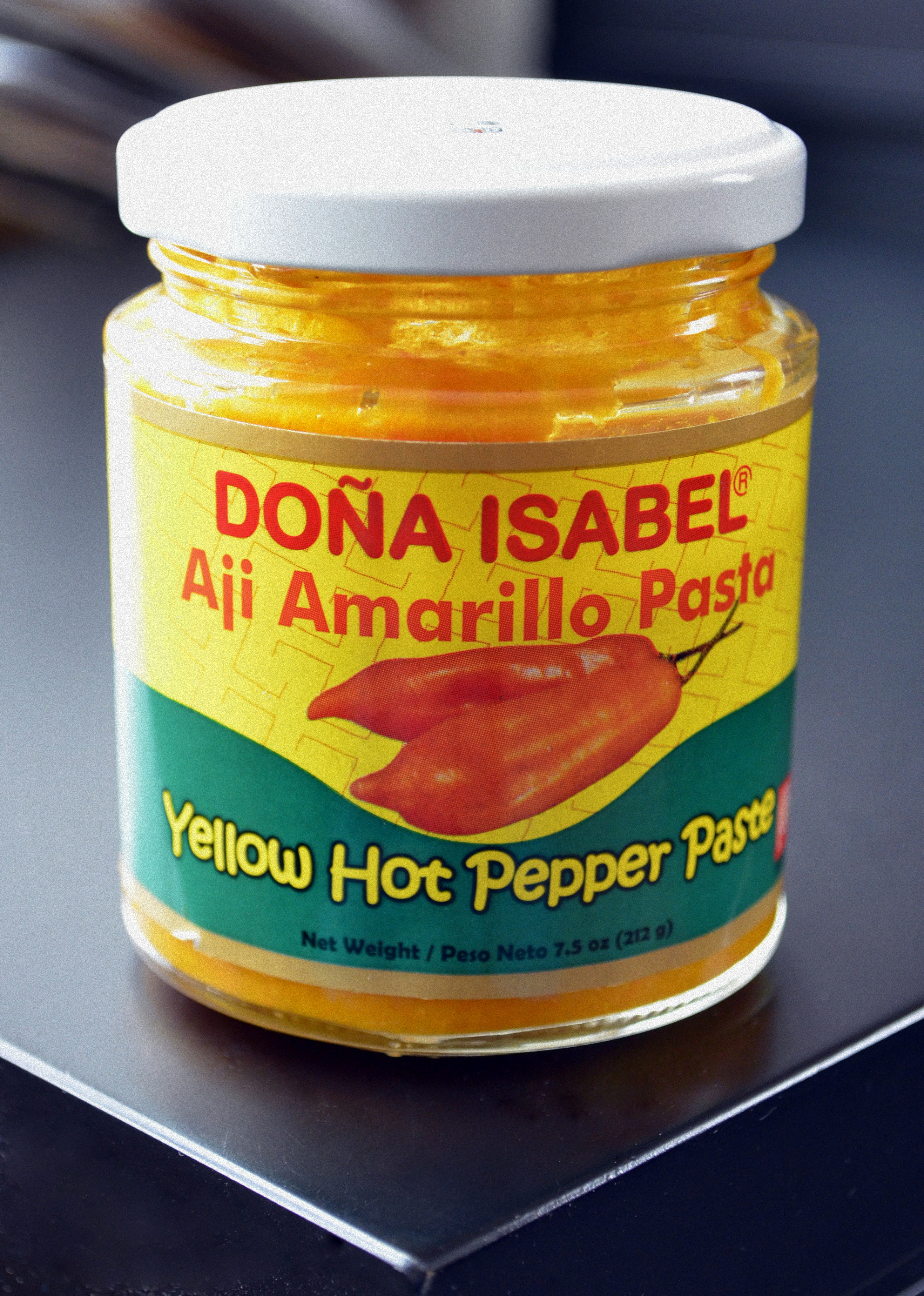
    1 tbsp. aji amarillo (yellow chili) paste –add more if you like your sauce hot
    1/2 c. roasted, salted peanuts
    1/2 c. grated Münster cheese (or feta or queso fresco)
    3/4-1 c. evaporated milk
    1/4 tsp. salt, or to taste

    chopped cilantro
    Kalamata (or other black) olives

    Preparation

    1. Trim the chicken breasts and cut each into two pieces.
    2. Combine the lime juice and olive oil in a glass container and add the chicken. Sprinkle the chicken with salt and pepper to taste, mix well, cover, and refrigerate for a couple of hours.
    3. Meanwhile, make the sauce. Heat the olive oil in a large skillet over medium-high heat; add the red onion and scallion and cook until soft. Add the garlic and aji amarillo paste (and huacatay puree if available/desired) and cook for another couple of minutes. Turn off the heat. Put the onion mixture into a blender along with remaining sauce ingredients; blend until smooth. If the sauce appears very thick, add a bit more milk. Place the sauce in a  covered container and refrigerate until needed. Set the skillet to the side on the stove; do not clean or rinse.
    4. After the chicken has marinated, heat the skillet over high heat and cook the chicken (in two batches if needed) until the pieces are golden brown on both sides (no need to add extra oil to the skillet first, since the marinade contains oil). Place the chicken pieces in a single layer in a baking dish, top each piece with an ample amount of the peanut sauce, cover with aluminum foil and bake at 350 degrees for about 20-30 minutes. Remove the aluminum foil, sprinkle Kalamata olives around the chicken, and broil until sauce begins to turn golden brown in spots.
    5. Remove the chicken from the oven, sprinkle with cilantro, and serve.

    Recipe: Bolivian Peanut Soup with Chicken (Sopa de Mani)

    3 Mar

    Bolivian Peanut Soup is a one-bowl wonder, the ultimate comfort food–especially with fried potatoes and queso fresco (or the un-Latin American but perfectly substitutable feta cheese) sprinkled on top. Traditionally, the soup is made with beef bones, but I prefer to make it with small pieces of boneless chicken breast instead; chicken and peanuts have a natural affinity for each other, and chicken makes the soup a bit lighter. This can easily be made vegetarian or vegan, too, by omitting the chicken and making the soup with vegetable broth. The 1 tbsp. chili paste listed here adds a mild kick to the soup–if you like heat, add more.

    Bolivian Peanut Soup with Chicken (Sopa de Mani)

    1 cup (150 gr.) roasted unsalted peanuts
    3 tbsp. peanut or canola oil, divided in half
    2 large boneless chicken breast halves (about 1.5 lb./680 gr. total), cut into small bite-sized pieces (about 1/4 inch)
    1 lg. white onion, diced
    1 large carrot, coarsely grated
    2 tsp. cumin
    1 tsp. oregano
    1/2 tsp. turmeric (or palillo)
    1 tbsp. aji amarillo paste (yellow chili paste), available at international/Latin food markets
    2 lg. potatoes, peeled and diced
    6 cup (1.4 liters) chicken broth
    salt and pepper
    chicken bouillon cube or powder (if needed)

    Garnish
    2 large potatoes, julienned, and fried in oil until golden
    crumbled queso blanco (or feta)
    chopped parsley or cilantro

    Preparation
    1. Grind the peanuts almost to a powder in a food processor (or pound them in a mortar and pestle in several batches); set aside.

    Crushed peanuts

    2. Heat 1.5 tbsp oil in large Dutch oven over medium-high heat, add the chicken, and cook until no longer pink; remove the chicken from the pot along with any juices that may have accumulated, and keep warm.
    3. Add the remaining oil to the pot, then cook the onion and carrots until the onion is soft, stirring occasionally.  Mix in the spices and aji amarillo (yellow chili) paste and cook 1-2 minutes.

    One of the many brands of aji amarillo paste

    4. Add the potatoes and peanuts to the pot, and stir well to coat.

    Onions, carrots, potatoes, peanuts, and spices

    5. Pour the broth over the vegetables, cover the pot, reduce the heat to low, and simmer about 20-30 minutes until the potatoes are tender. Blend the soup with an immersion blender (or in a standard blender, in batches, returning soup to pot after it is blended). Add chicken pieces and accumulated juices to the soup  and simmer another 15 minutes, adding a bit more broth if the soup appears thick. Season to taste with salt, pepper, and/or a chicken bouillon cube or bouillon powder if needed.


    Soup, pre-garnish

    6. Before serving the soup, fry potatoes until crisp; salt lightly.
    7. Ladle soup into bowls, top with fried potatoes, then sprinkle with cheese and parsley (or cilantro). Serve immediately.

    Recipe: Tortilla Soup

    5 Feb

    Twenty-four years ago today, my husband and I had our first date at an El Torito Mexican restaurant in Georgetown, Washington DC, whereupon I not only polished off a full platter of food, but found extra room for dessert, too. Ah, the joys of youth (and first dates). My future husband was amazed, but that was because he did not yet appreciate the magnitude of my sweet tooth — in my view, there’s always room for at least a little dessert.

    The restaurant is now gone and my ability to eat that much dinner has gone with it. So on the anniversary of that first date, I present a light meal that was an El Torito favorite: Tortilla Soup. If you have this for dinner, you will certainly have room to satisfy any sweet cravings afterward.

    This recipe calls for chicken, but a vegetarian version could easily be made without the chicken and using vegetable broth/bouillon instead of chicken broth/bouillon. A vegan version would also omit the cheese.

    Tortilla Soup

    [Updated instructions 2/7/2015]

    3 chicken breast halves (about 1.5 lb.)
    7 c. chicken broth
    1 onion, diced
    2 carrots, diced
    2 stalks celery, diced
    1/2 green bell pepper, seeded and diced
    1 potato, diced
    1/4 c. tomato paste
    2 bay leaves
    2 cloves garlic, sliced
    1 tsp. oregano
    1 tsp. cumin
    salt and pepper to taste
    1 zucchini, diced
    1 tomato, diced
    1/4 jalapeno pepper, seeded and thinly sliced
    chicken (or vegetable) bouillon powder or cubes to taste
    juice of 1/2 lime

    Accompaniments:
    corn tortilla strips (see cooking instructions below; will need 5 corn tortillas and canola oil)
    1 1/2 c. shredded Monterey Jack cheese
    2 avocados, sliced
    3/4 jalapeno pepper, seeded and thinly sliced
    chopped fresh cilantro

    Preparation

    1. Heat the broth in a large pot over medium heat. Add chicken breasts, reduce heat, and gently poach the chicken. [Note: Whenever possible, I like to poach the chicken ahead of time and let it cool in the broth: bring the chicken and broth to a simmer, turn down the heat so that the liquid ripples but doesn’t actually boil, cover the pot, poach the chicken for about 15 minutes–skimming the broth as needed–then turn off the heat and let the chicken breasts cool in the broth for about half an hour. If time is short, poach the chicken for 20-25 minutes, skimming as needed, remove from the pot, and transfer to a plate to cool.]
    2. Add onion, carrots, celery, bell pepper, potato, tomato paste, bay leaf, garlic, oregano, cumin, and a dash of salt and pepper to the broth in the soup pot. Bring to a boil,  reduce heat and simmer, covered, 25 minutes.
    3. While soup is simmering, cut the 5 corn tortillas into quarters and then cut each quarter into thin strips; leave the strips on the cutting board until ready to cook. Shred the cool chicken with a fork or clean fingers, and set aside.
    4. Heat canola oil over high heat in heavy skillet (should be at least 1- to 1.5-inch depth of oil). When oil is very hot, add a layer of corn tortilla strips. Fry until golden, flipping as needed to ensure even coloring. Drain tortilla strips on a layer of paper towels. Repeat until all strips have been cooked; reserve.
    5. Add zucchini, tomatoes, jalapeno, and shredded chicken to the soup pot, then simmer 10 more minutes. Check seasonings; if broth needs a bit more flavor, add chicken (or vegetable) bouillon powder or cubes and more pepper as needed. Add lime juice just before serving.
    6. Serve soup in individual bowls, with avocado slices, jalapenos, tortilla strips, cheese, and cilantro as accompaniments.

    Recipe: Light and Easy Cassoulet

    29 Jan

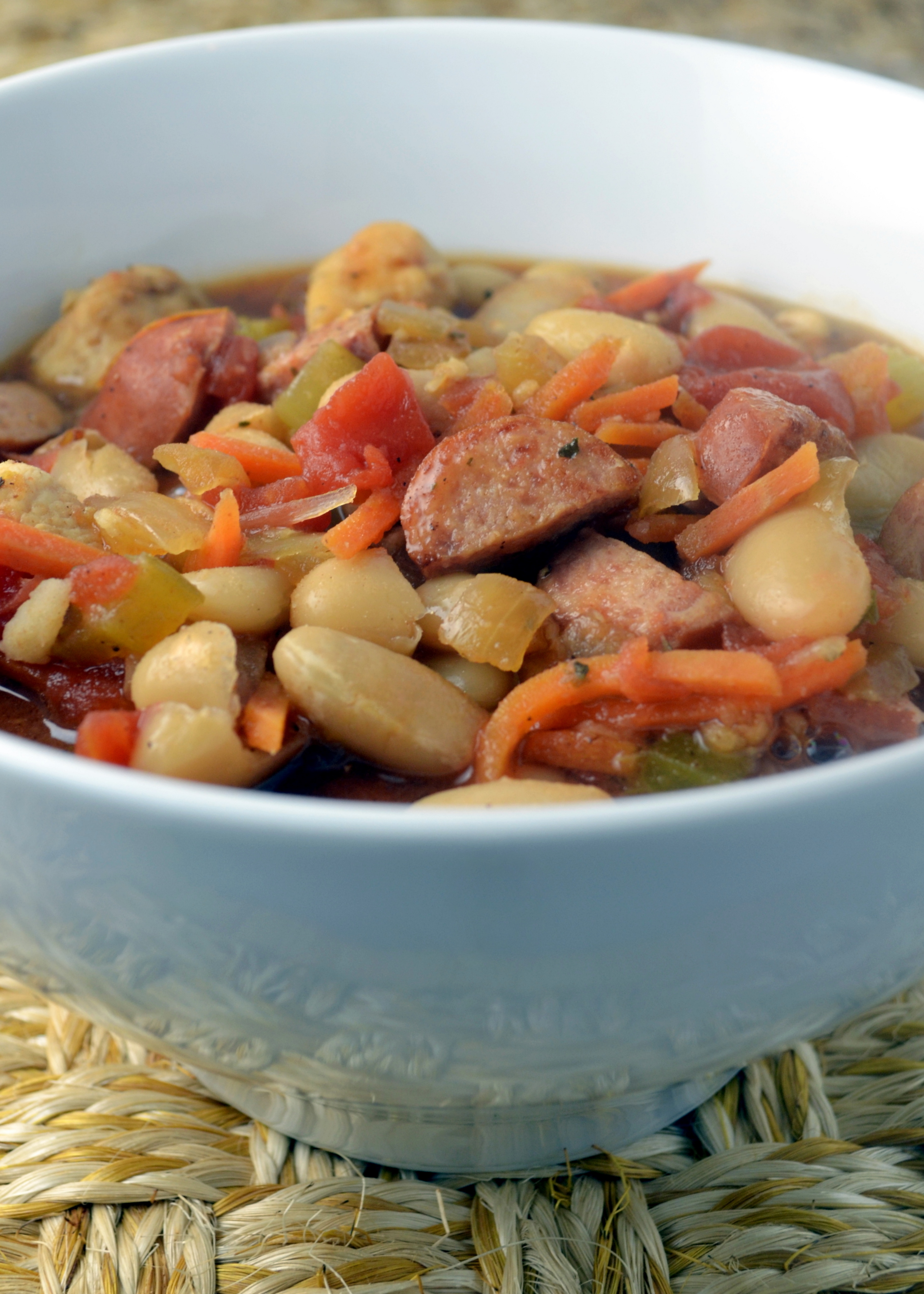
    A cassoulet is a slow-cooked one-pot meal, originally from the south of France. It typically includes an assortment of meats, sausages, duck confit, and white beans, topped off with crispy bread crumbs. In essence, it is a hearty bean-based casserole meant to stick to your ribs.  But delicious as it may be, duck confit can be hard to come by. And while I appreciate hearty dishes as much as the next person, I wanted to see if I could make an equally flavorful version that was just a tiny bit lighter, relied upon easy-to-find ingredients appealing to all members of the family, and took less than a full day to make. So, out with the pork sausages and duck confit, and in with some turkey kielbasa and diced chicken breast. This cassoulet is also fantastic the next day, when the flavors have melded and the beans have thickened it a bit more.

    Light and Easy Cassoulet

    2 tbsp. olive oil, divided
    1 lb. turkey kielbasa sausage, sliced  lengthwise and diced into quarters
    1 lb. chicken breast, cubed
    1 large onion, diced
    3 carrots, diced (or 1.5 c. grated carrots)
    3 celery stalks, diced
    4 cloves garlic, crushed
    3 (14-oz.) cans small white beans (cannellini), undrained (or one large, 1 lb. 13 oz. can, undrained)
    1 (14.5-oz.) can diced tomatoes with olive oil and garlic (or plain–see note below)
    1 (14.5-oz.) can diced tomatoes with basil, garlic, and oregano (or plain–see note below)
    splash white wine (optional)
    2 bay leaves
    lots of freshly ground pepper

    Preparation

    1. Cook kielbasa in 1 tbsp. olive oil in Dutch Oven (or other heavy-bottomed pot) over medium-high heat until nicely browned. Add chicken and cook until no longer pink; remove kielbasa and chicken from pot.
    2. Add the remaining 1 tbsp. olive oil to the pot, followed by the onion, carrot, celery, and a sprinkle of black pepper. Cook until soft, scraping the bottom of the pan with a wooden spoon to loosen the savory bits remaining from the kielbasa and chicken. Add the garlic and cook for 2-3 minutes.
    3. Return kielbasa and chicken to pot; mix into the vegetables. Add tomatoes, wine (if using), and bay leaves, plus another dusting of black pepper. NOTE: if using plain diced tomatoes, sprinkle roughly 1 tsp. each dried basil and oregano over top of the tomatoes. Mix well, then layer beans on top.
    4. Simmer on low heat for about an hour, stirring gently every so often.
    5. Serve cassoulet with hearty bread and a salad.

    Recipe: Mulligatawny Soup (Curried Rice Soup)

    11 Dec

    What do you do when 1) you have omnivores and vegans coming to dinner, and 2) it’s cold outside and you want something warm and filling that everyone will enjoy? Well, you could offer your guests a deconstructed curried rice soup to suit every palate (and dietary preference). Mulligatawny–with or without chicken–is another example of cross-cultural fusion: an Anglo-Indian soup with a name that means “pepper water.”  And like many other hybrids, there are infinite variations on the theme; this is just one version that can be served two ways.

    When I am making this for the family, I prepare it with chicken broth and chicken as in the photo below. But it is just as good (and more versatile) made with vegetable broth and served with a variety of accompaniments on the side, so guests can add the ingredients they prefer.

    Note: The instructions below are for making the soup to suit both omnivorous and vegan guests. If not meant to be vegan, the soup can be made with chicken broth and chicken; cook the chicken in the pot before you cook the onions, celery, and carrots. Remove the chicken from the pot when it is no longer pink, add the onions, celery, and carrots to the pot and proceed with the recipe as indicated below; return chicken to soup along with the apple and rice.

    Mulligatawny Soup (Curried Rice Soup–with or without Chicken)

    Soup Base

    3 tbsp. canola oil
    1 onion, finely chopped
    4 stalks celery, finely diced
    2 carrots, grated
    3 tbsp. flour
    1.5 tbsp. curry powder
    10-12  c.  vegetable broth (or water and equivalent bouillon cubes)
    1 green apple, peeled, cored, and grated
    1 c. rice (I usually use white jasmine rice, but have also made this with brown basmati)
    salt and lots of freshly ground pepper to taste
    1 (13.5-oz.) can lite coconut milk

    Accompaniments
    [Choose as many as desired and serve each separately alongside the soup]

    2-3 boneless chicken breast halves, cooked and cubed
    1 (15-oz.) can chickpeas/garbanzos, simmered in their liquid until warm, then drained
    8 0z. mushrooms, sliced and cut in half, sauteed in olive oil and seasoned with salt and pepper
    2 zucchinis, sliced and cut into quarters, prepared same as mushrooms
    1 small head broccoli, cut into small florets and steamed
    handful baby spinach, raw

    Preparation

    1. Saute onion, celery, and carrots in oil in large soup pot until soft and golden. Add flour and curry powder, and cook 5 minutes. Add broth (start with 10 c.), mix well, and bring to a boil. Simmer 30 minutes.
    2. Add apple, rice, salt, and pepper, and simmer 15-20 minutes more, or until rice is done. Add more broth as needed to maintain a fairly soupy consistency.
    3. Just before serving, add coconut milk and adjust seasonings to taste.
    4. Serve soup in bowls and allow your guests to add any of the accompaniments they desire.

    Recipe: Pakistani Chicken Patties

    3 Dec

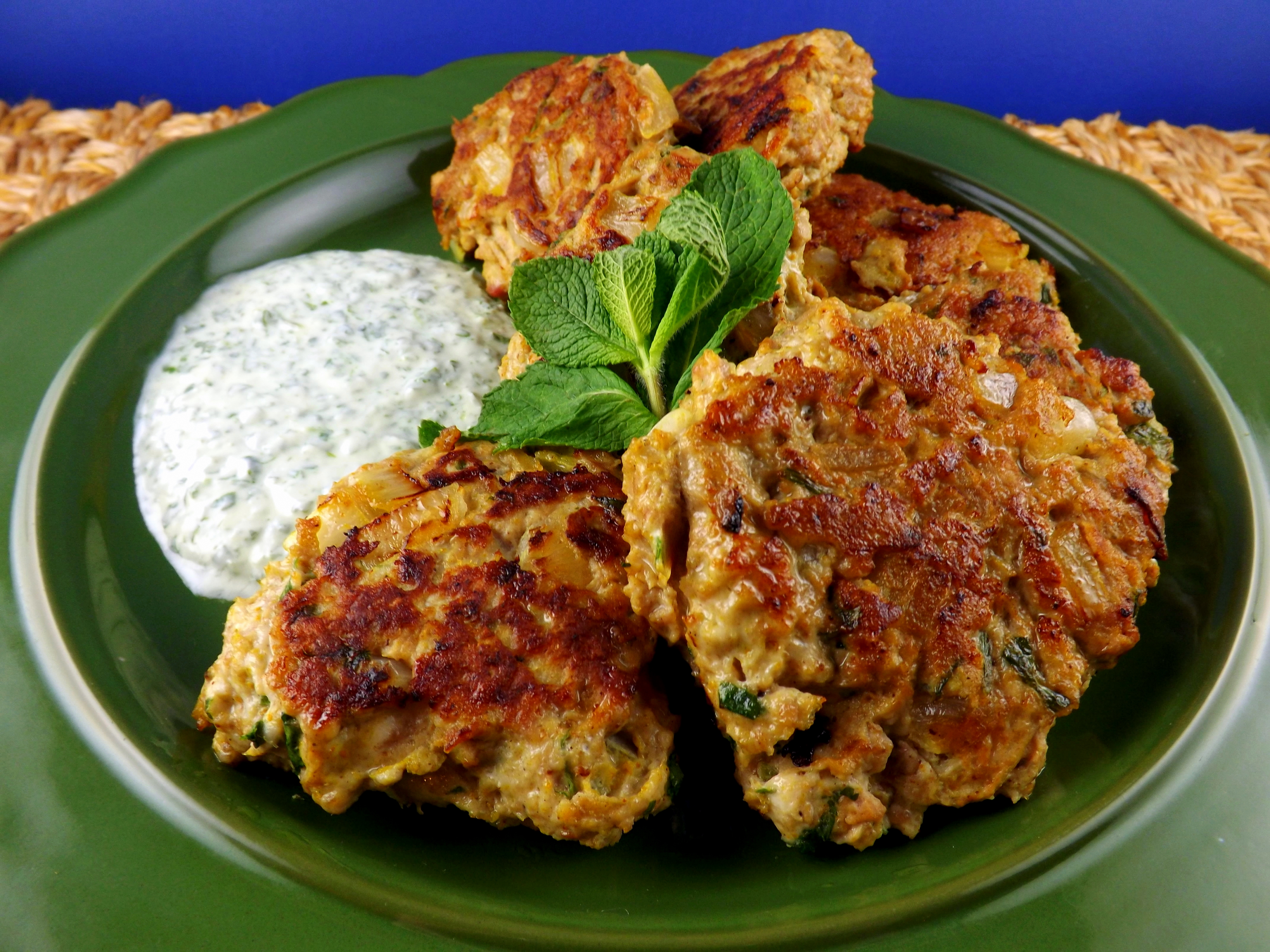
    These patties are from an old New York Times recipe for Pakistani Seekh Kebabs. I first tasted them cold, at a picnic on the edge of a river after a hike with our friends. Our friends brought the patties as their picnic contribution, and they (the patties) were heavenly (though our friends are quite nice, too).

    You could grill these, but you would miss out on the main reason to pan fry them in olive oil: the onions. As the patties cook, some of the onions fall out and turn golden brown in the olive oil. There is a battle at our house for those onion bits; their appeal cannot be underestimated.

    So, hot or cold–all parts of these patties are delectable. We eat them with curried couscous (a bit of cross-cultural fusion) and the accompanying Cilantro Mint Chutney.

    Pakistani Chicken Patties
    Serves 8

    Patties
    2 lb. (.90 kg.) ground chicken or turkey, or a combination of both
    1 egg yolk
    1 large onion, minced
    4 garlic cloves, minced
    2 tbsp. tomato paste
    1 tsp. ground ginger
    1 tsp. ground cumin
    1 tsp. ground black pepper
    1 tsp. garam masala
    1 tsp. turmeric
    ¼ c. cilantro, leaves and stems–finely chopped  (Note: if you are buying the cilantro in a bunch, you can use 1/3 for the patties 2/3 for the chutney)
    2 teaspoons salt

    olive oil

    Cilantro Mint Chutney
    1 c. (240 gr.) plain yogurt
    1/4 c. (25 gr.) mint leaves
    1/2 c. (50 gr.) cilantro, leaves and stems
    1 tbsp. lemon juice (I’ve used 1/2 tbsp. vinegar in a pinch)
    1/2 tsp. sugar

    Preparation
    1. For patties, combine all ingredients in a large bowl, mix well. Heat olive oil in a heavy skillet, shape meat mixture into patties with a spoon, and cook the patties in batches until golden. Serve with couscous and Cilantro Mint Chutney.

    2. For chutney, combine ingredients in a blender or a small food processor and process until smooth, scraping down sides of bowl once or twice. Refrigerate up to 2 days.

    Recipe: Chicken (or Veggie) Tajine

    13 Oct

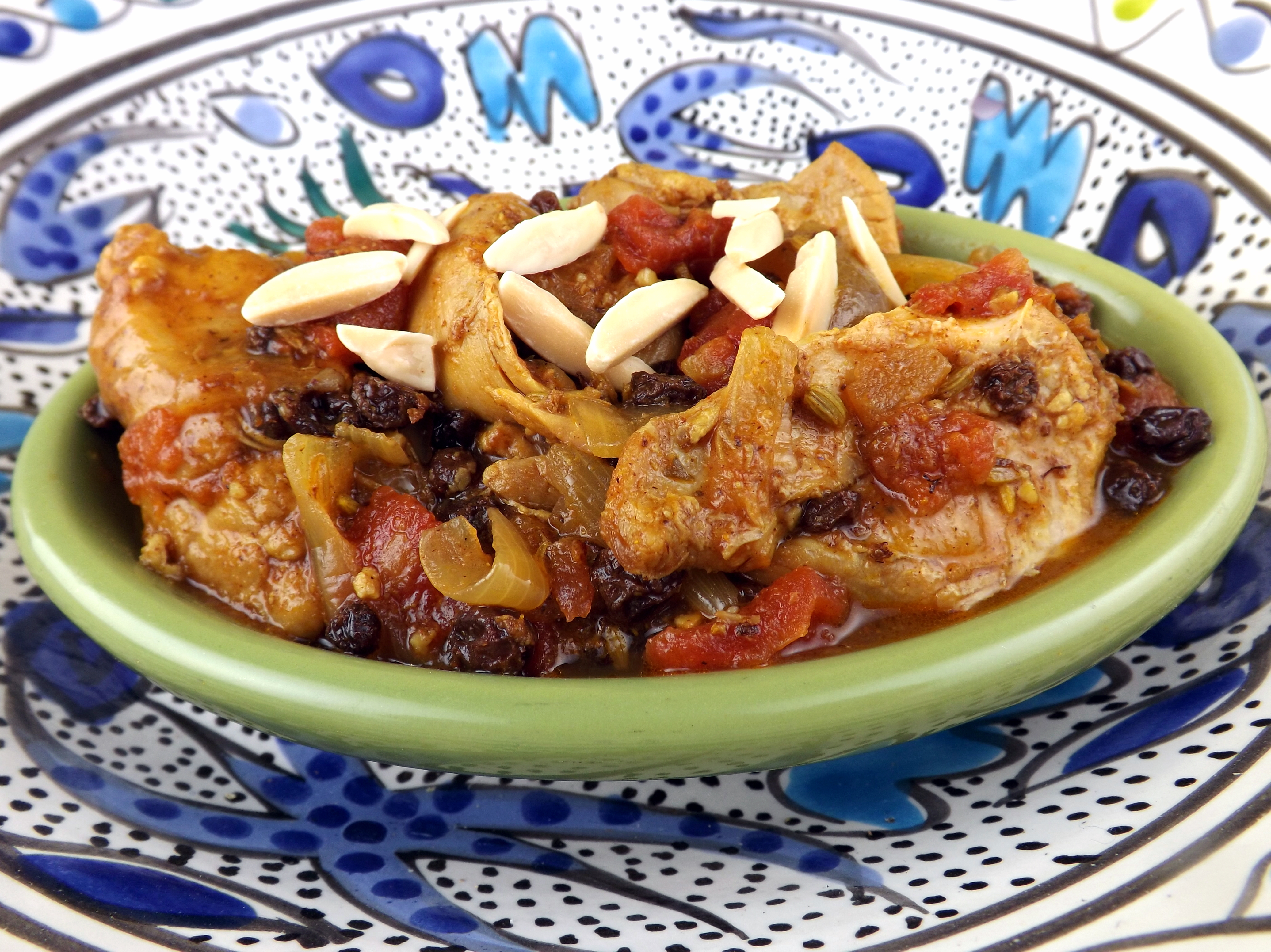
    There are certainly as many ways of making a tajine (tagine) as there are ways of making Spaghetti Bolognaise, but all boil down to the same delicious result: a fragrant, soul-warming North African stew that is perfect for a crisp autumn day. This version–with just a hint of sweetness from the cinnamon, currants, and honey–is a favorite.

    Tajines are named for the two-piece clay pot that they are traditionally cooked in. The pot has a flat bottom with deep sides, and a conical lid. The brightly colored glazed versions are gorgeous. Alas, I don’t have a tajine, so instead prepare this dish in a large, enameled, cast-iron Dutch Oven with a lid. This version is made with chicken, but is very easy to convert to a vegetarian or vegan dish:  substitute garbanzos beans (chickpeas) and veggies for the chicken. I usually add chickpeas anyway since I am quite fond of them, but this time around had a smaller crowd at home so omitted them. I also forgot the carrots, but luckily this dish is very forgiving. Don’t be put off by the long list of ingredients–most of them are spices. I put the spices into a small bowl while the onions are cooking, and add them all at once.

    Toasted almonds are a must as an accompaniment–they add a nice crunchy texture to the dish; toasted pine nuts would work, too. Serve with couscous.

    Chicken Tajine
    Serves 8

    2-6 tbsp. olive oil
    2 large  onions (cut onions in half, julienne, then cut slices in half again)
    1 c. shredded carrots
    6 large garlic cloves, minced
    1 tbsp. sweet paprika
    2 tsp. ground coriander
    1 tsp. salt
    1 tsp. turmeric
    1 tsp. fennel or anise seeds
    1 tsp. freshly ground black pepper
    1 tsp. ground cumin
    1 tsp. ground cinnamon
    1 tsp. ground ginger
    10 whole cloves
    2 (14.5-oz.) cans petite diced tomatoes, undrained
    1/2 c. chicken or veggie broth
    juice from 1 lemon
    3 lb. boneless, skinless chicken thighs, fat removed, cut into thirds
    1 c. currants
    1 (15.5-oz.) can chickpeas, drained
    1 tbsp. honey
    2 tbsp. butter (or non-hydrogenated buttery spread)
    1/2 c. toasted almonds (slivered or sliced), or pine nuts

    Preparation
    1. Heat 2 tablespoons olive oil in heavy, large Dutch oven over medium heat. Brown chicken (in batches if necessary); remove from pot.
    2. Add onions, carrots, and garlic to pot (plus more olive oil if needed). Cover and cook until onions are soft, about 10 minutes. Add paprika, salt, turmeric, coriander, fennel seeds, black pepper, cumin, cinnamon, ginger, and cloves; stir 1 minute. Add tomatoes, broth, and lemon juice; bring to boil. Put chicken back into pot in a single layer and add currants and chickpeas (if using). Nestle chicken into sauce; bring to boil. Reduce heat to medium-low, cover, and simmer about 30 minutes. Remove lid. Add honey and butter and simmer about 30 minutes longer, uncovered.
    3. Check and adjust seasonings. Before serving, sprinkle with almonds and cilantro. Serve with couscous.

    Recipe: Chicken Satays with Peanut Sauce

    20 Aug

    This is the dish I was beginning to prepare yesterday when I got side-tracked by my daughter’s lovely Mediterranean Wrap.

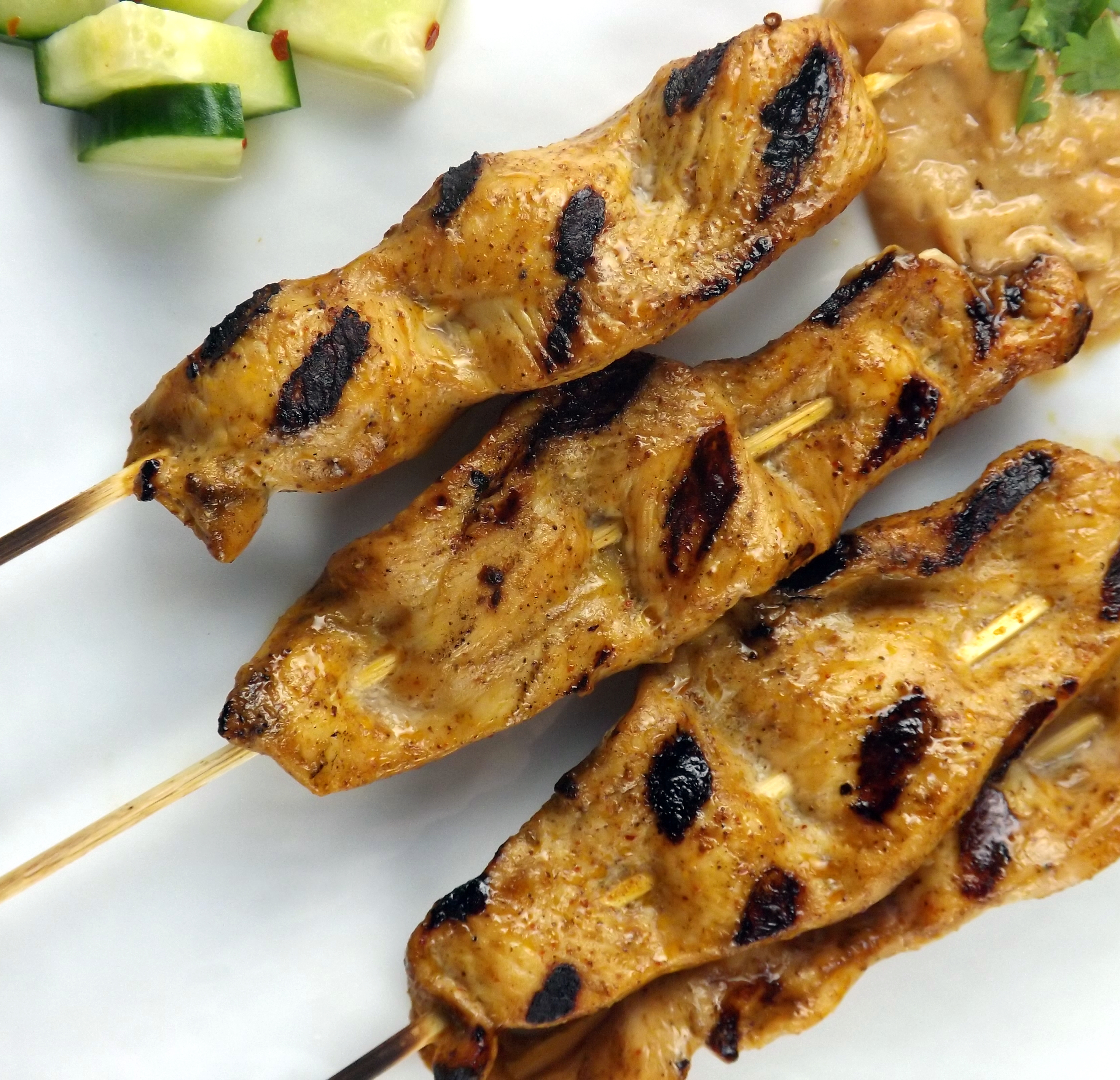
    I first tasted these satays at a friend’s house when we were living in Australia. I could not get enough of the peanut sauce and I could not get over that fact that our friend had made it from scratch. Even now, I’m happy to just have the sauce on rice after the satays have all disappeared, which they will do soon after making their initial appearance. I usually serve the satays with some diced cucumber sprinkled with seasoned rice vinegar and crushed red pepper.

    If  threading satays and making sauce seems like too much, just marinate boneless chicken breasts (or thighs) in the marinade and throw on the grill for a delectable dinner; the chicken by itself is also fantastic.

    This recipe is originally from an Australian Women’s  Weekly cookbook. Note the time needed to marinate the chicken.

    Chicken Satays with Peanut Sauce
    Makes about 20+ satays

    2 lb. (or about 1 kg.) chicken breast, cut in half horizontally, then cut into thin strips

    Marinade
    4 tsp. soy sauce
    2 tsp. honey
    1 tsp. chili powder
    2 tsp. cumin
    4 tbsp. canola oil
    1.5 tsp. curry powder

    Peanut Sauce
    1-2 tbsp. canola oil
    1 finely chopped onion
    2 cloves garlic, minced
    ½ tsp. chili powder
    1 tsp. ground ginger
    4 oz. low-sodium roasted peanuts, very finely chopped (or crushed with a mortar and pestle)
    1/4-1/2 cup (60-120 ml.) cider vinegar
    1 tsp. salt or soy sauce
    3 tbsp. creamy peanut butter
    1/3 cup fruit chutney (Major Grey, mango)
    ¾ cup (177 ml.) lite coconut milk
    1/8 cup (25 gr.) sugar; you can use brown sugar if preferred**

    Marinade: Combine marinade ingredients in large bowl with lid. Add chicken, coat well, cover, and marinate in refrigerator overnight (or at least for a few hours). If you will be using wooden skewers, soak in water for at least 30 minutes before cooking the chicken.

    Sauce: Cook onion and garlic in oil until onion begins to turn golden. Add spices and peanuts, and cook for 2 minutes. Add remaining ingredients and bring to boil; reduce heat and simmer slowly for 30 minutes or until mixture thickens, stirring occasionally. Cover and keep warm.

    After the chicken has marinated, thread the  strips onto skewers. Grill or broil chicken. Serve satays with peanut sauce (and cucumber salad if desired) as an appetizer, or add rice to make into a meal.

    ** [Note Feb. 2013: I recently made the sauce and forgot to add the sugar — and discovered it tasted great without it; use the sugar if you like the sauce to be a bit sweeter.]