Tag Archives: trees

The Differences Between Cycads, Palms, and Ferns

25 Jun

There are certain plants with pointy pinnate leaves (ie, leaves connecting to the stalk like quills on a feather) that look very alike, even though they are not at all related: cycads, palms, and ferns. For one, they evolved millions of years apart. Ferns, which reproduce by dispersing spores, appeared at least 360 million years ago, long before seed-bearing plants. Cycads are among the earliest of the seed-bearing plants and have been around for about 280 million years. The evolution from spores to seeds was one of two dramatic land-plant developments. The other was the emergence of flowers about 100 million years ago, after which palms arrived on the scene. At a mere 60 million years old, palms are botanical babies compared to the other two, though all three shared time and space with dinosaurs.

There are many ways to tell the three plants apart. Cycads and palms have woody trunks; ferns do not. And fern fronds are much softer and more delicate than stiff and spiky palm fronds or cycad leaves (some of which look positively lethal):

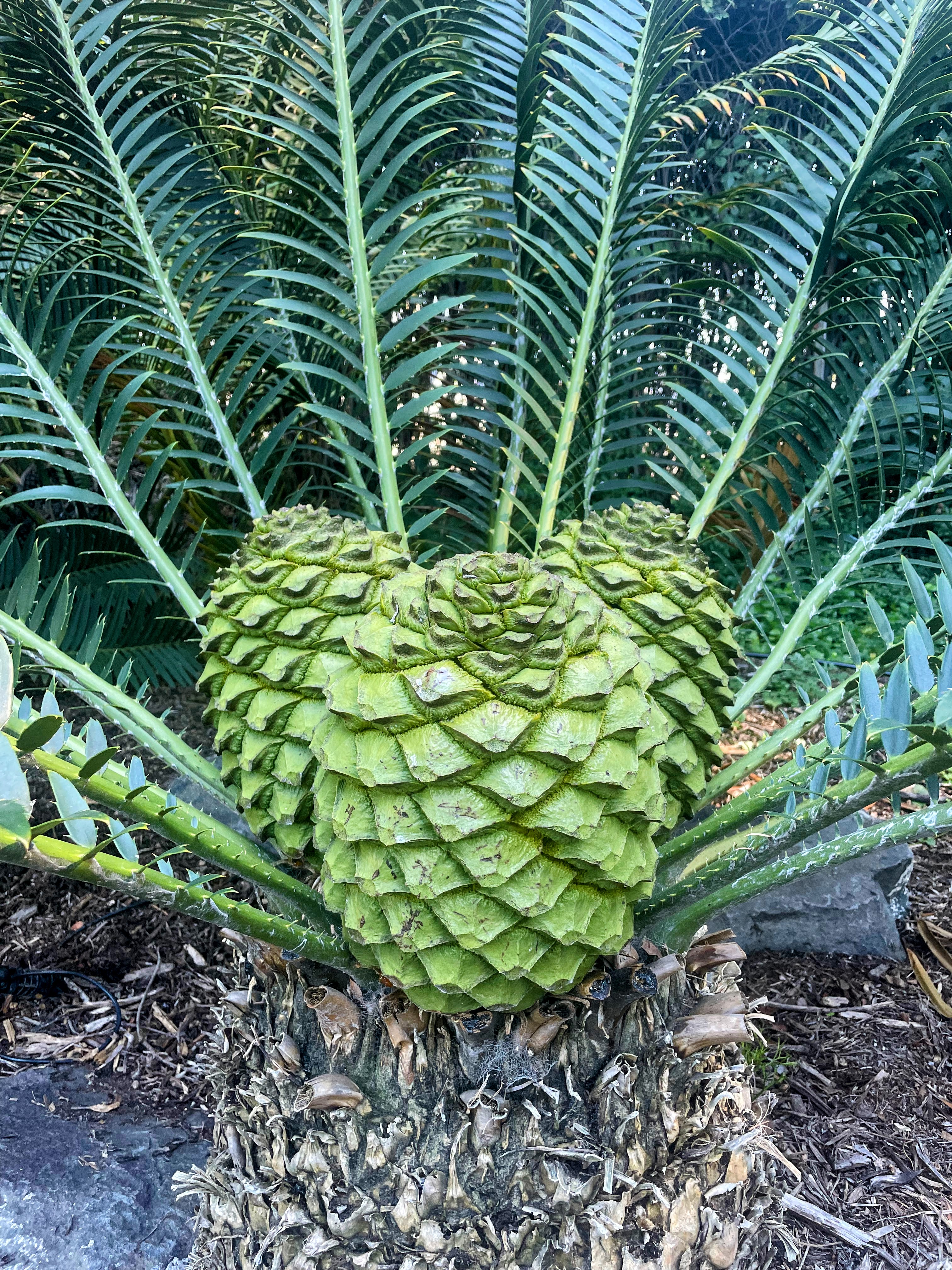
Alexandria cycad (Encephalartos arenarius), UC Berkeley Botanical Garden

Distinguishing between cycads and palms can sometimes be tricky as they both have crowns of pointy leaves atop a woody trunk. For a while, I assumed if it was tall and tree-like, it was a palm, and if it was closer to human height and a bit bushier, it was a cycad. Then I saw the Albany Cycad at the San Diego Zoo (at 500 years old, it is the Zoo’s oldest plant); it is taller than I am and looks a lot like a palm tree.

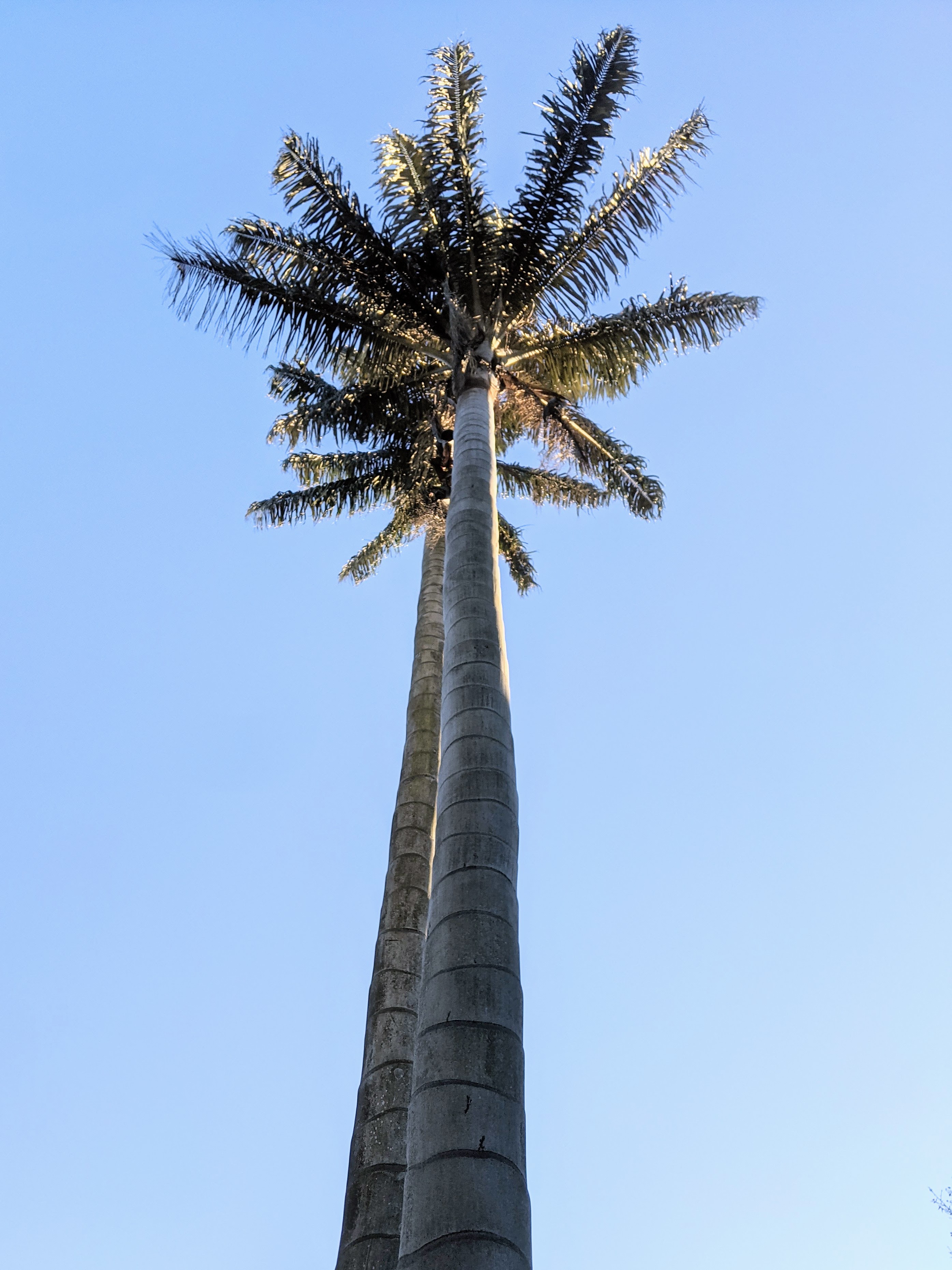
But there is a way to tell tall cycads and palm trees apart: look at the trunks. Cycad trunks are rough and stocky while palm trunks are slimmer. Also, while both plants have scarring on their trunks where the leaves have fallen off, cycad leaf scars appear in a spiral pattern, while palm leaf scars often look like rings around the trunk. So if you see ringed scarring on a tall and elegant trunk, that’s a good clue that you are looking at a palm and not a cycad.

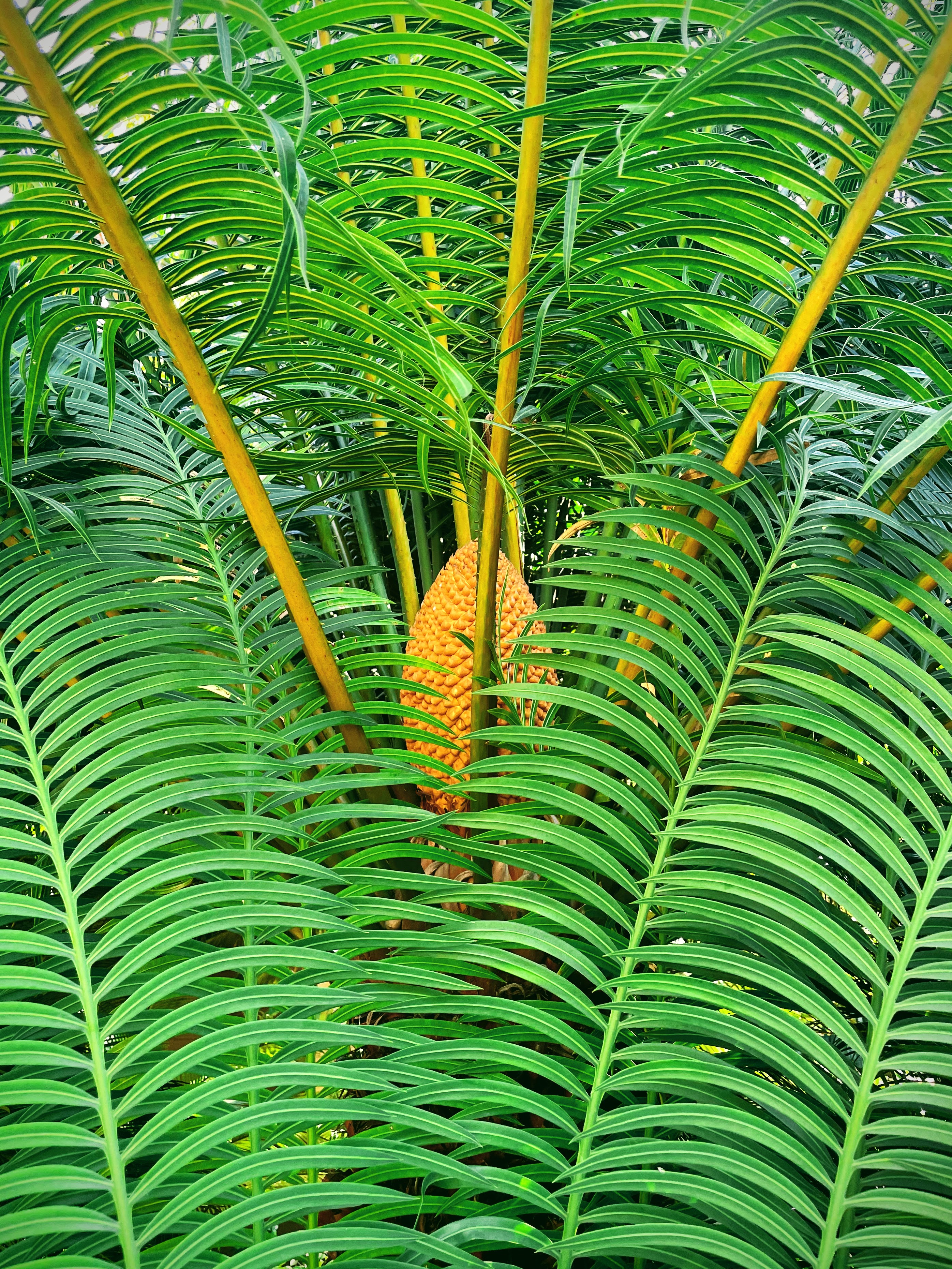
Another difference is that cycads are gymnosperms and palms are angiosperms, but those terms aren’t very helpful unless you know that gymnosperms = cones, and angiosperms = flowers and fruits. So if you are looking at an as-of-yet-unidentified plant with stiff and spiky pinnated leaves and see a cone at the center of those leaves, it’s a cycad. And that cone is why cycads are most closely related to conifers.

If you see any flowers at all (or fruits such as coconuts, dates, or berries), it’s a palm. Ferns are neither gymnosperms nor angiosperms; they are primordial, vascular plants and do not produce flowers, fruits, or cones. So if you are looking into what you think is a clump of ferns and see a cone, it’s not a fern. If you see a woody trunk, it’s also not a fern. But, if you see spores on the underside of the fronds, it IS a fern!

Spores on the underside of Florida Strap Fern

Finally, a word about Sago Palms, a group of palm-like plants that are actually cycads. They got their name because way back when, someone else had a hard time telling them apart. (So glad I am in good company.)

Misnamed Cycad: Cycas circinalis (Queen Sago Palm), Garfield Park Conservatory, Chicago

A final twist to this tale: though cycads can look like palms, their young, emerging leaves look remarkably similar to unfurling fern fronds. I don’t have a photo of a cycad leaf unfurling (unfortunately), so the first photo below is kindly borrowed. I’ve added a fern photo I do have for comparison. One could easily be forgiven for mistaking an unfurling cycad for a fern. But take a careful look at the rest of the plant. Touch the mature leaves to see how hard or soft they are and whether there are any spores underneath, see if there is a woody trunk (if so, look at leaf scarring), check for cones or fruits. All those things will point you in the right direction.

Landscapes from a Moving Car, Part II: California

19 Mar

One nice thing about road trips is that along scenic stretches, a car is a mobile room with a view. But when a long day of driving is on the agenda, it’s hard to stop and admire every lovely landscape. So I put my camera on Sports/Action mode, aim it through the window as we are whizzing by, and hope some of the resulting photos turn out. (Of course, I only do this when I am a passenger, not the driver…).  Here are some shots from a recent road trip from Northern to Southern California, and back.


Old farm buildings near Gilroy


Foggy morning landscape near Gilroy


Mountain landscape with wildflowers near Gilroy

  
Plowed earth near Monterey                     Mountain and clouds near Grapevine


Red barn building near Castroville


Northern California sunset

Cypress Knees

14 Dec

I’d heard of a bee’s knees, but not a tree’s knees. Turns out cypress trees have knees, as we discovered when walking through the gardens at Historic London Town last weekend. We rounded a corner and stumbled upon an eerie landscape: a tall Bald Cypress tree surrounded by what looked like little stumps or treelets poking up from a blanket of leaves. It was almost as if we had been transported to the Island of Misfit Trees.

Turns out these little* woody projections are called cypress knees, and they are a bit of a mystery. The knees grow vertically from the tree’s roots, but no one quite agrees on what function they serve. Normally, they are found in swampy areas. This Bald Cypress and its knees were in Historic London Town’s Bog Garden–a very moist area, but not one that was under water (or at least not when we were there).  One theory is that the knees may help get oxygen to the tree’s roots, especially in the case of trees that are growing in several feet of water. But scientists who tested this theory found that the knees aren’t very good conveyors of oxygen, as one might expect from what is essentially a very woody stump. Another theory is that the knees provide the tree with stability. But no one really knows for sure; there is another school of thought suggesting that perhaps these knees serve no purpose at all…. Except to keep us wondering.


*These knees are still relatively little — but they can actually get quite tall.

Postcard from Senegal, Part II

2 Jun

After a week of meetings in Dakar, we had a nice opportunity to get out of the capital city and go on a field trip: first to a farming cooperative east of Dakar and then south to the Bandia Wildlife Reserve. It was lovely to be able to see a bit of the countryside.

The area around the farm and the reserve (and in fact, a large part of Senegal) is savannah. The landscape is dotted with the famous baobab trees, which store water in their trunks and can live for thousands of years:

 
… and also with acacias (new foliage, left; old vine creeping around acacia trunk, right).

  
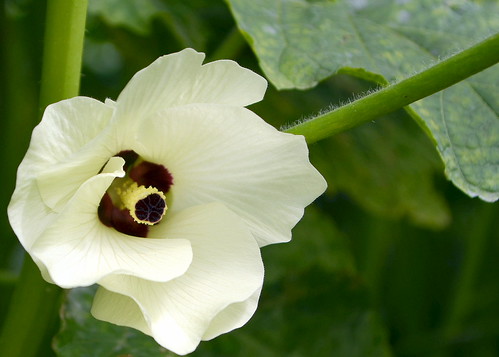
On the farm, okra plants were in bloom. I had never thought about okra flowers before (which shows that I have never grown okra)–but I now know that okra flowers are quite lovely–as are the pom-pom like flowers of the Acacia robusta trees lining some of the farm’s roads.
 
We did not make it to the Wildlife Reserve until the afternoon, when most animals would normally be taking a siesta in a shady spot, but we were lucky to see monkeys, antelope, warthogs, ostriches, zebras, rhinos (from a suitably safe distance), and giraffes.
 

Ready for Spring

3 Mar

It is cold, windy, and grey here in the Mid-Atlantic United States, and I am ready for color and warmth. Where is spring? In my own yard, there a few small signs: tender shoots emerging from the ground, buds on trees, and increased bird activity. And though nothing has yet bloomed, I was encouraged today when I saw a few promising indicators from around the neighborhood, including a lone daffodil in flower. Here’s hoping my garden will not be too far behind.


Daffodils


Maple Buds


Magnolia Buds