Tag Archives: seeds

The Differences Between Cycads, Palms, and Ferns

25 Jun

There are certain plants with pointy pinnate leaves (ie, leaves connecting to the stalk like quills on a feather) that look very alike, even though they are not at all related: cycads, palms, and ferns. For one, they evolved millions of years apart. Ferns, which reproduce by dispersing spores, appeared at least 360 million years ago, long before seed-bearing plants. Cycads are among the earliest of the seed-bearing plants and have been around for about 280 million years. The evolution from spores to seeds was one of two dramatic land-plant developments. The other was the emergence of flowers about 100 million years ago, after which palms arrived on the scene. At a mere 60 million years old, palms are botanical babies compared to the other two, though all three shared time and space with dinosaurs.

There are many ways to tell the three plants apart. Cycads and palms have woody trunks; ferns do not. And fern fronds are much softer and more delicate than stiff and spiky palm fronds or cycad leaves (some of which look positively lethal):

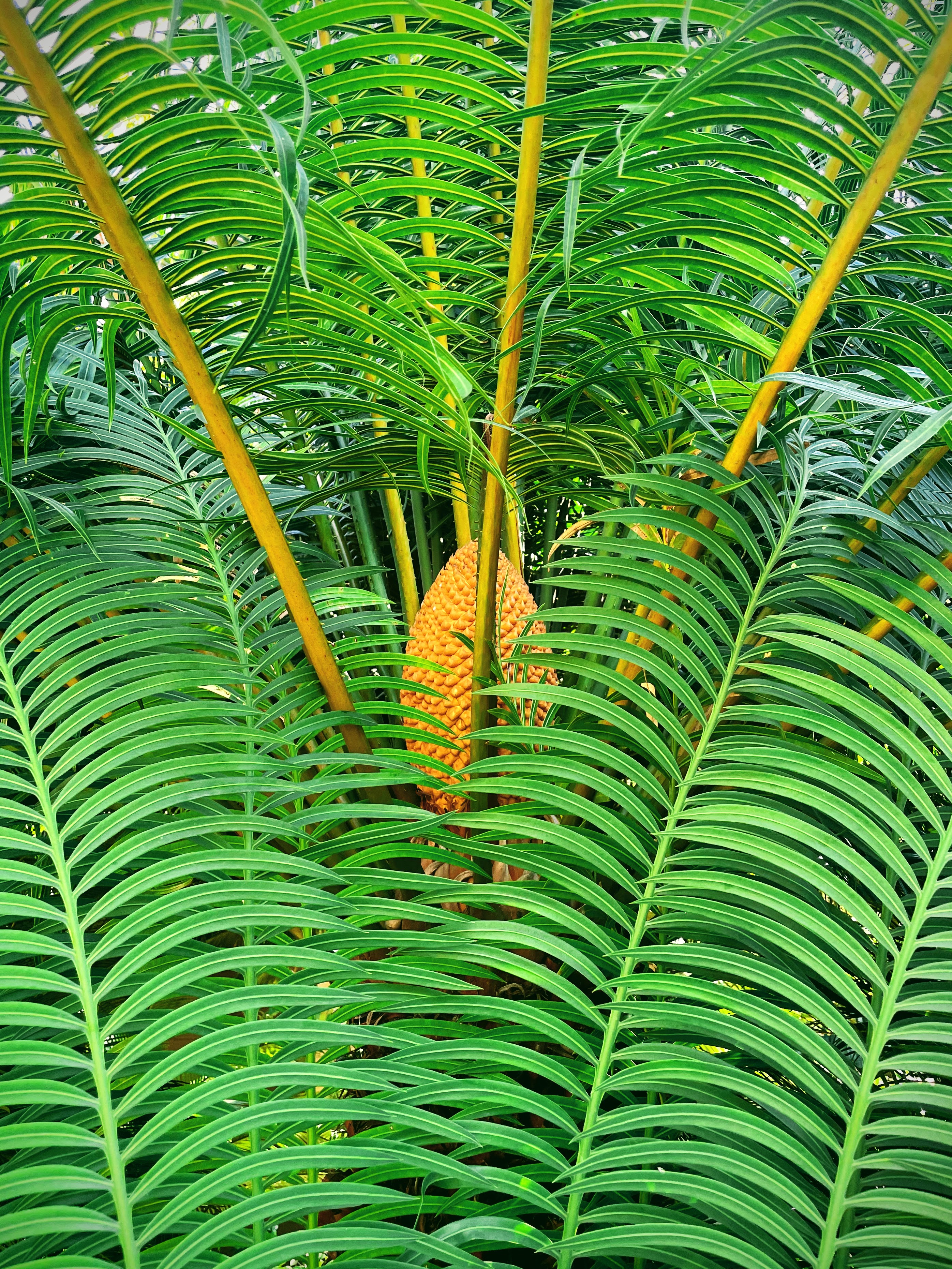
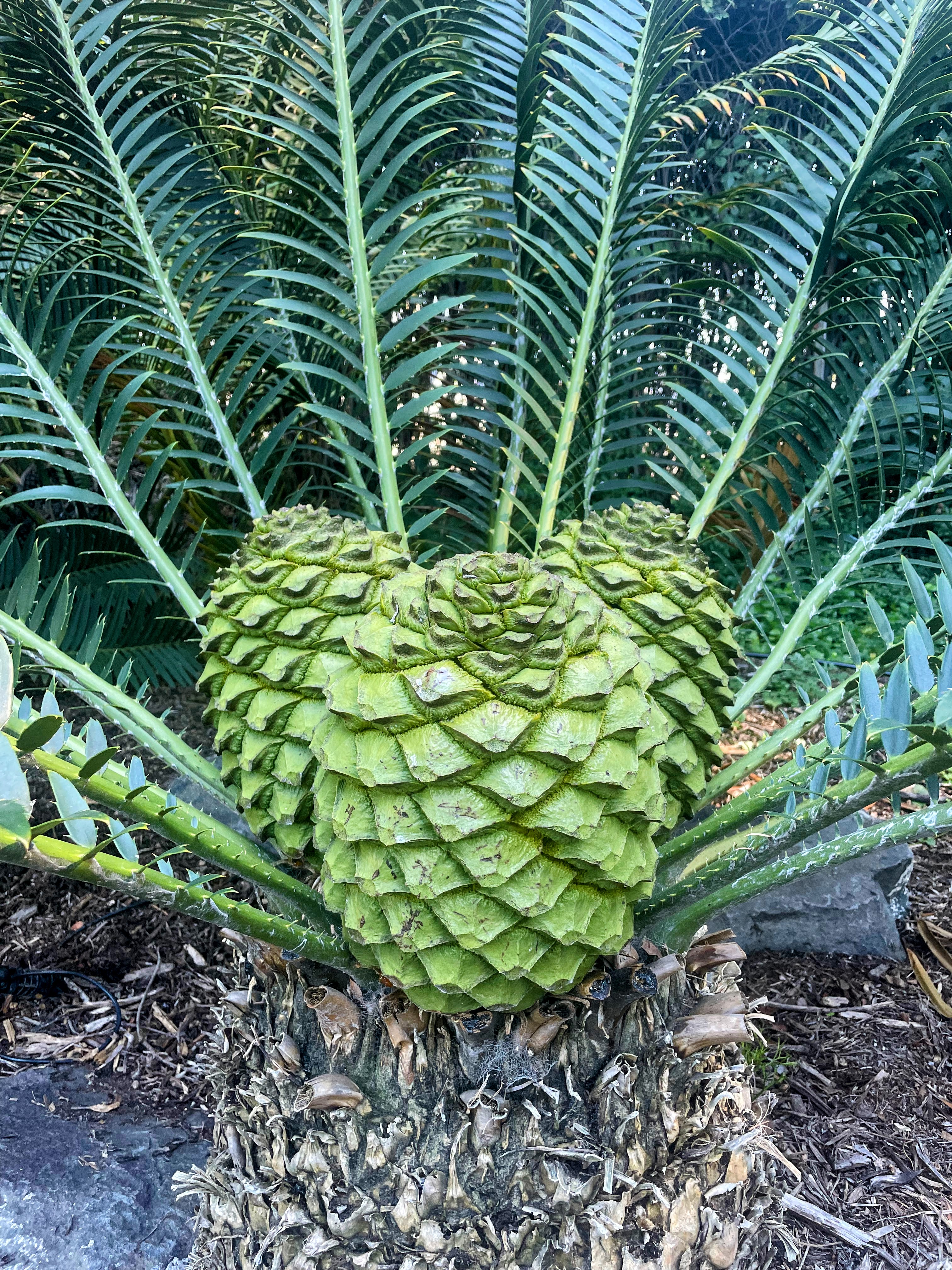
Alexandria cycad (Encephalartos arenarius), UC Berkeley Botanical Garden

Distinguishing between cycads and palms can sometimes be tricky as they both have crowns of pointy leaves atop a woody trunk. For a while, I assumed if it was tall and tree-like, it was a palm, and if it was closer to human height and a bit bushier, it was a cycad. Then I saw the Albany Cycad at the San Diego Zoo (at 500 years old, it is the Zoo’s oldest plant); it is taller than I am and looks a lot like a palm tree.

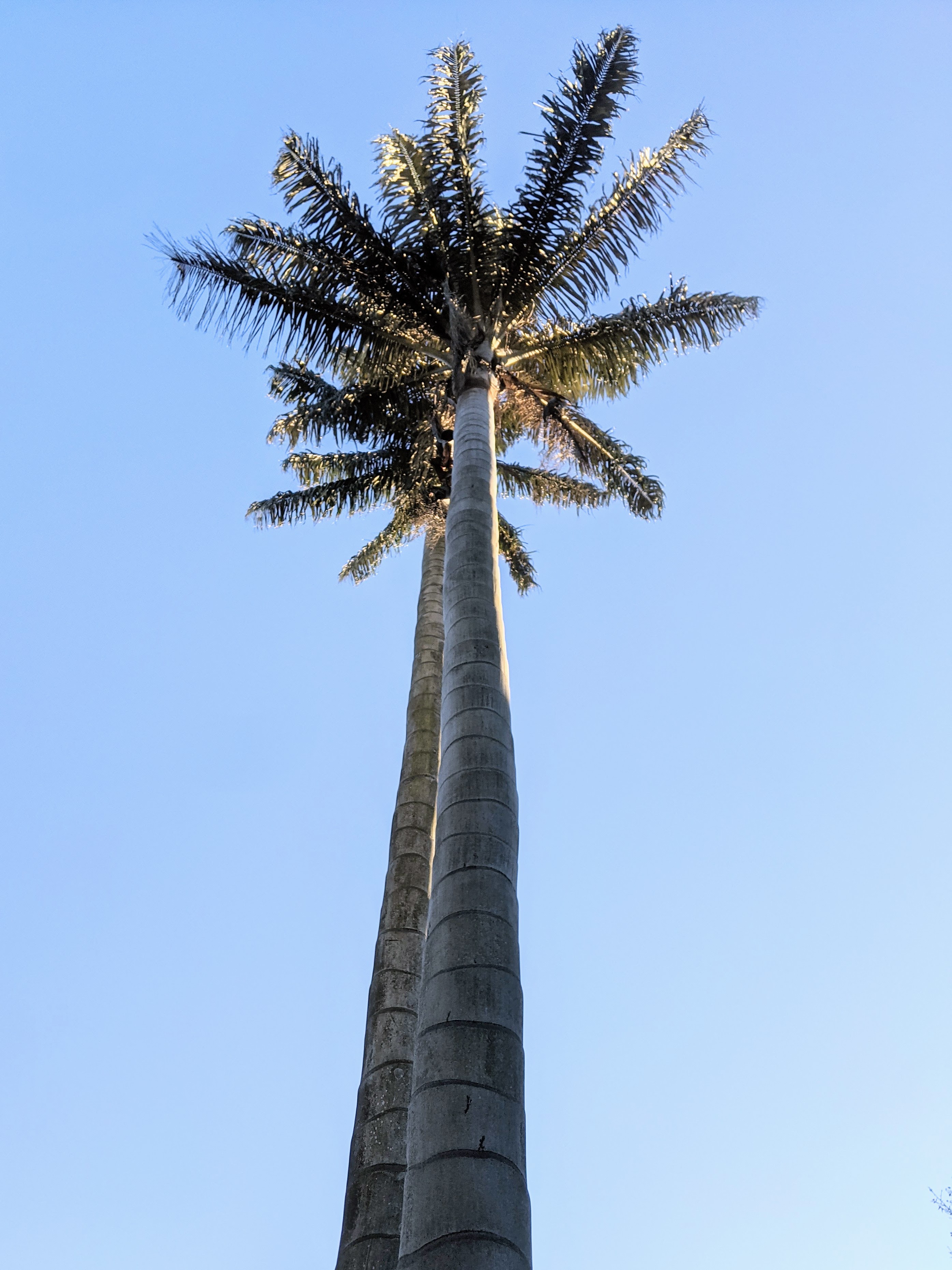
But there is a way to tell tall cycads and palm trees apart: look at the trunks. Cycad trunks are rough and stocky while palm trunks are slimmer. Also, while both plants have scarring on their trunks where the leaves have fallen off, cycad leaf scars appear in a spiral pattern, while palm leaf scars often look like rings around the trunk. So if you see ringed scarring on a tall and elegant trunk, that’s a good clue that you are looking at a palm and not a cycad.

Another difference is that cycads are gymnosperms and palms are angiosperms, but those terms aren’t very helpful unless you know that gymnosperms = cones, and angiosperms = flowers and fruits. So if you are looking at an as-of-yet-unidentified plant with stiff and spiky pinnated leaves and see a cone at the center of those leaves, it’s a cycad. And that cone is why cycads are most closely related to conifers.

If you see any flowers at all (or fruits such as coconuts, dates, or berries), it’s a palm. Ferns are neither gymnosperms nor angiosperms; they are primordial, vascular plants and do not produce flowers, fruits, or cones. So if you are looking into what you think is a clump of ferns and see a cone, it’s not a fern. If you see a woody trunk, it’s also not a fern. But, if you see spores on the underside of the fronds, it IS a fern!

Spores on the underside of Florida Strap Fern

Finally, a word about Sago Palms, a group of palm-like plants that are actually cycads. They got their name because way back when, someone else had a hard time telling them apart. (So glad I am in good company.)

Misnamed Cycad: Cycas circinalis (Queen Sago Palm), Garfield Park Conservatory, Chicago

A final twist to this tale: though cycads can look like palms, their young, emerging leaves look remarkably similar to unfurling fern fronds. I don’t have a photo of a cycad leaf unfurling (unfortunately), so the first photo below is kindly borrowed. I’ve added a fern photo I do have for comparison. One could easily be forgiven for mistaking an unfurling cycad for a fern. But take a careful look at the rest of the plant. Touch the mature leaves to see how hard or soft they are and whether there are any spores underneath, see if there is a woody trunk (if so, look at leaf scarring), check for cones or fruits. All those things will point you in the right direction.

Crocosmia: Flower or Weed?

24 Sep

I came across this poem recently, by Ian Emberson:

A weed is a flower in the wrong place,
a flower is a weed in the right place,
if you were a weed in the right place
you would be a flower;
but seeing as you’re a weed in the wrong place
you’re only a weed –
it’s high time someone pulled you out.

I suspect some difficult interpersonal dynamics led to the last few lines, so I won’t dwell on those. But I quite like the first two lines. They summarize my feelings about a beautiful flower in my garden, which I love when it’s in the right place and frown over when it pops up (again and again) in the wrong place(s): Crocosmia.

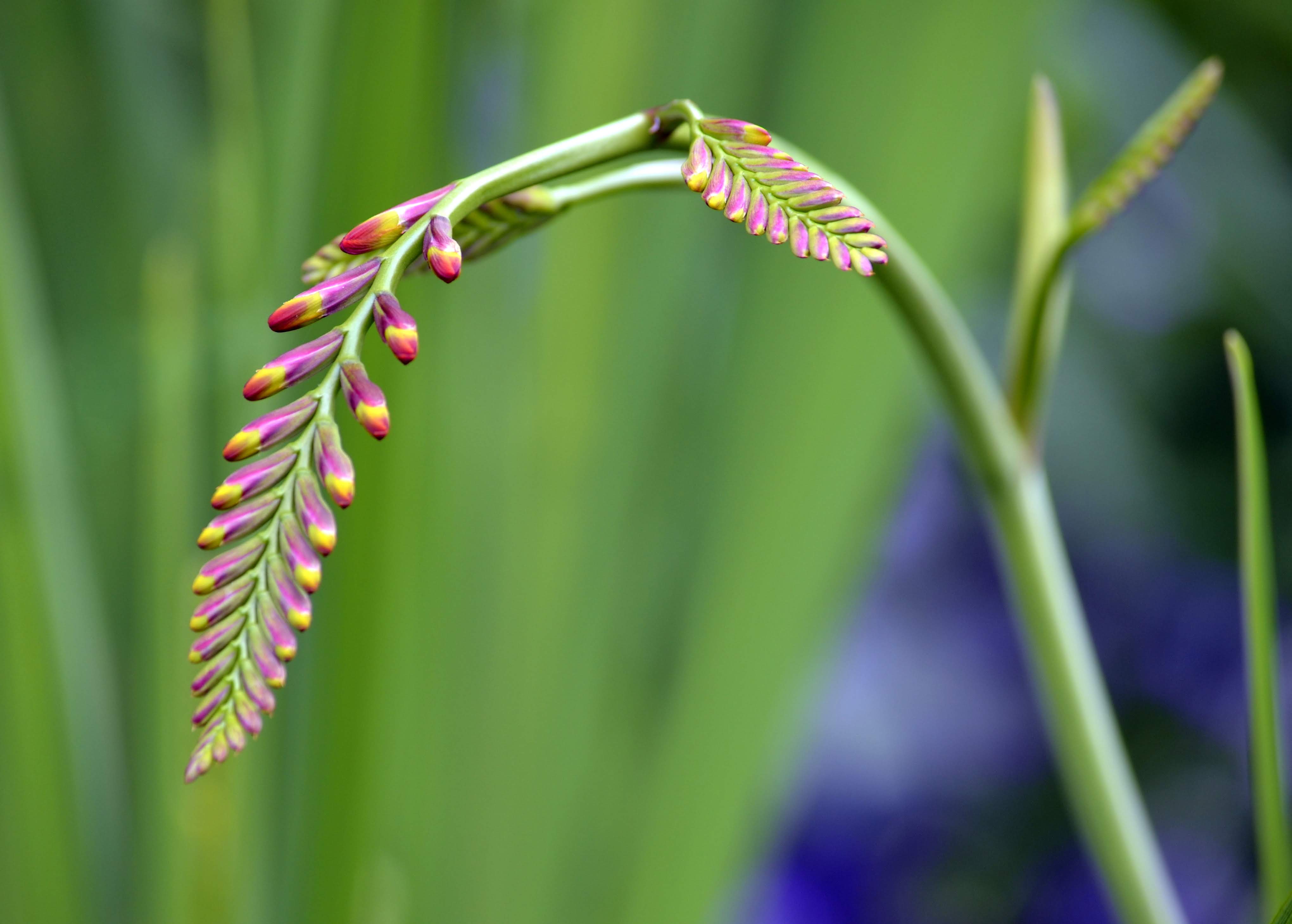
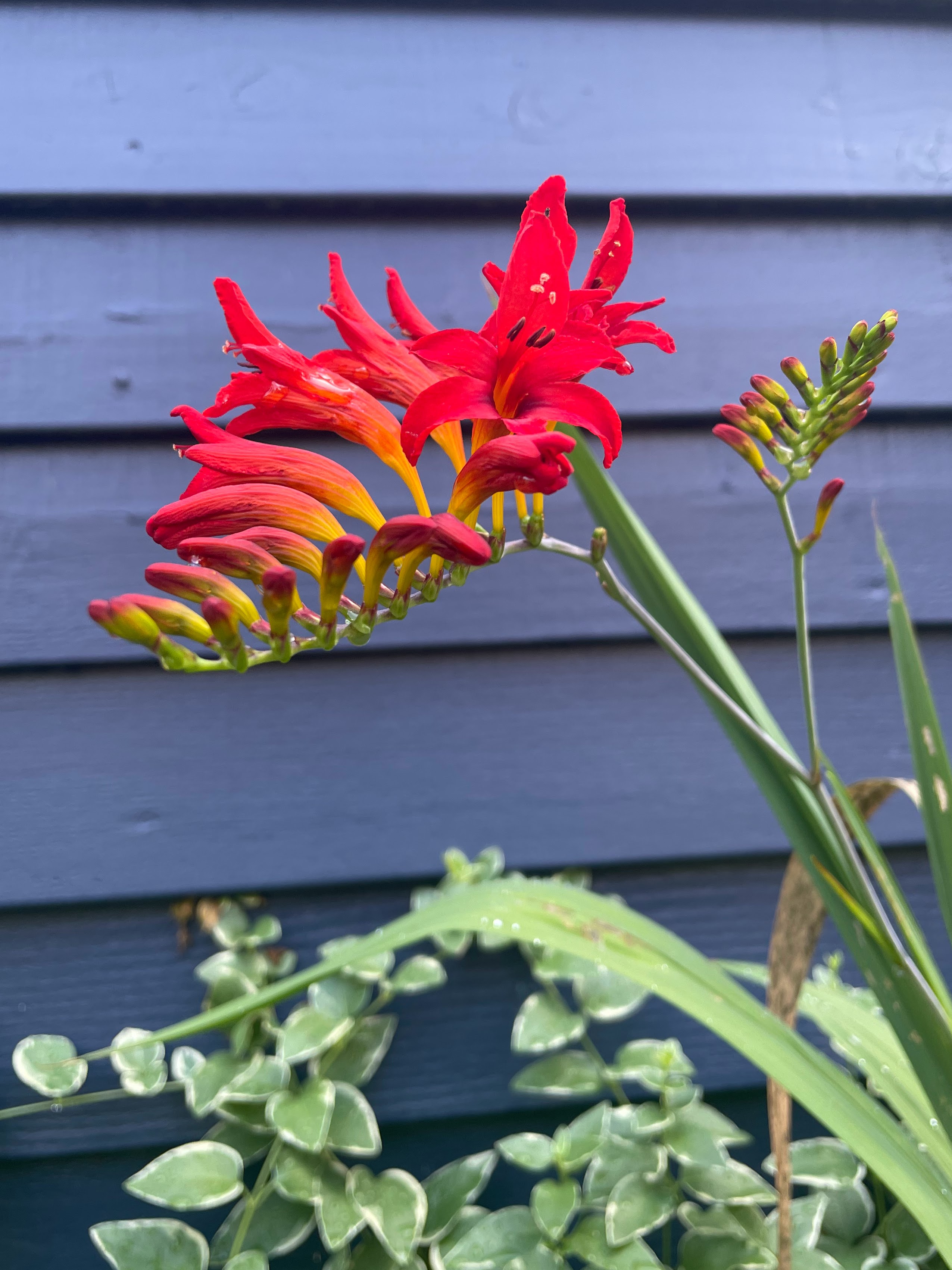
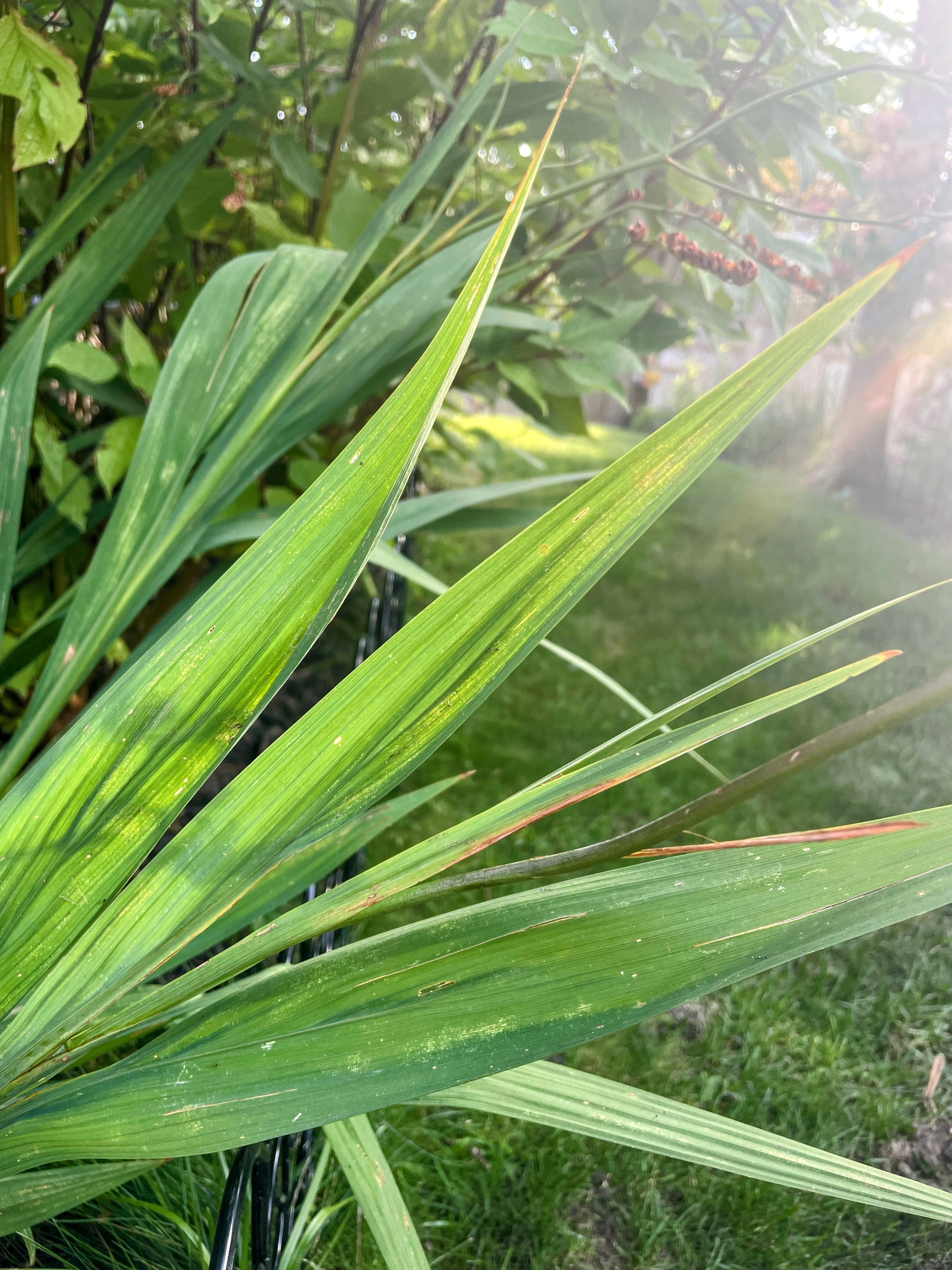
Crocosmia is a member of the Iris (Iridaceae) family, along with its gladiolus and crocus cousins. Plants in this family are perennial, and grow from bulbs, corms, or rhizomes. They have tall, upright foliage; Crocosmia leaves have been called “sword-like” and are easily spotted and admired in the garden.

The tubular, scarlet-red flowers are spectacular as well, and are wildly attractive to hummingbirds, who have been known to defend their Crocosmia patch against any and all interlopers. For hummingbirds, a Crocosmia is the proverbial Lady in Red.

So, what’s not to love? Crocosmia has great flowers, great leaves, and brings hummingbirds to the garden. How could it be a problem? Well, in the U.S. and other parts of the world, this Southern African native is considered an invasive species because of how well it grows, to the detriment of other plants. It really can grow almost anywhere; the ‘Lucifer’ cultivar (which has made itself a regular feature of my garden) is hardy to Zone 4. In the words of the California Invasive Plant Council:

“It prefers disturbed areas, including roadsides, coastal scrub, prairie and forests. Crocosmia is a superior competitor for water, light and nutrients, and it excludes native plants by growing in dense patches.”

I’ve seen mass plantings of Crocosmia, which can be stunning:

Intentional Crocosmia planting, Japanese Tea Garden, San Francisco

But where not controlled, Crocosmia could run riot. It is a determined grower whose corms multiply and multiply. You may think you’ve gotten them all, but you haven’t. In my own garden, no matter how often I have tried to transfer rogue Crocosmia from where I do not want it to grow, to where I do, it keeps cropping up in the old spots — and in new ones.

Crocosmia in yet another unplanned spot

The reason I am finding it in new spots in my garden, is that — in addition to propagation by corms — Crocosmia can also grow from seed. I did not realize how sneaky and able Crocosmia was until now, so I naively let the seed pods develop and scatter, mostly because I did not perceive them as a threat. In my skirmishes with this flower (or weed?), it has outwitted me each time. I’ve been focused on battling corm-spreading Crocosmia, without realizing my garden was also being strafed by airborne seeds. Now I know I should have been cutting Crocosmia off at the pass, literally; I should have been cutting the flower stems at their base as soon as the flowers were spent. Instead, I have allowed the (admittedly beautiful) seed pods to develop, along with the mini paratroopers housed therein, just waiting to spread further red cheer throughout my garden. Clearly, I am no military strategist.

But… lesson learned for next year. I vow to be ruthless. Really.

30-Plant Challenge

14 Aug

Last week, I finally got around to doing the 30-Plant Challenge, which is pretty simple: Eat 30 different fruits, vegetables, grains, nuts, and seeds per week. (Herbs and spices contribute to the total, too, as do garlic and coffee, but I decided to count those only in emergencies.) Essentially, the more diverse range of plant foods you can add to your diet, the better for your gut microbiome. The better your gut microbiome, the better your overall health.

I’m not vegetarian and I have a wicked sweet tooth, but I’ve convinced myself I eat pretty healthily otherwise. However, I am all for good microbiomes, and I wanted to do the challenge to see if it would be a challenge. I started on Sunday with a breakfast smoothie (spinach, banana, blueberries, cinnamon), followed by a curried chicken salad for lunch (made with celery, carrots, currants, red grapes, and almonds), with some cherries on the side. For dinner, it was pasta with cherry tomatoes, red onion, garlic, basil, and mascarpone, along with a salad made with mixed greens, pear, walnut, and goat cheese. Total for Sunday: 14 plant foods, not counting herbs, spices, or garlic. Or the coffee in the affogato I had after dinner, which was delicious. It’s too bad ice cream is not a plant food….

I thought, “This will be easy; I ate almost half of the total in one day!” For the next five days, I added new plant foods to my list if I happened to eat any, but I wasn’t really planning meals around new foods. I did notice that I repeated a lot of the plants on my list throughout the week, making it harder to find new things the farther along I got. Plus, I didn’t eat pure vegetables and fruits at every meal. At one breakfast, it was just coffee and a cinnamon roll; not a plant that I could count in sight.

By Friday, I was at 24 plants, so had to make a concerted effort to add 6 new items by end-of-day Saturday. Luckily, I made it. But I learned I need to plan a bit more, and have a few more things easily on hand (like pre-cooked lentils, more seeds and nuts, etc). I also learned I should incorporate more beans, legumes, and grains into my meal planning, and that I can’t have very many cinnamon-roll-only breakfasts without risking failing the challenge. 😦

Here was my total list from last week (in mostly chronological order):

  1. Banana
  2. Spinach
  3. Blueberries
  4. Celery
  5. Carrot
  6. Red grapes
  7. Currants
  8. Almonds
  9. Cherries
  10. Cherry tomatoes
  11. Red onion
  12. Lettuce
  13. Pear
  14. Walnuts
  15. Avocado
  16. Black beans
  17. Pineapple
  18. Cucumber
  19. Red bell pepper
  20. Green bell pepper (different colors of same thing count separately)
  21. Zucchini
  22. White mushrooms
  23. Broccoli rabe
  24. Potatoes
  25. Red cabbage
  26. Mango
  27. Quinoa
  28. Grapefruit
  29. Lentils
  30. Yellow tomatoes

In addition to the meals mentioned above, others included:

–Burrito with beef, black beans, avocado, lettuce, tomato; sliced pineapple
–Creamy chicken, zucchini, and mushroom pastry puffs; garden salad
–Roasted red pepper bruschetta, pork chops, mashed potatoes, broccoli rabe
–Egg salad on whole wheat, with lentil salad and sliced mangoes
–Other salads

Sweetness or Deceit? Attracting Pollinators

28 Sep

Plants are wily, in their own ways. Some beguile with sweetness, others lure with deceit. This weekend at the United States Botanic Garden, I saw examples of both.

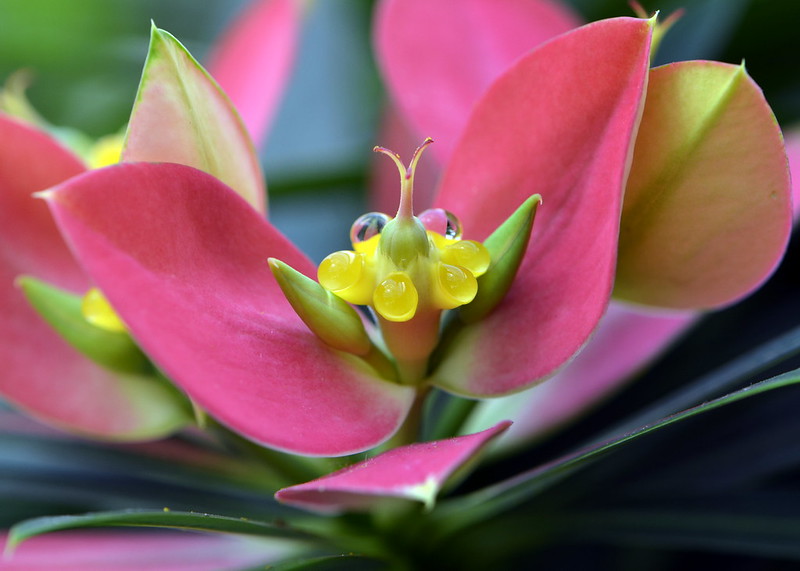
The Jamaican Poinsettia (Euphorbia punicea) takes the nicer approach. Below, you can see the brightly colored bracts, which are modified leaves, and a yellow, cup-like flower cluster called a cyathium. Insects are attracted to the clusters by the reddish-pink bracts and are then rewarded with the sugary nectar; in the photo, the glistening drops are almost overflowing from the cups. Arising from the center of the cluster is the pistil (the female reproductive organ), with three curved stigmas at the top, waiting to receive a dusting of pollen from the visiting pollinator.


Successful pollination leads to the development of a seed-bearing fruit. But if the plant has not been successfully pollinated, the fruit may wilt and never produce seeds.

Other plants, such as the Carrion Flower (Stapelia gigantea), attract pollinators by pretending to be (and smell like) something they are not: rotting flesh. You might think that if someone knows a flower smells like a decomposing mammal, s/he would avoid taking a sniff. But no. I partook of the putrid odor more than once, and can confirm that the flower does indeed smell vile. I pointed this out to other passersby, who also conducted repeated olfactory experiments of their own with identical results…. But back to the plant. In addition to its odor, this wrinkly and hairy flower is also meant to look like a decaying, oozing, leathery, peeling dead animal.


And boy, do some insects love that. Perfect spot to lay eggs, with plenty of food for the larvae, or so they think. They are mistaken; their reproductive efforts are futile. But they will have served their purpose: to help ensure the reproduction of the plant by taking and depositing pollen as they go about their business. A devious deception indeed. Here is a close up of the inside of the flower, complete with a green bottle fly circling around, and a pile of ill-fated eggs below.


Seed Transport: A Hairy Situation?

22 Oct

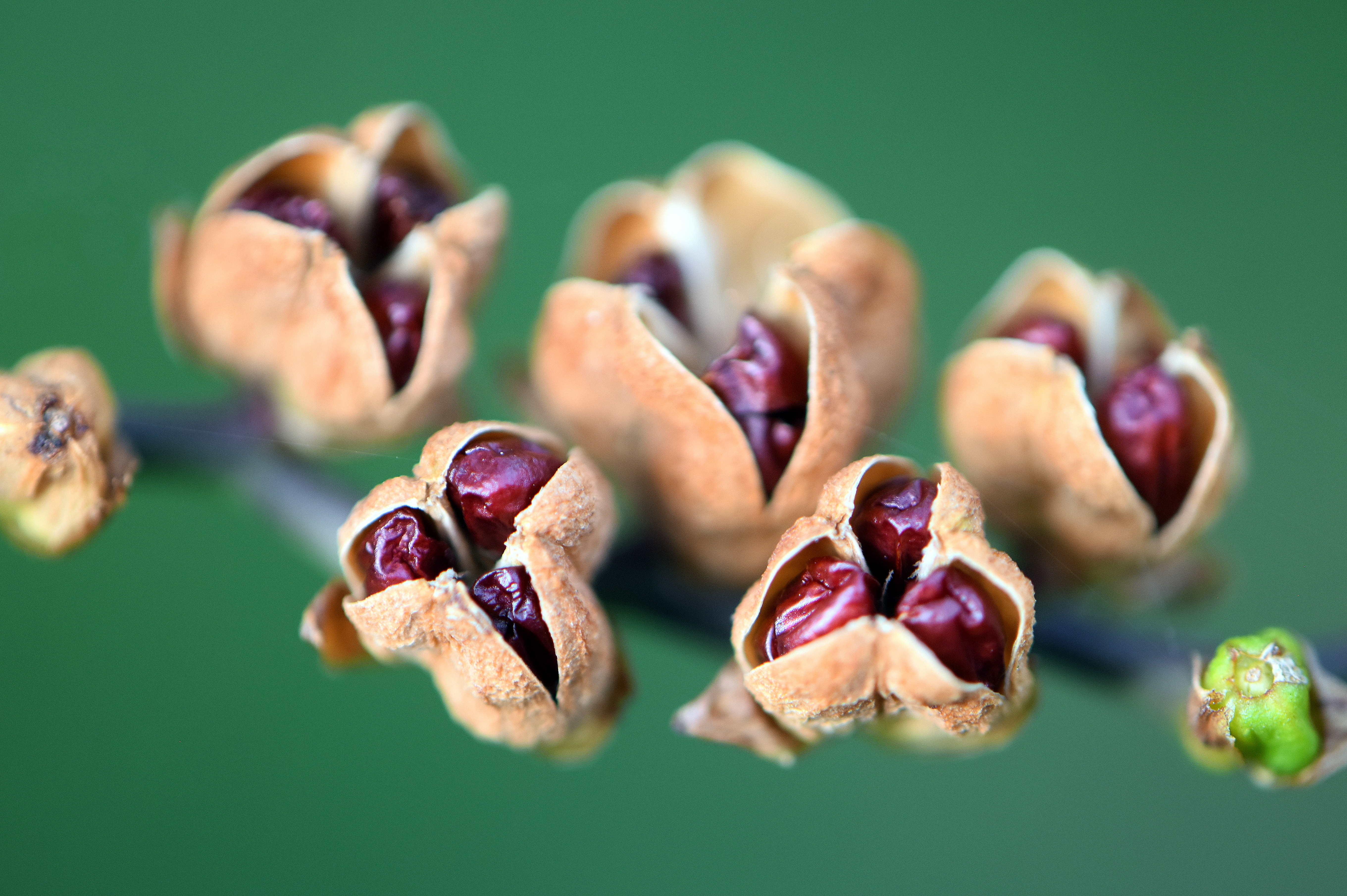
When I think of autumn, I think of brilliant, jewel-toned foliage: rich reds, oranges, and yellows. But fall is also a time for brown–and specifically, for really interesting seed pods that have dried up, split open, and offered up their treasures.

In a recent post, I wrote about wind dispersal of seeds via feathery parachutes. Seeds attached to or encased in balls of fluff can travel quite far on a good breeze. But there are other ways for seeds to get around. Catching a ride on a passing animal is one of them. And that is why some seeds are sticky — or hairy, as in the case of Rose of Sharon seeds, which are encircled by a fuzzy ring.

Despite this transport mechanism, however, Rose of Sharon plants are really, really good at self seeding, with dozens of seedlings springing up around the base of the parent plant each year. So while those seeds are designed for adventure, they are really homebodies at heart. And I’ll take a homebody any day, if it puts on a good show (see below).

Rose of Sharon seed pods

Rose of Sharon seeds

Rose of Sharon flower

Iris Seeds

28 Sep

Last weekend, I was ambling down a woody path at Brookside Gardens when I glanced to my left, and then glanced again. What I saw was a small patch of irises, blooms long gone, but with seed pods at the end of the stalks. And one of the pods had split open, revealing bright orange seeds.


Those of you who grow lots of irises may be very familiar with iris seeds, but I had never seen them before. After going home and doing a little research, I now know why: I only have two Japanese irises in my garden; one rarely flowers and the other produces just a couple blooms each year. So it isn’t surprising I haven’t seen any seed pods–my irises aren’t making it easy for bees to pollinate them, and there can’t be any seed pods without successful pollination.

There also can’t be any if each spent iris bloom is carefully removed, which is fairly common practice. Why would a gardener do this? To allow the plant to conserve all its energy for next year rather than spending some of it creating seed pods, which could lead to fewer future blooms on the parent plant. But those seeds could eventually lead to other blooms, and for me, part of the fun in gardening is encountering the occasional nice surprise.

So, assuming a miracle occurs and I do spot an iris seed pod in my garden one year, I would have two options (after letting the pod turn brown and split, harvesting the mature seeds, and drying them out):

  1. plant the seeds in the ground later in the fall (so they can chill throughout winter and so the rain and melting snow can help remove the seeds’ germination inhibitor), or
  2. soak the seeds in daily changes of water for up to two weeks (to get rid of the inhibitor), store them in a plastic bag in the refrigerator (with damp peat moss or potting mix to keep them moist), start them in pots in early spring, and then plant the seedlings. This moist/cold process is known as stratification.

All things considered, I’ll go straight for Option 1. Either way, it may be a year or two before the irises bloom since it takes a while for them to form mature rhizomes. The resulting irises may not look like the parent plant at all, and they may not be quite as fine specimens as other irises–or they might. I like a good mystery.

Feathery Parachutes

8 Sep

There are a variety of ways unexpected plants can crop up in your garden, but often, you can thank the wind for it. If bees play a vital role in pollination, then wind plays a similar role when it comes to seed dispersal. Think of the dandelion, the bane of many gardeners’ existence. It has developed a perfect way of ensuring a next generation by encasing its seeds in balls of fluff. What the wind doesn’t carry away (or lawnmowers cut down and disperse), young children will happily blow into the air–all but guaranteeing a new crop of the ubiquitous yellow flowers right in the middle of your lawn, or your neighbors’.

The Butterfly Weed plant disperses seeds in a similar fashion, but its seeds reside in pods that dry out and then crack open, allowing the feathery parachutes to travel hither and yon (if the Milkweed Bugs that love the seeds and tissue of Butterfly Weed plants don’t get to all the seeds first…). Luckily, there are many, many seeds to go around. And then, it’s up to wind, luck, and Mother Nature. In the bottom two photos, the Butterfly Weed seed parachutes have gotten stuck on 1) a Verbena Bonariensis and 2) a spider web near our brick staircase. I hold out more hope for the former’s prospects than for the latter’s.


Two Unexpected Appearances

9 Jul

There are few things cheerier than the color orange. In the garden, one of my favorite orange flowers is Butterfly Weed, which as its name suggests, is just as attractive to butterflies as it is to me. Here is a close up from early June:

Now, most of the blooms are gone, and the Butterfly Weed is creating seeds, housed in the pods you can see here:

The pods dry out and crack open, and the seeds disburse in search of new homes.  [Note: People who know about these things (ie, real gardeners) collect the pods and keep the seeds for the following year instead of letting them blow all over the neighborhood. Now that I have finally figured this out, I will attempt to do the same.]

Last year, the seeds I neglected to harvest went their merry ways. One of them floated across the yard and over the fence, where it softly descended into a small patch of mulched earth near our garage. And there, it settled in for the winter, popping up unexpectedly as a new plant this year. I just discovered it a few weeks ago — a very nice surprise indeed. So this evening, I went to take a photo of it, and what did I find? A second unexpected appearance–in this case, a baby rabbit.