Tag Archives: anthers

Tassels and Silks: The Beautiful Anatomy of a Corn Plant

7 Jul
Corn tassel consisting of individual spikelets, with anthers hanging from filaments

Last year, I carved out a patch in the vegetable garden, planted some corn kernels, and was very excited when the sprouts emerged. But a few days later, all the sprouts were severed, laying forlornly on their sides where they had fallen. Upon closer inspection, the sprouts had been pulled up and the corn kernels had been chomped off at the base — clearly the work of chipmunk commandos who had infiltrated the garden at the crack of dawn. Chipmunks 1, me 0.

This year, I planted seedlings instead of kernels, crossed my fingers, and hoped for the best. As of yet, there haven’t been any corn massacres, so I’ve been able to watch corn plants grow for the first time — and admire their constituent parts. There is a lot to notice, from the stripy leaves…

Macro view of corn leaf

… to the beguilingly named tassels and silks. The highly recognizable tassel at the top of every corn plant is the male part of the plant, and consists of about 1,000 spikelets, each containing 3 pollen-producing anthers and their filaments (collectively, the stamens). With 6,000 pollen-producing units on each corn plant, that’s a lot of pollen to be wind dispersed (read more about pollen shed in this great article on “sex in the corn field“).

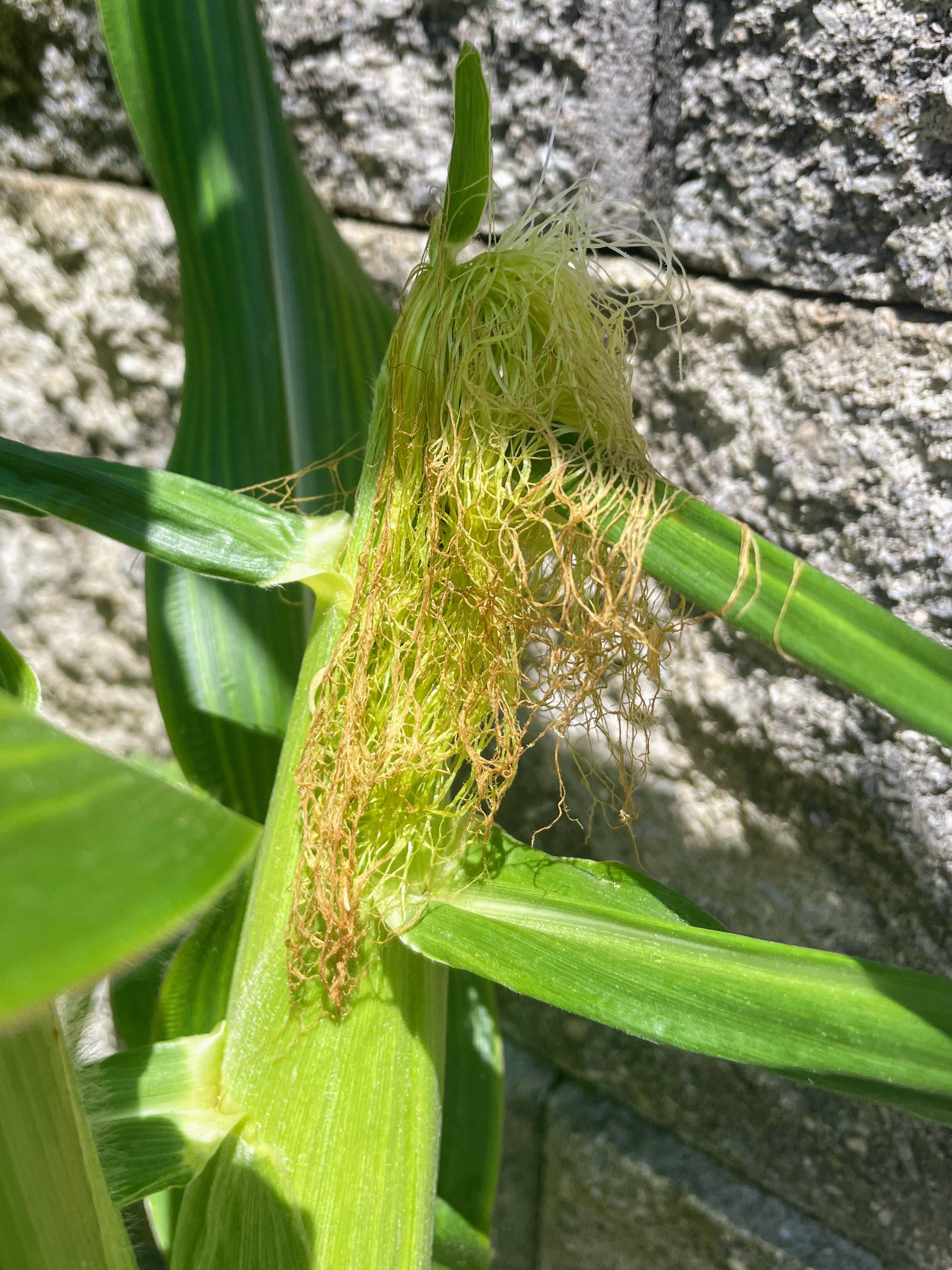
The silks are the female part of the corn plant. They form at the base of the ear but are most visible at the tip, emerging from the husk. Their job is to catch the pollen and guide it down to the unfertilized corn kernels (ovules) on the ear. Here’s the fascinating part: Each silk is connected to a kernel (or what would be a kernel if successfully pollinated). As not every ovule gets pollinated, most ears produce about 400 to 600 kernels.

You can tell when pollination has occurred because the silks dry up, turn brown, and often fall off. You can also tell when pollination hasn’t been very successful if your ear of corn has missing or misshapen kernels. That’s why it’s important for home gardeners to plant corn in a block rather than a single row, so the pollen has more chance of falling on nearby silks rather than being completely blown away from the row.

I don’t have any photos of pollen on the silks, but this is what the tiny yellow pollen grains look like on a corn leaf, along with some spent anthers (they drop off the tassel after the pollen is shed).
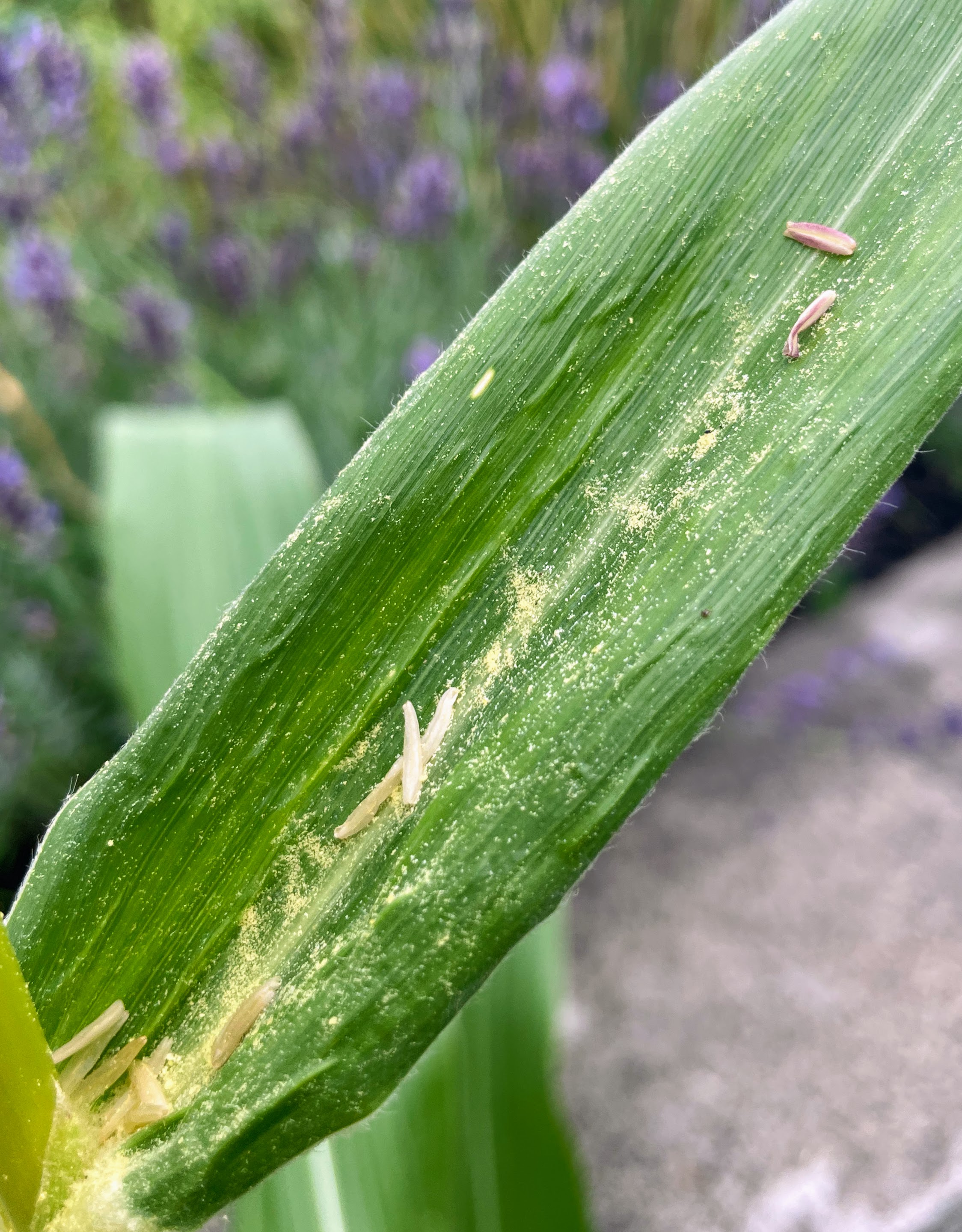
Some of the 2-5 million pollen grains produced by each corn tassel (and some anthers)

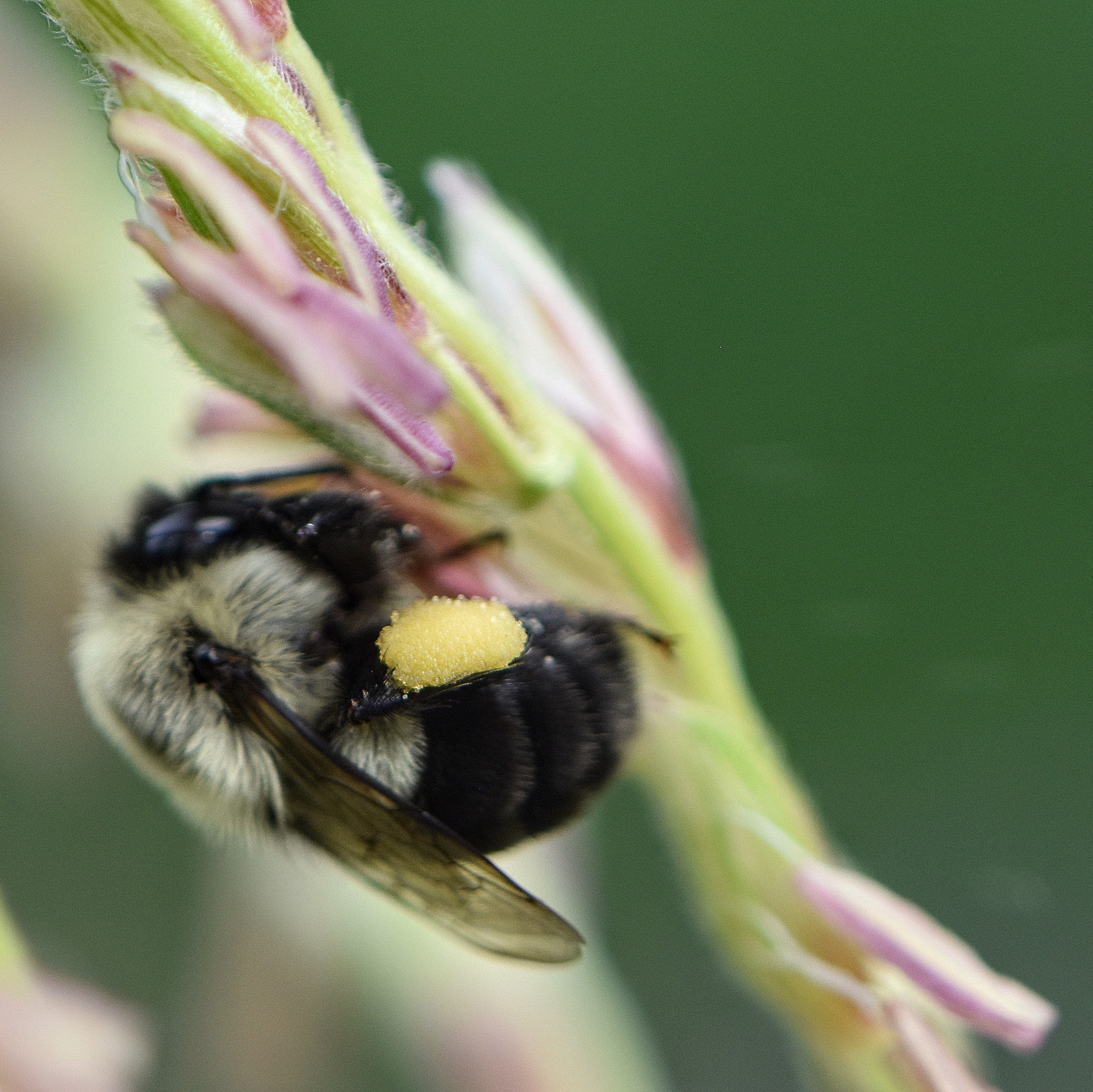
Though corn is pollinated by the wind (anemophily), pollination can also occur with the help of insects (entomophily). Luckily for me, as I was taking photos of the tassels, a bumble bee appeared. Or, more specifically, a female bumble bee appeared–as the females are the only ones to have pollen baskets (corbiculae) on their hind legs.
ROYGBIV: Orange

7 Apr

Depending on who you ask, the color orange brings to mind many things: amusement, danger, encouragement, energy, enjoyment, enthusiasm, extroversion, fascination, fire, happiness, heat, sunshine, and warmth.

It is one of my favorite colors, because it is so cheery (and because it goes so well with blue, its complementary color). I particularly like that it is associated with joy and creativity, and I love this description: “Orange oozes with delight.”

Interestingly, people did not have a good way to describe the color at first, sometimes calling it (in English) “yellow-red” or “saffron.” It wasn’t until oranges made their way around the world from their native Southeast Himalayan foothills that the color began to be associated with the ripe fruit. The first recorded use of orange as a color name in English was in 1512.

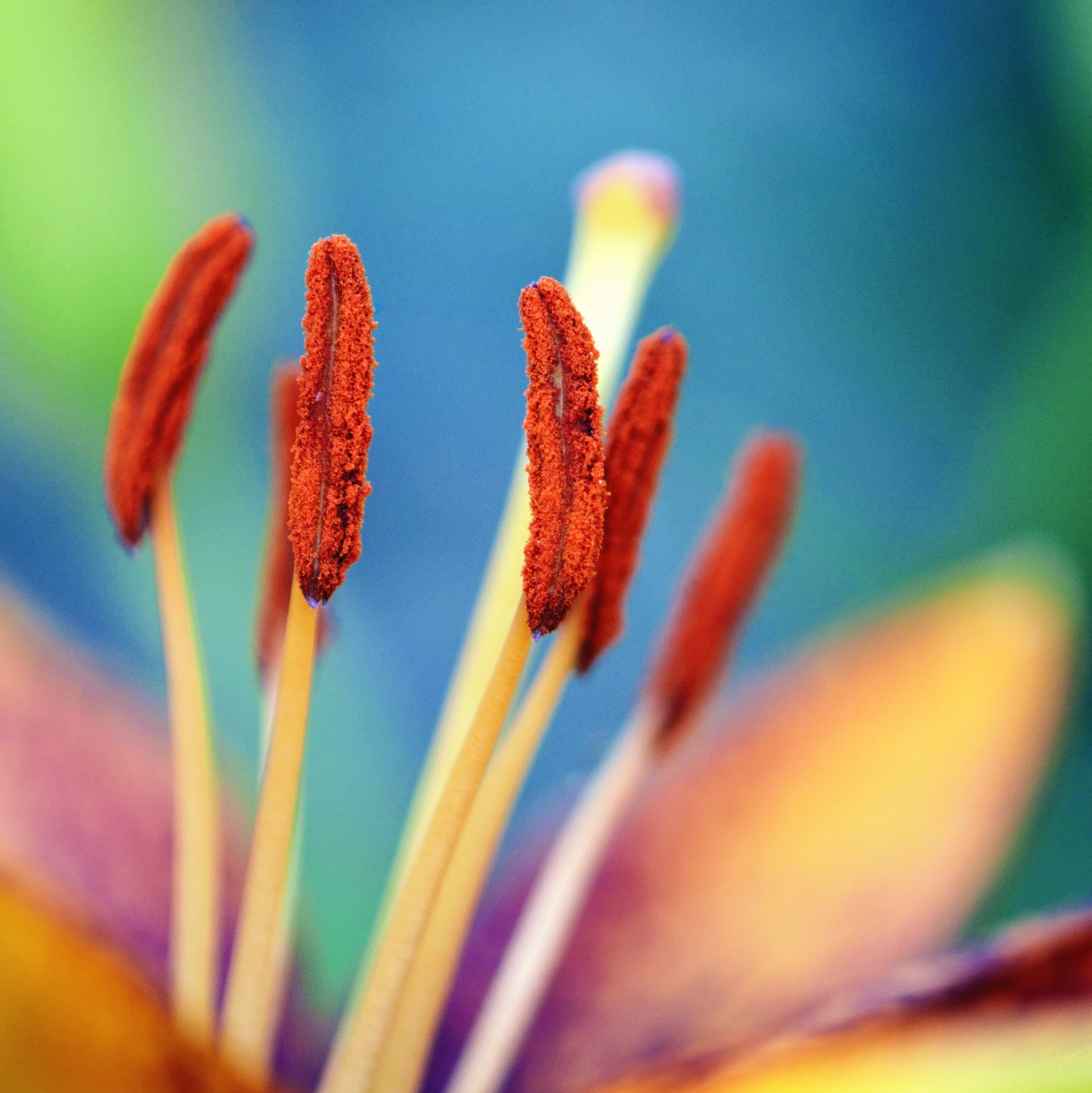
This week’s color, orange, appears on the six stamens of an Asiatic Lily ‘Tiny Sensation.’ The stamens are the male reproductive organs of flowers, consisting of anthers coated in pollen resting atop slim filaments. The female part of the flower, the pistil, can be seen rising blurrily in the back. Though not visible in the photo, the top part (the stigma) has three lobes and is sticky, to better catch the pollen.

Here is a better view of the pistil and its three-lobed stigma, surrounded by the six stamens. This photo is from a different lily, but luckily the pollen here is also orange, fitting in with this week’s theme.

Pollination occurs when bees, butterflies, and other pollinators carry the pollen from the lily’s anthers to the female parts of other lilies. Successful sexual reproduction leads to seeds that ripen in pods and are dispersed when the pods start to open in the fall. Unfortunately, I do not have any good photos of lily seed pods (though will now be on the lookout this fall), but did stumble upon iris seeds one autumn, as described here.

And of course, as lilies come from bulbs, another great way to get more lilies is via bulb division.

Collegiality, Competition, and Lotuses

29 Jun

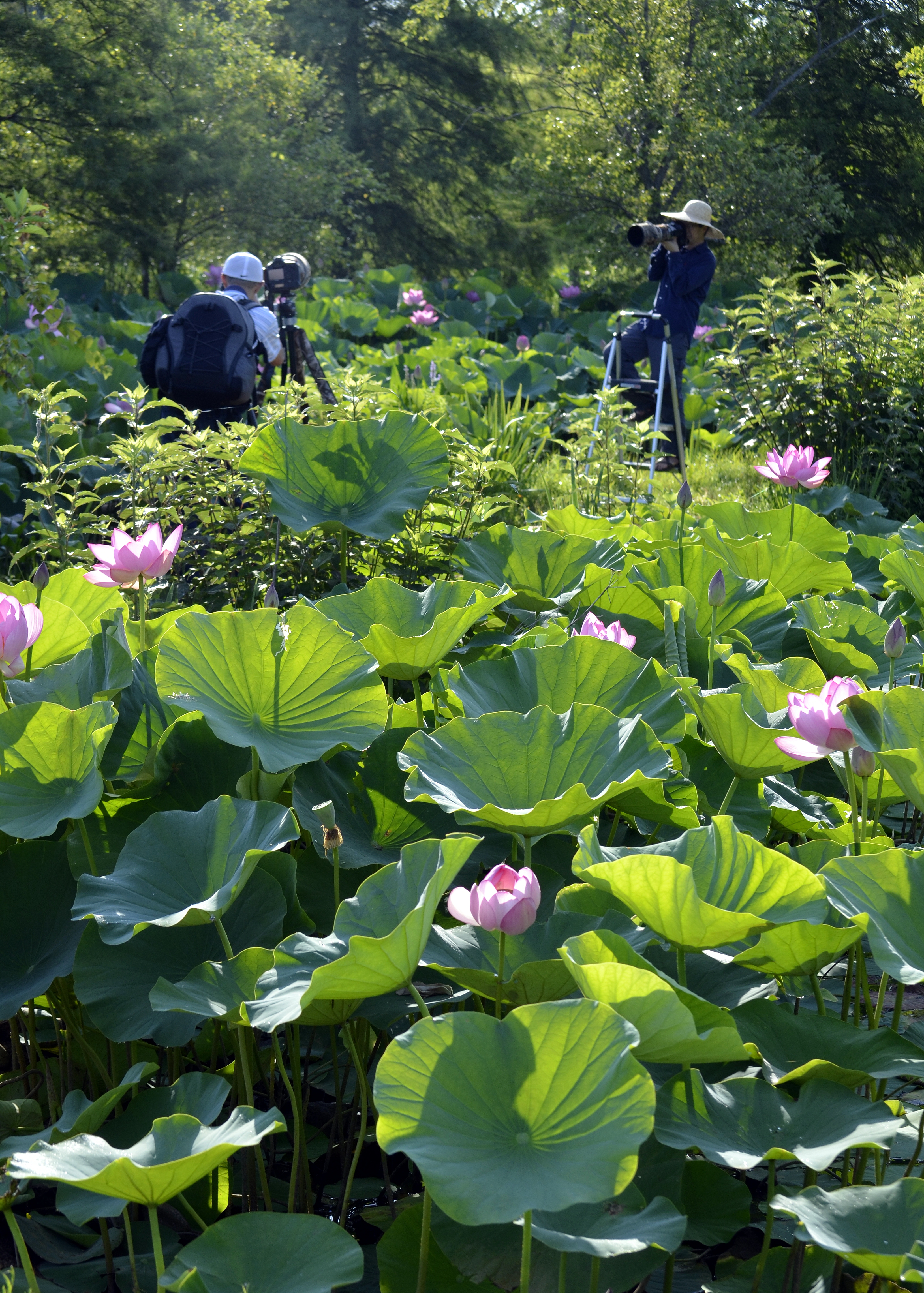
Early this morning, my mother and I stumbled upon an other-worldly scene: thousands of lotus flowers in bloom at Kenilworth Aquatic Gardens in Washington, DC. We arrived at 7:30 am to see the lotus flowers while they are open. The lotuses were indeed gorgeous, but the most striking aspect of our visit was seeing all the photographers who had arrived before us to stake their claims. The ones I spoke with were amateurs–but they were serious amateurs, with lenses almost as big as my leg, tripods, reflectors, step ladders, rolling equipment cases, and assistants. Some came from as far as New York. I had no idea Kenilworth’s lotus blooms attracted this much attention. I showed up with my camera, a small case containing three lenses (the largest of which is smaller than my hand), and my mother. No tripod, no reflector, no ladder. I looked glaringly out of place, unencumbered by the accoutrements of the trade, with not even a flak jacket to my name.

Photographers
For the most part, there was a great spirit of collegiality–sharing of tips, patient waiting for good spots, etc. But everyone was there to get a good shot, and as the sun bore down and the light became trickier, some competitiveness emerged. One photographer and her friend/assistant had spent some time setting up tripod and camera, and were focusing on a particularly lovely lotus flower. Another photographer stopped close by, but not in the first photographer’s line of vision, to see if he could get a differently angled shot of the same flower. He asked if that was okay. Female photographer: “I can’t tell you where you can or can’t stand, but there are lots of other flowers here.”  Male photographer got the hint and moved on. I’d like to think that was the exception, rather than the rule.

I was using a macro lens to capture a dragonfly on a lotus bud when another photographer came by, took a second look to see what I was shooting so close up, and got very excited when he saw the dragonfly. I stepped aside to give him a  turn. The good thing about dragonflies is that once they find a spot they like, they often spend some time there, so I knew I would probably get another chance. Plus, the gentleman I ceded the spot to had a huge lens and I knew he would be able to get a really, really nice close-up shot. If I got any closer with my little macro lens, I’d fall into the pond.

Later, I was admiring some lotuses, but ruing the fact they were in direct sunlight–and hence, beyond my ability to shoot them properly–when the same gentleman stopped by again, and had his friend hold up a huge reflector that allowed both of us to take the shot (third photo below). In the end, I like to think that though we are all photographers of varying abilities, we are kindred spirits nonetheless–out there to capture fleeting moments of beauty. Below are lotus buds and blooms, with close-ups of a lotus receptacle, and of water pooling on a lotus leaf.