Cheeky Buggers: Squirrels

23 Jun

In this war I wage with squirrels, I have won most battles, aided originally by some chicken wire, but now mostly by my trusty sidekicks: Schnauzer 1 and Schnauzer 2 —  in front of whom we have to spell the word s-q-u-i-r-r-e-l, as saying the word out loud propels them to the back door in hot pursuit. Schnauzer 1 has yet to learn she cannot climb trees, despite 7 years of trying.

But squirrels are intrepid souls. What are a couple of earth-bound dogs when there are bird feeders full of seeds at arms length? Ok, not at arms length, but squirrels are nothing if not optimistic.

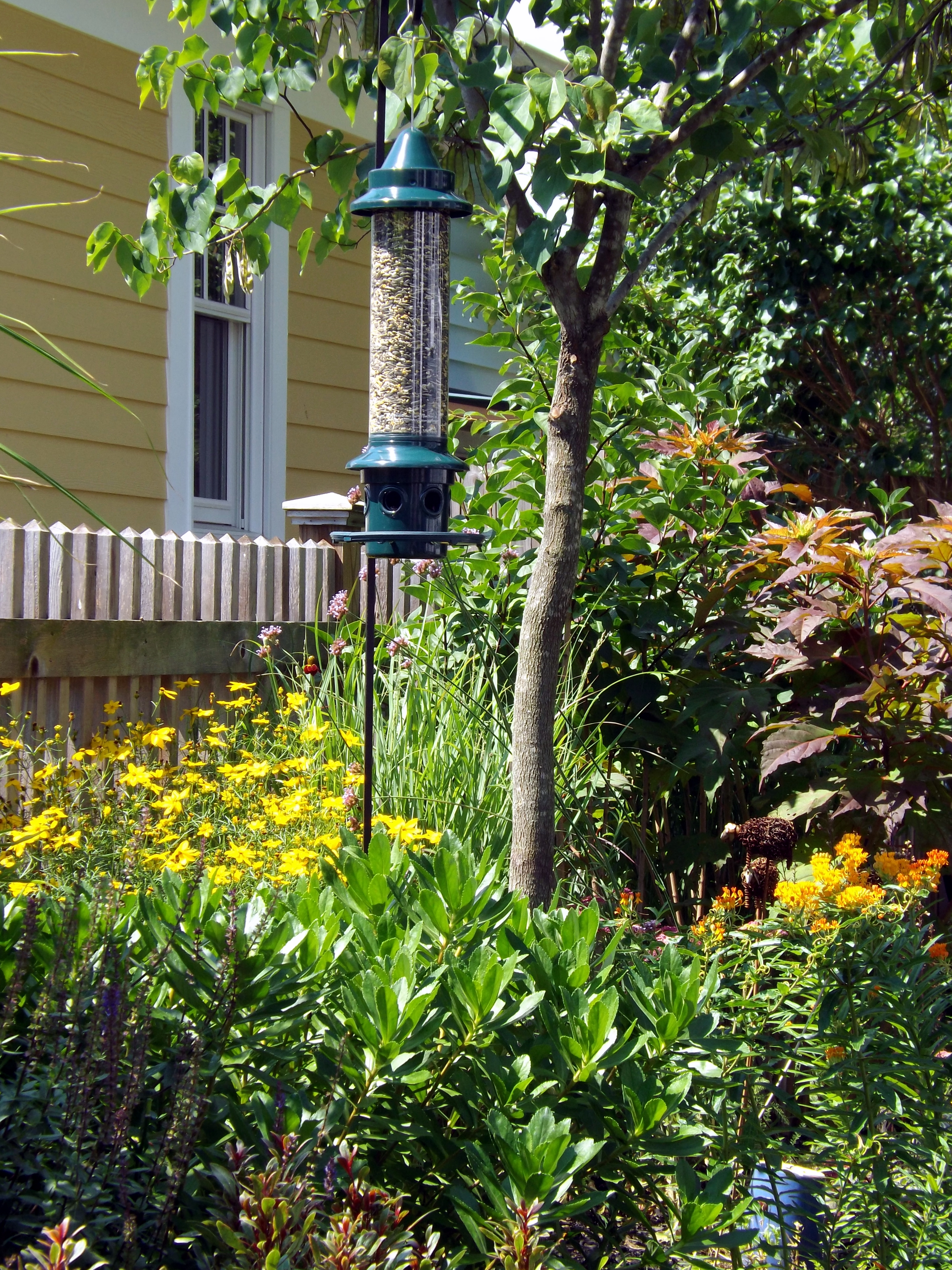
Today, I put up a second bird feeder…

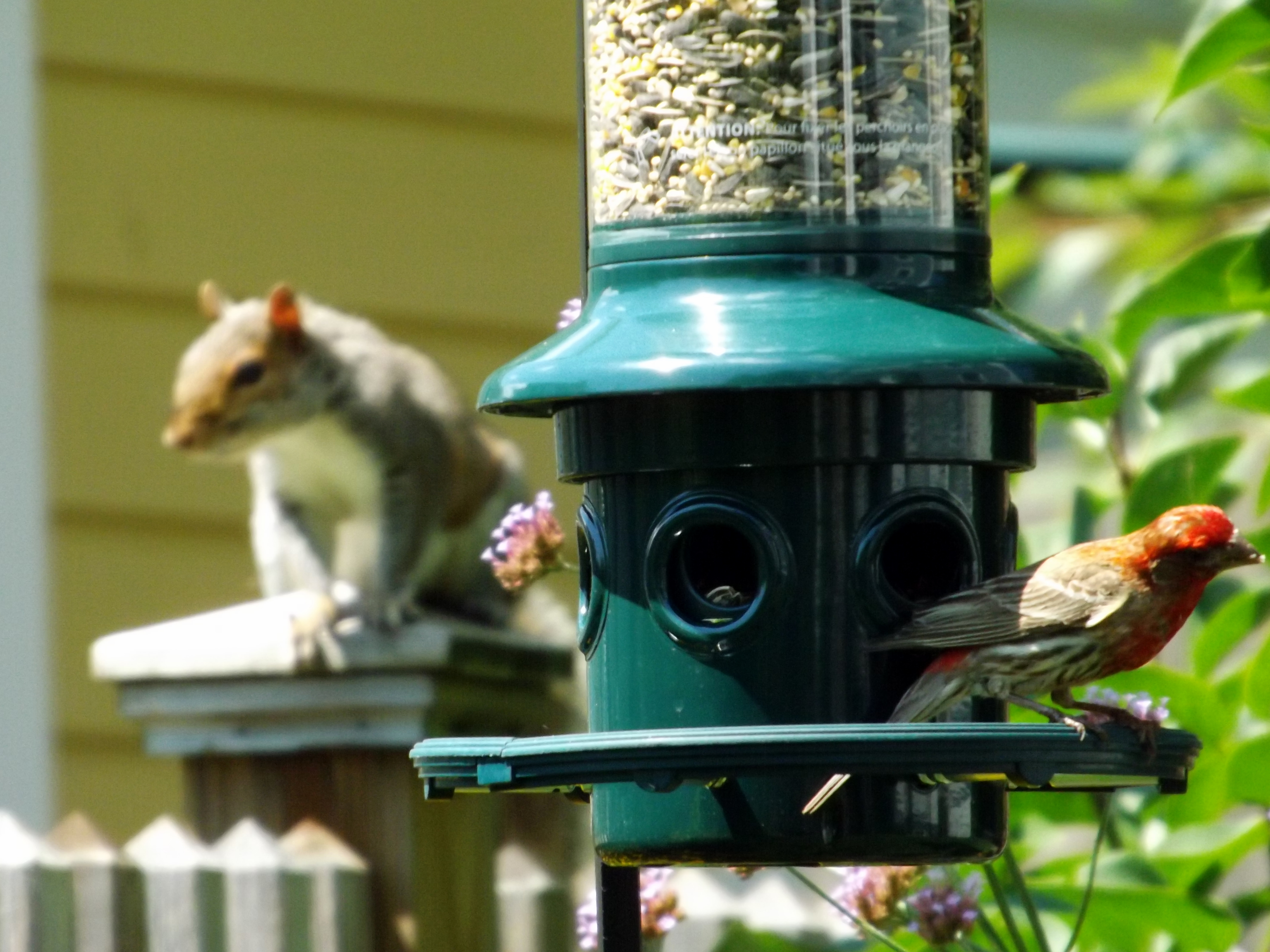
… and then waited to see what would happen.  Sure enough, along came one cheeky little bugger:

…who then considered a leap of faith:

He ran across the top of the fence, gauged the distance for a jump (too far), went up the tree near the bird feeder to see if that got him any closer  (no), went down the tree in the hopes that a different direction would have closed the gap  (no), and appeared to give up. Until he realized the birds were knocking seeds onto the ground.  So maybe this battle was a tie.

Flowers and Daughters

22 Jun

This will be a quick post in honor of my 15-year-old daughter, who is in Rome being a nanny for the summer. When we were all there as a family in 2005, we were walking through the Jewish Quarter behind the Teatro Marcello one day and stumbled upon an artist who had set up shop on a church stoop, painting flowers on strips of wood he had nailed together. We could not resist, and brought one back with us. It currently resides above the doorway of the office in our house, a permanent reminder of the cheerfulness of flowers. And that is why it is a good tribute to our daughter.

Here are more examples of the artist’s work. This photo was taken in 2005, but when I was there a few months ago,  I saw the artist and his wares at the same church stoop. Rome is truly the Eternal City.

2011: Lessons Learned from the Garden

21 Jun

When it comes to gardening, I learn as I go. In 2011, I learned some valuable lessons:

  1. Yarrow gets big and bushy and then it starts to fall open, exposing its barer, unattractive core. Of course, this could be due to the fact that perhaps one is supposed to stake Yarrow. But I am not about to start staking my plants. Harsh, I know — but when you don’t have a lot of time to garden, it comes down to survival of the fittest, not support for the floppiest. For this reason, Yarrow was on my do-not-resuscitate list. Actually, it earned a spot on my get-rid-of list, not only because of its spineless character, but also because when it fades, it doesn’t fade nicely. When I could no longer bear to look at it, I leveled it. And lo and behold, it bloomed again. For that act of bravery, it earned a reprieve. But I have my eye on it.
  2. Some plants, such as Asters, are space hogs.  Of course, had I paid more attention to info about plant spread, rather than just plant height, I might have realized this beforehand. This oversight on my part has caused some problems elsewhere in the garden, and I suspect I will be trimming or moving (or removing) plants in years to come for this very reason. As an example, Montauk Daisy is also a remarkable grower, and within one year, the two daisies I planted completely overtook the poor Asiatic Lilies in front of them, like a mother hen atop her eggs. The lilies did not survive the experience. The daisies are now on my watch list. As for the Asters, two of them had to go, and they did, in Spring 2012.
  3. Gaura (Belleza Dark Pink) did not survive the winter. All six plants died. I was willing to give them one more chance and plant them again, but I couldn’t find the same variety. Instead, I’ve planted Gaura (Passionate Rainbow), which caught my eye because of its wonderful foliage; you can see it here in the foreground (note the bushy green Montauk Daisy in the back). If this new Gaura does not survive, that’s it — I will move on to something hardier.
  4. Beware of hubris. A couple of my tulips did not come up in 2012. Those miserable squirrels (see the bottom of this post) must have figured out how to get them. But my squirrel-proof bird feeder gives them pause. Actually, it doesn’t; they just get the seeds that fall to the ground. Miserable squirrels.
  5. Marc Chagall said, “All colors are the friends of their neighbors and the lovers of their opposites.” But some flowers in my garden in 2011 just did not go well with their neighbors. They may have been friends, but they weren’t a love match. So I moved them. This is a lesson I learned a while ago — if you aren’t happy with a particular combination of flowers, if the colors don’t sing together, move things around. If the plants are hardy, they will be back next year. Otherwise, they shouldn’t be in the garden.
  6. Final lesson is one concerning dogs and gardens, but as there are as of yet no solutions to that particular problem, I will simply leave you with a photo of the two culprits:

Link

2011: Herb Garden

21 Jun

On Mother’s Day, 2011, my children and husband gave me a gift that will always keep on giving: an Herb Garden, which they dug out in front of Garden 1 (G1) . It was a wonderful present and with their combined muscle, it was created in one day. Here it is about a month afterward; the Yarrow in G1 is in full bloom behind the Herb Garden.

I planted rosemary in the center of the Herb garden with basil behind and tarragon in the front, oregano at the far left and thyme at the far right, Italian parsley to one side, and cilantro to the other, with some mint thrown in for good measure. I didn’t plant a lot of mint knowing it would take over the garden soon enough. But, I admire the tenacity of mint, and whenever it gets out of hand and I have to yank it out of the places it does not belong,  I console myself with the fact that it makes a nice iced tea.

The basil in the photo soon exploded, giving us a bumper crop. And so our four children decided they would make pesto one day. They weighed the pros and cons of several recipes and finally chose one, adjusting as they went. They blanched the basil to a perfect green, then added garlic, pine nuts, olive oil, and tangy Pecorino Romano (non-traditional, we know, but it is our go-to cheese because of its tang). By the time they had  parceled out the resulting sauce into freezer bags for future meals, the kitchen was in need of some attention. But I would make that trade any day. Their efforts yielded a lot of pesto, the last of which made an appearance (and then a disappearance) last week, almost a year later. Pasta with Pesto and Pan-Grilled Chicken (with some cherry tomatoes for color) is a family favorite, though the last batch was used for Salmon with Pesto in Puff Pastry. Luckily, this year’s basil is growing nicely, so I will remind the children of what a wonderful job they did last year….

The one herb I have not mentioned yet actually deserves a special mention. In each corner of the herb garden, I planted Hidcote Lavender, in honor of Hidcote Manor Garden in England, an absolutely lovely National Trust property near Stratford-upon-Avon.  If you ever find yourself in that part of the world, do stop there; it will be well worth the visit. In the meantime, take a look at this blog.

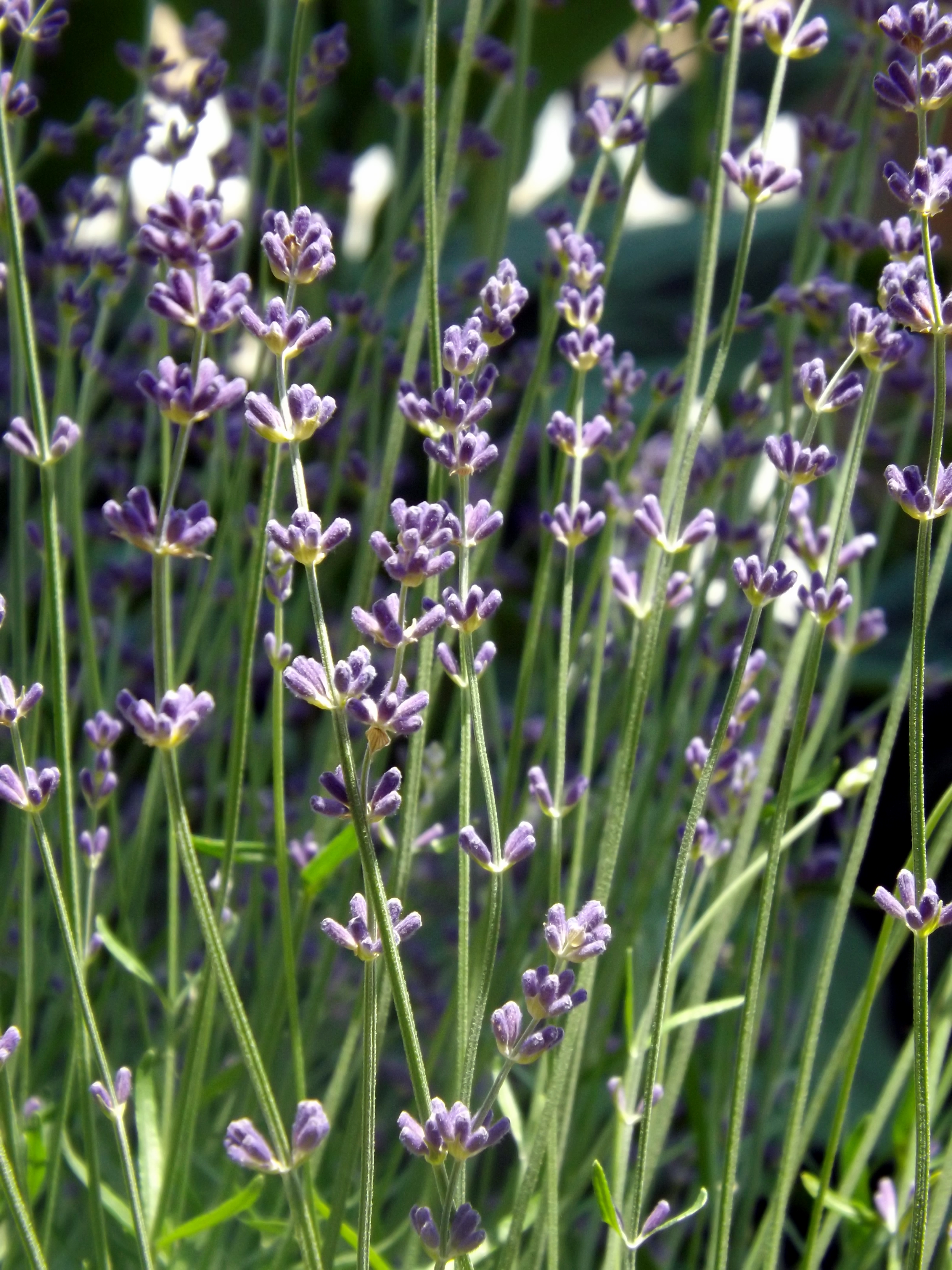
Hidcote Lavender is a smaller variety, with a wonderful fragrance. And it is gorgeous. Here is a close up of the lavender this year:

2011: Garden Phase 2

19 Jun

In the Spring of 2011, with the arrival of the squirrel-proof daffodils, tulips, camasia, and allium, and as the plants from 2010 began growing into their own, the flower garden started taking shape. But there was a lot of bare flower bed remaining. Enter Phase 2.

That spring/summer, I planted a couple of real favorites in Garden 2 (G2): Gaura (Belleza Dark Pink) and Euphorbia (Ascot Rainbow). The Gaura bloomed and bloomed all summer — small fuchsia flowers atop waving spikes. The Euphorbia has yellow-green variegated foliage and bubbly “flowers.” It is a joy from very early spring until the autumn. Here is a picture of it in April of this year, with the Crape Myrtle foliage just beginning to emerge in the background.

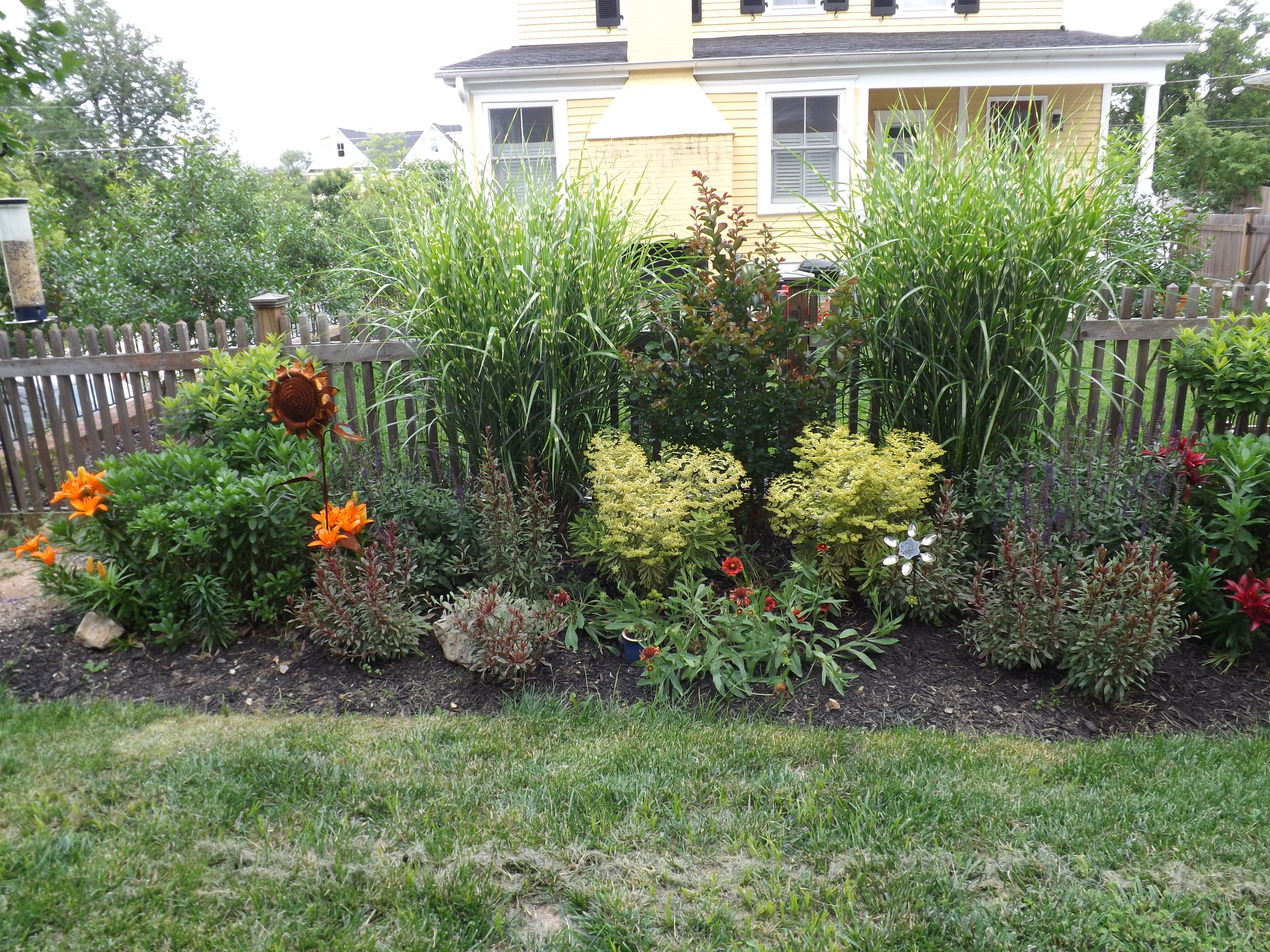
I added Tickseed (Golden Gain), Salvia (Caradonna), and Gaillardia (Trumpet Red) for more color. Here is what G2 looked like in early June, 2011. (Note that the leaves on the Crape Myrtle have grown in by June). Tall Asters are at the sides by the fence with Montauk Daisy and Asiatic Lilies in front, Porcupine Grass is also along fence toward the center with Euphorbia and small Gaura and Salvia in front, and Crape Myrtle is by the fence post with Gaillardia and Tickseed in front.

By now, you will have discovered that which I fight against, but fail to overcome: I love symmetry. I can’t help it. In each of the flower beds there is a central zone with a central plant, and identical (symmetrical) plants on each side.  In G2, the central plant is the Crape Myrtle. I have managed to uproot this tendency very slightly in G1 (and when hanging art on the walls of my house), but I have been more successful inside than out. In the garden, I hope that this love of order, comforting as it may be to me, will be less obvious as everything grows in. Plus, I doubt anyone other than myself will be looking at the garden long enough to notice….

Next: Herb Garden.

2010: Garden Phase 1

19 Jun

Some of the very first plants I planted in our new flower beds in the summer of 2010 were NE Asters  (Purple Dome), a Crape Myrtle (Siren Red), two Porcupine Grasses, some Asiatic Lilies (Tiny Dino and Tiny Ghost), a couple Montauk Daisies,  Red Hot Pokers (Flamenco), Echinacea (Red Knee High, Rocky Top Hybrid, Big Sky Sundown) and some daylilies (Baby Darling). After getting them in the ground, I waited to see what would happen. What happened was that that I loved the Porcupine Grass as it grew tall and striped, the Crape Myrtle with its red new-growth foliage and its crimson blooms, and the fact that in late summer, the Asters exploded in masses of bright purple blooms surrounded by buzzing bees that our dog persisted in chasing despite retaliation on the part of the bees. And the Montauk Daisies are so cheerful that I forgave them for being white in a garden that is mean to be bright.

Here’s new-growth foliage on the Crape Myrtle, from this year, with Porcupine Grass in background:

But even with these plants, I was aware that the garden was still fairly bare. So in the fall of 2010, I planted bulbs under the watchful eye of the neighborhood squirrels. Having battled bulb-eating squirrels before, I built impenetrable defenses around my bulbs: I coated them in foul-smelling deer repellent spray before planting them, covered the planted area with chicken wire, added a bit more soil, and topped up with a light layer of mulch, which I sprayed again. It worked — no squirrels got my bulbs. Note: use this method only if you do not ever plan to move the bulbs elsewhere or plant anything else in close proximity to them.  The chicken wire served as a great defense against my own future landscaping plans. But I got the best of the squirrels, so it was a small price to pay to have to pull out the wire cutters a couple of years later.

Next: Phase 2.

2010: An Unplanned Garden and the Philosophy Behind It

19 Jun

I did a lot of thinking and thumbing through gardening books during the winter of 2010 in preparation for our future garden, but basically, I am someone with more optimism than concrete knowledge of garden design (or in fact, gardening in general beyond the bare basics).  I do not know how to propagate, have rarely had to divide my plants, and can’t be bothered with elaborate plant care beyond deadheading, watering, mulching, fertilizing every once in a blue moon, and keeping them somewhat tidy. I realize this is anathema to real gardeners, and one day, I hope to become a real gardener. In the meantime, I will keep planting things and hoping for the best. In hindsight, this operating procedure of diving right in and tweaking as I go is not new. It is the underlying principle by which I have painted the interior of our houses, but that is another story. I will only say that it helps to have an understanding husband who likes the end result and puts up with the tortuous path I take in getting there.

But back to the garden: we started digging out three flower beds in the summer of 2010, after hosting an Easter Egg Hunt in our bare, grass-only yard, at which point it became quite clear that hiding colorful plastic Easter Eggs in a sea of flat green requires a lot of creativity.

My very simple gardening philosophy was the same then as it is now:

  1. Flower type: Perennials all the way, with a very occasional annual or two to liven things up as needed.
  2. Color scheme:  Hot (purples, fuchsias/wine reds, oranges, and yellow).
  3. Foliage: Different leaf shapes and colors (variegated and non-variegated) are essential.
  4. Height: It  matters! Flower gardens need a different mix of plant heights. Also, taller plants can help form a natural privacy screen along fences shared with neighbors.
  5. Bloom period:  Plant flowers with differing bloom times, to ensure at least some activity in the garden from early April into October.

2012 example of hot-colored perennials with diverse foliage and differing heights: Garden 2

Armed with these few concrete thoughts and a very preliminary list of possible plants that could meet my requirements, I ventured out to the local nursery. What always happens is I cannot find many plants on my list, either because the specific variety is simply not available (or is not common to my area), or I am visiting the nursery at the wrong time. So then I end up with plants not on my list. On the plus side: there are some beautiful plants in my garden I might never have considered had they not caught my eye at the nursery. On the minus side: as with clothes shopping, it is easy to buy something beautiful in the store only to realize once you are home that it just doesn’t look quite right on you no matter how hard you try to make it work. A far corner of my garden now features these spur-of-the moment horticultural purchases, the ones that don’t quite work in the main flower beds.  But I am now no longer swayed by a pretty bloom unless I know it will fit and make the garden look better by its presence.  I’d like to say that is also true of pretty dresses….

Next: Phase 1.

Garden Intro

12 Jun

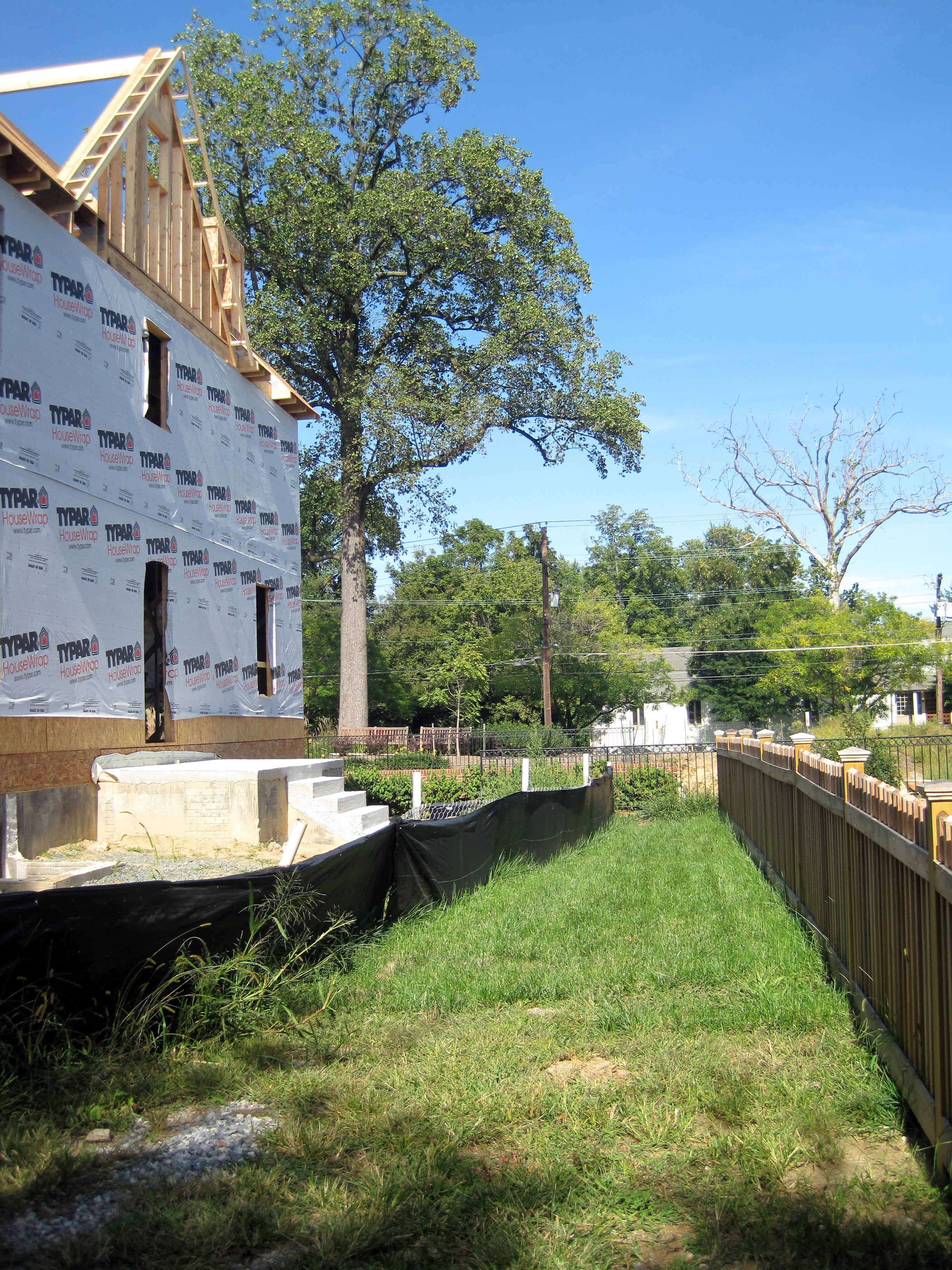
We live in a townhouse in Maryland, USA, but are lucky to have a yard with space for flower beds. When we moved in, in February 2010, there was nothing but grass (and snow). The flower beds were mine to make.  Alas, it was not a good time of year for gardening. But it gave me time to think. One thing we discovered as the house was being built was that there would be a shallow and narrow drainage ditch running through our lawn, parallel to the house (see construction photo below; future ditch to be located in front of black plastic sheeting). The ditch had not appeared on any of the plans we saw for the house, but we were told we had to keep it because of county regulations.

The layout out of the bit of grass around our house is roughly reverse L-shaped, running from the front of the house, which is where the ditch is, around to the back side. This layout, the presence of the ditch, and the fact we wanted to retain some actual grass, meant we had to create rectangular flower beds along the fence perimeters; we didn’t want to span the ditch and there wasn’t much space beyond that for creative bed shapes. When we moved in (after the photo above was taken), three trees had been planted along the wooden fence, (a Green Mountain Sugar Maple at the top corner, an Eastern Redbud in the middle, and an Autumn Flame Red Maple in the lower corner) and one was planted in the back corner behind the house (an Ornamental Plum-Thundercloud). Eventually, I planned for three separate (but adjoining) flower beds.

I dubbed the flower garden across the far back of the photo (hard to see, but it runs along a wrought-iron fence overlooking a parking area), “Garden 1.” The area between the Sugar Maple and Eastern Redbud, (ie, the first half section of the long wooden fence) is “Garden 2.” The next section, between the Eastern Redbud and the Autumn Flame, is “Garden 3.” I know, very creative naming.

During the past two years, and in phases, I have dug up (with the help of a very kind husband and children) a lot of grass, planted a lot of perennial plants, shifted many around, and replaced a couple that did not survive our relatively mild winters. In some cases, I planted plants knowing I wouldn’t see any flowers until the following year, but anticipating the thrill I’d get when they did bloom in just the way I imagined. I’ve drawn landscaping plans, plotted blooming times, and in general led my family to believe I was slightly nuts. But I have enjoyed every minute of it.

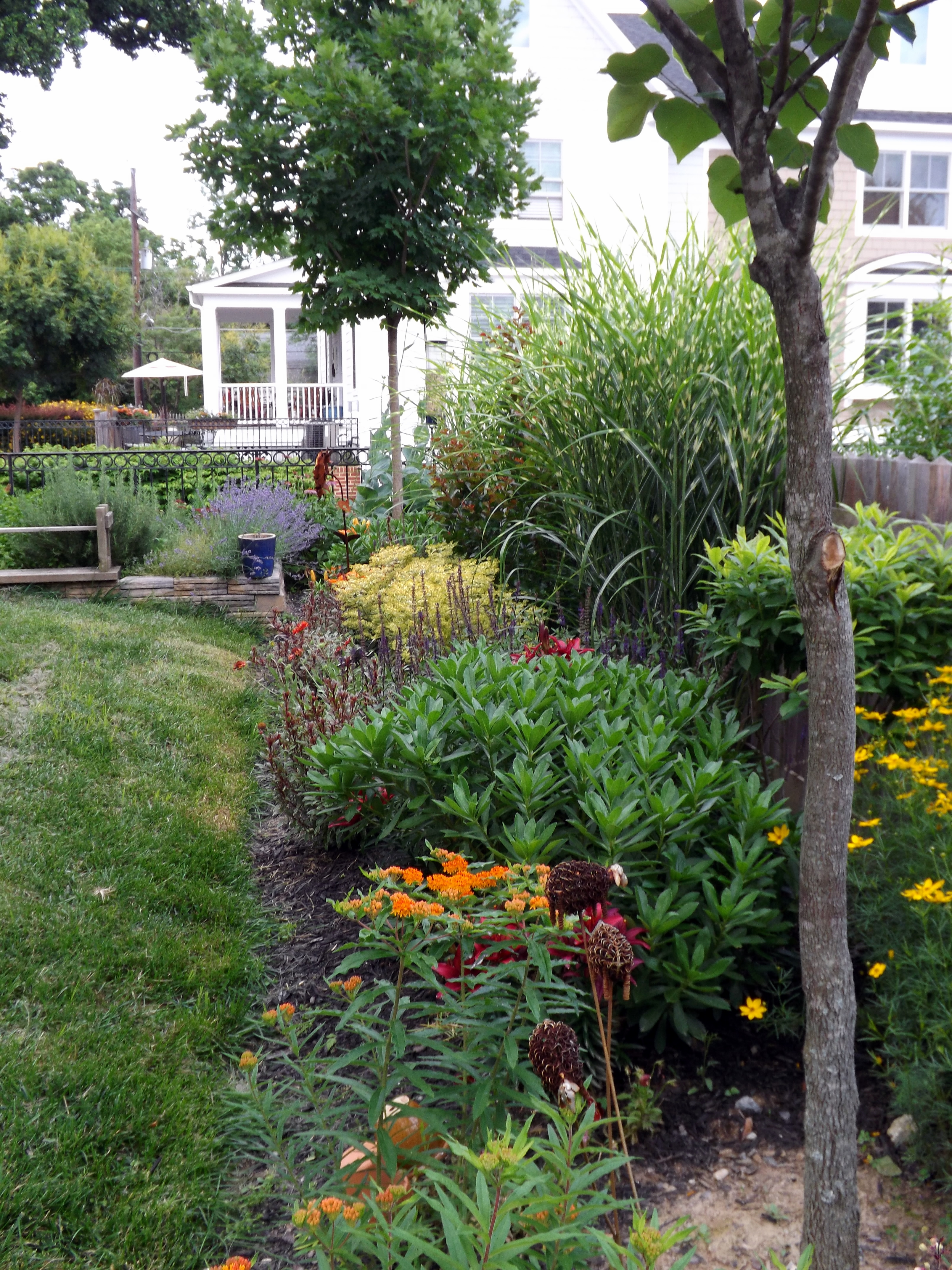
Here is what part of that same stretch of fence looks like two years later  (at closer range, with a focus on Garden 2; the Sugar Maple is in the background and the Eastern Redbud is in the foreground).