Archive | Travel RSS feed for this section

Weekly Photo Challenge: Unexpected

27 Nov

This photo is of something I was not expecting. During my recent trip to Rwanda, this gorgeous leaf formation caught my eye. I had never seen anything quite like it. It was a striking burst of color on an otherwise fairly bare branch. When I asked someone what it was, I was surprised to discover that it was a poinsettia, and that poinsettias can grow into small trees up to about 10 feet in height. I had no idea, because to my untrained eye this looks nothing like the potted poinsettias that abound at Christmastime (except perhaps for the red leaves). I’ll take the tree!

So an unexpected encounter led to an unexpected discovery — and I couldn’t be more delighted. The red leaves are called brachts; the actual poinsettia flowers are tiny and yellow.

Postcard from Rwanda: Countryside

16 Nov

In my previous post about Rwanda, I mentioned that it is called the land of a thousand hills, but in reality, it is more like the land of 10,000 hills–or so it appears when visiting the northern part of the country. As far as the eye can see, there are green, rolling hills–almost all of them carefully terraced. Banana trees are a common feature, and in many valleys, there are rice paddies with strategically placed scarecrows to defend the plots against avian intruders. Bicycle transport demonstrates that ingenuity is born of necessity, and balancing skills of any kind go a long way.


Postcard from Rwanda: Kigali

12 Nov

Apologies for the silence; I was away for work. But I was lucky enough to be in a gorgeous country–Rwanda, the land of a thousand hills. I had known about its tragic past (visiting the Kigali Genocide Memorial is a sobering experience), but had not realized how hilly and beautiful it was. The verdant landscape and vibrant colors were a pleasure to behold. And the capital city, Kigali, was  bustling, with motorcycle taxis taking passengers to and fro.  The photos below are from street level, from the unfinished top of the Kigali City Tower, and from the vantage point of a hill on the outskirts of the capital, from which we were able to observe striking clouds at dusk, some dumping rain over far parts of the city.


Of Water Lilies and Butterflies

1 Sep

I belatedly saw the BBC’s Ten North American gardens worth travelling for this morning (thanks to my husband, who suggested we should try to make it to all the gardens on the list!)–and was very pleasantly surprised to find the first garden featured was the Lewis Ginter Botanical Garden in Richmond, Virginia. I was just there less than two weeks ago–as a way to distract myself.

I had just taken our third son to university for his first semester and was acutely aware that the chatter and noise and laughter (and yes, chaos) that has been a hallmark of our family life is now giving way to a quieter, calmer modus vivendi. This has its pluses, but also its downsides, as it becomes clear that our family is soon to be permanently dispersed and the supply of teenaged dish washers is about to vanish. We are not empty nesters quite yet–our daughter does not leave for college until next year. But then we are in for various adjustments. Perhaps that is when we will start visiting the North American gardens on the BBC’s list. Though apparently, that sort of thing is a sure sign someone is middle aged. And I appear to have been middle-aged for a long time now, since I’ve been doing some of the things on the list since my 20s!

But, back to gardens. After dropping my son off, I headed straight to Lewis Ginter, and it was the perfect antidote. It is a gorgeous garden in many respects, but I was particularly taken by two things: the Butterfly Exhibit in the Conservatory and the water lilies in the ponds right outside the Conservatory. I don’t often come across water lilies except in botanical gardens, and even then I don’t always catch them in bloom. But on this visit, a Hardy Water Lily was in its full glory:

The ponds also featured Santa Cruz water lily pads. I have never seen such big water lily pads (at their largest, they can support a small adult). What must it be like to actually float on a lily pad? Perhaps the reality is not as nice as the fantasy, but I did engage in some wishful thinking. Here are two photos: a full pad, and a close-up showing the pattern along one side.

As for the butterflies, they were everywhere–the exhibit was a misty, moist, magical place. You had to watch where you stepped and be prepared to serve as a butterfly landing pad. Turns out those butterflies can move pretty quickly when they want to, so here are the three best photos I ended up with: a Melinaea Butterfly with nectar in its proboscis, a black and white Paper Kite Butterfly, and an orange Julia Butterfly.

Bay Area 5: Stanford and Palo Alto

27 Aug

During the final leg of my week-long stay in California, I greatly enjoyed a couple days at Stanford University, which I had never visited before. I was given an hours-long bicycle tour by a fantastic tour guide, and pretty rapidly determined that it is a gorgeous campus:


But, buildings aside, there was another surprise awaiting me:  the Arizona Cactus Garden, which is on campus. Turns out it is a hidden treasure–one that not many Stanford students even know exists because it is in a more secluded area, hidden behind a grove of trees. When we arrived, we had the garden to ourselves, with only the occasional lizard and woodpecker to distract our attention from the cacti.

The final treat was a stop in Palo Alto at the Elizabeth F. Gamble Garden, a lovely oasis full of gorgeous flowers. It was truly a memorable visit.

Bay Area 4: Tilden Botanic Garden, Berkeley Rose Garden

24 Aug

Gardening enthusiasts and plant lovers are spoiled for choice in Berkeley. Not only can visitors spend days wandering through the UC Botanical Garden, but the city is also home to the Regional Parks Botanic Garden at Tilden, and the famous Rose Garden. What joy!

I wrote about my lovely perambulation through the UC Garden, complete with a “Secret Paths” tour.  It was magical. And while the garden at Tilden is smaller and is solely devoted to plants native to California, it is no less enchanting. Here are just a few of the plants that captured my attention: the towering Humboldt Lily (I have never seen lilies that grow so tall–I had to aim upward and zoom in to take the photo), the aptly named Fried Egg Flower (Romneya), and an unknown fern.

We passed by the Berkeley Rose Garden right around lunch time–a hard time of day to take photographs unless there is a bit of shade somewhere–but here is a lovely magenta rose whose name I never discovered, and an overview of the garden itself, which is set amphitheater style into the hillside:

Bay Area 3: UC Botanical Garden at Berkeley

30 Jul

What is it about botanical gardens or other large, planned gardens that makes them magical places? The kind of place where you can wander in relative silence, revel in the beauty of plants that you have never seen before (or even ones you have seen, though now viewed in a different light), where you can stop and sit on a bench in a hidden spot to soak it all in, or even read, or think? Who designed the spaces, mapped out what types of plants would be featured where, and planned the spots that would lure people and bees and butterflies and birds? They, and the current-day keepers of those gardens, are magicians.

If not already obvious, I love wandering in those kinds of gardens. I like everything about them: the flora, the fauna, the paths and stairs and benches and arches and bridges and streams. The University of California Botanical Garden has many of those features, and is a veritable outdoor museum. It is home to collections of plants from nine major geographic regions around the world, including a large area devoted to California–a biodiversity hotspot that contains more than 40 percent of the world’s plant species. To all this, add special collections including orchids, ferns, cycads, palms, roses, and herbs.

A plant lover could spend days roaming the 34 acres. I only had 5 hours, but I made the best of it; I signed up for a 1.5-hour tour that was being offered (Secret Paths of the Garden), which got me off to a great start via paths less traveled, and then I spent the remaining time wandering to my heart’s content. It really was a magical day.

Here are some of my favorite photos (and plants) from the Garden:

 
Manzanita Tree Bark

   
Dudleya Pulverulenta (Chalk Lettuce, Chalk Liveforever)

 
Encephalartos arenarius (Alexandria cycad)

 
Opuntia Kuehnrichiana                               Opuntia microdasys (Polka-dot cactus)

Bay Area 2: Fruit and Vegetable Envy

25 Jul

While in Berkeley,  I was able to spend a lovely day with long-time family friends, and admire (ok, envy) their garden. It is a productive one–full of fruit trees and tomatoes and other vegetables–with not a rampaging dog in sight. The fruit trees–apple, fig, pear, persimmon, and plum–were all bearing fruit or on the verge of doing so, and the tomatoes were glistening. The sun was shining, the air was crisp, the birds were chirping–and everything I saw appeared jewel like. The contrast to my own garden was stark: the sun shines here, too, but the air is hot and thick, the neighborhood birds chirp only when the dogs are inside, I have no fruit trees, and my tomatoes have run wild (along with the zucchini plants–after just one week away, I came back to discover that two finger-sized zucchinis I had left behind were suddenly longer and thicker than my forearm–or anyone else’s forearm for that matter). Sigh.

But back to our friends’ garden. The photos below are of Satsuma plums, Seckel pears, and Sungold cherry tomatoes. This year was the first bearing year for the Satsuma plums, so jam making is on hold until next year when there is more of a crop. But how our friends will manage to set aside any plums for jam making is beyond me–I’d barely be able to get the plums from the tree to the kitchen without eating all of them. Perhaps when there are many, many plums to be had, the law of diminishing returns kicks in and people find the willpower to think longer term….


Satsuma plums

The Seckel pears also looked gorgeous, though I did not taste one since they were not quite ready to be picked. Last year was the first bearing year for the pears, so our friends ate what they harvested, gave some away, and did not have any left to store. This year, they will have a bumper crop and are trying to come up with a plan for what to do with them. Canning suggestions? Recommended pear recipes? We usually just eat them as they are or cut them into a fruit salad drizzled with a light honey-lime syrup. (Now that I think of it, I haven’t made that in a while; it would be perfect for a summer weekend brunch.) But I’d be happy to expand my pear repertoire if any suggestions come in.


Seckel pears

The Sungold cherry tomatoes really caught my eye. With multiple orbs of various colors (from green to gold to deep orange) hanging on each vine, they looked like garlands. There were also some Principe Borghese tomatoes in the garden, though I didn’t get a good photo. Those tomatoes are destined for sun drying — by pulling up the whole plant at the end of the season and hanging it upside down to dry in the sun. Our friend has not tried this before, but is counting down the days until she can conduct this natural experiment.  I’m counting down, too, since I’d like to know how that experiment works. My own non-cherry tomatoes have exploded (did I mention the 90+degree weather?), but my plants are not nearly as neat and tidy as their Berkeley counterparts because I didn’t know what I was doing when I planted them. The stakes I put in are not nearly tall enough, the space the tomatoes are in is too crowded (and there are roses there, too–a very bad idea of mine since thorns make tomato harvesting a tricky proposition). But, I may still try to sun dry some of the Romas, if I can get my act together and build a black box with glass lid in which to put them. Our neighbor in Australia did this every summer, and it worked like a charm.

 
Sungold cherry tomatoes

Until then, I will live vicariously through our friends, and wonder whether I can squeeze in a Satsuma plum tree somewhere in my own garden….

Bay Area 1: Berkeley–Town and Gown

22 Jul

I just spent a beautiful vacation week in Northern California, our former home of 6 years. During those years, diapers and baby bottles featured more prominently than flower beds and vegetable gardens, though I did manage to always have some lantana growing in a barrel in our courtyard–it looked just like this (I took many photos of lantana while on my trip for old time’s sake–I can’t grow it in Maryland):


I didn’t have much time for gardening in those days (I recall I foolishly signed up for a community garden plot while pregnant, spent days/weeks getting all the weeds out with two toddlers playing alongside me in the dirt, planted some vegetables, then had to hand the plot over to a neighbor when the baby came). The lantanas, which require no attention, were all I could manage.

But once the kids got bigger, my thumb got a bit greener–helped along by the lovely friends and neighbors who were so generous with advice during our time in Australia, which is a land of avid gardeners.  Armed with a perspective I did not have when we lived in Berkeley, I spent this visit looking at things with a new eye, admiring all the plants in bloom and taking full advantage of the wealth of botanic offerings on hand. In Berkeley alone there is the University of California Botanical Garden, the Botanic Garden at Tilden Park, and the Rose Garden. I made a pilgrimage to all those places, but found that there were beautiful things everywhere (yes, I did include a few non-botanical items….). Here are some highlights from Berkeley proper (to be followed later by highlights from the various gardens in Berkeley,  plus Sonoma Valley and Stanford/Palo Alto) :

A view of San Francisco Bay from Cesar Chavez Park,

a close up of the scroll work on Sather Gate on campus, as well as some Blue Salvia and
 

a Blue Potato Bush near Walden School in town, and

a copper Kangaroo Paw and a Redwood tree on campus.
 

Postcard from Montpellier, France: Part II

20 Jun

As much as I enjoyed the Jardin des Plantes in Montpellier (France’s oldest botanic garden), there were other sights to be seen. After leaving the gardens, I wound my way through central Montpellier by way of the Cathedral of St. Pierre.

It was closed when I passed by, but I quite liked the red doors …

… and the amazing porch (this photo looks straight up into the arch of the porch).

I was also lucky enough to meet up with a friend of a friend, who took me on a lovely outing to Villeneuve-lès-Maguelone on the coast. We passed a field of poppies on the way, and I managed to get a photo just before a farmer passed by on a tractor, plowing them up.


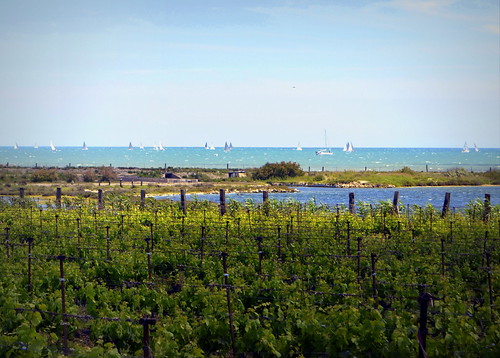
Then we arrived at the coast, a place where vineyards meet the sea…

… and white birds scamper in the water (egret) and roost in trees (peacock)…
 
… near the old Cathedral of Maguelone.