Archive | Gardening RSS feed for this section

Garden Update: Monarda, Milkweed, and a Moon

25 Jun

My husband and I began a very optimistic plan to lay a 450 sq. ft. patio this past weekend. The two of us. By ourselves (since our kids have all scattered far and wide). Our intention was to make a good start and to try to finish by next weekend, in and amongst working full time during the week. One tiny setback: a torrential downpour that occurred on Sunday morning, turning our denuded (but not yet paved) patio area into a mud pit. More on our venture later–but on the plus side, while we were toiling away I had multiple opportunities to admire how full and lush the garden has become (and to remind myself, repeatedly, of how much nicer the whole yard will look when swathes of dog-worn grass have been replaced with cobblestone pavers).

I have always loved the garden in June, when many of my favorite plants are in bloom. The photo on the left shows a small section containing a neglected bird feeder and (clockwise from top left) variegated Porcupine Grass, Montauk Daisy (not yet in bloom), yellow Tickseed (Golden Gain), tall lilac Verbena Bonariensis, a tiny bit of pink Monarda (Raspberry Wine), wine red Asiatic Lily (Tiny Ghost), small purple spikes of Veronica (Royal Candles), and orange Butterfly Weed. To the right is a close-up of the Monarda, which is new to the garden this year.
 
I added a couple more Butterfly Weed plants this year to fill in the space a bit and also because I love orange and Butterfly Weed is so cheerful and such a magnet for, well, butterflies–including Monarchs. I will be on the lookout this year and will bring in any Monarch caterpillars I see, to avoid the unknown fate that befell their 2012 counterparts. (I do not really blame the Nuthatch….).

And finally, after a grueling day digging dirt and laying bricks, we were rewarded with a lovely sight in the night sky: the Supermoon. I definitely did not have the right lens to do it justice–but here is a very rough view of the moon looming over a neighbor’s house, with a passing cloud absorbing some of the lunar glow.

Weekly Photo Challenge: Fleeting

11 Jun

This week’s theme is “Fleeting.” This photo was taken on a windy day in the garden. The Hidcote lavender danced to and fro, evading capture; the moment was fleeting, the result ephemeral.

In the Blink of an Eye

8 Jun

At this time of year, every day brings some new development in the garden. You take each change into account, bit by bit. But when you are away for an extended time, as I was recently for work, you come back and feel that those changes occurred far too quickly–how did that peony bloom in such a short time? Where did that red-hot poker come from?

All this was driven home to me yesterday, when my youngest son graduated from high school. How did that happen so quickly? Now, like his two brothers before him, he will follow his own path, and we will no longer see those day-to-day changes. But we will continue to admire the growth and the blooming. Luckily, our daughter is still at home for one more year. And the garden will remain, though it, too, undergoes constant and rapid metamorphoses.

Before I left for my two-week trip, the brand-new peonies I had planted were only in bud; when I returned, the blooms were already spent. I never did see what the full flowers looked like–I will have to save that treat for next year.

Peony (Kansas)
 
The new roses I had planted last month were also just beginning to bud, but since they bloom for months, I was able to see the flowers when I got back.

Hybrid Tea Rose (Love and Peace)
 
And finally, I caught the Red Hot Pokers just in time; now, their color is fading and the flower spikes are drying up. Here is one seen from above and in full bloom.

Red Hot Poker (Flamenco)
 

Allium Update

20 May

A short while ago, I posted a photo from above of an Allium ‘Purple Sensation’ bud just before it was about to open. Here are side views of subsequent phases in the Allium lifecycle: opening, and fully open (ok, those might not actually be the technical terms).


Alliums look delicate, but pitted against squirrels, Alliums will usually win. Why? Because they are members of the onion/garlic family, and squirrels prefer slightly less aromatic bulbs for dinner. Hummingbirds and butterflies have more sophisticated palates, however, and love Alliums. It can’t get any better: a flower that deters pests but attracts welcome guests.

Adding to the Alliums’ charms is the fact that they 1) don’t take up much space and so can be tucked almost anywhere, 2) are long lasting, 3) are pretty hardy, and 4) are just pretty. In the language of flowers, the message Alliums convey is one of perfection and elegance. It’s hard to disagree with that.

Birth of an Azalea ‘Gibraltar’

16 May

One of the joys of spring is seeing the transformation from bud to bloom. Last year, I planted two tree azaleas (they are more upright than bushy) just after peak blooming time and so caught only a brief glimpse of the sole remaining flower on one of the plants. Azalea ‘Gibraltar’ is a deep orange color, but I was not able to appreciate it in all its glory — though I had high hopes for Spring 2013.

But as summer progressed, the azaleas’ foliage turned brown and shriveled up. It was clear I had planted them where it was too sunny, and they were not at all happy. In fact, they were dying. So we took emergency measures and dug them out, relocating them into large whisky barrels in a shadier part of the garden. And then there was nothing to do but wait and hope they survived the experience.

Luckily, they did; here are some photos showing the birth of a glorious, ruffled, orange Azalea ‘Gibraltar’ bloom.

Aphids before the Storm

9 May

At the moment, the main insects on my radar are the 17-year cicadas that will crawl out of the ground any day now, cover everything in sight, deafen us with their mating songs, lay eggs, and then drop dead. They have yet to emerge from hibernation, at least in my neighborhood. I’m happy to delay the moment as long as possible, even if it is an historic event. Raking a blanket of cicada carcasses off the lawn isn’t among my favorite gardening activities.

Capitalizing on this lull before the storm, however, another insect group took up residence in the rose garden — aphids.  I am a welcoming sort, but not when it comes to critters trying to suck the life out of my newly planted roses, which are just beginning to bud.

 
So I squirted them. As carefully and naturally as possible. I added 2 tbsp. dishwashing liquid and 2 tbsp. vegetable oil to 32 oz. of water in a spray bottle and then sprayed each of the roses — buds and foliage together, sliding off as many aphids as I could with my fingers (that’s where the oil comes in handy).


Victory! The aphids are all gone (for now), but success came at a price: the soap slightly burned the foliage.


Should the aphids put in another appearance, I may need to reduce the amount of soap in the solution — and/or rinse the roses afterward. I didn’t rinse this time because I knew it would rain later that day and it did, but obviously not before the damage was done. On the plus side, the roses are pest free, though some of the leaves are a bit speckled. Safe to say, gardening is a never-ending learning process, and I have a lot to learn….

Next task: watching for the aphids’ cousins to emerge — yes, cicadas are related to aphids.

Weekly Photo Challenge: From Above

7 May

WordPress, which is the platform that hosts this blog, offers a Weekly Photo Challenge through the Daily Post. Most weeks I don’t have anything quite compatible to offer, but this week the challenge was “From Above.” And coincidentally, I had recently taken a photo from above, of one my Alliums (Purple Sensation) that was just beginning to open. So here is a bird’s-eye view.

2013: Garden Phase 4

4 May

Winter is a time of reflection, and spring is a time of action. During the past couple of months in the garden, it’s been all about putting everything in order (weeding, pruning, weeding, relocating, more weeding, planting, edging, weeding, expanding, mulching, and a bit more weeding).

As I mentioned when I started the blog last year, we live in a townhouse and are lucky to have a tiny bit of land surrounding it in which to plant things. A large portion of the available space for flower beds is long and straight, bordered by a wooden fence we share with a neighbor on one side, and a drainage ditch on the other (county mandated). Luckily, the space is broken up by three trees.  When we moved in, there was nothing but grass. The first spring in our townhouse (2010, Phase 1), we created a narrow flower bed  (G1) along a short side of our yard and put in two flower beds parallel to the long wooden fence (G2 and G3). In 2011 (Phase 2), the children built a small herb garden on Mother’s Day  next to G1, and I filled out G2 a bit more. In 2012, I built upon lessons learned in 2011, and continued to add to the three flower beds (especially G3) and the herb garden. That was Phase 3.
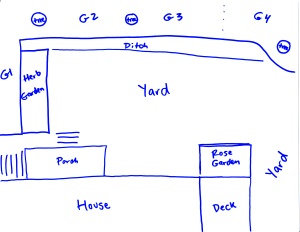
Garden_0001
Chicken-scratch version of main parts of Garden Layout, hopelessly out of scale….

Phase 4 (Spring 2013) has thus far entailed a lot of transplanting–moving plants to locations better suited to their temperaments and space requirements.  The feisty Porcupine Grass plants on either side of the Crape Myrtle (G2) were in danger of smothering it, so we dug them up and moved them  a couple feet farther away in each direction while they were still dormant. They are now happily growing away in their new spots.  The Montauk Daisies (G2) were also smothering everything in their paths, so we repositioned them so they were perpendicular to the fence rather than parallel to it; there was plenty of space in the back for them to do their thing, and that opened up space at the front of the flower bed. I fell in love with the Witch Hazels at Brookside Gardens and contrary to what I said, I decided not to admire them from afar. For better or worse, there is now a fine specimen growing in G1, though that meant moving a few plants to G3.

In Spring 2013, we also welcomed in the new. The entire family was here just before Easter (one son home from graduate school along with his girlfriend, another son back from college, and the two high-schoolers and a professor husband on spring break), and what did they do? They all spent part of their vacation helping to build a small Rose Garden along one side of the raised deck (the deck, porch, and entrance to the house are about 4 feet above garden level). I transplanted two existing roses into the new garden, and added four more. To top it off, last weekend I planted some vegetables in and around the roses. An odd combination, I know, but the Rose Garden is in a prime sunny spot, and it was looking a bit bare with just the roses, so I decided to be unconventional and go with vegetables: eggplant, tomatoes at the very back against the wall of the deck, and zucchini–everything I need for a nice ratatouille. (In my defense, tomatoes are supposed to help prevent black spot….). I’ll see what lessons I learn from this experiment. But a very huge thank you to my husband and the younger generation for making it all possible.

Adding to our expansion efforts, we removed a hammock that was along the far back portion of the fence adjacent to G3, dug up the earth and added manure, compost, and gypsum (since our house essentially sits on a mound of clay), and started a new flower bed there (G4), which wraps around a corner where the third tree is. It is still under construction, but I did get some bulbs in (Gladioli and Lilies), plus a Camellia, some Hostas, more Echinacea to accompany the lone surviving Double Scoop Bubble Gum, and some Astilbe, with two peonies still waiting to be planted (today, I hope).

As a finishing touch (though no garden is ever finished), I dug out the leaf- and old mulch-filled drainage ditch, lined the garden side with stones to prevent the mulch from falling into the ditch (the stones all emerged when we created the various flower beds–so our house actually sits on a clay and stone base), and then set up a small fence all around the flower gardens to keep the rampaging Schnauzers from killing the emerging and new plants. And that’s all for now…. Probably far more than you ever wanted to know. But the end result is and will be a pleasure to behold for those of us who are happy just watching things grow.
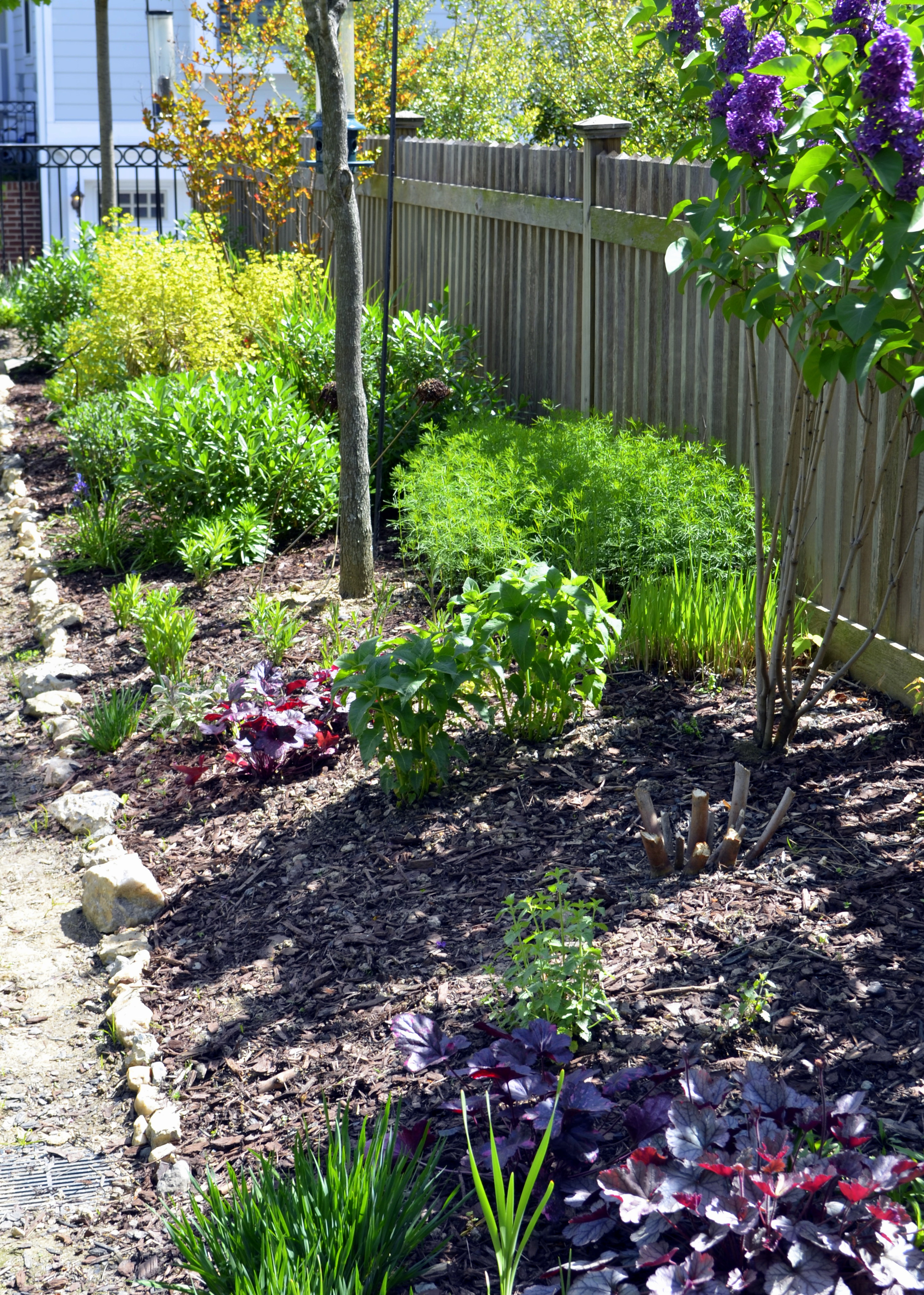
G2 and G3
G2 (with G3 and new G4 in background), ditch to right:
Montauks, Salvia, Gaillardia, Porcupine Grass, Crape Myrtle,
Euphorbia
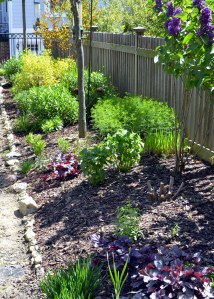
G3 and G2
G3 (with G2 in background): Heuchera, Blue-eyed Grass, Variegated
Sage, Aster, Lilacs, Hyssop, Butterfly Weed, Tickseed, Verbena
Bonariensis, and old Hibiscus (Kopper King) stumps
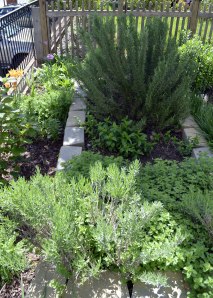
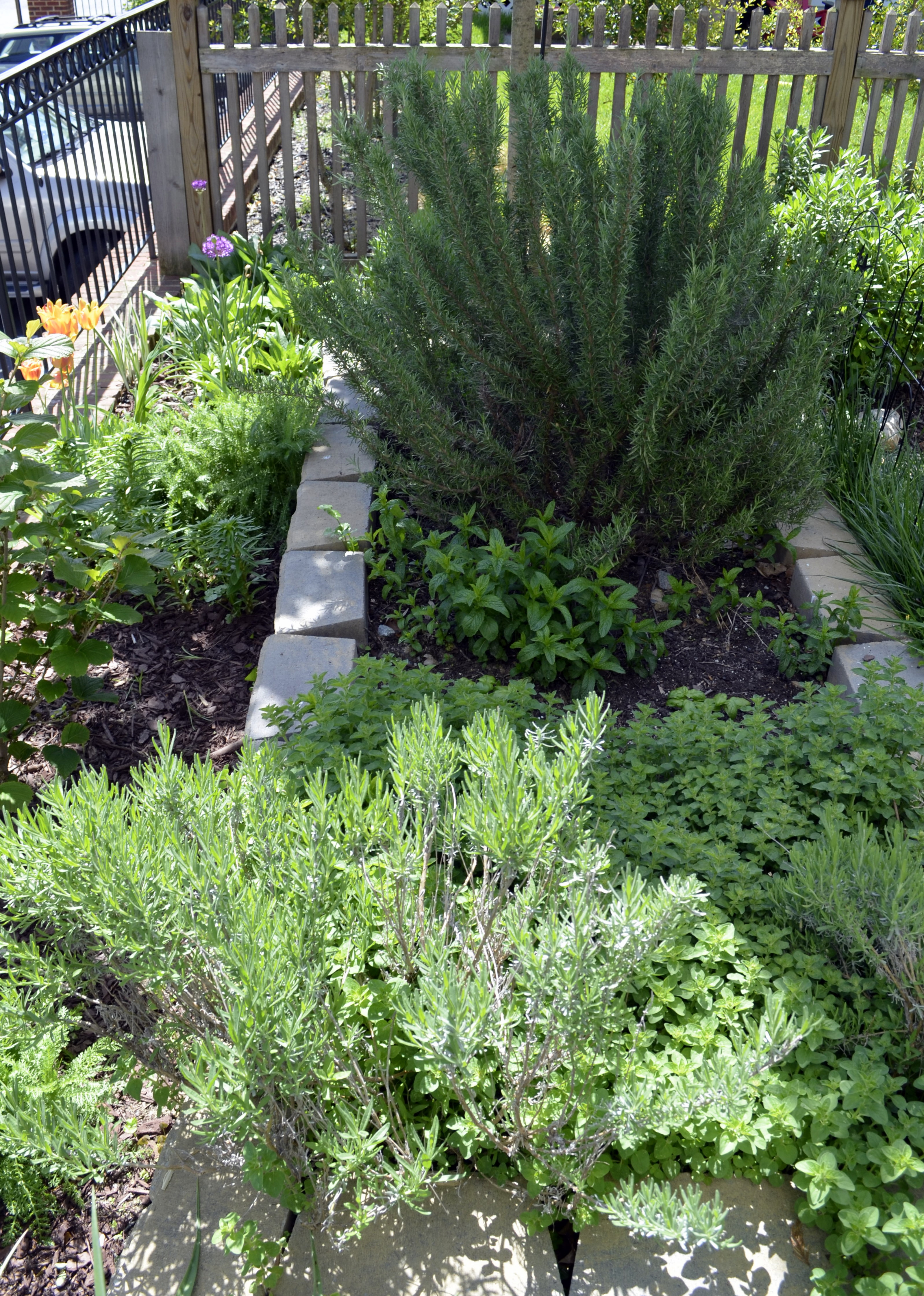
Herb Garden
Herb Garden (with G1 to the left): Lavender, Oregano, invisible but
newly planted Basil, Mint, exploding Rosemary, and wayward Cilantro
growing in G1

A Time for Tulips

25 Apr


Once upon a time, tulips were the most expensive flower in the world, the basis for a speculative bubble in the 1600s that later burst. Lucky for those of us who like tulips, we no longer have to fork over a small fortune to own just a single bulb; today, mere mortals can now choose from thousands of varieties. And while tulips are associated with the Dutch, the flower actually originated in Central Asia — the Ottomans were the first to cultivate it commercially.


The photos above are from a recent stroll around my neighborhood (which is, alas, not in the Netherlands or Turkey). I planted three varieties of tulips when I started my garden a couple of years ago, but now only have one variety left. Those miserable squirrels are tulip-bulb connoisseurs. But I have had the last laugh — the variety they did not manage to steal is my absolute favorite: a flame-colored, graceful, lily-flowering tulip, Tulipa Ballerina. It is aptly named. When I look at the photo below, I can almost see a group of ballerinas, gracefully bending to the right, holding their arms above their heads as they prepare for the next movement.

Euphorbia: A Chameleon in the Garden

11 Apr

This winter most of my perennials died back, conserving resources in order to make a reappearance in warmer weather.  One notable exception was Euphorbia “Ascot Rainbow,” a stoic plant that carried on through frosts, snow, and months of reduced sunlight. It did so by undergoing a transformation of sorts — turning from a mostly yellow and green plant in the summer, to being a much pinker plant in the winter. The colder it got, the darker the Euphorbia became–especially in the cold depths of March when it was a very dusky, reddish rose. And then, after just a few days of glorious sun and high temperatures (after we jumped straight from winter to summer with no spring in between), it rapidly became quite yellow again. These photos are all from the same plant during the past four months.

      
December                                                                    January

 
February                                                                 April