Archive | Gardening RSS feed for this section

Feathery Parachutes

8 Sep

There are a variety of ways unexpected plants can crop up in your garden, but often, you can thank the wind for it. If bees play a vital role in pollination, then wind plays a similar role when it comes to seed dispersal. Think of the dandelion, the bane of many gardeners’ existence. It has developed a perfect way of ensuring a next generation by encasing its seeds in balls of fluff. What the wind doesn’t carry away (or lawnmowers cut down and disperse), young children will happily blow into the air–all but guaranteeing a new crop of the ubiquitous yellow flowers right in the middle of your lawn, or your neighbors’.

The Butterfly Weed plant disperses seeds in a similar fashion, but its seeds reside in pods that dry out and then crack open, allowing the feathery parachutes to travel hither and yon (if the Milkweed Bugs that love the seeds and tissue of Butterfly Weed plants don’t get to all the seeds first…). Luckily, there are many, many seeds to go around. And then, it’s up to wind, luck, and Mother Nature. In the bottom two photos, the Butterfly Weed seed parachutes have gotten stuck on 1) a Verbena Bonariensis and 2) a spider web near our brick staircase. I hold out more hope for the former’s prospects than for the latter’s.


A Master Pollinator in Action

4 Sep

The phrase “busy as a bee” came about for a reason. Bees never seem to stop. And we are all better off because of their tireless search for nectar, which makes them prime pollinators. This weekend, I watched one bee as it attempted to get into each flower on our two, tall Rose of Sharon plants. That’s a lot of flowers to visit. But according to my trusty Botany for Gardeners, a bee’s habit of flying back and forth between flowers of the same species is what leads to successful pollination. That, and a few incentives. First, there’s the nectar, usually found at the base of a flower — meaning the bee has to brush past the flower’s reproductive organs to reach the jackpot. Then, to make it easier for the bee (or any other pollinator) to get to the nectar, many flowers have nectar guides–markings that say “this way to the good stuff.” Those guides can be stripes, patterns, dots, or heightened color, etc.

In the photos below, a bee is lured inside a Rose of Sharon flower by the darker red stripes on each petal and the darker red inner circle that forms when all the petals come together at the base of the flower. The bee is already carrying pollen from the other Rose of Sharon flowers it has visited. It then burrows down to the base of the flower to reach the nectar — and in the process drops off some of the pollen it is carrying and picks up a bit more. Then, it heads up and out — off to pollinate the next flower.

On Becoming a Worm Farmer

15 Aug

Until recently, I rarely thought about worms at all (earthworms, that is; I am glad to not have had many occasions to think about other types…). In the course of digging flower beds, or planting and shifting things around in the garden, I’ve noted with satisfaction the patches of earth that contained lots of worms and worried about areas where there were very few worms. I knew worms signaled healthy soil. But that’s about all I knew. After guiding the occasional uncovered worm back to a good burrowing spot, I never stopped to ponder its existence, or think about its contribution to the garden.

And then I read two of Amy Stewart’s books–From the Ground Up, about her first garden, and The Earth Moved: On the Remarkable Achievements of Earthworms, which is pretty self explanatory. The achievements of earthworms are remarkable: they not only aerate the soil by burrowing, but their castings (manure) enrich the soil tremendously. It turns out worm poop is like gold for the garden.

And so I rashly decided to try vermicomposting–ie, composting with the help of some red wigglers. Our yard is too small and too close to our neighbors for an outdoor composting area, so I had given up on the idea of ever composting until I learned about vermiculture–which can  easily be done inside (ie, in our garage).

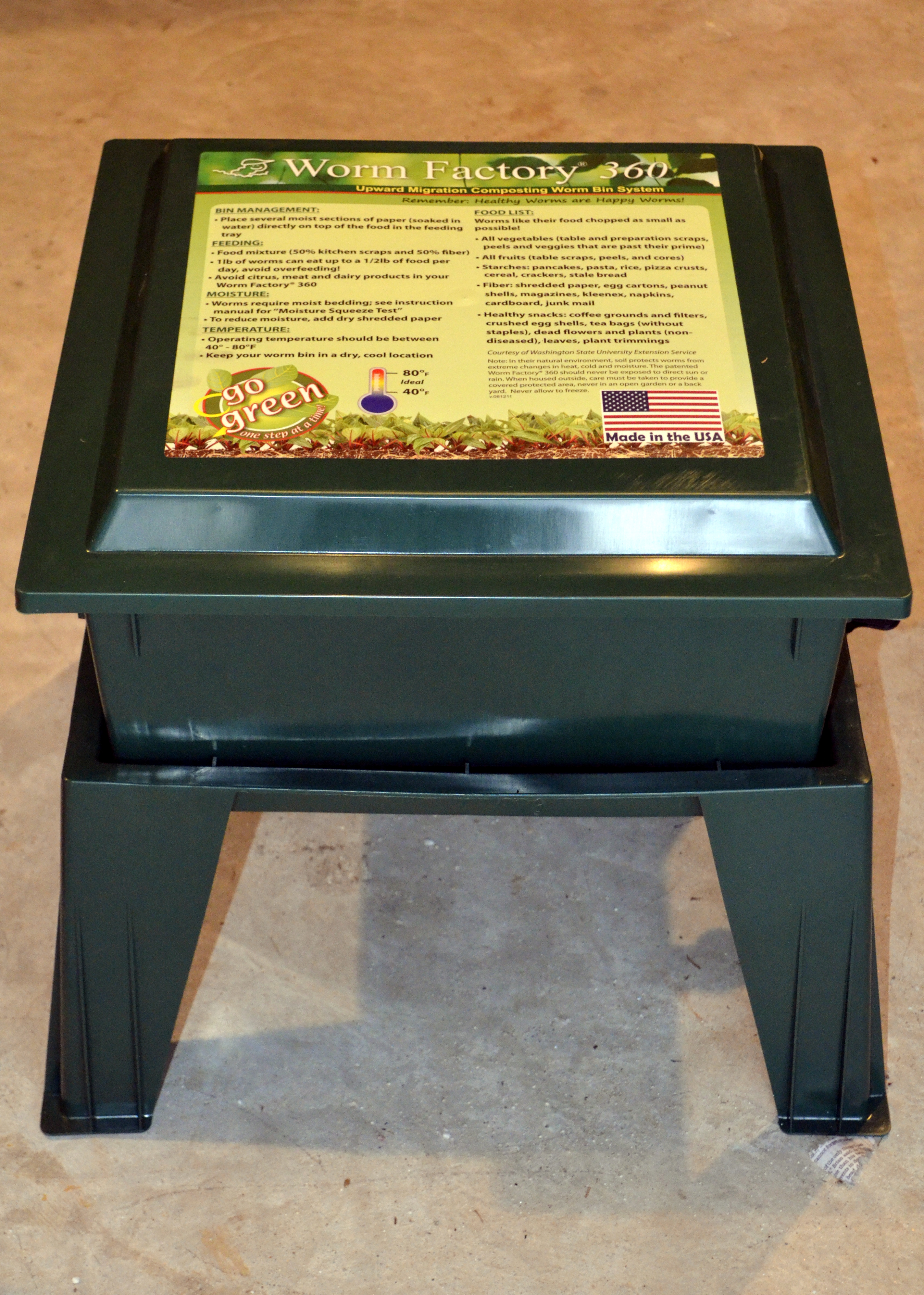
I bought a worm factory, carefully read the instructions, and set up the first tray: shredded newspaper, damp coconut coir bedding, a handful of garden soil with manure, and food–in this case, chopped up zucchini from the garden that was slightly past its prime, coffee grounds and filter, and crushed eggshells. Then I waited for the worms to arrive–1 lb., or about 1,000 worms.

When they arrived, I immediately added them to the mix–though it was difficult to see any actual worms, since they are quite little at first, they had burrowed into the bedding they arrived with, and they curl up together in a ball as a protective mechanism when traumatized. But I assumed there were lots of worms in the lump I added to the worm factory. I covered the worms with a damp newspaper as instructed, put the lid on, and left them alone for two days so they could adjust.

Then came the hard part: I had to open the lid and check on them. I needed to see if the worms were now spread out around the bedding/food (good sign), make sure I hadn’t left everything too dry (not good–worms will die), or too wet (also not good–the food will rot too quickly and upset the fine balance of the composting process, and attract fruit flies). As I slowly made my way to the worm tower, I realized I was nervous. What would I find when I lifted up the lid and then the damp newspaper? Dead worms, due to inadvertent negligence on my part? I berated myself–what with work, kids, dogs, and a garden, how did I think I could also assume responsibility for 1,000 worms? But perhaps they weren’t dead. Perhaps they would be so happy they would be crawling up the sides and all along the underside of the lid. The damp newspaper was supposed to help stop that, but perhaps these were intrepid little worms, and when I went to lift the lid, worms would start dropping all over my feet, the floor, and everywhere else. That was also not a scenario I relished. As I crept closer to the worm factory, I contemplated one last possibility: what if everything was too moist, and it all smelled horribly, and had attracted thousands of fruit flies that would well up in a cloud about my face as I peered into the tray?

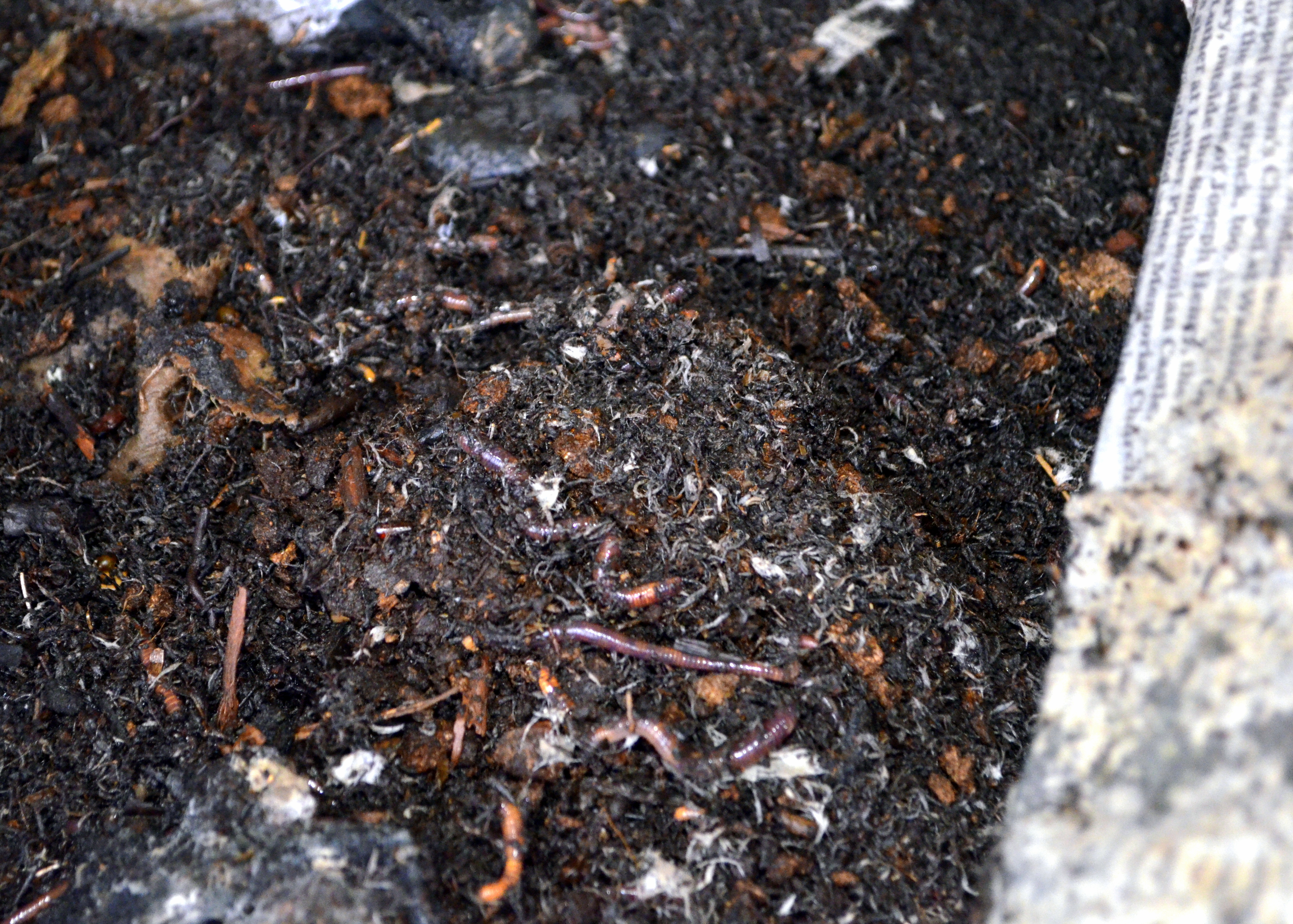
I had to force myself to open the lid and peel back the newspaper. And then I heaved a sigh of relief. Everything was just as it should be–happy-looking worms already producing lots of castings and looking a bit plumper than when they arrived, an environment that was damp but not too moist, and no smell at all. This photo is not ideal–by the time I got my act together, most of the worms had burrowed back underneath; they do not like light. But the photo does give a nice view of the rich humus they are beginning to produce.

Since then, I’ve added more food, kept an eye on the degree of moisture, put some shredded newspaper on top of the damp newspaper to make it more difficult for fruit flies to discover what’s going on underneath, and have seen the worms getting bigger each day. Once the bottom tray is full, I’ll add a second tray and lure the worms upward. As they get bigger and reproduce, I’ll add more trays, removing the humus and incorporating it into the garden. I am so happy to have a way to compost indoors, and I have the worms to thank for it.

I still have lots to learn about vermicomposting, but perhaps I am on my way to becoming a worm farmer after all.

Bay Area 3: UC Botanical Garden at Berkeley

30 Jul

What is it about botanical gardens or other large, planned gardens that makes them magical places? The kind of place where you can wander in relative silence, revel in the beauty of plants that you have never seen before (or even ones you have seen, though now viewed in a different light), where you can stop and sit on a bench in a hidden spot to soak it all in, or even read, or think? Who designed the spaces, mapped out what types of plants would be featured where, and planned the spots that would lure people and bees and butterflies and birds? They, and the current-day keepers of those gardens, are magicians.

If not already obvious, I love wandering in those kinds of gardens. I like everything about them: the flora, the fauna, the paths and stairs and benches and arches and bridges and streams. The University of California Botanical Garden has many of those features, and is a veritable outdoor museum. It is home to collections of plants from nine major geographic regions around the world, including a large area devoted to California–a biodiversity hotspot that contains more than 40 percent of the world’s plant species. To all this, add special collections including orchids, ferns, cycads, palms, roses, and herbs.

A plant lover could spend days roaming the 34 acres. I only had 5 hours, but I made the best of it; I signed up for a 1.5-hour tour that was being offered (Secret Paths of the Garden), which got me off to a great start via paths less traveled, and then I spent the remaining time wandering to my heart’s content. It really was a magical day.

Here are some of my favorite photos (and plants) from the Garden:

 
Manzanita Tree Bark

   
Dudleya Pulverulenta (Chalk Lettuce, Chalk Liveforever)

 
Encephalartos arenarius (Alexandria cycad)

 
Opuntia Kuehnrichiana                               Opuntia microdasys (Polka-dot cactus)

Bay Area 2: Fruit and Vegetable Envy

25 Jul

While in Berkeley,  I was able to spend a lovely day with long-time family friends, and admire (ok, envy) their garden. It is a productive one–full of fruit trees and tomatoes and other vegetables–with not a rampaging dog in sight. The fruit trees–apple, fig, pear, persimmon, and plum–were all bearing fruit or on the verge of doing so, and the tomatoes were glistening. The sun was shining, the air was crisp, the birds were chirping–and everything I saw appeared jewel like. The contrast to my own garden was stark: the sun shines here, too, but the air is hot and thick, the neighborhood birds chirp only when the dogs are inside, I have no fruit trees, and my tomatoes have run wild (along with the zucchini plants–after just one week away, I came back to discover that two finger-sized zucchinis I had left behind were suddenly longer and thicker than my forearm–or anyone else’s forearm for that matter). Sigh.

But back to our friends’ garden. The photos below are of Satsuma plums, Seckel pears, and Sungold cherry tomatoes. This year was the first bearing year for the Satsuma plums, so jam making is on hold until next year when there is more of a crop. But how our friends will manage to set aside any plums for jam making is beyond me–I’d barely be able to get the plums from the tree to the kitchen without eating all of them. Perhaps when there are many, many plums to be had, the law of diminishing returns kicks in and people find the willpower to think longer term….


Satsuma plums

The Seckel pears also looked gorgeous, though I did not taste one since they were not quite ready to be picked. Last year was the first bearing year for the pears, so our friends ate what they harvested, gave some away, and did not have any left to store. This year, they will have a bumper crop and are trying to come up with a plan for what to do with them. Canning suggestions? Recommended pear recipes? We usually just eat them as they are or cut them into a fruit salad drizzled with a light honey-lime syrup. (Now that I think of it, I haven’t made that in a while; it would be perfect for a summer weekend brunch.) But I’d be happy to expand my pear repertoire if any suggestions come in.


Seckel pears

The Sungold cherry tomatoes really caught my eye. With multiple orbs of various colors (from green to gold to deep orange) hanging on each vine, they looked like garlands. There were also some Principe Borghese tomatoes in the garden, though I didn’t get a good photo. Those tomatoes are destined for sun drying — by pulling up the whole plant at the end of the season and hanging it upside down to dry in the sun. Our friend has not tried this before, but is counting down the days until she can conduct this natural experiment.  I’m counting down, too, since I’d like to know how that experiment works. My own non-cherry tomatoes have exploded (did I mention the 90+degree weather?), but my plants are not nearly as neat and tidy as their Berkeley counterparts because I didn’t know what I was doing when I planted them. The stakes I put in are not nearly tall enough, the space the tomatoes are in is too crowded (and there are roses there, too–a very bad idea of mine since thorns make tomato harvesting a tricky proposition). But, I may still try to sun dry some of the Romas, if I can get my act together and build a black box with glass lid in which to put them. Our neighbor in Australia did this every summer, and it worked like a charm.

 
Sungold cherry tomatoes

Until then, I will live vicariously through our friends, and wonder whether I can squeeze in a Satsuma plum tree somewhere in my own garden….

Ode to a Flower That Could Have Been

11 Jul

It is a truth universally acknowledged, that a gardener in possession of flower beds and dogs must be in want of good sense. Or at least, must be prepared for disaster.

Earlier this year, we cleared a new flower bed in front of a section of our wooden fence. I carefully planted multiple gladiolus bulbs (my first foray into the fine art of growing gladioli), set up a small powder-coated steel garden fence in front of the bed to keep the dogs out, and sat back with eager anticipation. I watched the tiny shoots emerge and kept track as they grew, and was finally delighted to see the first spike beginning to bloom…

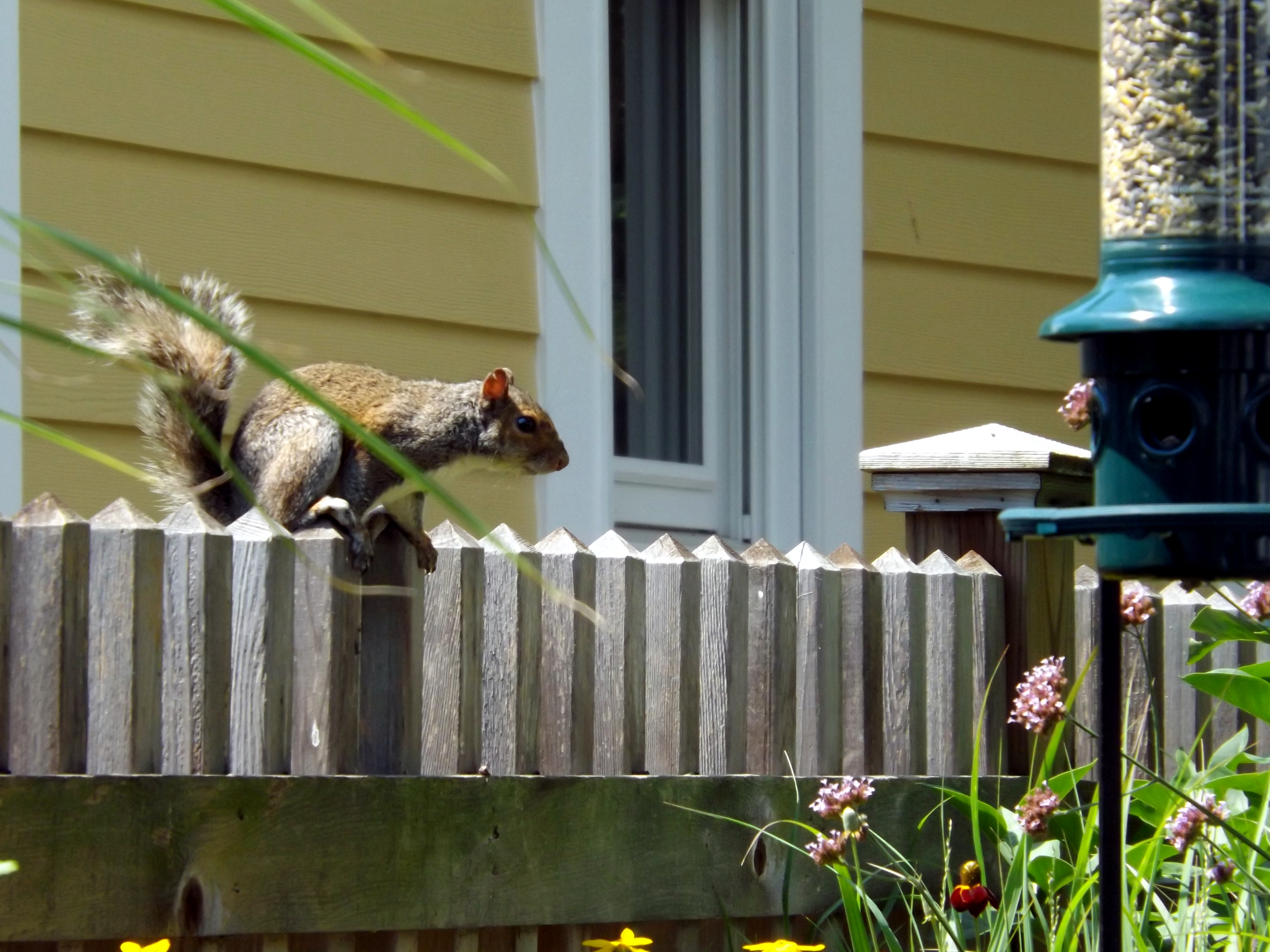
… and then I did two things that sealed the fate of that gladiolus and all its sisters. First, we built a patio, raising the level of earth (and patio) in front of the gladiolus bed. Meaning the distance from the ground to the top of the small steel garden fence protecting the gladioli was now shorter (just above knee height), with no way to compensate since the steel fence was set in lower ground. Second, I tidied up the garden after the patio was finished and attended to some long-neglected duties, including refilling the bird feeders for the first time in months. Within a day, the sounds of birds chirping filled the garden and I looked upon the scene with great satisfaction. And then the squirrels arrived.

Here is a photo from last year, which sums up the situation quite nicely:

If there is one thing that drives our dogs (Schnauzer 1 and Schnauzer 2) to utter distraction, it’s  s-q-u-i-r-r-e-l-s. Yes, our dogs recognize the word. In fact, they almost may be able to spell it by now, too. The gladiolus bed was (note use of past tense) in front of the wooden fence to the right of the bird feeder; squirrels hoping to get close to the feeder have to scramble across the top of that section of wooden fence. For our dogs, this is akin to waving a red cape in front of a mad bull. They go nuts. A day or so after I took the photo of the gladiolus, Schnauzer 1 (the smaller of the two dogs but the most zealous squirrel chaser) saw a squirrel dancing along the top of the wooden fence and immediately realized the new patio allowed her to clear the small steel garden fence quite easily, putting her within jaw-snapping distance of the squirrel. After an elegant leap landed her squarely on top of the gladiolus plants, she crashed through them, launching herself against the wooden fence in the hopes of shaking the squirrel off.

The gladioli survived this first game of rodent roulette, but just barely; they were all knocked over. So I propped them back up with stakes, set up a barricade of patio chairs in front of the flower bed, and yelled at the dogs. But instinct trumps all. Within another day, all the gladiolus plants were shredded; Schnauzer 1 went around, under, and over the chairs, or simply leapt the garden fence a bit further down the garden and trampled her way to the gladioli. Schnauzer 2 offered abundant vocal support. Here is a photo of the sorry scene–a couple of lilies were also leveled:


And here are the culprits, scanning the trees and fence lines for more enemy combatants. Wretched dogs…. I’m not quite ready to go the electric fence route, though each decimated plant moves me closer in that direction. So for now, it’s a choice between moving the bird feeder or filling it up only in the winter (which many people advocate anyway). I hope that with these additional precautions, I might actually see a gladiolus in bloom next year.

Garden Pests: Meeting a Soapy End

5 Jul

Turns out, while we were busy laying a patio and admiring our zucchini crop, certain nefarious activities were taking place in the garden. I must be a bit slow on the uptake, because I only noticed a day or so ago that many of the large leaves on our exploding Hibiscus (Kopper King) were being eaten into oblivion. Upon closer inspection (and these days, I have to get quite close to see anything that small), I noticed tiny green caterpillars happily chomping away.


The green “caterpillars” are actually the larvae of the Hibiscus Sawfly (Atomacera decepta). The adult female Sawfly very kindly lays eggs on the leaves, viewing them as a great source of food for the next generation. And those larvae sure know how to eat–they pick the leaf clean. How they can eat that much leaf without falling into the void is beyond me, but I am certainly not going to waste any time worrying about them. I also have bigger bugs to battle. Here is a Japanese Beetle on a Rose of Sharon leaf. Clearly, both pests have similar tastes, though in this case I cannot appreciate their discerning palates.


What to do? Battle Tactic #1: Put on the garden gloves and flick the larvae and beetles into a bowl of soapy water. I positioned the bowl under each Hibiscus leaf where larvae were visible, and pushed them straight in. I lost count of how many larvae met their fate this way, but I only came across one Japanese Beetle–on the Hibiscus, not the Rose of Sharon.  The two Rose of Sharon plants looked suspiciously pest free early this morning; will have to check up on them later.

This skirmish goes to me–but I came in a bit late in the game, so the victor of the battle itself remains to be seen.

Zucchini Flowers, Leaves, and Bees

3 Jul


Yes, it’s that time of year, a time when you realize you planted way too much zucchini. I have only one zucchini plant in the garden (not having much space for vegetables to begin with) — yet I find myself asking, how can one plant produce that much? And it’s barely gotten started.

Luckily, I love zucchini and am already thinking about what to do with my harvest. However, this post is not about cooking. It is about the plant itself, from flower to leaf. If you grow zucchini, you probably quite enjoy seeing the zucchini flowers/blossoms/blooms. I usually look at them and imagine them stuffed with a nice cheese, dipped in a light batter, and gently fried….heavenly! Some say the male flowers (which grow at the end of long stems, unlike female flowers, which grow at the end of the emerging zucchini) are the best for eating; I’ll happily sample either one. The flowers can also be eaten raw, sliced into salads or other dishes.

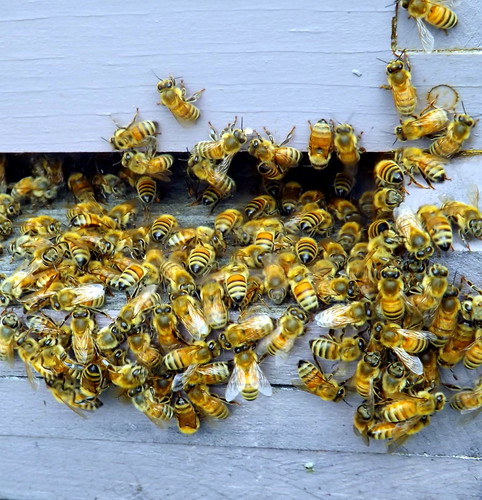
But I digress. My intention was to write about the plant–as a plant, not as a source of food. A couple of days ago, I was checking the status of the zucchini and was startled to see a fully open flower. I almost never see an open flower, which makes sense since they are only open for one day and usually from morning to early afternoon (when I am at work, or not paying sufficient attention). In order for any zucchini to be produced, bees must take advantage of this small window of opportunity and do their part by carrying pollen from the male flowers to the female flowers. [Ok, I have to digress again to show a completely unrelated photo of a friend’s beehive since I don’t have a photo of a bee on my zucchini flowers–and yes, honey bees are excellent pollinators of zucchini and many other fruits and vegetables. Go bees!]


Some of my baby zucchini seemed to wither on the stems and drop off before they even got going. I wondered if this was due to all the rain we’ve been having (or even worse, if it could possibly be the fault of our male dog–despite the barricades I erected). Luckily, I discovered it’s because the female flower didn’t get quite enough pollen from the male. Gardeners wishing to help the process along can try to hand pollinate by carefully removing the anther from the male flower and dabbing it onto the stigma of the open female flower (or by using cotton swabs to transfer the pollen). In my case, with plenty of zucchini already harvested and more to come, I may need to start tying all those flowers closed!

Here is a photo of a lovely, open zucchini flower (looks male)…

… and of another part of the plant that rarely gets mentioned: the leaf. I really like the way the leaves look, and I particularly like the downward angle in this photo. But zucchini leaves are a force of nature. They are so big and so prolific that they keep taking over the small space I allocated to the zucchini plant, and I have had to prune them several times. I felt guilty cutting them off at first, but then I learned that judicious pruning lets more light in and can help increase zucchini production. Wait–is that a plus?

Photo of the Month: June 2013 (Echinacea Ruby Star)

30 Jun

An Echinacea (Ruby Star), petals just beginning to open–in soft focus.

The Perils of Putting in a Patio

29 Jun

For the past couple of years, we have bemoaned the state of the grass in our yard (two dogs + small yard = eyesore).


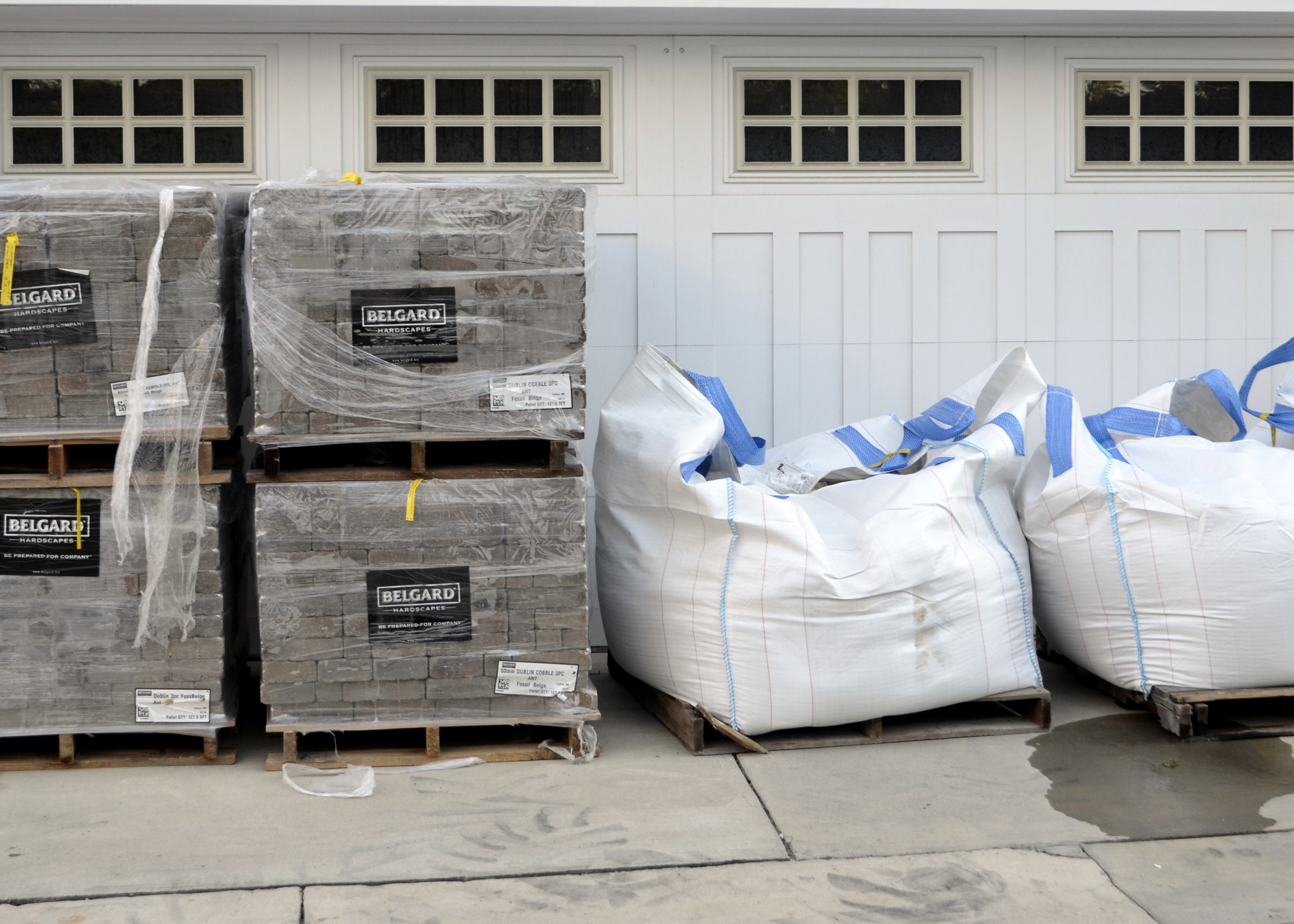
Each spring, we vowed to replace the grass with a patio. But until last week, we were all talk and no action. At that point, we realized we had a very small window in which to do it, or we would have to wait yet another year. So we decided to go for it — just after our last child headed off for a summer adventure. That left me and my husband, 400+ sq. ft. of yard to dig up, 4 pallets of pavers, two tons of sand, and a two-week timeframe (during which we both needed to go to our actual day jobs).


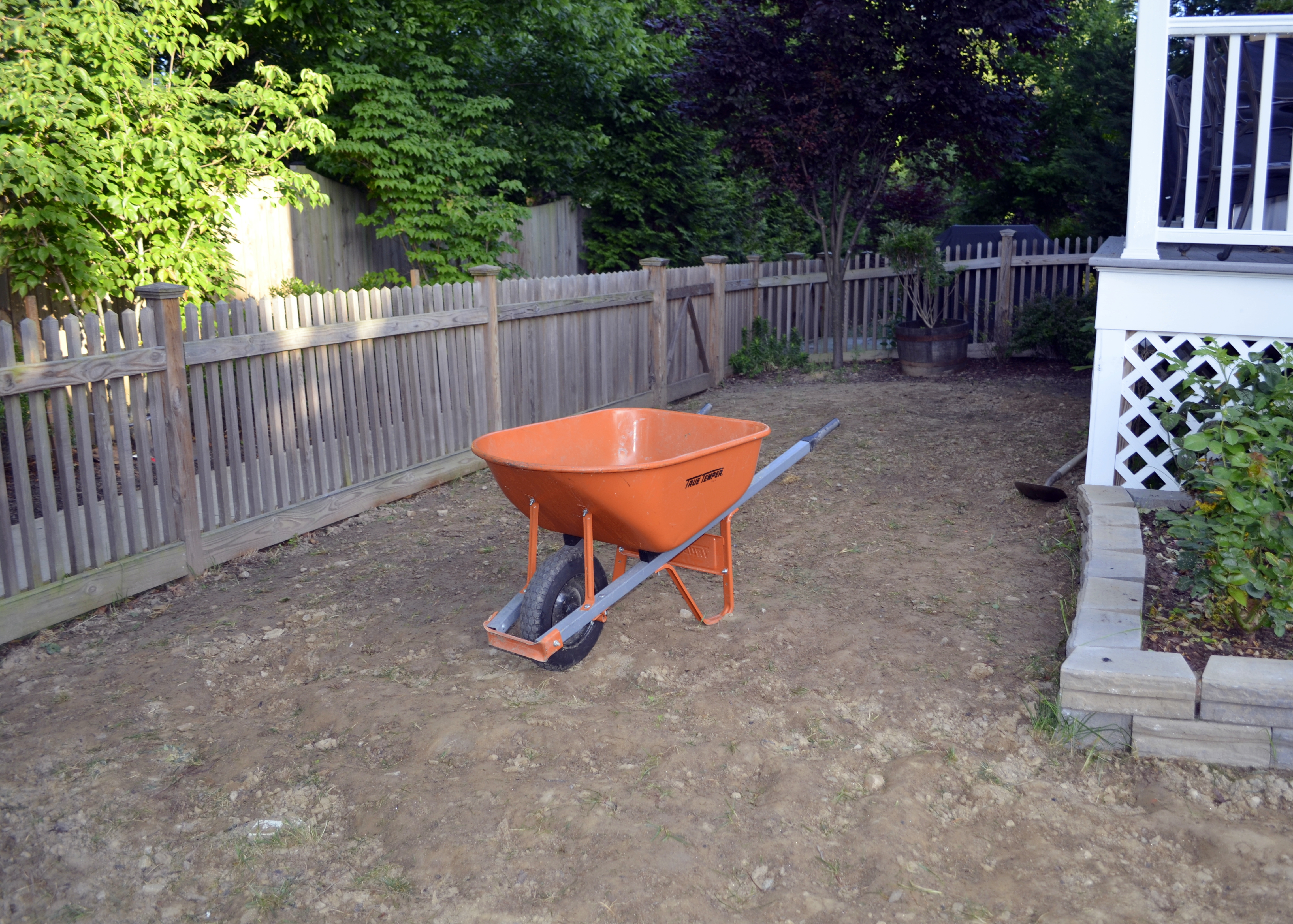
Clearly we were suffering from temporary insanity. The first week, my husband took some time off, dug up all the grass, and took it in several loads to our local dump. Very shortly, every single employee at the dump would come to know my husband well.

Using the pavers as a guide to depth, we realized we had to dig up 3 inches of the dirt from all over the yard. That task also fell to my husband–who during the next 1.5 weeks dug up and took roughly 5 tons of dirt to the dump–seven trips total. Had we known 3 inches of dirt = 5 tons, we may have thought twice about this whole proposition.
–Lesson 1: Do not try this by yourself at home unless you are a lunatic or have a source of strapping, teenage/20-something, happy-to-help child labor (or, frankly, anyone else willing to help). Since my husband actually did not mind the grueling manual labor, he is clearly a lunatic (several of our neighbors, who stopped by to comment, probably agree).

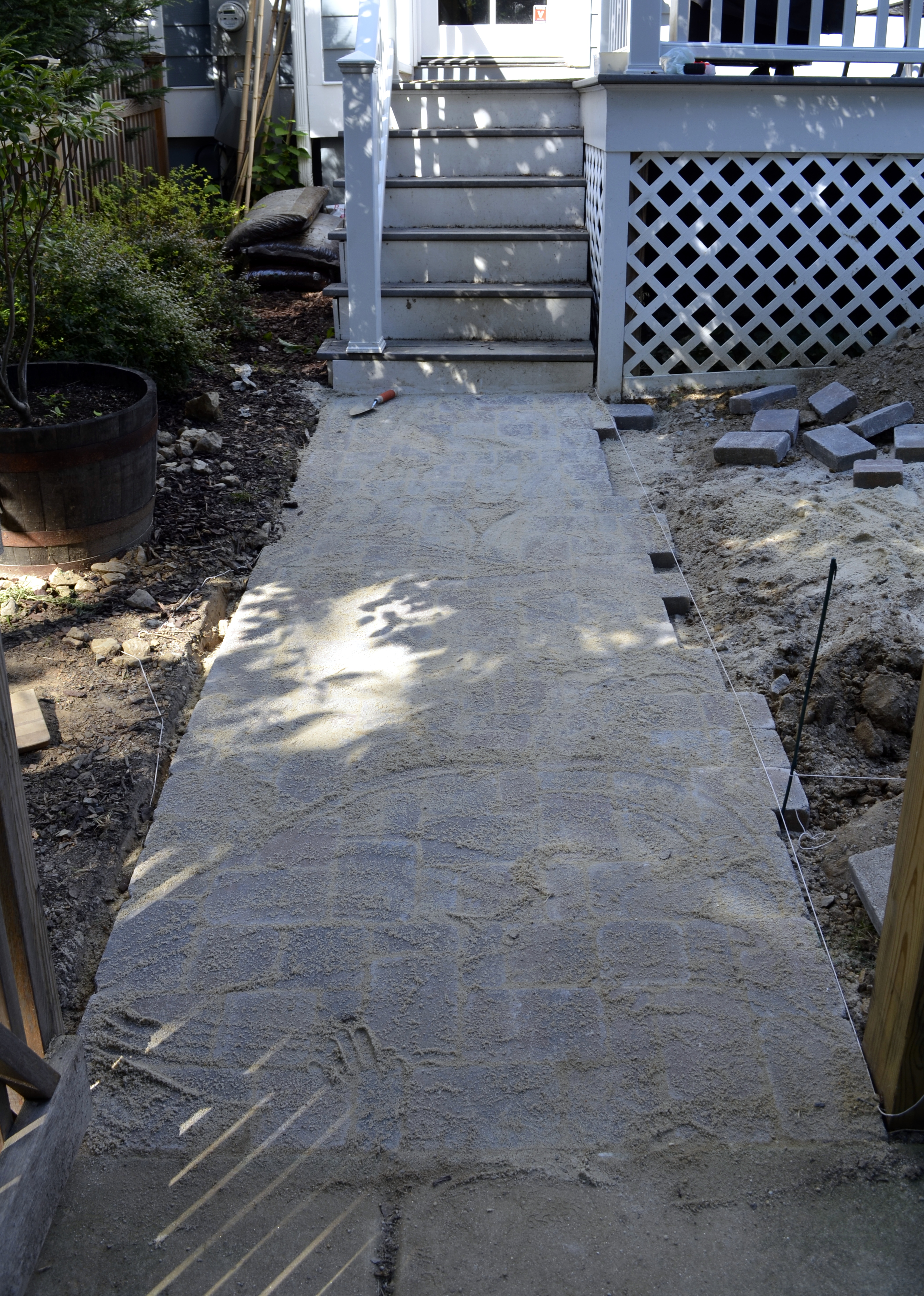
In between trips to the dump, my husband scattered a few loads of sand on the dug-up sections of the yard and set up the slope lines with some string; my job was smoothing the sand, laying the pavers and tamping them while maintaining the slope (turns out our yard slopes in multiple directions at once, so now the patio does, too–some of it intentional, some not). On Saturday–at the end of the first week of our project–I started laying the path between the back steps and the back gate, and managed to get it done in one broiling-hot day. I was very proud of myself, but I shouldn’t have been. Why? Because on Sunday, we turned to the biggest, highest part of the patio and began working our way downward toward the path.
Lesson 2: Building a patio from two separate ends is a mistake. Start in one place and go from there, or you will end  up boxing yourself in with limited space for adjustments should all the pavers not line up properly (as will surely be the case). We discovered that our rectangular yard was a complete illusion, forcing multiple adjustments as we went.
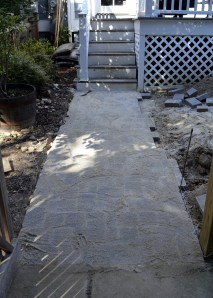

Unfortunately, we didn’t get very far on Sunday morning due to a torrential rainfall. With my husband at the dump, I soldiered on, laying pavers as long as possible (reminding myself rain is just water, really), but after sliding through the mud on a trip to get more pavers, I gave up.
Lesson 3: Check the weather forecast, or cover the bare dirt with a tarp (or dig up the grass and dirt in sections so you don’t end up with a vast mud pit should it rain).

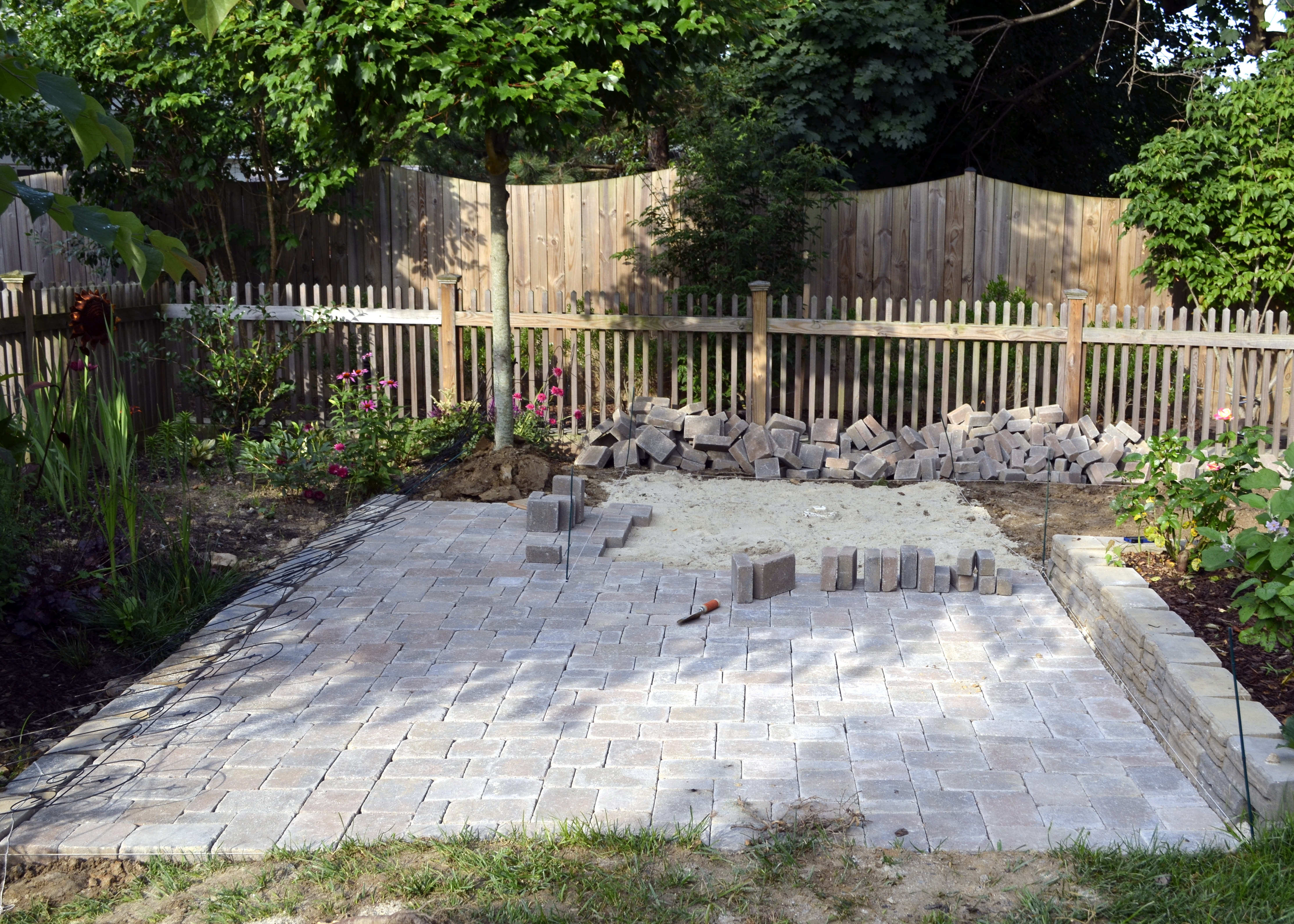
But the sun came out later that afternoon, so I managed to get a bit more done. In the photo below, you can see the emerging top section of patio, plus the piles of pavers and slope lines (the string between the green stakes), though they are hard to see. My trusty sledge hammer/wood for tamping is hidden behind a pile of pavers. 
Lesson 4:
Despite all the effort, and the heat, rain, and mosquitoes–and the fact that perfection is rarely attainable–it is important to occasionally stop and acknowledge an achievement. This almost looks like a patio!

On Monday, my husband and I went back to work (ie, at our day jobs). On Wednesday, he  took time off and dug up the next section of dirt, and on Thursday, we both spent 12 hours working on the patio, since the patio had to be done sometime on Friday, the last day of our short window of opportunity. We managed to get almost all the way done on Thursday, except for a small section. It was a marathon day.
–Lesson 5.1: You will discover muscles you never knew you had (or forgot you had). Turns out lifting pavers and swinging a sledge hammer is great for the triceps–by great, I mean that if you hadn’t previously used your triceps very much, you may not be able to lift your arms over your head by nightfall. Also, gripping pavers does wonders for your hand muscles; your hands will want to curl up afterward and stay that way for hours.
Lesson 5.2: Wear sturdy gloves. I was wearing my favorite gardening gloves, which are quite thin with a latex-like coating on the palms–perfect for smoothing sand and clearing it out of crevices. But by the end of the day Thursday, I was wondering why my thumb was sore, whereupon I realized the pavers had torn through my right-hand glove, taking a bit of my thumb with them. No comparison at all to the cuts and blisters on my husband’s hands (despite his very heavy gloves). But in both our cases, our hands showed us what they could accomplish, despite adversity. [Note: the animal in the photo below is an ungroomed Schnauzer, not a sheepdog. I have been talking about grooming the dogs for some time now, too, but not acting upon it–it’s almost on par with laying a patio….]

I took a few hours vacation time Friday morning  (I can think of other ways to spend vacation time, but we were down to the wire) and by about 10:30 am had almost finished the patio, after boxing myself into a small space:

I say almost, because it turns out that this section of the yard was not actually rectangular, and so the pavers did not end up perfectly aligned–meaning I was left with a few sizeable gaps at the very end–too large to fill with sand and too small to fit any of the three sizes of pavers we had. Now, we are not professional brick layers (as is painfully obvious), so we do not have cobblestone-cutting equipment–but a friend of ours does, and he is stopping by tomorrow morning to see if he can cut a few pavers to fit. And then, we will have a patio!
Lesson 6.1:  See Lesson 2. But also, have a back-up plan for how to fix unexpected gaps. For the most part, I was able to adjust as I went, either by  decreasing the depth of the flower bed running along the left side of the patio, or by inserting the occasional small paver vertically instead of horizontally (for a narrower fit). But it’s good to have handy friends.
–Lesson 6.2: Be prepared for odd tan lines and other reminders of your brick-laying adventure. Though I slathered myself with sunscreen, I noticed when I went back in to work on Friday that I had tan lines where white hands (gloves) met darker forearms, and where white feet (socks) met darker legs. Plus, there was a nice indent in my forehead from my straw hat. I’m hoping no one else at the meeting noticed!

Final note: it was all worth it. And huge thanks to my husband for his superhuman efforts.