Archive | Botany/Horticulture RSS feed for this section

Cypress Knees

14 Dec

I’d heard of a bee’s knees, but not a tree’s knees. Turns out cypress trees have knees, as we discovered when walking through the gardens at Historic London Town last weekend. We rounded a corner and stumbled upon an eerie landscape: a tall Bald Cypress tree surrounded by what looked like little stumps or treelets poking up from a blanket of leaves. It was almost as if we had been transported to the Island of Misfit Trees.

Turns out these little* woody projections are called cypress knees, and they are a bit of a mystery. The knees grow vertically from the tree’s roots, but no one quite agrees on what function they serve. Normally, they are found in swampy areas. This Bald Cypress and its knees were in Historic London Town’s Bog Garden–a very moist area, but not one that was under water (or at least not when we were there).  One theory is that the knees may help get oxygen to the tree’s roots, especially in the case of trees that are growing in several feet of water. But scientists who tested this theory found that the knees aren’t very good conveyors of oxygen, as one might expect from what is essentially a very woody stump. Another theory is that the knees provide the tree with stability. But no one really knows for sure; there is another school of thought suggesting that perhaps these knees serve no purpose at all…. Except to keep us wondering.


*These knees are still relatively little — but they can actually get quite tall.

Seed Transport: A Hairy Situation?

22 Oct

When I think of autumn, I think of brilliant, jewel-toned foliage: rich reds, oranges, and yellows. But fall is also a time for brown–and specifically, for really interesting seed pods that have dried up, split open, and offered up their treasures.

In a recent post, I wrote about wind dispersal of seeds via feathery parachutes. Seeds attached to or encased in balls of fluff can travel quite far on a good breeze. But there are other ways for seeds to get around. Catching a ride on a passing animal is one of them. And that is why some seeds are sticky — or hairy, as in the case of Rose of Sharon seeds, which are encircled by a fuzzy ring.

Despite this transport mechanism, however, Rose of Sharon plants are really, really good at self seeding, with dozens of seedlings springing up around the base of the parent plant each year. So while those seeds are designed for adventure, they are really homebodies at heart. And I’ll take a homebody any day, if it puts on a good show (see below).

Rose of Sharon seed pods

Rose of Sharon seeds

Rose of Sharon flower

Feathery Parachutes

8 Sep

There are a variety of ways unexpected plants can crop up in your garden, but often, you can thank the wind for it. If bees play a vital role in pollination, then wind plays a similar role when it comes to seed dispersal. Think of the dandelion, the bane of many gardeners’ existence. It has developed a perfect way of ensuring a next generation by encasing its seeds in balls of fluff. What the wind doesn’t carry away (or lawnmowers cut down and disperse), young children will happily blow into the air–all but guaranteeing a new crop of the ubiquitous yellow flowers right in the middle of your lawn, or your neighbors’.

The Butterfly Weed plant disperses seeds in a similar fashion, but its seeds reside in pods that dry out and then crack open, allowing the feathery parachutes to travel hither and yon (if the Milkweed Bugs that love the seeds and tissue of Butterfly Weed plants don’t get to all the seeds first…). Luckily, there are many, many seeds to go around. And then, it’s up to wind, luck, and Mother Nature. In the bottom two photos, the Butterfly Weed seed parachutes have gotten stuck on 1) a Verbena Bonariensis and 2) a spider web near our brick staircase. I hold out more hope for the former’s prospects than for the latter’s.


Zucchini Flowers, Leaves, and Bees

3 Jul


Yes, it’s that time of year, a time when you realize you planted way too much zucchini. I have only one zucchini plant in the garden (not having much space for vegetables to begin with) — yet I find myself asking, how can one plant produce that much? And it’s barely gotten started.

Luckily, I love zucchini and am already thinking about what to do with my harvest. However, this post is not about cooking. It is about the plant itself, from flower to leaf. If you grow zucchini, you probably quite enjoy seeing the zucchini flowers/blossoms/blooms. I usually look at them and imagine them stuffed with a nice cheese, dipped in a light batter, and gently fried….heavenly! Some say the male flowers (which grow at the end of long stems, unlike female flowers, which grow at the end of the emerging zucchini) are the best for eating; I’ll happily sample either one. The flowers can also be eaten raw, sliced into salads or other dishes.

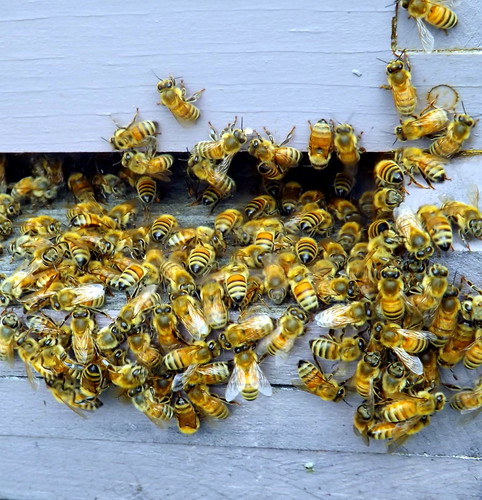
But I digress. My intention was to write about the plant–as a plant, not as a source of food. A couple of days ago, I was checking the status of the zucchini and was startled to see a fully open flower. I almost never see an open flower, which makes sense since they are only open for one day and usually from morning to early afternoon (when I am at work, or not paying sufficient attention). In order for any zucchini to be produced, bees must take advantage of this small window of opportunity and do their part by carrying pollen from the male flowers to the female flowers. [Ok, I have to digress again to show a completely unrelated photo of a friend’s beehive since I don’t have a photo of a bee on my zucchini flowers–and yes, honey bees are excellent pollinators of zucchini and many other fruits and vegetables. Go bees!]

Some of my baby zucchini seemed to wither on the stems and drop off before they even got going. I wondered if this was due to all the rain we’ve been having (or even worse, if it could possibly be the fault of our male dog–despite the barricades I erected). Luckily, I discovered it’s because the female flower didn’t get quite enough pollen from the male. Gardeners wishing to help the process along can try to hand pollinate by carefully removing the anther from the male flower and dabbing it onto the stigma of the open female flower (or by using cotton swabs to transfer the pollen). In my case, with plenty of zucchini already harvested and more to come, I may need to start tying all those flowers closed!

Here is a photo of a lovely, open zucchini flower (looks male)…

… and of another part of the plant that rarely gets mentioned: the leaf. I really like the way the leaves look, and I particularly like the downward angle in this photo. But zucchini leaves are a force of nature. They are so big and so prolific that they keep taking over the small space I allocated to the zucchini plant, and I have had to prune them several times. I felt guilty cutting them off at first, but then I learned that judicious pruning lets more light in and can help increase zucchini production. Wait–is that a plus?

Succulents: Jade Plant

20 Jan

In spy movies or thrillers, you sometimes see the protagonists pull out a cache of passports and decide who they will be that day.  They are maestros of multiple identities, but they have nothing on the Jade Plant. The Jade Plant is in the Crassula genus and has many, many names.  On the formal side it can be referred to as Crassula Ovata, Crassula Argentea, Crassula Portulacea, or Crasssula Obliqua. They are all synonyms for the same plant, though the last three are older classifications that have not quite cycled out of usage. Crassula Ovata is the correct form of reference.  And then there is Crassula Arborescens, which is very similar to (but not the same as)  Crassula Ovata–people mix them up all the time.

If all this weren’t enough, the Jade Plant is also commonly known as a Jade Tree, a Money Tree, a Silver Dollar (or just Dollar) Plant, or a Friendship Plant.  The Jade Plant has more aliases than Jason Bourne.

So, it is with some trepidation that I offer you two photos of Crassula Ovata taken during our recent trip to California; I think that’s what they are, but tomorrow I could discover they are something else entirely….


Succulents: Aloe

12 Jan

Upon arriving in San Diego just before Christmas, one of the first things I noticed was a profusion of striking Red Hot Pokers in flower; they were everywhere, or so I thought. Upon closer inspection, I realized they weren’t Red Hot Pokers. Or were they? The  dark-orange spires I saw everywhere in San Diego were aloes. And the Red Hot Pokers I know and love (and have in my garden) are kniphofias.  Both plants are originally from Africa, and the flowers look remarkably similar.  But one is a succulent, and the other is not.

When most people talk about Red Hot Pokers, they mean kniphofias, which feature clumps of grass-like leaves.  Aloe plants have thick and frequently spiky foliage; you can snap off a piece of aloe vera and apply the soothing gel to burns. But some people refer to both aloes and kniphofias  as Red Hot Pokers. And in fact, the  genus Kniphofia is very closely related to the genus Aloe.

Here are three photos of aloes in bloom in San Diego in January, plus an inadvertent (and less than ideal) photo taken this past May in my garden of a Red Hot Poker Flamenco — a kniphofia — next to a Foxglove.


Aloe

 
Aloe                                                            Kniphofia (with Foxglove on left)


And an aloe that doesn’t look like a Red Hot Poker: Aloe Saponaria

Succulents: Aeonium

7 Jan

One nice thing about traveling is that it allows you to taste food you might not normally have at home. But traveling also exposes you to unfamiliar flora. And having put my own East Coast garden to bed for winter, I was delighted to make the acquaintance of some gorgeous succulents in Southern California during the holidays.  Succulents — which include aloe and agave, and even the euphorbia I grow in my own garden — have thick, fleshy stems and leaves and retain water even under the most trying conditions. They are ideal desert plants — and coastal plants, too, since they tolerate relatively high levels of salt and minerals.

I was not familiar with aeoniums, but their beauty made me stop in my tracks as we wandered through Old Town, San Diego.  The photographs below were taken just after a rainfall and they show yet another characteristic of many succulents: waterproof leaves.


A Forgotten Flower

15 Sep

Some flowers have appeared in my garden unbeknownst to me. But there are other flowers that I did plant, and then forgot about. These have usually been late-season additions to the garden–discounted specimens that caught my eye when I was at the nursery in the autumn looking for mulch, for example, or a spade, but not flowers. I would tuck these spur-of-the moment purchases somewhere in the garden, with a vow to keep track of  them more properly later. Inevitably,  I forgot even to note their names.

There is currently a plant in bloom in the garden that I have absolutely no record of, though I vaguely remember sticking it in its current, horrible spot by the hammock–an afterthought really, since I thought I would find a better place for it this year. Which I would have done had I developed a plan for it, which I didn’t since I forgot I had even planted it.

It is an aster. Well, technically it isn’t. If you thought DNA testing was only for crime scenes, think again. It also helps with the (re)classification of plants. Genetic testing of asters in the 1990s revealed that all asters are not, in fact, asters. All the North American varieties were reclassified as Symphyotrichum. Not surprisingly, everyone still calls them asters. To further confuse matters, asters are also known as Michaelmas Daisies. Michaelmas is the celebration of the Feast of Saint Michael the Archangel, which is on September 29. Michaelmas was also traditionally the end of the harvest season in the Northern Hemisphere, a time when asters are in bloom. Hence, the nickname.

The forgotten aster (sorry, symphyotrichum) in my garden is a Winston Churchill. It is a novi-belgii– a New York Aster. Not knowing the history behind the naming of this flower, it is nonetheless fascinating to speculate about the possibilities. Winston’s mother, Jennie, was from New York.  So, a nice tribute to his mother. But then, the verbal sparring between Winston Churchill and Lady Nancy Astor, an American-born member of Parliament, was legendary– so perhaps the person who originally named this cultivar had a sense of humor…. Either way, it is a flower that deserves to be unforgettable.