
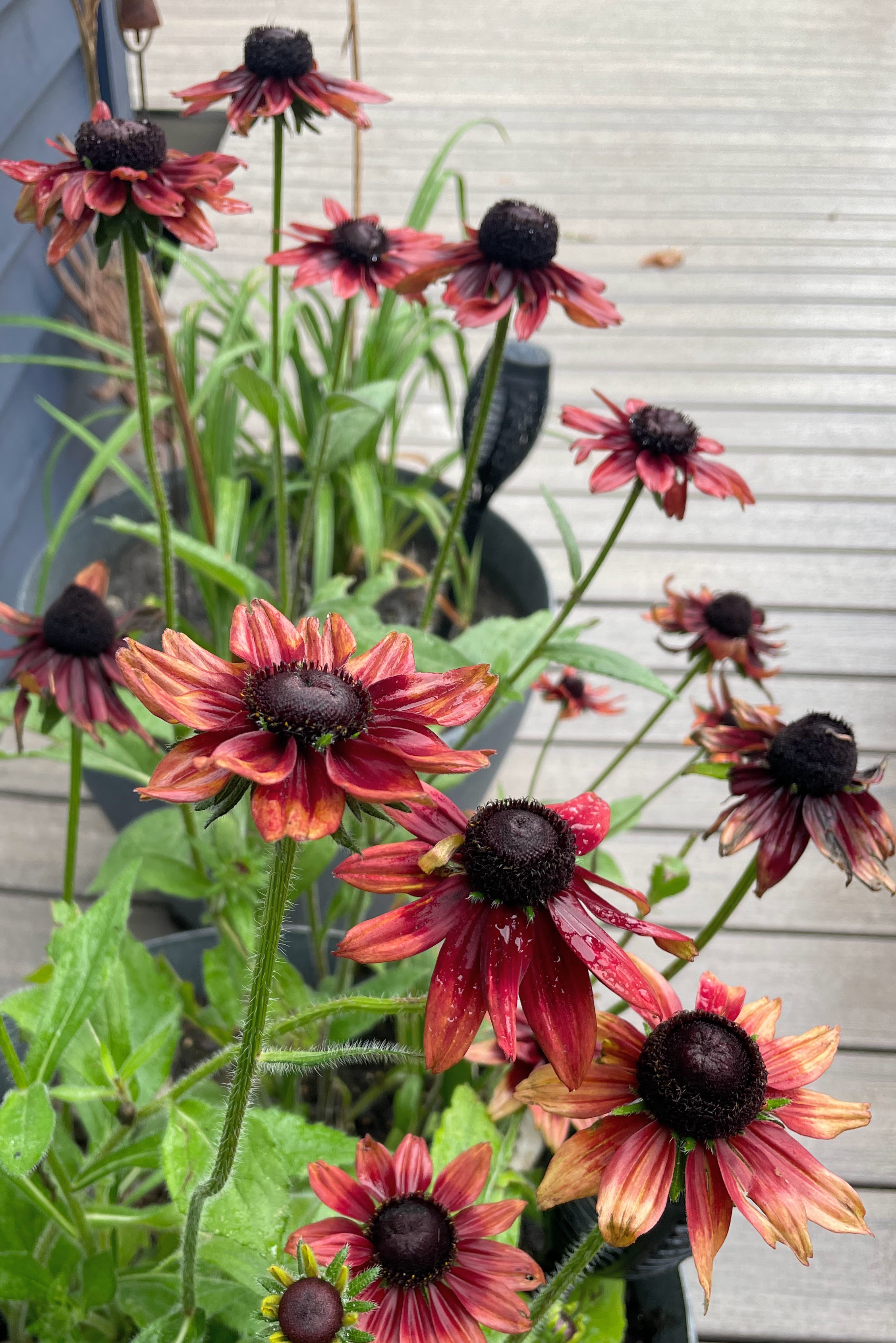
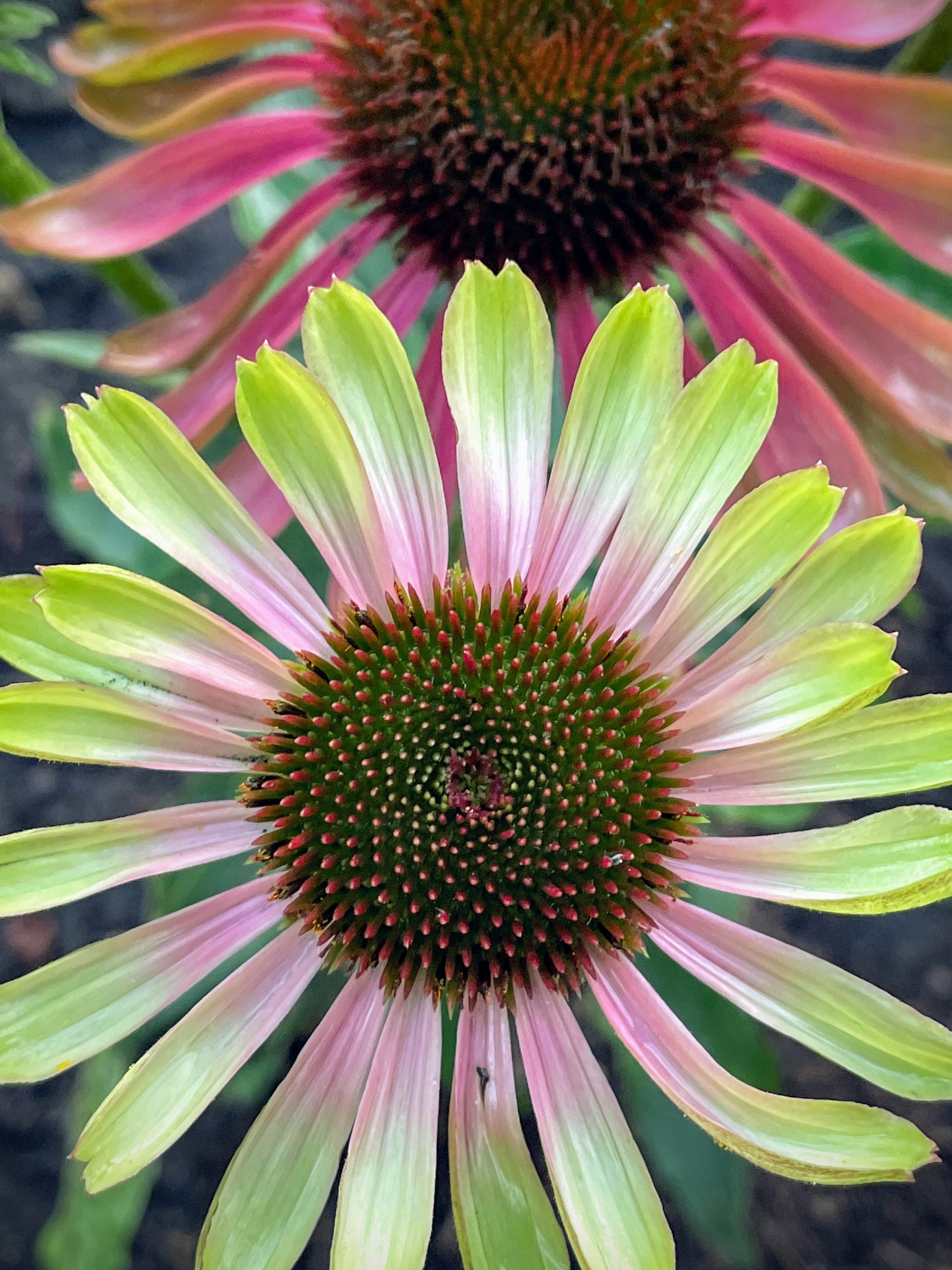
You may look at the beautiful potted flowers above and know right away what they are. When I look at them now, I also know. And forever more, I will know. But for the past couple of weeks, every time I walked by this part of the deck, I reveled in how beautiful these ‘echinacea’ were, and what an unusual color, too. I would then glance over to a different part of the garden and marvel at how many other beautiful varieties of echinacea existed:

But I was wrong about the potted flowers in the first photo, despite abundant evidence. My disregard for the facts started when I forgot what was written on the original plant tags and did not feel I needed to re-check; it spiraled from there and led me to overlook the obvious.
Mostly, it was hubris; I thought I knew, so I failed to observe properly, or fact check. What clues did I miss? Many. As this blogger stated, a gardener confusing a rudbeckia with an echinacea is like a farmer confusing a sheep with a goat. Ouch. In my defense, sheep and goats are very closely related genetically– as are rudbeckia and echinacea. And until a couple of weeks ago, I did not have this ‘Cherry Brandy’ rudbeckia in my garden. But I get the point, and now I can see the obvious differences between the “sheep” and “goats” in my garden.
Here’s how to tell them apart:
1. First, it’s not by how hairy one plant is, vs the other. I read that one way to tell them apart is that echinacea have hairier leaves. But both plants have hairy leaves; echinacea leaves feel rough like a cat’s tongue, while Rudbeckia hirta leaves are softer and more velvety (see photo below):

Since both plants have hairy leaves, it’s not the best test. There is a better one (in fact, the best and easiest one):
2. Examine the cones. Rudbeckia hirta cones (l) are relatively soft and usually look like black button tufts (hence the name Black-Eyed Susans), while echinacea cones (r) are harder and pricklier and more conical — and are not black, but orange or green or brown.


3. Look at the “petals” (though technically, they are ray florets, not petals): This can often help, but not always. According to this way of telling the difference between the two plants, echinacea petals tend to droop and point downward while rudbeckia petals tend to stick straight out. But in the photo below, some of the echinacea petals are drooping and some are sticking straight out. It depends on the variety and the plant’s stage of development. So use the “petal” test as a first form of evidence gathering if you like, but be sure to confirm with the cone test; it will give you the right answer.

In seeking the right answer today, I learned something new. Not just about the difference between Rudbeckia hirta and echinacea, but about assumptions and facts. And about taking the time to stop and smell the roses — and see the petals and leaves, and touch the cones.


 Perennial Pastimes
Love the learning and discernment. I have had much success with the Rudbeckia and very little with the Echinacea. So the Rudbeckia rules in my garden.
LikeLike
I’m sure it’s a gorgeous garden!
LikeLike
So glad you’re blogging again! Your site is so beautiful. I love all the information on it and I love this article. I really didn’t know the difference between the two flowers. I love both of these varieties and I have them all over my garden. Thanks for your enlightenment on the subject.
LikeLike
Thanks! Yes, both great flowers to have here in the Midwest. They keep going and going. And now we can tell them apart!
LikeLike
I sat there last week wondering if I was looking at Echinacea or Black-Eyed Susans. 🙂
LikeLike