
Taking a page from Keats, who is buried in the cemetery near our apartment, this post is dedicated to a single beautiful object: not a Grecian urn, but an Italian sandwich.
The object of my affection can be found at the Testaccio Market, a wondrous place away from the usual madding crowds of Rome, a veritable feast for the senses and the stomach. Fantastic produce? Check. Meat, poultry, fish, cheese, nuts? Check. Honey, preserves, pastries, gelato, and all other delicious sweet things? Check. Coffee and wine? Check. Plus housewares, vintage clothes, flowers, and more, including the panini at Mordi e Vai (which means “Bite and Go,” or slightly less literally, “Grab and Go”).
You cannot miss the stall; the heady aromas wafting around it will help guide the way to this bastion of Roman street food. Proprietor Sergio Esposito, a proud native son, wanted to offer his customers serious Roman panini–panini with fillings born from Testaccio’s history as the city’s meat-packing district. And more, he wanted to engender an appreciation for this authentic fare. He succeeded, judging by the devout following Mordi e Vai has cultivated.
As it was my first time there, I asked Signor Esposito’s son for his recommendation. He said the most popular panino (panini is plural) is the one made with Allesso di Scottona and chicory:

Allesso comes from cotto a lesso, which means “boiled,” though “simmered” might be more accurate; the preparation is similar to a French pot-au-feu. A scottona is a heifer, a female bovine that has not yet had a calf and is no more than 15 or so months old. (A “cow” has had at least one calf.) Scottona meat is marbled with small flecks of fat and is very, very tender. As the meat simmers, the fat melts and gives additional flavor to the meat.
To prepare the panino, Signor Esposito’s son took a piece of the fork-tender meat from the simmering liquid and placed it on a cutting board, where he carefully (I would say almost lovingly) cut it into smaller pieces. He sliced a crusty ciabatta roll in half, dipped an open side into the simmering liquid, and then gently placed the meat on top. He followed it with some braised chicory–a somewhat bitter leafy green that is related to dandelions, endive, escarole, and radicchio. Finally, he added the other half of the bread, pressed the sandwich lightly together, wrapped it in a translucent wrapper, and handed it over. Cost: 3.5 euro.
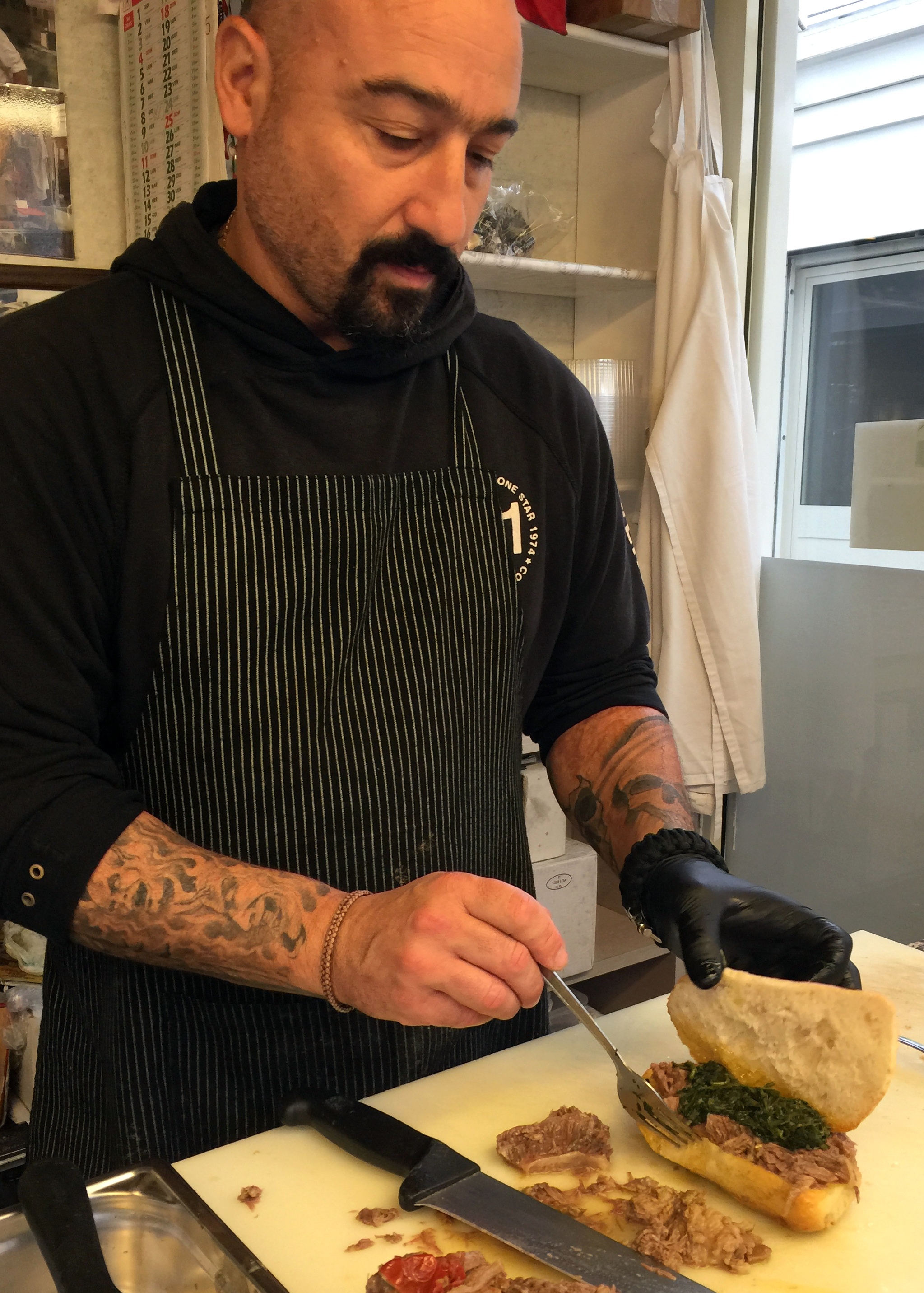
What a triumph. The crusty bread balanced the tender savoriness of the meat while the chicory countered its richness. It was the perfect panino for a fall lunch, and the perfect introduction to Mordi e Vai’s offerings, which include panini with fillings ranging from meatballs and sausage to tripe and bits of liver, lung, and heart–as well as other fare.
If you get there early, you may be doubly lucky: you may not have to wait long for your panino and you may be able to find a table in the central courtyard of the market, where you can give this delectable Roman sandwich all the attention it deserves.

Mordi e Vai
Box 15
Testaccio Market
Open 8am-2:30pm.


 Perennial Pastimes
Did you follow up your meal with some profiterole? There is an excellent pastry shop in Testaccio where our head of boarding would order profiterole for birthday celebrations. I need to find a profession where I can enjoy the markets from 8am-2:30pm.
LikeLike
Unfortunately, there are LOTS of good pastries all over Rome…. 🙂 And, Mordi e Vai is open on Saturdays!
LikeLike
Paola and I ate lunch there today. I had the same beef but the sandwich also had onions (cooked with the beef) and cherry tomatoes. Paola had a polpette di nonna panino. Both were delicious! They cost 6 Euros now but still a bargain.
We went into the little room where they have tables and they made a fuss about getting the fan set up so it would face us.
They beamed when we finished and I told them it was molto buono. You can tell they have such pride in and love for their work.
We also enjoyed the market. I bought two olive wood glasses that are meant for beer. I think the man thought I chose the wrong Italian word when I said I would use them for fiori. Then I said “a tavola” and he decided it was a creative way to use them. (I can’t say much in Italian but I can understand a fair bit.) Paola told him I’m from Canada and he said Canadian carvers buy some olive wood from him and ask him for advice about how to carve it. It was great having an Italian with me.
Thank you so much for the recommendation. Paola sends her thanks as well. 🙂 We are wondering what neighbourhood you lived in when you were in Rome.
xoxo
LikeLike