Tag Archives: patios

Starting Over: The Joys of a New Garden

3 Sep

When we moved back to the U.S. three years ago, we bought a house with a big grassy backyard, sloping down to a wooden fence along the property line. It was a great backyard, but other than a small flower bed off the (old) deck, there wasn’t much active “gardening” space. There was a walkway border garden out front and a few roses scattered around there, too, but that was it. After living in apartments in Rome for five years, we wanted to enjoy the outside — and I really wanted to garden again. Luckily, the spaces around our new house had great potential to become places of joy not just for us, but also for the local bees, butterflies, and birds. I won’t dwell on the chipmunks, squirrels–and for a short while, rabbits–who have also found great joy here, too. Who knew squirrels could climb up giant sunflowers and take the heads right off? I didn’t. Lesson learned, though; no giant sunflowers next year.

But I digress. The hope we had for our outdoor spaces–which we thought about for a year before getting started–included flower beds, an herb garden, a vegetable garden, and a couple patios to provide more gathering space. As they say, beware what you wish for, because what followed took three years and a LOT of work. But it kept us busy during COVID and beyond, when we were glad to have something productive to do during the weekends.

Original sale photo of the backyard, taken Summer 2019, six months before we bought the house.

Today we have 12 separate garden beds, including a pollinator garden that looks like a wild English border garden, an herb garden, a vegetable garden, a rose garden, and new areas for all the plants we moved around, plus many new ones. This required completely redoing the backyard, rethinking a lot of the front yard, and lots of digging, weeding, transplanting/planting, weeding, seed starting, weeding, and finger crossing that everything we shifted around (often more than once) would survive.

We started Phase 1 by taking out most of the grass in the back and terracing the sloping plot, with help–as we could not move tons of soil on our own, nor could we install all the hardscaping alone. We toyed with the idea of laying down the patios ourselves (as we’ve done in the past), but knew we did not have the skills to build retaining walls, nor the necessary time, seeing as we both have actual other jobs requiring our daily attention. And this was not a weekend task.

Once all soil was out and the hardscaping was in, our work began: filling it all in. But it was early September (autumn) by then, so mostly we transplanted things from around the front, back, and side yards, and made a list of the new plants that would go in next spring. The top bed in the first photo below would be the future Pollinator Garden (I had saved plants from the old flower bed before we redid the yard, so got a head start by putting those back into the new bed). The second level would become the Herb Garden (ready to be planted with some perennial herbs I had grown in fabric bags during the summer), and the bottom level (barely visible) would be the Vegetable Garden. These were the first three of the 12 garden beds we would put in (or redo) around the house!

Note the missing deck section in the first photo above; we replaced the old deck entirely in Phase 2–with help from our children, family, and friends; but mostly done solo by my husband all through Fall 2021.

Finished deck and hardscaping, early Spring 2022

Backyard terrace beds: Top = Pollinator Garden, Middle = Herb Garden, Bottom = Vegetable Garden

In the two top beds above were the “skeleton plants” we had in Spring 2021. I added other plants to fill out the Pollinator and Herb Gardens, and grew some veggies from seed for the vegetable garden, though I also bought some more mature plants to jump start the process a bit. Here’s how the terraced garden beds evolved:

And here are some photos of the front yard garden beds, which were part of Phase 3:

Below is what the front Walkway Garden looked like before (first photo taken while house was being painted). The bed was filled with yellow daylilies and magenta Campion Rose flowers, and I wanted to redo it from Day One. First, I am not fond of magenta and yellow as a color combination. As part of a riot of bold colors, yes, but not by themselves. Secondly, Campion Rose spreads everywhere. I needed to isolate it to a very small section of the yard. Thirdly, and most importantly, the Walkway Garden is in view of the Rose Garden, and I wanted to plant it with flowers that complemented the colors of the roses.

Here are some of the transplanted flowers that are happy in their new spots: 1) Spiky Giant Hyssop now along the southernmost part of the new deck, popping above the railings and attracting bees far and wide (though they are very friendly bees; I stick my head among the flowers to tie them up periodically, and the bees pay me no mind at all). 2) Panicle Hydrangea turning a dusty pink from its initial white, now in its third and final resting place, and 3) the yellow daylilies from the front yard, now in the back along with some Spiderwort ( a much more pleasing combination in my very biased opinion!).

Some of the many newcomers to the garden: Hollyhock, Allium Schubertii, Astilbe, Baptisia Australis, Black-Eyed Susans (Rudbeckia hirta), Aquilegia

And finally, a few things from the garden other than flowers:

The Perils of Putting in a Patio

29 Jun

For the past couple of years, we have bemoaned the state of the grass in our yard (two dogs + small yard = eyesore).


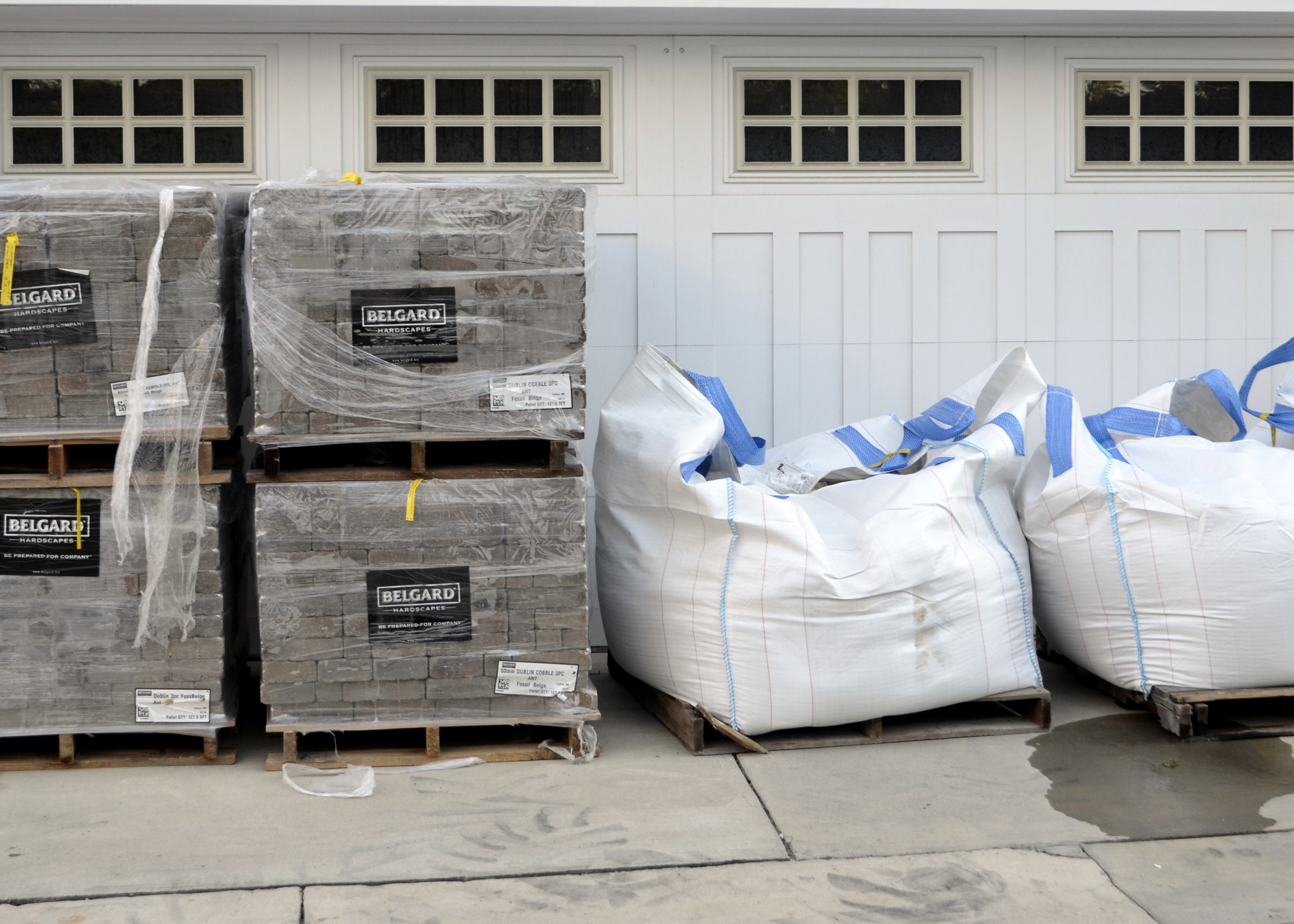
Each spring, we vowed to replace the grass with a patio. But until last week, we were all talk and no action. At that point, we realized we had a very small window in which to do it, or we would have to wait yet another year. So we decided to go for it — just after our last child headed off for a summer adventure. That left me and my husband, 400+ sq. ft. of yard to dig up, 4 pallets of pavers, two tons of sand, and a two-week timeframe (during which we both needed to go to our actual day jobs).


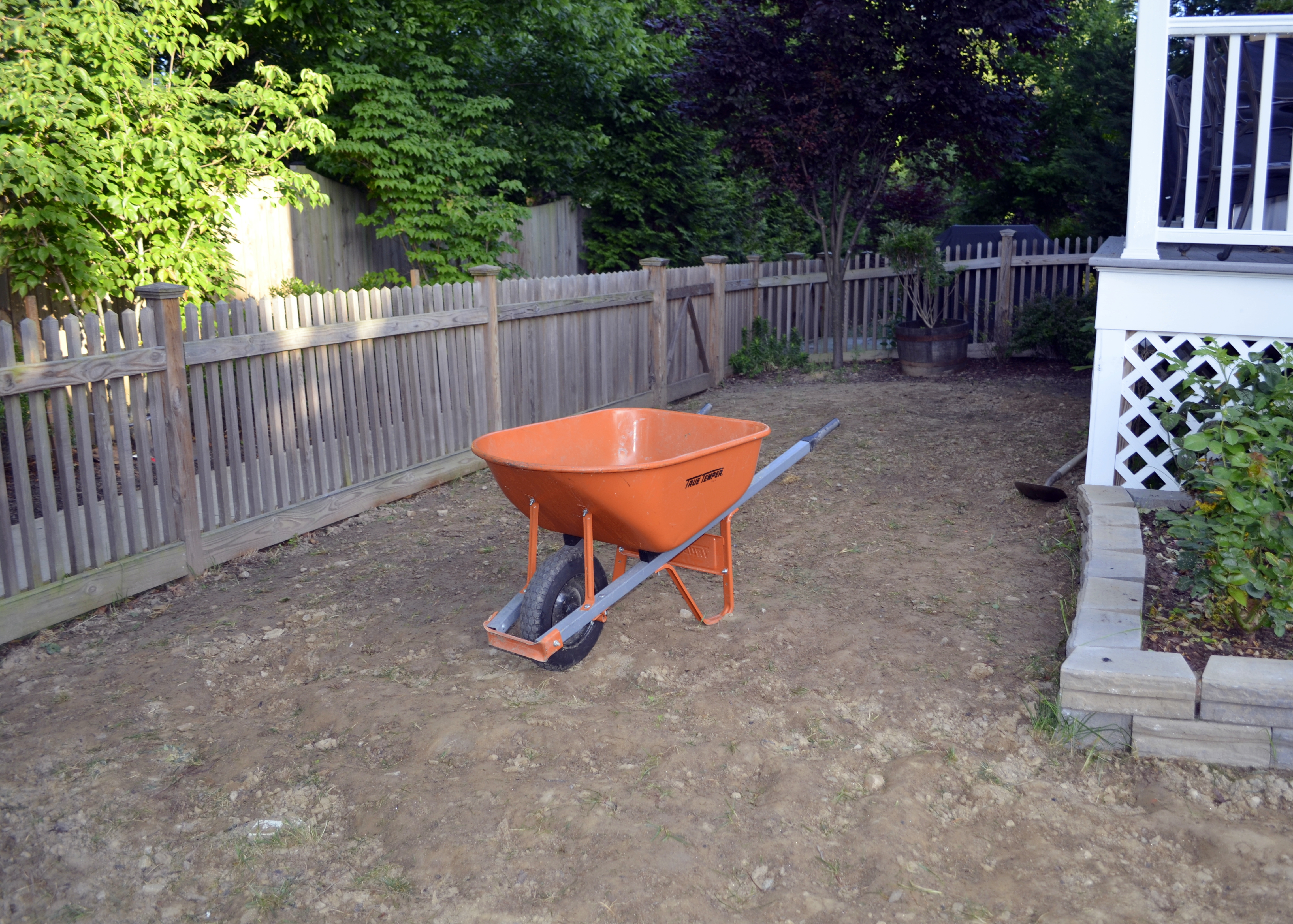
Clearly we were suffering from temporary insanity. The first week, my husband took some time off, dug up all the grass, and took it in several loads to our local dump. Very shortly, every single employee at the dump would come to know my husband well.


Using the pavers as a guide to depth, we realized we had to dig up 3 inches of the dirt from all over the yard. That task also fell to my husband–who during the next 1.5 weeks dug up and took roughly 5 tons of dirt to the dump–seven trips total. Had we known 3 inches of dirt = 5 tons, we may have thought twice about this whole proposition.
–Lesson 1: Do not try this by yourself at home unless you are a lunatic or have a source of strapping, teenage/20-something, happy-to-help child labor (or, frankly, anyone else willing to help). Since my husband actually did not mind the grueling manual labor, he is clearly a lunatic (several of our neighbors, who stopped by to comment, probably agree).

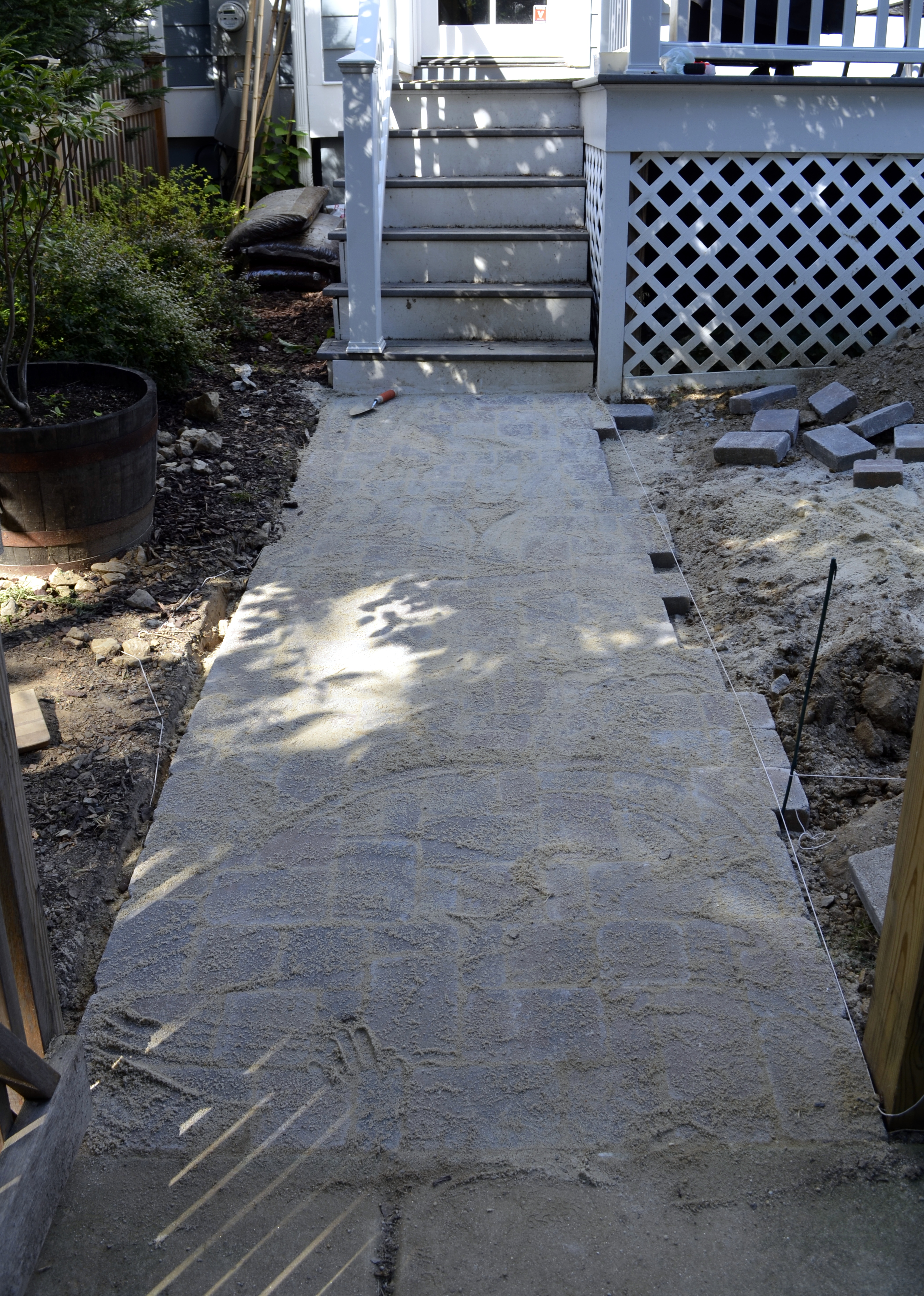
In between trips to the dump, my husband scattered a few loads of sand on the dug-up sections of the yard and set up the slope lines with some string; my job was smoothing the sand, laying the pavers and tamping them while maintaining the slope (turns out our yard slopes in multiple directions at once, so now the patio does, too–some of it intentional, some not). On Saturday–at the end of the first week of our project–I started laying the path between the back steps and the back gate, and managed to get it done in one broiling-hot day. I was very proud of myself, but I shouldn’t have been. Why? Because on Sunday, we turned to the biggest, highest part of the patio and began working our way downward toward the path.
Lesson 2: Building a patio from two separate ends is a mistake. Start in one place and go from there, or you will end  up boxing yourself in with limited space for adjustments should all the pavers not line up properly (as will surely be the case). We discovered that our rectangular yard was a complete illusion, forcing multiple adjustments as we went.


Unfortunately, we didn’t get very far on Sunday morning due to a torrential rainfall. With my husband at the dump, I soldiered on, laying pavers as long as possible (reminding myself rain is just water, really), but after sliding through the mud on a trip to get more pavers, I gave up.
Lesson 3: Check the weather forecast, or cover the bare dirt with a tarp (or dig up the grass and dirt in sections so you don’t end up with a vast mud pit should it rain).

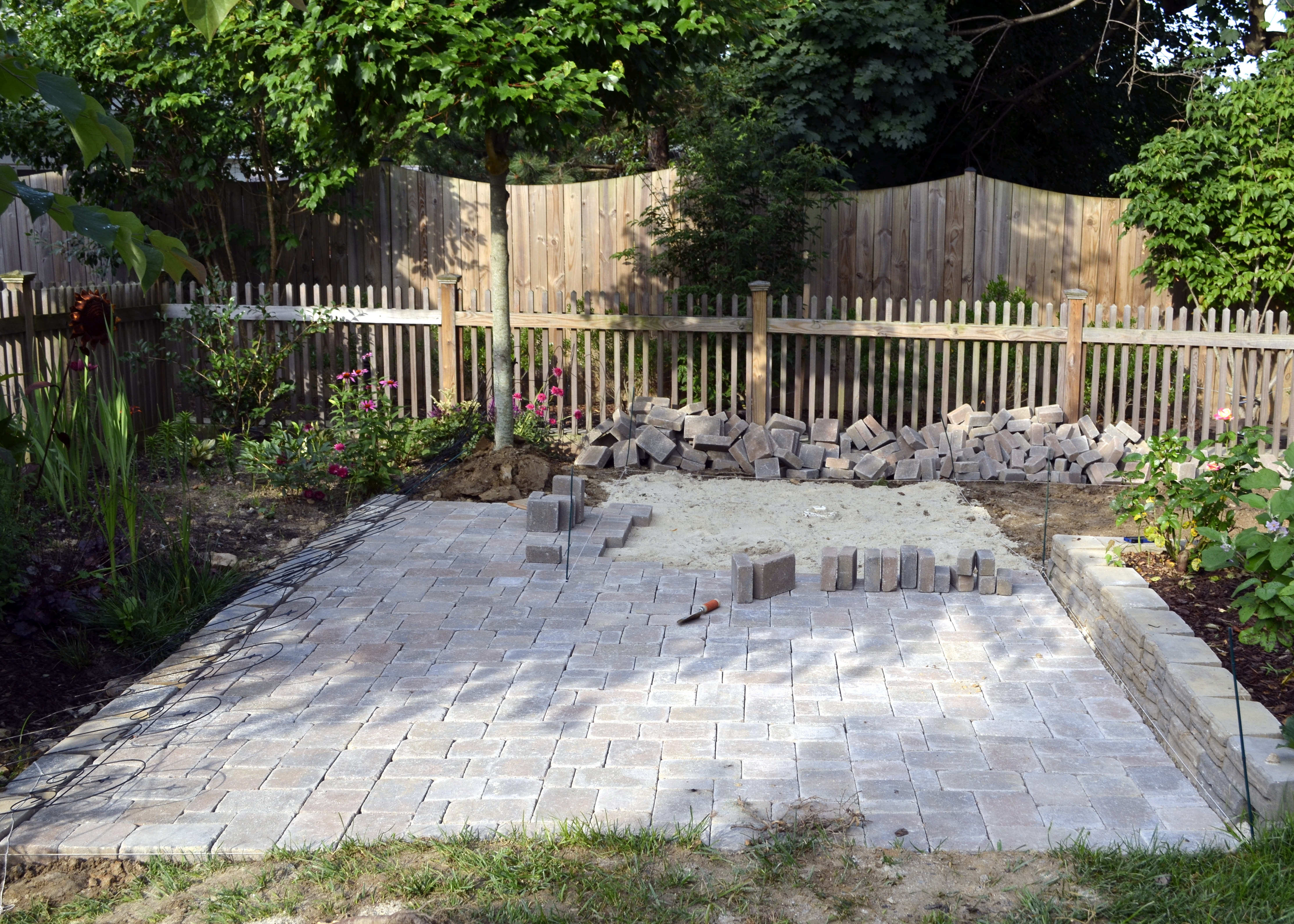
But the sun came out later that afternoon, so I managed to get a bit more done. In the photo below, you can see the emerging top section of patio, plus the piles of pavers and slope lines (the string between the green stakes), though they are hard to see. My trusty sledge hammer/wood for tamping is hidden behind a pile of pavers. 
Lesson 4:
Despite all the effort, and the heat, rain, and mosquitoes–and the fact that perfection is rarely attainable–it is important to occasionally stop and acknowledge an achievement. This almost looks like a patio!

On Monday, my husband and I went back to work (ie, at our day jobs). On Wednesday, he  took time off and dug up the next section of dirt, and on Thursday, we both spent 12 hours working on the patio, since the patio had to be done sometime on Friday, the last day of our short window of opportunity. We managed to get almost all the way done on Thursday, except for a small section. It was a marathon day.
–Lesson 5.1: You will discover muscles you never knew you had (or forgot you had). Turns out lifting pavers and swinging a sledge hammer is great for the triceps–by great, I mean that if you hadn’t previously used your triceps very much, you may not be able to lift your arms over your head by nightfall. Also, gripping pavers does wonders for your hand muscles; your hands will want to curl up afterward and stay that way for hours.
Lesson 5.2: Wear sturdy gloves. I was wearing my favorite gardening gloves, which are quite thin with a latex-like coating on the palms–perfect for smoothing sand and clearing it out of crevices. But by the end of the day Thursday, I was wondering why my thumb was sore, whereupon I realized the pavers had torn through my right-hand glove, taking a bit of my thumb with them. No comparison at all to the cuts and blisters on my husband’s hands (despite his very heavy gloves). But in both our cases, our hands showed us what they could accomplish, despite adversity. [Note: the animal in the photo below is an ungroomed Schnauzer, not a sheepdog. I have been talking about grooming the dogs for some time now, too, but not acting upon it–it’s almost on par with laying a patio….]

I took a few hours vacation time Friday morning  (I can think of other ways to spend vacation time, but we were down to the wire) and by about 10:30 am had almost finished the patio, after boxing myself into a small space:

I say almost, because it turns out that this section of the yard was not actually rectangular, and so the pavers did not end up perfectly aligned–meaning I was left with a few sizeable gaps at the very end–too large to fill with sand and too small to fit any of the three sizes of pavers we had. Now, we are not professional brick layers (as is painfully obvious), so we do not have cobblestone-cutting equipment–but a friend of ours does, and he is stopping by tomorrow morning to see if he can cut a few pavers to fit. And then, we will have a patio!
Lesson 6.1:  See Lesson 2. But also, have a back-up plan for how to fix unexpected gaps. For the most part, I was able to adjust as I went, either by  decreasing the depth of the flower bed running along the left side of the patio, or by inserting the occasional small paver vertically instead of horizontally (for a narrower fit). But it’s good to have handy friends.
–Lesson 6.2: Be prepared for odd tan lines and other reminders of your brick-laying adventure. Though I slathered myself with sunscreen, I noticed when I went back in to work on Friday that I had tan lines where white hands (gloves) met darker forearms, and where white feet (socks) met darker legs. Plus, there was a nice indent in my forehead from my straw hat. I’m hoping no one else at the meeting noticed!

Final note: it was all worth it. And huge thanks to my husband for his superhuman efforts.